Best Alternative to Alibaba: Platforms by Region & Use Case
Direct Answer: The best alternative to Alibaba depends entirely on what you are trying to do. If you need to request quotations (RFQ) and compare supplier prices, the right platform is determined by your target geography — Global Sources or Made-in-China.com for China, IndiaMART or TradeIndia for India, ThomasNet for North America, Europages or Kompass for Europe. If you are a manufacturer, distributor, or raw material supplier looking to build long-term international trade partnerships — not one-off orders — that is a fundamentally different need, and one that RFQ platforms are not designed for. That is the gap that GTsetu addresses: a purpose-built platform for verified, legally protected, commission-free long-term trade collaboration in industrial sectors.
📅 May 1, 2026⏱ 18 min read✍️ GTsetu Editorial Team🔄 Updated regularly
15+
Platforms Compared
6
Regions Covered
2
Distinct Use Cases
0%
Broker Commission on GTsetu
When someone searches for an “alternative to Alibaba,” they could mean two very different things. Understanding which one applies to your situation will save you from choosing the wrong platform and discovering the mismatch three months into a failed supplier relationship.
This guide first maps the best Alibaba alternatives by geography for RFQ and transactional sourcing — because that is what most people need, and the right answer genuinely varies by region. It then addresses the second, distinct use case: when you are not looking for quotes at all, but for verified long-term trade partners in industrial sectors like manufacturing, distribution, and raw materials supply.
💡 Who This Guide Is For
This article is written for procurement teams, international trade managers, manufacturers seeking distributors, and distributors seeking manufacturer principals. It deliberately separates RFQ and transactional sourcing (one set of platforms) from long-term B2B trade partnership formation (a different category entirely). Both are covered in full.
SECTION 1
1 The Two Very Different Reasons People Look for an Alternative to Alibaba
Before comparing any platforms, it is worth being precise about what problem you are actually trying to solve. Alibaba is a transactional marketplace: you describe what you want, suppliers respond with prices, you place an order. Its alternatives divide cleanly into two categories, and conflating them leads to poor platform choices.
Use Case A
RFQ & Transactional Sourcing
You need supplier quotes for a specific product or component
You want to compare multiple factory prices before placing an order
You are placing a one-off, spot, or test order
Speed of discovery matters more than depth of relationship
You need suppliers within a specific country or region
Global SourcesMade-in-ChinaIndiaMARTThomasNetEuropagesDHgate
Use Case B
Long-Term Trade Partnership
You are a manufacturer seeking a verified international distributor
You are a distributor seeking a verified manufacturer principal
You need to share pricing, product specs, or market strategy — securely
You need to know your partner’s legal identity is confirmed, not self-stated
You are building a multi-year commercial relationship, not placing an order
GTsetu
The sections below cover Use Case A in detail, region by region. Section 10 covers Use Case B and why it requires a fundamentally different platform.
SECTION 2
2 Why Businesses Look Beyond Alibaba
🎯 The Core Issue
Alibaba is the world’s largest B2B marketplace and a logical first stop. But it is not the right tool for every job. The most common reasons experienced trade professionals look for alternatives are geographic reach beyond China, better supplier verification, category specialisation, and commission or fee structures that erode deal economics.
🌏
China-Centric Supplier Base
Alibaba’s network is overwhelmingly China-based. Businesses seeking manufacturers in India, Southeast Asia, the Middle East, Europe, or the Americas find significantly thinner and less consistent coverage.
🎭
Supplier Verification Gaps
Alibaba’s “Gold Supplier” badge reflects a paid subscription, not an independent identity check. Trading companies often list as manufacturers, and credential claims are frequently self-attested rather than verified against official government records.
📦
Category Depth Varies Widely
Alibaba is broad but shallow in many industrial categories. Specialised platforms — particularly for North American industrial components, European engineering suppliers, or sector-specific sourcing — offer far greater depth in their domains.
💸
Fee and Commission Structures
Transaction fees, membership tiers, and in some intermediated models, percentage-of-deal commissions, add cost to every sourcing exercise. Regional platforms and purpose-built alternatives often offer more transparent pricing.
🔗
No Long-Term Partnership Infrastructure
Alibaba is designed for transactions, not relationships. There is no NDA workflow, no encrypted document sharing, no anonymous discovery, and no structure for the kind of multi-year commercial partnership that manufacturers and distributors actually need.
🗂️
Language and Localisation
For buyers working with suppliers in India, South Korea, Turkey, or Germany, platforms with stronger local market presence and bilingual listings reduce friction and improve the quality of supplier communication from the first contact.
SECTION 3
3 Alibaba Alternatives for RFQ & Sourcing: China & Asia
China remains the world’s largest manufacturing base. If you need to source from Chinese factories specifically, these platforms offer the best alternatives to Alibaba for RFQ and supplier discovery within that geography.
①
Global Sources
globalsources.com · Hong Kong-Based B2B Trade Platform · Est. 1971
Best: Electronics & OEM
Global Sources is one of the most established Alibaba alternatives, best known for its twice-yearly Hong Kong trade fairs and a curated online platform focused on electronics, smart home devices, accessories, and consumer goods OEM/ODM. Factory verification includes on-site audit data and documented compliance checks, giving it meaningfully stronger verification than Alibaba’s paid badge system for the categories it covers. Particularly strong for buyers seeking established Asian OEM or ODM manufacturers. For more on the distinction, see OEM vs ODM vs EMS explained.
✓ Pros
More curated than Alibaba in electronics and consumer goods
Factory audit data and verification documentation
Physical trade fairs allow in-person vetting
Long-established; trusted by experienced sourcing professionals
✗ Cons
Narrower category coverage than Alibaba
Primarily China and Asia; limited global reach
Membership fees for full platform access
No partnership infrastructure beyond RFQ
Best for RFQ when: You need OEM or ODM manufacturers for electronics, smart devices, or consumer accessories from established Asian factories and want more curation than Alibaba’s open marketplace.
②
Made-in-China.com
made-in-china.com · China Manufacturing B2B Platform · Est. 1998
Best: Industrial Parts
Made-in-China.com has operated since 1998 and focuses on connecting international buyers with Chinese manufacturers of industrial products, electronics, home appliances, and manufacturing components. Bilingual (English and Chinese) product listings reduce the language friction common on domestic-only platforms like 1688.com. Factory documentation checks are required before listing. Strong particularly for buyers sourcing contract manufacturing partners for industrial or mechanical components.
✓ Pros
Strong in industrial, mechanical, and engineering categories
Bilingual listings reduce language barrier
Factory documentation required before listing
Export-ready manufacturer profiles
✗ Cons
Interface and listing quality can be inconsistent
China-only; no distributor or global partner network
No NDA workflows or deal security
Verification depth varies significantly by category
Best for RFQ when: You need industrial components, home appliances, or electronics from Chinese factories and want bilingual listings with basic factory documentation.
③
DHgate
dhgate.com · China Wholesale & Small-Batch Sourcing
Best: Small Wholesale
DHgate specialises in smaller wholesale orders from Chinese suppliers, making it useful for buyers who want to test a product category before committing to larger minimum order quantities. It sits closer to the consumer end of the B2B spectrum and should not be treated as a platform for verified manufacturer discovery. Supplier verification is minimal; quality is variable. Useful for low-risk product testing and dropshipping.
Transaction-focused; no partnership infrastructure
Best for RFQ when: You need small-batch wholesale orders or product testing from China at low commitment. Not appropriate for industrial sourcing or long-term supplier relationships.
④
EC21
ec21.com · South Korean Global B2B Platform
Best: Korean Manufacturers
EC21 is South Korea’s leading B2B export platform, offering access to Korean manufacturers across electronics, automotive parts, chemicals, cosmetics, and industrial goods. It also covers Chinese and other Asian suppliers but has its strongest depth in the Korean manufacturing ecosystem. Useful for buyers specifically seeking South Korean-origin products or supplier diversification away from Chinese manufacturers.
✓ Pros
Best platform coverage for South Korean manufacturers
Strong in electronics, cosmetics, and chemicals
English-language listings for international buyers
✗ Cons
Primarily listing-based; verification is limited
Narrower outside Korea and China
No deal infrastructure or partnership tools
Best for RFQ when: You are specifically seeking South Korean manufacturers or looking to diversify your Asian supply chain beyond China.
SECTION 4
4 Alibaba Alternatives for RFQ & Sourcing: India
India has become one of the world’s most important alternative manufacturing bases, particularly in textiles, pharmaceuticals, chemicals, engineering goods, and food processing. The following platforms are the main Alibaba alternatives for India-specific sourcing.
①
IndiaMART
indiamart.com · India’s Largest B2B Marketplace
Best: India Volume
IndiaMART is India’s dominant B2B marketplace, with over 7 million suppliers listed across virtually every product category. For international buyers seeking initial discovery of Indian manufacturers — whether for white label or private label production, engineering components, pharmaceuticals, or textiles — IndiaMART offers the broadest coverage available in any India-specific platform. The platform operates an open-listing model with tiered membership for suppliers; paid listings do not guarantee identity verification, so due diligence on shortlisted suppliers must be conducted separately.
✓ Pros
Largest India B2B platform by supplier volume
Covers virtually all Indian manufacturing categories
Familiar to Indian suppliers; high response rates
Strong mobile app and regional language support
✗ Cons
Open listing model; no mandatory identity verification
India-only; no international distribution network
Listing quality varies enormously by category
No confidentiality or partnership tools
Best for RFQ when: You need to cast a wide net across Indian suppliers quickly. Use it for initial discovery, then conduct independent due diligence on any supplier you shortlist before sharing sensitive commercial information.
TradeIndia is India’s second-largest B2B directory, offering an alternative to IndiaMART when supplier responses on that platform are slow or coverage in a specific category is thin. It operates a similar open-listing model and is particularly used by smaller Indian manufacturers who may not maintain active IndiaMART presences. For buyers, it provides a secondary source for India supplier discovery that can surface different suppliers than IndiaMART for the same category.
✓ Pros
Useful secondary source when IndiaMART coverage is thin
Strong in SME and cottage-industry manufacturers
Lower competition for attention among buyers
✗ Cons
Smaller database than IndiaMART
Open listing; no identity verification
India-only scope; no cross-border partnership tools
Best for RFQ when: IndiaMART has not surfaced sufficient options for your category, or you want to verify that you have not missed relevant suppliers in a specific Indian market segment.
③
ExportersIndia
exportersindia.com · India Export Directory
Best: Export-Focused India
ExportersIndia focuses specifically on Indian companies with an export orientation, which can be useful for international buyers who want to filter for manufacturers already experienced in international trade documentation, EXIM compliance, and cross-border logistics. The supplier pool is smaller than IndiaMART but tends to skew toward exporters rather than domestic-market-focused suppliers, which reduces some of the friction in international purchasing negotiations.
✓ Pros
Export-oriented suppliers; better international trade experience
Useful for buyers who need EXIM-ready manufacturers
✗ Cons
Much smaller supplier database than IndiaMART
No identity verification; directory model only
Best for RFQ when: You specifically need Indian exporters with proven international shipping and documentation experience rather than domestic-market manufacturers.
SECTION 5
5 Alibaba Alternatives for RFQ & Sourcing: North America
①
ThomasNet
thomasnet.com · North American Industrial Supplier Network · Est. 1898
Best: US Industrial
ThomasNet is the definitive platform for North American industrial manufacturing sourcing — the digital successor to the Thomas Register of American Manufacturers, which has been used by US procurement teams since 1898. It covers machining, custom fabrication, electronics manufacturing, chemicals, plastics, and engineering components with a depth of verified US and Canadian supplier data that Alibaba simply cannot match for that geography. Particularly valuable for buyers seeking domestic or nearshore contract manufacturing or toll manufacturing.
✓ Pros
Unmatched depth in North American industrial manufacturing
Strong supplier qualification and certification data
Trusted by US procurement and engineering teams
Specialised categories absent from Alibaba
✗ Cons
North America only; no global supplier or distributor reach
Consumer goods and standard manufactured products poorly covered
No international distribution partnership infrastructure
Best for RFQ when: You need domestic or nearshore North American industrial contract manufacturing, custom fabrication, or specialist engineering components — categories where Alibaba’s China-centric coverage is irrelevant.
②
Maker’s Row
makersrow.com · US Manufacturing & Production Platform
Best: US Apparel & Consumer
Maker’s Row connects brands with American manufacturers in apparel, accessories, home goods, and consumer products. It is designed for brands and entrepreneurs looking to manufacture domestically in the US, with a directory that emphasises transparency about production capabilities, MOQs, and lead times. Strong alternative to Alibaba specifically for US-made product requirements.
✓ Pros
US-only manufacturing; strong for “Made in USA” requirements
Good coverage of apparel, accessories, and consumer goods
Transparent production capability data
✗ Cons
US domestic only; no international reach
Narrower than ThomasNet for industrial categories
Best for RFQ when: You need US-based manufacturing for apparel, accessories, or consumer goods with a “Made in USA” or domestic supply chain requirement.
SECTION 6
6 Alibaba Alternatives for RFQ & Sourcing: Europe
①
Europages
europages.com · European B2B Business Directory
Best: European Suppliers
Europages is the largest B2B directory focused on European manufacturers and suppliers, covering over 26 European countries with listings across manufacturing, engineering, chemicals, food, and professional services. It operates a directory model — suppliers are listed with product catalogues and contact details — and is primarily used for initial discovery and RFQ. For buyers who specifically need European-origin manufacturing or who face regulatory requirements for European supplier sourcing, it is the most direct alternative to Alibaba in that region.
✓ Pros
Largest European B2B directory by country coverage
Strong across manufacturing, engineering, and chemicals
Multilingual platform covering 26+ European countries
✗ Cons
Directory model; verification is limited
No RFQ workflow or deal infrastructure
Coverage depth varies significantly by country
Best for RFQ when: You need to source from European manufacturers or meet regulatory requirements for European-origin supply and need a broad initial discovery across multiple EU countries.
②
Kompass
kompass.com · Global B2B Company Database
Best: Global Database
Kompass is a global B2B company database covering 150+ countries, with particularly strong data in Europe. Unlike transactional marketplaces, it operates as a structured company database with standardised fields for company classification, employee count, revenue, and product categories. Strong for lead generation and market research across multiple regions simultaneously. Less suitable for active RFQ workflows but valuable for building targeted supplier shortlists.
✓ Pros
150+ country coverage; genuinely global database
Structured company data useful for market research
Strong European data depth
✗ Cons
Database/directory model; not designed for active RFQ
No trade partnership or deal infrastructure
Subscription cost for full data access
Best for RFQ when: You need structured company data to build a supplier shortlist across multiple European or global markets before initiating outreach directly.
③
Wer liefert was (wlw)
wlw.de · Germany, Austria & Switzerland B2B Platform
Best: DACH Industrial
Wer liefert was (meaning “who supplies what”) is the leading B2B sourcing platform for German-speaking markets — Germany, Austria, and Switzerland. It has particularly strong coverage of DACH-region industrial manufacturing, precision engineering, automotive supply chain, and technical components. For buyers who specifically need German-quality engineering or DACH-region suppliers, it offers a depth that no global platform can match.
✓ Pros
Definitive platform for German-speaking industrial suppliers
Deep coverage in precision engineering and automotive supply
✗ Cons
DACH-only scope
German-language primary; limited for non-German buyers
Best for RFQ when: You specifically need DACH-region precision engineering, automotive components, or industrial suppliers and can navigate German-language listings.
SECTION 7
7 Alibaba Alternatives for RFQ & Sourcing: Global & Multi-Region
①
HKTDC Marketplace
hktdc.com · Hong Kong Trade Development Council
Best: HK Trade Fairs
The Hong Kong Trade Development Council’s marketplace and associated trade fairs — including the Canton Fair equivalent events in Hong Kong — bring together manufacturers from across Asia (particularly China, Hong Kong, and Southeast Asia) in electronics, gifts, toys, fashion, and home goods. The HKTDC imprimatur provides a degree of exhibitor credibility absent from fully open platforms, and the physical trade fair format allows in-person vetting that online-only platforms cannot replicate.
✓ Pros
Physical trade fairs allow face-to-face vetting
HKTDC credibility adds exhibitor quality floor
Strong in electronics, gifts, fashion, home goods
✗ Cons
Primarily event-driven; online platform is secondary
Asia-centric; limited for European or Americas sourcing
No partnership or deal security infrastructure
Best for RFQ when: You are already attending or planning to attend Asian trade fairs and want the most credible platform for pre-show supplier discovery and post-show follow-up.
②
TradeKey
tradekey.com · Global B2B Trade Platform
Best: Low-Barrier Entry
TradeKey is a global B2B platform covering a broad range of categories and geographies, positioned as a lower-barrier entry point for international trade than Alibaba’s more premium tiers. It attracts suppliers and buyers from developing markets — particularly South Asia, the Middle East, and Africa — who are not well represented on China-centric platforms. Verification is minimal; treat it as a contact-initiation tool rather than a verified supplier directory.
✓ Pros
Broad global coverage including underserved markets
Lower cost of entry for smaller suppliers
✗ Cons
Minimal verification; spam and unresponsive listings common
Quality floor is low; independent verification essential
Best for RFQ when: You are exploring a new geography — particularly South Asia, the Middle East, or Africa — and need an initial broad scan of potential suppliers before applying more rigorous vetting.
SECTION 8
8 Alibaba Alternatives for RFQ & Sourcing: Middle East & Africa
①
Zawya / Thomson Reuters B2B
Middle East & North Africa Business Intelligence
Best: MENA Region
Zawya, backed by Thomson Reuters, provides business intelligence and company data for the MENA (Middle East and North Africa) region. It is primarily used for market intelligence and company research rather than transactional sourcing, but serves as a useful starting point for identifying verified companies operating in the region before making direct contact. Combined with trade directories like the Dubai Chamber directory for UAE-based manufacturers.
Best for RFQ when: You need company intelligence and initial identification of trading partners across the MENA region before initiating direct contact or sourcing outreach.
②
1688.com
1688.com · Alibaba’s China Domestic Wholesale Platform
Best: China Factory Pricing
1688.com is Alibaba Group’s domestic Chinese wholesale platform, operating in Chinese only and designed for China-based buyers purchasing from Chinese manufacturers and wholesalers at factory-direct prices. It is not designed for international buyers (no English interface, no international shipping), but China-based sourcing agents frequently use it to source at lower prices than the international-facing Alibaba platform. If you work with a China-based agent, asking them to source from 1688 can reduce costs compared to international Alibaba pricing.
Best for RFQ when: You work with a China-based sourcing agent and want them to access factory-direct pricing unavailable on the international Alibaba platform. Not accessible for direct use by international buyers without Chinese-language capability and a local agent.
SECTION 9
9 Full Comparison Table: Alibaba Alternatives by Region
The table below summarises all major Alibaba alternatives by their primary geography, best use case, verification standard, and key limitation for serious international trade.
Platform
Primary Region
Best Use Case
Verification Level
Key Limitation
Alibaba
China (global)
Broad product discovery; spot sourcing from China
Paid badge; self-attested
China-centric; paid badge ≠ verification; no partnership tools
Global Sources
China / Asia
Electronics, OEM/ODM sourcing from established factories
Factory audit data
Narrow category coverage; Asia-only; no deal infrastructure
Made-in-China.com
China
Industrial parts, components, home appliances
Basic documentation
China-only; inconsistent verification by category
DHgate
China
Small wholesale orders; product testing
Minimal
Very low quality floor; not suitable for industrial sourcing
EC21
South Korea / Asia
Korean manufacturer discovery; electronics, chemicals
Listing-based; limited
Primarily Korea; limited outside that geography
IndiaMART
India
Broad India supplier discovery across all categories
Open listing
India-only; no identity verification; quality varies widely
European manufacturer discovery across 26+ countries
Directory model; limited
No RFQ workflow; verification varies by country
Kompass
Global (150+ countries)
B2B company database; market research; lead generation
Database; partial
Not designed for RFQ; subscription for full access
Wer liefert was
Germany / DACH
German industrial suppliers; precision engineering
Regional B2B verification
DACH-only; German language primary
HKTDC
Hong Kong / Asia
Asian trade fair supplier discovery; electronics, gifts
Exhibitor credibility check
Event-driven; online platform secondary
TradeKey
Global (developing markets)
Initial broad scan in South Asia, MENA, Africa
Minimal
Low verification; spam common; contact-initiation only
1688.com
China (domestic only)
China factory-direct pricing via local sourcing agent
Domestic listing
Chinese only; no international access; agent required
📌 A Note on What This Table Does Not Include
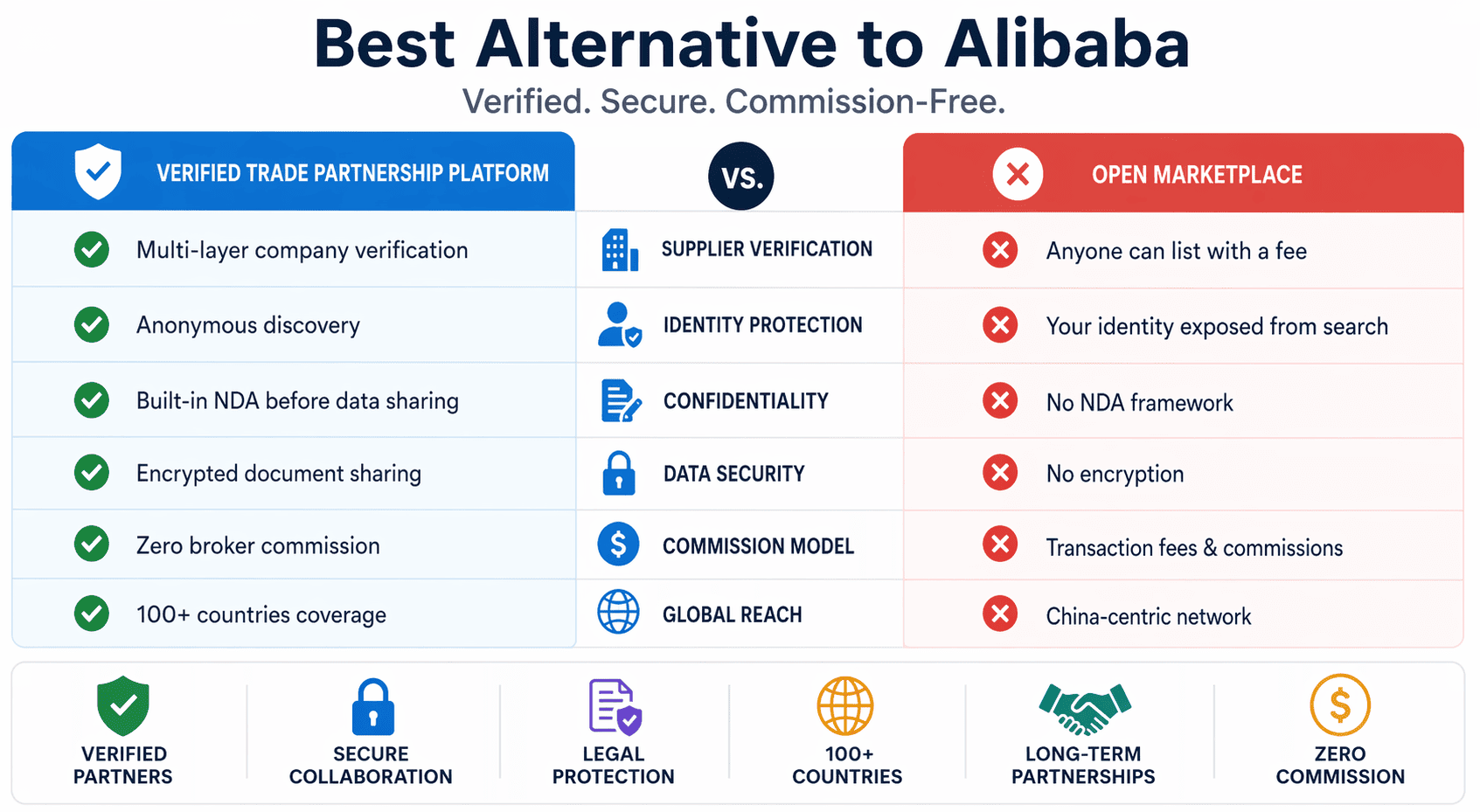
You will notice that GTsetu is not in the table above. That is intentional. GTsetu is not an RFQ platform or a regional sourcing marketplace — it is a fundamentally different kind of tool, built for a fundamentally different use case. The section below explains that distinction and when it matters.
SECTION 10
10 When RFQ Is Not Enough: Long-Term Trade Partnerships
Every platform in the table above is optimised for the same basic workflow: you describe what you want, suppliers respond, you compare and transact. This is the right tool for spot orders, product testing, and commodity sourcing. It is the wrong tool for something categorically different: building a verified, long-term international trade partnership.
🤝 What Is a Long-Term Trade Partnership?
A long-term trade partnership is a multi-year commercial relationship — between a manufacturer and their exclusive or preferred international distributor, between a raw material supplier and a manufacturer client, or between a distributor and a principal brand. These relationships involve shared commercial strategy, exclusive territories, minimum purchase commitments, and deep commercial information exchange. They are not transactions. They are relationships, and they require a different kind of infrastructure.
🔍
Identity Must Be Verified, Not Just Claimed
In a long-term partnership, you may share pricing strategy, product roadmaps, and market plans with your partner. If their identity is self-stated rather than verified against government records, you have no legal standing if they misrepresent who they are. RFQ platforms do not solve this.
📄
Commercial Information Needs Legal Protection
Sharing your pricing structure, distribution strategy, or product pipeline with a prospective partner without a signed NDA in place is a commercial risk. Most RFQ platforms have no mechanism for this. It is simply assumed that buyers and sellers will manage their own legal arrangements — and most do not.
🕵️
Discovery Should Be Anonymous
When a manufacturer is evaluating distributors for a new market entry, the last thing they want is for their market entry strategy to become visible to competitors before they have secured a partner. On RFQ platforms, every search and enquiry exposes your identity and intent.
💸
Commission Should Not Erode Deal Value
A 5–10% broker commission on a multi-year distribution agreement worth $500,000 annually costs $25,000–$50,000 per year. Commission-based intermediaries make long-term partnerships commercially punishing. The right platform charges for access, not for the value of your deals.
🌍
Geography Should Not Be China-Only
Long-term distribution partnerships need to span multiple markets and regions. A platform that only covers China (or only India, or only the US) cannot support a global distribution strategy. You need a platform where verified partners exist across all your target geographies simultaneously.
Manufacturers, distributors, and raw material suppliers operate in industries where regulatory compliance, production certifications, minimum order commitments, and exclusive territory arrangements are standard. Consumer-facing platforms are not equipped to support this complexity.
If any of the points above describe your situation, you are not looking for an alternative to Alibaba in the RFQ sense. You are looking for a platform purpose-built for long-term industrial trade partnership formation — which is an entirely different category.
SECTION 11
11 GTsetu: Built for Industrial Long-Term Trade Collaboration
GTsetu is not a sourcing marketplace. It does not list products with prices. It does not process purchase orders. It is not a place to find the cheapest factory for a one-off order.
It is a verified partnership platform, purpose-built for manufacturers, distributors, and raw material suppliers who need to identify, vet, and engage long-term international trade partners — with every company on the platform verified via government records before any engagement begins, and with built-in legal, confidentiality, and security infrastructure that no RFQ platform provides.
🤝 For Long-Term Industrial Trade, Not RFQ
The Infrastructure That RFQ Platforms Don’t Have
GTsetu is built around four principles that no Alibaba alternative in the RFQ category provides: verified identities, anonymous discovery, legal protection before data sharing, and zero commission on partnerships formed. If your goal is a long-term distribution agreement, manufacturer-principal relationship, or raw material supply contract — not a product order — this is the platform for that.
🏛️
6-Point Government Tie‑Up VerificationLegal name, registered address, registration number, company status, type, and date of incorporation — verified via official government sources, not self-attested. Every company on the platform.
🕵️
Anonymous DiscoveryEvaluate partner profiles across 100+ countries without revealing your company identity or market expansion plans to the market.
📄
NDA Before Any Data ExchangeBuilt-in NDA workflow triggered before pricing, product specifications, or commercial strategy is shared with any party. No separately-arranged legal documents required.
🔐
Encrypted Document SharingAES-256 encryption at rest, TLS in transit. No unprotected email attachments for sensitive commercial documents.
🚫
Zero Broker CommissionNo percentage of deal value taken by the platform. The full commercial value of every partnership stays between the two parties who built it.
🌍
500+ Verified Industrial CompaniesManufacturers, distributors, and raw material suppliers across Asia, the Middle East, Europe, Africa, Australia, and the Americas — not China-only.
Manufacturers seeking verified international distributors for a new market — without trade show travel, cold outreach, or broker intermediaries taking a cut of the relationship they help form
Distributors seeking verified manufacturer principals whose legal status has been independently confirmed before any commercial conversation begins
Raw material suppliers seeking long-term industrial buyer relationships — where contract length, purchase volumes, and product specifications need to be shared securely before any agreement is signed
International trade professionals who need documented, auditable interaction trails for anti-bribery compliance and due diligence records
Companies expanding into new geographies who need to evaluate multiple potential partner markets simultaneously without exposing their expansion strategy to the market prematurely
💡 Choosing the Right Tool for the Right Job
Use IndiaMART, ThomasNet, Global Sources, or Europages when you need to request quotes, compare supplier prices, or place sourcing orders within a specific geography. Use GTsetu when you are a manufacturer, distributor, or raw material supplier building a multi-year international trade relationship — where legal identity, confidentiality, and deal security matter more than price comparison. These are not competing tools. They solve different problems.
Digital NDA triggered before any sensitive exchange
Encrypted document workspace
No; typically email attachments
AES-256 at rest; TLS in transit
Commission on deal value
Transaction fees or % commission in intermediated models
Zero — flat platform access model
Geographic coverage
Regionally concentrated (China, India, US, or Europe)
100+ countries; equally accessible across all regions
Audit trail for due diligence
No structured interaction record
Full timestamped audit trail; downloadable for compliance
Sectors served
Consumer goods, broad marketplace
Industrial: manufacturers, distributors, raw material suppliers
FAQ
? Frequently Asked Questions
QWhat is the best alternative to Alibaba for sourcing and RFQ?
The best Alibaba alternative for RFQ depends on your target geography. For Chinese manufacturers, Global Sources (electronics/OEM) and Made-in-China.com (industrial) are the strongest alternatives. For India, IndiaMART is the largest platform by volume. For North America, ThomasNet leads in industrial manufacturing. For Europe, Europages is the broadest regional alternative. For a global database, Kompass covers 150+ countries. Each is optimised for transactional sourcing within its region. If you are not placing an order but building a long-term trade partnership between manufacturers, distributors, or raw material suppliers, GTsetu is purpose-built for that distinct need.
QWhat is the difference between an RFQ platform and a long-term trade partnership platform?
An RFQ (Request for Quotation) platform is optimised for transactional sourcing: you post a requirement, suppliers respond with quotes, you compare and place an order. Alibaba and every regional alternative in this guide operate on that model. A long-term trade partnership platform is built for a different purpose: forming multi-year commercial relationships between manufacturers, distributors, and raw material suppliers — where identity verification, NDA workflows, encrypted data sharing, anonymous discovery, and zero commission on deals formed all matter significantly more than price comparison. GTsetu is the latter. The platforms in the comparison tables above are the former. Choosing the wrong category for your use case leads to poor outcomes regardless of which platform you pick within it.
QWhat is the best Alibaba alternative in India?
For RFQ and supplier discovery within India, IndiaMART is the largest and most widely used platform, followed by TradeIndia for secondary coverage and ExportersIndia for export-oriented suppliers specifically. For international buyers who need verified, long-term partnerships with Indian manufacturers or distributors — where knowing your partner’s legal identity is confirmed against government records matters, and where commercially sensitive information needs to be protected before it is shared — GTsetu provides infrastructure that none of the India-specific RFQ platforms offer.
QWhat is the best Alibaba alternative in Europe?
For European supplier discovery and RFQ, Europages is the broadest regional platform, covering manufacturers across 26+ European countries. Kompass covers Europe as part of its 150+ country global database and is useful for structured market research. For DACH-region industrial suppliers specifically, Wer liefert was offers the deepest coverage. For verified long-term partnerships with European manufacturers or distributors, GTsetu’s global network includes European partners alongside Asia, the Middle East, and the Americas, with the same identity verification and legal protection infrastructure regardless of geography.
QWhen should I use GTsetu instead of an Alibaba alternative?
Use the regional RFQ platforms — IndiaMART, ThomasNet, Global Sources, Europages — when you need to compare supplier quotes, source a specific product, or place a transactional order. Use GTsetu when you are a manufacturer seeking verified international distributors, a distributor seeking verified manufacturer principals, or a raw material supplier seeking long-term industrial buyer relationships. Specifically, use GTsetu when: you need your partner’s legal identity confirmed against government records before sharing any commercial information; you need an NDA in place before pricing or product data is exchanged; you want anonymous discovery so your market expansion plans remain confidential during the partner evaluation phase; and you need a platform that takes zero commission on the partnership you build, regardless of its commercial value.
QAre there free alternatives to Alibaba?
Most serious B2B platforms charge membership or listing fees. TradeKey and some regional directories offer basic free listings, but verification and response quality reflect their pricing. IndiaMART and Europages offer limited free browsing. GTsetu operates on a flat-access model with zero broker commissions on any partnership formed — meaning the platform fee never scales with the commercial value of your deals. A 5% commission on a $500,000 annual distribution agreement costs $25,000 per year; GTsetu’s model eliminates that cost entirely, regardless of how large the partnerships you form become.
QWhat should I look for in an Alibaba alternative?
The right criteria depend on your use case. For RFQ and transactional sourcing, prioritise: geographic coverage of your target market, category depth in the product segment you are sourcing, supplier verification quality (factory audits versus open listings), and cost of access. For long-term trade partnership formation, the criteria shift significantly: mandatory government-verified company identities (not self-stated); anonymous discovery to protect your market strategy during the evaluation phase; a built-in NDA workflow that creates legal protection before any sensitive data is shared; encrypted document infrastructure for commercial file exchange; zero commission on deals formed; and genuine multi-region coverage across all your target geographies simultaneously.
At a Glance: Best Platform by Region and Use Case
🇨🇳
China & Asia
For RFQ & Transactional Sourcing
Global Sources
Best for electronics, OEM/ODM from established Asian factories
Made-in-China.com
Best for industrial parts, components, bilingual listings
EC21
Best for South Korean manufacturers specifically
DHgate
Small wholesale orders and product testing only
🇮🇳
India
For RFQ & Transactional Sourcing
IndiaMART
Largest volume; broad category coverage across India
TradeIndia
Secondary discovery; useful when IndiaMART is thin
ExportersIndia
Export-oriented manufacturers with EXIM experience
🇺🇸
North America
For RFQ & Transactional Sourcing
ThomasNet
US/Canada industrial contract and custom manufacturing
Maker’s Row
US-made apparel, accessories, consumer goods
🇪🇺
Europe
For RFQ & Transactional Sourcing
Europages
Broadest European B2B directory; 26+ countries
Kompass
Global database; strong European data for market research
Wer liefert was
DACH industrial suppliers; precision engineering
🌍
Global (Any Region)
For Long-Term Trade Partnerships
GTsetu
Verified manufacturer–distributor–raw material supplier partnerships. 100+ countries. 6-point government tie‑up verification. NDA workflows. Zero commission. For industrial sectors seeking long-term collaboration, not RFQ.
If you are a manufacturer, distributor, or raw material supplier seeking long-term international trade partnerships — with verified partners, legal protection before data sharing, and zero broker commission — GTsetu is purpose-built for exactly that. 500+ verified industrial companies. 100+ countries. Government-verified identities. Built-in NDA workflows. Zero commissions.
They represents the product, and research team behind GTsetu, a global B2B collaboration platform built to help companies explore cross-border partnerships with clarity and trust. The team focuses on simplifying early-stage international business discovery by combining structured company profiles, verification-led access, and controlled collaboration workflows.
With a strong emphasis on trust, and disciplined engagement, Team GTsetu shares insights on global trade, partnerships, and cross-border collaboration, helping businesses make informed decisions before entering deeper commercial discussions.