Business Partnership Contract: Complete Guide, Templates & Key Clauses
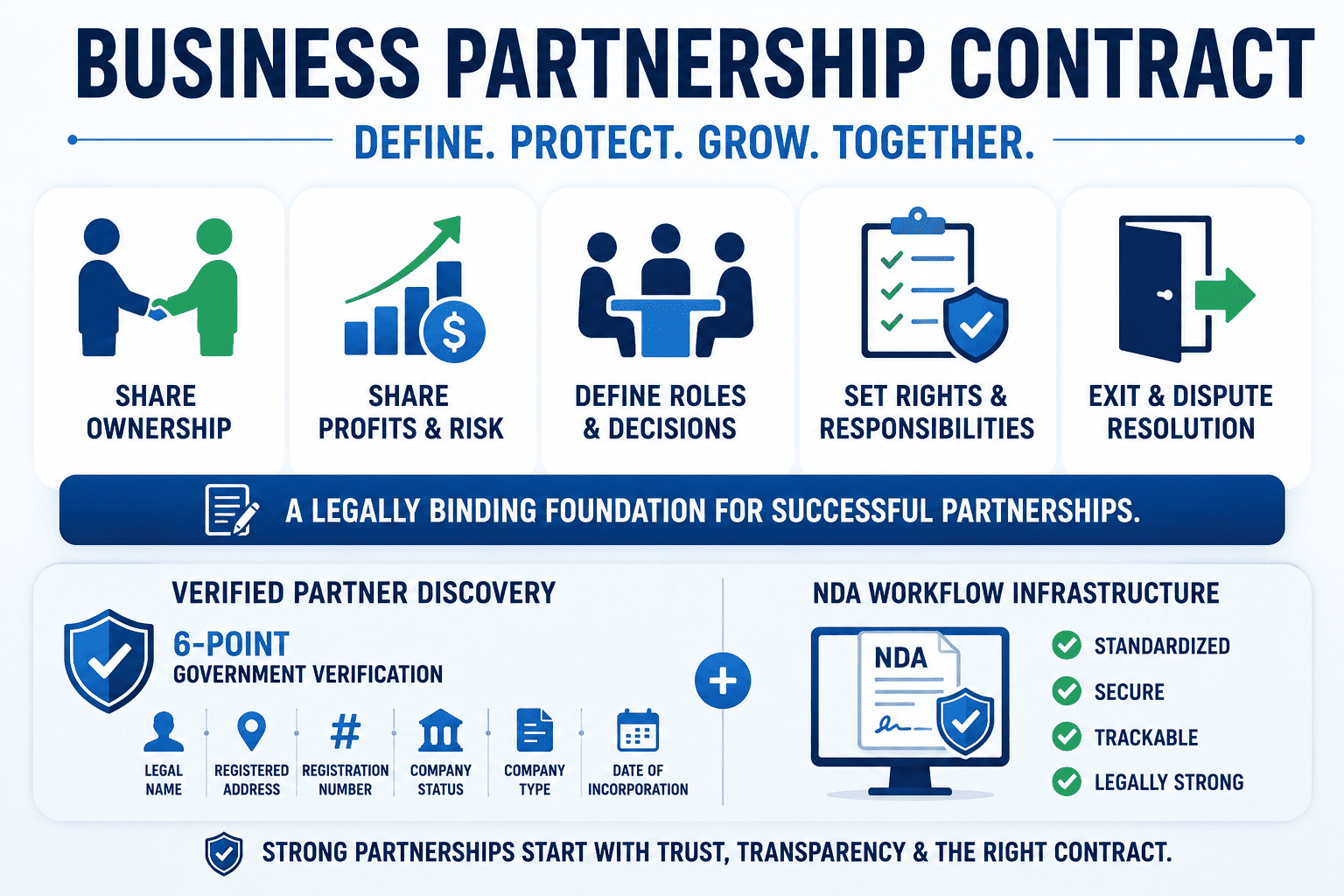
Direct Answer: A business partnership contract is a legally binding document that defines how two or more parties share ownership, profits, decision-making authority, responsibilities, and risk in a commercial relationship. It is the foundational legal instrument for any business partnership, from a simple 50/50 agreement between two founders, to a complex international manufacturer-distributor arrangement, to a brand collaboration or technology licensing deal. A complete partnership contract covers capital contributions, profit and loss sharing, roles, governance, non-compete and confidentiality obligations, exit mechanisms, and dispute resolution. For cross-border trade partnerships, GTsetu provides verified partner discovery (6-point government tie‑up verification: legal name, registered address, registration number, company status, company type, date of certificate of incorporation) and NDA workflow infrastructure that makes every partnership contract stronger from day one.
Every business partnership, whether between two founders launching a startup, a manufacturer and an international distributor, two brands co-marketing a campaign, or two technology companies licensing IP to each other, needs a contract. Without one, each party operates on assumptions that will eventually differ. With a well-drafted contract, rights, obligations, and remedies are clear from the first day of the relationship.
This guide covers every dimension of business partnership contracts: what they are, which type applies to your situation, the clauses that must be included, how to draft each one, and the specific considerations for international trade partnerships between manufacturers, distributors, and global trade partners. We also cover the specialised forms most commonly searched, 50/50 agreements, brand partnerships, technology agreements, and LLC structures, and provide a complete template structure.
This guide is written for entrepreneurs entering business partnerships, manufacturers and distributors formalising cross-border trade partnerships, business development teams drafting collaboration agreements, and anyone navigating the full range of partnership contract types, from simple general partnership contracts to complex joint ventures and strategic alliances.
1 What Is a Business Partnership Contract?
A business partnership contract (also called a partnership agreement or business partnership agreement) is a legally binding document between two or more parties that governs the terms of a shared commercial relationship. It defines each party’s ownership stake, capital contributions, profit and loss share, roles and responsibilities, decision-making authority, and the procedures for resolving disputes, admitting new partners, or dissolving the partnership. It is the foundational legal instrument that converts a business relationship from an informal arrangement into an enforceable legal structure.
A business partnership contract is distinct from a simple service agreement or NDA. Where an NDA protects information, and a service contract governs a transaction, a partnership contract creates an ongoing legal relationship with shared economic interests and shared legal obligations. In most jurisdictions, partnership contracts are governed by partnership law, either the statutory provisions of the relevant Partnership Act or, where they supersede statute, the terms of the contract itself.
Partnership Agreement vs. Contract: Are They the Same?
Yes, a partnership agreement is a contract. It satisfies all the standard requirements of a binding contract: offer, acceptance, consideration (the parties’ contributions to the partnership), and intention to create legal relations. The terms “partnership agreement,” “partnership contract,” “business partnership agreement,” and “contract of partnership” are used interchangeably in commercial practice and are legally equivalent.
| What a Partnership Contract Is | What a Partnership Contract Is Not |
|---|---|
| A legally binding document creating mutual obligations between partners | A memorandum of understanding (MOU), which is typically non-binding |
| A framework governing the ongoing relationship between parties with shared economic interests | A service agreement, which governs a specific transaction, not an ongoing shared venture |
| An instrument that can override many statutory default provisions of partnership law | A shareholders’ agreement, which governs a corporation, not a partnership structure |
| Enforceable in court if any party breaches its terms | A heads of terms or letter of intent, which are typically pre-contractual and non-binding on key commercial terms |
| The foundation document for joint ventures, strategic alliances, and general partnerships | A non-disclosure agreement alone, which protects information but creates no shared commercial venture |
2 7 Types of Business Partnership Contracts
The right type of partnership contract depends on the structure of the relationship, the parties’ liability exposure, the nature of the commercial activity, and the jurisdiction. These are the seven most commonly used forms in international trade and business.
General Partnership Contract
All partners share management responsibility, profits, losses, and, critically, unlimited personal liability. The simplest and most common partnership structure for small businesses and professional practices.
Limited Partnership Contract
At least one general partner bears unlimited liability and manages the business; limited partners contribute capital but have liability capped at their investment. Common in investment vehicles, real estate, and project-based ventures.
LLC Partnership Contract
A Limited Liability Company with multiple members creates an operating agreement that functions as a partnership contract, distributing profits, assigning management rights, and governing transfers of membership interest with liability protection for all members.
Business Collaboration Agreement
Two independent companies agree to collaborate on a specific project, product, or initiative without forming a new legal entity. Each party retains its independence. Widely used in industrial business collaboration, co-development, and co-marketing.
Joint Venture Partnership Contract
Two or more parties create a new jointly-owned entity (or project-specific arrangement) for a defined purpose. Each party contributes capital, IP, or expertise. See our full guide on joint ventures vs. strategic alliances.
Brand Partnership Contract
Two brands collaborate for co-branding, co-marketing, or licensed brand use. Covers brand usage rights, approval processes, revenue sharing, and quality standards. Critical for protecting both brands’ identity and market positioning.
Technology Partnership Agreement
Governs a relationship where one party provides technology, IP, or know-how to another for a defined commercial purpose. Covers IP ownership, licensing scope, transfer terms, improvement ownership, and confidentiality. See our guide on technology transfer agreements.
3 The 50/50 Business Partnership Contract
A 50/50 partnership contract is the most common arrangement between two founders or co-owners, and simultaneously the most prone to deadlock if not carefully drafted. Equal ownership sounds fair and straightforward; in practice, it creates a governance structure that requires explicit mechanisms for resolving disagreements before they paralyse the business.
- Equal ownership stake in the business
- 50% share of all profits and losses
- Equal vote on all ordinary decisions
- Equal capital contribution obligation
- Defined role and operational responsibilities
- Buyout rights if partnership dissolves
- Equal ownership stake in the business
- 50% share of all profits and losses
- Equal vote on all ordinary decisions
- Equal capital contribution obligation
- Defined role and operational responsibilities
- Buyout rights if partnership dissolves
The Deadlock Problem in 50/50 Partnerships
The fundamental challenge in a 50/50 structure: when the two partners fundamentally disagree, no one has the casting vote. Without a deadlock resolution mechanism written into the contract, the business can be paralysed, neither partner can compel the other. Courts are generally reluctant to interfere in management disputes, meaning the only remedy without a contractual mechanism may be full dissolution of the partnership.
Two equal partners build a business for four years. They disagree on a major strategic direction. The partnership agreement has no deadlock clause. Neither can outvote the other. They cannot agree on a buyout price. Their only legal remedy is a court-supervised dissolution, selling the business at a forced sale price to resolve the impasse. A deadlock clause would have cost nothing to include at drafting. The dissolution cost them a business worth three times what either would have accepted in a negotiated buyout. Always draft deadlock resolution into a 50/50 partnership contract before it is needed.
4 14 Essential Clauses Every Partnership Contract Needs
A complete business partnership contract, whether it is a simple 50/50 agreement between two founders or a complex international distribution partnership, must address fourteen core areas. Missing any one of them creates a legal gap that will be exploited if the relationship deteriorates.
Clause 1, Partner Identification & Authority
Full legal names of all partners, registered addresses, business registration numbers, and, critically, confirmation that each signatory has the legal authority to bind the entity they represent. For international partnerships, this includes verification of authority letters and corporate registration. GTsetu’s 6-point government tie‑up verification (legal name, registered address, registration number, company status, company type, date of certificate of incorporation) confirms these core credentials before any partnership engagement begins.
Clause 2, Partnership Structure & Purpose
Define the legal structure (general partnership, limited partnership, LLC, joint venture, collaboration agreement), the specific purpose of the partnership, and the geographic scope of operations. For trade partnerships, this includes the products, territories, and market segments covered. Cross-reference with territory rights and exclusivity arrangements.
Clause 3, Capital Contributions
Specify exactly what each partner contributes: cash, assets, intellectual property, equipment, services, or know-how. Include the agreed valuation of non-cash contributions. State the timing of contributions, consequences of delayed contribution, and whether additional capital calls are permitted, and under what conditions.
Clause 4, Profit & Loss Distribution
Define precisely how profits and losses are allocated between partners, including the calculation basis (revenue, gross profit, net profit), distribution timing (quarterly, annually), minimum retained earnings before distribution, and whether distributions can be withheld for reinvestment. For manufacturing partnerships, pricing and margin arrangements are central to this clause.
Clause 5, Roles, Responsibilities & Decision-Making
Specify each partner’s operational role, what decisions each can make unilaterally, what requires consensus, and what requires unanimity. Define management authority thresholds by transaction value (e.g., either partner may approve purchases under USD 10,000; joint approval required above). Include a decision-making timeline to prevent deadlock by inaction.
Clause 6, Banking & Financial Management
Define which bank accounts the partnership operates, who has signing authority and at what threshold (single signatory vs. joint), accounting standards to be applied, the partnership’s financial year, and the audit or review rights each partner holds. For cross-border partnerships, include currency, foreign exchange handling, and payment terms.
Clause 7, Confidentiality & Non-Disclosure
Define what information is confidential, the obligations of each party, permitted disclosure (legal, regulatory), duration of confidentiality obligations, and consequences of breach. For comprehensive protection, pair with a standalone mutual NDA. GTsetu’s built-in NDA workflow provides a digitally executed, timestamped confidentiality framework before any sensitive information is shared.
Clause 8, Non-Compete & Non-Circumvention
Define any restrictions on partners competing against the partnership or circumventing each other to deal with introduced contacts directly. These are two separate protections serving distinct commercial interests. See our complete guide on non-compete vs. non-circumvention for drafting guidance. For distribution agreements, pair with exclusivity clauses.
Clause 9, Intellectual Property Ownership
Explicitly allocate ownership of: IP each party brings into the partnership (remains with originating party, licensed to partnership), IP created jointly during the partnership, and improvements to existing IP. For manufacturing and technology partnerships, this is one of the most commercially significant clauses. See our guides on IP ownership in contract manufacturing and technology transfer agreements.
Clause 10, Admission of New Partners & Transfer of Interest
Define whether new partners can be admitted and under what conditions (unanimous consent? majority?). Define whether existing partners can sell, transfer, or pledge their interest, and if so, whether remaining partners have a right of first refusal. This clause prevents unwanted third parties from acquiring a stake in the partnership without the other partners’ agreement.
Clause 11, Force Majeure
Define events that excuse non-performance (pandemic, war, natural disaster, government action, supply chain disruption), the procedure for invoking the clause, the mitigation obligation, and the consequences if the force majeure event persists beyond a defined period (suspension vs. termination right). See our dedicated guide on force majeure in global trade.
Clause 12, Exit, Dissolution & Winding Up
Define the events that trigger dissolution (mutual agreement, death or incapacity of a partner, insolvency, material breach), the winding-up procedure, order of payment priority (creditors first, then capital return, then profit surplus), and how assets and liabilities are distributed. For trade partnerships, include post-termination obligations on stock, IP reversion, and client relationships. See our guide on termination clauses.
Clause 13, Dispute Resolution
Define the escalation process: negotiation → mediation → binding arbitration. Specify the governing law, seat of arbitration, arbitral institution (ICC, SIAC, LCIA), and language of proceedings. For international partnerships, arbitration is strongly preferred over court litigation because of the New York Convention’s cross-border enforceability. Full guidance in our dispute resolution guide.
Clause 14, Governing Law, Amendments & Entire Agreement
Specify which jurisdiction’s law governs the contract, how amendments must be made (in writing, signed by all parties), a severability clause (if one clause is void, others survive), and an entire agreement clause confirming this document supersedes all prior oral or written agreements between the parties on the same subject matter. Include the governing language if the contract is translated.
5 Partnership Contract Template: Full Structure
The following template structure covers all fourteen essential clauses for a business partnership contract. Use this as a drafting framework, every [PLACEHOLDER] must be completed with your specific terms. This template is applicable to general partnerships, business collaboration agreements, and most cross-border trade partnership arrangements. For LLC operating agreements, joint venture structures, or sector-specific partnerships, consult qualified legal counsel in your jurisdiction.
This Business Partnership Agreement (“Agreement”) is entered into as of [DATE] between [PARTNER A FULL LEGAL NAME], a company incorporated under the laws of [JURISDICTION], with registration number [REG NO] and registered address at [ADDRESS] (“Partner A”), and [PARTNER B FULL LEGAL NAME], a company incorporated under the laws of [JURISDICTION], with registration number [REG NO] and registered address at [ADDRESS] (“Partner B”), collectively referred to as the “Partners.”
The Partners agree to establish a [TYPE: general partnership / collaboration / joint venture] for the purpose of [SPECIFIC BUSINESS PURPOSE, product category, territory, activity] (the “Partnership Business”), commencing on [START DATE] and continuing until terminated in accordance with this Agreement.
Partner A shall contribute [AMOUNT / ASSET DESCRIPTION] valued at [VALUE]. Partner B shall contribute [AMOUNT / ASSET DESCRIPTION] valued at [VALUE]. Contributions shall be made by [DATE]. No partner shall be required to make additional capital contributions without unanimous written consent.
Partner A holds a [X]% ownership interest in the Partnership. Partner B holds a [Y]% ownership interest in the Partnership. The Partners’ interests shall be proportional to their capital contributions unless otherwise stated herein.
Net profits and net losses of the Partnership shall be allocated to the Partners in proportion to their respective ownership interests ([X]% to Partner A; [Y]% to Partner B), unless the Partners unanimously agree otherwise in writing. Distributions of net profits shall be made [quarterly / annually] following approval of partnership accounts, subject to retention of [RESERVE AMOUNT] for working capital.
Partner A shall be responsible for [OPERATIONAL DOMAIN, e.g., product development, manufacturing]. Partner B shall be responsible for [OPERATIONAL DOMAIN, e.g., sales, distribution, marketing]. Each Partner may act independently on decisions within their domain for transactions not exceeding [THRESHOLD AMOUNT]. All decisions exceeding this threshold, and all decisions concerning [RESERVED MATTERS LIST], require the written consent of both Partners.
If the Partners are unable to reach a decision on a reserved matter within [30 / 45] days of written notice of the deadlock, the matter shall be referred to [MEDIATION / NAMED THIRD PARTY / SPECIFIED MECHANISM]. If the deadlock persists for [90] days, either Partner may trigger the buyout provisions set out in Section [X].
Each Partner shall keep confidential all Confidential Information received from the other Partner and shall use it solely for the purposes of the Partnership Business. This obligation shall survive termination of this Agreement for a period of [3 / 5] years. “Confidential Information” means [DEFINITION, pricing, formulations, client data, technical specifications, financial data, etc.].
Intellectual property owned by each Partner prior to the commencement of this Agreement remains the exclusive property of that Partner and is licensed to the Partnership on a non-exclusive basis solely for the Partnership Business. All intellectual property created jointly by the Partners during the term of this Agreement shall be owned [EQUALLY / IN PROPORTION TO CONTRIBUTION / AS SPECIFIED] by the Partners.
During the term of this Agreement and for [12 / 24] months following termination, neither Partner shall, directly or indirectly, [compete against the Partnership in the defined territory / approach introduced business contacts directly without the other Partner’s consent]. For full drafting guidance see our guide on non-compete vs. non-circumvention clauses.
This Agreement commences on [DATE] and continues until terminated by: (i) mutual written agreement; (ii) either Partner giving [90 / 180] days’ written notice; (iii) material breach not remedied within [30] days of notice; (iv) insolvency or bankruptcy of either Partner. On termination, the Partners shall conduct an orderly wind-down in accordance with Section [X]. See also our guide on termination clauses in trade agreements.
Any dispute arising out of or in connection with this Agreement shall first be referred to senior management of each Partner for resolution within [30] days. If unresolved, the dispute shall be submitted to binding arbitration administered by [ICC / SIAC / LCIA] under its current rules, with the seat of arbitration in [CITY, COUNTRY], conducted in [ENGLISH], before [1 / 3] arbitrator(s). For full guidance see our dispute resolution guide.
This Agreement shall be governed by and construed in accordance with the laws of [JURISDICTION], without regard to its conflict of laws provisions. The Partners submit to the non-exclusive jurisdiction of the courts of [JURISDICTION] for enforcement purposes only.
This template structure provides the essential framework for a business partnership contract. Every [PLACEHOLDER] must be replaced with your specific terms. For international partnerships, specific sector agreements (manufacturing, distribution, technology), or LLC structures, qualified legal counsel in your jurisdiction should review and finalise the document. The template above is for structural reference and educational purposes only and does not constitute legal advice.
6 Business Collaboration Agreement: Definition & Usage
A business collaboration agreement is a specific type of partnership contract where two independent companies agree to work together on a defined project, initiative, or commercial goal, without creating a new legal entity or formal partnership structure. Each company retains its independence, its own legal identity, and its own P&L; the collaboration agreement governs only the shared activity.
What a Business Collaboration Agreement Must Include
- Identity of both parties and their authority representatives (verified through business identity verification)
- Specific scope of the collaboration, what is included and explicitly what is excluded
- Each party’s deliverables, milestones, and timeline commitments
- Revenue sharing model or cost allocation for the collaborative activity
- Ownership of jointly created intellectual property
- Confidentiality obligations covering all information shared during the collaboration
- Non-compete or non-circumvention clauses where the collaboration creates proprietary introductions
- Term, renewal conditions, and termination triggers
- Dispute resolution process and governing law
- Force majeure provisions, especially relevant for cross-border partnerships
A Memorandum of Understanding (MOU) is typically non-binding, it records intent without creating enforceable obligations. A business collaboration agreement is a binding contract. If you want the collaboration to be legally enforceable with defined remedies for breach, use a collaboration agreement, not an MOU. If you want a non-binding framework for early-stage discussions, use an MOU, but convert it to a binding agreement before any sensitive information or commercial resources are committed. GTsetu’s built-in NDA workflow provides binding confidentiality protection from the first interaction, long before a formal collaboration agreement is signed.
7 Brand Partnership Contract
A brand partnership contract governs the relationship between two brands that agree to collaborate commercially, through co-branding, cross-promotion, licensed brand use, or joint product development. For manufacturers and distributors, brand partnerships are a significant commercial vehicle: a manufacturer may grant a distributor the right to use their brand in a market, or two manufacturers may co-brand a product for a specific channel.
Brand Usage Rights
Precisely define which marks, logos, trade names, and brand assets are licensed, in what format, on which products and channels, in which geographies, and for what duration. Vague brand licences generate the most expensive IP disputes.
Brand Approval Process
Define the approval workflow for any use of one brand’s assets by the other, artwork, copy, campaigns, packaging. Include approval timelines and deemed-approval provisions to prevent one party from blocking the other indefinitely.
Brand Standards & Quality Control
The licensor brand must maintain quality control rights over how their brand is presented. Include minimum quality standards, audit rights, and the right to withdraw the licence if standards are not met. A brand used below standard damages the licensor regardless of the licensee’s contractual position.
Revenue Sharing & Royalties
Define how co-branded revenue is split, whether royalties are payable on brand use, the royalty calculation basis, payment timing, and audit rights over sales records. For white-label or private-label arrangements, the commercial terms differ significantly from standard co-branding.
Brand Protection & Infringement
Define which party is responsible for monitoring and enforcing brand protection against third-party infringers, the cost allocation for enforcement actions, and what happens if one party fails to protect the shared brand assets in their territory.
Exit & Brand Reversion
On termination, all brand assets must revert to the originating owner. Define the transition period, how existing co-branded inventory is handled, and how the public-facing brand transition is communicated. Poorly drafted brand reversion provisions create market confusion that damages both parties.
8 Technology Partnership Agreement
A technology partnership agreement governs a relationship where one party provides technology, know-how, software, or proprietary process to another party for a defined commercial purpose. In the manufacturing context, technology partnerships cover process technology transfers, equipment know-how, formulation licences, and software integrations. For distributors, they may cover proprietary sales systems, digital ordering platforms, or analytics tools provided by the manufacturer.
| Element | What to Define | Common Dispute Points |
|---|---|---|
| Technology Definition | Precisely what technology, know-how, software, or process is being licensed or transferred, including version, specifications, and documentation | “We thought the upgrade was included” vs. “We only licensed version 1.0” |
| Licence Scope | Is the licence exclusive or non-exclusive? Geographically limited? Field-of-use restricted? Sublicensable to the licensee’s own distribution chain? | Licensee sublicenses to third parties; licensor claims exclusivity was only to the licensee entity |
| IP Ownership, Improvements | If the licensee improves or adapts the technology, who owns those improvements? This is the most commercially significant IP question in any technology partnership. | Licensor claims all improvements revert; licensee claims improvements are their independent IP |
| Know-How Transfer | What technical assistance, training, and documentation is included? Who bears the cost of technology transfer support? Over what timeline? | Licensor provides less support than licensee expected; licensee cannot implement technology without more assistance |
| Royalty & Milestone Payments | Upfront fee, ongoing royalty rate, royalty calculation basis (sales, units, revenue), audit rights, minimum royalty commitments | Licensee under-reports sales; licensor disputes audit results |
| Confidentiality Duration | Technology know-how confidentiality should survive termination for a longer period than standard commercial confidentiality, often 7–10 years or the life of the relevant IP | Licensee argues standard 2-year confidentiality applies; licensor argues technology know-how has longer protection |
For detailed guidance on structuring technology transfers in manufacturing contexts, see our guides on technology transfer agreements and IP ownership in contract manufacturing.
9 LLC Partnership Contract (Operating Agreement)
When two or more parties form a Limited Liability Company (LLC) to conduct their partnership business, the foundational document is the LLC Operating Agreement, which functions as the partnership contract for the LLC structure. It combines partnership contract elements with LLC-specific legal requirements.
Member Interests & Capital Accounts
Unlike general partnerships where ownership is by percentage share, LLC operating agreements maintain individual capital accounts for each member. Capital contributions, profit allocations, and distributions are tracked per capital account. This creates a more precise financial record but requires proper bookkeeping from formation.
Member-Managed vs. Manager-Managed
An LLC can be member-managed (all members participate in management) or manager-managed (one or more designated managers run the LLC, which may or may not include all members). This choice fundamentally affects governance, decision-making authority, and what each member can bind the LLC to in dealings with third parties.
Tax Treatment Elections
LLCs can elect to be taxed as a sole proprietorship (single-member), partnership, S-corporation, or C-corporation. This election has profound implications for each member’s personal tax position. The operating agreement must record the agreed tax treatment and the process for changing it. Always involve a qualified tax advisor in this decision.
Transfer of Membership Interest
LLC membership interests are typically not freely transferable without the consent of other members, to prevent unwanted third parties from acquiring a stake. The operating agreement must specify: right of first refusal terms, approved transfer conditions, and what happens to voting rights vs. economic rights if an interest is transferred to a non-approved party.
Dissolution & Winding Up of LLC
Unlike general partnerships which may dissolve automatically on a partner’s death or departure, LLCs can be structured for perpetual existence. The operating agreement must define the events that trigger dissolution, the voting threshold required, and the winding-up procedure, including priority of payments and distribution of remaining assets.
10 How to Write a Business Partnership Contract
Writing a business partnership contract is not simply a matter of filling in a template. The most important work happens before a word is written: structuring the commercial relationship clearly, so that the contract reflects a genuine meeting of minds on every significant issue. Here is the step-by-step process.
Verify Your Partner Before Any Drafting Begins
Before investing time and resources into contract drafting, verify that your prospective partner is a legitimate, registered, compliant business entity, with the authority to enter into the agreement you are proposing. GTsetu verifies companies using government tie‑ups across six points: legal name, registered address, registration number, company status, company type, and date of certificate of incorporation. This step is not administrative, it is the foundation of whether the contract is enforceable against a real legal entity. Import licences, certifications, and financial standing must be exchanged directly between parties.
Agree the Commercial Terms Before Drafting the Legal Document
Draft a term sheet or heads of terms first, a short non-binding document listing the key commercial agreements: ownership percentages, profit sharing, roles, territory, exclusivity, term, and exit triggers. Get both parties to sign off on the commercial terms before the legal drafting begins. Nothing is more expensive than redrafting a 30-page agreement because the commercial deal changed after the lawyers started. For trade partnerships, agree on volume commitments, Incoterms, and pricing structures at this stage.
Execute a Non-Disclosure Agreement First
Before sharing any proprietary information during the term sheet negotiation and due diligence process, execute a formal NDA, mutual for most partnerships. GTsetu’s built-in NDA workflow creates a digitally executed, timestamped NDA before any confidential information enters the shared workspace. This protects both parties during the negotiation phase before the partnership contract is finalised.
Choose the Right Legal Structure
Determine whether your relationship should be structured as a general partnership, limited partnership, LLC, joint venture, or collaboration agreement, based on liability exposure, tax implications, governance needs, and your jurisdiction’s legal framework. Each structure has different default rules and different contracting instruments. If you are uncertain, consult qualified legal counsel before drafting begins, restructuring after signing is expensive.
Select Governing Law and Dispute Resolution Forum
For international partnerships, this is a decision that must be made before drafting, because the choice of governing law affects which clauses are enforceable and how they must be written. For cross-border trade partnerships, English law or Singapore law paired with ICC or SIAC arbitration is the most commercially reliable combination. For the full framework, see our dispute resolution guide.
Draft All 14 Essential Clauses, In Order
Work through the 14 essential clauses set out in Section 4. Draft in order: foundation clauses first (parties, structure, purpose), then commercial clauses (capital, profit, roles), then protection clauses (confidentiality, IP, non-compete), then continuity clauses (force majeure, amendment), then exit and dispute clauses. Each clause should be precise, defined, and consistent with every other clause, internal contradictions are the most common source of contract disputes.
Have Both Parties’ Counsel Review Before Signing
Both parties should have independent legal counsel review the contract before execution, ideally counsel qualified in the governing law jurisdiction. This is not a formality: legal review in the relevant jurisdiction will identify enforceability risks, missing provisions, and jurisdiction-specific requirements that a standard template will not capture. For international contracts involving global expansion or cross-border risk allocation, dual-jurisdiction review is essential.
Execute with Authority-Verified Signatories
The contract is only enforceable if signed by parties with the legal authority to bind their respective entities. For companies, this typically means a director or authorised officer, with authority confirmed by a board resolution or corporate authority certificate. GTsetu’s compliance verification confirms signatory authority through authority letter review before any company engages on the platform.
11 Common Mistakes That Invalidate or Weaken Partnership Contracts
Verbal Agreements Without Written Confirmation
In most jurisdictions, partnership agreements can be oral, but proving what was agreed is impossible. In international partnerships, oral agreements are effectively unenforceable. Always reduce the partnership agreement to writing before any commercial activity begins.
Signing Without Verifying the Counterparty
Entering a partnership contract with an entity whose legal status, registration, or signatory authority has not been verified. A contract signed by someone without authority is voidable. A contract with a fraudulent entity is worse. Business verification before signing is non-negotiable.
No Deadlock Resolution in 50/50 Structures
The most expensive oversight in 50/50 partnership contracts. Equal voting power means equal deadlock risk. Without an explicit mechanism for resolving tied decisions, the only exit is dissolution.
Vague IP Ownership Provisions
“IP created during the partnership belongs to the partnership” without defining what “created during” means, who owns improvements, and what happens on dissolution. IP disputes are the most expensive and longest-running partnership disputes.
No Governing Law Specified
In international partnerships, failure to specify governing law leads to courts applying their own conflict of laws rules, which may produce an unexpected and unfavourable outcome. Always specify governing law explicitly, and choose a jurisdiction compatible with your intended enforcement strategy.
Undefined Exit Mechanism
A partnership contract with no buyout formula or exit procedure leaves both partners hostage to the other in the event of breakdown. How is the business valued? Who has the right to buy whom out? What is the payment timeline? Every partnership contract needs answers before the relationship begins.
Confidentiality Clause That Doesn’t Survive Termination
A confidentiality clause that expires with the contract leaves all shared information unprotected the moment the partnership ends, precisely when the risk of misuse is highest. Always include a survival period for confidentiality obligations post-termination.
Using a Template Without Jurisdiction-Specific Review
A free template from the internet drafted for US law is not automatically enforceable in India, the UAE, or the EU. Every jurisdiction has specific requirements, mandatory provisions, and enforceability limitations. Free templates are starting points, not finished contracts for international use.
12 How GTsetu Helps Build Verified Trade Partnerships
A business partnership contract is only as strong as the partner it is signed with. Even the most precisely drafted agreement is commercially worthless if the counterparty is fraudulent, unverified, or lacks the authority to sign. GTsetu is built specifically to ensure that manufacturers and distributors entering cross-border trade partnerships start from a verified, documented, and secure foundation, before the first contract clause is drafted.
The Verified Foundation for Every Cross-Border Business Partnership Contract
GTsetu connects manufacturers and distributors across 100+ countries through a platform that verifies every company using government tie‑ups across six core credentials: legal name, registered address, registration number, company status, company type, and date of certificate of incorporation. This mandatory verification eliminates the most common sources of partnership failure from day one. Import licences, industry certifications, and financial standing are not verified by GTsetu and must be exchanged directly between partners. Where standard outreach leaves you guessing about who you are dealing with, GTsetu ensures every potential partner is who they say they are (based on these six government‑verified points) before any commercial discussion begins.
GTsetu does not provide legal advice or draft partnership contracts, that is the role of qualified legal counsel in your jurisdiction. What GTsetu provides is the verified partner foundation (6-point government tie‑up verification) that makes those contracts effective: compliance-checked core credentials, NDA-protected information exchanges, and a complete audit trail from first contact to signed agreement. Learn more about our approach to B2B secure collaboration and supplier collaboration platforms.
? Frequently Asked Questions
Related Articles
Joint Venture vs. Strategic Alliance
Choosing the right structure for your international partnership, and what each means contractually.
Licensing vs. Distribution Agreements
How the contract structure differs between licensing IP and distributing products internationally.
Mutual vs. One-Way NDA
The confidentiality layer your partnership contract is built on, how to choose and draft the right NDA.
Non-Compete vs. Non-Circumvention
Two clauses every partnership contract needs, and the crucial difference between them.
Dispute Resolution in International Contracts
The governing law and arbitration clause, essential for every cross-border partnership contract.
Cross-Border Business Partnerships
The complete guide to structuring and managing international trade partnerships across borders.
Find Verified Partners to Build Your Partnership Contract With
Join 500+ verified manufacturers and distributors on GTsetu, with 6-point government tie‑up verification, anonymous discovery, built-in NDA workflows, and zero broker commissions. Every strong partnership contract starts with a verified partner.
Get Started Free → Browse Verified Partners
They represents the product, and research team behind GTsetu, a global B2B collaboration platform built to help companies explore cross-border partnerships with clarity and trust. The team focuses on simplifying early-stage international business discovery by combining structured company profiles, verification-led access, and controlled collaboration workflows.
With a strong emphasis on trust, and disciplined engagement, Team GTsetu shares insights on global trade, partnerships, and cross-border collaboration, helping businesses make informed decisions before entering deeper commercial discussions.