Free for a limited time·Profile verification free·First collaboration free·No Commission·No Profit Share·Free for a limited time·Profile verification free·First collaboration free·No Commission·No Profit Share·Free for a limited time·Profile verification free·First collaboration free·No Commission·No Profit Share·
IP Ownership in Contract Manufacturing: Complete Guide for Manufacturers | GTsetu
Home ›
Blog ›
IP Ownership in Contract Manufacturing
⚖️ Contract Manufacturing & IP Law
IP Ownership in Contract Manufacturing: Complete Guide for Manufacturers
Direct Answer: IP ownership in contract manufacturing is not automatic — in most jurisdictions, the party who creates the IP holds initial rights unless a written agreement transfers them. That means a contract manufacturer can legally own innovations, process improvements, and product adaptations developed at your expense, unless your agreement contains an explicit IP assignment clause, background IP protections, NDA, and improvement ownership provisions. For manufacturers seeking contract manufacturing partners internationally, GTsetu provides verified partner discovery, built-in NDA workflows, and encrypted document sharing — so your IP is protected from first contact, not just after the contract is signed.
📅 April 9, 2026⏱ 18 min read✍️ GT Setu Editorial Team🔄 Updated regularly
$600B+
Global IP Value at Risk Annually
78%
of IP disputes stem from missing clauses
100+
Countries — GTsetu Verified Network
0%
Broker Commission on GTsetu
When a manufacturer outsources production to a third-party contract manufacturer — whether domestically or across borders — intellectual property changes hands in ways that most businesses significantly underestimate. Product formulations, tooling designs, production processes, packaging innovations, and manufacturing improvements developed during the contract relationship can end up legally owned by the manufacturer you hired, not by the brand owner who funded them.
This is not a theoretical edge case. It is a recurring commercial crisis with documented consequences: products reverse-engineered by the same factory that made them, pricing strategies leaked to competitors, proprietary formulas recreated under a different brand, and trade secrets lost permanently because there was no NDA in place before technical briefings began.
This guide covers the full IP protection framework for manufacturers engaging in contract manufacturing relationships — from the clauses your agreement must contain, to the security controls you need during partner discovery, to the jurisdictional complexities of cross-border outsourcing.
💡 Who Is This Guide For?
This article is written for brand owners, product companies, and innovators who outsource or are considering outsourcing production to third-party manufacturers — and who need to understand how to protect their intellectual property throughout the engagement lifecycle. It is also essential reading for procurement teams, legal counsel, and business development managers involved in co-development partnerships, technology transfer agreements, and white-label and private-label manufacturing.
SECTION 1
1 What Is IP Ownership in Contract Manufacturing?
🎯 Definition
IP ownership in contract manufacturing refers to the legal determination of which party — the brand owner (principal) or the contract manufacturer (CM) — holds rights to intellectual property created, used, improved upon, or disclosed during a manufacturing outsourcing relationship. This includes patents, trade secrets, product formulations, tooling designs, copyrights, trademarks, and process know-how that are exchanged, developed, or adapted throughout the engagement.
The fundamental problem is this: under the default law of most jurisdictions, the party who creates the IP is its initial owner — regardless of who funded, instructed, or briefed the work. A contract manufacturer who develops a more efficient production process for your product may, by default, own that improvement unless your agreement explicitly states otherwise.
In OEM, ODM, and EMS relationships, this distinction becomes commercially critical. An ODM manufacturer who develops a product to your specification may retain ownership of the design IP — meaning they can sell the same design to your competitors — unless a clear assignment clause transfers those rights to you.
Background IP vs. Foreground IP — The Core Distinction
IP CategoryDefinitionWho Typically Owns It
Background IP (Pre-existing)
IP owned by either party before the contract manufacturing relationship begins — formulas, patents, know-how, trademarks already in existence
✓ Each party retains their own
Foreground IP (Newly Created)
IP created specifically during and for the manufacturing engagement — process improvements, product adaptations, tooling designs, packaging innovations
✗ Creator by default — must be assigned
Improvements to Brand Owner IP
Modifications or enhancements the CM makes to the brand owner’s existing product, formula, or process
Physical tools, dies, and moulds created for your product — costly to duplicate if ownership is unclear
✗ Often CM’s by default — must be specified
Confidential Know-How
Unpatented technical processes, production parameters, and quality protocols shared during onboarding
✗ Requires NDA + trade secret protection
SECTION 2
2 Types of IP at Risk When Outsourcing Production
Every category of intellectual property faces distinct risk profiles in a contract manufacturing relationship. Understanding what you are exposing — and to whom — is the first step to protecting it.
🔬
Patents
Registered inventions covering product designs, compositions, and manufacturing processes. Protected if registered — but filing in the CM’s country separately is often necessary.
Protection: 20 years (utility)
🤫
Trade Secrets
Unpatented formulations, proprietary processes, production parameters, and know-how. The most common IP category shared with CMs — and the most frequently misappropriated.
Protection: Indefinite (if secret)
🎨
Industrial Designs
The ornamental appearance of a product — shape, configuration, surface pattern. Often automatically produced by a CM; ownership must be contractually assigned.
Protection: 10–25 years (varies)
™️
Trademarks & Brand Assets
Brand names, logos, and product marks applied during manufacturing. CMs can misuse trademarks in their own markets if branding rights are not restricted in the agreement.
Protection: Renewable indefinitely
📐
Technical Drawings & Specs
CAD files, engineering drawings, product specifications, and technical documentation shared for production. Copyright protects the expression; trade secrecy protects the content.
Copyright: Life + 70 years
🏭
Tooling & Moulds
Custom-made manufacturing tools paid for by the brand owner. Without explicit ownership clauses, these assets may be held by the CM and used to produce for competitors.
Must be contractually owned
⚠️ The Trade Secret Paradox
Trade secrets are simultaneously the most valuable and the most vulnerable IP category in contract manufacturing. Unlike patents — which are public — trade secrets are protected only by the secrecy itself. The moment you share a formulation or process with a contract manufacturer, you are relying entirely on your contractual protections to prevent misuse. A robust NDA executed before any technical briefing is not optional; it is the only protection you have for unpatented know-how.
SECTION 3
3 Who Owns IP in a Contract Manufacturing Relationship?
The answer to this question varies significantly by jurisdiction, type of IP, and the specific facts of the manufacturing relationship — but the default position in most legal systems favours the creator, not the client. This is the primary source of IP disputes in outsourced manufacturing.
67%
of brand owners incorrectly assume they automatically own CM-developed improvements
$1.8M
average cost of an IP litigation dispute in manufacturing (WIPO data)
3–5 yrs
typical time to resolve a cross-border IP ownership dispute through litigation
The IP Ownership Matrix by Scenario
Scenario
Default Ownership (No Contract Clause)
Required Clause to Protect Brand Owner
Risk Level Without Clause
Brand owner shares formula; CM produces it
Brand owner retains formula (background IP) — but CM may learn and replicate it
NDA + trade secret clause + non-compete
🔴 High — formula misappropriation
CM improves brand owner’s production process
CM owns the improvement in most jurisdictions
Improvement assignment clause — all improvements vest in brand owner
🔴 High — brand owner funds improvements CM owns
CM designs custom tooling/moulds for product
Typically CM’s property
Tooling ownership clause specifying brand owner title upon payment
🔴 High — CM can hold tooling hostage or reuse for competitors
ODM develops product to brand owner’s brief
ODM retains design IP — can sell same design to others
Full IP assignment for all deliverables developed under contract
🔴 Critical — competitor may receive identical product
Both parties co-develop a new product variant
Jointly owned — either party may exploit independently in most systems
Joint development agreement with exclusive field-of-use provisions
🟡 Medium — CM can exploit IP in competing applications
CM creates packaging design for brand owner
CM holds copyright to the design as creator
Copyright assignment clause for all creative deliverables
🟡 Medium — brand owner may not legally own their own packaging
🔴 High — CM may use data to engage directly with customers
SECTION 4
4 Key IP Clauses Every Manufacturing Agreement Must Include
A contract manufacturing agreement without comprehensive IP provisions is not a protective document — it is a risk document. These are the non-negotiable clauses that every brand owner must insist upon before any production begins. For deeper guidance on related contract structures, see our guides on licensing vs. distribution agreements and technology transfer agreements.
01
Background IP Clause — Protect What You Already Own
Explicitly states that all pre-existing IP brought into the relationship by either party remains exclusively owned by that party. This prevents the CM from claiming rights to your formula, brand, or technology simply because they worked with it. The clause should include a schedule listing key background IP assets for absolute clarity.
02
Foreground IP Assignment Clause — Own What Gets Created
Requires the CM to assign all IP created specifically for your product — designs, process adaptations, software, packaging — to you upon creation, or upon payment. Without this clause, anything the CM’s team invents in the course of making your product may belong to them. The assignment should be automatic (not requiring a separate act) and global in scope.
03
Improvements Ownership Clause — Capture Every Enhancement
Specifies that any improvements, modifications, or optimisations made to your background IP during the manufacturing relationship are automatically assigned to you. This is the most frequently litigated clause in manufacturing disputes — CMs often claim ownership of process improvements they developed, even when those improvements were made to your product. The clause must explicitly state that the consideration for the assignment is included in the manufacturing fee.
04
Tooling & Moulds Ownership Clause
States that all tooling, moulds, dies, jigs, and fixtures created for your product are your property upon payment — and that the CM has no right to use, sell, or retain them. Include a provision requiring the CM to return or destroy all tooling upon contract termination, and specify who bears the cost of return shipping. This clause prevents the classic scenario where a CM holds your tooling hostage during a pricing renegotiation.
05
Confidentiality & Trade Secret Clause
Covers all proprietary information — formulas, processes, customer data, pricing, market strategy — shared during the relationship. Specifies the duration of confidentiality (typically surviving contract termination by 5–10 years), the permitted use restriction (production only), need-to-know access limits within the CM’s organisation, and the obligation to notify in case of any unauthorised disclosure. This clause works in tandem with a pre-contract NDA.
06
Non-Compete & Non-Circumvention Clause
Restricts the CM from producing competing products using your IP, process knowledge, or brand learnings — either directly or by sharing your information with a competing brand. Non-circumvention prevents the CM from using introductions, customer lists, or commercial intelligence you provided to approach your customers or partners directly. These clauses typically apply for 2–3 years post-termination. See our guide on exclusivity clauses for related frameworks.
07
Return / Destruction of Materials Clause
Upon contract termination — for any reason — the CM must promptly return or certifiably destroy all copies of proprietary materials: technical drawings, formulas, customer data, digital files, and samples. The CM should provide written certification of destruction with a timestamp. This clause closes the information leak risk that persists after the commercial relationship ends.
08
Governing Law & Dispute Resolution Clause
Specifies which jurisdiction’s law governs the agreement and how disputes are resolved. For cross-border manufacturing, choose a neutral jurisdiction with strong IP protection enforcement (Singapore, England & Wales, Switzerland, or the Netherlands are frequently used). Include arbitration rather than litigation — international arbitration awards are enforceable in 170+ countries under the New York Convention, making them far more practical for cross-border enforcement than court judgments.
⚡ Drafting Priority
If you can only strengthen one clause in your manufacturing agreement, make it the Foreground IP Assignment combined with the Improvements Clause. These two together prevent the single most damaging scenario in contract manufacturing: a CM legally owning innovations created at your expense.
SECTION 5
5 IP Assignment vs. License vs. NDA — What You Need When
Instrument
What It Does
When to Use in Contract Manufacturing
Key Limitation
IP Assignment
Permanently transfers full IP ownership from CM to brand owner — like a sale of rights. The CM has no further rights to the assigned IP.
All foreground IP, product-specific designs, improvements to brand owner’s IP, tooling designs, and deliverables created under the contract
Must be in writing; in some jurisdictions requires separate recordal at IP office to be effective against third parties
Exclusive IP License
Grants brand owner the right to use CM’s background IP (e.g., patented manufacturing technology) exclusively in a field or territory — CM retains ownership but cannot license to others in that field
When the CM owns valuable background technology your product relies on — you need guaranteed access without buying the IP outright
CM retains ownership; if CM becomes insolvent, licence may be at risk in some jurisdictions
Non-Exclusive License
CM can use your IP for production but you retain ownership and can license to others
Granting the CM a limited licence to use your background IP (formula, design) solely for manufacturing your product — restricts use to production only
Does not prevent CM from developing a competing product using learnings from the relationship — must be paired with non-compete
Pre-Contract NDA
Establishes confidentiality obligations before any IP or commercial information is disclosed — before the manufacturing agreement is signed
Must be executed before any RFQ briefings, factory tours, sample requests, or technical discussions. See also our guide on mutual vs. one-way NDAs
Protects confidentiality only — does not assign IP rights; must be supplemented by the manufacturing agreement’s IP clauses
Joint Development Agreement
Governs IP ownership when both parties actively co-develop a product — specifies who owns what, who can commercialise in which fields, and how joint IP is managed
Co-development partnerships, product innovation projects involving both brand owner and CM engineering teams. See our co-development partnerships guide
Complex to negotiate; without field-of-use restrictions, CM may exploit jointly owned IP in competing applications
Technology Transfer Agreement
Governs the transfer of technology (know-how, patents, processes) from brand owner to CM for production purposes — including scope, restrictions, and royalty structures
When sharing significant technical know-how with a CM in a new jurisdiction; common in pharma and speciality chemicals. See our technology transfer agreements guide
If poorly structured, technology transfer can inadvertently create enforceable rights for the CM in the transferred know-how
🔑 The Layered Approach
No single instrument provides complete protection. Best practice combines: (1) a pre-contract NDA before any disclosure, (2) comprehensive IP clauses in the manufacturing agreement including assignment and improvements provisions, (3) a limited non-exclusive licence back to the CM for production purposes only, and (4) non-compete and non-circumvention provisions governing post-termination conduct. All four must be active simultaneously.
SECTION 6
6 IP Threats in Contract Manufacturing — From Partner Discovery Onwards
IP protection must begin at the partner discovery phase — not after the contract is signed. The information exchanged during RFQ briefings, factory assessments, and sample development is often as sensitive as anything in the contract itself.
🔴 Critical Risk
Formula & Process Replication
A CM uses your proprietary formulation, process know-how, or technical specifications to produce identical products for a competitor or under their own brand — often after the contract ends.
🔴 Critical Risk
Tooling Misuse
Custom moulds and tooling paid for by the brand owner are used by the CM to produce counterfeit or competing products — especially common in plastic parts, packaging, and consumer goods manufacturing.
🔴 Critical Risk
Pre-Contract IP Leak
Technical information shared during an RFQ briefing or factory assessment — before any NDA is signed — is disclosed by the prospective CM to a competitor, who then copies the product concept before you launch.
🔴 Critical Risk
CM Registers Your IP
In jurisdictions with first-to-file patent or trademark systems (notably China), a CM may register your invention or brand name in their name, gaining legal rights that block your own use in that market.
🟡 Medium Risk
Improvement Claim Disputes
CM claims ownership of a process improvement made during production — which may now be embedded in your product — and demands compensation or threatens to stop using the improved process.
🟡 Medium Risk
Overproduction & Grey Market Sales
CM produces excess units beyond your purchase order — using your brand, packaging, and design — and sells them through unauthorised channels, undermining your pricing and distribution strategy.
🔴 Critical Risk
Unverified CM Identity
A company posing as a legitimate manufacturer collects your technical specifications, RFQ responses, and product samples during a “quoting” process — with no genuine manufacturing intent — then sells your IP to a competitor.
🟡 Medium Risk
Sub-Contractor IP Leak
Your CM sub-contracts part of production to a third party without your knowledge, exposing your formulation, design files, or specifications to an entity you never vetted or signed any agreement with.
🚨 Real-World Case Pattern
A consumer goods brand outsourced production of a novel personal care product to a Southeast Asian manufacturer. During the RFQ briefing — before any NDA was executed — they shared the complete formulation and production parameters. The manufacturer passed on a version of this formulation to a related entity, which launched a competing product six months later under a different brand. Because no NDA was in place at the time of disclosure, the brand owner had no contractual basis for a claim. Legal proceedings in three jurisdictions over four years recovered nothing of commercial value. This scenario — entirely preventable — is not rare.
SECTION 7
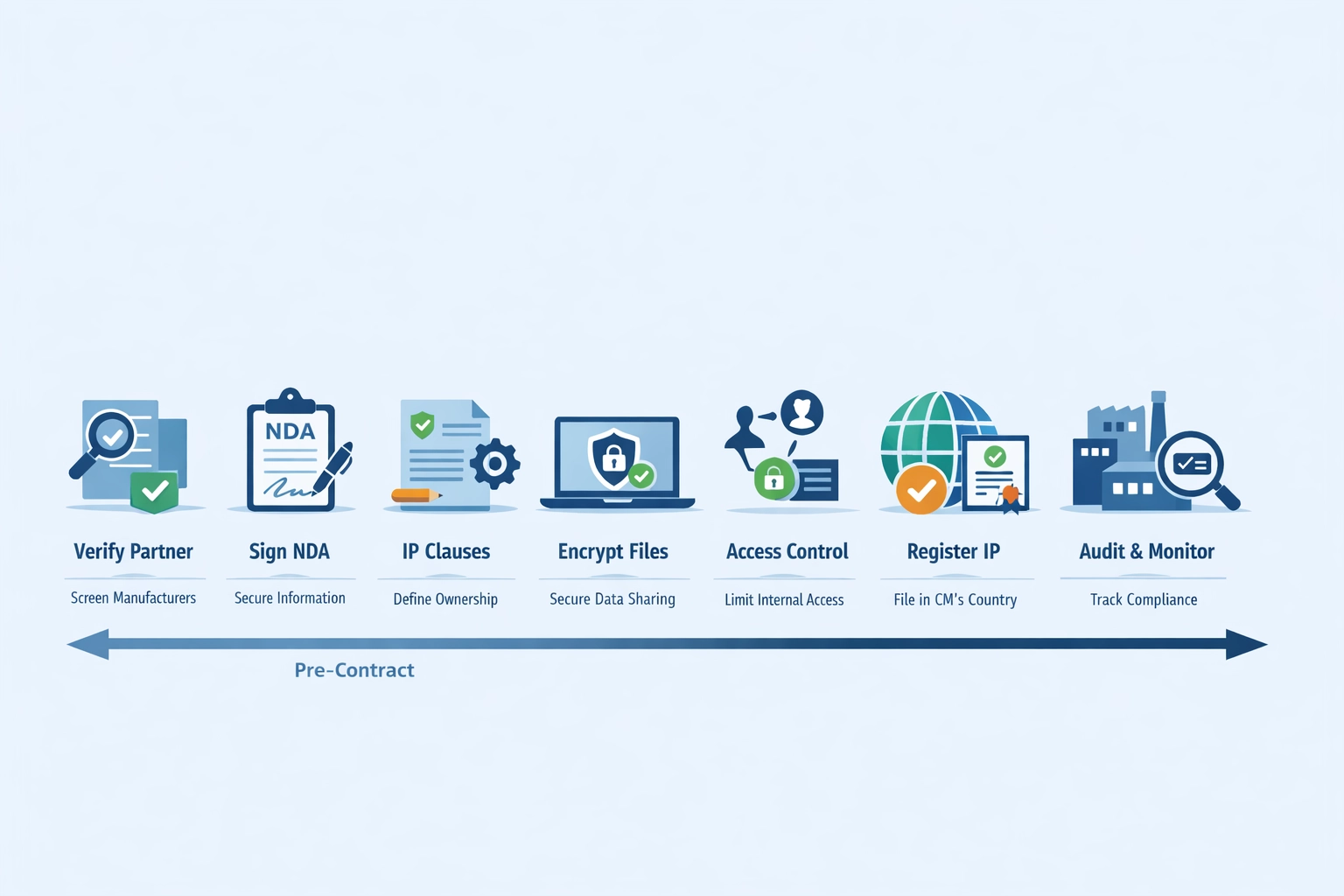
7 The 7 Layers of IP Protection in Contract Manufacturing
Effective IP protection in contract manufacturing is a layered discipline — each layer addresses a different vulnerability in the outsourcing lifecycle. Missing any single layer creates an exploitable gap.
✅
Layer 1 — Partner Verification Before First Disclosure
Verify the manufacturing partner’s legal identity, registration, compliance status, and business legitimacy before sharing any product information. Use a platform like GTsetu’s verified partner network where every company is pre-vetted before engagement.
Pre-Contract
📄
Layer 2 — NDA Before Any Technical Briefing
Execute a comprehensive mutual NDA before sharing any formulation, design, process, pricing, or market information. The NDA must cover the pre-contract discovery phase — not just the manufacturing agreement period. See our guide on mutual vs. one-way NDAs.
Pre-Contract
📋
Layer 3 — Comprehensive IP Clauses in Manufacturing Agreement
Background IP protection, foreground IP assignment, improvements ownership, tooling title, non-compete, non-circumvention, and return/destruction obligations — all drafted with local legal counsel and tailored to the specific jurisdiction.
Contractual
🔐
Layer 4 — Staged and Encrypted Information Disclosure
Share information in stages proportional to the trust established — general product brief first, detailed formulation only after NDA and contract execution. All file sharing via encrypted channels; no email attachments for sensitive technical files. Use GTsetu’s encrypted document workspace for secure technical exchange.
Operational
👤
Layer 5 — Need-to-Know Access Controls
Within the CM’s organisation, restrict access to your proprietary information to named, necessary individuals only. The production engineer needs the manufacturing process parameters; the sales team does not. Role-based access within a secure platform prevents the most common internal leak vector.
Operational
🏛️
Layer 6 — Proactive IP Registration in CM’s Jurisdiction
Register patents, trademarks, and design rights in the country where your CM operates — before engaging them. In first-to-file jurisdictions like China, early registration is the only reliable protection against the CM registering your IP in their own name. Also consider registering the CM’s country as a priority jurisdiction in your international IP filing strategy.
Legal
📋
Layer 7 — Audit Trail and Ongoing Monitoring
Maintain complete records of what IP was shared, when, and with whom — including access logs from any secure collaboration platform. Conduct periodic audits of the CM’s production records and quality documentation. Monitor IP registries in the CM’s jurisdiction for any filings that replicate your assets.
Compliance
SECTION 8
8 Cross-Border IP Risks — Jurisdiction-Specific Considerations
Cross-border contract manufacturing introduces IP risks that domestic outsourcing does not. Each country’s legal system approaches IP ownership, trade secret protection, and enforcement differently — often in ways that disadvantage the foreign brand owner.
Jurisdiction
Default IP Ownership Rule (Employment/Contractor)
Trade Secret Law
Key Risk for Foreign Brand Owners
Recommended Mitigation
China
Employer/client owns work-for-hire IP if agreement specifies; otherwise creator may have rights
Anti-Unfair Competition Law provides some protection but enforcement is variable
First-to-file patents and trademarks; CM can register your IP in China before you do
Register patents and trademarks in China before engaging any CM; explicit IP assignment in local-language contract
India
Contract worker IP defaults to creator; employment IP goes to employer — contractor relationship is ambiguous
Reasonable protection under contract law; no standalone trade secret statute
Contractor status means CM may own IP created without explicit assignment
Explicit assignment clause; register design patents under Designs Act 2000 before production
EU Member States
Generally employee/commissioned work goes to employer if within scope; independent contractor retains rights
Strong — EU Trade Secrets Directive 2016 provides robust framework
GDPR applies to any personal data in technical documentation or communications
Explicit assignment; GDPR-compliant data sharing protocols; local counsel for country-specific variations
United States
Work-for-hire doctrine may apply; but independent contractors generally own their work unless explicit written assignment
Defend Trade Secrets Act (DTSA) provides federal protection
Written assignment required — verbal agreements insufficient for IP transfer
Comprehensive written assignment in manufacturing agreement; register trade secrets as trade secrets before disclosure
Southeast Asia (Thailand, Vietnam, Indonesia)
Highly variable — each country has distinct IP statutes; work-for-hire rules differ
Generally weaker enforcement infrastructure than EU/US
Enforcement of foreign judgments may require separate local proceedings
International arbitration clause (Singapore SIAC recommended); strong pre-contract NDA; local legal registration of key IP
🌍 Global IP Filing Strategy
If you are sourcing from manufacturers in multiple countries, consider filing under the PCT (Patent Cooperation Treaty) for patents and the Madrid Protocol for trademarks — both allow you to seek protection in multiple jurisdictions from a single application. This is significantly more cost-effective than filing country-by-country and ensures coverage in your CM’s jurisdiction before production begins. For cross-border partnership structures, also see our guides on global expansion advantages and disadvantages and cross-border business partnerships.
SECTION 9
9 Protecting IP Before the Contract Is Signed
The period between first contact with a prospective CM and the signing of the manufacturing agreement is the highest-risk phase for IP — and the least protected. During this phase, brand owners routinely share product concepts, formulations, technical briefs, and commercial targets with multiple prospective manufacturers, most without any formal confidentiality protection in place.
What Happens in the Pre-Contract Phase
Pre-Contract Activity
IP Typically Disclosed
Protection Required
Most Common Mistake
Initial outreach / RFQ
Product category, general specifications, target volume
Anonymous discovery mode — don’t reveal company identity prematurely
Sending branded RFQ with company name, logo, and product details before vetting the CM
Capability assessment
More detailed product requirements, quality standards
NDA executed before detailed briefing begins
Sharing detailed product brief to “shortlist” manufacturers before NDA is signed
Factory visit / audit
Full technical specifications to evaluate production capability
NDA signed; limited to essential technical reviewers on CM side
Walking a factory team through your full production process during a site visit with no NDA
Sample development
Full formulation, process parameters, quality specifications
NDA + sample agreement specifying IP ownership of samples and moulds
Sharing full formulation for sample development with no contract in place — CM can produce and sell samples to competitors
Revealing target price, distribution strategy, and customer base before agreement is finalised
The safest pre-contract approach follows the staged disclosure principle: share only what is absolutely necessary to assess fit at each stage, never share the complete picture before the NDA is signed, and use anonymous discovery tools during the initial search phase so your market intent stays private. This is exactly how GTsetu’s partner discovery platform works — connecting brand owners with verified manufacturing and distribution partners through a privacy-first, NDA-first engagement flow.
SECTION 10
10 How GTsetu Protects Your IP from First Partner Contact
🔐 Platform Spotlight — GTsetu
Find Verified Manufacturing Partners Without Leaking Your IP
GTsetu was built to solve the exact problem that causes most pre-contract IP losses: brand owners sharing sensitive product information with unverified, unknown manufacturers during the discovery phase. Every feature is designed around one principle — your IP should be protected from the first interaction, not just after the contract is signed.
🏛️
Multi-Layer CM Verification
Business registration, tax compliance, manufacturing licences, export certifications, and authority letters — all reviewed before any company joins the network. No unverified CMs in the pool.
🕵️
Anonymous Discovery
Browse verified manufacturer profiles across 100+ countries without revealing your company name, product category, or market interest. Your IP starts protected from search result one.
📄
NDA-First Engagement
Built-in NDA workflow is triggered before any sensitive information can be exchanged. Digital signatures with timestamps and full audit trail — the pre-contract phase is legally protected.
🔐
Encrypted Document Workspace
Technical files, formulations, and specifications shared via AES-256 encrypted workspace — never via open email or unprotected file links. Every access event is logged.
👤
Role-Based Access Controls
Define exactly which individuals on the CM’s team can access which documents. Limit formulation access to production leads; prevent commercial teams from seeing technical specs.
📋
Full Audit Trail
Every access event, document view, message, and NDA signature is logged with timestamp and user identity — providing legal evidence if a pre-contract or post-contract IP dispute arises.
🌍
100+ Countries
Verified manufacturing partner network spanning Asia, Middle East, Europe, Africa, Australia, and the Americas — with jurisdiction-specific compliance profiles.
🚫
Zero Broker Commission
GTsetu never takes a success fee or percentage of your contract value. Your manufacturing economics remain entirely between you and your partner.
GTsetu vs. Standard Manufacturer Discovery — IP Security Comparison
IP Security DimensionGTsetuTrade Fairs / Cold Outreach / Directories
CM identity verified before any disclosure
✓ Mandatory — multi-layer verification
✗ None — trust on faith
Your identity protected during search
✓ Anonymous browsing as default
✗ Exposed from first email or business card
NDA before any technical briefing
✓ Built-in workflow — structural requirement
✗ Frequently skipped or handled ad-hoc
Technical file encryption
✓ AES-256 encrypted workspace
✗ Email attachments — unencrypted
Access log of who received your IP
✓ Automated, timestamped, downloadable
✗ No record — freely forwarded
Risk of engaging fraudulent CM
✓ Eliminated — all companies pre-vetted
✗ High — no identity verification
Sub-contractor disclosure control
✓ Sub-contractor restrictions in verified profiles
✗ Unknown — no visibility
Commission on partnership formed
✓ Zero — always
~ Agents / brokers charge 5–15%
SECTION 11
11 Red Flags in Contract Manufacturing Agreements
When reviewing a contract manufacturing agreement — whether presented by the CM or drafted by your team — these are the specific provisions (or absences) that should trigger immediate legal review before signing.
🚩
No IP Ownership Clause at All
The agreement is silent on IP — no mention of who owns what. This leaves all questions of IP ownership to be resolved by the default rules of the governing jurisdiction, which frequently favour the CM.
🚩
“License” Instead of “Assignment” for Foreground IP
The CM agrees to “license” you the right to use IP they create for your product, rather than assigning full ownership. This means the CM retains title and may license the same IP to others after the agreement ends.
🚩
No Tooling Ownership Provision
The agreement does not specify who owns moulds, dies, and tooling created for your product. The CM can hold these assets — which may cost hundreds of thousands to replace — as leverage in commercial disputes.
🚩
No Improvements Clause
The agreement covers only pre-existing IP but says nothing about who owns improvements developed during production. This is the most frequently litigated IP gap in manufacturing contracts.
🚩
Confidentiality Duration Less Than 3 Years
An NDA or confidentiality clause that expires at contract termination or less than 3 years post-termination leaves your formulas and processes unprotected exactly when the CM — now your competitor’s supplier — is most likely to misuse them.
🚩
No Sub-Contractor Restriction
The CM can freely sub-contract your production — and share your IP — with third parties without your knowledge or consent. Your confidentiality agreement covers only the CM, not their sub-contractors.
🚩
No Non-Compete Post-Termination
The CM can immediately begin producing a competing product — using process knowledge, production parameters, and formulation learnings gained from your relationship — the day after the contract ends.
🚩
Local Court Jurisdiction Only
Dispute resolution is in the CM’s local court system — which may be inaccessible, unfamiliar, or biased. Cross-border IP disputes settled in local courts can take 5–10 years and rarely favour foreign plaintiffs without a strong local legal team.
IP Protection Checklist for Contract Manufacturing Agreements
Background IP clause protecting pre-existing IP of both parties
Foreground IP full assignment clause for all deliverables and creations
Improvements ownership clause — all improvements to brand owner’s IP assigned to brand owner
Tooling and moulds ownership clause with return/destruction obligation
Comprehensive confidentiality clause surviving termination by 5+ years
Need-to-know restriction on internal access to proprietary information within CM
Sub-contractor restriction — no further disclosure without written consent
Non-compete clause preventing CM from producing competing products post-termination
Non-circumvention clause preventing CM from approaching brand owner’s customers or partners
Return or destruction of all proprietary materials upon termination
International arbitration clause (not local court) for dispute resolution
IP indemnification provision — CM indemnifies brand owner against third-party IP claims arising from CM’s processes
Right to audit — brand owner can inspect CM’s compliance with IP restrictions
Governing law in a neutral, internationally recognised jurisdiction
The Secure IP-Protected Manufacturing Engagement Journey
🔍
Anonymous Discovery
Browse verified CMs without revealing product intent.
Mutual NDA signed before any technical disclosure.
🔐 Legal gate
📁
Staged Disclosure
Technical files shared via encrypted workspace — access logged.
🔐 E2E encrypted
⚖️
IP Clauses Agreed
Assignment, improvements, tooling, non-compete — all documented.
🔐 IP assigned
🏭
Production Begins
Manufacturing starts with IP fully protected from day one.
🔐 Full audit trail
FAQ
? Frequently Asked Questions
Q
Who owns IP created during contract manufacturing?
By default in most jurisdictions, the party who creates the IP holds initial rights — meaning the contract manufacturer may own innovations, process improvements, and product adaptations developed during your engagement, unless a written agreement explicitly assigns ownership to you. This is why a clear foreground IP assignment clause, improvements ownership clause, and tooling title clause in the manufacturing agreement are non-negotiable. Without them, you may lose rights to inventions and enhancements created at your expense.
Q
What is the difference between IP assignment and IP license in contract manufacturing?
An IP assignment permanently transfers all ownership rights from the CM to you — like a sale of rights. A license grants permission to use the IP under defined conditions while the CM retains ownership. In contract manufacturing, brand owners should insist on full assignment for all IP created specifically for their product — formulations, designs, process adaptations, tooling — not merely a license. A license can be revoked, expires, or becomes worthless if the CM enters insolvency. An assignment is permanent and unconditional.
Q
What is background IP and why does it matter in manufacturing agreements?
Background IP is any intellectual property that either party owned before the contract manufacturing relationship began — your formulations, patents, brand assets, and the CM’s existing manufacturing technology and processes. A background IP clause ensures each party retains ownership of their pre-existing IP and that neither party gains rights to the other’s background IP simply by working with it during the engagement. Without this clause, a CM could claim that your formulation — shared with them for production — granted them some rights in that IP through their use of it.
Q
How do you protect trade secrets when outsourcing manufacturing?
Trade secret protection in contract manufacturing requires multiple simultaneous actions: execute a mutual NDA before any technical disclosure (not just in the manufacturing agreement — before the RFQ briefing); implement need-to-know access restrictions limiting your proprietary information to named essential personnel only; use encrypted document sharing rather than email; include non-compete and non-circumvention clauses in the manufacturing agreement; stage disclosure so the most sensitive IP is shared only after trust and legal protection are fully established; and work exclusively with identity-verified manufacturers through a secure platform like GTsetu.
Q
What IP risks are specific to contract manufacturing in China?
China operates a first-to-file patent and trademark system — meaning a Chinese CM can register your invention or brand name in China before you do, and then hold those registrations against you. China’s enforcement of trade secret misappropriation has improved significantly under the 2019 Anti-Unfair Competition Law amendments, but enforcement remains variable and proceedings can be lengthy. Recommended mitigations include: registering your patents (via China CNIPA) and trademarks before engaging any Chinese manufacturer; using local-language contracts with explicit IP assignment clauses; working with verified, reputable manufacturers who have documented IP compliance records; and engaging specialised China IP counsel.
Q
What happens to tooling ownership if the manufacturing contract ends?
Without a tooling ownership clause, custom moulds, dies, and jigs paid for by the brand owner may be legally treated as property of the CM — since they physically possess and created them. Upon contract termination, the CM can refuse to release the tooling, use it to produce for competitors, or demand additional payment for return. A proper tooling clause specifies that all custom tooling is the brand owner’s property upon full payment, must be held in trust by the CM during the contract, and must be returned (or destroyed if return is impractical) within a specified number of days after termination — with the CM providing written certification.
Q
Why is an NDA before the manufacturing contract important?
The pre-contract phase — when you are sharing product briefs, formulations, sample requirements, and technical specifications with prospective manufacturers before any agreement is signed — is typically unprotected. An NDA executed before the first technical briefing creates a legal confidentiality obligation from the moment of first disclosure. Without it, any information you share during RFQ processes, factory assessments, or sample development is unprotected — and if leaked to a competitor before you have a manufacturing agreement in place, you may have no legal recourse. For platform-based partner discovery, GTsetu’s built-in NDA workflow ensures this protection is in place before any sensitive exchange begins. For a deeper understanding of NDA types, see our mutual vs. one-way NDA guide.
Q
How does toll manufacturing affect IP ownership?
In toll manufacturing, the brand owner supplies the raw materials and formula, and the toll manufacturer provides only the processing capacity. IP ownership is generally cleaner — the brand owner supplies and retains the formulation IP, and the toll manufacturer contributes only their equipment and labour. However, any process improvements made by the toll manufacturer, and any tooling specifically created for your product, still require explicit ownership clauses in the toll manufacturing agreement. See our toll manufacturing explained guide for the full contractual framework.
Q
What is the safest way to find contract manufacturers without leaking my product IP?
The safest approach combines anonymous initial discovery (so your company identity and market intent are not exposed during the search), mandatory CM identity verification (so you only engage with legally registered, compliance-verified manufacturers), and NDA-first engagement before any technical information is shared. GTsetu delivers all three: anonymous browsing of a 500+ verified manufacturer network across 100+ countries, multi-layer compliance verification of every company on the platform, and built-in NDA workflows that trigger before sensitive information can be exchanged — with no broker commissions on any partnership formed.
Find Verified Manufacturing Partners — With Your IP Protected from Day One
Join 500+ verified manufacturers and brand owners on GTsetu — the only partner discovery platform with anonymous browsing, built-in NDA workflows, encrypted document sharing, and zero broker fees.
Team GTsetu represents the product, compliance, and research team behind GTsetu, a global B2B collaboration platform built to help companies explore cross-border partnerships with clarity and trust. The team focuses on simplifying early-stage international business discovery by combining structured company profiles, verification-led access, and controlled collaboration workflows.
With a strong emphasis on trust, compliance, and disciplined engagement, Team GTsetu shares insights on global trade, partnerships, and cross-border collaboration, helping businesses make informed decisions before entering deeper commercial discussions.