Why Use an Escrow Agreement in Business?
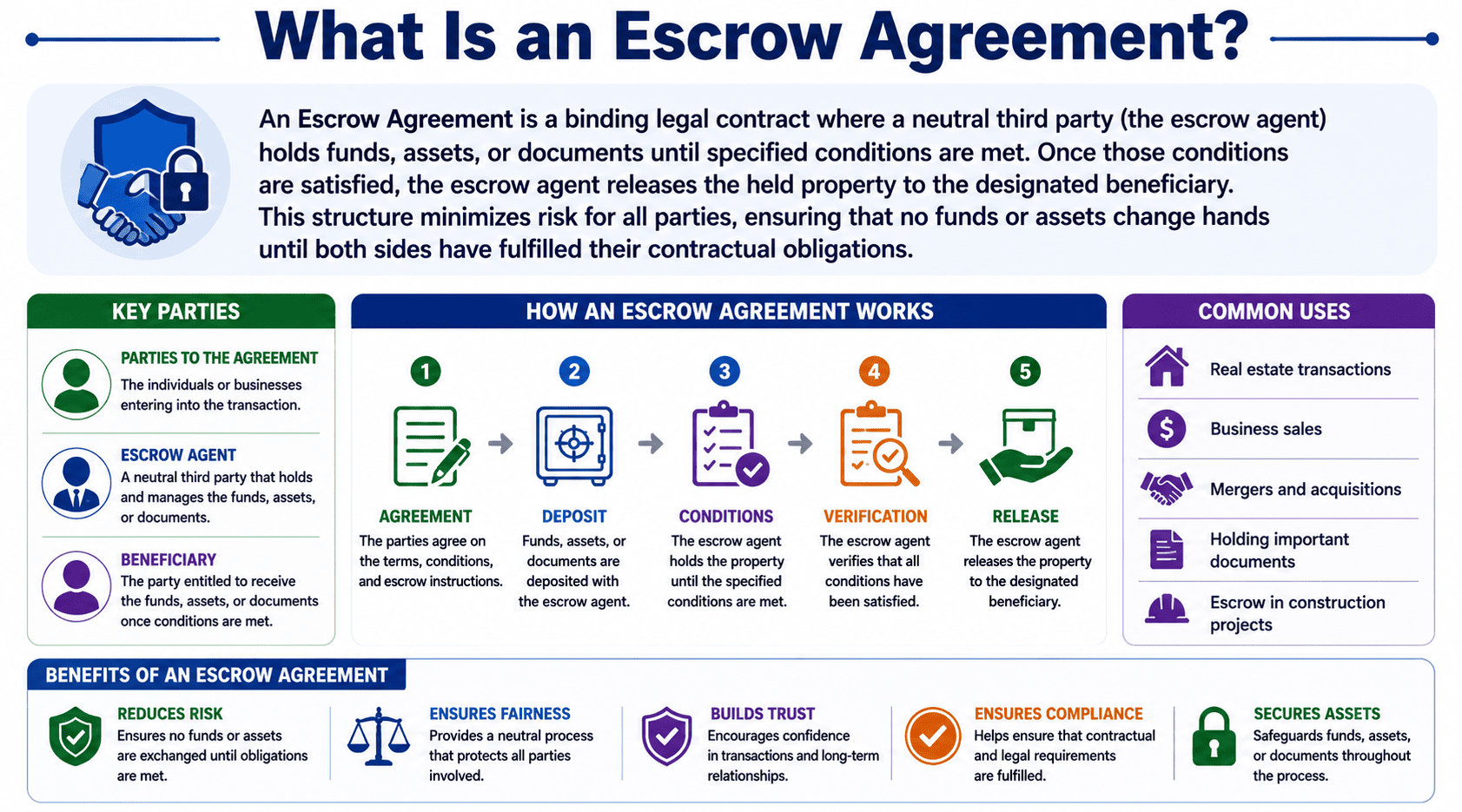
In international trade, M&A, real estate, and software licensing, an Escrow Agreement bridges the gap of trust between parties who may not have an established relationship. The buyer wants assurance that payment only leaves their account when the asset is delivered as promised. The seller wants assurance that the buyer has the funds and will pay once delivery is complete. The escrow agent, typically a bank, title company, or specialised financial institution, holds the asset securely and releases it only when both parties confirm that conditions are met.
Beyond simple payment security, escrow agreements protect against counterparty default, fraud, and performance failures. In a cross-border software source code escrow, for example, the licensee (beneficiary) gains access to the source code only if the licensor (depositor) goes bankrupt or stops supporting the software. In mergers and acquisitions, a portion of the purchase price is often held in escrow for 12–24 months to cover any post-closing indemnification claims.
⚡ Key Principle
An Escrow Agreement is not a sign of distrust, it is a sign of prudent risk management. It provides a neutral, enforceable mechanism that protects both sides, reduces negotiation friction, and allows transactions to proceed that might otherwise stall due to information asymmetry or performance uncertainty.
Three Core Parties
The Three Core Parties in an Escrow Arrangement
🏦
Depositor
The party who places the asset (funds, documents, source code, or other property) into the escrow account. In a real estate purchase, the buyer is the depositor of the earnest money. In a software escrow, the software vendor is the depositor of the source code.
📄
Beneficiary
The party entitled to receive the escrowed asset once the release conditions are met. In a real estate transaction, the seller is the beneficiary of the purchase funds. In an M&A indemnity escrow, the buyer is typically the beneficiary of the holdback funds.
⚖️
Escrow Agent
A neutral, independent third party, usually a bank, trust company, licensed escrow agent, or attorney, who safeguards the asset, verifies condition satisfaction, and executes disbursement exactly as instructed. The escrow agent owes a duty of impartiality to both parties.
Common Types of Escrow
Types of Escrow Agreements by Industry
🏠 Real Estate Escrow
Holds earnest money deposits, purchase funds, and title documents. Common in residential and commercial property transactions, including RERA-mandated escrow accounts in India for real estate projects.
💼 M&A Escrow
A portion of the purchase price (typically 10–20%) is held for 12–24 months to secure indemnification claims, working capital adjustments, or earn-out obligations after closing.
💻 Software Escrow
The software vendor deposits source code with an escrow agent. If the vendor goes bankrupt, stops support, or breaches the license, the agent releases the code to the licensee to maintain the software.
📜 IP Escrow
Protects patents, trademarks, or trade secrets in licensing or R&D collaboration. The IP is released only if the licensee meets payment milestones or the licensor defaults.
How Escrow Works
How an Escrow Agreement Works: Step by Step
01
Agreement Execution
The depositor, beneficiary, and escrow agent sign the Escrow Agreement, defining the asset, release conditions, fees, governing law, and dispute resolution mechanism.
02
Asset Deposit
The depositor transfers the asset (funds, documents, or code) to the escrow agent. The agent verifies receipt and holds the asset in a designated escrow account, separate from its own operating funds.
03
Condition Fulfillment
The beneficiary performs its obligations under the underlying transaction (e.g., delivering goods, providing clear title, completing services).
04
Release Instruction
Once conditions are met, the parties provide joint written release instructions to the escrow agent, or, if the agreement allows, one party provides a signed release and the other has a set period to object.
05
Disbursement
The escrow agent disburses the asset to the beneficiary as instructed (e.g., wiring funds to seller, releasing source code to licensee, or delivering title documents).
Key Legal Clauses
Critical Clauses in an Escrow Agreement
1
Conditions of Release
The most important clause, defines precisely what must happen for the escrow agent to release the asset. Conditions must be objective, verifiable, and avoid ambiguous terms like “satisfactory completion”.
2
Escrow Instructions
Details the type, amount, and form of the escrowed property. For software escrow, this includes the verification and update frequency of deposited source code.
3
Fees and Expenses
Specifies setup fees, annual administration fees, disbursement fees, and who pays (buyer, seller, or split). The escrow agent typically has a lien on escrowed funds for unpaid fees.
4
Dispute Resolution
Defines how the escrow agent should act if parties disagree on condition satisfaction, usually interpleader (depositing assets with a court) or binding arbitration.
5
Termination and Expiry
Sets a deadline for condition satisfaction. If unmet by that date, the agreement may require return of assets to depositor or extension by mutual written consent.
6
Governing Law & Jurisdiction
Critical in cross-border escrows, specifies which country’s law governs the agreement and where disputes will be litigated or arbitrated.
✨ Practical Guidance
Release conditions must be written as objective, binary triggers, not subjective judgments. Avoid “to the reasonable satisfaction of the buyer” unless the escrow agent has clear, enforceable guidelines. For international escrows, always specify the currency, exchange rate mechanism (if any), and bank clearance timelines for cross-border wire transfers.
Risks & Limitations
Potential Risks and Misunderstandings
⚠️
Ambiguous Release Conditions
Vague terms like “mutual satisfaction” or “successful completion” leave room for dispute. If parties disagree, the escrow agent cannot decide, the asset remains frozen or requires costly interpleader action.
⚠️
Insolvency of the Escrow Agent
While escrow accounts are typically segregated from the agent’s own funds, failure of a non-bank escrow agent can complicate recovery. Always use a regulated, insured financial institution as escrow agent.
⚠️
Incomplete Documentation
Missing signature pages, incomplete tax forms (W-9/W-8), or incorrect wire instructions cause delays in disbursement. Always verify all exhibits and authorisation certificates before funding.
⚠️
No Expiry or Sunset Provision
Without a deadline, escrowed assets can remain frozen indefinitely if one party refuses to agree on release. Always include a termination date and fallback distribution instruction.
⚠️
Overly Broad Indemnification
Escrow agents often require broad indemnification clauses. Depositors and beneficiaries should ensure indemnity is proportionate and excludes gross negligence or wilful misconduct by the agent.
FAQ
Frequently Asked Questions
QIs an Escrow Agreement legally binding?
Yes, a properly executed Escrow Agreement is a fully binding legal contract. It creates enforceable obligations for all three parties. If the escrow agent wrongfully releases funds, or if a party fails to meet release conditions, the injured party can sue for breach of contract and seek damages or specific performance. The binding nature applies equally to the escrow agent’s duty to follow written instructions precisely.
QWho typically pays the escrow agent fees?
Fee structures vary by transaction type and negotiation. Common arrangements include: split equally between depositor and beneficiary, paid entirely by the party requesting the escrow, or paid from the escrowed funds themselves. For real estate, fees are often split. For M&A indemnity escrows, the seller (depositor) typically pays. Always confirm fee allocation before signing, fees include setup, annual administration, disbursement, and sometimes early termination charges.
QWhat happens if release conditions are never met?
The Escrow Agreement should specify the outcome. Common provisions include: (i) automatic return of escrowed property to depositor after a stated deadline; (ii) extension of the deadline by mutual written agreement; (iii) dispute resolution clause requiring arbitration or court determination; or (iv) interpleader, where the escrow agent deposits the property with a court, pays its fees from the deposit, and withdraws from the agreement. Without a clear provision, assets can remain frozen indefinitely while parties litigate.
QCan an Escrow Agreement be terminated early?
Yes, but only as provided in the agreement. Termination typically requires either (i) mutual written consent of all parties (depositor, beneficiary, and escrow agent), (ii) satisfaction of release conditions and full disbursement, or (iii) a court order. Unilateral termination is generally not permitted unless the agreement explicitly grants a party that right (e.g., a “no-fault” termination window before funding). Early termination may still trigger fee obligations.
QIs an escrow agent a fiduciary?
This depends on the agreement and jurisdiction. Most commercial escrow agreements explicitly state the agent acts as a “stakeholder” or “neutral depositary,” not as a fiduciary. The agent’s duties are defined contractually and are ministerial (following written instructions). However, some courts have found escrow agents owe limited fiduciary duties, such as safekeeping assets and acting impartially. To avoid ambiguity, the agreement should clearly state the agent’s role and liability standard.