Why Intellectual Property Matters in Global Business
Intellectual property is often a company’s most valuable intangible asset. In international trade, IP rights enable businesses to protect innovations, brands, and creative works from unauthorized use across borders. Without IP protection, competitors could freely copy products, replicate brands, or exploit proprietary information, eroding competitive advantage and reducing incentives to invest in research, development, and creative expression. For exporters, distributors, and partners, understanding IP is essential to safeguarding market position and ensuring that the value created by innovation remains with its rightful owner.
⚡ Core Insight
IP rights are territorial: a U.S. patent or trademark provides no protection in China, the EU, or Brazil unless you separately file for protection in those jurisdictions. International treaties simplify the process but do not create a single global IP right.
The Four Pillars of IP
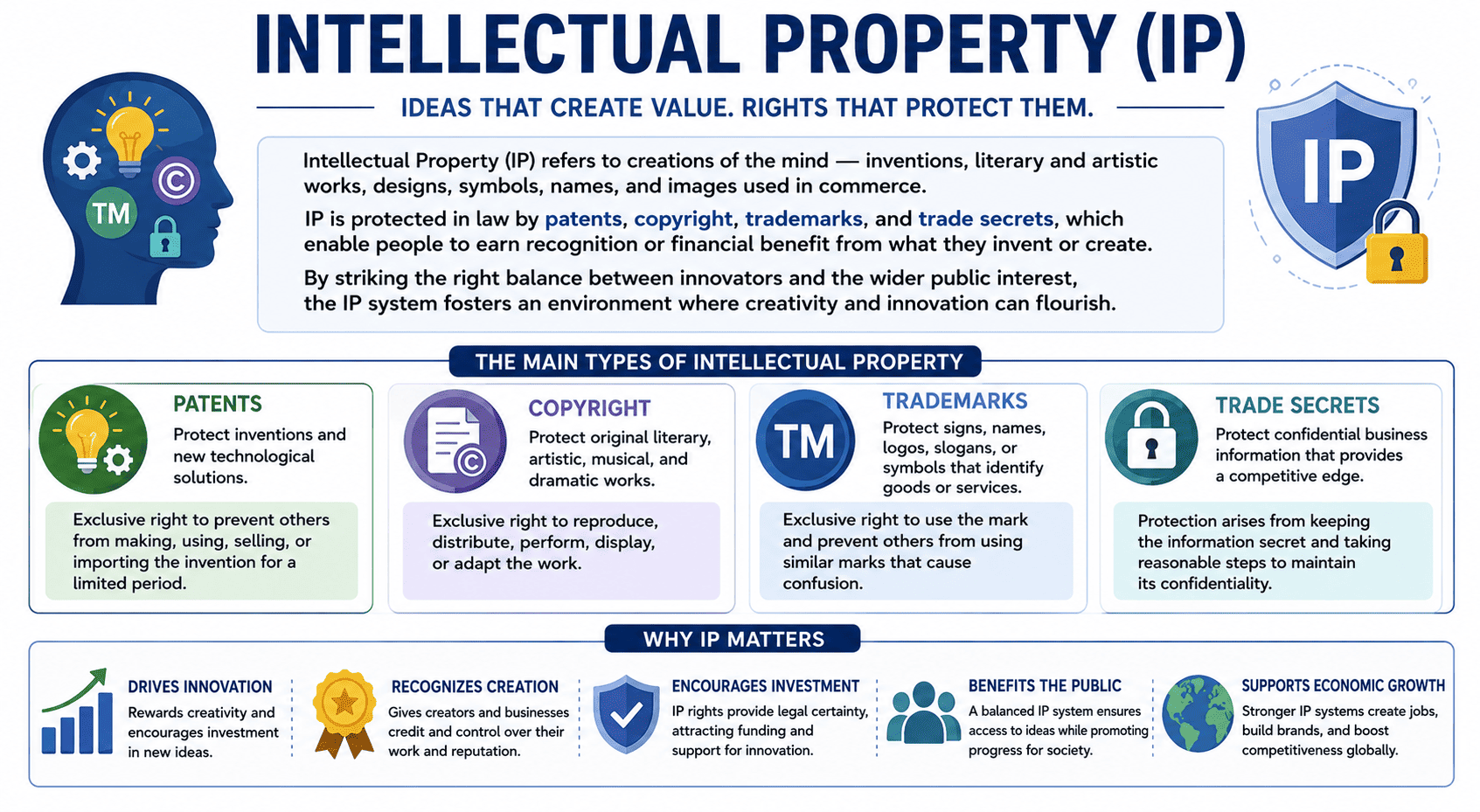
The Four Main Types of Intellectual Property
🔬
Patents
Exclusive rights granted for an invention, a product or process that provides a new way of doing something or offers a new technical solution. Utility patents protect how something works; design patents protect how it looks.
✔️ Duration: 20 years from filing date
✔️ Requires novelty, usefulness, non-obviousness
©️
Copyright
Protects original works of authorship fixed in a tangible medium: books, music, paintings, sculptures, films, software, architecture, and photographs. The creator has exclusive rights to reproduce, distribute, and perform the work.
✔️ Duration: Life of author + 70 years
✔️ Automatic upon fixation, but registration enables enforcement
™️
Trademarks
Any word, phrase, symbol, design, or combination that identifies and distinguishes the source of goods or services. Trademarks build brand recognition and prevent consumer confusion.
✔️ Duration: Indefinite (renew every 10 years)
✔️ Registered ® vs unregistered ™ rights
🤫
Trade Secrets
Confidential business information that provides a competitive edge: formulas, manufacturing processes, customer lists, recipes. No registration; protection lasts as long as secrecy is maintained through reasonable safeguards.
✔️ Famous examples: Coca-Cola formula, KFC recipe
✔️ Protected against misappropriation by law
Protection Duration & Scope
How IP Rights Compare: Duration, Scope, and Requirements
| IP Type | What Is Protected | Term of Protection | Registration Required? |
|---|
| Patent (Utility) | Inventions, processes, machines, compositions of matter | 20 years from filing | Yes (USPTO or national office) |
| Patent (Design) | Ornamental design of a functional item | 15 years (US) / 25 years (EU) | Yes |
| Copyright | Original literary, artistic, musical, software works | Life + 70 years (individuals) | No, but recommended for litigation |
| Trademark | Brand names, logos, slogans, sounds, colors | 10 years, renewable indefinitely | Yes for federal registration (®) |
| Trade Secret | Confidential formulas, methods, customer data | As long as secret & protected | No (secrecy is the protection) |
🌍 International Protection Strategies
Use the Patent Cooperation Treaty (PCT) to file one international patent application covering 150+ countries. The Madrid Protocol simplifies international trademark registration. Copyright is automatically protected in all Berne Convention member countries (181+ nations). Trade secrets require local confidentiality measures in each jurisdiction.
How to Protect Your IP
Practical Steps to Protect Intellectual Property
01
Identify Your IP Assets
Conduct an IP audit: catalog patents, trademarks, copyrights, trade secrets, domain names, and proprietary data. Understand what you own and where it creates value.
02
File for Protection Early (First-to-File Rule)
Most countries follow a “first-to-file” system. File patent and trademark applications before any public disclosure or launch. In the U.S., you have a 12-month grace period; elsewhere, disclosure before filing can destroy rights.
03
Use NDAs and Confidentiality Agreements
Before sharing trade secrets or proprietary information with partners, employees, or investors, require signed non-disclosure agreements (NDAs) with binding confidentiality clauses.
04
Register in Key Markets
Identify countries where you manufacture, distribute, or sell. File for IP protection in those jurisdictions. Use the PCT, Madrid System, or regional offices (EUIPO) for efficiency.
05
Monitor and Enforce Your Rights
Watch for infringement via online marketplaces, trade shows, and customs seizures. Register IP with customs authorities. Send cease-and-desist letters or pursue legal action when necessary.
FAQ
Frequently Asked Questions
QWhat are the four main types of intellectual property?
The four main types of intellectual property are: patents (inventions and processes), copyright (original works of authorship like books, music, software), trademarks (brand names, logos, slogans), and trade secrets (confidential business information that provides a competitive edge). Each type has different requirements, duration, and legal protection mechanisms.
QIs my IP protected internationally if I register it in the United States?
Generally, no. IP rights are territorial, a U.S. patent, trademark, or copyright provides protection only within the United States. For international protection, you must file for IP rights in each country where you seek protection. However, treaties like the Patent Cooperation Treaty (PCT) for patents, the Madrid Protocol for trademarks, and the Berne Convention for copyright provide streamlined processes for seeking protection in multiple countries from a single application.
QHow long does IP protection last?
Patents generally last 20 years from the filing date. Copyright lasts for the life of the author plus 70 years (for works created after January 1, 1978). For anonymous works or works made for hire, copyright lasts 95 years from publication or 120 years from creation, whichever is shorter. Trademarks can last indefinitely as long as they are continuously used in commerce and renewed every 10 years. Trade secrets last as long as the information remains secret and reasonable protections are maintained.
QWhat is the difference between a trademark and a copyright?
A trademark protects brand identifiers, names, logos, slogans, that distinguish goods or services in the marketplace. Copyright protects original creative expressions fixed in a tangible medium, such as books, songs, artwork, software code, and photographs. A single product may involve both: a software company holds copyright in its code and a trademark in its brand name and logo.