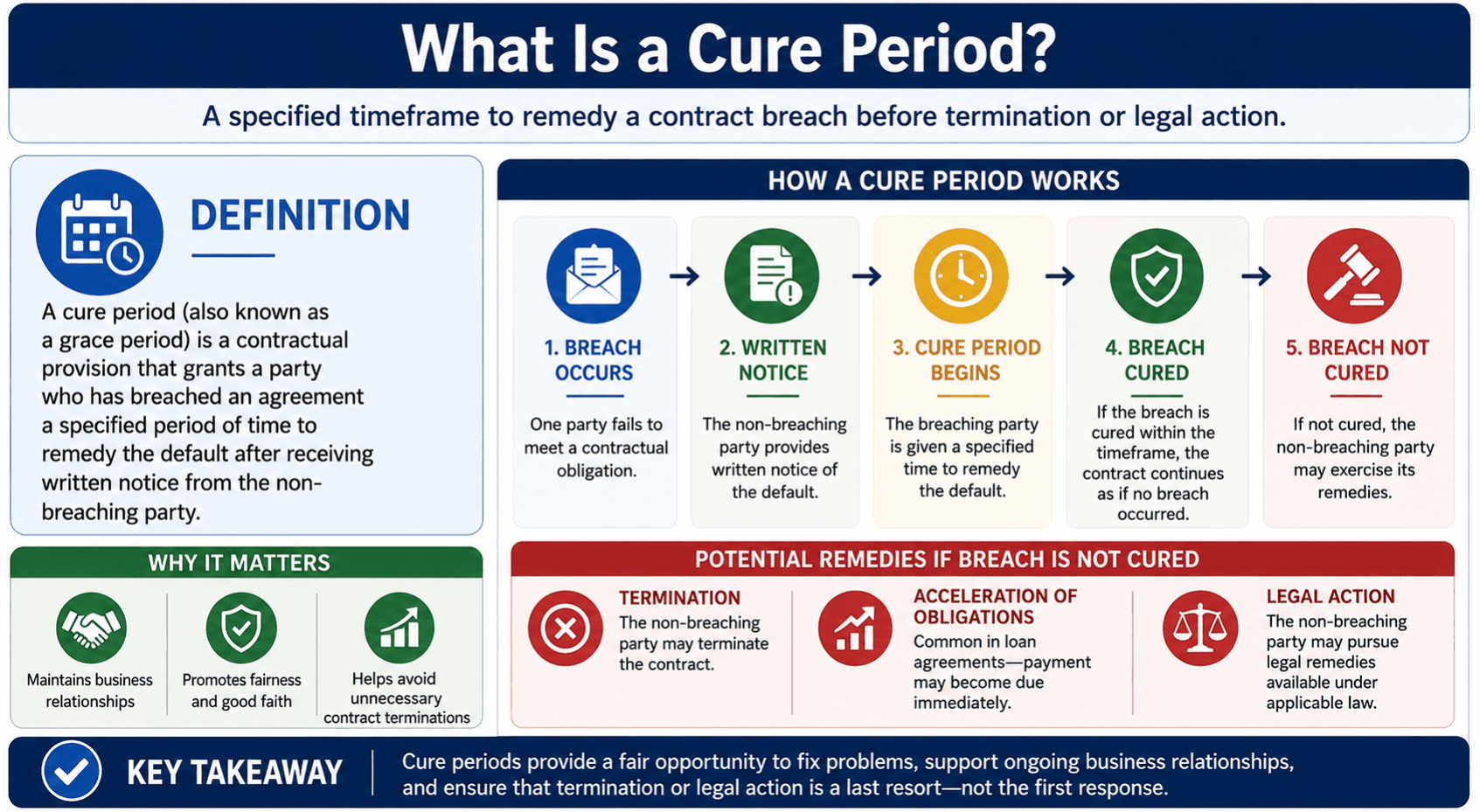
Why Is a Cure Period Essential in Commercial Contracts?
In any long‑term business relationship, small mistakes or delays are inevitable. A missed payment, a late delivery, or a temporary service outage does not necessarily mean either party wants to end the contract. Without a cure period, a single minor breach could give the non‑breaching party an immediate right to terminate, a result that is often disproportionate and commercially unreasonable.
The cure period solves this problem by introducing a proportional response to non‑material breaches. It gives the breaching party a fair chance to correct the issue before any drastic action is taken. This protects the underlying business relationship, reduces the risk of opportunistic termination, and encourages good‐faith cooperation. In long‑term agreements such as supply contracts, leases, and service level agreements (SLAs), a cure period is considered a standard fair practice clause.
The cure period also reduces litigation and dispute costs. Instead of terminating a contract and then fighting over damages, the parties have a structured opportunity to resolve the problem amicably. This is particularly important in high‑value international contracts, where termination can disrupt supply chains and trigger cross‑border claims.
Common Contract Types Where a Cure Period Appears
🏗️
Construction Contracts
Allows contractors to correct defective workmanship or delays before the owner can terminate or hire a replacement contractor. Typical cure period: 10 to 30 days.
🏢
Lease Agreements (Commercial & Residential)
Gives tenants time to pay overdue rent or remedy property damage before eviction proceedings. Typical cure period: 5 to 30 days depending on jurisdiction.
📦
Supply & Procurement Contracts
Allows suppliers to replace defective goods or remedy late deliveries before the buyer cancels the order. Often tied to materiality thresholds.
💳
Loan & Credit Agreements
Gives borrowers a grace period to cure a payment default or covenant breach before the lender can accelerate the loan. Often 10 to 30 days for monetary defaults.
📈
Stock Exchange Listing Agreements
Listed companies receive cure periods (often 6 months) to regain compliance with share price or filing requirements before delisting.
⚙️
Service Level Agreements (SLAs)
Service providers receive cure periods to restore performance to agreed levels before service credits or termination apply.
⚡ Key Principle
A cure period does not apply automatically. The non‑breaching party must typically provide written notice of the breach, specifying the nature of the default and the timeframe in which it must be cured. The cure period begins only after that notice is received. Contracts should always specify the notice requirement and the method of delivery (email, registered mail, etc.).
Typical Cure Periods
Typical Cure Periods: Initial and Additional Periods
The length of a cure period depends on the type of breach and the nature of the contract. Some breaches can be cured quickly (e.g., a missed payment), while others require more time (e.g., correcting construction defects or filing delinquent financial reports). Many contracts also provide for an additional cure period in specific circumstances, such as stock exchange listing requirements.
⏱️ Initial Cure Period
- Payment defaults: 5–30 days (commercial), 3–15 days (residential lease)
- Service level breaches: 10–30 days to restore performance
- Construction defects: 30–60 days for non‑material defects
- Listing compliance (share price): 6 calendar months (NYSE, Nasdaq)
- Filing delinquencies (SEC reports): 6 months initial cure period (NYSE)
- Loan covenant breaches: 30–60 days (non‑monetary), 10–30 days (monetary)
🔄 Additional Cure Period
- Granted at the discretion of the exchange or non‑breaching party
- Stock exchange filing delinquency: up to an additional 6 months
- Loan agreements: may permit one or two extensions if borrower is acting in good faith
- Construction contracts: sometimes allows one extension if cure is substantially underway
- Not an automatic right, must be explicitly provided for in the contract or exercised at the sole discretion of the non‑breaching party
- Additional cure periods are often subject to stricter conditions (e.g., progress reports, no further defaults)
✨ Drafting Tip, IRS Loan Cure Period
For retirement plan loans (e.g., 401(k) loans), the Internal Revenue Code provides a cure period that begins on the date of the missed payment and ends on the last day of the following calendar quarter. For example, a payment missed on February 2 must be cured by June 30. If not cured, the outstanding loan balance is treated as a deemed distribution, subject to income tax and potential penalties.
Cure Period vs Notice Period
Cure Period vs Notice Period: Clearing the Confusion
These two terms are often used together, but they serve different functions. Understanding the distinction is critical when drafting or enforcing a contract.
| Aspect | Cure Period | Notice Period |
|---|
| Purpose | Gives the breaching party time to fix the breach | Simply informs the breaching party that a breach has occurred (or gives notice of termination) |
| Action required | Remediation, payment, repair, or other corrective action | No action other than receipt of the notice |
| Begins when | After the non‑breaching party provides notice of the breach (and cure period is typically stated in the notice) | Upon delivery of the notice (or after a fixed period such as 30 days’ notice of termination) |
| Consequence of expiry | If breach not cured, non‑breaching party may terminate or pursue remedies | After notice period expires, a legal event occurs (e.g., termination, acceleration, right to sue) |
| Typical length | 5–30 days (commercial), up to 6 months (listing compliance) | 10–90 days (notice to terminate a contract without cause) |
| Example clause | “Buyer shall provide Seller with written notice of any defect. Seller shall have 15 days from receipt to cure.” | “Either party may terminate this agreement upon 30 days’ written notice to the other party.” |
📋 Practical Example
A software vendor fails to meet an uptime commitment of 99.9%. The customer sends a notice of breach demanding cure. The contract provides a 20‑day cure period. During those 20 days, the vendor works to restore service. If service is restored on day 18, the breach is cured and the contract continues. If not, the customer may terminate the agreement on day 21. The notice period (the 20 days) is the cure period, the two terms overlap. The key difference is that a cure period requires action; a standalone notice period does not.
How a Cure Period Works
How a Cure Period Works, Step by Step
The cure period is not automatic. It typically requires the non‑breaching party to give formal notice. The following steps illustrate the standard workflow in most commercial contracts.
01
Breach Occurs
The breaching party fails to perform a contractual obligation, for example, fails to pay an invoice on time, delivers non‑conforming goods, or falls below a service level standard.
02
Non‑Breaching Party Gives Notice of Default
The non‑breaching party sends a written notice (email, letter, or through a contract management system) specifying: (a) the nature of the breach, (b) the required cure, and (c) the cure period duration (e.g., “You have 15 days from receipt of this notice to cure”).
03
Cure Period Runs
The clock starts on the date the notice is received (or as specified in the contract). The breaching party takes corrective action. In some contracts, the cure period may be extended if the breach is complex and the breaching party is acting diligently.
04
Two Possible Outcomes
If cured within period: The contract continues as if no breach occurred. The non‑breaching party cannot terminate based on that breach (though it may still claim damages if the contract allows). If not cured: The non‑breaching party may exercise its remedies, termination, acceleration (loan), claim for damages, or other contractual rights.
05
Potential Additional Cure Period
If the contract provides for it, the non‑breaching party (or an exchange, in listing contexts) may, in its sole discretion, grant an additional cure period. This is common in stock exchange compliance where companies need more time to file delinquent reports.
Drafting a Cure Period Clause
Essential Elements of a Well‑Drafted Cure Period Clause
A well‑drafted cure period clause leaves no room for ambiguity. It must specify what triggers the cure period, how notice is given, how long the period lasts, what constitutes a cure, and what happens if cure fails.
Standard Cure Period Clause (General)
In the event that either party fails to perform any material obligation under this Agreement (a "Default"), the non‑breaching party shall provide written notice of such Default to the breaching party. The breaching party shall have fifteen (15) days from the date of receipt of such notice to cure the Default. If the Default is cured within such period, this Agreement shall continue in full force and effect. If the Default is not cured within such period, the non‑breaching party may terminate this Agreement or pursue any other remedies available at law or in equity.
Loan Agreement Cure Period (Monetary Default)
Any failure by Borrower to pay any amount due under this Agreement shall constitute an immediate Default. Borrower shall have ten (10) business days from written notice of such failure to cure by paying the full outstanding amount. If Borrower cures within such period, no Default shall be deemed to have occurred for purposes of acceleration or enforcement. Failure to cure shall entitle Lender to accelerate all outstanding principal and accrued interest.
Stock Exchange Cure Period (Share Price)
Pursuant to Section 802.01C of the NYSE Listed Company Manual, the Company has a Cure Period of six (6) months following receipt of notice to regain compliance with the minimum share price requirement of US$1.00. The Company may regain compliance at any time during the Cure Period if on the last trading day of any calendar month the Company has a closing share price of at least US$1.00 and an average closing share price of at least US$1.00 over the 30 trading‑day period ending on that date.
Lease Agreement Cure Period (Non‑Payment)
If Tenant fails to pay Rent when due, Landlord shall provide Tenant with written notice of such failure. Tenant shall have five (5) days from receipt of such notice to pay the outstanding Rent in full. If Tenant pays within such five‑day period, this Lease shall continue in full force and no late fee shall be assessed. If Tenant fails to pay within the cure period, Landlord may terminate this Lease and pursue eviction proceedings.
✨ Key Drafting Considerations
When drafting a cure period clause, always specify: (1) whether the cure period applies to all breaches or only material ones, (2) whether notice is required and the permitted methods of delivery, (3) the exact duration (calendar days or business days), (4) whether the breach recurs (repeat default), many contracts provide for a shorter or no cure period for repeat defaults, and (5) what happens if the cure period expires on a weekend or holiday.
Common Pitfalls
Common Pitfalls and How to Avoid Them
Poorly drafted cure period clauses are a common source of disputes. The following pitfalls are consistently identified by contract lawyers and courts.
🚩
Failing to Require Written Notice
If the contract does not require written notice of the breach, the cure period may never begin. The breaching party could argue that it was never notified. Always state: “The non‑breaching party shall provide written notice specifying the nature of the Default.”
🚩
Ambiguous Cure Period Duration
Phrases like “a reasonable time” or “as soon as practicable” are ambiguous and lead to disputes. State a fixed number of days (e.g., “15 calendar days” or “10 business days”). For complex breaches, consider tiered cure periods (e.g., 5 days for payment defaults, 30 days for performance issues).
🚩
No Cure Period for Non‑Material Breaches
Some contracts require a cure period only for “material breaches.” This invites litigation over whether a breach is material. Consider requiring a cure period for all breaches, with shorter periods for non‑material ones, to avoid threshold disputes.
🚩
No Cure Period for Repeat Defaults
A party that repeatedly commits the same breach may abuse the cure period. Draft an exception: “If the same Default has occurred two or more times in any twelve‑month period, no cure period shall apply to any subsequent occurrence.”
🚩
Failure to Define What Constitutes “Cure”
Is a partial payment a cure? Does a promise to fix count, or must the fix be completed? Define cure clearly. For payment defaults: “payment in full.” For performance defaults: “substantial correction of the defect” or “full compliance with the specification.”
🚩
No Extension Mechanism for Complex Cures
Some breaches (e.g., repairing major equipment) cannot be cured within a short period. Consider including a mechanism for the non‑breaching party to grant a reasonable extension if the breaching party is diligently pursuing cure and provides a detailed plan.
No Cure Period? Consequences
What Happens If There Is No Cure Period Clause?
If a contract is silent on cure periods, the general common law rules apply, and they are not hospitable to the breaching party. In most jurisdictions, a non‑material breach does not automatically give the non‑breaching party a right to terminate; instead, the non‑breaching party may only claim damages. However, if the breach is material, the non‑breaching party may terminate immediately without any obligation to give the breaching party a chance to cure (unless the contract expressly provides otherwise).
This creates significant uncertainty. A party may terminate a long‑term contract based on a single, unintentional, and easily curable breach, with no opportunity to fix it. For this reason, commercial contracts almost always include express cure period clauses. They are considered a fundamental fair practice provision, protecting both parties from disproportionate responses to minor defaults.
In loan agreements, the absence of a cure period for payment defaults can be particularly harsh. The lender could accelerate the entire outstanding principal upon a single missed payment, without any grace period. Most loan documents therefore include a cure period (often 10 to 30 days) precisely to avoid this draconian outcome.
⚠️ Critical Warning
Never assume that a cure period applies automatically. If you are the breaching party, check the contract carefully. Some contracts specify that certain types of breaches (e.g., non‑payment, unauthorised assignment, violation of confidentiality) are not subject to a cure period and give the non‑breaching party an immediate right to terminate. These “incurable breach” provisions are enforceable.
FAQ
Frequently Asked Questions
QWhat is a cure period in a contract?
A cure period is a contractual clause that gives a party who has breached the contract a specified amount of time to fix or “cure” the breach after receiving written notice. If the breaching party successfully cures within that timeframe, the contract continues as if no breach occurred. If not, the non‑breaching party may terminate the agreement or pursue other remedies.
QWhat is the difference between a cure period and a notice period?
A notice period simply informs a party that a problem or breach has occurred. It is a communication of the default. A cure period, in contrast, gives that party additional, defined time to actually correct the problem before further action (like termination) can be taken. The notice period typically ends when notice is received; the cure period begins after notice is given.
QHow long does a typical cure period last?
The length depends on the type of contract and the breach. Common durations include: 10 to 30 days for service level breaches or payment defaults in commercial contracts, 30 to 60 days for lease agreements (late rent), 3 to 6 months for stock exchange listing compliance (share price or filing delinquencies), and up to the last day of the following calendar quarter for IRS loan cure periods. Parties negotiate cure periods based on how quickly a breach can reasonably be fixed.
QCan a cure period be extended?
Yes, if the contract provides for an additional cure period. In stock exchange listing contexts, the exchange may grant an additional six months for filing delinquencies. In commercial contracts, the non‑breaching party may agree to an extension, but it is not required unless the contract says so. Some contracts allow one extension if the breaching party is diligently pursuing cure and provides a detailed corrective action plan.
QWhat happens if a breach is not cured within the cure period?
If the breach is not cured within the specified period, the non‑breaching party may exercise its contractual remedies. Typical remedies include: termination of the agreement, acceleration of all amounts due (in loan agreements), claim for damages, suspension of performance, or enforcement of security interests. The exact remedy depends on the contract. Notably, termination is not automatic, the non‑breaching party must still take an affirmative step (e.g., delivering a termination notice).