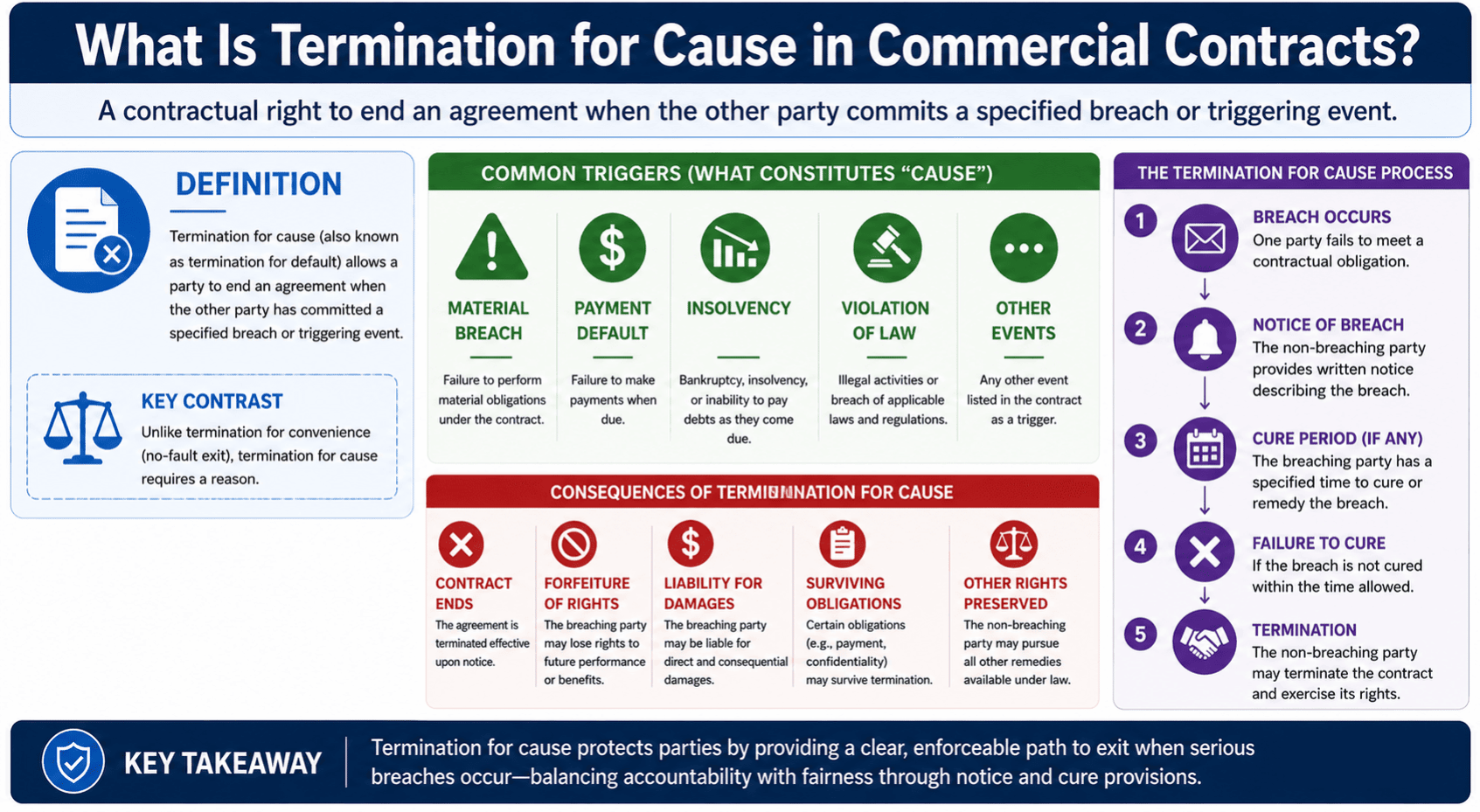
Why Termination for Cause Matters
Termination for cause is the enforcement mechanism behind every contract. Without a credible right to terminate for non‑performance, contractual obligations become merely aspirational. A well‑drafted clause provides certainty, incentivizes performance, and allocates risk. Approximately 99% of commercial contracts include a termination for cause provision (ABA Model Contract Survey). Disputes over the validity of termination for cause account for about 25% of commercial contract litigation (Westlaw data).
In employment contexts, termination for cause (e.g., for misconduct, incompetence, or policy violation) typically results in forfeiture of severance and notice pay. In commercial contracts, termination for cause allows the non‑breaching party to cease performance, seek damages, and transition to an alternative provider.
Common Contract Types with Termination for Cause
💻SaaS & Technology Agreements
Termination for material breach of SLA, data security obligations, or payment default, with 30-day cure periods.
🏗️Construction Contracts
Owner may terminate if contractor fails to supply skilled labor, disregards laws, or fails to pay subcontractors.
👔Employment Agreements
Cause includes dishonesty, gross negligence, felony conviction, or violation of company policy; often no cure period.
🏬Distribution & Supply Agreements
Termination for failure to meet minimum purchase commitments, quality failures, or breach of exclusivity.
⚡ Key principle
Termination for cause must be exercised strictly in accordance with the contract’s notice and cure provisions. A termination notice that fails to specify the alleged breach or provide the required cure period may be ineffective, and the terminating party could itself be held in breach.
Termination for Cause vs. Convenience
Termination for Cause vs. Termination for Convenience
❌ Termination for Cause
- Requires breach or default by other party
- Non‑breaching party may claim damages
- No termination fee payable to breaching party
- Often includes cure period (e.g., 30 days)
- Typical trigger: material breach, non-payment, insolvency
✅ Termination for Convenience
- No breach required, any reason or no reason
- Usually includes a termination fee or wind‑down payment
- Damages limited to work performed before termination
- No cure period
- Common in government contracts and long-term agreements
The choice between these clauses reflects bargaining power. The party with stronger negotiating leverage will push for broad termination for cause rights (against the other party) while limiting its own exposure to termination for cause. Many contracts include both: termination for cause for material breach, and termination for convenience allowing either party to exit without fault by paying a fee.
| Aspect | Termination for Cause | Termination for Convenience |
|---|
| Fault required? | Yes, breach or default by other party | No, any reason or no reason |
| Cure period? | Typically 15‑60 days | Not applicable |
| Damages recoverable? | Yes, actual, consequential, and liquidated damages | Limited, usually only work performed before termination |
| Termination fee? | No, breaching party forfeits rights | Often yes, e.g., 10‑20% of remaining contract value |
| Effect on other party | May be liable for damages; reputation harm | Receives compensation; no fault |
Key Elements of a Termination for Cause Clause
Essential Components for Enforceability
01
Defined triggering events
Specify what constitutes “cause”: material breach, payment default (e.g., 10‑30 days overdue), insolvency/bankruptcy, violation of law, breach of confidentiality or IP provisions, and failure to meet service levels.
02
Notice requirements
Require written notice identifying the breach in reasonable detail. Vague notices (“you are in breach”) are insufficient. Specify delivery method (certified mail, email with read receipt).
03
Cure period
Allow the breaching party a reasonable period to remedy the breach. Market standard is 30 days for commercial contracts. Payment defaults may have shorter periods (10 days). Incurable breaches (fraud, trade secret disclosure) permit immediate termination.
04
Materiality threshold
Define whether only “material” breaches trigger termination, or whether any breach of specified provisions suffices. List breaches deemed material per se (e.g., breach of confidentiality, non‑payment beyond the cure period).
05
Consequences of termination
Specify payment obligations (breaching party forfeits termination fees), return of property and data, survival of certain provisions (confidentiality, indemnity), and the non‑breaching party’s right to pursue damages.
Standard Cure Periods by Contract Type
- Payment default: 10‑15 days (SaaS, service contracts)
- General material breach: 30 days (most commercial contracts)
- Technical/performance breach: 45‑60 days (complex IT implementations)
- Incurable breaches: No cure period, immediate termination (fraud, IP infringement, trade secret disclosure)
📘 Jurisdictional note
Under English law, a termination clause must be exercised strictly in accordance with its terms (Geys v Societe Generale, 2012). Under the U.S. Bankruptcy Code, ipso facto clauses that terminate a contract solely due to bankruptcy filing may be unenforceable, but the contractual right to terminate for non‑payment or other defaults remains. In Singapore, express termination clauses are enforced as drafted (RDC Concrete v Sato Kogyo, 2007). Always seek local legal advice.
Common Termination Triggers
Common Events That Constitute “Cause”
💰
Non‑payment
Failure to pay undisputed invoices within the cure period. Many contracts list payment default as a separate, shorter cure period trigger.
📜
Material breach of any provision
Broad trigger, but courts may require materiality. Better to specify which provisions are material or define materiality (e.g., 10% contract value impact).
🏦
Insolvency / bankruptcy
Filing of voluntary or involuntary petition; appointment of receiver or liquidator; assignment for benefit of creditors. Note that ipso facto clauses have limits under bankruptcy law.
⚖️
Violation of law
Conduct that results in criminal conviction or regulatory sanction affecting performance.
🤐
Confidentiality / IP breach
Unauthorized disclosure of trade secrets or infringement of intellectual property rights, often designated as incurable.
🔄
Unauthorized assignment
Assigning the contract without consent where such consent is required.
Sample Clause Language
Sample Termination for Cause Clauses
| Context | Sample Language |
|---|
| Commercial / SaaS | “Either party may terminate this Agreement for cause if the other party materially breaches any provision of this Agreement and fails to cure such breach within thirty (30) days after receiving written notice thereof (or ten (10) days for a payment default). Either party may terminate immediately upon written notice if the other party: (a) becomes insolvent; (b) files a voluntary bankruptcy petition; or (c) breaches Section 7 (Confidentiality) in a manner causing irreparable harm.” |
| Executive Employment | “The Company may terminate Executive’s employment for Cause upon written notice. ‘Cause’ means: (i) conviction of a felony; (ii) willful misconduct or gross negligence; (iii) material breach of this Agreement that remains uncured for 30 days after notice; (iv) fraud or embezzlement; or (v) material failure to perform assigned duties after notice and cure opportunity.” |
| Construction (Owner‑favorable) | “Owner may terminate Contractor’s right to proceed upon seven (7) days’ notice if Contractor: (a) fails to supply enough properly skilled workers; (b) fails to make payment to subcontractors; (c) disregards laws or safety rules; or (d) otherwise materially breaches this Contract.” |
| Government procurement (Australia) | “The Customer may issue a Notice to immediately terminate or reduce the scope of the Contract if: the Supplier does not deliver the Goods as specified; the Customer rejects Goods and they are not remedied; the Supplier breaches a material term that is not capable of remedy; or the Supplier becomes insolvent.” |
Response & Best Practices
What to Do When Facing a Termination for Cause Notice
01
Assess the notice
Check whether the notice complies with contractual requirements: does it specify the breach in reasonable detail? Is the cure period correct? Is the notice method proper?
02
Evaluate cure options
If the breach is curable, take immediate steps to remedy. Document cure efforts. If cure is impossible or the notice is invalid, consider seeking declaratory relief.
03
Preserve evidence
Document your performance, communications, and any mitigating factors. If the termination is disputed, this evidence will be critical.
04
Seek legal advice promptly
Wrongful termination can constitute a material breach. An attorney can advise on whether the asserted cause is valid, whether cure is required, and how to respond without waiving rights.
Drafting Best Practices (for the non‑breaching party’s perspective)
- Define material breach specifically: Supplement general materiality with a list of “deemed material” breaches (e.g., breach of confidentiality, non‑payment, change of control without consent).
- Tailor cure periods to breach severity: Payment defaults, 10 days; technical failures, 45‑60 days; incurable breaches, immediate termination.
- Require detailed notice: The notice must identify the specific provision breached and the facts constituting the breach. This prevents opportunistic termination.
- Address repeated breaches: Provide that three or more cured breaches of the same type within 12 months constitute cause without further cure opportunity.
- Preserve damage claims: State that termination for cause does not waive any right to damages or other remedies.
- Check insolvency provisions: Under U.S. bankruptcy law (Section 365(e)), an ipso facto clause that terminates solely due to bankruptcy may be unenforceable. However, termination for non‑payment or other defaults remains valid.
⚡ Common drafting pitfalls
Avoid: (1) using “any breach” without a materiality qualifier; (2) failing to specify whether the cure period restarts for each new breach; (3) omitting insolvency as a trigger; (4) conflicting termination provisions with limitation of liability clauses; (5) requiring arbitration of “cause” disputes before termination takes effect, this can delay exit for months.
FAQ
Frequently Asked Questions
QIs a single late payment grounds for termination for cause?
Generally, a single late payment is considered a minor breach, not justifying termination, unless the contract expressly states that any late payment (after notice and cure) is a material breach. Many contracts provide a shorter cure period for payment default (e.g., 10 days) after which termination is permitted. Review your contract’s specific provisions.
QWhat happens if I terminate for cause but a court later finds the breach was not material?
Your termination may be deemed wrongful. In that case, the termination could convert to a termination for convenience (if the contract allows) or you could be held in breach. You may be liable for damages suffered by the other party, including lost profits. This is why careful legal review before terminating is essential.
QCan I terminate for cause without a cure period?
Yes, for incurable breaches. Common incurable breaches include: fraud, willful misconduct, trade secret misappropriation, criminal conviction, and unauthorized assignment. The contract must specify that these breaches allow immediate termination. Without explicit language, a court may imply a reasonable cure period.