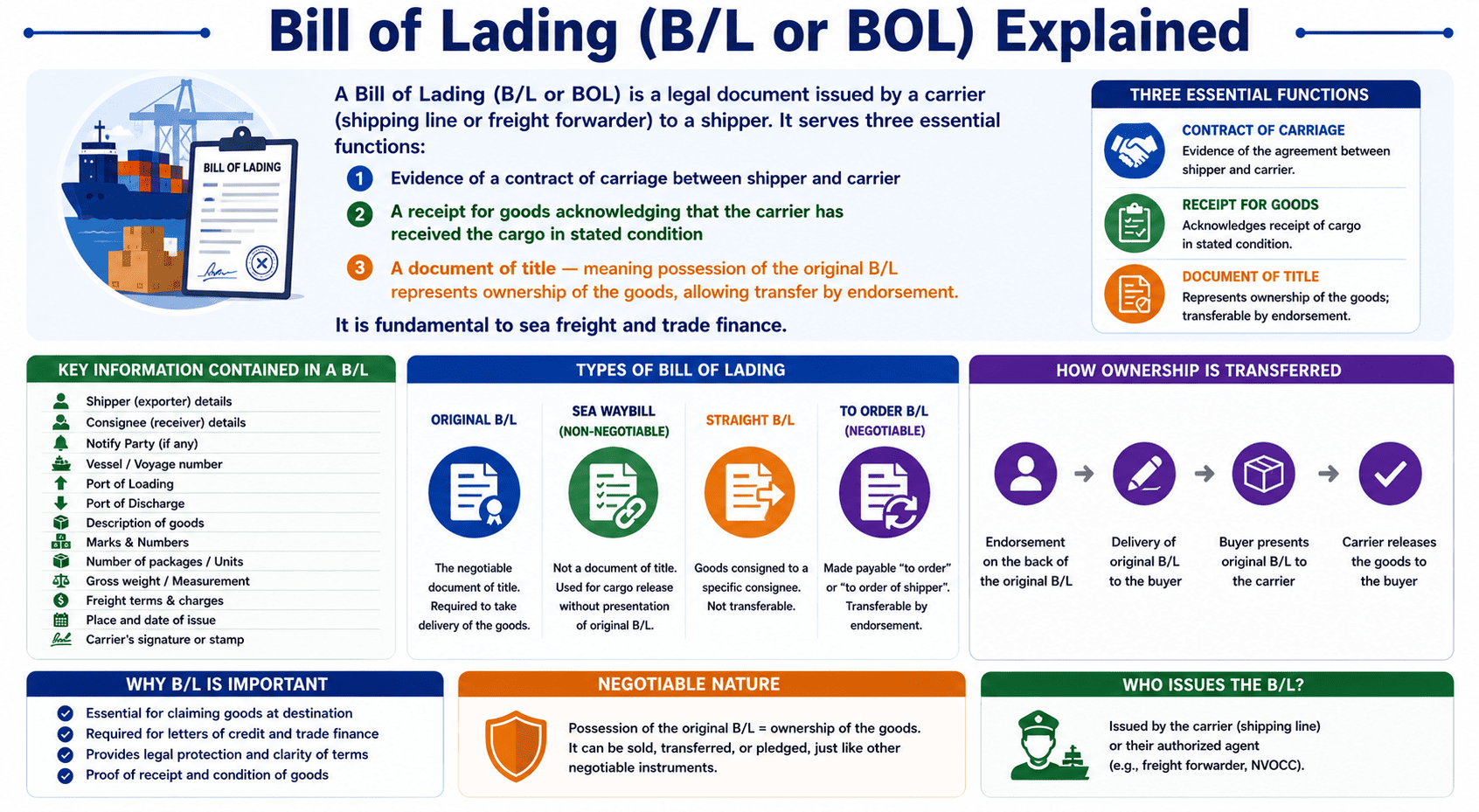
The Three Core Functions of a Bill of Lading
No other shipping document combines these three distinct legal roles. Understanding each function is critical for any importer, exporter, freight forwarder, or logistics professional.
| Function | Description | Practical Implication |
|---|
| Evidence of Contract of Carriage | Outlines the terms under which the carrier agrees to transport the goods, including liability limits, routing, and responsibilities. | Defines who bears risk if cargo is delayed, damaged, or lost. It’s the legally binding transportation agreement. |
| Receipt of Goods | Acknowledges that the carrier has received the goods from the shipper in a specified apparent condition (clean or claused). | Used to verify that cargo was loaded as described; discrepancies between B/L and actual delivery support damage claims. |
| Document of Title | Represents ownership of the goods. The holder of the original, negotiable B/L has the right to take possession of the cargo at destination. | Enables goods to be bought/sold while in transit by endorsing and transferring the B/L. Critical for letters of credit and trade finance. |
🔑 “Key to the Cargo”
The Bill of Lading is often called the “key to the cargo” because carriers will only release goods at destination against presentation of an original, endorsed Bill of Lading (unless a Seaway Bill or telex release is used). Losing an original B/L can cause severe delays and require costly court indemnities.
Main Types of Bill of Lading (Based on Negotiability & Transfer)
The negotiability of a B/L determines whether ownership can be transferred while goods are in transit. This has profound implications for payment terms, risk, and trade finance.
| Type | Negotiable? | How Ownership Transfers | Typical Use Case |
|---|
| Order Bill of Lading | ✅ Yes (negotiable) | By endorsement (signature) of the consignee. Can be endorsed in blank or to a specific new party. | International sales where goods may be sold multiple times during transit, or where a bank holds title under a letter of credit. |
| Straight Bill of Lading | ❌ No (non-negotiable) | Not transferable. Cargo must be delivered to the named consignee only. | Prepaid shipments, captive movements, or transactions where buyer has already paid in full. |
| Bearer Bill of Lading | ✅ Yes (highly negotiable) | Simply by physically delivering the document, no endorsement required. The bearer holds title. | Rare in modern trade due to high fraud risk; used only in exceptional, tightly controlled situations. |
📌 Note on Seaway Bill (Express Release)
A Seaway Bill is not a Bill of Lading in the strict title sense, it is non-negotiable and serves only as evidence of contract and receipt. Cargo is released to the named consignee without presenting an original document. It is faster but cannot be used for trade financing or transferring ownership during transit.
Other Important Types of Bill of Lading (By Condition, Route, Issuer)
| Type | Key Characteristic | When Used / Why It Matters |
|---|
| Clean Bill of Lading | No clause declaring defective condition of goods or packaging. | Required for most letters of credit. Indicates goods were received in apparent good order. |
| Claused (Foul) Bill of Lading | Contains notations indicating damage, shortage, or defective packaging (e.g., “cartons stained” or “drums leaking”). | Buyer may reject the shipment or negotiate lower price. Often triggers inspection and claims. |
| Through Bill of Lading | Covers multiple modes of transport (sea + inland). | Used for door-to-door intermodal shipments where a single carrier takes responsibility across different legs. |
| Master Bill of Lading (MBL) | Issued by the main carrier (e.g., Maersk, MSC) to the freight forwarder. | Governs the relationship between the carrier and the forwarder. |
| House Bill of Lading (HBL) | Issued by a freight forwarder (NVOCC) to the actual shipper. | Governs relationship between forwarder and shipper. The forwarder acts as carrier for the shipper. |
| Received for Shipment B/L | Issued after carrier receives goods but before they are loaded on vessel. | Less secure than “Shipped on Board” B/L. Many L/Cs require “Shipped on Board” notation. |
Risks & Common Mistakes
Common Risks and Pitfalls with Bills of Lading
⚠️
Losing the Original Bill of Lading
Lost original B/Ls can halt cargo release for weeks or months, incurring demurrage, storage fees, and legal costs for court indemnities. Always use secure couriers for original documents.
⚠️
Inconsistency Between B/L and Commercial Invoice / L/C
Even minor discrepancies (e.g., misspelled name, weight differences) can cause banks to reject documents under a letter of credit, leaving the seller unpaid. Strict compliance is essential.
⚠️
Using the Wrong Type of B/L for Payment Terms
Issuing a Seaway Bill (non-negotiable) when the L/C requires a negotiable “Shipped on Board” Ocean Bill of Lading can break the payment chain and transfer risk prematurely.
⚠️
Assuming a “Clean” B/L Means No Hidden Damage
A clean B/L only certifies external apparent condition. Latent damage (e.g., internal machinery damage) may not be visible at loading, separate inspection is required.
⚠️
Delayed Surrender of Original B/L at Destination
If original B/Ls arrive after the cargo, the consignee cannot take delivery, leading to demurrage. For time-sensitive cargo, consider telex release or express B/L.
Key Components & Workflow
Key Data Elements on a Bill of Lading
Every Bill of Lading contains standard information that must be accurate to avoid disputes or customs holds.
| Component | Description |
|---|
| Shipper (Consignor) | Full name and address of the party supplying the goods (usually the exporter/seller). |
| Consignee | Named party to whom goods are to be delivered (for straight B/L) or “to order” for negotiable B/L. |
| Notify Party | Party to be notified when cargo arrives at destination (often the buyer or customs broker). |
| Carrier | Name of shipping line or main carrier issuing the B/L. |
| Vessel & Voyage Number | Name of the ship and voyage reference number. |
| Port of Loading & Discharge |
Origin port where cargo loaded and destination port where it will be discharged. |
| Description of Goods |
Nature, quantity, gross/net weight, number of packages, marks & numbers, container numbers. |
| Freight Terms |
“Freight Prepaid” (seller pays) or “Freight Collect” (buyer pays at destination). |
| Number of Originals |
Typically 3 original B/Ls issued. Only one needs to be surrendered for cargo release, others become void. |
Bill of Lading Workflow: From Issuance to Cargo Release
1
Shipper provides shipping instructions
After booking, the shipper submits accurate details: cargo description, weight, consignee, and notifying parties.
2
Carrier issues draft B/L for verification
Shipper checks for errors before finalization. Mistakes at this stage are costly to amend later.
3
Goods loaded on vessel → “Shipped on Board” B/L issued
Carrier signs and stamps the B/L with the on-board date. This is the critical document for L/C negotiation.
4
Original B/L sent to shipper (or directly to bank/consignee)
Shipper holds title until payment or transfers to buyer via bank (under L/C) or directly.
5
Consignee endorses B/L (for order B/L) & surrenders to carrier at destination
One original B/L must be surrendered to the carrier’s destination agent in exchange for delivery order.
6
Cargo released to consignee after import clearance
Carrier releases goods only against surrendered original B/L (unless telex release or Seaway Bill used).
eBL & Digital Future
Electronic Bill of Lading (eBL) & Digital Transformation
Paper B/Ls remain dominant, but eBLs (electronic Bills of Lading) are gaining traction through platforms like TradeLens, Bolero, and essDOCS. Key benefits include eliminating courier delays, reducing fraud risk, and enabling faster cargo release. However, legal recognition varies by jurisdiction, and many banks still require paper originals for L/C transactions. The industry is moving toward global eBL interoperability, with major carriers pledging 100% eBL adoption by 2030.
📡 Telex Release / Express Release
Not an eBL, but an electronic message authorizing the carrier to release cargo without original B/L. Used for trusted relationships where title transfer is not required. Faster and cheaper than courier, but not acceptable for all letters of credit.
FAQ
Frequently Asked Questions, Bill of Lading
QWhat is the difference between a Bill of Lading and an Air Waybill (AWB)?
An Air Waybill is used for air freight. Unlike a negotiable Bill of Lading, an AWB is always non-negotiable and does not serve as a document of title. It functions only as a receipt and evidence of contract of carriage. Ownership cannot be transferred by endorsing an AWB.
QWhat does “Shipped on Board” notation mean on a B/L?
It confirms that the goods have actually been loaded onto the named vessel, rather than just received at the terminal. Most letters of credit require a “Shipped on Board” Bill of Lading with a date of loading, which is critical for meeting shipment deadlines.
QWho issues the Bill of Lading, the shipper or the carrier?
The Bill of Lading is issued by the carrier (shipping line or its agent) or, in the case of a House Bill of Lading, by a freight forwarder / NVOCC acting as a carrier. The shipper provides the underlying shipping instructions but does not issue the B/L.
QWhat happens if the original Bill of Lading is lost or destroyed?
The consignee must request a “lost B/L indemnity” from the carrier, often requiring a bank guarantee or court order. This is a time-consuming and costly process. To avoid this, carriers increasingly recommend telex release or express B/L for non-L/C shipments.