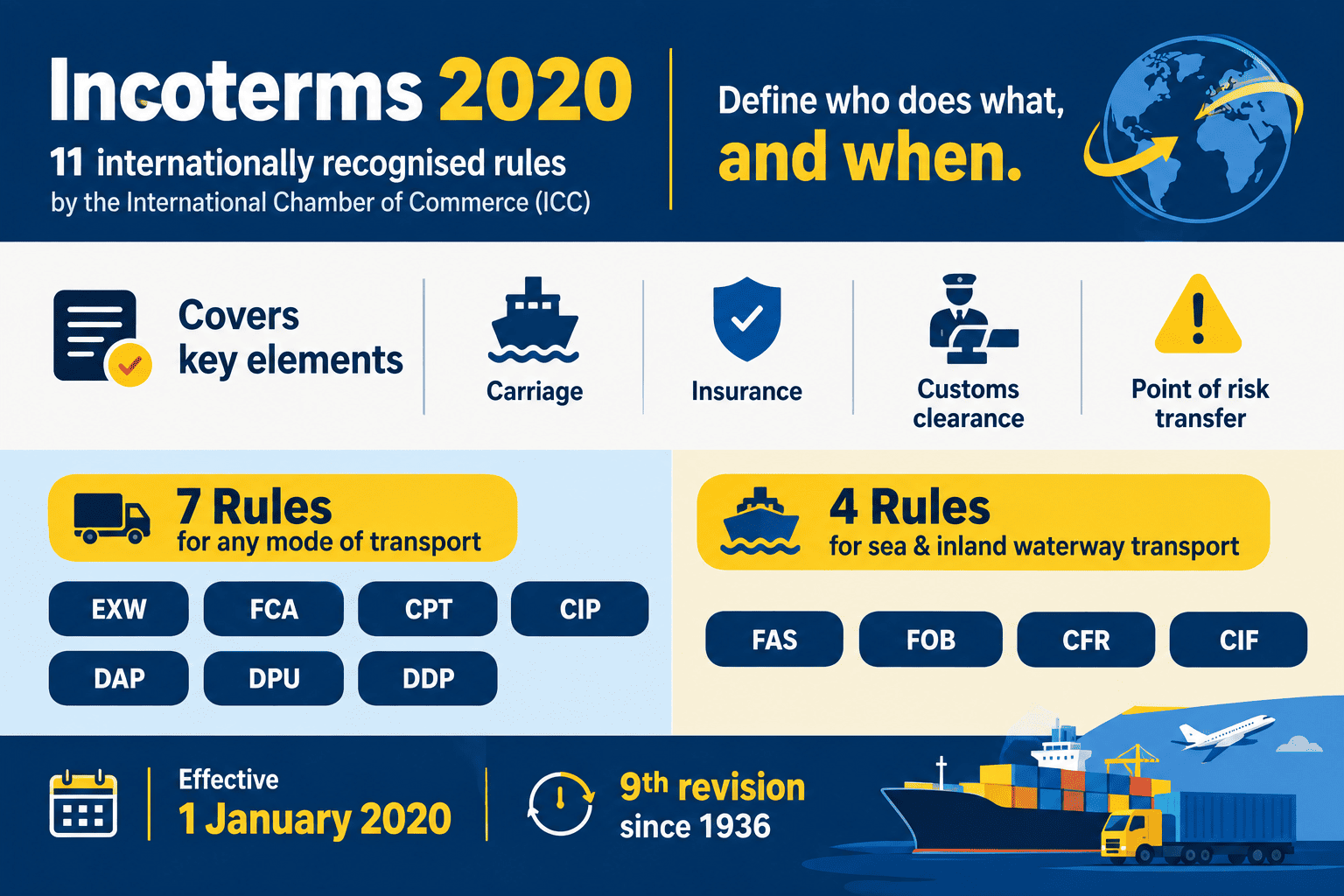
Why Incoterms 2020 Matter
In international trade, ambiguity over who arranges freight, who pays for insurance, who clears customs, and precisely when risk passes from seller to buyer is a leading cause of costly disputes. Incoterms eliminate that uncertainty. Because they are recognised by governments, courts, and freight forwarders worldwide, they provide a shared language that makes cross-border transactions smoother and more predictable. For exporters and importers alike, correct use of Incoterms reduces the risk of unexpected charges, insurance gaps, and ownership disputes during transit.
📊 Key Statistic
Incoterms are incorporated into contracts for the sale of goods worldwide and have been published by the ICC since 1936. Incoterms 2020 is the ninth revision, reflecting modern trade practices such as containerised shipments, security requirements, and the growing use of a party’s own transport.
The 11 Incoterms 2020 Rules
Incoterms 2020 groups its 11 rules into two categories: those usable for any mode of transport and those reserved for sea and inland waterway transport. Choosing the right rule depends on the mode of transport, the level of control each party wants, and who is best placed to arrange carriage and insurance.
Rules for Any Mode of Transport (7 Rules)
| Rule | Full Name | Risk Transfers | Best For |
|---|
| EXW | Ex Works | At the seller’s premises, before loading | Buyers with strong logistics capability; minimum seller obligation |
| FCA | Free Carrier | When goods are handed to the buyer’s nominated carrier | Containerised goods; versatile across all modes |
| CPT | Carriage Paid To | When goods are handed to the first carrier | Seller arranges carriage; risk passes early |
| CIP | Carriage and Insurance Paid To | When goods are handed to the first carrier | As CPT, with all-risks insurance (Clause A) required |
| DAP | Delivered at Place | At the named destination, goods ready for unloading | Seller delivers to buyer’s door; buyer unloads |
| DPU | Delivered at Place Unloaded | At the named destination, after unloading | Replaces DAT; seller unloads at any named place |
| DDP | Delivered Duty Paid | At the named destination, cleared for import | Maximum seller obligation; buyer wants hassle-free delivery |
Rules for Sea and Inland Waterway Transport (4 Rules)
| Rule | Full Name | Risk Transfers | Best For |
|---|
| FAS | Free Alongside Ship | When goods are placed alongside the vessel at the port of shipment | Bulk or break-bulk cargo loaded at a quay |
| FOB | Free on Board | When goods are on board the vessel at the port of shipment | Bulk shipments; seller clears for export |
| CFR | Cost and Freight | When goods are on board the vessel at the port of shipment | Seller pays freight to destination port; risk passes early |
| CIF | Cost, Insurance and Freight | When goods are on board the vessel at the port of shipment | As CFR, with minimum insurance (Clause C) required |
💡 Practical Insight
Always name the place or port precisely in the contract, for example “FCA Shanghai Pudong Terminal 3” rather than just “FCA Shanghai.” Risk and cost shift at that exact point, and vague wording frequently creates disputes over loading fees, terminal handling, and inland transport.
What Changed from 2010
Key Changes in Incoterms 2020 vs Incoterms 2010
Incoterms 2020 retains the core structure of the 2010 edition with several important refinements. Understanding these changes is essential for businesses updating existing contracts and templates.
| Rule | 2010 Version | 2020 Version | What Changed |
|---|
| DAT → DPU | Delivered at Terminal | Delivered at Place Unloaded | Renamed to remove confusion that delivery must occur at a “terminal.” DPU allows any named place, loaded or not. |
| CIP | Minimum cover (Institute Cargo Clauses C) | All-risks cover (Institute Cargo Clauses A) | Default insurance upgraded to comprehensive cover, better suited to manufactured goods. |
| CIF | Minimum cover (Clause C) | Minimum cover (Clause C) | Unchanged. Parties may still agree to higher cover expressly. |
| FCA | No on-board bill of lading provision | On-board bill of lading option | Buyer may instruct the carrier to issue an on-board bill of lading to the seller, enabling FCA to work with letters of credit for containerised goods. |
| Costs | Scattered across articles | Consolidated in A9/B9 | All costs for each rule now appear together, allowing users to see the full cost allocation at a glance. |
| Security | Limited provisions | Clearer obligations in A4/A7 | Explicit security-related obligations and their costs, relevant to container screening and mandatory filings. |
| Own Transport | Assumed third-party carrier | Recognises own transport | Allows for the buyer’s own means of transport under FCA and the seller’s own transport under DAP, DPU, and DDP. |
⚠️ Attention: DPU Replaces DAT
The former DAT (Delivered at Terminal) has been replaced by DPU (Delivered at Place Unloaded). The ICC made this change because the word “terminal” caused confusion, DPU emphasises that the place of destination can be any place, not just a terminal, and that the seller unloads the goods. Under DAP the seller does not unload; under DPU, the seller does.
Applying Incoterms in Contracts
How to Apply Incoterms 2020 in Sales Contracts
Incoterms are contractual rules, they only bind the parties if they are expressly incorporated into the contract of sale. Correct citation format and version identification are essential to avoid ambiguity.
1
Choose the Right Rule
Select a rule that matches your mode of transport and the level of control each party wants. Use sea-only rules (FAS, FOB, CFR, CIF) only for non-containerised sea freight; use FCA for containerised goods.
2
Name the Place or Port Precisely
Always insert the exact named place, port, or point. Vague references shift the risk transfer point and invite disputes over cost responsibility.
3
State the Incoterms Version Year
Always add “Incoterms 2020” after the rule and named place. Without the year, the applicable version may be unclear, and earlier versions may apply by default.
4
Align with Payment and Insurance Terms
Coordinate the Incoterm with your payment method (letters of credit often require a bill of lading) and insurance arrangements. Under CIF and CIP the seller insures in the buyer’s name, at different default levels.
5
Audit Existing Contracts and Templates
Review contracts extending into 2020 and beyond. Update templates to reference Incoterms 2020 and confirm that risk, insurance, and cost allocations remain commercially appropriate.
Incoterms and Related Contractual Clauses
Incoterms allocate logistics responsibilities but do not govern all aspects of the sale. They must be read alongside the wider contractual framework, including clauses on warranties, breach, and risk allocation.
| Clause | How It Interacts with Incoterms |
|---|
| Warranty Clause | Incoterms do not address the quality or condition of goods. Warranties cover defects and performance standards, and breach of warranty is separate from the logistics risk allocated by an Incoterm rule. |
| Material Breach | Failure to perform delivery obligations consistent with the chosen Incoterm can contribute to a material breach. Clear allocation of tasks reduces the risk of such disputes. |
| Breach of Contract | Incoterms clarify which party is responsible for specific tasks. A party’s failure to perform those tasks, such as arranging carriage or clearing customs, can constitute a breach. |
| Consequential Damages | Incoterms do not address liability for late delivery or indirect losses. Contracts typically include waivers or caps on consequential damages, which operate independently of the chosen rule. |
| Indemnification Clause | Indemnities may cover losses arising from a party’s failure to fulfil its Incoterm obligations, such as customs penalties or demurrage costs. |
| Exclusivity Clause | In distribution and supply agreements, exclusivity terms determine who may sell in a territory. Incoterms define how goods move under those arrangements. |
| Termination for Convenience | If a buyer terminates a supply arrangement, Incoterms help determine which party bears the cost of goods already in transit. |
| Master Services Agreement (MSA) | In ongoing supply relationships, the MSA typically sets the commercial framework while individual purchase orders specify the applicable Incoterm and named place for each shipment. |
| Asset Purchase Agreement (APA) | In asset deals involving inventory or equipment, Incoterms may govern the physical transfer of those assets, complementing the APA’s allocation of title and liability. |
Limits, Due Diligence & Market Entry
What Incoterms 2020 Do Not Cover
Incoterms are deliberately limited in scope. Misunderstanding their boundaries is a common source of commercial risk, particularly for companies expanding into new markets.
| Not Covered by Incoterms | Where to Address It |
|---|
| Transfer of title or ownership | Property/title clause in the contract of sale |
| Method and timing of payment | Payment terms, letters of credit, documentary collections |
| Price of the goods and contract value | Commercial terms of the sales contract |
| Liability for defective or non-conforming goods | Warranty clause and representations |
| Consequences of delayed delivery | Liquidated damages, service credits, termination rights |
| Dispute resolution and governing law | Arbitration or jurisdiction clause |
| Force majeure and hardship | Dedicated force majeure and hardship provisions |
Because Incoterms leave these matters open, they are best understood as one component of a comprehensive commercial framework, not a substitute for a complete contract. Companies entering new markets should pair Incoterms with robust due diligence on their counterparty and a clear understanding of local customs and regulatory requirements.
Incoterms, Due Diligence, and Market Entry
Selecting the right Incoterm is a commercial decision informed by due diligence. Before agreeing to terms with a new international counterparty, companies should assess the partner’s logistics capability, financial standing, and compliance record. A supplier who cannot reliably clear customs is a poor fit for a DDP arrangement, while a buyer without freight expertise may prefer a DAP or DDP term to shift responsibility to the seller.
For businesses entering new markets, Incoterms interact directly with distribution and partnership structures. A company appointing a local distributor may choose FCA or FOB to retain control of export clearance while leaving inland logistics to the partner. Conversely, a company selling directly to end customers in a new market may prefer DDP to offer a seamless delivered experience, absorbing customs and duty obligations itself.
🌍 Market Entry Strategy
When structuring an international market entry partnership, align the chosen Incoterm with the division of responsibilities in the wider agreement. A distributor taking on import clearance should not also be subject to a DDP term that keeps that obligation with the seller, inconsistent terms create disputes about who bears cost and risk.
Commercial counterparties should also conduct commercial due diligence to verify that a partner has the operational capacity to perform its Incoterm obligations, particularly where customs clearance, insurance, or specialised carriage is involved.
Risks & Best Practices
Common Incoterms Risks & Mitigation Strategies
⚠️
Using the Wrong Rule for the Mode of Transport
Mitigation: Never use FAS, FOB, CFR, or CIF for containerised goods; the ICC recommends FCA for containers. Using sea-only rules for multimodal shipments creates gaps in risk allocation.
⚠️
Vague Named Place or Port
Mitigation: Specify the exact terminal, warehouse, or address. “FOB Shanghai” is insufficient when multiple terminals operate in the port; specify the terminal name.
⚠️
Failing to State the Version Year
Mitigation: Always cite “Incoterms 2020” after the rule and place. Without the year, the applicable edition may be disputed, and older versions may be assumed.
⚠️
Insurance Gaps Under CIF and CIP
Mitigation: Confirm the level of cover. CIF defaults to minimum Clause C cover, and CIP now requires Clause A all-risks cover. If greater protection is needed, agree expressly in the contract.
⚠️
Assuming Incoterms Cover Title or Payment
Mitigation: Address title transfer, payment terms, and default remedies separately. Incoterms do not determine ownership or the method and timing of payment.
⚠️
Ignoring Security and Filing Obligations
Mitigation: Incoterms 2020 clarifies security-related obligations in articles A4 and A7. For US-bound ocean freight, confirm who is the Importer Security Filing party under the chosen rule.
FAQ
Frequently Asked Questions About Incoterms 2020
QWhat are Incoterms 2020?
Incoterms 2020 are the ninth revision of the International Chamber of Commerce’s International Commercial Terms, effective 1 January 2020. They are a set of 11 rules that define which party (seller or buyer) is responsible for tasks, costs, and risks in an international sale of goods, including carriage, insurance, export and import clearance, and the exact point at which risk transfers.
QWhat changed in Incoterms 2020 compared to Incoterms 2010?
Key changes include: (1) DAT was renamed DPU (Delivered at Place Unloaded) to clarify delivery can occur at any place; (2) CIP now requires all-risks insurance under Institute Cargo Clauses (A), while CIF retains the minimum Clause C default; (3) FCA now allows the buyer to instruct the carrier to issue an on-board bill of lading to the seller; (4) all costs are consolidated in articles A9/B9; and (5) security-related obligations are clearer in articles A4 and A7.
QCan I still use Incoterms 2010 after 1 January 2020?
Yes. Incoterms rules are contractual and bind only if the parties incorporate them. Parties may agree to use Incoterms 2010 or any earlier version after 2020, but they must clearly state the version year in the contract, for example “CIF Longbeach Incoterms 2020”. If no year is stated, the applicable version is determined by the date of the contract.
QWhich Incoterms are most commonly used?
The most frequently used rules are EXW, FCA, FOB, CIF, and DDP. EXW places minimal responsibility on the seller; FCA is versatile and preferred for containerised goods; FOB and CIF dominate bulk sea freight; and DDP is favoured by buyers who want the seller to manage all logistics, customs clearance, and import duties.
QDo Incoterms determine when ownership of the goods transfers?
No. Incoterms govern the transfer of risk and the allocation of tasks and costs, but they do not address when title or ownership passes from seller to buyer. That must be dealt with separately in the contract of sale through a property or title clause.
QWhat is the difference between CIF and CIP insurance requirements?
Under Incoterms 2020, CIF (sea and inland waterway only) requires only minimum cover, complying with the Institute Cargo Clauses (C), unless the parties agree otherwise. CIP (any mode of transport) now requires a higher level of cover, complying with the Institute Cargo Clauses (A) or similar all-risks clauses. This difference reflects the ICC’s recognition that manufactured goods shipped under CIP generally warrant more comprehensive protection than commodities shipped under CIF.