Advantages & Disadvantages of Global Expansion — 2026 B2B Guide
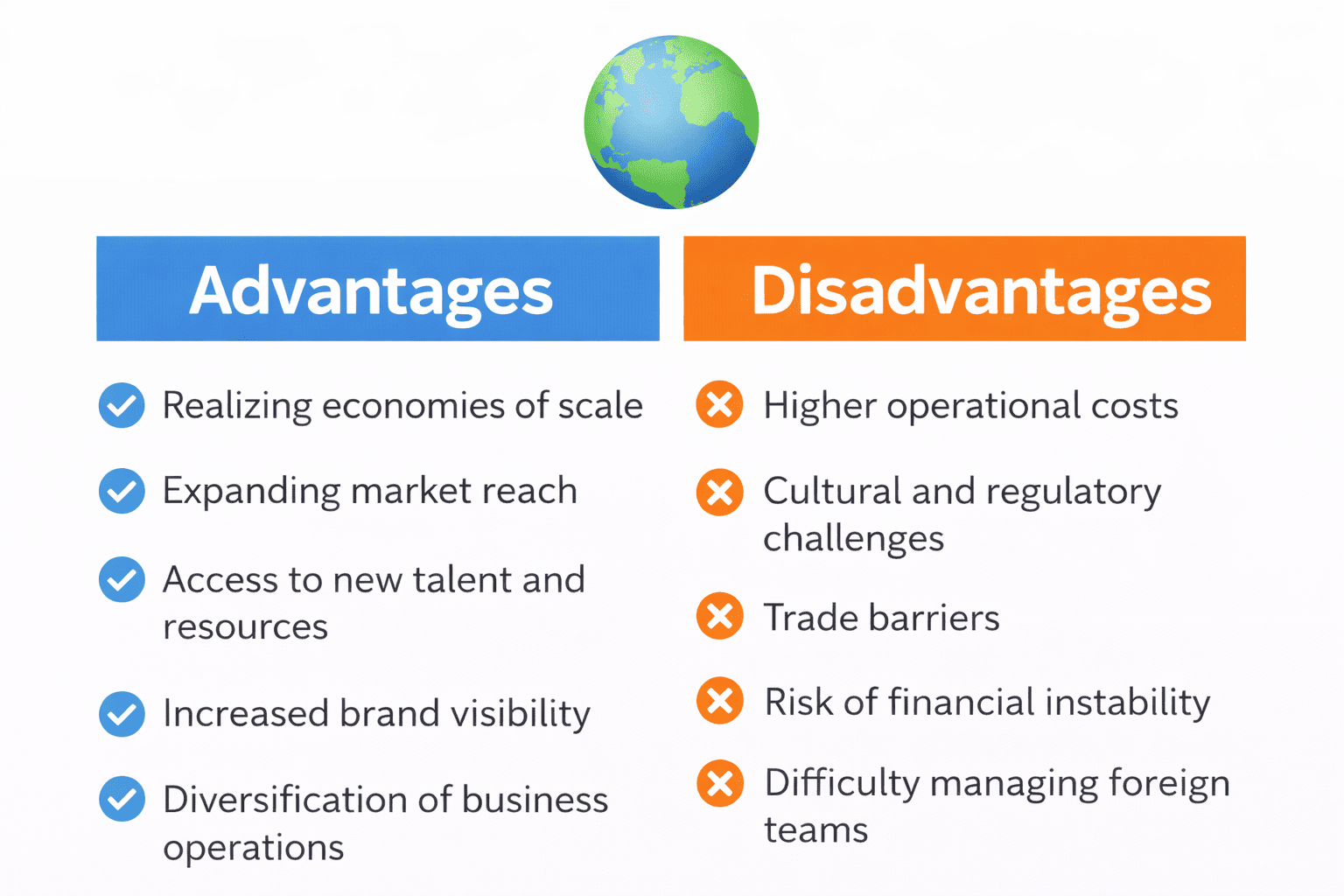
Direct answer:Global expansion (international expansion) is the move to sell, source, manufacture, or hire outside your home market; its advantages typically include new revenue, diversified risk, economies of scale, brand lift, talent and resource access, and strategic partnerships, while disadvantages include compliance cost and complexity, cultural and language friction, currency and political exposure, setup capital, logistics burden, and IP and contract risk. For manufacturers and distributors, outcomes hinge less on generic “going global” enthusiasm and more on market entry partnerships, documented trade terms, and verified counterparties—areas where GTsetu helps teams de-risk discovery.
📅 March 27, 2026⏱ 14 min read✍️ GTsetu Editorial Team🔄 Updated regularly
10+
Common Upsides
10+
Common Risks
5
Readiness Factors
100+
Countries on GTsetu
International growth shows up in board decks as a single bullet—“expand to Region X”—but execution spans customers, channels, supply, talent, tax, and data. Guides from operators and researchers consistently pair upside (reach, resilience, learning) with downside (compliance, culture, capital). Themes align across employer-of-record and HR platforms describing hiring complexity (Atlas HXM), consultancies summarising pros and cons (ConnectaVerse), payroll/Global HR perspectives (Papaya Global; Multiplier), trade-credit and receivables angles on international risk (Allianz Trade), globalisation drivers roundups (Rapid), and literature tying success to market research and local partnerships (AB Academies). Below is a manufacturer–distributor–centric synthesis with deep links into GTsetu’s negotiation and operations library.
Global expansion (international, overseas, or foreign expansion) means extending operations beyond your home country: selling into new markets, sourcing or producing abroad, hiring internationally, or partnering with local entities. It is a strategic bet on growth and resilience—not a single tactic—whether you enter via international distributors, joint ventures or alliances, franchise models, or owned subsidiaries.
Purpose (why companies go global)
Typical aims include diversifying revenue away from one economy, accessing talent and resources, achieving scale economies, building credibility with global buyers, and improving resilience when one region slows—balanced against cost and compliance load.
Sell where utilisation and growth are strongest—not only where HQ sits.
Top-line
Resilience
Balanced exposure
Diversify customers, supply, and currency naturally—if you manage complexity.
Survivability
Learning
Faster iteration
Local feedback improves product, packaging, and service levels globally.
Innovation
Leverage
Partners & scale
Use distributors, JVs, and manufacturers instead of funding everything captive.
Capital efficiency
SECTION 4
4 Disadvantages & Hidden Costs
Drawbacks recur across EOR/expansion blogs and academic reviews: compliance, culture, cost, volatility, and complexity (AB Academies obstacle table; OWDT international risk factors). For industrial firms, these map directly to contracts, logistics, and counterparties:
Disadvantage
Why it hurts
Mitigation (GTsetu library)
Compliance & legal load
Each market layers product, trade, tax, and labour rules.
Net upside≈Incremental margin+resilience benefit−complexity cost−risk of weak partners
Improving partner quality and contract clarity shifts the last two terms faster than “more market trips.”
SECTION 6
6 Expansion Modes & Partnership Structures
Strategy surveys typically compare licensing, M&A, entity setup, PEO/EOR-style hiring (PamGro strategy section). Industrial firms often lead with channel and supply partnerships before wholly owned operations:
Mode
When it fits
GTsetu deep reads
Distribution / agency
Need local coverage without your own legal entity.
Global Expansion Is a Partner Sport for Manufacturers & Distributors
The advantages of global expansion only compound when you can find, qualify, and contract the right distributors, suppliers, and manufacturing partners. The disadvantages amplify when counterparties are unverified or when trade terms are ambiguous. GTsetu is built for international B2B discovery with verification-minded profiles, structured introductions, and zero broker commission—so economic terms stay between you and your partner.
✅
Verification-first discoveryEvaluate fit before deep technical or legal exposure—see business verification.
🤝
Manufacturing & channel partnersDistributors, contract manufacturers, OEM/ODM relationships—aligned with your market entry plan.
🔐
Secure early-stage collaborationProtect specs and pricing with B2B secure collaboration patterns.
🌍
100+ countriesBuild pipelines for international distributors and supply without gambling on cold email alone.
Risk areaWith GTsetu-style verificationAd hoc outreach
Counterparty quality
✓ Structured signals before NDA
✗ Self-reported only
IP / spec leakage
✓ Secure collaboration path
✗ Email attachments
Time-to-first qualified meeting
✓ Matchmaking + filters
~ Manual triage
FAQ
? Frequently Asked Questions
QWhat are the main advantages of global expansion?
Broader revenue, diversified risk, scale economies, brand credibility, access to talent and resources, innovation from new markets, and strategic partnerships—when execution matches strategy.
QWhat are the biggest disadvantages?
Compliance and legal complexity, cultural and language barriers, upfront cost and working capital, currency and political exposure, logistics difficulty, IP risk, and managing distributed teams or partners.
QIs global expansion still worth it in 2026?
For many industrial firms, yes—if demand is validated and partners and terms are competent. Research and practitioner checklists emphasise readiness: capital, validated demand, operational capacity, and cultural adaptability (see synthesis in guides such as ConnectaVerse and Atlas HXM).
QWhere do manufacturers fail first?
Weak channel or supply partners, unclear Incoterms and payment security, and MOQ/lead-time mismatches—often before “strategy” fails.
QHow does GTsetu help?
GTsetu accelerates credible introductions across manufacturing and distribution with verification-minded discovery and secure collaboration so you capture globalization upsides while shrinking partner and IP downsides. Join GTsetu →
Team GTsetu represents the product, compliance, and research team behind GTsetu, a global B2B collaboration platform built to help companies explore cross-border partnerships with clarity and trust. The team focuses on simplifying early-stage international business discovery by combining structured company profiles, verification-led access, and controlled collaboration workflows.
With a strong emphasis on trust, compliance, and disciplined engagement, Team GTsetu shares insights on global trade, partnerships, and cross-border collaboration, helping businesses make informed decisions before entering deeper commercial discussions.