B2B Business Network: Complete Guide to B2B Networking, Platforms & Strategies
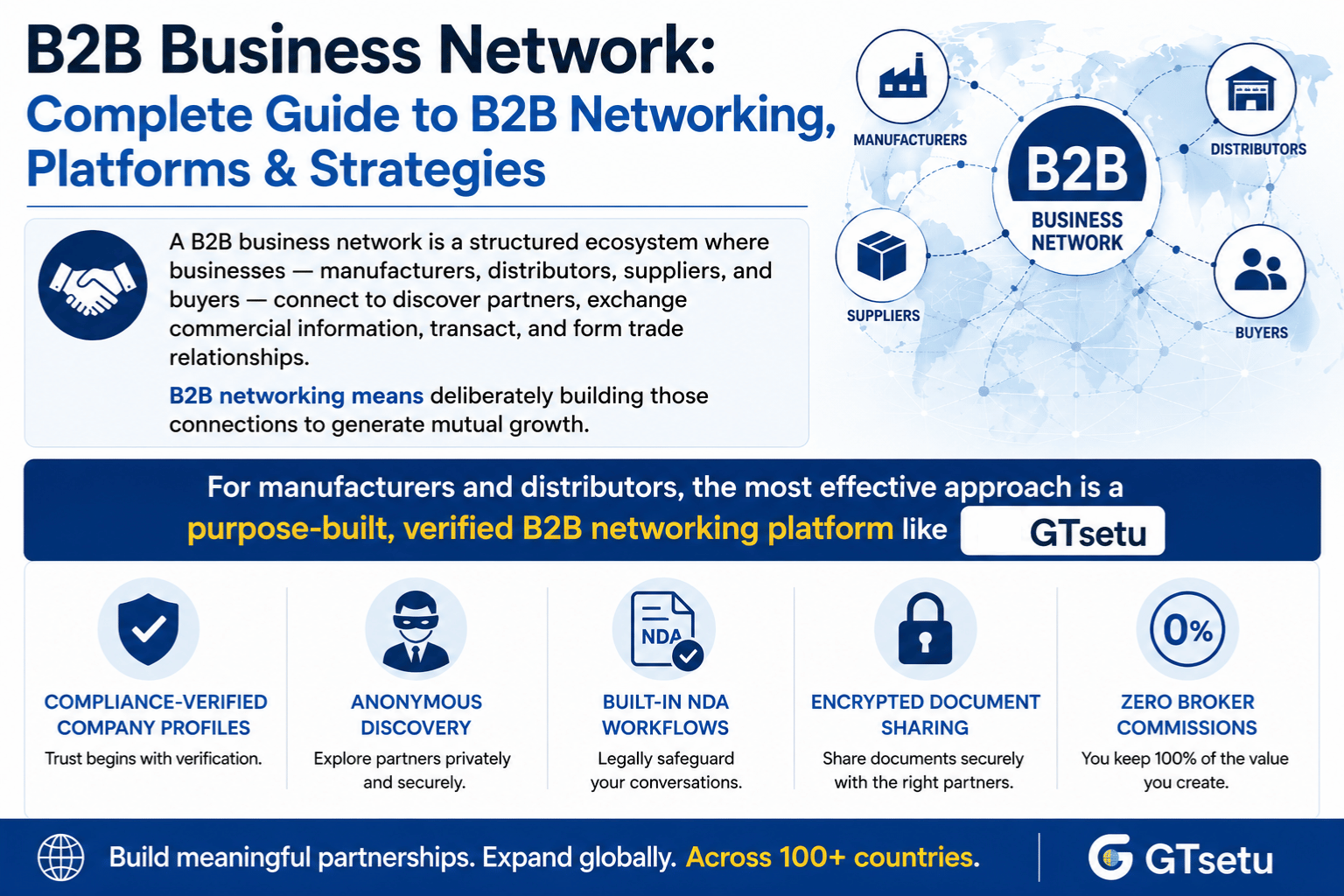
Direct Answer: A B2B business network is a structured ecosystem where businesses, manufacturers, distributors, suppliers, and buyers, connect to discover partners, exchange commercial information, transact, and form trade relationships. B2B networking means deliberately building those connections to generate mutual growth. For manufacturers and distributors, the most effective approach is a purpose-built, verified B2B networking platform like GTsetu, which verifies companies on 6 key data points (Name, Address, Registration Number, Company Status, Company Type, Date of Certificate of Incorporation) using government tie-ups, combined with anonymous discovery, built-in NDA workflows, and encrypted document sharing, with zero broker commissions on any partnership formed, across 100+ countries.
📅 February 26, 2026⏱ 18 min read✍️ GTsetu Editorial Team🔄 Updated regularly
500+
Verified Companies
100+
Countries
6-Point
Govt. Tie-Up Verification
0%
Broker Commission
Every manufacturer seeking its next distributor, every distributor expanding into a new market, and every supplier looking for a reliable buyer faces the same fundamental challenge: finding the right business to partner with, in the right geography, with verified credentials, and without leaking commercially sensitive information in the process. That challenge is precisely what a B2B business network is built to solve.
A B2B business network, whether a digital platform, a supply chain network, a payment network, or a structured association, is the infrastructure through which commercial relationships between businesses are discovered, built, and maintained. This guide covers every dimension of the topic: what B2B networking means, how different types of B2B networks operate, the strategies that produce results, the platforms available globally, and how GTsetu provides a verified, secure, zero-commission B2B business network for manufacturers and distributors across 100+ countries.
💡 Who Is This Guide For?
This guide is written for manufacturers seeking international distributors, distributors seeking manufacturer principals, procurement teams managing supplier networks, and business development leaders responsible for expanding commercial partnerships across borders. It is also a reference for anyone researching B2B payment networks, SAP Ariba, B2B networking sites, or supply chain collaboration platforms.
SECTION 1
1 What Is a B2B Business Network?
🎯 Definition
A B2B business network is a structured ecosystem in which businesses, manufacturers, distributors, suppliers, buyers, and financial institutions, connect with each other to discover partners, exchange commercial value, execute transactions, and form trade relationships. Unlike a consumer network, every participant in a B2B network is a business entity, and the purpose of every connection is commercial partnership rather than personal connection.
The term covers several overlapping but distinct concepts, all of which fall under the B2B network umbrella:
🏭
B2B Supplier / Trade Network
A platform or ecosystem connecting manufacturers, distributors, and buyers for partner discovery, sourcing, and trade relationship formation.
Partner Discovery
💳
B2B Payment Network
A closed, secure financial infrastructure enabling businesses to make and receive payments, ACH, virtual cards, between verified business counterparties.
Financial Infrastructure
🔗
B2B Supply Chain Network
A collaborative ecosystem linking suppliers, manufacturers, logistics partners, and buyers to synchronise procurement, inventory, and fulfilment workflows.
Operations
📱
B2B Marketing / Digital Network
Digital channels, LinkedIn, industry forums, trade associations, where businesses build brand visibility, generate leads, and develop thought leadership among peer companies.
Lead Generation
🤝
B2B Networking Events
Trade shows, industry conferences, roundtables, and business summits where decision-makers from different companies meet to discuss partnerships and market intelligence.
Relationship Building
🏛️
Industry Associations & Chambers
Formal membership organisations that create structured networking environments for businesses in a specific sector or geography, often with directories and events.
Community
This guide covers all of these, but with particular depth on the types most relevant to manufacturers and international distributors: verified partner discovery networks, B2B payment networks, and the strategies and platforms that make cross-border networking effective.
SECTION 2
2 B2B Networking Meaning: A Clear Definition
🎯 B2B Networking Meaning
B2B networking is the deliberate, structured practice of building commercial relationships between two or more businesses, not for personal connection, but to generate mutual commercial value: new clients, distribution partners, suppliers, market intelligence, or strategic alliances. It is relationship-led at its core but commercially motivated in its outcomes.
B2B Networking vs. B2C Networking vs. General Networking
Dimension
General (Personal) Networking
B2C Marketing
B2B Networking
Who is connecting
Individuals
Business reaching consumers
Business connecting with business
Primary goal
Personal relationship, career development
Consumer sales, brand awareness
Commercial partnership, trade, sourcing
Decision-making cycle
Immediate, personal
Short-to-medium, emotional
Long-cycle, rational, multi-stakeholder
Trust requirements
Personal rapport
Brand reputation
Business verification, legal frameworks, audit trails
Key channels
Social events, LinkedIn
Advertising, social media, e-commerce
Verified platforms, trade shows, referrals, industry associations
Volume of connections
Broad
Mass audience
Targeted, qualified, curated
Value of one relationship
Variable
Transactional
High, long-term revenue streams, often multi-year contracts
The critical distinction for manufacturers and distributors: B2B networking is not about the quantity of connections. A manufacturer with 2,000 unverified LinkedIn connections generates less value than one with five verified, active distribution partners in target markets. The quality, verification, and commercial relevance of connections is everything.
⚡ The B2B Network Connection Principle
A B2B network connection has real commercial value only when both parties are verified, both have confirmed mutual interest, and both understand what they are offering and seeking. Unverified, one-sided, or casual connections generate noise, not partnerships. The most effective B2B networks are built around structured, intentional connection rather than broad broadcast outreach.
SECTION 3
3 Types of B2B Networks Explained
The phrase “B2B network” is used to describe several structurally different things. Understanding the distinctions is essential before choosing where to invest networking effort and platform spend.
Network Type
Primary Function
Who Uses It
Key Examples
Best For
Verified Trade & Partner Discovery
Find, vet, and connect with verified business partners globally
Manufacturers, distributors, trading companies
GTsetu
Finding new distribution or supply partners internationally B2B Payment Network
Automate and secure business-to-business payments
Accounts payable/receivable teams, finance departments
SAP Ariba, Bottomline Paymode
Paying or receiving payment from vendors and buyers Procurement / Supply Chain Network
Manage sourcing, contracts, and supplier relationships at scale
Enterprise procurement teams, large manufacturers
SAP Business Network, Coupa
Automating procurement and supply chain collaboration Professional Social Network
Build brand, generate leads, and establish thought leadership
Sales teams, marketing professionals, executives
LinkedIn
Digital outreach and brand-building among B2B audiences Industry Association / Chamber
Structured community networking for sector-specific businesses
Member companies in a vertical or geography
CII, FICCI, BCI, local chambers
Relationship-building within an established industry community Trade Event Network
In-person or virtual connection at industry gatherings
All B2B companies with exhibition or attendance budgets
Trade shows, expos, roundtables
Face-to-face partner engagement and market intelligence B2B Marketplace
Buyer–seller discovery with transaction facilitation
Buyers and suppliers in commodity or mid-market categories
Alibaba, IndiaMART, ThomasNet
Volume-oriented sourcing (lower trust infrastructure than verified platforms)
⚠️ Marketplace ≠ Verified Network
B2B marketplaces like Alibaba list hundreds of thousands of suppliers, but most use self-reported, unverified profiles. Any company can pay to be listed and claim any credential. A verified B2B business network, where every company’s registration, tax status, licences, and representative authority are checked by a compliance team, is structurally different and carries dramatically lower fraud risk for high-value trade partnerships.
SECTION 4
4 B2B Payment Networks: How They Work
A B2B payment network is a closed, secure financial system through which businesses make and receive payments from other businesses, replacing slow, fraud-prone, paper-based methods like checks with encrypted, automated digital payment rails. These networks are administered by a private company or bank and serve as the financial plumbing between buyers and their vendors.
How B2B Payment Networks Differ from Traditional Payment Methods
SAP Ariba, now part of the broader SAP Business Network, is one of the largest enterprise procurement and supply chain collaboration networks in the world. It connects buyers and suppliers for sourcing, contract management, invoice processing, and payment flows. Key points about SAP Ariba for manufacturers and distributors:
🏢
Enterprise-Oriented
SAP Ariba is primarily designed for large enterprises managing complex procurement workflows, not for SMEs or manufacturers seeking new distribution partners internationally.
🔗
Supply Chain Collaboration
SAP Business Network Supply Chain Collaboration enables suppliers and buyers to share forecasts, purchase orders, advance shipping notices, and inventory data in real time within existing relationships.
💰
Transaction-Based Fees
Suppliers on the Ariba network typically pay transaction fees based on document volume. This is a different model from zero-commission verified discovery platforms.
🌐
Procurement Automation
Ariba’s core value is automating procurement processes within established supply chains, not helping manufacturers find new distribution partners in new markets.
🆓
Free Trial Available
SAP Business Network Supply Chain Collaboration offers a free trial for suppliers evaluating connectivity with existing buyer relationships on the platform.
🆚
vs. GTsetu
While SAP Ariba manages procurement within established relationships, GTsetu helps manufacturers and distributors find and form new verified trade partnerships, a complementary but different use case.
💡 Key Distinction
SAP Ariba and similar enterprise procurement networks are optimised for managing transactions and workflows within existing supply chains. If you are a manufacturer seeking new distributors or a distributor seeking new manufacturer principals, you need a partner discovery network, not a procurement automation tool. These are complementary layers of the B2B network stack, not alternatives.
A B2B supplier network connects buyers with suppliers, manufacturers, raw material providers, component makers, and sub-contractors, to enable sourcing, qualification, and ongoing supply chain collaboration. A supply chain partner network is the broader ecosystem of all parties involved in taking a product from raw materials to end customer: suppliers, manufacturers, logistics companies, distributors, and retailers.
What Makes a Strong Supply Chain Partner Network
✅
Verified Partner Identities Across the Chain
Every node in a supply chain, from raw material supplier to last-mile distributor, should be a compliance-verified entity. Unverified participants create quality, fraud, and regulatory risk at every handoff.
Foundation
📊
Real-Time Data Sharing
Supply chain partner networks at their most effective enable shared visibility into inventory levels, order status, and demand forecasts, reducing the bullwhip effect and supply shocks.
Visibility
⚖️
Contractual and Compliance Framework
Strong supply chain networks are built on formalised agreements, NDAs, supply agreements, quality standards, with clear audit trails maintained for regulatory compliance and dispute resolution.
Legal
🌍
Geographic Diversification
A resilient supply chain partner network is not concentrated in a single geography. Diversification across manufacturing regions and distribution markets reduces exposure to country-specific disruptions.
Resilience
🔐
Secure Data Exchange
Commercially sensitive data flowing between supply chain partners, pricing, capacity plans, proprietary specifications, must be encrypted and access-controlled to prevent leakage to competitors or bad actors.
Security
📋
Performance Monitoring and KPIs
Mature supply chain partner networks track partner performance, on-time delivery, quality compliance, fill rates, with shared dashboards and escalation protocols agreed at contract formation.
Performance
SECTION 6
6 Why B2B Networking Matters for Growth
B2B networking is not a soft skill or a nice-to-have, it is a core commercial growth driver. For manufacturers and distributors, the right network connection can open a new continent’s worth of revenue. The wrong one, with an unverified, fraudulent, or misaligned partner, can cost millions and years to unwind. The commercial stakes of B2B networking are higher than in almost any other business function.
78%
of B2B companies say partner referrals are their highest-quality lead source
5×
higher conversion rate from warm network introductions vs. cold outreach
60%
of manufacturers say finding qualified international distributors is their top market entry challenge
The specific commercial benefits of an active B2B business network for manufacturers and distributors:
🗺️
Market Entry Acceleration
An established distribution partner in a new market provides instant access to retailer and wholesaler networks that would take years to build independently.
📈
Revenue Diversification
Multiple distribution partners across regions reduces dependence on any single market, protecting revenue against local economic downturns or regulatory changes.
🧠
Market Intelligence
A strong B2B network provides continuous intelligence on competitor activity, pricing benchmarks, consumer trends, and regulatory changes across markets.
🛡️
Supply Chain Resilience
A diversified supplier and distributor network means that disruptions in one node, geopolitical, logistical, or regulatory, can be absorbed without catastrophic supply or revenue loss.
🤝
Trust-Based Negotiation
Relationships built through verified networks, where both parties’ credentials have been checked, enter commercial negotiations with a trust baseline that cold-outreach partnerships never achieve.
💡
Innovation Through Collaboration
Manufacturer-distributor partnerships often generate product development insights: distributors bring front-line knowledge of what customers want that manufacturers cannot obtain any other way.
SECTION 7
7 7 Proven B2B Networking Strategies
Effective B2B networking does not happen through passive presence on a platform or occasional trade show attendance. The manufacturers and distributors that build the most valuable networks follow a deliberate strategy, combining digital and in-person channels, qualifying before engaging, and always prioritising verified connection over volume.
01
Define Your Ideal Partner Profile Before You Search
The most common networking mistake is searching broadly and hoping for relevance. Before engaging any channel, define precisely what you are looking for: geography, industry vertical, company size range, existing market coverage, financial standing requirements, and regulatory certifications needed. A well-defined ideal partner profile turns every networking interaction into a qualification conversation, not a general social exchange. This focus multiplies the commercial output of every networking hour invested.
02
Join a Verified B2B Platform for Anonymous Discovery
The most efficient starting point for international partner discovery is a verified platform where every company has been verified on 6 key data points via government tie-ups before you encounter them. This eliminates the fraud-screening workload that consumes weeks of cold outreach. Platforms like GTsetu additionally offer anonymous discovery, you can browse verified profiles of potential partners without revealing your own identity, protecting your market expansion strategy until you are ready to engage. This is structurally impossible via cold email or trade directories.
03
Attend Industry Trade Shows with a Structured Agenda
Trade shows remain one of the highest-quality B2B networking channels, but only when approached strategically. Casual attendance without a pre-confirmed meeting schedule produces poor ROI. Best practice: research attendees and exhibitors four to six weeks in advance, identify your top 15 target conversations, schedule meetings before the event, and set a clear objective for each interaction (qualification, relationship-building, or market intelligence). Post-event follow-up within 48 hours is non-negotiable, the majority of trade show value is lost in delayed or absent follow-up.
04
Leverage LinkedIn for Sustained Digital Presence
LinkedIn is the dominant digital channel for B2B networking, particularly for initial contact with decision-makers at target companies before formal engagement. Effective LinkedIn B2B networking goes beyond connection requests: it requires consistent thought leadership content demonstrating sector expertise, personalised outreach that references specific company contexts rather than generic scripts, active participation in relevant industry groups, and company page content that positions your business clearly for the partners you want to attract. LinkedIn is a visibility and warm-up channel, not a closing tool.
05
Build a Referral Network from Existing Partners
The highest-conversion B2B networking channel is a warm referral from an existing trusted partner. A distributor you already work with in Germany may have a relationship with a complementary distributor in France. A supplier who knows your standards may know another manufacturer they can introduce you to. Systematically asking your existing network for introductions, and offering reciprocal referrals, creates compounding network value at near-zero acquisition cost. Build a structured referral-asking process into your annual partner reviews.
06
Join Sector-Specific Associations and Chambers
Industry associations and bilateral chambers of commerce provide structured networking environments with built-in credibility signals: all members have paid to belong, which creates a basic qualification filter absent from open digital channels. More importantly, associations provide regular event calendars, member directories, and committee participation opportunities that enable relationship-building over time, the sustained contact that produces trust-based partnerships. For cross-border networking, bilateral chambers (India-UK, India-Germany, etc.) are particularly valuable for meeting pre-qualified trade partners in specific country corridors.
07
Always Qualify and Verify Before Sharing Commercially Sensitive Information
The single most important networking discipline for manufacturers and distributors: never share pricing, product specifications, market strategy, or client information with a partner who has not been verified. This applies regardless of how professional the introduction, how credible the company appears, or how urgently they request information. Every piece of sensitive commercial data shared before verification is a potential competitor intelligence leak. Use staged disclosure: public information first, verification second, NDA third, proprietary information only after both conditions are met.
✅ Strategy Selector: Which Channel for Which Goal?
Use verified platforms (GTsetu) for finding new international partners efficiently and securely. Use LinkedIn for digital warm-up and thought leadership. Use trade shows for relationship deepening and market intelligence. Use associations for community-building and referral development. Use referral networks for high-conversion warm introductions. Combine all five for a truly resilient B2B business network.
SECTION 8
8 B2B Networking Platforms & Sites Compared
The B2B networking platform landscape spans a wide spectrum, from open professional social networks to closed, verified partner discovery ecosystems. Understanding what each type of platform does, and does not, deliver is essential for allocating networking investment effectively.
Platform Type
Examples
Identity Verification
Best Use Case
Limitations for Trade Partnerships
Verified Trade Discovery
GTsetu
✅ 6-point verification via government tie-ups
Finding & vetting new international distributors or manufacturers
Focused on manufacturers and distributors, not general business networking
Professional Social
LinkedIn
❌ Self-reported, unverified
Digital outreach, brand building, thought leadership
No business verification; high noise-to-signal ratio; not built for trade partnerships
B2B Marketplace
Alibaba, IndiaMART, ThomasNet
⚠️ Partial, paid badges
Commodity sourcing, product discovery
Largely self-reported; limited compliance depth; fraud risk in high-value partnerships
Procurement Network
SAP Ariba, Coupa, Jaggaer
⚠️ Within buyer’s system
Managing procurement within existing supplier relationships
Not designed for new partner discovery; enterprise-centric; high cost for SMEs
Payment Network
Bottomline Paymode, SAP Business Network
✅ For payment purposes
Automating B2B payments between established partners
Not a partner discovery tool, only useful after trade relationships are formed
Industry Association
CII, FICCI, DCHCC, bilateral chambers
⚠️ Membership-level only
Community networking, events, referrals
Verification is membership payment, not compliance documentation; limited to association’s geography/sector
High cost; time-limited access; no persistent verified profile after event
What to Look For in a B2B Networking Platform
Pre-verified company identities using government tie-ups, not self-reported profiles that anyone can fabricate
Anonymous discovery mode, browse without exposing your market expansion strategy
Built-in NDA workflow before sensitive information can be exchanged
Encrypted document sharing, not email attachments or unprotected links
Role-based access controls limiting who can see commercially sensitive materials
Full audit trail of all access, communication, and document exchange events
Geographic breadth, coverage across the markets where you want partners
Sector specificity, partners relevant to your industry, not generic business directories
Zero commission model, platform earnings should not depend on your deal size
Ongoing compliance monitoring, not just one-time onboarding verification
Mobile accessibility, partner discovery and communication on any device
Clear partner profile structure, standardised information enabling rapid qualification
SECTION 9
9 The B2B Network Connection Journey
A B2B network connection, from first discovery to active trade partnership, follows a structured journey when managed properly on a verified platform. Here is how that journey maps onto GTsetu’s workflow.
🎯
Profile & Verification
6-point verification via government tie-ups before joining.
✅ Verified
🔍
Anonymous Discovery
Browse verified partner profiles privately.
🔐 Anon mode
🤝
Mutual Interest
Both confirm interest; identities revealed.
🔐 Gated reveal
📄
NDA Signed
Legal confidentiality in place before any data moves.
🔐 Legal gate
📁
Secure Exchange
Specs, pricing, docs shared via encrypted workspace.
🔐 E2E encrypted
⚖️
Partnership Signed
Distribution agreement executed. Trade begins.
🔐 Full audit trail
01
Verification via Government Tie-ups, The Trust Foundation
Before any company can appear in GTsetu’s network, it goes through verification on 6 key data points using government tie-ups: Name, Address, Registration Number, Company Status, Company Type, and Date of Certificate of Incorporation. This is done by accessing official government registries, not a self-attestation flow. The result is a network in which every profile you encounter has been vetted against authoritative sources, eliminating the fraud-screening workload that consumes weeks of cold outreach effort.
02
Anonymous Discovery, Browse Without Risk
On GTsetu, manufacturers and distributors browse verified company profiles, seeing geography, product category, verification status, and stated partnership intent, without their own identity being visible to those companies. This protects your market expansion strategy: competitors don’t learn which markets you are entering before you are ready to signal intent. Identities are revealed only when both parties confirm mutual interest simultaneously, giving neither party an information advantage during discovery.
03
NDA Before Data Exchange, Legal Infrastructure First
When mutual interest is confirmed, the platform surfaces the NDA workflow. Both parties review, customise permitted fields, and sign digitally, with timestamps and a permanent audit trail, before the secure document workspace unlocks. No pricing, no product specification, no commercial proposal changes hands until confidentiality is legally formalised. The NDA process takes minutes on GTsetu rather than days of email back-and-forth with external legal counsel.
Post-NDA, both parties access a shared, encrypted workspace. Documents are AES-256 encrypted at rest and TLS-secured in transit. Role-based permissions determine who on each team can view, download, or comment on specific documents. Every access event is automatically logged, who viewed what, when, from which device. This eliminates the most common data leak vector in B2B partnerships: the uncontrolled email attachment that gets forwarded to unauthorised parties.
05
Commercial Negotiation and Due Diligence
Territory discussions, pricing structures, exclusivity terms, and performance KPI setting all happen within the secure workspace. All communication is logged. Document versions are tracked. The full audit trail means that if any dispute arises about what was shared, agreed, or committed to, a complete evidentiary record exists, something that traditional email negotiation never provides.
06
Partnership Agreement and Commercial Commencement
The distribution or trade agreement is executed with full audit trail maintained. Zero broker commission is taken by GTsetu on any partnership formed, all commercial economics remain between the manufacturer and distributor. The partnership begins with verified credentials, legal framework, and security infrastructure already established, a significantly stronger foundation than partnerships formed through cold outreach or unverified introductions.
SECTION 10
10 Building a B2B Global Network Across Borders
Building a B2B global network, one that spans multiple continents, regulatory environments, and cultural business contexts, is qualitatively different from domestic networking. The challenges multiply with distance: verification is harder, trust takes longer to establish, legal frameworks differ, and communication gaps create more friction. Here is how to build a resilient global B2B network systematically.
Global Networking Challenge
Why It’s Harder Cross-Border
How Verified Platforms Solve It
Identity Verification
Business registration systems, document formats, and verification processes differ by country, making it difficult to validate credentials independently
GTsetu verifies companies using government tie-ups, accessing official registries in each country, so you don’t need to know Indonesian or Brazilian company law to trust a verified profile
Language and Communication
Misunderstandings in cross-border negotiation are more common and more costly, what seems polite in one culture reads as evasive in another
Structured platform communication, standardised profile fields, NDA templates, reduces ambiguity and ensures key terms are explicitly documented
Legal Framework
Governing law, contract enforceability, and dispute resolution vary dramatically across jurisdictions
GTsetu’s NDA workflow includes governing law selection and jurisdiction clauses that can be tailored to cross-border agreements
Cultural Trust-Building
In many Asian, Middle Eastern, and African markets, relationship trust must be established before commercial discussion, timeline expectations differ from Western markets
Verified platform profiles create a baseline of institutional trust (via government-sourced data) before personal rapport is established, accelerating the trust timeline without shortcutting it
Time Zone and Logistics
Coordinating real-time communication across 12-hour time differences is logistically demanding
Asynchronous document sharing and secure workspace mean collaboration can happen without requiring simultaneous availability
Regulatory Compliance
Export controls, import licencing, and data privacy laws (GDPR, DPDPA) add compliance layers to every cross-border data exchange
GTsetu’s platform infrastructure satisfies data security requirements across major regulatory frameworks, with encrypted storage and access controls
Priority Regions for B2B Global Networks in 2026
🇮🇳
South Asia
India is the world’s fastest-growing major manufacturing economy. Distribution partnerships spanning FMCG, chemicals, pharma, and industrial goods are in high demand from global manufacturers seeking market entry.
🌏
Southeast Asia
ASEAN markets, Indonesia, Vietnam, Thailand, Philippines, represent the next wave of manufacturing and consumer growth. Verified distributors in these markets are actively seeking global brand partnerships.
🌍
Middle East & Africa
GCC markets (UAE, Saudi, Qatar) and rapidly growing African consumer markets offer significant distribution opportunities, particularly for manufacturers with halal-certified, climate-suitable, or premium product ranges.
🇪🇺
Europe
EU markets remain the largest premium consumer destination. Accessing European distribution requires GDPR-compliant data practices, CE certifications, and often country-specific regulatory compliance, all of which verified B2B networks surface during discovery.
🌎
Latin America
Brazil, Mexico, Colombia, and Chile offer substantial distribution opportunities, particularly for manufacturers in FMCG, agricultural inputs, and industrial equipment. Local regulatory expertise is essential for navigation.
🇦🇺
ANZ & Pacific
Australia and New Zealand are high-value, premium consumer markets with transparent regulatory frameworks, attractive for manufacturers seeking a well-regulated English-speaking entry point before broader APAC expansion.
SECTION 11
11 How GTsetu Powers Your B2B Business Network
🌐 Platform Spotlight, GTsetu
The Verified B2B Business Network for Global Trade Partnerships
GTsetu was built specifically for manufacturers and distributors who need to find, vet, and partner with international trade partners, securely, efficiently, and without the cost and risk of traditional outreach methods or broker-intermediated introductions. Every feature is designed around one principle: in B2B trade, trust must be built structurally, not assumed casually.
🏛️
6-Point Verification via Government Tie-ups
Using official government registries, we verify: Name, Address, Registration Number, Company Status, Company Type, and Date of Certificate of Incorporation.
🕵️
Anonymous Discovery
Browse verified partner profiles across 100+ countries without revealing your identity. Your market strategy stays private until you choose to engage.
📄
Built-In NDA Workflow
Digital NDA execution with timestamped signatures and permanent audit trail, triggered before sensitive information can be shared between parties.
🔐
Encrypted Document Workspace
All files encrypted in transit (TLS) and at rest (AES-256). No unprotected email attachments or external cloud links.
👤
Role-Based Access Controls
Granular permissions per user, per document, you control exactly who on each team sees what at every stage.
📋
Full Audit Trail
Every access event, document view, NDA signature, and message is logged with timestamp, downloadable for compliance or legal purposes.
🚫
Zero Commission
GTsetu never takes a success fee or broker commission. Every dollar of commercial value in your partnerships stays between you and your partner.
🌍
100+ Countries
Active verified network spanning Asia, Middle East, Europe, Africa, Australia, and the Americas, accessible from a single platform.
Pre-verified business identities (6 points via govt. tie-ups)
✓ Mandatory, all companies
✗ Self-reported or absent
Anonymous partner discovery
✓ Default, built-in
✗ Identity exposed from first contact
NDA before data exchange
✓ Structural requirement
✗ Informal or absent
Encrypted document sharing
✓ AES-256 + TLS standard
✗ Email attachments, open links
Role-based access controls
✓ Per user, per document
✗ Freely forwarded
Full audit trail
✓ Automated, downloadable
✗ Email thread only
100+ country coverage
✓ Active verified members
~ Varies
Broker / success fee
✓ Zero, always
~ Often 5–15% of deal value
Time to find qualified partners
✓ Days, pre-verified pool
✗ Weeks to months of cold screening
FAQ
? Frequently Asked Questions
Q
What is a B2B business network?
A B2B business network is a structured ecosystem where businesses, manufacturers, distributors, suppliers, buyers, and financial institutions, connect to discover partners, exchange commercial value, execute transactions, and form trade relationships. It differs from a consumer network in that every participant is a verified business entity and every connection is commercially motivated. The term covers several overlapping types: verified partner discovery networks, B2B payment networks, supply chain collaboration networks, professional social platforms, and industry associations.
Q
What is B2B networking meaning?
B2B networking means the deliberate process of building commercial relationships between two or more businesses to generate mutual value, new clients, distribution partners, suppliers, market intelligence, or strategic alliances. It is relationship-led in its method and commercially motivated in its outcomes. For manufacturers and distributors, it specifically encompasses partner discovery, qualification, engagement, and partnership formation, the full commercial relationship lifecycle from first connection to active trade.
Q
What is a B2B payment network and how does it work?
A B2B payment network is a closed, secure financial system through which businesses make and receive payments from other businesses, replacing slow, fraud-prone methods like paper checks with encrypted, automated digital payment rails. Businesses (payers and payees) enroll in the network, which then handles payment processing, vendor enrollment, fraud protection, and reconciliation. Examples include SAP Ariba (part of SAP Business Network), Bottomline Paymode, and similar enterprise platforms. These networks are not partner discovery tools, they facilitate financial transactions within already-established trade relationships.
Q
What is the SAP Ariba B2B network?
SAP Ariba, now part of SAP Business Network, is an enterprise procurement and supply chain collaboration network connecting buyers and suppliers for sourcing, contract management, invoice processing, and payment automation. It is primarily designed for large enterprises managing complex procurement workflows within existing supply relationships. SAP Business Network Supply Chain Collaboration enables real-time sharing of purchase orders, forecasts, and inventory data between established trading partners. It is not a partner discovery tool and is not designed to help manufacturers find new international distributors, that is a different use case better served by verified partner discovery platforms like GTsetu.
Q
What is a B2B network connection?
A B2B network connection is a relationship between two verified business entities within a B2B network, established with mutual interest, confirmed credentials, and a shared commercial objective. In the context of trade partnerships, a meaningful B2B network connection is not merely a contact in a CRM or a LinkedIn follower, it is a verified, mutually consented relationship with a clear basis for commercial engagement: the right industry alignment, geography, product fit, and financial standing on both sides.
Q
What are the most effective B2B networking strategies?
The most effective B2B networking strategies combine multiple channels with a clear qualification framework: (1) Define your ideal partner profile precisely before beginning outreach. (2) Join a verified B2B platform for anonymous, pre-qualified partner discovery. (3) Attend industry trade shows with pre-scheduled meetings and a structured follow-up process. (4) Use LinkedIn for digital outreach, thought leadership, and warm-up before formal engagement. (5) Build referral processes into existing partner relationships. (6) Join sector-specific associations and bilateral chambers for community-based networking. (7) Never share commercially sensitive information without prior identity verification and NDA execution.
Q
What is the difference between a B2B supplier network and a B2B payment network?
A B2B supplier network connects manufacturers with distributors, buyers, and trading partners for partner discovery, sourcing, and trade relationship formation, the commercial “who you work with” layer. A B2B payment network is the financial infrastructure layer that facilitates secure digital payments between businesses once commercial relationships are already established, the “how you pay them” layer. These are complementary but distinct parts of the B2B network stack. SAP Ariba straddles both: it is a procurement and supply chain platform that handles both sourcing workflows and payment flows within enterprise supply chains.
Q
How does GTsetu work as a B2B business network?
GTsetu is a verified B2B business network specifically designed for manufacturers and distributors seeking international trade partnerships. All companies are verified on 6 key data points (Name, Address, Registration Number, Company Status, Company Type, Date of Certificate of Incorporation) using government tie-ups before joining. Members then discover each other anonymously (without revealing their identity during browsing), confirm mutual interest, sign digital NDAs before any sensitive information is shared, and collaborate via an encrypted document workspace with role-based access controls and a full audit trail. GTsetu takes zero broker commission on any partnership formed, covers 100+ countries, and supports partnerships across manufacturing and distribution verticals globally.
Q
What are the best B2B networking sites for manufacturers and distributors?
The best B2B networking sites for manufacturers seeking distributors depend on what you need: For verified partner discovery with 6-point government tie-up verification, anonymous browsing, NDA workflows, and zero commissions, GTsetu is purpose-built for this. For digital brand visibility and professional outreach, LinkedIn is the dominant channel. For volume commodity sourcing, Alibaba or IndiaMART. For enterprise procurement automation within existing relationships, SAP Ariba or Coupa. For community networking within your sector, industry-specific associations and bilateral chambers of commerce. No single site covers all needs; the most effective approach is combining a verified discovery platform with digital channels and in-person events.
Q
What is B2B marketing network and how does it differ from a trade partner network?
A B2B marketing network refers to the channels, platforms, and relationships a business uses to generate leads, build brand awareness, and nurture prospects among other businesses, LinkedIn, industry publications, trade events, content marketing, and digital advertising. A B2B trade partner network is the ecosystem of verified commercial partners, distributors, suppliers, manufacturers, that a business actively trades with or is seeking to trade with. Marketing networks build awareness and fill the top of the funnel. Trade partner networks produce the distribution agreements and supply relationships that generate revenue. GTsetu operates at the trade partner network layer, enabling the final step from awareness to verified partnership.
Join the Verified B2B Business Network for Global Trade Partnerships
Connect with 500+ verified manufacturers and distributors across 100+ countries on GTsetu, with 6-point verification via government tie-ups, anonymous discovery, built-in NDA workflows, and zero broker commissions on every partnership you form.
They represents the product, and research team behind GTsetu, a global B2B collaboration platform built to help companies explore cross-border partnerships with clarity and trust. The team focuses on simplifying early-stage international business discovery by combining structured company profiles, verification-led access, and controlled collaboration workflows.
With a strong emphasis on trust, and disciplined engagement, Team GTsetu shares insights on global trade, partnerships, and cross-border collaboration, helping businesses make informed decisions before entering deeper commercial discussions.