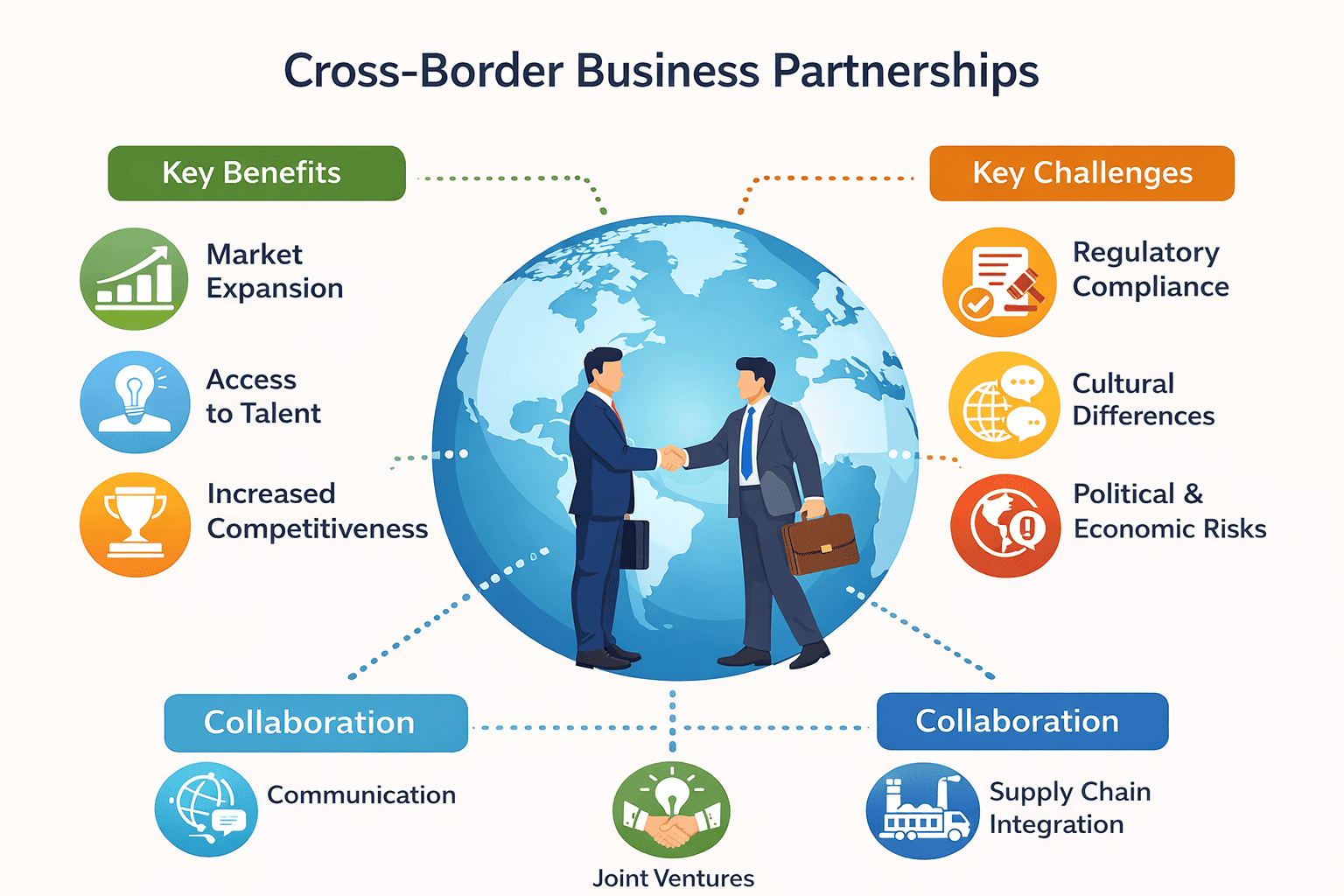
Cross-Border Business Partnerships: Complete B2B Guide for Manufacturers & Distributors
Direct Answer: A cross-border business partnership is a formal commercial collaboration between companies in different countries to achieve shared objectives — market entry, production, distribution, or technology access. The six principal structures are: Distribution Partnerships (manufacturer + foreign distributor), Joint Ventures (shared equity entity in a new market), Contract Manufacturing (brand owner + foreign producer), Strategic Alliances (cooperation without a new entity), Licensing (IP rights for royalties), and Co-Development Partnerships (joint product or technology creation). The three most common failure points are: unverified partner credentials, cultural misalignment, and poorly drafted agreements without governing law or exit provisions. GT Setu is a compliance-verified B2B discovery platform that connects manufacturers and distributors across 100+ countries — with pre-verified credentials, built-in NDA workflows, and zero broker commission — so your cross-border partnership starts on verified ground.
📅 March 28, 2026⏱ 22 min read✍️ GT Setu Editorial Team🔄 Updated regularly
6
Partnership Types Decoded
100+
Countries on GT Setu
0%
Broker Commission
500+
Verified B2B Partners
The era of purely domestic manufacturing and distribution is over. Manufacturers seeking cost-efficient production are partnering with contract manufacturers in Vietnam, India, and Mexico. Distributors seeking new product lines are connecting with suppliers across Europe and East Asia. Brand owners seeking rapid market entry are appointing exclusive distributors across the Middle East, Africa, and Southeast Asia — instead of establishing costly local subsidiaries.
Cross-border business partnerships are now the primary mechanism through which mid-market manufacturers and distributors access new markets, new production capacity, and new revenue streams. But they are also one of the most complex commercial undertakings a business can pursue — involving multiple legal systems, cultural frameworks, currencies, regulatory environments, and logistical realities that domestic partnerships never require.
This guide covers every type of cross-border business partnership used in B2B trade — from international distribution agreements to contract manufacturing, from joint ventures to co-development — with the strategies, legal frameworks, cultural considerations, due diligence checklists, and partner verification approach that determine whether your cross-border partnership creates lasting commercial value or becomes a costly legal dispute.
Every cross-border business partnership fits one of six principal structures. Understanding which structure fits your commercial objective — before approaching any prospective partner — is the single most important decision in cross-border trade. The wrong structure creates misaligned expectations from day one.
DIST
Distribution Partnership
A manufacturer appoints a foreign company to purchase, stock, and resell its products in a defined territory — under exclusive, sole, or non-exclusive terms. The most common cross-border partnership structure for market entry.
🏪 Sell Through
JV
Joint Venture
Two or more companies from different countries create a new, separate legal entity — sharing equity, governance, risk, and reward. Highest commitment level; ideal for regulated or relationship-intensive markets.
🤝 Shared Entity
CM
Contract Manufacturing
A brand owner or principal contracts a foreign manufacturer to produce goods to its specification — retaining IP and brand ownership while outsourcing production cost-efficiently.
🏭 Make For Me
SA
Strategic Alliance
Cooperative agreement between companies from different countries — for co-marketing, technology sharing, joint procurement, or supply chain integration — without creating a new legal entity.
🔗 No New Entity
LIC
Licensing
An IP owner grants a foreign entity the right to use its brand, technology, patent, or know-how in exchange for royalties or fees — without transferring ownership. Capital-light international reach.
📜 IP for Royalties
CO-DEV
Co-Development
Companies from different countries collaborate to jointly develop new products, technologies, or market solutions — pooling R&D, engineering, and market knowledge to create something neither could build alone.
🔬 Build Together
SECTION 2
2 Why Cross-Border Partnerships Matter in B2B Trade Today
Cross-border partnerships are no longer a strategic option for growth-oriented manufacturers and distributors — they are an operational requirement. Supply chains have globalised irreversibly: the components in a product sold in Germany may be manufactured in Taiwan, assembled in Vietnam, and distributed through a partner in the UAE. For businesses that have not built verified, structured cross-border partnerships, the alternative is declining competitiveness, narrower margins, and missed market opportunities.
80%+
of global trade involves cross-border B2B partnerships in supply, manufacturing, or distribution — not direct company-to-consumer sales
3–5×
faster market entry through local distribution partners vs establishing a wholly-owned subsidiary in a new country
60%
of cross-border partnerships that fail do so within the first 2 years — most commonly due to unverified partner credentials or misaligned commercial expectations
100+
countries actively covered by GT Setu’s pre-verified manufacturer and distributor network — enabling rapid, low-risk partner discovery for global expansion
Five Strategic Drivers of Cross-Border Partnerships
🌍
Market Access
A local distributor or JV partner brings existing customer relationships, market knowledge, and regulatory familiarity that a foreign entrant would take years to build independently. International distribution partnerships are typically 3–5× faster for market entry than direct investment.
⚙️
Production Cost Efficiency
Contract manufacturing partnerships in lower-cost regions deliver significant input cost advantages — particularly for labour-intensive assembly, injection moulding, textiles, electronics, and FMCG production — without the capital requirements of owned facilities.
🔬
Technology & Innovation Access
Co-development and technology transfer partnerships give companies access to engineering capability, proprietary processes, or R&D infrastructure that would take years and significant capital to develop internally.
📉
Risk Distribution
Operating through local partners distributes financial, regulatory, and operational risk across multiple geographies — reducing dependence on a single economy, currency, or supply source. Particularly valuable during supply disruption events.
🏛️
Regulatory Navigation
Local partners bring regulatory knowledge, government relationships, import licences, and compliance infrastructure that foreign entrants simply cannot replicate quickly. Critical in regulated sectors: pharma, food, medical devices, defence, and financial services.
💰
Capital Efficiency
Distribution partnerships and licensing arrangements allow revenue generation from new markets without the capital expenditure of establishing a wholly-owned local entity — preserving capital for core operations and product development.
SECTION 3
3 Cross-Border Distribution Partnerships
🎯 Definition
A cross-border distribution partnership is the most common mechanism through which manufacturers enter international markets. The manufacturer appoints a foreign company — the distributor — to purchase products at a wholesale price, take ownership of inventory, and resell to end customers or retailers in a defined territory. The distributor operates as an independent business: it bears the risk of unsold inventory, manages its own logistics, and builds its own customer base — but under terms (pricing, territory, exclusivity, minimum volumes) set by the manufacturer’s distribution agreement. The three core variants are: exclusive (distributor is the only authorised seller in the territory), sole (exclusive to the distributor, but manufacturer may sell directly), and non-exclusive (multiple distributors in the same territory).
✅ Why Manufacturers Choose Distribution Partnerships
✅ Fastest route to market entry — distributor brings existing customer base and local relationships immediately
✅ Local compliance expertise — distributor manages import licences, local regulations, and after-sales
✅ Scalable — appoint distributors market-by-market without building owned infrastructure in each country
⚠️ Key Risks to Manage
⚠️ Loss of market control — distributor manages customer relationships; manufacturer may not know end users
⚠️ Underperformance risk — exclusive territory locked to a distributor who fails to achieve volume targets
⚠️ Mandatory protection laws — many countries require minimum notice and compensation on distributor termination regardless of contract
⚠️ Unverified partner risk — appointing a distributor without verified credentials creates payment default and brand damage exposure
🌐 GT Setu for Distribution Discovery
Finding the right distribution partner requires more than a trade show introduction. GT Setu’s pre-verified global distributor network allows manufacturers to identify, anonymously evaluate, and connect with verified distributors across 100+ countries — with confirmed business registration, trading history, and sector credentials. See: how to find international distributors and exclusivity clauses in distribution agreements.
Key Commercial Terms in a Distribution Partnership Agreement
Term
What It Covers
Common Market Benchmark
Reference
Exclusivity
Whether the distributor is the sole authorised seller in the territory; whether the manufacturer can sell direct
Exclusive for initial 1–2 year term; linked to minimum performance targets; renewable if targets met
A cross-border joint venture creates a new, separate legal entity jointly owned by companies from different countries — sharing equity, governance, liabilities, and profits in that new entity. A strategic alliance is a cooperation agreement between companies that retain their separate identities — no new entity, no shared equity — typically covering co-marketing, joint procurement, technology sharing, or supply chain integration. Joint ventures are the deepest form of cross-border partnership commitment; strategic alliances are the most operationally flexible. Both require precisely drafted agreements — but the governance complexity of a JV is substantially higher. See: complete JV vs strategic alliance comparison.
Dimension
Joint Venture
Strategic Alliance
When to Choose
Legal Entity
New entity created (JVCo)
No new entity — partners retain separate identity
JV where operations are ongoing and long-term; alliance for project-specific or flexible cooperation
Equity Required
Yes — each party contributes capital, IP, or assets
No equity contribution required
JV where both parties commit significant resources; alliance for lower-risk initial collaboration
Governance Complexity
High — board, management, decision rights, deadlock resolution all needed
Moderate — governance through steering committee or liaison process
JV for regulated markets (pharma, defence, financial services) where local entity is required; alliance for commercial cooperation in open markets
Exit Complexity
Very high — buy-out valuation, asset allocation, ongoing liabilities
Low to moderate — agreement termination with notice
Strategic alliances are structurally easier to enter and exit; JVs require exit planning from day one
Best for B2B Trade
Large-scale manufacturing in regulated or protected markets; joint distribution in high-investment markets (India, China, Saudi Arabia)
A cross-border contract manufacturing partnership is the arrangement through which a brand owner, OEM principal, or retailer contracts a manufacturer in another country to produce goods to its exact specification — retaining ownership of the product design, IP, and brand while outsourcing production. Contract manufacturing partnerships are the backbone of global product supply chains: an Indian brand manufacturing in China, a European OEM producing in Vietnam, a US retailer sourcing private label goods in South Asia. The principal structures are: OEM (Own Equipment Manufacturing), ODM (Own Design Manufacturing), and EMS (Electronics Manufacturing Services); toll manufacturing; and white label and private label manufacturing.
The brand owner provides full product specifications, tooling, and design. The CM produces exclusively to the principal’s brief. Brand owner retains all IP. Highest control; highest tooling investment.
The contract manufacturer designs and produces a product to the brand owner’s performance requirements — contributing its own engineering and design capabilities. Faster to market; lower development cost; IP sharing risk must be managed.
The CM produces a standard or lightly modified product that the brand owner sells under its own brand. Fastest time-to-market; minimal IP risk; lowest differentiation. See: white label vs private label.
📍 FMCG, food & beverage, supplements, cosmetics
04
Toll Manufacturing
The brand owner provides raw materials or inputs; the CM provides processing, conversion, or assembly services for a fee. Brand owner retains ownership of materials throughout. See: toll manufacturing explained.
Specialised CM partners providing PCB assembly, system integration, testing, and supply chain management for electronics products. Typically involves complex multi-tier supply chain management. See: OEM vs ODM vs EMS.
📍 Consumer electronics, medical devices, telecoms equipment
06
Co-Development Manufacturing
The brand owner and CM jointly develop a new product — the CM contributes engineering capability and manufacturing insight; the brand owner contributes market knowledge and commercial requirements. IP ownership must be precisely defined. See: co-development partnerships.
📍 New product categories, ingredient innovation, advanced manufacturing
📌 Critical Contract Manufacturing Agreement Elements
Licensing partnerships monetise existing IP across borders without transferring ownership — the IP owner grants the foreign licensee the right to use the technology, brand, or know-how in exchange for royalties. Co-development partnerships create new IP jointly — combining the R&D, engineering, and market knowledge of partners from different countries to build something neither could create alone. Both involve significant IP protection requirements and are governed by licensing agreements and technology transfer agreements. The critical difference: in licensing, IP already exists; in co-development, IP is being created — and ownership must be defined before a single line of engineering work begins.
Partnership Type
IP Position
Revenue Model
Key Risk
Best Used For
Technology Licensing
Licensor retains full IP ownership; licensee gets rights to use
Royalties (% of sales or fixed fee per unit)
IP leakage; sub-licensing without consent; unpaid royalties
8 Five Strategies for Cross-Border Partnership Success
Research consistently shows that the partnerships that succeed across borders share five strategic characteristics — regardless of geography, sector, or partnership type. These are not theoretical frameworks: they are operational practices that the most successful global trade partnerships build into their foundation from the first commercial conversation.
1
Verify Before You Trust — Then Build Trust Systematically
The foundation of every successful cross-border partnership is verified credentials. Before any commercial discussion begins, confirm: business registration, tax compliance, trading history, financial standing, and regulatory certifications. GT Setu pre-verifies all of this before a partner profile goes live. After verification, invest deliberately in relationship-building — cross-border partnerships require more trust-building time than domestic relationships, particularly in Asia, the Middle East, and Latin America where personal trust precedes commercial commitment. See: business verification in B2B trade.
2
Follow Local Rules — Not Just Your Own
Cross-border partnerships are governed by the laws of multiple jurisdictions — and the host country’s rules typically take precedence over the home country’s commercial preferences. Manufacturers entering the UAE face mandatory commercial agency protections. Distributors in Belgium face minimum notice requirements that override contractual terms. Manufacturers in China face technology transfer regulations. The most successful cross-border partnerships invest in local legal expertise from day one — not after a dispute arises. See: jurisdiction-specific termination considerations.
3
Define the Commercial Terms in Writing — Before Operations Begin
The two most common sources of cross-border partnership failure are verbal agreements treated as binding, and written agreements that are ambiguous on the most commercially important terms. Every cross-border partnership must have a written agreement covering: exclusivity and territory, volume commitments, pricing and payment terms, IP ownership, quality standards, termination rights with governing law, and dispute resolution. Execute an NDA before sharing any commercial information. GT Setu provides built-in NDA workflows that protect both parties from the first conversation. See: secure B2B collaboration.
4
Build Cultural Intelligence Into Partnership Operations
HBR research on cross-border alliances consistently identifies cultural misalignment — not commercial disagreement — as the most common root cause of partnership failure. Cultural intelligence means understanding how decisions are made, how hierarchy operates, how disagreement is expressed, and what “yes” actually means across cultures. The Daimler-Chrysler merger, eBay’s failure in China, and Tesco’s US exit all illustrate what happens when companies impose their domestic cultural operating model on a cross-border relationship. See Section 10 of this guide for a full cultural framework by region.
5
Monitor, Measure, and Adapt — Continuously
Cross-border partnerships operate in dynamic environments — regulatory changes, currency shifts, supply disruptions, management changes, and competitive dynamics all affect performance. Successful partnerships build formal performance review cycles (quarterly KPI reviews, annual relationship health assessments), early-warning indicators for partner performance, and formal escalation paths before issues become disputes. Use supplier collaboration platforms to maintain structured visibility on partner performance across geographies.
SECTION 9
9 Cross-Border Partnership Challenges & How to Overcome Them
Every cross-border partnership faces challenges that domestic partnerships do not. Understanding these challenges — and having specific mitigation strategies for each — is what separates businesses that build lasting global trade relationships from those that experience expensive partnership failures within the first two years.
The Six Major Challenges
Challenge
Why It Happens
Specific Mitigation
GT Setu Solution
Unverified Partner Credentials
Partners identified through trade shows, referrals, or online searches are self-reported — no independent verification of registration, solvency, or trading history
Require verified business documentation before commercial discussions; conduct independent credit and compliance checks
GT Setu pre-verifies business registration, trading history, and compliance credentials before any partner profile goes live — eliminating unverified partner risk from the discovery stage. See: business verification
Cultural Misalignment
Different communication styles, decision-making processes, hierarchy norms, and trust-building timelines create misunderstandings that compound over time
Invest in cross-cultural training; conduct in-person relationship visits before signing agreements; use local advisors as cultural intermediaries
GT Setu’s partner profiles include sector and trading context — reducing cold-start cultural friction by providing pre-established commercial context before initial contact
Regulatory & Legal Complexity
Multiple jurisdictions apply to a single cross-border agreement; mandatory local protections may override contractual terms; import/export regulations differ significantly
Engage qualified legal counsel in both jurisdictions before drafting; research mandatory distributor/agent protections in the partner’s country
GT Setu provides verified partner profiles with country-specific sector credentials — reducing regulatory risk at the partner selection stage
Payment & Currency Risk
Exchange rate volatility, delayed payment, payment default, and banking infrastructure differences across jurisdictions create financial exposure
Use letters of credit for new relationships; consider currency hedging for long-term contracts; build payment default triggers into termination clauses. See: payment terms guide
GT Setu’s partner verification reduces payment default risk by confirming partner solvency and trading history before relationship initiation
IP Protection
Product specifications, formulations, brand assets, and technical know-how shared with cross-border partners create IP leakage risk if not contractually protected and jurisdiction-registered
Execute NDA before sharing any commercial information; register IP in all relevant jurisdictions; include IP reversion and audit rights in all agreements. See: NDA guide
GT Setu provides built-in NDA workflow and encrypted document sharing — protecting IP from the first commercial conversation. See: secure B2B collaboration
Operational Misalignment
Differences in quality standards, lead time expectations, MOQ norms, logistics capabilities, and communication practices create friction in day-to-day execution
Conduct factory or operational audits before agreement signing; define quality standards explicitly in agreements with inspection rights; build KPI review cycles into governance frameworks
GT Setu partner profiles include operational context (sector, product categories, trading history) enabling better pre-qualification before operational engagement
SECTION 10
10 Cultural Intelligence in Cross-Border Trade Partnerships
HBR research on cross-border alliances identifies cultural incompatibility — not strategic misalignment — as the single most common root cause of partnership failure. The Daimler-Chrysler merger collapsed under the weight of cultural clashes between German engineering hierarchy and American management pragmatism. eBay’s Chinese partnership failed because US internet commerce assumptions were imposed on a market with fundamentally different consumer trust dynamics. Cultural intelligence is not a soft skill in cross-border B2B trade — it is a commercial competency as important as contract drafting.
⚠️
“Yes” Doesn’t Always Mean Agreement
In many Asian, Middle Eastern, and Latin American business cultures, “yes” in a meeting may mean “I understand what you are saying” or “I respect you” — not “I agree to this.” Treating an initial meeting “yes” as commercial commitment is one of the most common and costly cross-border partnership mistakes.
⚠️
Decision-Making Hierarchy Differs Profoundly
In high-context cultures (Japan, South Korea, India, Middle East), decisions require consensus up the hierarchy — the person in a meeting may not have authority to commit. Western businesses that expect decisions at negotiation speed frequently misread the pace as obstruction rather than process.
⚠️
Relationship Before Transaction
In China, India, the Middle East, and much of Africa and Southeast Asia, commercial relationships are built on personal trust — and personal trust is built before the commercial agreement is discussed. Businesses that approach cross-border partnerships as transactional from the first meeting consistently find that partners are either unresponsive or uncommitted in execution.
⚠️
Legal Documents Are Not the Relationship
In Anglo-American business culture, the signed contract is the relationship. In many other cultures, the relationship governs how the contract is interpreted and executed — a partner who feels disrespected will find ways to underperform that no contract clause fully addresses. Relationship investment is not a courtesy; it is commercial infrastructure.
💡 Practical Cultural Intelligence Checklist
Before your first cross-border partner meeting: (1) research the business culture of the partner’s country — not just the country culture; (2) understand the decision-making hierarchy and identify who the actual decision-maker is before the meeting; (3) invest in in-person relationship-building before expecting commercial commitment; (4) use local advisors or intermediaries who understand both business cultures; (5) be explicit about timelines and expectations in writing — do not rely on implied understanding across cultural boundaries; (6) follow local protocol on hierarchy, titles, business card exchange, and hospitality. GT Setu’s platform helps bridge initial cultural friction by providing structured, verified commercial context before first contact — reducing the cold-start relationship-building burden.
SECTION 11
11 Legal Framework & Governing Agreements for Cross-Border Partnerships
Cross-border partnerships require more legal infrastructure than domestic ones — because multiple legal systems apply, local mandatory protections may override contractual terms, and enforcement of foreign court judgments is often impossible. Every cross-border partnership needs a written agreement that explicitly addresses governing law, dispute resolution, and the mandatory legal requirements of both jurisdictions. The agreements required vary by partnership type.
01
Non-Disclosure Agreement (NDA)
Execute before sharing any commercial information, product specifications, pricing, or draft agreement terms. Mutual NDA protects both parties. See: mutual vs one-way NDA. GT Setu provides built-in NDA workflow — execute before revealing commercial details.
📍 Required for all partnership types before commercial discussions
02
Distribution Agreement
Governs exclusive/non-exclusive territory rights, volume commitments, pricing, IP usage (trademarks), termination rights, and post-termination obligations. Must address mandatory local distributor protection laws in the distributor’s jurisdiction. See: exclusivity clauses and territory rights.
📍 Required for all distribution partnerships
03
Contract Manufacturing Agreement
Governs product specifications, quality standards, lead times, pricing, MOQs, tooling ownership, IP confidentiality, delivery terms (Incoterms), and termination with WIP provisions.
📍 Required for all contract manufacturing partnerships
04
Joint Venture Agreement
Governs equity structure, governance (board composition, voting rights), decision-making authority, deadlock resolution, profit distribution, exit rights, and buy-out valuation mechanism. The most complex cross-border agreement type. See: JV vs strategic alliance.
📍 Required for all joint venture partnerships
05
Technology Transfer / Licensing Agreement
Governs IP rights granted, royalty calculation and payment, exclusivity, sub-licensing rights, audit rights, quality standards, and IP reversion on termination. See: technology transfer agreements and licensing vs distribution.
📍 Required for all licensing and technology transfer partnerships
06
Governing Law & Dispute Resolution Clause
Every cross-border agreement must specify: (1) the governing law (English, Singapore, UAE DIFC, Swiss, or applicable national law); (2) the dispute resolution mechanism (arbitration preferred for enforceability — ICC, SIAC, LCIA, CIETAC); and (3) the arbitration seat and language. Without these, cross-border enforcement is practically impossible.
📍 Required in every cross-border agreement
SECTION 12
12 Regional Partnership Guide: Asia, Europe, Middle East & Beyond
The commercial dynamics, cultural norms, legal frameworks, and partnership structures that work in one region frequently do not translate to another. Here is a region-by-region guide for manufacturers and distributors building cross-border partnerships across GT Setu’s 100+ country network.
🌏
South & Southeast Asia
India, Vietnam, Bangladesh, Indonesia, Thailand, Philippines. The world’s largest manufacturing and distribution opportunity — but also one of the highest-complexity partnership environments.
Partnership priority: Contract manufacturing, distribution, and market entry partnerships. Relationship-building precedes commercial commitment. India has no statutory distributor protection — contractual terms govern, but “reasonable notice” norms apply.
🏭 Manufacturing Hub
🇨🇳
China & East Asia
China, South Korea, Japan, Taiwan. Deep manufacturing capability and complex local distribution dynamics. Personal relationships (guanxi) are commercial currency.
Partnership priority: Contract manufacturing, OEM/ODM/EMS, and technology partnerships. Use CIETAC arbitration for China-based agreements — Chinese courts do not enforce foreign judgments.
⚙️ OEM/ODM Leader
🇪🇺
Europe (EU & UK)
Germany, France, UK, Belgium, Netherlands, Poland, Italy. Sophisticated commercial law frameworks — but mandatory distributor and agent protection laws require careful navigation.
Partnership priority: Distribution agreements, licensing, and strategic alliances. Belgium requires minimum notice of 1 month per year of relationship for distribution termination. France requires “reasonable notice” based on relationship duration. Commercial Agents Directive governs agent compensation across EU.
⚖️ Strong Legal Framework
🌍
Middle East & GCC
UAE, Saudi Arabia, Qatar, Kuwait, Oman, Bahrain. High-growth consumer market with mandatory commercial agency protections that significantly complicate termination of distribution relationships.
Partnership priority: Distribution and agency agreements. UAE Federal Commercial Agencies Law requires compensation on termination of a registered commercial agent regardless of contract. Structure arrangements to avoid triggering “commercial agency” status. DIFC jurisdiction provides more commercially flexible framework.
🏪 High-Growth Distribution
🌍
Africa
Nigeria, South Africa, Kenya, Ghana, Egypt, Ethiopia. Fastest-growing consumer market globally — but significant variance in legal infrastructure and partner verification complexity across markets.
Partnership priority: Distribution partnerships (exclusive, given market size), with strong contract provisions for payment security. Arbitration seats: OHADA (francophone Africa), ICC, or LCIA. Partner verification is more critical here than in any other region — GT Setu’s pre-verification is particularly valuable for African market entry.
📈 Fast-Growth Markets
🌎
Latin America
Brazil, Mexico, Colombia, Chile, Argentina. Large consumer markets with strong relationship-based commercial cultures and complex regulatory environments that vary significantly by country.
Partnership priority: Distribution and contract manufacturing (Mexico for nearshoring to US market). Brazil and Mexico have specific distributor protection requirements. Personal relationship investment is essential — business decisions require trust that is built over time.
🤝 Relationship-Driven
SECTION 13
13 Real-World Cross-Border Partnership Examples: What Works & What Fails
✅ Partnership Successes
Starbucks + Tata Group (India)
Rather than entering India independently, Starbucks partnered with Tata Group — one of India’s most respected business houses — to access local supply chain expertise, real estate relationships, and regulatory knowledge. The JV gave Starbucks market credibility it could not have built independently. The partnership succeeded because both parties brought genuinely complementary capabilities.
Nissan + Renault Alliance (Global)
One of the most successful cross-border strategic alliances in automotive history — enabling shared technology platforms, combined purchasing power, and complementary geographic market presence. Key success factor: precisely defined governance structure with clear decision rights and a balanced value exchange for both parties.
Indian Manufacturer → EU Distributor Network
A Gujarat-based industrial components manufacturer built a verified distributor network across Germany, France, and Poland through GT Setu — appointing pre-verified exclusive distributors in each market with structured agreements governing territory, volume commitments, and termination provisions that comply with local law. Revenue from EU markets grew from zero to 35% of total turnover within 3 years.
⚠️ Partnership Failures & Lessons
Daimler + Chrysler (US-Germany)
The 1998 “merger of equals” collapsed within a decade — not due to commercial incompatibility but cultural clash between German hierarchical engineering culture and American management pragmatism. Integration teams consistently failed to agree on everything from product strategy to office norms. Lesson: cultural due diligence is as critical as financial due diligence in cross-border partnerships.
eBay + EachNet (China)
eBay’s Chinese partnership failed because it imposed a US platform model on a market with fundamentally different consumer trust dynamics — Chinese consumers trusted peer-to-peer communication on Taobao over eBay’s Western-style transactional interface. Lesson: local partner knowledge must genuinely shape product and market strategy, not just provide distribution logistics.
A pattern GT Setu consistently encounters: a manufacturer appoints an international distributor based on a trade show meeting or email introduction — without verifying the business’s registration, financial standing, or trading history. The distributor takes initial stock on credit, fails to pay, and is untraceable. Lesson: partner verification is not optional due diligence — it is the minimum requirement for any cross-border trade relationship. See: business verification in B2B trade.
SECTION 14
14 Partner Due Diligence Checklist for Cross-Border Partnerships
The single most preventable cause of cross-border partnership failure is insufficient partner due diligence before the agreement is signed. Every element of due diligence listed below has a direct commercial consequence if skipped.
✅
Business Registration Verification
Confirm the partner is a legally registered business in its stated jurisdiction — with active status, correct corporate name, and no history of deregistration or name changes indicating avoidance of liability.
✅
Trading History & Track Record
Verify actual trading history — years in operation, product categories traded, volume scale. A partner claiming 10 years of electronics distribution experience in a new market should be able to provide evidence of actual shipments, customer references, and logistics relationships.
✅
Financial Standing & Solvency
Request financial statements or credit reports. A distributor who cannot fund initial inventory purchase without 100% advance payment from the manufacturer is not a financially viable distribution partner. Confirm no insolvency proceedings or debt defaults.
✅
Regulatory & Compliance Status
Confirm the partner holds all licences, certifications, and regulatory approvals required to distribute or manufacture your product category in their jurisdiction. A pharmaceutical distributor without the relevant import licence, or a food manufacturer without export certification, is a compliance liability.
✅
Anti-Corruption & Sanctions Screening
Screen the partner entity, directors, and key shareholders against OFAC, EU, UN, and other relevant sanctions lists. Verify no history of corruption, bribery, or regulatory enforcement actions — particularly important for FCPA and Bribery Act compliance in US and UK supply chains.
✅
Customer & Supplier References
Request and actually contact two or three current trade references — both customers and suppliers. Ask specifically about payment behaviour, communication responsiveness, quality management, and dispute handling. References who are vague or deflect specific questions are a red flag.
✅
Physical Facility Verification
For manufacturing partners, conduct a factory audit — either in person or through a third-party inspection service — before signing. Confirm the manufacturing capability claimed in commercial presentations actually exists in the facility. Virtual tours alone are insufficient for contract manufacturing partnerships.
✅
Competing Partnerships Check
Confirm the prospective partner does not have exclusive relationships with your competitors, is not subject to non-compete obligations from a previous partnership, and has genuine capacity to prioritise your business alongside their existing portfolio. A distributor representing 40 competing brands will not prioritise yours.
✨ GT Setu Pre-Verification
GT Setu pre-verifies business registration, trading history, compliance credentials, and sector experience for every partner on the platform — before any profile goes live. This means manufacturers and distributors starting their search on GT Setu begin from verified data rather than self-reported claims. The due diligence work on the checklist above is substantially pre-completed before the first commercial conversation. See: business verification in B2B trade and supplier collaboration platforms.
SECTION 15
15 Red Flags When Evaluating Cross-Border Partners
🚩
No Verifiable Business Registration
A partner who cannot provide verifiable business registration documents — or whose registration cannot be independently confirmed through the relevant business registry — is not a legitimate trade partner, regardless of how professional their website or presentation appears.
🚩
Pressure to Skip Written Agreements
“We work on trust, not contracts” is a red flag in cross-border trade. Any partner who resists written agreements, formal NDAs, or documented commercial terms is either inexperienced in international trade or deliberately avoiding accountability. Every cross-border partnership requires a written agreement. See: NDA guide.
🚩
Unrealistically Large Claims vs Verifiable Track Record
A distributor claiming to reach 500+ retail outlets across five countries with no verifiable customer references, no warehouse address, and no customs import records is misrepresenting their capability. Verify all commercial claims independently before entering any agreement.
🚩
Request for Upfront Payment Without Secured Terms
A “distributor” who requests advance payment for inventory, tooling, or market entry fees before any agreement is signed, and before their credentials are verified, is a classic trade fraud pattern. Payment should be structured against verified delivery milestones — not upfront against promises. See: payment terms guide.
🚩
Evasive About Competing Partnerships
A partner who avoids answering direct questions about their existing brand portfolio, whether they currently represent your competitors, or whether they are subject to existing exclusivity obligations — is likely concealing a conflict of interest that will compromise execution of your agreement.
🚩
No Physical Presence in Claimed Territory
A distributor claiming to cover a market without a verifiable physical warehouse, office, or operations footprint in that territory is a broker representing itself as a distributor. Brokers play a legitimate role, but they are structurally different from distributors — they hold no inventory, bear no market risk, and should not be appointed under distribution agreements with exclusive territory and volume commitments.
🧭 Which Cross-Border Partnership Structure Should You Use?
I want to sell my products in a new country
Distribution Partnership
Fastest market entry
Appoint an exclusive or non-exclusive distributor with volume commitments and territory rights. Use GT Setu to find verified distributors in 100+ countries.
I want to manufacture at lower cost overseas
Contract Manufacturing
Capital-light production
Choose between OEM, ODM, or EMS depending on your IP ownership needs and design stage. Verify factory credentials before signing.
I want to enter a highly regulated or protected market
Joint Venture
Shared equity commitment
JV with a local partner gives regulatory access, government relationships, and market credibility. Complex governance and exit provisions are required. See: JV vs strategic alliance.
I want to monetise my technology or brand internationally
I want to co-build a product with a foreign partner
Co-Development Partnership
Joint IP creation
Define IP ownership by development stage before engineering begins. See: co-development partnerships. Protect background IP with an NDA.
I want to expand into multiple international markets simultaneously
Multi-Country Distributor Network
Scalable, capital-light
Appoint verified distributors market-by-market using GT Setu’s 100+ country network. Use standardised distribution agreement templates adapted for local mandatory law requirements in each jurisdiction.
SECTION 16
16 How GT Setu Helps You Build Verified Cross-Border Trade Partnerships
🌐 Platform Spotlight — GT Setu
The Global B2B Partnership Platform for Manufacturers & Distributors
Cross-border partnerships fail most often at the partner selection stage — not the negotiation stage. Manufacturers appoint distributors without verified credentials. Distributors source from manufacturers without confirmed quality or compliance records. The result is expensive partnership failures that damage revenue, brands, and commercial relationships. GT Setu was built to solve this problem at scale: a compliance-verified B2B discovery platform connecting manufacturers with verified distributors and trading partners across 100+ countries — with pre-verified credentials, built-in NDA workflows, anonymous discovery, encrypted document sharing, and zero broker commission. Your cross-border partnership starts on verified ground, not unverified assumptions.
✅
Multi-Layer Verification
Business registration, trading history, compliance credentials, and sector experience verified before any profile goes live — eliminating the most common cross-border partnership failure cause.
📄
Built-In NDA Workflow
Execute mutual NDAs before sharing product specifications, pricing, or draft agreement terms — IP protection from conversation one.
🕵️
Anonymous Discovery
Evaluate multiple potential partners in parallel without revealing your commercial strategy — essential before committing to exclusive distribution or manufacturing arrangements.
🚫
Zero Broker Commission
No intermediary fees. Your commercial negotiation, pricing, and partnership terms are set entirely between you and your verified trade partner.
🔐
Encrypted Document Sharing
Share draft agreements, specifications, and term sheets securely with access controls and full audit trail. See: secure B2B collaboration.
🌍
100+ Country Coverage
Verified manufacturer and distributor network across Asia, Middle East, Europe, Africa, Australia, and Americas. See: supplier collaboration platforms.
GT Setu vs Traditional Cross-Border Partner Discovery
FeatureGT SetuTraditional Channels
Pre-verified partner credentials
✓ Always — before listing
✗ Self-reported only
Built-in NDA before commercial disclosure
✓ Integrated workflow
~ Requires separate legal engagement
Anonymous initial partner evaluation
✓ Yes
✗ Identity exposed immediately
Zero broker commission
✓ Always
✗ Typically 5–15%
Parallel evaluation of multiple partners
✓ Practical and secure
✗ Slow, sequential, exposes strategy
Replacement partner pipeline during transitions
✓ Available before termination
✗ Typically begins after termination
Coverage across emerging markets
✓ 100+ countries, including Africa, MENA, SEA
~ Concentrated in developed markets
FAQ
? Frequently Asked Questions
QWhat is a cross-border business partnership?
A cross-border business partnership is a formal commercial collaboration between companies in different countries to achieve shared objectives — market entry, production cost efficiency, technology access, or revenue growth. Cross-border partnerships take many forms including distribution agreements, joint ventures, contract manufacturing, strategic alliances, licensing, and co-development. They differ from domestic partnerships in that they involve multiple legal systems, currencies, cultural frameworks, regulatory environments, and logistical complexities. For manufacturers and distributors, cross-border partnerships are the primary mechanism for global expansion — and the quality of partner verification from the outset is the strongest predictor of long-term partnership success.
QWhat are the main types of cross-border business partnerships?
The six principal types are: (1) Distribution Partnerships — a manufacturer appoints a foreign distributor to sell products in a territory; (2) Joint Ventures — two companies create a new legal entity jointly to pursue a shared commercial objective; (3) Contract Manufacturing — a brand owner contracts a foreign manufacturer to produce goods to its specification; (4) Strategic Alliances — cooperation agreements for co-marketing, technology sharing, or supply chain integration without a new entity; (5) Licensing — an IP owner grants foreign rights to use its brand, technology, or know-how for royalties; (6) Co-Development Partnerships — companies from different countries collaborate to jointly build new products or technologies. Most manufacturers and distributors use a combination of these structures across their global partner network.
QWhat are the biggest challenges in cross-border business partnerships?
The five biggest challenges are: (1) Unverified partner credentials — partners identified through trade shows or online searches are self-reported; independent verification of business registration, solvency, and trading history is essential; (2) Cultural misalignment — different decision-making styles, hierarchy norms, and trust-building timelines create persistent friction that contract clauses cannot resolve; (3) Regulatory complexity — multiple legal systems apply, and local mandatory protections (such as UAE commercial agency law or Belgian distributor notice requirements) may override contractual terms; (4) IP protection risk — product specifications, formulations, and brand assets shared with foreign partners must be protected by NDAs and jurisdiction-registered IP before disclosure; (5) Operational misalignment — differences in quality standards, lead times, MOQ expectations, and communication practices create execution friction. GT Setu addresses the first challenge — partner verification — systematically through pre-verified partner profiles.
QHow do I find verified cross-border trade partners?
Finding verified cross-border trade partners requires: (1) using B2B platforms like GT Setu that pre-verify business registration, trading history, and compliance credentials before listing partners; (2) trade show participation and follow-up due diligence; (3) trade body and chamber of commerce referrals with independent verification; (4) government trade promotion agency databases (India DGFT, Germany GTAI, Singapore Enterprise Singapore); (5) requesting and following up on trade references from existing customers and suppliers. GT Setu specifically pre-verifies all partner credentials — eliminating the most common and costly step of cross-border partner discovery — and provides anonymous discovery, built-in NDA workflow, and encrypted document sharing for the full partner evaluation process. See: how to find international distributors.
QWhat is the difference between a joint venture and a strategic alliance in cross-border trade?
A joint venture creates a new, separate legal entity jointly owned by the partners — with shared equity, governance, and liability in that new entity. A strategic alliance is a cooperation agreement under which each partner retains its separate legal identity — no new entity is created, no equity is exchanged. Joint ventures are structurally more committed (equity investment required, formal governance and exit provisions needed) and are better suited for regulated or large-scale market entry. Strategic alliances are more flexible and faster to implement, making them better suited for co-marketing, technology sharing, joint procurement, or supply chain integration between complementary businesses. In international B2B trade, most companies start with a strategic alliance or distribution agreement before committing to a joint venture. See: complete JV vs strategic alliance comparison.
QWhat legal agreements are needed for a cross-border business partnership?
The agreements required depend on the partnership type: (1) An NDA is required before sharing any commercial information in all partnership types — GT Setu provides a built-in NDA workflow. (2) A Distribution Agreement covering exclusivity, territory, volume commitments, pricing, and termination rights for distribution partnerships. (3) A Contract Manufacturing Agreement covering specifications, quality, lead times, pricing, and IP ownership. (4) A Joint Venture Agreement covering equity, governance, decision rights, and exit mechanism for JVs. (5) A Technology Transfer / Licensing Agreement covering IP rights, royalties, and reversion on termination. Every cross-border agreement must specify governing law (English, Singapore, or applicable national law is recommended) and arbitration for dispute resolution — international arbitration awards are enforceable in 170+ countries under the New York Convention; foreign court judgments often are not.
QHow does cultural difference affect cross-border business partnerships?
Cultural difference affects cross-border partnerships in four principal ways: (1) Decision-making pace — in high-context cultures (Japan, South Korea, India, Middle East, China), decisions require hierarchy consensus; expecting Western transactional speed creates friction and damages trust; (2) Communication style — indirect communication in many Asian and Middle Eastern cultures means “yes” may indicate understanding rather than agreement; reading silence or deflection as obstruction rather than process leads to misinterpretation; (3) Relationship investment — in most non-Western markets, personal trust must be established before commercial commitment is made; businesses that skip relationship-building and move straight to contract negotiation find partners either unresponsive or uncommitted in execution; (4) Contract vs relationship — in Anglo-American business culture the signed contract is the governing document; in many other cultures, the relationship governs how the contract is interpreted in practice. Cultural incompatibility — not commercial disagreement — is identified in HBR research as the single most common cause of cross-border partnership failure.
Build Your Cross-Border Partnership Network on Verified Ground
Join 500+ verified manufacturers and distributors building transparent, verified cross-border trade partnerships on GT Setu — with pre-verified credentials, zero broker fees, built-in NDA workflows, and secure document sharing across 100+ countries.
Team GTsetu represents the product, compliance, and research team behind GTsetu, a global B2B collaboration platform built to help companies explore cross-border partnerships with clarity and trust. The team focuses on simplifying early-stage international business discovery by combining structured company profiles, verification-led access, and controlled collaboration workflows.
With a strong emphasis on trust, compliance, and disciplined engagement, Team GTsetu shares insights on global trade, partnerships, and cross-border collaboration, helping businesses make informed decisions before entering deeper commercial discussions.