Free for a limited time·Profile verification free·First collaboration free·No Commission·No Profit Share·Free for a limited time·Profile verification free·First collaboration free·No Commission·No Profit Share·Free for a limited time·Profile verification free·First collaboration free·No Commission·No Profit Share·
Dispute Resolution in International Contracts: Complete Guide for Manufacturers & Distributors | GTsetu
Home ›
Blog ›
Dispute Resolution in International Contracts
⚖️ International Trade Law
Dispute Resolution in International Contracts: Complete Guide for Manufacturers & Distributors
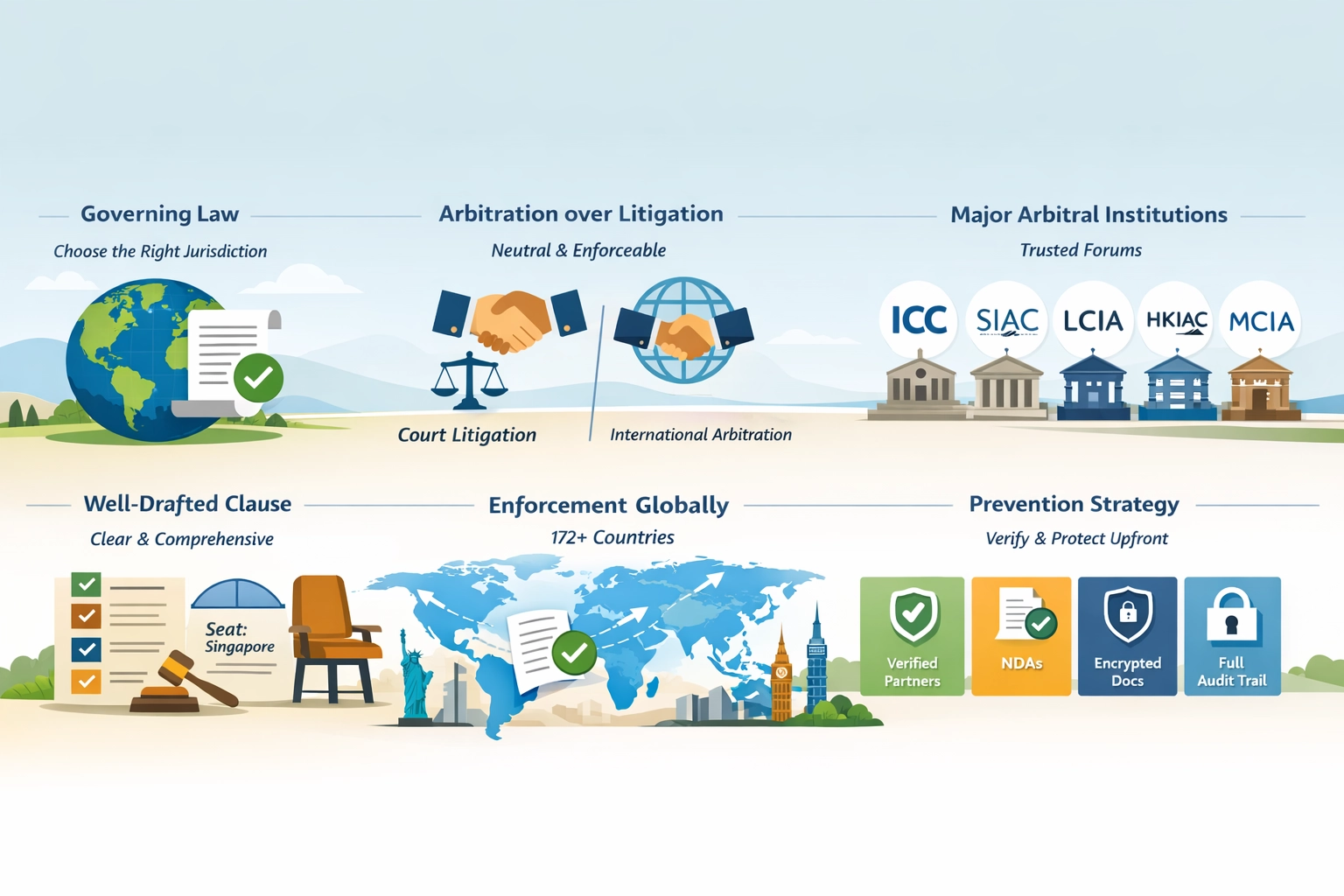
Direct Answer: Dispute resolution in international contracts is the legally agreed framework — embedded in a contract’s dispute resolution clause — that determines which country’s law governs, which forum resolves disputes (arbitration or courts), where proceedings take place, and how awards are enforced across borders. For manufacturers and distributors in cross-border partnerships, international arbitration is typically the preferred mechanism because arbitral awards are enforceable in 172+ countries under the New York Convention, proceedings are confidential, and a neutral forum eliminates home-court bias. The strongest protection against disputes, however, starts before any contract is signed: working only with verified, compliance-checked partners through a platform like GTsetu eliminates the identity fraud and misrepresentation that cause the majority of B2B trade disputes.
📅 March 12, 2026⏱ 18 min read✍️ GT Setu Editorial Team🔄 Updated regularly
172+
New York Convention Signatories
$4.9M
Avg. B2B Dispute Cost
6+
Major Arbitral Institutions
0%
GTsetu Broker Commission
A manufacturer and a distributor sign a cross-border partnership agreement. Eighteen months later, the distributor claims the manufacturer failed to deliver on exclusivity commitments. The manufacturer claims the distributor never met agreed sales targets. Both parties are right about their interpretation — because the contract was ambiguous. Neither party specified which country’s law governs, where disputes are resolved, or whether arbitration or court proceedings apply.
The result: two years of parallel proceedings in two different jurisdictions, legal fees that dwarf the value of the original contract, and a commercial relationship destroyed beyond repair.
This is not a hypothetical. It is a pattern that international trade lawyers see repeatedly in distribution agreements, contract manufacturing arrangements, and joint venture partnerships. The dispute resolution clause — often treated as boilerplate — is in fact the most commercially critical provision in any cross-border contract. This guide explains every element of it, and how to get it right.
💡 Who Is This Guide For?
This guide is written for manufacturers and distributors engaged in cross-border partnerships, procurement and legal teams drafting or reviewing international trade agreements, and business development professionals involved in market entry partnerships. It covers both the legal framework and the practical, commercial decisions behind every element of a dispute resolution clause.
SECTION 1
1 What Is Dispute Resolution in International Contracts?
🎯 Definition
Dispute resolution in international contracts is the set of contractually agreed mechanisms by which the parties to a cross-border agreement will resolve disagreements, claims, or breaches arising from that agreement. It encompasses the choice of governing law (which country’s legal system applies), the forum (arbitration or national courts), the seat and language of proceedings, and the procedures for escalating from negotiation through mediation to binding resolution. In cross-border trade, the enforceability of any dispute resolution mechanism depends critically on whether the chosen structure can actually be executed across the jurisdictions involved.
Unlike domestic contracts — where both parties share a legal system, courts, and enforcement mechanisms — international contracts involve fundamental uncertainty: whose law governs, whose courts have authority, and how a judgment or award can actually be collected against a party in another country. Dispute resolution provisions are the contractual answer to all three questions.
The dispute resolution clause is not boilerplate. As one international arbitration scholar put it, it is the clause parties negotiate least carefully but invoke most desperately. Treating it as an afterthought is one of the most costly mistakes in international commercial contracting — and one that cross-border business partnerships routinely make.
SECTION 2
2 Why a Robust Dispute Resolution Clause Is Non-Negotiable
In domestic contracts, a poorly drafted dispute resolution clause is an inconvenience. In international contracts, it can make a contractual right entirely unenforceable — even if you are clearly in the right.
$4.9M
Average cost of a major B2B commercial dispute (including legal fees and business disruption)
2–5yr
Typical duration of international commercial litigation without a clear dispute clause
172
Countries where a properly structured arbitral award can be enforced under the New York Convention
In the context of manufacturer-distributor relationships, disputes typically arise from four categories of disagreement:
Contested application of termination clauses, disputes over notice periods, exit compensation, and post-termination obligations including stock buyback and IP reversion.
🔒
Confidentiality Breaches
Misuse of proprietary product or pricing information — covered in the NDA framework but often requiring enforcement through formal dispute proceedings when breached. See our guide on mutual vs. one-way NDAs.
An American company and an Indonesian company with no dispute resolution clause found their breach-of-contract claim filed simultaneously in US federal court and the Indonesian Commercial Court — each deciding differently on jurisdiction, with contradictory outcomes that took four years and millions in legal fees to resolve. A clearly drafted arbitration clause designating Singapore as the seat, with ICC rules, would have resolved the same dispute in 12–18 months with a single enforceable award.
SECTION 3
3 Governing Law: The First and Most Critical Choice
The governing law clause determines which country’s legal system is used to interpret the contract and decide disputes under it. All subsequent decisions — forum, seat, procedure — flow from this choice. Getting it wrong makes the rest of the dispute resolution framework nearly useless.
Key Criteria for Selecting Governing Law
Criterion
What to Assess
Practical Implication
Legal System Type
Common law (UK, Singapore, UAE DIFC, US) vs. civil law (France, Germany, India) vs. hybrid
Common law systems offer more developed commercial case law, predictable interpretation, and clearer damages frameworks for B2B disputes
Familiarity of Arbitrators / Judges
Will adjudicators actually understand the chosen law?
Choosing Indonesian law for an arbitration in Singapore creates a knowledge gap — arbitrators may lack competency in the governing law
Remedies Available
Does the jurisdiction allow specific performance, injunctions, punitive damages?
Some civil law systems severely restrict certain remedies that may be critical to your case — assess before selecting
Fee Recovery
Does the prevailing party recover legal costs?
Many civil law systems follow the “loser pays” principle; US courts generally do not — affects the cost-benefit of pursuing a claim
Rule of Law Compliance
Is the judiciary independent? Is judicial bribery a documented risk?
Critical for court litigation; less relevant for international arbitration where you choose your arbitrators
Alignment with Contract Location
Is the contract substantially performed in the governing law jurisdiction?
Practical alignment between governing law and performance location reduces ambiguity in interpretation
Neutrality for Both Parties
Is the governing law jurisdiction associated with either party?
Neutral jurisdictions (English law, Singapore law, Swiss law) are widely accepted in cross-border B2B contracts precisely because neither party is disadvantaged
Most Commonly Used Governing Laws in International B2B Contracts
🇬🇧
English Law
The most widely used governing law in international commercial contracts globally. Well-developed commercial case law, strong predictability, widely understood by international arbitrators, and particularly favoured in trade finance, commodities, and distribution agreements.
Most Common
🇸🇬
Singapore Law
Closely modelled on English common law. Favoured for Asia-Pacific partnerships. Singapore’s courts are internationally respected for independence and competence. SIAC arbitration pairs naturally with Singapore law.
Asia-Preferred
🇨🇭
Swiss Law
Favoured in continental European and Middle Eastern partnerships for its neutrality, stability, and well-developed commercial code. Swiss arbitration law is modern and arbitration-friendly.
European Neutral
🇳🇾
New York / Delaware Law
Commonly used in contracts involving US parties or US-listed companies. New York commercial courts are well-regarded; New York law has sophisticated case law on most commercial issues relevant to B2B trade.
US Transactions
🇮🇳
Indian Law
Appropriate when both parties are Indian or when a transaction is substantially performed in India. Indian courts have jurisdiction over Indian law contracts, but court backlogs make arbitration (with MCIA or ICC rules) strongly preferable. Indian arbitration law has been substantially reformed since 2015 and 2019.
India-Specific
⚡ The Governing Law + Forum Alignment Rule
Never choose a governing law that the selected arbitrators or judges are unlikely to understand. Choosing French law for a Singapore arbitration, or Indonesian law for an ICC arbitration in Paris, creates a practical problem: the cost and time of explaining the governing law to the tribunal adds years and millions to any significant dispute. Governing law and forum should be practically aligned — either the same jurisdiction, or combinations where the governing law is well known to practitioners in the arbitral seat (e.g., English law + Singapore seat is a well-established pairing).
SECTION 4
4 Arbitration vs. Litigation: Choosing the Right Forum
Once governing law is selected, the most consequential structural decision is whether disputes will be resolved through international arbitration or national court litigation. For the overwhelming majority of cross-border B2B contracts, international arbitration is the superior choice — but the reasons matter for understanding when the exception applies.
✓ Parties choose arbitrators with industry expertise
✗ Assigned judge may have no trade background
Speed
~ 12–24 months typical (expedited: 6 months)
✗ 2–8 years in many jurisdictions
Cost
~ Higher upfront; more predictable total
~ Lower initial filing; unpredictable total
Interim relief
~ Available; slightly slower to obtain
✓ Faster via emergency court injunctions
Finality
✓ Limited grounds for appeal — faster resolution
✗ Multi-level appeal rights extend timeline
Preservation of relationship
✓ Private, less adversarial tone
✗ Public and typically relationship-ending
✅ When to Choose Court Litigation Instead
National court litigation may be preferable when: (1) both parties are in the same jurisdiction and enforcement is purely domestic, (2) you need emergency injunctive relief and speed is paramount, (3) the dispute value is too small to justify arbitration institutional fees, or (4) you need to set a public legal precedent. For the vast majority of cross-border manufacturer-distributor disputes, however, international arbitration remains the structurally superior choice.
SECTION 5
5 Major International Arbitral Institutions Compared
Selecting a reputable arbitral institution — and incorporating its rules by reference in your arbitration clause — is one of the most important structural decisions in cross-border dispute resolution. The institution administers the proceedings, appoints or confirms arbitrators, and provides procedural rules that govern everything from timelines to document production.
ICC
International Chamber of Commerce
The world’s most widely used arbitral institution. Headquartered in Paris. Accepts disputes from any jurisdiction, in any language. Particularly appropriate for high-value, complex multi-party cross-border trade disputes.
Global Standard
SIAC
Singapore International Arbitration Centre
The leading arbitral institution for Asia-Pacific disputes. Widely used by Indian, Chinese, South-East Asian, and Middle Eastern parties. Modern rules with an excellent emergency arbitrator procedure. Fast-growing global recognition.
Asia-Pacific Leader
LCIA
London Court of International Arbitration
The second-most-used global institution. Particularly favoured where English law governs. Known for highly experienced arbitrators and a strong procedural framework. Natural choice for contracts between Commonwealth parties.
English Law Contracts
HKIAC
Hong Kong International Arbitration Centre
The primary arbitral institution for China-related disputes and partnerships involving Chinese manufacturers. Awards are enforceable in mainland China under the mutual enforcement arrangement.
China Partnerships
AAA/ICDR
American Arbitration Association / International Centre
The ICDR is the international arm of the AAA. Appropriate when one or both parties are US-based. Well-established rules; widely accepted in North American contracts and investments.
US Transactions
MCIA
Mumbai Centre for International Arbitration
India’s leading international arbitration institution, established to serve India-related cross-border disputes. Increasingly preferred for India-outbound and India-inbound manufacturer-distributor disputes as an alternative to SIAC for India-connected contracts.
India Contracts
⚡ Which Institution for Manufacturer-Distributor Disputes?
For Indian manufacturers dealing with international distributors: SIAC (Singapore seat) or MCIA (Mumbai seat) are the two most practical choices. SIAC is recommended when the distribution partner is in Asia, Middle East, or Africa. MCIA is increasingly well-regarded for India-specific commercial disputes where Indian parties prefer to keep proceedings closer to home while maintaining international standards. Both pair naturally with English or Singapore governing law.
SECTION 6
6 Seat, Venue, and Language of Proceedings
These three decisions are technically distinct — and frequently confused — in international arbitration. Each has different legal and practical implications.
Concept
Legal Meaning
Practical Implication
How to Choose
Seat of Arbitration
The legal domicile of the arbitration — the jurisdiction whose arbitration law governs the proceedings and whose courts provide supervisory jurisdiction
Determines which national courts can intervene, challenge awards, or assist with interim measures. Also determines applicable mandatory arbitration law.
Choose a jurisdiction with modern, arbitration-friendly law and respected courts. Singapore, London, Paris, Geneva, Hong Kong, Dubai (DIFC) are gold standard. Avoid jurisdictions where courts routinely interfere in arbitral proceedings.
Venue / Place of Hearing
The physical location where hearings take place — not necessarily the same as the seat
Affects travel costs and convenience but has no legal significance. The seat governs legally even if hearings take place elsewhere (or online).
Can be agreed after dispute arises, or left to the tribunal’s discretion. In post-COVID arbitration, virtual hearings have made venue less practically significant.
Language of Proceedings
The language in which all submissions, hearings, and awards are conducted
Directly affects interpretation of technical terms (e.g., manufacturing specifications), cost of translation, and choice of eligible arbitrators.
Specify a single language. English is the overwhelming choice for international B2B contracts involving parties who are not both native speakers of the same language. Avoid requiring two languages unless both parties insist — dual-language proceedings dramatically increase cost and time.
⚠️ The Seat Selection Trap
A manufacturer and a distributor chose their dispute to be resolved in Mexico City, applying New Jersey law, with proceedings in English. Each choice made individual sense to one party — but the combination created a scenario where arbitrators in Mexico were expected to apply New Jersey law (which few Mexican practitioners specialise in), in English (a non-primary legal language for that seat). The result was unpredictable outcomes, extended proceedings, and costs that dwarfed the original contract value. This is a documented pattern in poorly negotiated international contracts. The lesson: seat, governing law, and language must work together as a coherent system.
SECTION 7
7 Anatomy of a Well-Drafted Dispute Resolution Clause
A complete, enforceable dispute resolution clause for an international B2B contract must address each of the following elements explicitly. Silence on any one of them creates an ambiguity that opposing counsel will exploit.
Specify that disputes must first be referred to senior management for negotiation (typically 30 days), then to mediation if negotiation fails (optional but recommended), and only then to binding arbitration. This staged approach preserves the commercial relationship while ensuring binding resolution is available if needed. Specify timelines for each stage — vague language like “good faith efforts” creates disputes about whether the precondition has been met.
02
Governing Law (Explicit)
State the governing law explicitly: “This Agreement shall be governed by and construed in accordance with the laws of [jurisdiction], without regard to its conflict of laws provisions.” The “without regard to conflict of laws” language is critical — it prevents a court from applying a different law to specific issues through conflict of laws analysis.
03
Arbitration Clause (Institution, Rules, Seat)
Name the arbitral institution and incorporate its rules by reference. Specify the seat of arbitration. Use each institution’s model clause as the starting point — deviation from tested model language creates ambiguity. Example: “Any dispute arising out of or in connection with this Agreement, including any question regarding its existence, validity, or termination, shall be referred to and finally resolved by arbitration administered by the Singapore International Arbitration Centre (SIAC) in accordance with the Arbitration Rules of the SIAC for the time being in force, which rules are deemed to be incorporated by reference into this clause. The seat of arbitration shall be Singapore.”
04
Number and Appointment of Arbitrators
Specify one arbitrator (cost-efficient for smaller disputes, under USD 1M) or three arbitrators (for larger, complex disputes). The three-arbitrator model typically has each party appoint one, with the two party-appointed arbitrators choosing the presiding arbitrator (or the institution appointing if they cannot agree). Specify the procedure for replacing an arbitrator who becomes unavailable.
05
Language of Arbitration
Specify a single language explicitly. English is strongly recommended for international B2B contracts. Include a provision on translation: which party bears the cost of translating documents not originally in the arbitration language, and whether certified translations are required.
06
Emergency and Interim Relief
Most major institutional rules include an emergency arbitrator procedure for urgent interim relief (e.g., to prevent disposal of assets, stop continued breach). Specify whether the emergency arbitrator procedure is opted-in or excluded. Also specify whether parties retain the right to seek interim relief from national courts in parallel — this is typically permitted and important for freezing orders.
07
Confidentiality of Proceedings
While most institutional rules include some confidentiality protection, the extent varies. Specify explicitly that all proceedings, submissions, awards, and evidence are confidential — and that neither party may disclose the existence or outcome of the arbitration except as required by law or for enforcement purposes. This is particularly important for manufacturers who do not want pricing or product information becoming public through court filings associated with the arbitration.
Most international commercial disputes are resolved before they reach arbitration — because a structured escalation framework creates the pressure and space for commercial settlement. A well-designed escalation ladder serves two purposes: it preserves commercial relationships by creating opportunities for resolution at each stage, and it ensures that parties cannot indefinitely delay binding resolution by staying at the “negotiation” stage.
Stage
Mechanism
Typical Timeline
When It Works
Limitation
Stage 1
Senior management negotiation — a written notice triggers a mandatory negotiation window in which senior officers of both parties must meet
30 days from notice
Minor commercial disputes, first occurrence of breach, relationship is commercially valuable to both sides
No compulsion; bad faith negotiation cannot be sanctioned
Stage 2
Mediation — a neutral third-party mediator facilitates a structured negotiation. Can be administered by SIAC, ICC, or SIMC (Singapore International Mediation Centre)
30–60 days
Both parties want resolution but cannot reach it bilaterally. Mediator can propose solutions neither party has considered.
Non-binding; either party can withdraw. Works only if both parties genuinely want resolution.
Stage 3
Binding arbitration — formal proceedings under agreed institutional rules, resulting in a final, enforceable award
12–24 months (standard); 3–6 months (expedited)
When commercial settlement has genuinely failed or when one party is acting in bad faith and only a binding award will compel compliance
Cost and time; award enforcement may require additional court proceedings in debtor’s jurisdiction
💡 The Arb-Med-Arb Hybrid (Singapore Model)
Singapore has pioneered the “Arb-Med-Arb” model: parties commence arbitration first (which preserves the right to enforcement under the New York Convention), pause for mediation, and if mediation succeeds, the settlement agreement can be recorded as a consent arbitral award — immediately enforceable in 172+ countries. This combines the flexibility of mediation with the enforcement power of arbitration and is particularly well-suited to ongoing commercial relationships like manufacturer-distributor partnerships where preserving the relationship after resolution is a genuine objective.
SECTION 9
9 Enforcement of Awards Across Borders
The most important practical advantage of international arbitration over court litigation is the enforceability of awards across borders. An arbitral award rendered in Singapore is enforceable in India, the UAE, the UK, the US, and 168 other countries — under the New York Convention on the Recognition and Enforcement of Foreign Arbitral Awards (1958). No equivalent global treaty exists for court judgments.
The New York Convention — How It Works
🌐
172+ Signatory States
Countries including India, China, USA, UK, UAE, Singapore, Germany, Japan, and virtually every major trading nation have ratified the Convention. An award made in any signatory state is enforceable in all others.
⚡
Limited Grounds for Refusal
Signatory states can only refuse enforcement on narrow grounds: incapacity of a party, invalid arbitration agreement, procedural irregularity, non-arbitrability of subject matter, or violation of public policy. Courts cannot review the merits of the award.
⚖️
Enforcement Procedure
The winning party files the award and the arbitration agreement with a national court in the country where the debtor has assets. The court issues an enforcement order without re-examining the merits. In most jurisdictions, this is a summary procedure.
🏦
Asset Location Strategy
Enforcement is only effective where the debtor has attachable assets. Before commencing arbitration, identify and, where possible, preserve the counterparty’s assets in enforcement-friendly jurisdictions. Asset protection orders can be sought from courts in parallel with arbitral proceedings.
Enforcement Jurisdiction
New York Convention Status
Enforcement Track Record
Practical Notes
India
✓ Signatory (1960)
Improving — reformed 2015 and 2019 Arbitration Acts accelerated enforcement. Some delays remain in High Courts.
Enforcement of foreign awards requires filing in High Court. Public policy objections have historically been raised broadly but are narrowing under recent case law.
UAE (DIFC)
✓ Signatory (2006)
Strong within DIFC courts; onshore UAE courts less predictable. DIFC-LCIA seat offers excellent enforcement pathway.
Route awards through DIFC courts for enforcement in UAE — the DIFC-onshore enforcement bridge provides access to UAE assets.
China
✓ Signatory (1987)
HKIAC awards enforced via Mainland China–Hong Kong mutual enforcement arrangement. Foreign ICC/SIAC awards require mainland court process — variable by jurisdiction.
For China-related disputes, HKIAC seat and Hong Kong law is strongly recommended over other jurisdictions.
Singapore
✓ Signatory (1986)
Excellent — Singapore courts enforce foreign arbitral awards reliably and quickly. Model enforcement jurisdiction.
First choice for asset preservation and enforcement proceedings in Asia.
United Kingdom
✓ Signatory (1975)
Excellent — UK courts enforce foreign awards efficiently. English courts also recognise and enforce DIFC judgments via bilateral arrangement.
Arbitration Act 1996 provides a world-class framework. London remains a top global enforcement jurisdiction.
SECTION 10
10 Common Mistakes That Make Dispute Clauses Unenforceable
Even well-intentioned dispute resolution clauses fail in practice because of drafting errors, internal inconsistencies, or practical impossibilities. These are the most common — and most costly — mistakes in cross-border contract drafting.
🚩
The “Pathological Clause”
A clause that names a non-existent institution (“International Arbitration Institute of Geneva” — not a real institution), uses contradictory rules, or specifies mutually exclusive seats and governing laws. Courts have spent years untangling pathological clauses — often concluding the arbitration agreement is void.
🚩
Hybrid Clauses That Aren’t Enforced As Written
Clauses that give one party the option to choose between arbitration or litigation (“plaintiff may elect to arbitrate or litigate”) have been invalidated in multiple jurisdictions as violating the mutuality requirement of arbitration agreements.
🚩
Governing Law and Seat Disconnect
Selecting a governing law that is entirely foreign to the arbitral seat — without ensuring the tribunal will have access to qualified experts or translations — creates unpredictable outcomes and dramatically increases costs.
🚩
No Specific Scope Language
Clauses that say “major disputes” go to arbitration but do not define “major” invite satellite litigation about whether the clause applies at all. The scope clause should read “any and all disputes arising out of or in connection with this Agreement.”
🚩
Failure to Update After Institutional Rule Changes
Contracts referencing outdated rule versions (“SIAC Rules 2013”) when the institution has since updated its rules create procedural ambiguity. Always use “for the time being in force” language when referencing institutional rules.
🚩
Missing Language Clause
Failure to specify the language of arbitration leads to immediate disputes — particularly where parties speak different languages. Each party files submissions in their preferred language; the tribunal must rule on which applies before proceedings can begin.
🚩
Non-Arbitrability of Certain Claims
Some claims cannot be arbitrated in certain jurisdictions — including competition law violations, certain IP claims, and in some countries, employment disputes. Failing to check non-arbitrability for the types of disputes likely to arise under the specific contract creates an unenforceable clause for the most significant disputes.
🚩
Unsigned or Improperly Incorporated Arbitration Clauses
An arbitration clause in a standard form contract that was never specifically negotiated or flagged may be challenged as not forming part of the agreement — particularly in jurisdictions with strict incorporation requirements. Always ensure the arbitration clause is explicitly agreed and signed.
SECTION 11
11 Prevention Is the Best Dispute Resolution Strategy
The most cost-effective dispute resolution strategy is preventing disputes from arising in the first place. The majority of manufacturer-distributor disputes in cross-border trade are caused by three categories of preventable failure: partner misrepresentation, contractual ambiguity, and absence of structured communication protocols. Each is addressable before any contract is signed.
The Root Causes of B2B Trade Disputes — and Their Prevention
Dispute Category
Root Cause
Prevention Strategy
GTsetu Tool
Partner Fraud / Misrepresentation
Distributor or manufacturer misrepresents credentials, market coverage, financial standing, or authority
Multi-layer business verification before engagement — business registration, tax compliance, industry certifications, authority letters
Compliance-verified profiles on GTsetu — all claims pre-verified by our team before any company can engage
Ambiguous Contract Terms
Vague definitions of exclusivity, territory, performance targets, or pricing adjustment mechanisms
Explicit contractual definitions for every commercial term. Cross-reference to Incoterms, volume commitment structures, and pricing adjustment formulas.
GTsetu’s structured partnership profile fields create clarity on core terms before contract drafting begins
Confidentiality Breaches
Pricing, product specifications, or client data shared without NDA, or shared beyond NDA scope
NDA executed before any sensitive information is shared, with explicit scope, permitted use, and breach consequences
Built-in NDA workflow on GTsetu — digital execution with audit trail, mandatory before encrypted document workspace unlocks
Termination Disputes
Ambiguous notice periods, post-termination obligations, or stock / IP reversion terms
Explicit termination clauses with defined notice periods, cause vs. without-cause termination rights, and post-termination mechanics
GTsetu partnership documentation framework captures termination terms at the outset
Payment Disputes
Contested payment terms, currency clauses, or deduction rights
Explicit payment mechanisms with no ambiguity on currency, timing, deduction entitlements, and dispute-period obligations
Financial verification on GTsetu provides baseline assurance of partner financial standing before credit terms are offered
IP / Technology Disputes
Contested ownership of jointly developed IP or unauthorised use of transferred technology
GTsetu’s NDA framework protects IP from disclosure before the formal agreement is in place
The Dispute Prevention Checklist for Cross-Border B2B Partnerships
Partner identity verified through official business registration, tax documents, and authority letters — not self-attested
NDA executed with explicit scope, duration, governing law, and breach consequences before any commercial information is shared
Distribution agreement includes explicit definitions for exclusivity scope, territory, performance targets, and pricing adjustment mechanisms
Incoterms specified for all shipments — risk transfer point is unambiguous
Payment terms specify currency, due date, deduction rights, and dispute-period payment obligations
Termination clause specifies notice period, cause definition, post-termination obligations, and stock / IP reversion
Dispute resolution clause specifies governing law, forum, seat, language, institution, and number of arbitrators — using institutional model clause as base
IP ownership and technology transfer provisions explicitly allocate ownership of all jointly developed or licensed material
Audit rights clause allows periodic verification of sales data and market conduct — reduces information asymmetry that drives disputes
Review by qualified legal counsel in both parties’ jurisdictions before execution
SECTION 12
12 How GTsetu Reduces Dispute Risk From Day One
🔐 Platform Spotlight — GTsetu
The Verified Collaboration Platform That Eliminates the Most Common Sources of B2B Trade Disputes
Dispute resolution is expensive, damaging, and slow. The strongest protection is a partnership that was built on verified identity, clear contractual terms, and a documented information exchange record from the first day of engagement. GTsetu is built specifically to deliver exactly this — for manufacturers and distributors building cross-border trade partnerships across 100+ countries.
🏛️
Multi-Layer Verification
Business registration, tax documents, import/export licences, industry certifications, and authority letters — all reviewed before a company can engage. Eliminates partner fraud before it starts.
📄
Built-In NDA Workflow
Digital NDA execution with timestamped signatures and permanent audit trail — before any sensitive commercial information is shared. Creates a legally enforceable confidentiality baseline from day one.
🔐
Encrypted Document Workspace
All specifications, pricing, and commercial documents shared through AES-256 encrypted channels with full access logging — creating an irrefutable record of what was shared, when, and to whom.
📋
Full Audit Trail
Every document access, NDA signature, and communication event is logged with timestamp and user identity — providing a complete evidentiary record if any dispute does arise.
🕵️
Anonymous Discovery
Browse verified partner profiles without revealing your own identity — protecting market expansion strategy and reducing premature competitive intelligence leaks that generate territorial disputes.
🚫
Zero Broker Commission
No success fees or commissions. GTsetu’s incentives are aligned with your partnership success — not with extracting value from every transaction.
GTsetu does not provide legal advice or draft dispute resolution clauses — that is the work of qualified legal counsel in your jurisdiction. What GTsetu provides is the verified partnership foundation that dramatically reduces the probability of disputes arising: verified partner identities, NDA-protected information exchanges, encrypted document workspaces, and a complete audit trail. When partnerships start right, fewer of them end in arbitration.
✓ Authority letters verified — signing power confirmed
✗ Unknown — contract may be unenforceable
Financial standing of partner
✓ Compliance verification includes financial documentation
✗ Self-reported or unknown
Regulatory compliance of partner
✓ Licences, certifications, and registrations verified
✗ Not verified — regulatory exposure possible
FAQ
? Frequently Asked Questions
Q
What is dispute resolution in international contracts?
Dispute resolution in international contracts refers to the contractually agreed framework by which parties to a cross-border commercial agreement will resolve disagreements. It encompasses the choice of governing law, the forum (arbitration or national courts), the seat and language of proceedings, the escalation mechanisms (negotiation → mediation → arbitration), and the method of enforcing outcomes across borders. In cross-border B2B trade, a well-drafted dispute resolution clause is one of the most commercially critical provisions in any agreement — because it determines whether your legal rights can actually be enforced against a party in another country.
Q
What is an arbitration clause in an international contract, and why is it important?
An arbitration clause is a contractual provision that requires disputes to be resolved through binding arbitration rather than national courts. It specifies the arbitral institution (ICC, SIAC, LCIA, etc.), the seat of arbitration, the governing law, the number of arbitrators, and the language of proceedings. Arbitration clauses are important in international contracts because arbitral awards are enforceable in 172+ countries under the New York Convention — compared to court judgments, which have no equivalent global enforcement treaty and are often unenforceable across borders.
Q
Is arbitration or court litigation better for international B2B contracts?
For the vast majority of cross-border B2B contracts between manufacturers and distributors, international arbitration is the better choice for four reasons: (1) awards are enforceable in 172+ countries under the New York Convention — court judgments are not; (2) proceedings are confidential, protecting commercially sensitive information; (3) parties choose specialist arbitrators with relevant industry expertise; and (4) a neutral forum eliminates home-court bias. The main exception where litigation may be preferable: when both parties are in the same jurisdiction, making enforcement purely domestic and cross-border enforceability irrelevant.
Q
Which is the best arbitral institution for manufacturer-distributor disputes?
For Indian manufacturers dealing with international distributors, SIAC (Singapore) is the most widely recommended institution — it has deep expertise in Asia-Pacific trade disputes, excellent procedural rules, and its awards are enforceable across Asia, the Middle East, and globally. For India-to-India disputes with an international element, MCIA (Mumbai) is a growing alternative. For European partnerships, ICC (Paris) or LCIA (London) are the standard choices. For China-connected disputes, HKIAC (Hong Kong) provides the best enforcement pathway into mainland China. Always use the institution’s own model clause language as the starting point.
Q
What is the New York Convention and why does it matter for enforcing arbitral awards?
The New York Convention on the Recognition and Enforcement of Foreign Arbitral Awards (1958) is the foundational treaty of international arbitration. Its 172+ signatory states are obliged to recognise and enforce foreign arbitral awards in their courts, subject only to narrow grounds for refusal (procedural irregularities, non-arbitrability, or violation of public policy). This makes arbitral awards far more internationally portable than court judgments — no equivalent global enforcement treaty exists for judgments. An award rendered in Singapore is therefore enforceable against a defendant’s assets in India, the UAE, Germany, and 169 other countries without re-litigating the merits.
Q
How does governing law affect a distribution agreement?
Governing law determines how every ambiguous provision in the distribution agreement is interpreted, what remedies are available for breach, how damages are calculated, whether specific performance can be ordered, and whether post-termination restraint provisions are enforceable. For example, whether an exclusivity clause survives early termination, how a distributor’s “reasonable efforts” obligation is assessed, and whether a minimum sales target constitutes a strict obligation or a best-efforts target — all of these are interpreted through the governing law. Choosing governing law without understanding these implications can mean that provisions you believed were enforceable are not, under the selected law.
Q
What is the seat of arbitration and how does it differ from the venue?
The seat of arbitration is the legal domicile of the arbitration — the jurisdiction whose arbitration law governs the proceedings and whose national courts have supervisory jurisdiction. It is a legal concept, not a physical one. The venue is the physical location where hearings actually take place — which can be different from the seat, and in modern arbitration is increasingly virtual. The seat is the critical legal choice; the venue is largely logistical. Always specify the seat explicitly in the arbitration clause — “the seat of arbitration shall be Singapore” — and separately note that hearings may take place at any agreed location.
Q
How can verified B2B platforms like GTsetu reduce dispute risk?
The majority of cross-border manufacturer-distributor disputes are caused by partner misrepresentation, absence of a formal NDA before information sharing, and lack of documentary evidence of what was agreed and when. GTsetu addresses all three: it verifies every company’s business registration, tax compliance, licences, and representative authority before engagement; it enforces a structured NDA workflow before any sensitive information can be shared; and it maintains a complete timestamped audit trail of every document access and communication event. When disputes do arise, this documentation infrastructure can be decisive. More importantly, verified partnerships built on accurate information and formal confidentiality frameworks generate far fewer disputes in the first place. Learn more about B2B secure collaboration and business verification on the GTsetu blog.
Q
What are the most common clauses that cause disputes in distribution agreements?
The clauses most frequently the subject of disputes in international distribution agreements are: (1) exclusivity scope — whether “exclusive” means the manufacturer cannot sell directly or also cannot appoint other distributors; (2) territory definition — whether online sales into the territory from outside constitute a breach; (3) minimum sales targets — whether they are strict obligations or best-efforts targets; (4) termination provisions — what constitutes “cause” and how notice periods work; (5) post-termination stock obligations — who must buy back unsold inventory and at what price; and (6) NDA scope — what information is covered and how long the obligation survives. Each of these should be explicitly defined in the contract. See our related guides on exclusivity clauses, territory rights, and termination clauses.
Build Cross-Border Partnerships That Are Structured to Avoid Disputes
Join 500+ verified manufacturers and distributors on GTsetu — with compliance-backed partner verification, anonymous discovery, built-in NDA workflows, and a zero-commission model. The best dispute resolution clause is one you never have to invoke.
Team GTsetu represents the product, compliance, and research team behind GTsetu, a global B2B collaboration platform built to help companies explore cross-border partnerships with clarity and trust. The team focuses on simplifying early-stage international business discovery by combining structured company profiles, verification-led access, and controlled collaboration workflows.
With a strong emphasis on trust, compliance, and disciplined engagement, Team GTsetu shares insights on global trade, partnerships, and cross-border collaboration, helping businesses make informed decisions before entering deeper commercial discussions.