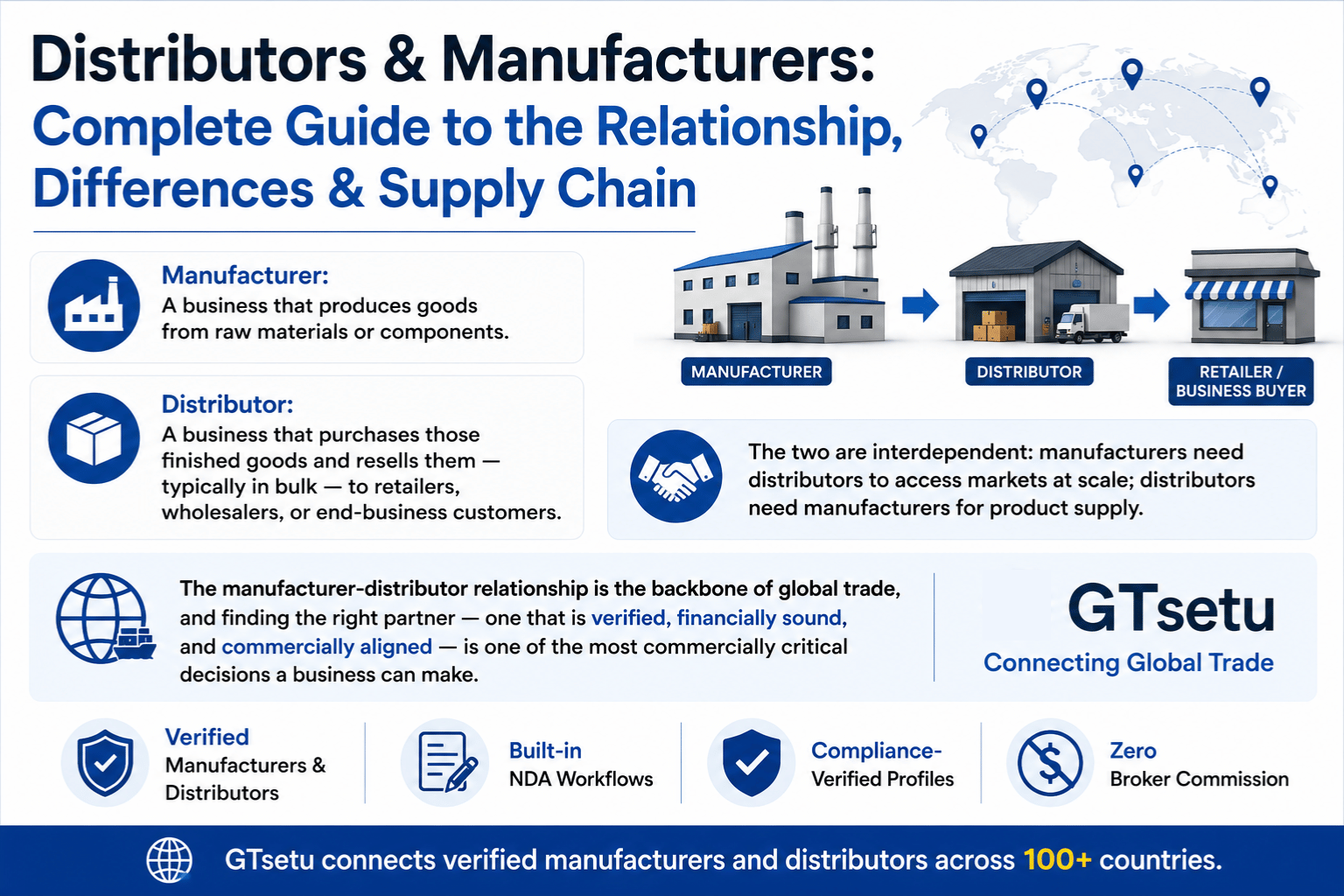
Distributors & Manufacturers: Complete Guide to the Relationship, Differences & Supply Chain
Direct Answer: A manufacturer is a business that produces goods from raw materials or components. A distributor is a business that purchases those finished goods and resells them, typically in bulk, to retailers, wholesalers, or end-business customers. The two are interdependent: manufacturers need distributors to access markets at scale; distributors need manufacturers for product supply. The manufacturer-distributor relationship is the backbone of global trade. GTsetu connects verified manufacturers and distributors across 100+ countries with zero broker commission, built-in NDA workflows, and 6-point government-sourced verification (Name, Address, Registration Number, Company Status, Company Type, Date of Certificate of Incorporation).
📅 February 19, 2026⏱ 18 min read✍️ GTsetu Editorial Team🔄 Updated regularly
500+
Verified Companies
100+
Countries
6-Point
Govt. Sourced Verification
0%
Broker Commission
The relationship between manufacturers and distributors is the engine of global commerce. Nearly every physical product you encounter, whether a pharmaceutical, a consumer electronic, an industrial component, or a food brand, has moved through this relationship at least once before reaching its destination. Yet despite its centrality to trade, the mechanics of how manufacturers and distributors find each other, structure their arrangements, and build productive long-term partnerships remain poorly understood outside the industry.
This guide explains everything: what manufacturers and distributors are, how they differ from wholesalers and suppliers, how the manufacturer-distributor supply chain actually works, what makes the relationship succeed or fail, and how to find and vet verified international distribution partners for global market expansion.
💡 Who Is This Guide For?
This article is written for manufacturers seeking international distributors, distributors seeking manufacturing principals, trade buyers evaluating supply chain options, and business development professionals building cross-border commercial relationships. It also covers the practical questions: do distributors buy from manufacturers? Can a manufacturer act as a distributor? What is the real difference between a manufacturer, distributor, wholesaler, and supplier?
SECTION 1
1 What Are Manufacturers and Distributors?
🎯 Core Definitions
A manufacturer is a business entity that creates finished goods or components by transforming raw materials, parts, or sub-assemblies through a defined production process, whether industrial, chemical, food-grade, pharmaceutical, or otherwise. A distributor is a business entity that purchases finished goods from one or more manufacturers and resells them, typically in bulk, to retailers, wholesalers, or B2B end-buyers, within a specific geographic territory or market segment.
🏭
The Manufacturer
Creates the product
Owns and operates production infrastructure
Transforms raw materials into finished goods
Holds product IP, formulations, and specifications
Sets wholesale / distributor pricing
Manages production capacity and lead times
Responsible for product quality and regulatory compliance
Needs market access, relies on distributors for scale
Revenue model: production margin on goods sold
🚚
The Distributor
Moves the product to market
Purchases finished goods from manufacturers at distributor pricing
Warehouses inventory and manages regional logistics
Owns the customer relationships with retailers and trade buyers
Assumes inventory risk on purchased stock
Provides after-sales service, technical support (in many categories)
Often holds exclusive or semi-exclusive territory rights
Needs product supply, relies on manufacturers for inventory
Revenue model: buy-sell margin between purchase price and resale price
The distinction matters commercially because the two roles generate value in entirely different ways. Manufacturers compete on product quality, price, and innovation. Distributors compete on market reach, logistics infrastructure, and customer relationships. Neither can optimally do the other’s job, which is precisely why the manufacturer-distributor partnership is so commercially powerful when it works well.
For manufacturers exploring how to find international distributors, understanding the distributor’s role, and what a good distributor actually brings to the table, is the essential starting point. Equally, distributors looking to expand their portfolio benefit from understanding how manufacturers think about selecting and supporting their distribution partners.
SECTION 2
2 Manufacturer vs. Distributor: Key Differences
The difference between a manufacturer and a distributor is more than definitional, it reflects fundamentally different business models, risk profiles, capital requirements, and strategic objectives. Understanding these differences is essential for structuring a functional partnership between them.
Dimension
Manufacturer
Distributor
Primary Function
Produce goods from raw materials or components
Purchase and resell finished goods to market channels
Import compliance, local market registration, after-market warranty
Branding
Owns the brand; defines brand standards
Represents the brand in their market; bound by brand guidelines
Strategic Dependency
Depends on distributors for market reach and volume
Depends on manufacturers for product supply and margin
⚡ The Complementarity Principle
The manufacturer’s weakness (lack of local market presence) is precisely the distributor’s strength, and vice versa. A manufacturer attempting to build its own logistics and sales infrastructure in every market it enters would face prohibitive capital requirements. A distributor attempting to manufacture its own products would lose the agility and focus that makes it a strong market operator. This mutual complementarity is what makes the relationship strategically durable when both parties respect their respective roles.
SECTION 3
3 The Supply Chain: Manufacturer → Distributor → Retailer
The manufacturer-distributor-retailer model is the foundational structure of most physical product supply chains globally. Understanding how value, risk, and margin flow through each stage is essential for anyone involved in trade partnerships.
⚙️
Supplier
Raw materials & components
Input cost
🏭
Manufacturer
Produces finished goods
Ex-works price
🚚
Distributor
Warehouses & sells to trade
Distributor price
🏪
Retailer / Trade Buyer
Sells to end customers
Wholesale price
🛒
End Consumer / B2B Buyer
Uses the product
Retail / end price
How Pricing Flows Through the Supply Chain
Each layer in the supply chain adds cost and margin. Understanding this pricing waterfall is critical for manufacturers setting distributor pricing and for distributors evaluating whether a principal’s pricing structure allows a viable margin at their resale level.
Supply Chain Stage
Typical Margin Added
What the Margin Covers
Key Commercial Term
Manufacturer → Distributor
40–60% off RRP (distributor discount)
Manufacturer’s production cost + profit margin
Ex-works or CIF distributor price
Distributor → Retailer / Trade Buyer
20–40% margin on distributor buy price
Warehousing, logistics, sales team, working capital cost
Wholesale / trade price
Retailer → End Consumer
30–60% markup on wholesale price
Store operations, staff, marketing, shrinkage
Retail price / RRP
The pricing structure between manufacturer and distributor is one of the most commercially sensitive aspects of any distribution agreement. Manufacturers must leave enough margin for distributors to cover their operational costs and return a profit; distributors must stay competitive against direct-import buyers and alternative brands. This balance, and who controls what, is at the heart of most manufacturer-distributor commercial negotiations. Understanding Incoterms is also critical when agreeing on delivery and risk transfer points across borders.
In some industries, the supply chain includes a wholesaling layer between the distributor and the retailer, particularly in fast-moving consumer goods (FMCG), food and beverage, and pharmaceutical distribution. In others, the manufacturer sells directly to a large retailer or B2B buyer, bypassing the distributor. The model that applies depends on:
📦
Product Category
Commodities and FMCG often involve wholesalers. Specialised industrial products typically move direct from manufacturer to distributor to end-user without a retail layer.
🗺️
Market Geography
Smaller or fragmented markets may require more intermediary layers to achieve coverage. Concentrated urban markets may allow direct manufacturer-to-retailer arrangements.
💰
Margin Economics
High-margin products can sustain more intermediary layers. Low-margin commodities favour shorter, direct supply chains to preserve viability at each stage.
⚙️
Technical Complexity
Products requiring after-sales service, technical installation, or training typically require a distributor who can provide these capabilities, not just a logistics intermediary.
📜
Regulatory Requirements
In pharmaceuticals, medical devices, and food, regulatory import registration may require a locally-licensed distributor regardless of the manufacturer’s preference for a direct model.
📊
Volume and Scale
Very high-volume commodity trade often collapses the supply chain: a large manufacturer may ship directly to a retailer or B2B buyer with no distributor layer at all.
SECTION 4
4 The Manufacturer-Distributor Relationship Explained
The manufacturer-distributor relationship is not a simple buyer-seller transaction. At its best, it is a long-term strategic partnership in which each party invests in the other’s success: the manufacturer supports the distributor with product knowledge, marketing materials, and competitive pricing; the distributor commits to market development, volume targets, and brand representation standards.
3–5 yrs
Typical initial term of a distribution agreement in most sectors
67%
of manufacturers cite “finding the right distributor” as their top market entry challenge
$2.1T
annual value of goods flowing through distributor networks globally (est.)
What a Strong Manufacturer-Distributor Relationship Looks Like
📋
Clearly Defined Territory and Exclusivity
A well-structured exclusivity clause and defined territory rights prevent channel conflict. Both parties know exactly where the distributor is authorised to sell, whether they have exclusive or non-exclusive rights, and what the consequences of territorial violation are.
Foundation
🎯
Agreed Volume Commitments and Performance Targets
Manufacturers need confidence that a distributor will generate meaningful volume, not just sit on exclusivity without selling. Volume commitments, minimum annual purchase quantities, are the standard mechanism. These protect the manufacturer’s commercial planning while holding the distributor accountable to genuine market development.
Commercial
🤝
Transparent Pricing and Margin Structures
Both parties need to earn a viable margin for the relationship to endure. The manufacturer’s pricing structure must leave the distributor enough room to cover logistics, sales, after-sales service, and profit, while remaining competitive in the market. Pricing conflicts are one of the primary causes of distribution relationship breakdown.
Pricing
📢
Joint Market Development Investment
The most productive manufacturer-distributor relationships involve joint investment in market development: the manufacturer provides marketing materials, training, and sometimes co-operative marketing funds; the distributor provides local market intelligence, sales team deployment, and end-customer relationships. Both parties treating it as a shared investment rather than a transactional order-taking exercise produces dramatically better outcomes.
Growth
⚖️
Clear Agreement on Termination and Exit Conditions
Every distribution agreement needs well-drafted termination clauses that specify the grounds for termination, notice periods, stock buyback obligations, and transition arrangements. The absence of these provisions, or their asymmetry, is a frequent source of expensive disputes when market conditions change or a relationship underperforms.
Legal
🔐
Confidentiality and IP Protection Throughout
Manufacturers share sensitive pricing, product formulations, and market strategy with their distributors. Distributors share client networks and market intelligence. A robust mutual NDA and appropriate IP ownership provisions in the distribution agreement protect both parties against information misuse, even if the partnership is later terminated.
Security
Why Manufacturer-Distributor Relationships Fail
Most distribution relationship failures are predictable and preventable. The most common causes are:
Failure Cause
Manufacturer Perspective
Distributor Perspective
Prevention
Pricing Conflict
Manufacturer undercuts distributor with direct sales or lower pricing to other channels
Manufacturer’s pricing leaves insufficient margin after local costs
Agreed pricing floor and channel conflict protection in contract
Volume Underperformance
Distributor holds exclusivity but generates negligible volume
Manufacturer’s support insufficient to achieve promised targets
Realistic volume commitments tied to measurable support obligations
Brand Misrepresentation
Distributor uses incorrect product claims, sub-standard packaging, or grey-market diversion
Manufacturer provides no brand guidelines or training
Detailed brand standards in agreement + periodic compliance audits
Lack of Market Development
Distributor takes orders but invests nothing in building the market
Manufacturer expects market growth without providing tools or co-investment
Agreed joint business plan with shared targets and investment commitments
Communication Breakdown
Manufacturer changes pricing/product without adequate notice
Distributor withholds market intelligence to protect negotiating position
Regular structured reviews; transparent information sharing protocols
Unverified Partner Selection
Manufacturer signs with a distributor whose capabilities were not properly vetted
Distributor takes on a manufacturer whose claims about product and support do not match reality
Rigorous pre-engagement verification of both parties’ credentials and capabilities
⚠️ The Verification Gap
A significant proportion of failed distribution relationships stem from inadequate pre-engagement verification. Manufacturers sign with distributors who exaggerated their market coverage, financial standing, or existing customer relationships. Distributors partner with manufacturers whose product quality, supply consistency, or pricing commitments did not match their claims. The solution is not goodwill, it is structured verification of both parties’ core business identities using government-sourced data. This is exactly what the verification infrastructure on a platform like GTsetu provides: 6-point confirmation of Name, Address, Registration Number, Company Status, Company Type, and Date of Incorporation.
SECTION 5
5 Types of Distributors and What Manufacturers Should Know
Not all distributors are the same. Understanding the different types of distribution arrangements helps manufacturers select the right structure for their product category, market, and growth objectives.
🔒
Exclusive Distributor
Has sole rights to sell the manufacturer’s products in a defined territory. In return, they typically commit to volume targets and active market development. High commitment, high investment from both sides.
🔓
Non-Exclusive Distributor
Has the right to sell the product but so do other distributors in the same territory. Lower commitment required from both sides. Common for products with broad market availability needs.
🌍
Master Distributor
Holds exclusive rights for a large territory (often a country or region) and has permission to appoint sub-distributors. Acts as an intermediary between the manufacturer and the local distribution network.
🏪
Value-Added Reseller (VAR)
Common in technology and industrial sectors. The distributor adds services, customisation, or integration to the manufacturer’s product before selling to end customers, increasing product value but adding margin layers.
📦
Stocking Distributor
Purchases and holds physical inventory for immediate supply to market. Assumes full inventory risk. Provides faster delivery to customers and reduces the manufacturer’s working capital requirement in that market.
📋
Commissioned Agent / Sales Rep
Does not take title to goods, acts as an intermediary on commission. Different legal and commercial structure from a true distributor. See our guide to licensing vs distribution agreements for the distinction.
🌐
International / Import Distributor
Specialises in cross-border distribution, handles import documentation, customs, local regulatory registration, and in-market logistics. Critical for manufacturers entering new national markets.
🏭
Affiliated Distributor
An affiliated distributor has a formal ownership, investment, or joint-venture relationship with the manufacturer, rather than being fully independent. Common in capital-intensive industries where manufacturer investment in distribution infrastructure makes commercial sense. See also: joint venture vs strategic alliance.
✅ Choosing the Right Distributor Model
The right distribution model depends on market maturity, product complexity, margin economics, and the manufacturer’s appetite for market control vs. capital efficiency. Exclusive arrangements suit manufacturers who need deep market development and can support one committed partner. Non-exclusive suits manufacturers who need broad availability and are comfortable with distributor competition. Master distributor structures suit markets where local channel knowledge is complex and the manufacturer lacks the bandwidth to manage many direct relationships.
SECTION 6
6 Distributor vs. Wholesaler vs. Supplier: What’s the Difference?
The terms distributor, wholesaler, and supplier are frequently confused, sometimes used interchangeably, which leads to misaligned commercial expectations. Here is the precise distinction between each role.
DimensionDistributorWholesalerSupplier
Relationship with Manufacturer
Typically exclusive or semi-exclusive; contractual partnership
Transactional; buys from multiple sources
IS the manufacturer or raw material provider
Territory Rights
Usually defined exclusive or assigned territory
No exclusivity; buys and sells freely
Not applicable, supplies to anyone
Value-Added Services
Often provides after-sales service, technical support, training
Typically logistics and availability only
Product production and quality
Inventory Ownership
Takes title to goods; assumes inventory risk
Takes title to goods; assumes inventory risk
Holds raw materials and finished goods pre-sale
Typical Customer
Retailers, B2B buyers, sub-distributors
Retailers, small distributors, end-buyers
Manufacturers; distributors (for raw material suppliers)
Brand Representation
Usually represents the manufacturer’s brand actively
Minimal brand representation; sells on availability/price
Owns and controls the brand
Selection Process
Selected by manufacturer; mutual fit evaluation
Self-selecting; accesses any product they can buy profitably
Selected based on capability, quality, and price
Commercial Agreement
Formal distribution agreement with terms, targets, exclusivity
Standard trade terms; no formal partnership contract
Manufacturing or supply agreement; pricing schedule
The full supplier-manufacturer-distributor-retailer-customer chain can be thought of as a pipeline where each party adds a specific type of value: the supplier provides inputs, the manufacturer creates the product, the distributor provides market access and logistics, the retailer provides point-of-sale access, and the customer receives end-use value. Understanding which role a potential partner plays, and whether that role matches your need, is the essential commercial framing for any trade partnership discussion. Related reading: supplier collaboration platforms and B2B secure collaboration.
SECTION 7
7 Can a Manufacturer Be a Distributor?
🎯 Direct Answer
Yes, a manufacturer can operate as a distributor. This is known as a direct distribution or manufacturer-direct model, and it is commercially common in certain industries. However, it involves fundamentally different capabilities and capital requirements from pure manufacturing, and most manufacturers find that using independent distributors is more capital-efficient for reaching multiple markets at scale.
When Manufacturers Distribute Their Own Products
Model
How It Works
Common In
Trade-Off
Direct-to-Retail (DtR)
Manufacturer sells and delivers directly to retail chains, bypassing distributor layer
Large consumer goods manufacturers, automotive parts, medical devices
Higher control, higher logistics cost, requires own sales infrastructure
Direct-to-Consumer (DtC)
Manufacturer sells via own e-commerce, brand stores, or direct sales team
Luxury goods, electronics, niche DtC brands
Maximum margin capture; requires marketing and fulfilment investment
Manufacturer-Owned Distribution Company
Manufacturer creates or acquires a wholly-owned subsidiary that functions as a distributor
Pharmaceutical, chemical, industrial equipment companies in key markets
Full control and data visibility; very high capital and operational commitment
Hybrid Model
Manufacturer uses direct distribution in home market or key accounts while using independent distributors in international markets
Most large manufacturers globally
Balances control and capital efficiency; can create channel conflict if not managed
Manufacturers also sometimes act as distributors for complementary products, goods they do not manufacture themselves but that their distributor network and customer base can absorb. This is particularly common in industrial, chemical, and building materials sectors where a manufacturer’s sales team and logistics infrastructure can efficiently carry related products alongside their own. This is sometimes associated with white label or private label manufacturing arrangements where the manufacturer brands another company’s product for distribution through their channels.
SECTION 8
8 Do Distributors Buy from Manufacturers?
🎯 Direct Answer
Yes, this is the foundational commercial transaction in the manufacturer-distributor relationship. A distributor purchases finished goods from the manufacturer at an agreed distributor price (typically 30–60% below retail price, depending on the sector and product), takes physical ownership of that inventory, and assumes the commercial risk of selling it into their market. The manufacturer receives a confirmed order and payment; the distributor receives stock and assumes the resale and logistics responsibility.
The purchase terms between manufacturer and distributor govern one of the most commercially sensitive aspects of the relationship. These include:
01
Minimum Order Quantity (MOQ)
Most manufacturers set a minimum order quantity, the smallest order they will accept from a distributor, to ensure commercial viability of each production run or shipment. Understanding MOQ implications is essential for distributors evaluating a new manufacturer relationship: too-high MOQs can create unacceptable inventory risk for distributors in smaller markets.
02
Payment Terms
How and when the distributor pays the manufacturer for purchased goods is a critical commercial negotiation. Options include advance payment, letter of credit, and open account terms, each carrying different risk and cash flow implications. See our guide to advance payment vs LC vs open account for the full comparison.
03
Lead Time and Delivery
The time between a distributor placing an order and receiving goods affects their ability to maintain stock availability for their customers. Lead times need to be clearly understood and contractually confirmed, particularly for seasonal products or time-sensitive market launches. Most distribution agreements include agreed maximum lead times and consequences for delays.
04
Incoterms and Risk Transfer
When does ownership of the goods transfer from manufacturer to distributor, and who bears the risk during transport? Incoterms define the exact point of risk transfer and responsibility for freight, insurance, and customs. The choice of Incoterm (EXW, FOB, CIF, DDP) has significant implications for both parties’ logistics costs and responsibilities.
05
Volume Commitments and Annual Targets
Distribution agreements often include agreed annual purchase volumes, either as a firm commitment or as a soft target with consequences for underperformance (such as loss of exclusivity). Volume commitments are the manufacturer’s protection against a distributor holding exclusivity without genuine commercial effort.
06
Rebates and Incentive Structures
Many manufacturers operate rebate programmes, additional discounts or payments to distributors who achieve volume, growth, or market development targets above their baseline commitment. These incentive structures can meaningfully strengthen the manufacturer-distributor relationship when designed well, aligning both parties’ interests around shared growth rather than pure transactional pricing.
SECTION 9
9 How Manufacturers Find Verified International Distributors
Finding the right international distribution partner is one of the most commercially consequential decisions a manufacturer makes when entering a new market. The wrong choice, a distributor who lacks genuine market reach, financial stability, or commercial commitment, can set back market entry by years. The right choice, however, can unlock a market faster and more cost-effectively than any direct investment.
18 mo
Average time lost when a manufacturer signs with the wrong distributor and needs to replace them
72%
of failed distributor partnerships involve inadequate pre-engagement verification of credentials
5x
faster market penetration achieved by manufacturers who pre-vet distribution partners vs. reactive selection
Traditional Methods, and Their Limitations
Method
How It Works
Limitation
Trade Shows and Exhibitions
Meet potential distributors in person at industry events
High cost per contact; no pre-vetting; post-show follow-up unsecured; annual frequency limits responsiveness
Cold Email / LinkedIn Outreach
Contact potential distributors directly via email or social media
No identity verification; confidential information shared before any NDA; low response rates; high fraud risk
Trade Directories (e.g. Alibaba, IndiaMART)
Browse listings of importers, distributors, and traders
Self-reported profiles with no government-sourced verification; no NDA infrastructure; commission-driven incentives; see our alternative to Alibaba comparison
Chamber of Commerce Referrals
National or bilateral chambers provide distributor introductions in target markets
Coverage uneven; no structured vetting; limited to chamber membership pool
Broker-Assisted Introductions
A trade agent introduces manufacturers to distributors for a commission
5–15% commission on deal value; broker incentives not always aligned with manufacturer’s long-term interests
Verified B2B Platform (GTsetu)
Browse 6-point government-sourced verified distributor profiles, engage anonymously, execute NDA before any data is shared
Best-practice solution, see Section 11 for full comparison
🌍 International Wholesale Distributor USA, A Special Case
The US market is one of the most sought-after distribution territories globally. US-based wholesale distributors typically expect manufacturers to have FDA, FCC, or other relevant regulatory clearances already in place before they will engage. They also expect robust product liability insurance and clear MSRP / MAP (minimum advertised price) policies. Manufacturers seeking US distribution should verify these requirements and have documentation ready, a verified platform like GTsetu ensures US-registered distributors on the platform have their core business credentials (Name, Address, Registration Number, Company Status, Company Type, Date of Incorporation) pre-verified using government tie-ups, reducing the vetting burden on both sides.
SECTION 10
10 What to Look For When Selecting a Distribution Partner
Not all distributors with market coverage are the right distributors for your product. The selection criteria that matter most depend on your product category, target market, and commercial objectives, but the following framework applies universally:
Selection Criterion
What to Verify
How to Verify It
Red Flag
Legal Business Registration
The company is a legally registered entity in its claimed jurisdiction
Business registration certificate from official registry; company number check; GTsetu pre-verifies these 6 points using government tie-ups
No verifiable registration; registration country doesn’t match operational claims
Import and Trade Licences
The distributor holds valid import licences for your product category in their market (Note: GTsetu does not verify licences; this is buyer’s responsibility)
Review licence documents directly with the distributor; check validity dates and product scope with issuing authorities
“We can get the licence” is not the same as holding one
Existing Market Coverage
They genuinely have the retailer/trade buyer relationships they claim
Request verifiable references; check product categories they already distribute
Distributor cannot name specific current accounts or provide verifiable references
Financial Health
They have the working capital to purchase and hold your inventory
Request financial summary; assess credit standing; review payment history with other principals
Requests for extended credit from day one; inability to demonstrate financial capacity
Logistics Infrastructure
They have warehouse facilities, transport, and delivery capability appropriate to your product
Site visit (where possible); photo documentation; third-party logistics audit
Distributor who “uses third-party logistics for everything” with no owned infrastructure
Technical Capability
For technical products, they have staff who can understand and represent your product correctly
Request team qualifications; conduct product knowledge assessment
Sales team with no technical background for a product requiring technical selling
Competing Principals
They do not already distribute directly competing products that would conflict with your interests
Review their current product portfolio; contractually prohibit direct competitor carriage
Distributor represents your direct competitor in the same category
Authority of Representative
The person you are negotiating with has authority to bind the company commercially
Request authority letter or board resolution confirming signing authority (Note: GTsetu does not verify this; buyer’s responsibility)
Negotiating with someone who later says “I need to get approval from above” after heads of terms agreed
Distribution Partner Selection Checklist
Business registration verified against official registry in their jurisdiction (6-point: Name, Address, Registration Number, Company Status, Company Type, Date of Incorporation)
Import and trade licences valid and in-scope for your product category (buyer verification required)
Authority letter confirming the representative’s signing power (buyer verification required)
Verifiable existing customer / retailer relationships in the target market
Financial health assessment, adequate working capital for inventory investment
Warehouse and logistics infrastructure confirmed (not just claimed)
No direct competing principals in your product category
Technical capability of sales team assessed against your product requirements
Mutual NDA executed before any pricing or product specification is shared
Reference check with at least two of their current manufacturer principals
Regulatory compliance status in their market confirmed (import rules, labelling, registration)
Terms of proposed distribution agreement reviewed by qualified legal counsel
SECTION 11
11 How GTsetu Connects Verified Manufacturers & Distributors
🌐 Platform Spotlight, GTsetu
The Verified Platform for Manufacturer-Distributor Partnerships Across 100+ Countries
GTsetu was built specifically to solve the two biggest problems in international manufacturer-distributor matching: the verification gap (engaging with unverified companies who misrepresent their credentials) and the information security gap (sharing sensitive commercial data before proper confidentiality infrastructure is in place). Every company on GTsetu is verified on six government-sourced points: Name, Address, Registration Number, Company Status, Company Type, and Date of Certificate of Incorporation. Every sensitive data exchange is protected by NDA workflow and end-to-end encryption.
🏛️
6-Point Government-Sourced Verification
GTsetu verifies Name, Address, Registration Number, Company Status, Company Type, and Date of Certificate of Incorporation using government tie-ups. No self-reporting, no document uploads without confirmation.
🕵️
Anonymous Discovery
Browse verified manufacturers and distributors across 100+ countries without revealing your identity until mutual interest is confirmed. Your market expansion strategy stays private.
📄
Built-In NDA Workflow
Digital NDA execution with timestamped signatures and audit trail, triggered before any sensitive information can be shared between potential partners.
🔐
Encrypted Document Workspace
All pricing, product specs, and commercial documents shared via AES-256 encrypted workspace, never via open email or unprotected file links.
📋
Full Audit Trail
Every document view, NDA signature, and communication event logged and timestamped, providing legal evidence and compliance documentation.
🚫
Zero Commission
GTsetu never takes a success fee or broker commission on any partnership formed. Your deal economics stay entirely between you and your partner.
🌍
100+ Countries
Active verified network across Asia, Middle East, Europe, Africa, Australia, and the Americas, including verified wholesale distributors USA.
⚡
Days, Not Months
Pre-verified partner pool means qualified matches in days rather than the months of trade show and cold outreach cycles.
Q
What is the difference between a manufacturer and a distributor?
A manufacturer creates or produces physical goods from raw materials or components through a defined production process. A distributor purchases those finished goods from the manufacturer and resells them, typically in bulk, to retailers, wholesalers, or B2B end-buyers within a defined territory. The manufacturer owns production capacity, product IP, and brand; the distributor owns market access, customer relationships, and logistics infrastructure. Manufacturers make money on production margin; distributors make money on the buy-sell spread between their purchase price and resale price. The two roles are complementary and interdependent.
Q
Do distributors buy from manufacturers?
Yes, this is the foundational commercial transaction in the manufacturer-distributor relationship. A distributor purchases finished goods from the manufacturer at an agreed distributor price (typically 30–60% below retail price, depending on the sector), takes physical ownership of that inventory, and assumes the commercial risk of selling it into their market. The purchase terms, including MOQ, payment terms, lead times, and delivery conditions under agreed Incoterms, are typically governed by a formal distribution agreement between the two parties.
Q
Can a manufacturer be a distributor?
Yes. Some manufacturers operate their own distribution networks, known as direct distribution or manufacturer-direct models. This is common in industries where brand control and customer relationships are strategically critical, automotive, pharmaceuticals, luxury goods, and industrial equipment, for example. Manufacturers may also distribute complementary products (not their own) through their existing sales infrastructure. However, most manufacturers find that using independent distributors is more capital-efficient for reaching multiple geographic markets at scale, since building distribution infrastructure in every territory is costly and operationally complex.
Q
What is the manufacturer-distributor-retailer supply chain?
The manufacturer-distributor-retailer chain is the standard B2B supply chain structure for physical goods: the manufacturer produces goods and sells to a distributor at distributor pricing; the distributor warehouses and manages inventory in their territory, then sells to retailers or trade buyers; retailers sell to end consumers at retail price. Each stage adds cost, risk, and margin. Variants include models with an additional wholesaler layer between distributor and retailer, and direct manufacturer-to-retailer models in sectors where the supply chain is concentrated enough to make the distributor layer unnecessary.
Q
What is the difference between a distributor and a wholesaler?
A distributor typically has a contractual, often exclusive relationship with the manufacturer for a specific territory, represents the manufacturer’s brand, and may provide after-sales service and technical support. A wholesaler buys in bulk from multiple manufacturers or distributors without exclusivity and resells to retailers or small distributors purely on price and availability, with minimal brand representation or service obligation. Distributors are generally more integrated into the manufacturer’s go-to-market strategy; wholesalers are primarily logistics and price intermediaries.
Q
What is an affiliated distributor?
An affiliated distributor is a distributor that has a formal ownership, investment, or corporate relationship with the manufacturer, rather than being fully independent. The manufacturer may own a minority or majority stake in the distributor company, or the two may be part of the same corporate group. Affiliated distributor arrangements are common in capital-intensive sectors where the manufacturer wants greater control over market execution while still benefiting from the distributor’s local infrastructure and market relationships. This is distinct from a wholly-owned subsidiary, where the manufacturer owns the distributor entirely.
Q
What is the difference between a supplier, manufacturer, and distributor?
A supplier provides raw materials, components, or inputs to manufacturers. A manufacturer transforms those inputs into finished goods. A distributor purchases those finished goods and moves them through trade channels to retailers or B2B buyers. In common usage, “supplier” is sometimes used loosely to describe any upstream party, including manufacturers, but the precise distinction is that a supplier provides inputs, a manufacturer creates outputs, and a distributor delivers those outputs to market. Each role in the supplier-manufacturer-distributor-retailer-customer chain adds different types of value and carries different commercial risks.
Q
How do manufacturers find verified international distributors?
Manufacturers can find verified international distributors through purpose-built B2B platforms like GTsetu, which pre-verify every distributor’s business registration details (Name, Address, Registration Number, Company Status, Company Type, Date of Certificate of Incorporation) using government tie-ups before allowing them onto the platform. This eliminates the fraud, misrepresentation, and information security risks common with cold email outreach or unverified trade directories. GTsetu covers 100+ countries and operates on a zero-commission model, no success fee is taken on any partnership formed. Manufacturers can also use trade show networking, chamber of commerce introductions, and broker-assisted outreach, though all of these require additional verification effort compared to a pre-verified platform.
Q
What should a manufacturer look for when selecting a distributor?
Key criteria include: verified legal business registration (Name, Address, Registration Number, Company Status, Company Type, Date of Incorporation) against official registry; valid import and trade licences for your product category in their market (buyer to verify); demonstrable existing customer relationships (not just claimed ones); adequate financial standing to purchase and hold inventory; appropriate warehousing and logistics infrastructure; technical capability matched to the product category; no current distribution of directly competing products; and authority confirmation of the person negotiating the agreement. Manufacturers should also require a mutual NDA before sharing any pricing or product specification, and should conduct reference checks with at least two of the distributor’s current manufacturer principals.
Q
What is buying from a manufacturer vs. buying from a distributor?
Buying directly from a manufacturer typically means lower per-unit pricing (since the distributor margin is removed), but also higher minimum order quantities, longer lead times, and more responsibility for logistics, import documentation, and regulatory compliance. Buying from a distributor means paying a higher per-unit price that includes the distributor’s margin, but gaining the benefit of local stock availability, shorter lead times, local language support, and the distributor handling import and regulatory logistics. For most buyers, retailers, trade buyers, and B2B companies, the distributor’s services more than justify their margin; only very large buyers with sufficient volume can make direct manufacturer sourcing cost-effective.
Find Verified Manufacturers and Distributors Across 100+ Countries
Join 500+ verified manufacturers and distributors building global trade partnerships on GTsetu, with 6-point government-sourced verification, anonymous discovery, zero broker fees, and built-in NDA workflows to protect your most sensitive commercial information.
They represents the product, and research team behind GTsetu, a global B2B collaboration platform built to help companies explore cross-border partnerships with clarity and trust. The team focuses on simplifying early-stage international business discovery by combining structured company profiles, verification-led access, and controlled collaboration workflows.
With a strong emphasis on trust, and disciplined engagement, Team GTsetu shares insights on global trade, partnerships, and cross-border collaboration, helping businesses make informed decisions before entering deeper commercial discussions.