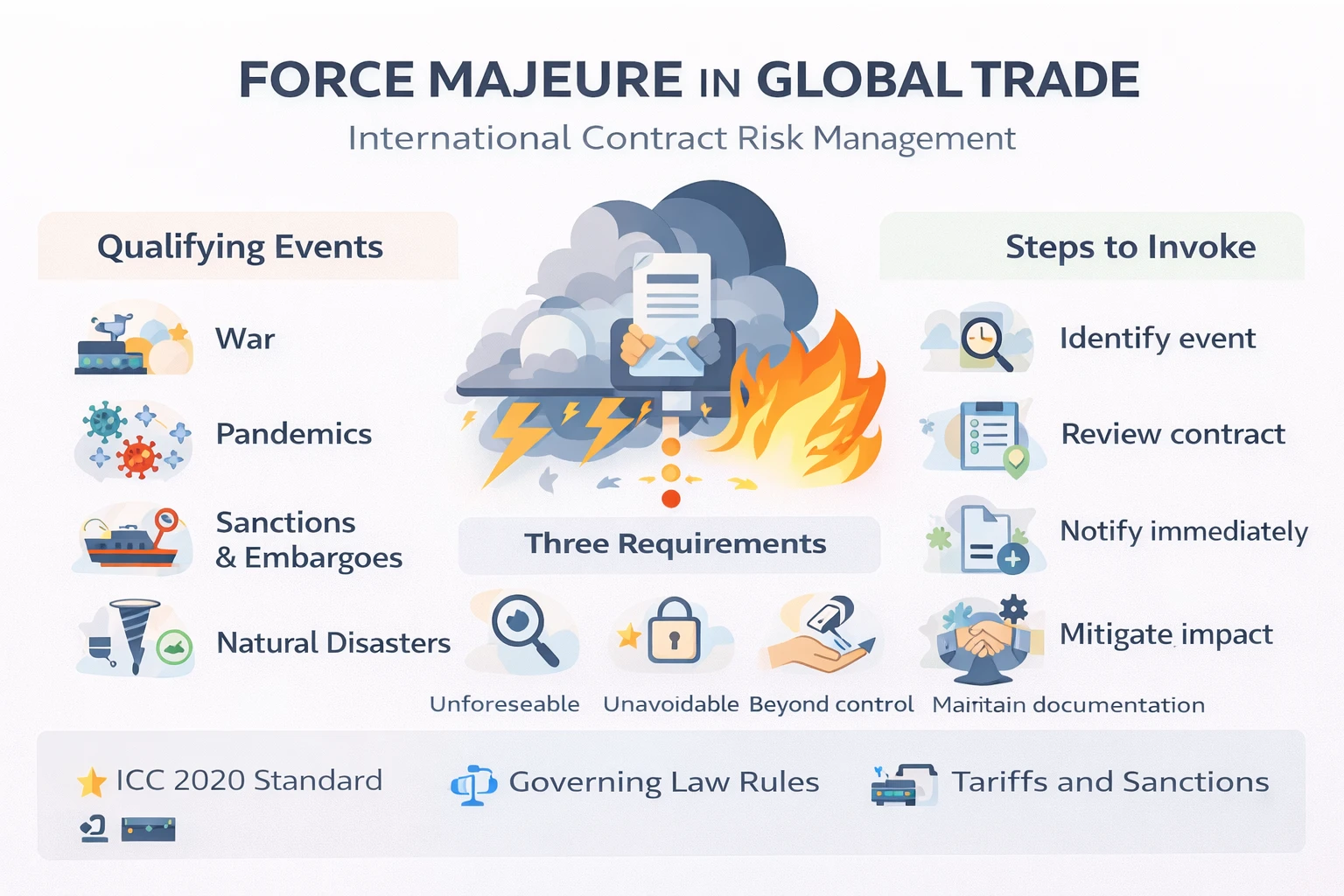
Force Majeure in Global Trade: Complete Guide for Manufacturers & Distributors
Direct Answer: Force majeure in global trade is a contractual doctrine that excuses a manufacturer or distributor from performing their contractual obligations when an unforeseeable, unavoidable, and external event — such as a war, pandemic, trade embargo, natural disaster, or sudden government restriction — makes performance impossible or impracticable. Under common law systems like English law, force majeure has no automatic legal existence: it must be expressly written into the contract with precise language covering qualifying events, notification obligations, and consequences. For manufacturers and distributors managing cross-border distribution agreements, licensing and distribution contracts, or contract manufacturing arrangements, a robust force majeure clause is not optional — it is commercial risk infrastructure.
📅 April 10, 2026⏱ 18 min read✍️ GT Setu Editorial Team🔄 Updated regularly
3
Core Legal Elements
100+
Jurisdictions Affected
$4.9M
Avg B2B Contract Dispute Cost
ICC
Model Clause Standard
Every cross-border trade contract is executed in a world that will not stay still. Geopolitical tensions escalate overnight. Pandemics shut ports and factories. Governments impose sudden export bans. Earthquakes disrupt supply chains that took years to build. In each of these scenarios, the question that determines commercial survival is not “what happened?” — it is “what does your contract say?”
Force majeure is the legal mechanism that answers that question. Yet despite its universal importance, it remains one of the most poorly understood, inconsistently drafted, and frequently contested clauses in international trade agreements. Manufacturers assume their contracts are protected. Distributors assume an event “beyond their control” is automatically covered. Both are often wrong — sometimes catastrophically so.
This guide covers the complete framework: what force majeure means in international trade, how it differs across legal systems, how the ICC model clause works, how to draft a clause that actually holds up in arbitration, and how the partner verification infrastructure on GTsetu reduces the underlying commercial risk that makes force majeure events so damaging in the first place.
💡 Who Is This Guide For?
This guide is written for manufacturers and distributors managing cross-border trade agreements, procurement officers, business development teams engaged in cross-border business partnerships, legal counsel drafting or reviewing international contracts, and business owners entering new markets who need to understand how force majeure intersects with Incoterms, termination clauses, and exclusivity clauses in their agreements.
SECTION 1
1 What Is Force Majeure in Global Trade?
🎯 Definition
Force majeure (from the French: “superior force”) is a contractual doctrine that excuses a party from performing their contractual obligations when an unforeseeable, unavoidable, and externally caused event makes that performance impossible or impracticable. In global trade, it addresses the legal consequences when extraordinary events — wars, pandemics, natural disasters, government trade restrictions, or embargoes — prevent a manufacturer or distributor from fulfilling their contracted duties.
The doctrine traces its origins to French civil law, where it evolved from the concept of cas fortuit (fortuitous event). Today it appears, in varying forms, across virtually every major legal system — though with critically different interpretations and thresholds that make cross-border drafting a specialist exercise.
Crucially, force majeure and hardship — though related — are distinct legal concepts with different triggers and different consequences. Understanding that distinction is essential for any manufacturer or distributor managing long-term cross-border agreements. We cover this in detail in Section 3.
Force Majeure vs. Related Doctrines — A Quick Map
Doctrine
Applicable When
Consequence
Legal System
Force Majeure
Performance becomes impossible or impracticable due to external, unforeseeable event
Suspension of obligation; potential termination if prolonged
Civil law + contractual (common law)
Hardship (Imprévision)
Performance remains possible but is excessively burdensome due to changed circumstances
Right to renegotiate; contract adaptation
Civil law (France, Germany, Italy); UNIDROIT
Frustration
Supervening event radically changes the nature of what was contracted
Automatic discharge of contract
English common law
Impossibility / Impracticability
Performance becomes objectively impossible or commercially impracticable
Discharge of obligation
US law (UCC §2-615)
Rebus Sic Stantibus
Fundamental change of circumstances that would not have led parties to enter contract
Right to modify or terminate
Spanish, Italian, and Scandinavian systems
⚠️ The Common Law Trap
Under English law — and other common law jurisdictions including Singapore and Hong Kong — force majeure has no standalone legal existence. It applies only if expressly provided for in the contract. Without a written force majeure clause, a party claiming relief under English law must rely on the far narrower doctrine of frustration, which rarely succeeds. Many manufacturers and distributors using English law as governing law in their licensing and distribution agreements are unknowingly unprotected.
SECTION 2
2 The Three Core Elements of Force Majeure
To successfully invoke force majeure in a cross-border trade contract — whether under civil law, the ICC clause, CISG Article 79, or UNIDROIT Principles — the claiming party must satisfy three cumulative elements. All three must be present simultaneously. Failing any single element defeats the claim entirely.
01
Element One
Unforeseeability
The event could not reasonably have been anticipated by the parties at the time of contract formation. An event that was already foreseeable — including known political instability, ongoing disputes, or pre-existing regulatory conditions — fails this test. The “reasonable foreseeability” standard varies by jurisdiction but is always assessed at the moment the contract was signed.
02
Element Two
Irresistibility / Unavoidability
The party could not prevent the event or its consequences despite exercising reasonable diligence. This element requires demonstration that alternatives were explored and found genuinely unavailable — not merely inconvenient or more expensive. A manufacturer who could have sourced from an alternative supplier typically cannot invoke force majeure on the basis of their primary supplier’s disruption.
03
Element Three
Externality / Causation
The event must be genuinely beyond the party’s control and causally linked to their non-performance. Internal business failures — financial difficulties, supply chain mismanagement, internal labour disputes — do not qualify. The event must be external to both parties and must directly cause the impossibility of performance, not merely make it more difficult.
⚠️ The Most Common Failure Points
In ICC arbitration cases, force majeure defences most frequently fail on two grounds: (1) the unforeseeability element — the court finds the event was reasonably anticipatable given available information at contract signing; and (2) causation — the party cannot prove the event directly caused their inability to perform rather than merely increasing their costs or inconvenience. Courts apply strict standards on both. Vague force majeure clauses that do not expressly define qualifying events make these defences even harder to maintain.
The CISG Article 79 Framework
For international sale of goods contracts governed by the CISG (UN Convention on Contracts for the International Sale of Goods — applicable to transactions between parties in over 90 signatory countries), Article 79 provides the primary force majeure framework. It excuses a party from liability for failure to perform if they can prove the failure was due to an impediment beyond their control that they could not reasonably be expected to have taken into account, or to have avoided or overcome.
CISG Article 79 Requirement
What It Means in Practice
Common Failure Scenario
Impediment beyond control
Objective obstacle external to both parties
Financial difficulty, internal logistics failure — not qualifying
Not reasonably expected at contract formation
Objective foreseeability test at signing date
Signing contract during ongoing geopolitical crisis = foreseeable
Could not be overcome
Genuine impossibility after exhausting alternatives
Alternative suppliers existed but were more expensive = not qualifying
Notice requirement
Party must notify other party promptly of impediment
Delayed notification can invalidate an otherwise valid claim
Third-party impediment
CISG Art 79(2): third-party failures only exempt if third party also meets Art 79(1)
Supplier failure ≠ automatic force majeure unless supplier also qualifies
SECTION 3
3 Force Majeure vs. Hardship: A Critical Distinction
Force majeure and hardship address different problems. Confusing them is one of the most consequential errors in cross-border contract management — particularly in long-term distribution agreements and joint venture or strategic alliance arrangements where economic conditions can shift dramatically over the contract term.
DimensionForce MajeureHardship
Performance status
Impossible or impracticable
Still possible but excessively burdensome
Trigger
External, unforeseeable event makes performance impossible
Changed circumstances fundamentally alter economic equilibrium of contract
Primary consequence
Suspension of obligation; possible termination
Right to renegotiate; contract adaptation by arbitrator
Trade example
Factory destroyed by earthquake — delivery impossible
Sudden 25% tariff increase makes contract commercially non-viable but delivery remains possible
ICC model coverage
ICC Force Majeure Clause 2020
ICC Hardship Clause 2020
Common law status
No automatic existence; must be in contract
Generally not recognised — must be expressly included
Civil law recognition
Most civil law systems recognise it automatically
Recognised in Germany, France, Netherlands, Italy, and UNIDROIT
💡 Practical Implication for Trade Agreements
In a 5-year exclusive distribution agreement, force majeure addresses a sudden warehouse fire or port closure. Hardship addresses a scenario where a sudden tariff regime makes the agreed pricing structure commercially untenable — delivery is still possible, but the economic basis of the deal has been destroyed. Best-practice cross-border contracts include both force majeure and hardship clauses. For guidance on how these interact with exclusivity clauses and termination provisions, refer to our dedicated guides.
SECTION 4
4 Qualifying Events in International Trade Contracts
What qualifies as a force majeure event in global trade? The answer depends on three things: the specific contract language, the governing law, and the facts of the particular event. However, certain categories of events are widely recognised across jurisdictions and by the ICC.
🌪️
Acts of God / Natural Disasters
Earthquakes, hurricanes, floods, wildfires, volcanic eruptions, tsunamis. Universally recognised across all legal systems, provided no prior warning existed at contract signing.
⚔️
War & Armed Conflict
Declared or undeclared wars, armed conflict, civil war, insurgency, military operations. Typically recognised, though contracts may exclude armed conflict in certain territories.
🦠
Pandemics & Health Emergencies
Government-declared health emergencies with mandatory shutdowns. COVID-19 was widely accepted in jurisdictions with government-imposed lockdowns. Now frequently listed explicitly in contracts.
🚫
Trade Embargoes & Sanctions
Sudden government-imposed trade restrictions, export bans, or sanctions that post-date contract signing. Pre-existing embargoes or anticipated restrictions may fail the foreseeability test.
🏛️
Government Acts / Regulatory Changes
New laws or regulations making contractual performance illegal. Government seizure or nationalisation of assets. Import/export licence revocation after contract signing.
💥
Terrorism & Sabotage
Terrorist attacks that directly prevent performance. Sabotage of critical infrastructure by third parties beyond the contracting party’s control.
🛠️
Labour Disputes (Jurisdiction-Dependent)
Strikes and industrial action: recognised in some jurisdictions (Vietnam, Thailand) as potential force majeure. Not recognised in France. Depends heavily on contract language and governing law.
⚡
Critical Infrastructure Failure
Major cyber attacks on critical infrastructure, widespread internet outages, power grid failures affecting entire production capacity. Increasingly included in modern contracts post-2020.
Events That Typically Do NOT Qualify
Does Not Qualify
Financial Difficulty
A party’s inability to pay or financial insolvency is never force majeure — it is an internal business risk that must be managed through other contractual mechanisms.
Does Not Qualify
Market Price Changes
Fluctuations in raw material costs, currency movements, or commodity prices are foreseeable commercial risks. They may qualify as hardship but rarely as force majeure.
Does Not Qualify
Supply Chain Mismanagement
Failure to manage your own supply chain, inventory, or logistics does not constitute force majeure even if a sub-supplier fails — unless that sub-supplier independently qualifies.
Does Not Qualify
Pre-Existing Conditions
Events already underway or foreseeable at the time of contract signing — including ongoing political instability, known regulatory changes, or existing disputes — fail the unforeseeability test.
Disputed
Tariff Increases
Whether sudden tariff shocks qualify depends entirely on contract language and governing law. Most legal systems do not automatically recognise tariffs as force majeure — explicit inclusion is required.
Disputed
Brexit / Political Change
Gradual political shifts or referendum results: mixed outcomes in arbitration. Courts have generally found political change was foreseeable. Specific regulatory outcomes post-event are more arguable.
SECTION 5
5 Force Majeure Across Jurisdictions
The single most important determinant of whether a force majeure claim succeeds is the governing law of the contract. The same event can exempt a party under French law while creating full liability under English law. This divergence is why manufacturers and distributors structuring cross-border business partnerships must address governing law explicitly — and why the ICC model clause matters so much.
🇫🇷
France
Civil Law
Civil Code Article 1218 codifies force majeure with three requirements: irresistibility, unforeseeability, and external character. Strikes are generally excluded. Hardship (imprévision) was formally incorporated in 2016.
Strong statutory protection
🇬🇧
England & Wales
Common Law
No statutory force majeure doctrine. Purely contractual — clause required. Frustration doctrine exists but is extremely narrow. Courts interpret force majeure clauses strictly against the claiming party.
No automatic protection
🇺🇸
United States
Common Law + UCC
UCC §2-615 provides limited impracticability doctrine for sale of goods. General common law otherwise follows contractual approach. Courts vary by state. Tariffs generally not recognised as force majeure without express contract language.
Partial statutory basis
🇩🇪
Germany
Civil Law
BGB §275 addresses impossibility of performance. Force majeure as such is not codified but similar protections exist through impossibility and frustration doctrines. Good faith obligations (Treu und Glauben) provide additional protection.
Strong civil law framework
🇨🇳
China
Civil Law
Civil Code Articles 180 and 590 expressly recognise force majeure. Three requirements: unforeseeable, unavoidable, insurmountable. Government lockdowns during COVID-19 widely accepted. CCPIT issued force majeure certificates.
Codified + active use
🇮🇳
India
Common Law
Contract Act 1872 Sections 32 and 56 govern impossibility and frustration. Force majeure purely contractual without express clause. Courts apply a relatively narrow test; commercial inconvenience insufficient. Express contractual clause essential.
Contractual clause required
🇸🇬
Singapore
Common Law
Strict contractual interpretation — applies only if expressly in contract and event clearly falls within defined scope. Without a clause, frustration doctrine applies narrowly. Preferred seat for international arbitration; courts apply international standards.
No automatic protection
🌐
UNIDROIT Principles
International Standard
Article 7.1.7 of UNIDROIT PICC mirrors CISG Article 79. Parties may elect UNIDROIT as the governing framework in lieu of national law — commonly used in ICC arbitration where no domestic law is adequate.
International arbitration standard
⚖️ Governing Law Selection in Trade Agreements
When structuring distribution or licensing agreements between parties in different countries, the choice of governing law directly determines what force majeure protection exists by default. Manufacturers and distributors should select governing law deliberately — not by default — with legal counsel familiar with both parties’ jurisdictions. For cross-border agreements between common law and civil law jurisdictions, the ICC Force Majeure Clause provides a neutral, internationally recognised foundation.
SECTION 6
6 The ICC Force Majeure Clause Explained
The International Chamber of Commerce published updated Force Majeure and Hardship Clauses in 2020, replacing the earlier 2003 versions. These model clauses have become the de facto international standard for cross-border commercial contracts, used in manufacturing agreements, distribution agreements, technology transfer agreements, and joint venture arrangements worldwide.
📋
ICC Clause Component 1 — Definition of Force Majeure Event
The clause defines a force majeure event as one that is beyond the party’s reasonable control, could not reasonably have been foreseen at contract formation, and whose effects could not reasonably have been avoided or overcome. The clause provides a non-exhaustive list of examples including war, riot, natural disasters, fire, explosion, pandemic, epidemic, and government acts.
Foundation
📣
ICC Clause Component 2 — Notice Obligation
The affected party must notify the other party promptly upon becoming aware of the force majeure event. Notification must include the nature of the event, its anticipated duration, and its effect on contractual performance. Failure to give timely notice can defeat an otherwise valid force majeure claim — a point frequently missed in practice.
Procedural
⏸️
ICC Clause Component 3 — Effect of Temporary Force Majeure
If the force majeure event is temporary, performance obligations are suspended for the duration. Neither party is in breach during the suspension period. Parties must continue to perform all obligations not affected by the force majeure event. If the party whose performance is suspended is a seller, the buyer’s payment obligation is correspondingly suspended.
Temporary Effect
🔚
ICC Clause Component 4 — Prolonged Force Majeure
If the force majeure event continues beyond a specified period (typically 120 days, though parties may customise this), either party may terminate the contract by notice. On termination, neither party is liable for the consequences of the force majeure event itself, though obligations accrued before the event must be honoured.
Termination Gate
🛠️
ICC Clause Component 5 — Duty to Mitigate
The invoking party must take all reasonable steps to mitigate the effects of the force majeure event — including exploring alternative performance methods, sub-contracting, or partial performance. Failure to mitigate when mitigation was reasonably available can void or limit the force majeure protection.
Obligation
📌 ICC 2020 vs. ICC 2003 — Key Changes
The 2020 revision of the ICC Force Majeure Clause expanded the definition of qualifying events to include pandemics and epidemics explicitly, updated the list of government-imposed restrictions, and clarified the interaction between force majeure and hardship. It also refined the notice provisions to account for digital communication. For contracts signed after 2020, the updated ICC 2020 clause is the appropriate reference. For legacy contracts drafted with the 2003 clause, the interaction between the two versions should be reviewed by qualified legal counsel.
SECTION 7
7 How to Invoke Force Majeure: Step-by-Step
Knowing that a force majeure event has occurred is not enough. The procedural requirements for invoking the clause are just as important as the substantive ones. Many manufacturers and distributors lose valid force majeure claims not because the event was not qualifying — but because they failed to follow the contractual procedure correctly.
01
Identify and Document the Triggering Event
As soon as a potential force majeure event occurs, document everything: date and time of occurrence, nature of the event, official declarations (government orders, emergency decrees, natural disaster certifications), and the direct impact on your ability to perform contractual obligations. For manufacturers in China, obtaining a force majeure certificate from CCPIT (China Council for Promotion of International Trade) is standard practice and carries evidentiary weight in international disputes. For other jurisdictions, contemporaneous records are your primary evidence.
02
Review the Contract Force Majeure Clause Immediately
Pull the contract and read the force majeure clause in full. Confirm: (a) whether the event fits within the defined scope of qualifying events; (b) the notification deadline — many clauses specify 24, 48, or 72 hours; (c) the required content of the notice; (d) who must receive the notice; and (e) the prescribed communication method (registered mail, email, fax). Do not assume — read the exact language. A notice delivered to the wrong person or via the wrong channel may be defective.
03
Issue Formal Written Notice Without Delay
Send written notice as soon as possible and within any contractual deadline. The notice should state: the event that has occurred, the date of its commencement, why it constitutes force majeure under the contract, which obligations are affected, the estimated duration of the impediment, and the steps being taken to mitigate. Send via all methods specified in the contract — and keep delivery receipts. If the contract is silent on notification procedure, send via registered mail and email simultaneously, with read receipts requested.
04
Demonstrate Active Mitigation Efforts
Begin mitigation immediately and document every effort. Courts and arbitrators will scrutinise whether you took all reasonable steps to continue performance through alternative means. This may include: sourcing from alternative suppliers, using different transport routes, partial performance of unaffected obligations, engaging sub-contractors, or seeking regulatory dispensations. Keep a detailed log of every alternative explored, the outcome, and the reason it was insufficient.
05
Maintain Communication Throughout
Force majeure does not end the relationship — it suspends specific obligations. Maintain regular communication with your counterparty about the status of the event, expected duration, and progress on mitigation. Silence during a force majeure period is commercially damaging and may be interpreted as abandonment of the contract. A transparent, documented dialogue demonstrates good faith and significantly reduces the risk of the counterparty treating your non-performance as a material breach.
06
Evaluate Whether to Suspend, Renegotiate, or Terminate
If the force majeure event continues beyond the threshold in the contract (typically 60–180 days), both parties face a decision. Suspension may be appropriate for temporary disruptions. Renegotiation (engaging hardship provisions if included) may be appropriate where economic fundamentals have changed. Termination may be unavoidable if the event is permanent or prolonged. Whatever path is chosen, document the decision and the commercial rationale in writing — it protects both parties in any subsequent dispute.
🚨 Critical: Notice Deadline Failure
In international arbitration, one of the most commonly litigated force majeure issues is the failure to give timely notice. Many contracts require notification within 24–72 hours of the force majeure event. A party that waits weeks to notify — even if the underlying event would have qualified — may find their claim defeated on procedural grounds alone. Set a calendar alert the moment you identify a potential force majeure event. This is especially critical for manufacturers managing contract manufacturing arrangements where multiple parties in the supply chain may be simultaneously affected.
SECTION 8
8 Drafting a Robust Force Majeure Clause
The best time to negotiate force majeure protection is before any crisis occurs — at contract drafting stage, with both parties engaged, incentivised to reach agreement, and free of the commercial pressure that a live dispute creates. The ICC clause provides a solid starting point, but every trade relationship has specific characteristics that warrant tailored drafting.
Force Majeure Clause Drafting Checklist
Clause Component
What to Include
Common Drafting Error
Best Practice
Definition of FM Event
Explicit list of qualifying events + general catch-all clause
Generic catch-all only; no specific events listed
Use enumerated list + general clause: “including but not limited to…”
Three Element Test
Expressly require event to be unforeseeable, unavoidable, and external
No qualification criteria — any “extraordinary event” qualifies
Mirror ICC 2020 language with jurisdiction-specific modifications
Trade Restrictions
Explicitly address embargoes, sanctions, sudden import/export bans, and tariff shocks
Omitting trade-specific events entirely
Include “government-imposed trade restrictions enacted after the date of this agreement”
Notification Deadline
Specify timeframe (e.g., 48 hours), method, and recipient
No deadline specified; vague “prompt” language
48–72 hours; via email + registered mail; to named contract representative
9 Tariffs, Sanctions & Trade Restrictions as Force Majeure
The era of economic nationalism — including the significant tariff disruptions of 2025 and ongoing sanctions regimes — has brought a new category of force majeure claims into focus: whether sudden, unexpected government-imposed trade restrictions qualify as force majeure events. The answer is commercially important for every manufacturer and distributor operating across trade borders.
+25%
Tariffs announced unilaterally that triggered wave of force majeure reviews in 2025
67%
of cross-border manufacturers reviewed force majeure clauses following 2024–2025 trade disruptions
Most
trade lawyers now recommend expressly including tariff shocks in force majeure definitions
The Tariff Force Majeure Analysis
ScenarioForce Majeure OutcomeHardship Outcome
Tariff announced and implemented after contract signing, making export economically impossible
~ Depends on contract language + governing law; strong argument if “government trade restrictions” expressly listed
Tariff increase announced in policy discussions before contract was signed
✗ Fails foreseeability test — known risk at signing
✗ Also likely fails — foreseeable economic risk
Complete export ban imposed by government, making performance legally prohibited
✓ Strong force majeure claim — performance rendered legally impossible
~ Relevant but FM more apt where legal impossibility confirmed
Sanctions imposed on the counterparty’s country after contract signing
✓ Clear force majeure — legal impossibility due to external government act
~ Also relevant for renegotiation if not legally impossible
Currency devaluation or exchange rate movement making contract costly
✗ Commercial risk — does not qualify as force majeure
~ Possible hardship if extreme and unforeseeable
📋 Practical Recommendation — 2026 and Beyond
Given the current environment of trade policy unpredictability, manufacturers and distributors entering new market entry partnerships or renewing existing distribution agreements should include explicit language in their force majeure clauses covering: (1) sudden government-imposed tariffs exceeding [X%] on the contracted goods; (2) newly imposed sanctions on either party’s country enacted after contract signing; (3) complete export or import bans on the contracted product category. These are no longer theoretical — they are live commercial risks that require contractual infrastructure.
SECTION 10
10 Force Majeure in Manufacturer-Distributor Agreements
Manufacturer-distributor relationships have specific force majeure dynamics that differ from one-time sales contracts. These are long-term, multi-obligation arrangements involving volume commitments, exclusivity rights, territory rights, and performance targets — all of which can be affected differently by a force majeure event.
📦
Supply Disruption (Manufacturer-Side)
A factory shutdown, raw material embargo, or production halt due to government order may excuse the manufacturer from delivery obligations. But what happens to the distributor’s exclusivity and minimum purchase commitments during the suspension period? This must be explicitly addressed.
🛒
Demand Collapse (Distributor-Side)
A distributor serving a market under economic shutdown, government restriction, or conflict may be unable to sell contracted goods — and therefore unable to meet minimum order quantities or volume targets. Does this excuse them from performance targets? Only if expressly addressed.
🚢
Logistics Disruption
Port closures, shipping route interruptions, customs authority shutdowns, or Incoterms-relevant events that prevent physical delivery create force majeure considerations for both parties depending on which party bears the transport risk under the agreed Incoterm.
📃
Exclusivity & Territory Rights
If a manufacturer invokes force majeure and suspends supply, does the distributor lose exclusivity? Does the manufacturer regain the right to appoint another distributor during the suspension? The force majeure clause must address what happens to exclusivity and territory rights during and after a force majeure event.
🎯
Performance Targets
Annual sales targets and volume commitments that cannot be met due to a force majeure event must be explicitly addressed: are they suspended, reset, or used as grounds for agreement termination? Silence on this point creates disputes.
🔄
Contract Term Extension
Should the contract term be extended to compensate for the period lost to force majeure? Or does the original end date stand? For long-term exclusive arrangements, a force majeure event mid-contract may necessitate a term extension to allow both parties to realise the commercial benefit of their investment.
Specific Force Majeure Provisions for Manufacturer-Distributor Agreements
Agreement Element
Force Majeure Provision Required
Why It Matters
Minimum Purchase Obligations
Suspend MPOs for the duration of FM event; reset annual targets pro rata
Without this, distributor is in breach of MPOs they cannot fulfil due to FM
Exclusivity Rights
Exclusivity maintained during FM suspension; not grounds for appointment of alternative distributors
Without this, manufacturer may argue FM justifies appointing a parallel distributor
Territory Rights
Territory rights maintained during FM; not subject to clawback during suspension
Prevents manufacturer from using FM to reclaim territory while supply is disrupted
Payment Obligations
Specify whether advance payments or outstanding invoices are suspended during FM
Distributor should not be required to pay for goods that cannot be delivered
Lead Times & Production Times
FM extends agreed lead times without triggering breach
Prevents distributor from claiming late delivery breach during FM supply disruption
Contract Term
Contract term extended by duration of FM event if exceeding [30/60] days
Preserves commercial value of relationship; prevents premature termination
Termination Rights
FM should not automatically constitute a material breach triggering termination rights
Ensures FM events are treated as suspensive rather than immediately terminative
11 How GTsetu Reduces Force Majeure Risk in Partner Discovery
Force majeure addresses what happens when things go wrong inside an existing contract. But the risk landscape is shaped much earlier — at partner selection. The quality of the counterparty, the robustness of their compliance infrastructure, and the strength of the legal framework established before the partnership begins all determine how much commercial damage a force majeure event causes.
This is where GTsetu changes the equation for manufacturers and distributors. A force majeure event is difficult enough to navigate with a well-verified, trust-established partner. With an unverified, unknown counterparty — engaged through cold email or a trade directory with no compliance checks — it can be commercially catastrophic.
🔐 Platform Spotlight — GTsetu
Build Partnerships on Verified Foundations — Before Force Majeure Becomes a Question
GTsetu connects manufacturers and distributors across 100+ countries through a verified, secure collaboration infrastructure. When a force majeure event occurs — a port closure, a sanctions announcement, a pandemic shutdown — the commercial damage is dramatically reduced when the partnership is built on verified compliance, established trust, and documented legal foundations. GTsetu creates those foundations before the first sensitive commercial conversation begins.
🏛️
Multi-Layer Compliance Verification
Business registration, tax documents, import/export licences, industry certifications, and authority letters reviewed before engagement. Know exactly who your counterparty is before any contract is signed.
📄
Built-In NDA Workflows
Digital NDA execution with full audit trail before sensitive commercial information — including pricing structures, product specifications, and market strategy — changes hands.
🔐
Encrypted Document Workspace
All contract drafts, commercial proposals, and due diligence materials shared through AES-256 encrypted channels — with role-based access and complete audit trail.
🕵️
Anonymous Discovery
Browse verified distributor and manufacturer profiles without revealing your identity or market expansion plans. Identities revealed only on mutual confirmation of interest.
🌍
100+ Country Coverage
Verified manufacturers and distributors across Asia, Middle East, Europe, Africa, Australia, and the Americas — with jurisdiction-aware compliance profiles.
🚫
Zero Broker Commission
No success fee or commission on any partnership formed. The commercial terms of your distribution agreement remain entirely between you and your partner.
The GTsetu Advantage: Why Verified Partners Navigate Force Majeure Better
When a force majeure event affects a distribution relationship built through GTsetu, the commercial and legal consequences are materially different from those affecting an unverified partnership. Here is why:
Force Majeure ScenarioUnverified Partner (Cold Email / Directory)GTsetu-Verified Partner
Counterparty identity during dispute
✗ Unknown — may be unregistered or fraudulent
✓ Fully verified — business registration, tax, licences
NDA enforceability
✗ Often absent or unsigned
✓ Executed pre-negotiation with digital audit trail
Audit trail of information exchange
✗ Email threads — no access log
✓ Full timestamped log of all exchanges
Authority of signatory
✗ Unknown — may not be authorised to bind company
✓ Authority letter verified before engagement
Compliance documentation for dispute
✗ Ad hoc; incomplete; hard to reconstruct
✓ Structured, downloadable compliance record
Trust baseline when crisis hits
✗ Low — relationship built on unverified assumptions
✓ High — relationship built on verified mutual compliance
For manufacturers and distributors concerned about force majeure risk in international trade, the most effective first step is not a better contract clause — it is ensuring the counterparty themselves is verifiable, legitimate, and commercially capable of honouring the agreement. GTsetu’s verification infrastructure provides that foundation. Explore how it works for finding international distributors and supplier collaboration platforms, and how our B2B secure collaboration framework underpins every partnership formed on the network.
FAQ
? Frequently Asked Questions
Q
What is force majeure in global trade?
Force majeure in global trade is a contractual doctrine that excuses a party from performing their contractual obligations when an unforeseeable, unavoidable, and externally caused event makes performance impossible or impracticable. Common examples include wars, pandemics, natural disasters, government trade restrictions, and embargoes. Under common law systems like English law, force majeure does not exist as a standalone legal doctrine — it only applies if expressly written into the contract with precise language. For civil law systems like French or Chinese law, it may be available as a statutory protection even without a contractual clause.
Q
What are the three elements required to invoke force majeure?
The three cumulative elements are: (1) Unforeseeability — the event could not reasonably have been anticipated at contract formation; (2) Irresistibility or unavoidability — the party could not prevent the event or its consequences despite exercising reasonable diligence; and (3) Externality and causation — the event is genuinely beyond the party’s control and directly caused their inability to perform. All three must be satisfied simultaneously. Under CISG Article 79 and the ICC Force Majeure Clause 2020, these are the standard requirements for international trade contracts.
Q
What is the difference between force majeure and hardship in international contracts?
Force majeure applies when performance becomes impossible or impracticable — the affected party genuinely cannot perform. Hardship applies when performance remains technically possible but has become excessively burdensome due to changed economic circumstances — for example, a sudden tariff increase that destroys the commercial equilibrium of a distribution agreement. Force majeure typically leads to suspension or termination; hardship typically triggers renegotiation obligations. Best-practice cross-border contracts include both an ICC Force Majeure Clause and an ICC Hardship Clause, as the two doctrines address different risk scenarios.
Q
Does English law automatically protect parties under force majeure?
No. Under English law, force majeure has no standalone legal existence. It is purely contractual — it only applies if the contract expressly includes a force majeure clause, and only if the event clearly falls within the defined scope of that clause. Without an express force majeure clause in an English law contract, a party must rely on the doctrine of frustration, which is far narrower and rarely succeeds in commercial disputes. This makes it essential for manufacturers and distributors using English law as governing law in their distribution agreements to include a comprehensive, tailored force majeure clause.
Q
Does a tariff increase qualify as force majeure?
Whether a tariff increase qualifies as force majeure depends on: (1) the specific contract language — if the clause expressly includes “government-imposed trade restrictions” or “tariff changes enacted after contract signing,” there is a stronger argument; (2) the governing law — most legal systems do not automatically recognise tariffs as force majeure; and (3) the foreseeability test — tariffs that were already under public discussion at contract signing will likely fail. A tariff increase that makes performance economically non-viable (but not legally impossible) is more likely to qualify as hardship than force majeure. Given current trade policy unpredictability, manufacturers and distributors should include express tariff and trade restriction language in their force majeure and hardship clauses.
Q
What is the ICC Force Majeure Clause and should I use it?
The ICC Force Majeure Clause (most recently updated in 2020) is a model contractual clause developed by the International Chamber of Commerce for use in cross-border commercial contracts. It provides a balanced, internationally recognised template covering the definition of qualifying events, notification requirements, effects of temporary versus permanent force majeure, the duty to mitigate, and the allocation of consequences between parties. Using the ICC clause as a starting point in cross-border trade contracts — including distribution agreements, contract manufacturing arrangements, and technology transfer agreements — is strongly advisable. It should be customised to reflect the specific industry, trade corridor, and governing law of each agreement.
Q
How does force majeure affect exclusivity and minimum purchase obligations in distribution agreements?
This is one of the most contested force majeure questions in distribution relationships. Without express contractual provisions: a manufacturer invoking force majeure and suspending supply may face a claim from the distributor that exclusivity has been constructively terminated; a distributor unable to meet minimum purchase obligations due to a force majeure event affecting their market may face contract termination by the manufacturer. Best-practice distribution agreements should expressly provide that: minimum purchase obligations are suspended during force majeure events; exclusivity rights are maintained during the suspension period; and the contract term is extended by the duration of any force majeure suspension. Refer to our guides on exclusivity clauses and volume commitments for detailed treatment.
Q
What is the notification requirement for force majeure under the ICC clause?
Under the ICC Force Majeure Clause, the affected party must notify the other party promptly upon becoming aware of the force majeure event. The notification must specify the nature of the impediment, its expected duration, and the obligations affected. The clause does not specify a fixed deadline (though parties should add one during drafting — typically 24–72 hours). Failure to give timely notice may not automatically void the force majeure claim, but may result in liability for losses caused by the delay in notification. In practice, many contracts specify an explicit deadline (e.g., “within 48 hours of the party becoming aware”), and failure to comply with that deadline can defeat an otherwise valid claim.
Q
How does force majeure interact with Incoterms in international trade contracts?
Incoterms govern when risk of loss transfers from seller to buyer, and which party bears the cost and responsibility for transport, insurance, and customs. They do not address force majeure directly, but they interact with it significantly. For example: under CIF or CFR, if a shipment is prevented by a port closure (a potential force majeure event), the risk allocation between seller and buyer depends on whether risk had already transferred when the closure occurred. Under EXW, the seller’s obligation ends at their factory — a logistics force majeure event after that point is the buyer’s risk. When drafting force majeure clauses, always read them alongside your Incoterms selection to ensure consistent risk allocation throughout the contract.
Q
How is force majeure different in contract manufacturing vs distribution agreements?
In contract manufacturing agreements, force majeure risk is concentrated on the production side — factory closures, raw material supply disruptions, regulatory shutdowns of production facilities. The manufacturer is typically the force majeure risk holder. In distribution agreements, risk is more bilateral — the manufacturer faces supply-side force majeure, while the distributor faces demand-side force majeure (inability to sell due to market lockdowns, sanctions on their territory, or regulatory bans on the product). For OEM, ODM, and EMS arrangements, additional complexity arises from IP ownership and confidentiality obligations that continue despite force majeure suspension of physical delivery. Each contract type requires tailored force majeure provisions rather than generic boilerplate.
Build Cross-Border Trade Partnerships on Verified Foundations
Join 500+ verified manufacturers and distributors on GTsetu — with compliance-backed partner verification, anonymous discovery, built-in NDA workflows, and zero broker fees. When force majeure events occur, verified partnerships survive them better.
Team GTsetu represents the product, compliance, and research team behind GTsetu, a global B2B collaboration platform built to help companies explore cross-border partnerships with clarity and trust. The team focuses on simplifying early-stage international business discovery by combining structured company profiles, verification-led access, and controlled collaboration workflows.
With a strong emphasis on trust, compliance, and disciplined engagement, Team GTsetu shares insights on global trade, partnerships, and cross-border collaboration, helping businesses make informed decisions before entering deeper commercial discussions.