Non-Compete vs Non-Circumvention: Complete Guide for Manufacturers & Distributors
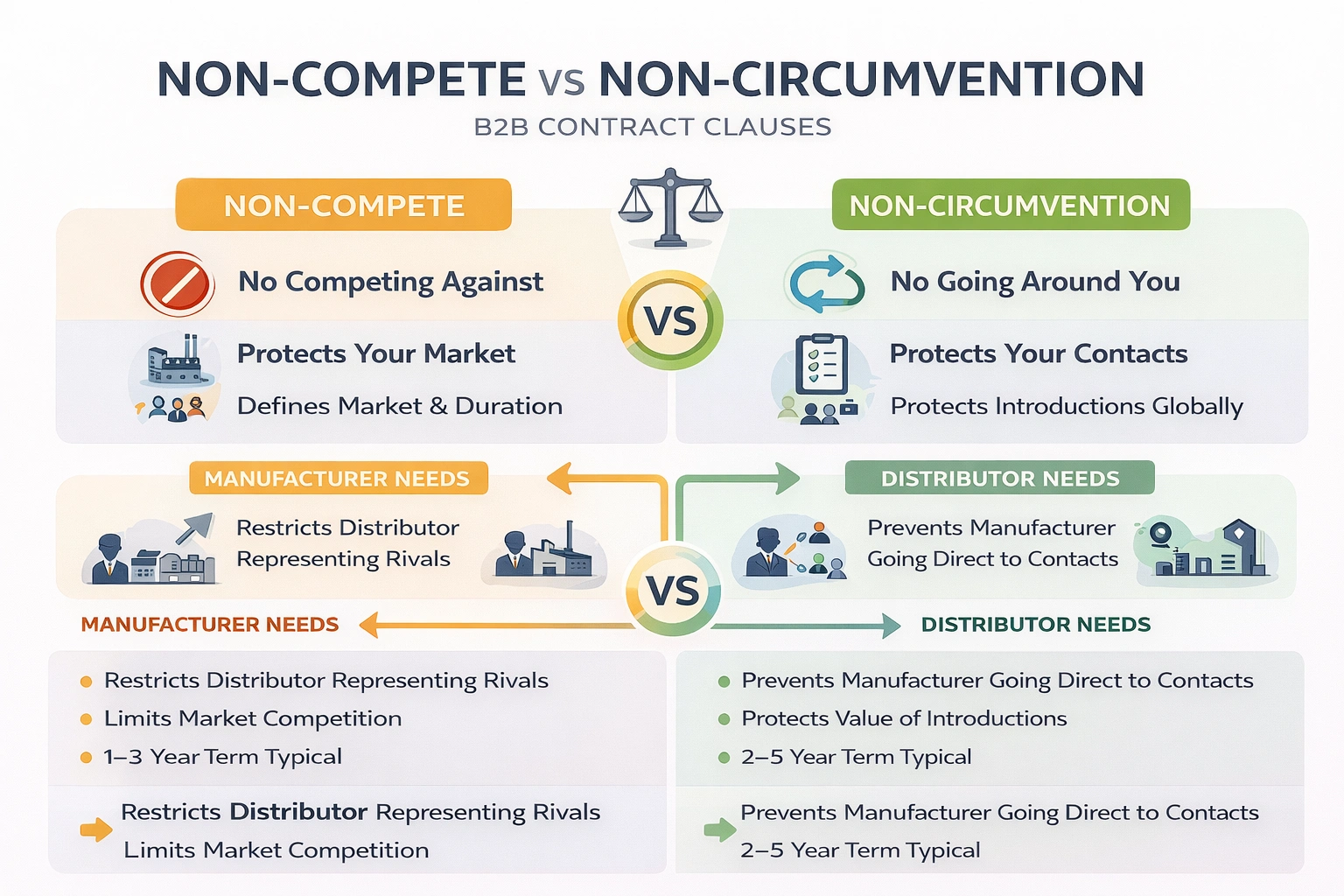
Direct Answer: A non-compete clause prevents a party from entering your industry or competing against your business directly. A non-circumvention clause prevents a party from bypassing you to deal directly with contacts, suppliers, or customers you introduced — cutting you out of the value you created. In cross-border B2B trade, manufacturers typically need non-compete clauses to stop distributors from handling rival brands; distributors typically need non-circumvention clauses to stop manufacturers from going around them to end customers they established. Most robust trade agreements use both. The strongest protection, however, begins before any clause is drafted: building partnerships through GTsetu’s verified network ensures you are dealing with genuine, compliance-checked counterparties before confidential introductions are ever made.
📅 April 10, 2026⏱ 15 min read✍️ GT Setu Editorial Team🔄 Updated regularly
2
Distinct Protections
500+
Verified GTsetu Companies
100+
Countries Covered
0%
Broker Commission
You spend months finding the right distributor for a new market. You share your pricing, introduce your key contacts, and build the relationship — only to discover six months later that the distributor has quietly gone direct to your end customers, or is now representing your main competitor in the same territory.
Or consider the distributor’s perspective: you invest heavily in establishing a market for a manufacturer’s product — building retailer relationships, educating the trade, running promotions — only to have the manufacturer eventually approach those same retailers directly, cutting you out entirely.
Both scenarios involve different legal violations requiring different contractual protections. The first calls for a non-compete clause. The second calls for a non-circumvention clause. Knowing which is which — and how to draft each one effectively — is one of the most commercially valuable legal skills in international trade. This guide explains both, in full, with direct application to manufacturer-distributor partnerships.
💡 Who Is This Guide For?
This guide is written for manufacturers seeking international distributors, distributors evaluating manufacturer principals, trade intermediaries facilitating introductions, and legal and business development teams drafting or reviewing distribution agreements, joint venture structures, and market entry partnerships. It is also relevant for anyone working with agents, consultants, or brokers who introduce business opportunities.
SECTION 1
1 Non-Compete vs Non-Circumvention: Core Definitions
Non-Compete
🚫 Non-Compete Clause
Restricts one party from directly or indirectly competing against the other party — in the same industry, market, or product category — during or after the contractual relationship.
Prevents a distributor from also representing a competing brand in the same territory
Stops a contractor or employee from joining a rival company after leaving
Prohibits a party from starting a competing business within a defined scope
Limits financial participation (shares, directorship) in competing ventures
Typically time-limited and geographically defined
Non-Circumvention
🔄 Non-Circumvention Clause
Prevents one party from bypassing the other to deal directly with contacts, suppliers, customers, or partners that were introduced or originated by the protected party — thereby cutting them out of the value chain.
Stops a manufacturer from going direct to retailers the distributor introduced
Prevents a buyer from approaching a supplier introduced by the broker
Blocks an investor from cutting out the intermediary who sourced the deal
Protects the originator of an introduction from losing the economic benefit
Covers the protected party’s business network, not just trade secrets
🎯 The Core Distinction
A non-compete clause says: “You cannot compete against me.” A non-circumvention clause says: “You cannot go around me to the people and relationships I introduced to you.” They protect different commercial interests and are often both needed in the same contract. Confusing the two — or relying on only one when you need both — is one of the most common and costly errors in B2B trade contracting.
SECTION 2
2 The Critical Differences — Side by Side
DimensionNon-CompeteNon-Circumvention
What it prevents
Competing against you in your market or industry
Bypassing you to deal with contacts you introduced
Primary concern
Competition for the same customers or market
Loss of the economic value of your relationships and introductions
Brokers, agents, intermediaries, distributors, anyone who makes introductions with commercial value
What it protects
Market position, revenue streams, customer base
Business relationships, introductions, network connections
Geographic scope
Required — must define territory to be enforceable
Often global — follows the relationships regardless of geography
Time limitation
Required — typically 1–3 years post-termination
Required — typically 2–5 years; some clauses extend longer
Relationship with NDA
Often paired with NDA; different protection layer
Frequently combined with NDA into NCND agreement
Can both be needed?
✓ Yes — in most distribution and trade partnerships, both clauses serve distinct and complementary roles
⚠️ The Classic Confusion — and Its Cost
A manufacturer signs a distribution agreement with a non-compete clause preventing the distributor from selling competing products. The distributor respects this — but after 18 months, goes directly to three key retail chains the distributor spent two years introducing and developing. The non-compete clause does not cover this. The manufacturer needed a non-circumvention clause too. By the time the legal gap is discovered, the retail relationships have been bypassed, channel conflict has erupted, and the distributor has lost their market investment. Both clauses would have cost nothing extra to include at the drafting stage.
SECTION 3
3 Non-Compete Clauses: Deep Dive
A non-compete clause (also called a restraint of trade clause or covenant not to compete) is one of the most widely used but most frequently litigated provisions in commercial contracts. Courts in most jurisdictions enforce them only when they are reasonable in scope, duration, and geographic reach.
What a Non-Compete Clause Covers in Manufacturer-Distributor Agreements
🏭
Competing Brand Representation
The distributor may not represent, promote, or distribute products that directly compete with the manufacturer’s portfolio in the defined territory, during the contract term and for a defined period after termination.
💼
Financial Participation in Competitors
The restricted party may not hold equity, serve as director, officer, or employee, or provide financial assistance or guarantees to a business that competes in the same product category and geography.
🏷️
Name Use in Competing Business
The restricted party may not permit their name, trade name, or brand reputation to be associated with or used in connection with a competing business — directly or indirectly.
🤝
Consulting or Advisory Roles
The restricted party may not provide advice, consultancy, or technical assistance to any competing company, even without formal employment or equity involvement.
🌐
Online and Cross-Border Activity
In modern distribution agreements, non-compete clauses should explicitly address e-commerce and digital sales — a distributor selling competing products online into the exclusive territory is a breach even if no physical presence exists.
⏱️
Post-Termination Tail
The non-compete period typically continues for 12–24 months after contract termination. Courts generally accept up to 2 years for senior commercial relationships; longer periods face higher scrutiny and risk of being struck down.
The Four Requirements for an Enforceable Non-Compete Clause
01
Legitimate Protectable Interest
The court must be satisfied that the restriction is protecting a genuine business interest — not merely preventing a former partner from earning a livelihood. In the manufacturer-distributor context, legitimate interests include: protecting proprietary pricing structures, exclusive market relationships, investment in market development, and trade secrets shared under the agreement. The restriction must be rationally connected to what is actually being protected.
02
Reasonable Duration
There is no universal “reasonable” duration — it depends on the nature of the relationship, the industry, and what time is genuinely needed to protect the interest. For most manufacturer-distributor non-competes, 12–24 months post-termination is well within accepted norms globally. Clauses with no time limit or durations beyond 3 years face significant enforceability risk in most jurisdictions.
03
Defined Geographic Scope
The restriction must be limited to the geographic area where the protectable interest actually exists. A non-compete covering territories the manufacturer does not operate in will be struck down. The clause should reference the specific countries, regions, or territories covered by the distribution agreement — no more, no less. For exclusive territory arrangements, the non-compete geography naturally mirrors the exclusivity geography.
04
Clearly Defined Prohibited Activities
The clause must specify precisely which activities are restricted. Vague language like “competing activities” without definition gives courts the freedom to narrow the clause or void it entirely. Define the product categories, the type of competitive involvement (employment, equity, consulting, distribution), and the specific conduct that is restricted. See the checklist in Section 7 for specific drafting guidance.
SECTION 4
4 Non-Circumvention Clauses: Deep Dive
Non-circumvention clauses are the commercial world’s protection against one of the most common forms of bad faith in B2B relationships: the bypass. You make an introduction, share a proprietary contact, facilitate a connection — and the other party then goes around you, building a direct relationship with the party you introduced, cutting you out of the value chain you created.
🎯 Definition
A non-circumvention clause is a contractual provision that prevents a party who has been introduced to business contacts, suppliers, customers, or partners through another party from establishing direct commercial relationships with those introduced parties — thereby bypassing and economically excluding the introducer. It protects the introducer’s network, not their confidential information (that is the NDA’s job) and not their market position (that is the non-compete’s job).
Where Non-Circumvention Is Most Critical in B2B Trade
🏭
Manufacturer Going Direct to the Distributor’s Retailers
A distributor invests in developing retail relationships in their market for the manufacturer’s products. Without a non-circumvention clause, nothing legally prevents the manufacturer from approaching those same retailers directly once the relationship is established — eliminating the distributor from the chain entirely. This is the most common circumvention scenario in international trade.
Most Common
🤝
Broker or Agent Being Cut Out of a Deal
A trade broker introduces a buyer and a seller. Both parties, once they have each other’s contact details, proceed with a transaction without involving the broker — and without compensating them for the introduction. A non-circumvention clause in the broker’s engagement terms prevents this.
The manufacturer shares supply chain information with the distributor as part of the partnership. The distributor then approaches the manufacturer’s upstream raw material suppliers or contract manufacturers directly, cutting the manufacturer out of their own supply chain economics. A non-circumvention clause prevents access to introduced supply contacts from being exploited.
Supply Chain Risk
💡
Technology or IP Introducer Being Bypassed
In technology transfer agreements and co-development partnerships, one party introduces another to a technology owner or licensor. Once the introduced parties have a direct relationship, the introducer risks being eliminated from the ongoing commercial arrangement. Non-circumvention protects the facilitating party’s continued role.
Technology Context
🌍
Market Entry Partnership Bypass
In market entry partnerships, one party provides market access and local business relationships. Once the foreign partner has established their presence using those introductions, they attempt to operate independently, eliminating the local partner who made the entry possible. Non-circumvention is essential in any market entry agreement.
Market Entry
What a Non-Circumvention Clause Must Specify
Element
What to Include
Why It Matters
Definition of “Introduced Parties”
An explicit list or category of the contacts, companies, and relationships covered by the clause — including subsidiaries, affiliates, and successor entities
Without a clear definition, the restricted party will argue that any contact they already knew before the introduction is not covered
Prohibited Conduct
Specifically what is prohibited: direct contact, negotiation, transaction, ownership interest, employment — define each
Vague prohibitions allow workarounds — e.g., “we didn’t negotiate, we just had a friendly conversation that happened to lead to a contract”
Duration
Typically 2–5 years from the date of introduction or the last transaction related to the introduced party
A non-circumvention clause with no time limit is frequently struck down as unreasonably perpetual
Geographic Scope
For trade partnerships, often global (the introduced relationship exists regardless of geography); or defined as the same territory as the partnership
Unlike non-competes, non-circumvention clauses can legitimately be global — because the introduced party exists wherever they operate
Compensation Provisions
What the restricting party owes if they proceed with an introduced party (either consent-based commission or damages calculation)
Having a specified remedy makes enforcement faster and less costly than having to prove damages in full through litigation or arbitration
Exceptions
Contacts the restricted party already had a relationship with before the introduction (requires documentation of pre-existing relationships)
Without carve-outs for pre-existing relationships, the clause is overbroad and likely unenforceable — and creates legitimate grievance
Survival After Termination
Explicitly state that the clause survives contract termination — for the defined duration
Without this, a party could terminate the contract and then immediately engage with the introduced parties with no legal barrier
SECTION 5
5 The NCND Agreement: Combining Both Protections
The NCND agreement — Non-Circumvention and Non-Disclosure — combines two complementary protections into a single document. It is one of the most commonly used instruments in international trade, particularly in introductory situations where one party is simultaneously sharing both confidential information and proprietary business relationships.
ComponentWhat It CoversWhat It Does Not Cover
NDA Component
Confidential information — pricing, specifications, trade secrets, proprietary data
Business relationships and introductions (that’s the non-circumvention component)
Non-Circumvention Component
Business relationships, introduced contacts, originator’s position in the value chain
Confidential information (that’s the NDA component)
NCND Combined
Both — information and relationships are protected simultaneously in a single, signed document
Competition protection (you still need a non-compete clause for that — typically in the main agreement)
💡 NCND in International Trade Brokerage
NCND agreements are particularly prevalent in commodity trading, international supplier introductions, and cross-border B2B matchmaking — where an intermediary introduces a buyer and a seller and needs protection against both parties going direct and sharing the intermediary’s confidential sourcing intelligence with third parties. On GTsetu, our built-in NDA workflow provides the non-disclosure foundation. The non-circumvention layer should be added by your legal counsel in the partnership agreement that follows.
NCND vs. NDA vs. Non-Compete — Which Does What
Agreement Type
Protects Information
Protects Relationships
Prevents Competition
Best Used When
NDA Only
✓ Yes
✗ No
✗ No
Early-stage exploration; protecting confidential information before any introduction or partnership
Non-Compete Only
✗ No
✗ No
✓ Yes
Employment or contractor agreements; exclusive distribution relationships where competing representation is the primary risk
Non-Circumvention Only
✗ No
✓ Yes
✗ No
Introductory situations where the relationship itself is the asset being protected; brokerage and agency arrangements
NCND (NDA + Non-Circumvention)
✓ Yes
✓ Yes
✗ No
Introductions involving both confidential information and proprietary business contacts; most trade intermediary situations
Full Distribution Agreement (NDA + Non-Circumvention + Non-Compete)
✓ Yes
✓ Yes
✓ Yes
Complete manufacturer-distributor partnership covering all three protection layers; the gold standard for international trade agreements
SECTION 6
6 Which Clause Do You Need? Scenario Guide
The right clause depends entirely on what you are protecting. Work through these common scenarios to identify which protection your specific situation requires.
🏭
Manufacturer giving exclusivity to a distributor
You need the distributor to focus exclusively on your products and not represent competing brands in the same territory during the agreement period.
Non-Compete
🏪
Distributor who built the retail network
You spent years developing relationships with 40 retail chains for the manufacturer. You need protection against the manufacturer approaching those retailers directly after learning their details through your partnership.
Non-Circumvention
🤝
Trade broker making an introduction
You are introducing a buyer to a seller. Once they have each other’s details, you need to prevent them from transacting directly and cutting you out of the commission or fee arrangement.
Non-Circumvention
💼
Departing sales executive
A senior sales executive who managed your key accounts is leaving. You need to prevent them from joining a competitor or approaching your clients for a defined period.
Non-Compete + Non-Solicitation
🌏
Market entry partner who provided access
You provided a foreign manufacturer with local government contacts, retail relationships, and regulatory introductions. You need to prevent them from operating independently in your market after using those introductions.
Non-Circumvention
🔬
Co-development partner with access to IP
You are co-developing a product with a partner who has access to your proprietary technology. You need them not to share that technology and not to work with competitors using what they learn.
NDA + Non-Compete
📦
Contract manufacturer who knows your formula
Your contract manufacturer or toll manufacturer has access to your product formula and production specifications. You need them not to produce for your competitors using your IP.
NDA + Non-Compete
🌐
Full international distribution partnership
A complete manufacturer-distributor relationship where both parties are sharing information, introducing contacts, and need protection against both competitive behaviour and bypass.
All Three Clauses
SECTION 7
7 How to Draft Each Clause Correctly
Non-Compete Clause Drafting Checklist
Define the specific industry, product categories, and product lines to which the restriction applies — by name or by clear functional description
Specify the geographic territory covered — using country names, regions, or defined distribution territory references from the main agreement
Define the duration explicitly — both during the contract and for a defined post-termination period (recommend 12–24 months for most B2B trade agreements)
List every form of prohibited involvement: employment, equity ownership, directorship, consulting, lending, name use, financial guarantees
Address e-commerce and digital sales channels explicitly — online sales into the restricted territory count as a breach
Define “competitor” precisely — vague definitions are litigated; specific product category descriptions are enforced
Include a carve-out for products or activities that were pre-existing before the agreement (with documentation requirement)
Specify governing law and jurisdiction for the clause (can differ from the main agreement if needed for enforceability)
Include a severability clause: if any element is found unreasonable, the court may narrow rather than void the entire clause
Consider including a garden leave or compensation provision — courts are more willing to enforce restrictions where the restricted party is compensated for the limitation
Non-Circumvention Clause Drafting Checklist
Define “Protected Parties” with specificity — list by name, category, or description the contacts and entities being protected
Include a list or schedule of introduced contacts at the time of signing — and a mechanism for updating it as new introductions are made
Define prohibited conduct exhaustively: direct contact, negotiation, contracting, subcontracting, referral to third parties, indirect engagement through affiliates
Specify the duration — typically 2–5 years from the date of last introduction or last transaction involving the introduced party
Address geographic scope — non-circumvention clauses can legitimately be global since introduced parties exist wherever they operate
Include a remedy provision: either a specified compensation amount (commission equivalent) or a liquidated damages clause for breach
Define the “introduction” — what constitutes a covered introduction vs. a general market connection (important for avoiding disputes about scope)
Include survival language explicitly: the clause survives termination of the main agreement for the full defined duration
Carve out pre-existing relationships — require the restricted party to disclose any prior relationships with listed parties within a defined window
Consider a notification obligation: if the restricted party is approached by a protected party, they must notify the originator within a set number of days
SECTION 8
8 Enforceability: What Makes These Clauses Hold Up
Both non-compete and non-circumvention clauses are restrictive by nature — and courts in most jurisdictions approach them with scrutiny. The onus is always on the party seeking to enforce the restriction to demonstrate that it is reasonable, legitimate, and proportionate to the interest being protected.
Enforceability Factor
Non-Compete
Non-Circumvention
Legitimate Interest Required
Yes — must protect a genuine business asset (trade secrets, customer base, market investment), not merely restrict competition as a general principle
Yes — must protect a genuine introduced relationship or value created by the protected party, not merely prevent any direct commercial contact
Time Limitation
Required. Courts scrutinise durations over 2 years for commercial parties; over 1 year for individuals. Unlimited duration is void in most jurisdictions.
Required. 2–5 years is generally acceptable. Some jurisdictions have challenged longer durations; unlimited non-circumvention clauses face the same risk as unlimited non-competes.
Geographic Scope
Required. Must be limited to where the protectable interest exists. Global non-competes are regularly struck down unless the party truly operates globally.
Can be global where the introduced relationships are international. Courts are generally more accepting of global scope for non-circumvention than non-compete.
Consideration
Required. Restrictions imposed after contract commencement without fresh consideration are often unenforceable. Include compensation, payments, or benefits tied to the restriction.
Required. The introduction itself — and the commercial opportunity it creates — is generally considered adequate consideration for a non-circumvention obligation.
Clarity of Scope
High. Vague definitions of “competing activity” are routinely narrowed or voided. Courts favour precision.
High. The definition of “introduced parties” and “prohibited conduct” must be exact — ambiguity is exploited by the restricted party.
Governing Law
Critical. Enforceability varies dramatically by jurisdiction. English, Singapore, and UAE law are generally commercial-friendly. Some civil law jurisdictions restrict non-competes significantly.
Generally enforced wherever clear and reasonable. Less variation by jurisdiction than non-compete. New York and English law have well-developed non-circumvention case law.
⚡ The Blue Pencil Rule
In many jurisdictions, courts apply the “blue pencil” doctrine — rather than voiding an entire non-compete or non-circumvention clause that is overly broad, they simply strike out the unreasonable portion and enforce the rest. This means drafting your restriction more broadly than you ultimately need is not necessarily fatal. However, some jurisdictions will void the entire clause if any element is unreasonable. The safest approach: draft with precision, include a severability clause, and have local legal counsel review enforceability in every relevant jurisdiction.
SECTION 9
9 Cross-Border Considerations for International Trade
Non-compete and non-circumvention clauses in international trade agreements face an additional layer of complexity: they must be enforceable not just under the governing law chosen by the parties, but practically executable across the jurisdictions where a breach is likely to occur.
🇮🇳
India
Under Section 27 of the Indian Contract Act, agreements in restraint of trade are broadly void — with limited exceptions for sale of business goodwill. Non-competes in employment and distribution are more restrictive here than in common law jurisdictions. Non-circumvention clauses face less statutory headwind and are generally more enforceable. Indian law parties should also consider NDA frameworks carefully.
🇬🇧
England & Wales
Non-competes are enforceable when reasonable in scope, duration, and geography — courts apply the “restraint of trade” doctrine with a degree of flexibility. Non-circumvention clauses are well-recognised and regularly enforced. English law is one of the most commercially reliable choices for both types of clause in international agreements.
🇸🇬
Singapore
Singapore follows the English common law approach to restraint of trade. Non-competes are enforceable if reasonable; non-circumvention clauses are well-supported. SIAC arbitration combined with Singapore governing law is the preferred structure for Asia-Pacific trade agreements involving non-compete or non-circumvention provisions.
🇺🇸
United States
Enforceability varies dramatically by state. California effectively prohibits non-competes entirely (with narrow exceptions). New York, Florida, and Texas enforce them if reasonable. Non-circumvention clauses are generally enforceable nationwide. For US-connected contracts, specify the governing state carefully — and avoid California law if non-compete protection is critical.
🇦🇪
UAE
Both non-compete and non-circumvention clauses are enforceable under UAE law when reasonable. The DIFC (Dubai International Financial Centre) and ADGM (Abu Dhabi Global Market) courts apply English common law principles — making them reliable jurisdictions for enforcement of these clauses in Middle East-connected trade partnerships.
🇨🇳
China
Non-competes are recognised in Chinese law, primarily in employment contexts, with statutory limitations (maximum 2 years, compensation required). Commercial non-circumvention clauses between companies are generally enforceable in Chinese courts if clear and reasonable. HKIAC arbitration is strongly recommended for China-connected agreements as an alternative to mainland court proceedings.
⚠️ The Indian Law Trap for Non-Competes
This is the most commonly encountered enforcement trap for Indian manufacturers: an Indian company signs a distribution agreement governed by Indian law with a non-compete clause restricting the distributor from handling competing brands. Under Section 27 of the Indian Contract Act, this clause may be unenforceable in Indian courts — because Indian law broadly invalidates agreements in restraint of trade. The solution: choose English law or Singapore law as the governing law for the agreement. Indian courts generally respect governing law choices in commercial contracts between sophisticated parties, and the non-compete becomes enforceable under the chosen law. Always have local Indian counsel review the enforceability strategy for Indian-connected agreements.
SECTION 10
10 Common Mistakes That Nullify These Clauses
🚩
No Time Limit
Both non-compete and non-circumvention clauses without a defined duration are void or severely weakened in virtually every jurisdiction. “Perpetual” restrictions are treated as unreasonable restraints of trade.
🚩
Overly Broad Geographic Scope
A non-compete covering the entire world when your business only operates in three countries will not survive court scrutiny. Geographic scope must be proportionate to the actual business interest being protected.
🚩
Vague Definition of “Competitor”
“Any competing business” without product category definition is routinely challenged. If the distributor makes 20 different product categories, which ones trigger the non-compete? Vague definitions invite breach and complicate enforcement.
🚩
No List of Protected Relationships
A non-circumvention clause that does not specify who the “introduced parties” are will be litigated on the question of whether a given contact was truly introduced or pre-existing. A schedule of introduced parties, signed at the time of introduction, is essential.
🚩
Clause Imposed Without Fresh Consideration
A non-compete or non-circumvention clause added to an existing agreement mid-relationship — without any new benefit or payment to the restricted party — often fails the consideration requirement. New restrictions require new consideration.
🚩
Wrong Governing Law for the Context
Indian law governing a non-compete clause, or California law governing a non-compete between US-connected parties — these are fatal mismatches. The governing law must be compatible with the protection you are seeking. See Section 9.
🚩
Clause Does Not Survive Termination
Both non-compete and non-circumvention clauses must explicitly state they survive termination of the main agreement. Without this, they expire with the contract — leaving you unprotected precisely when you are most at risk.
🚩
Confusing Non-Compete with Non-Circumvention
The most common error: using a non-compete clause when you need non-circumvention protection. If a manufacturer bypasses a distributor to deal with the retailers the distributor developed — and only a non-compete clause exists — there is no remedy. Both must be in the agreement from day one.
SECTION 11
11 How GTsetu Reduces Circumvention Risk Structurally
Non-circumvention clauses are reactive protection — they provide a legal remedy after circumvention has already occurred. The more powerful strategy is structural prevention: building partnerships from the start in a way that makes circumvention less likely to occur, and that creates an unimpeachable documentary record if it does.
🔐 Platform Spotlight — GTsetu
Verified Partnerships That Reduce Circumvention Risk Before Any Clause Is Needed
GTsetu is built for manufacturers and distributors seeking verified cross-border trade partnerships. Every company on the platform has been compliance-verified before engagement. Every introduction is made in a structured, documented environment. Every document exchange is logged with a full audit trail. This structural approach does not replace non-circumvention or non-compete clauses — it makes them easier to enforce, and makes the behaviour they prevent far less likely to happen.
🏛️
Multi-Layer Verification
Every company is verified against business registration, tax documents, licences, and authority letters before any engagement. You are never making a proprietary introduction to an unverified party.
📄
Built-In NDA Workflow
Digital NDA execution with timestamped signatures before any confidential information is shared — creating the non-disclosure foundation before any introduction is made. Pairs naturally with a non-circumvention clause in your partnership agreement.
📋
Full Audit Trail
Every introduction, document access, and communication is logged with timestamp and user identity. This record is precisely what you need to demonstrate that a specific party was introduced through your channel — the evidentiary foundation of any non-circumvention enforcement.
🕵️
Anonymous Discovery
Browse verified partner profiles without revealing your identity or your market expansion plans — protecting the strategic intelligence that makes circumvention attractive in the first place.
🔐
Encrypted Document Workspace
All product, pricing, and commercial documents shared through encrypted channels with role-based access control — ensuring confidential information only reaches named, authorised parties.
🚫
Zero Commission
GTsetu charges no success fee or broker commission on partnerships formed — aligning platform incentives with your long-term commercial success, not transaction extraction.
Non-circumvention and non-compete clauses are legal instruments that require qualified counsel in your jurisdiction to draft and enforce. GTsetu provides the verified, documented, encrypted partnership foundation that makes those instruments effective — and makes the behaviour they restrict structurally harder to execute from day one. Learn more about our approach to B2B secure collaboration and business verification.
✓ Digital NDA with timestamped signature on platform
✗ Paper NDA — often unsigned, lost, or disputed
Proof of what information was shared
✓ Complete document access log with user and timestamp
✗ Email attachments — no access record, freely forwarded
Identity of counterparty verified
✓ Compliance-verified before engagement — no dispute possible
✗ Unknown — counterparty identity may be disputed in enforcement
Authority of signatory confirmed
✓ Authority letter verified — signatory had power to commit
✗ Unverified — agreement may be challenged as unauthorised
FAQ
? Frequently Asked Questions
Q What is the difference between non-compete and non-circumvention?
A non-compete clause prevents a party from competing against you — entering your market, representing rival brands, or joining a competitor. A non-circumvention clause prevents a party from bypassing you to deal directly with contacts or relationships you introduced — cutting you out of the value chain you created. They protect different things: non-compete protects your market position; non-circumvention protects your relationships and introductions. In most international manufacturer-distributor agreements, both clauses are needed simultaneously because each addresses a distinct commercial risk.
Q Are non-circumvention agreements enforceable in international contracts?
Yes — non-circumvention clauses are generally enforceable in international commercial contracts when they are reasonable in scope, time-limited, clearly define the protected relationships and prohibited conduct, are supported by adequate consideration, and are governed by a jurisdiction with a clear legal framework for enforcing such restrictions. They are less controversial than non-competes in most jurisdictions because they do not prevent someone from earning a livelihood — they only prevent them from exploiting a specific relationship they did not originate. Choosing a reliable governing law (English, Singapore, or New York) significantly strengthens enforceability in cross-border disputes.
Q What is an NCND agreement?
An NCND agreement is a Non-Circumvention and Non-Disclosure agreement — a document that combines both protections into a single signed instrument. The NDA component protects confidential information from being disclosed or misused. The non-circumvention component protects the originator’s business relationships from being bypassed. NCND agreements are widely used in international trade brokerage, supplier introductions, and any situation where an intermediary is sharing both proprietary contacts and confidential information simultaneously. They do not typically include a non-compete component — that is a separate clause usually embedded in the main distribution or partnership agreement.
Q Do I need both non-compete and non-circumvention in my distribution agreement?
For most international manufacturer-distributor agreements, yes — you need both, because each protects a different risk. The non-compete clause protects you from the distributor representing competing brands or entering your market independently. The non-circumvention clause protects you (as distributor) from the manufacturer going directly to the retail clients and end customers you introduced and developed — or protects you (as manufacturer) from the distributor approaching your upstream suppliers and production partners. Running a distribution agreement with only one of the two clauses means one entire category of commercial risk is legally unprotected. See our full guide on exclusivity clauses in distribution agreements for related provisions.
Q Are non-compete clauses enforceable in India?
Non-compete clauses in India face a significant statutory hurdle: Section 27 of the Indian Contract Act broadly voids agreements in restraint of trade, with limited exceptions (notably the sale of business goodwill). This makes non-competes in Indian-law-governed distribution agreements difficult to enforce in Indian courts. The practical solution widely used by Indian manufacturers and their international counsel: choose English law or Singapore law as the governing law for the distribution agreement, which removes the Section 27 bar while Indian courts still generally respect governing law choices between sophisticated commercial parties. Non-circumvention clauses face less statutory headwind in India and are more broadly enforceable. Always consult qualified Indian legal counsel for your specific situation.
Q How long should a non-circumvention clause last?
Non-circumvention clauses typically last 2–5 years from the date of the last introduction or the last transaction involving the introduced party — whichever is later. Unlike non-competes where courts are particularly sensitive to duration, non-circumvention clauses face slightly less scrutiny on duration because they do not prevent the restricted party from working in their industry generally — only from exploiting a specific introduced relationship. That said, unlimited or perpetual non-circumvention clauses face enforcement risk in most jurisdictions and should be avoided. For international trade partnerships, 3 years post-introduction is a widely used and generally accepted standard.
Q Can a non-circumvention clause be global in scope?
Yes — and this is one important way non-circumvention clauses differ from non-compete clauses. Non-competes require geographic limitation to the territory where the protectable interest exists. Non-circumvention clauses can legitimately be global because the introduced business relationship exists wherever the introduced party operates — not in a defined geographic territory. If a distributor introduced you to a retail chain that operates in 15 countries, the non-circumvention protection needs to follow that relationship across all 15 countries. Courts in most major commercial jurisdictions accept global scope for non-circumvention when the introduced relationship is itself international in nature.
Q How does GTsetu help with non-circumvention protection?
GTsetu does not draft legal clauses — that is the role of qualified legal counsel. What GTsetu provides is the structural foundation that makes non-circumvention clauses enforceable and the behaviour they prevent less likely to occur. Specifically: every introduction made through GTsetu’s platform is logged with a timestamp and user identity — creating an irrefutable record that a specific party was introduced through you, which is the evidentiary foundation of any non-circumvention claim. The built-in NDA workflow creates a signed, timestamped confidentiality record before any introduction is made. The full audit trail documents exactly what information was shared, when, and to whom. Collectively, this documentation infrastructure removes the most common defence in non-circumvention disputes: “we knew them before you introduced us.” Learn more about how GTsetu’s secure collaboration platform works.
Build Trade Partnerships That Are Protected From Day One
Join 500+ verified manufacturers and distributors on GTsetu — with compliance-backed partner verification, anonymous discovery, built-in NDA workflows, and a full audit trail that supports every non-circumvention and non-compete protection you put in place.
Team GTsetu represents the product, compliance, and research team behind GTsetu, a global B2B collaboration platform built to help companies explore cross-border partnerships with clarity and trust. The team focuses on simplifying early-stage international business discovery by combining structured company profiles, verification-led access, and controlled collaboration workflows.
With a strong emphasis on trust, compliance, and disciplined engagement, Team GTsetu shares insights on global trade, partnerships, and cross-border collaboration, helping businesses make informed decisions before entering deeper commercial discussions.