What Is DAP and When Is It Used?
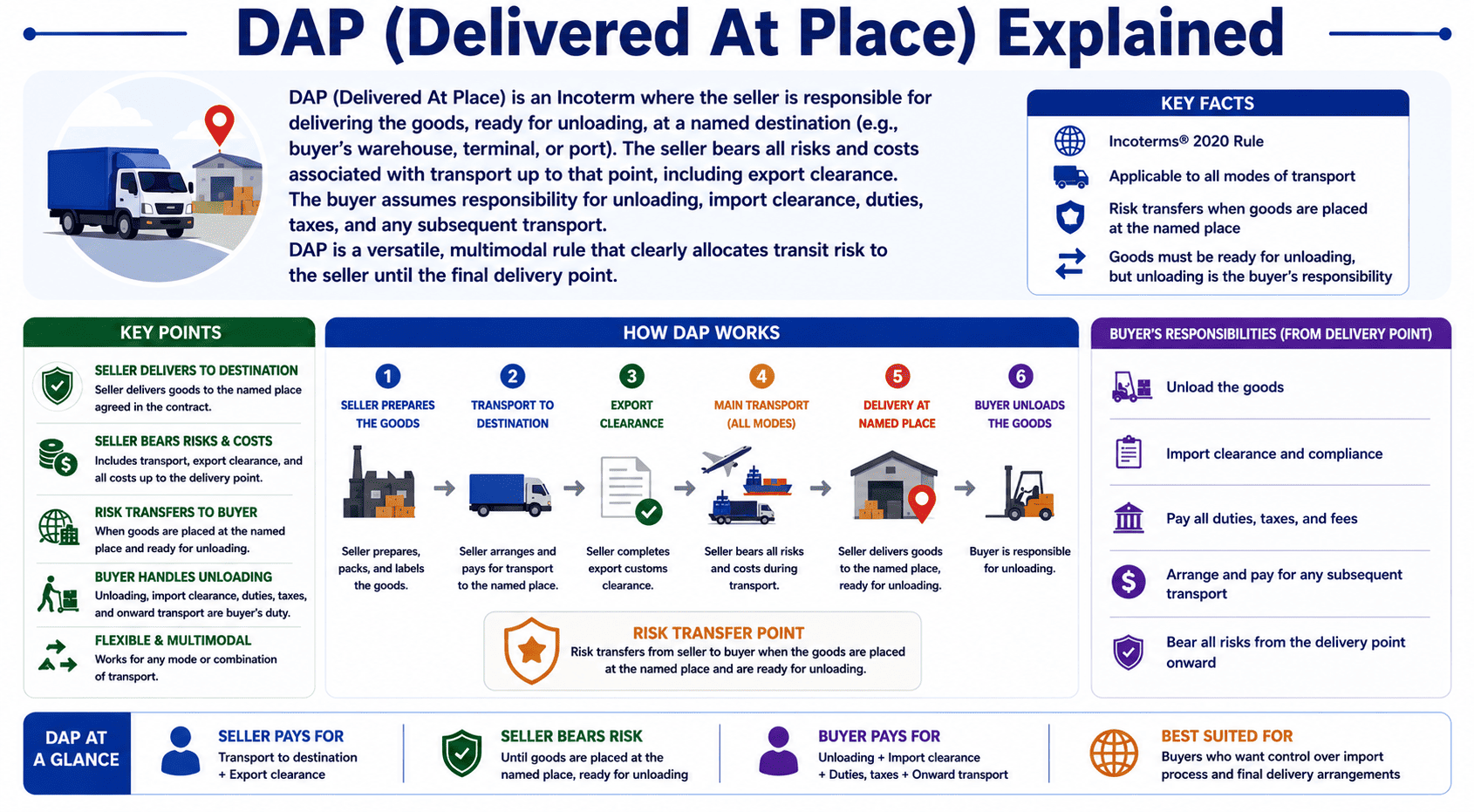
Delivered At Place (DAP) is an Incoterms® 2020 rule published by the International Chamber of Commerce (ICC). It replaced the former Incoterms 2010 term “Delivered at Place” without substantive change. DAP is designed for multimodal transport and can be used for any mode or combination of modes, road, rail, air, sea, or intermodal.
The rule strikes a balance between seller and buyer responsibility: the seller controls and pays for the main carriage and bears the risk of loss or damage during transit, while the buyer handles import formalities and unloading. DAP is commonly used when the buyer wants to minimize logistics involvement but can manage customs clearance and duties. It is also useful when the seller has better freight rates or logistics capabilities.
⚡ Key Principle
Under DAP, risk transfers from seller to buyer when the goods are made available at the named destination, ready for unloading, not when the goods are shipped. The seller bears all transit risk, including loss or damage during the main carriage.
Seller vs Buyer Obligations
DAP Seller and Buyer Obligations (Incoterms 2020)
✅ SELLER’S RESPONSIBILITIES
- Provide goods, commercial invoice, and documentation
- Pack and mark goods appropriately for transport
- Clear goods for export (export licenses, formalities)
- Arrange and pay for pre-carriage, main carriage, and delivery to named destination
- Bear all risks and costs until goods are ready for unloading at destination
- Provide proof of delivery to buyer
⚠️ BUYER’S RESPONSIBILITIES
- Pay the price of goods as per sales contract
- Unload the goods from the arriving means of transport
- Clear goods for import (import licenses, customs entry)
- Pay all import duties, taxes, and customs fees
- Arrange onward carriage from named place if needed
- Bear risk from the moment goods are made available at destination
✨ Practical Guidance
Specify the named destination precisely in your contract, include the full address, unloading point, and any access restrictions. A vague description (e.g., “buyer’s warehouse”) can lead to disputes over risk transfer and additional costs. The more precise the location, the clearer the obligations.
Risks & Common Pitfalls
Key Risks and Considerations with DAP
🚩
Unloading Disputes
The seller is not required to unload. If the buyer fails to provide unloading equipment or labour, the shipment may be delayed, and the buyer may incur demurrage or storage charges.
🚩
Seller Assumes Transit Risk
Unlike EXW or FCA, the seller bears all risk of loss or damage during transit. Any incident (theft, damage, accident) is the seller’s responsibility until delivery. Sellers should obtain adequate cargo insurance.
🚩
Import Clearance Delays
The buyer is responsible for import clearance. If the buyer is slow or unable to clear goods, the seller may face storage fees, demurrage, or even return of goods, while the buyer might still be liable for payment.
🚩
Unforeseen Destination Costs
Terminal handling charges, port fees, or local delivery restrictions at the named place can create unexpected costs. The seller should research the destination thoroughly before quoting a DAP price.
🚩
Insurance Gaps
DAP does not require the seller to insure the goods. If the seller chooses not to insure and goods are damaged in transit, they bear the full loss. Professional sellers should always insure DAP shipments.
DAP vs DDP vs DAP (border)
Comparison: DAP vs DDP vs Other Incoterms
| Incoterm | Export Clearance | Main Carriage & Risk | Import Clearance & Duties | Unloading at Destination |
|---|
| DAP | Seller | Seller (until destination, ready for unloading) | Buyer | Buyer |
| DDP | Seller (all risks & costs to final destination, duty paid) | Seller | Seller |
| FCA | Seller | Buyer from carrier handover | Buyer | Buyer |
| EXW | Buyer | Buyer from seller’s premises | Buyer | Buyer |
📌 Recommendation for Exporters & Importers
Choose DAP when you want the seller to control the main transport and bear transit risk, but the buyer is comfortable with import clearance and duties. If the buyer cannot or will not handle import formalities, use DDP instead. If the seller wants to limit risk, consider FCA or CPT.
Best Practices for DAP Shipments
Managing DAP Shipments: 5 Best Practices
01
Specify the Exact Delivery Point
Include the full address, unloading dock number, and any time restrictions. For example: “DAP, Buyer’s Warehouse, 123 Logistics Street, Rotterdam, Netherlands, unloading at dock B.”
02
Agree on Unloading Arrangements in Advance
Clarify who provides labour and equipment for unloading. If the buyer is responsible, confirm they have the means to unload promptly to avoid demurrage.
03
Seller Should Obtain Cargo Insurance
Since the seller bears transit risk, a marine or cargo insurance policy is essential. Without insurance, a single damaged shipment could be financially devastating.
04
Provide Buyer with Documentation for Import
The seller must supply commercial invoice, packing list, certificate of origin, and export documents so the buyer can clear customs efficiently. Delays in documentation lead to delays in delivery.
05
Use a Reliable Freight Forwarder
Choose a forwarder experienced with DAP shipments in the destination country. They can advise on local quirks, port fees, and ensure proper proof of delivery is obtained.
FAQ
Frequently Asked Questions about DAP
QWho is responsible for import duties under DAP?
The buyer is solely responsible for all import duties, taxes, and customs clearance fees. The seller has no obligation to pay or assist with import duties unless otherwise agreed.
QWhat is the difference between DAP and CIF?
CIF (Cost, Insurance & Freight) applies only to sea or inland waterway transport and transfers risk when goods are loaded on the vessel at the port of origin. DAP can be used for any mode and transfers risk at the final destination, ready for unloading. DAP gives the seller more responsibility and risk than CIF.
QDoes DAP require the seller to insure the goods?
No. DAP does not obligate the seller to obtain insurance. However, because the seller bears risk of loss or damage until delivery, wise sellers always purchase cargo insurance to protect themselves.
QCan DAP be used for any mode of transport?
Yes. DAP is a multimodal Incoterm and works for road, rail, air, sea, and any combination. It is one of the most flexible rules in Incoterms 2020.
QWhen does risk transfer from seller to buyer under DAP?
Risk transfers when the goods are made available to the buyer at the named place of destination, ready for unloading. The seller bears all risk up to that point; the buyer then assumes risk for unloading and onward handling.