Why Is a Warranty Clause Essential in Commercial Contracts?
Imagine purchasing industrial equipment for $500,000. After six months, a critical component fails, halting production for two weeks. Without a warranty clause, you would bear the full cost of repairs, replacement parts, and lost profits. The warranty clause shifts that risk back to the supplier—it is a financial guardrail that ensures accountability after delivery.
Warranties are essential because they provide predictability for both parties. The buyer knows what to expect in terms of quality and has a clear remedy if expectations are not met. The seller knows the scope of its post‑delivery obligations and can price its products or services accordingly, often setting aside reserves for warranty claims (averaging 1.4% of product sales revenue across industries). Without a warranty clause, disputes over product defects become protracted litigation over implied standards and unspoken expectations.
In international trade, warranty clauses also help allocate liability across borders, particularly when goods pass through multiple distributors. A well‑drafted clause specifies which party is responsible for defects discovered after shipment, who bears the cost of returns and replacements, and whether the warranty is transferable to subsequent buyers.
Common Contract Types Where Warranty Clauses Appear
🏭
Sale of Goods & Manufacturing
Warranties against defects in materials and workmanship, often for 12 months, with repair/replacement as the exclusive remedy.
💻
Software & SaaS Agreements
Warranty that software will conform to specifications for a defined period; often excludes consequential damages and third‑party components.
🔧
Services & Consulting Contracts
Services warranty that work will be performed in a professional and workmanlike manner, in accordance with industry standards.
🚗
Automotive & Consumer Goods
Limited warranties covering specific components for a defined period (e.g., 3 years/36,000 miles), with exclusions for wear and tear.
🏗️
Construction & Engineering
Warranties that materials and workmanship meet specifications; often one year from completion, with obligations to remedy defects.
📦
Distribution & Reseller Agreements
Requires distributor to pass through manufacturer’s limited warranty and not offer additional warranties without approval.
⚡ Key Principle
A warranty is not an unlimited guarantee. Most warranties are limited in duration, scope, and remedy. They coexist with disclaimers of implied warranties and limitations of liability. The buyer’s exclusive remedy is typically repair, replacement, or refund—not consequential damages like lost profits.
Express vs Implied Warranties
Express Warranties vs Implied Warranties: Key Differences
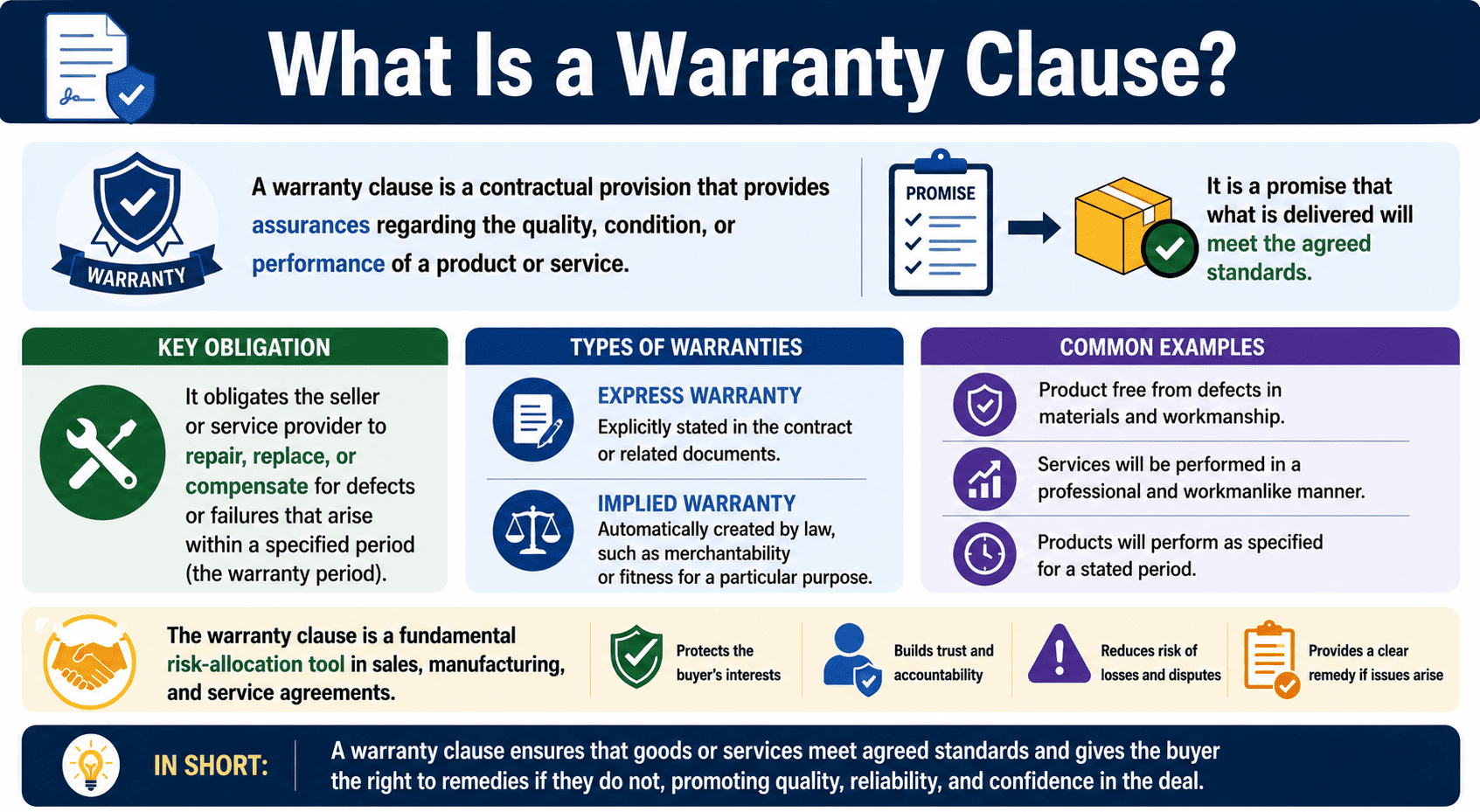
Warranty obligations arise from two distinct sources. Express warranties are explicitly stated in the contract, in product descriptions, or made orally by the seller. Implied warranties are created by law (e.g., the Uniform Commercial Code in the US) regardless of whether they are written—they represent minimum standards of quality that apply automatically to most sales of goods.
📝 Express Warranty
- Source: Explicit statement in contract, advertisement, or oral promise
- Example: “This battery will last 24 months” or “The software will comply with the attached specifications”
- Form: Can be written, oral, or even by sample/model
- Disclaimable: Yes, but must be clear and specific
- Typical content: Conformity to specifications, freedom from defects, workmanlike performance
⚖️ Implied Warranty (Created by Law)
- Source: UCC § 2-314 (merchantability) and § 2-315 (fitness for particular purpose)
- Merchantability: Product is fit for ordinary purposes, adequately packaged, and conforms to promises on label
- Fitness for particular purpose: Seller knows buyer’s specific use and product is suitable for that use
- Disclaimable: Yes, but must be “conspicuous” (often ALL CAPS) and use specific language like “AS IS”
- Consumer protection: Some jurisdictions restrict disclaimer of implied warranties in consumer sales (Magnuson-Moss Warranty Act)
✨ Drafting Tip, Disclaiming Implied Warranties
Under the UCC, to disclaim the implied warranty of merchantability, the disclaimer must mention “merchantability” and be conspicuous. For fitness for a particular purpose, the disclaimer must be in writing and conspicuous. The safest approach is to include a standalone disclaimer section in ALL CAPS or bold, such as: “THE GOODS ARE SOLD ‘AS IS’ AND THE SELLER DISCLAIMS ALL IMPLIED WARRANTIES, INCLUDING MERCHANTABILITY AND FITNESS FOR A PARTICULAR PURPOSE.”
Limited vs Full Warranty
Limited Warranty vs Full Warranty: Scope and Remedies
Under the Magnuson-Moss Warranty Act (US), written warranties on consumer products must be designated either “full” or “limited.” These designations have specific legal meanings, but in commercial B2B contracts, “limited warranty” is the default and most negotiated form.
| Feature | Limited Warranty | Full Warranty |
|---|
| Duration | Specified period (e.g., 12 months, 2 years) | Specified period but may extend to “reasonable” duration under law |
| Remedy | Repair, replacement, or refund (seller’s choice; may limit to replacement only) | Repair or replacement; if unsuccessful, refund within reasonable time |
| Consequential damages | Typically excluded (no liability for lost profits or business interruption) | May not exclude consequential damages unless limitation is conspicuous |
| Transferability | Often limited to original purchaser | Must be transferable to subsequent owners during warranty period (under Magnuson-Moss) |
| Disclaimer of implied warranties | Permitted but must be conspicuous | Duration of implied warranties cannot be limited to less than the full warranty period |
| Typical use | Commercial, B2B, industrial equipment, software, components | Consumer products, high‑end appliances, vehicles (rare in B2B) |
📋 Sample Limited Warranty Clause (Commercial)
Seller warrants that the Products will be free from defects in materials and workmanship for a period of twelve (12) months from the date of delivery (the "Warranty Period"). Seller's sole obligation and Buyer's exclusive remedy for any breach of this warranty shall be, at Seller's option, to (a) repair or replace the defective Product, or (b) refund the purchase price paid for such Product. This warranty does not apply to defects caused by misuse, unauthorized modifications, improper installation, normal wear and tear, or failure to follow operating instructions. THE FOREGOING WARRANTY IS EXCLUSIVE AND IN LIEU OF ALL OTHER WARRANTIES, EXPRESS OR IMPLIED, INCLUDING ANY IMPLIED WARRANTY OF MERCHANTABILITY OR FITNESS FOR A PARTICULAR PURPOSE.
Warranty vs Representation
Warranty vs Representation: Two Different Contractual Tools
These terms are often used interchangeably, but they have distinct legal meanings and consequences. Understanding the difference is critical when drafting or reviewing contracts.
| Aspect | Warranty | Representation |
|---|
| Definition,
| Promise that goods/services will meet specified standards in the future (or at delivery) | ,
Statement of fact made to induce the other party to enter the contract |
| Time focus,
| Forward-looking (performance, condition, quality) | ,
Backward-looking or present fact (e.g., “the car has never been in an accident”) |
| Remedy for breach,
| Contractual remedies: repair, replacement, refund, damages (often limited) | ,
Misrepresentation claim: rescission, damages (potentially including tort remedies) |
| Standard of liability,
| Strict liability (if product defective, warranty breached) | ,
Requires proof that statement was false, material, and relied upon |
| Survival,
| Typically survives closing/delivery for a defined warranty period | ,
Often survives indefinitely or until statute of limitations runs |
| Contract language,
| “Seller warrants that the Products shall be free from defects…” | ,
“Buyer represents that it has reviewed all technical documentation…” |
✨ Best Practice
Do not rely solely on labelling a provision a “representation” to avoid warranty obligations. Courts look at substance, not labels. If the clause promises future performance or quality, it is likely a warranty regardless of what you call it. Conversely, statements about past or present facts that are not promises of future performance are properly treated as representations.
Essential Components
Essential Components of a Well‑Drafted Warranty Clause
A robust warranty clause leaves no room for ambiguity about what is covered, for how long, and what happens if a defect arises. The following eight components are widely recognised as essential.
01
Scope of Coverage
Define exactly what aspects of the product or service are warranted. For products: materials, workmanship, specific components, or performance standards. For services: workmanlike manner, compliance with specifications, or industry standards. Avoid vague terms like “all defects.”
02
Warranty Period
Specify the duration: 12 months from delivery, 24 months from installation, or a usage‑based period (e.g., 10,000 operating hours). Include starting point (delivery, acceptance, or installation) and be clear about what happens to repaired/replaced parts (does the original period continue, or does it restart?).
03
Remedies (Exclusive)
State the buyer’s sole remedy: repair, replacement, refund, or credit. Most commercial contracts make the remedy exclusive, meaning the buyer cannot claim other damages. Define who bears shipping costs, who performs repairs (seller or third party), and time limits for performance.
04
Exclusions
List specific circumstances that void the warranty: misuse, abuse, unauthorized modifications or repairs, improper installation or maintenance, normal wear and tear, failure to follow instructions, accident, environmental conditions, or acts of nature. Exclusions protect sellers from unreasonable claims.
05
Claim Procedure and Notice Requirements
Detail how the buyer must notify the seller of a defect: written notice within a specified period (e.g., 30 days of discovery), proof of purchase, defect description, photos, and return of defective product if requested. Missing these procedural steps may void the claim.
06
Disclaimer of Implied Warranties
Include a conspicuous disclaimer of all implied warranties (merchantability, fitness for a particular purpose). Under the UCC, the disclaimer must be in writing and, for merchantability, specifically mention “merchantability.” Use ALL CAPS or bold formatting to satisfy the “conspicuous” requirement.
07
Limitation of Liability
Coordinate with the limitation of liability clause. Typically, the warranty clause states that the remedies provided are the buyer’s exclusive remedy, and the seller is not liable for consequential, incidental, or indirect damages (lost profits, business interruption). This cap applies even if the exclusive remedy fails of its essential purpose (unless courts find it unconscionable).
08
Transferability
State whether the warranty extends to subsequent purchasers or is limited to the original buyer. In consumer contexts, full warranties must be transferable, but commercial B2B warranties are often non‑transferable to protect the seller from unknown downstream uses.
Services Warranties
Services Warranties: Performance of Work, Not Just Products
Services warranties differ from product warranties because services are intangible and performance is subjective. A typical services warranty promises that the work will be performed in a “professional and workmanlike manner” and will conform to agreed specifications. The warranty period often starts at completion of the service and lasts 30–90 days (or up to 12 months for long‑term projects).
📋 Example, Services Warranty Clause
Supplier warrants to Buyer that any Services shall at the time of performance and during the Services Warranty Period be (i) performed in a good and workmanlike manner and free of any defect or deficiency, (ii) consistent with a level of care, skill and judgment conforming with prudent industry practices, and (iii) in compliance with this Agreement and the applicable Statement of Work. The Services Warranty Period shall be ninety (90) days following completion of the Services. For any breach, Supplier shall, at Buyer's option, re‑perform the defective Services or refund the fees paid for such Services.
Services warranties are particularly important in IT consulting, construction, maintenance contracts, and business process outsourcing. They give the buyer recourse if the delivered work is substandard or fails to achieve the agreed outcome. However, unlike product warranties, services warranties rarely include “replacement” (since services are performed, not delivered as goods), the remedy is typically re‑performance or refund.
Disclaimer & “As Is” Clauses
Disclaimers of Warranties: “As Is,” “With All Faults,” and Exclusion of Implied Warranties
Sellers often include disclaimers to avoid unintentional warranty obligations. A disclaimer of warranties informs the buyer that the seller is making no promises about quality or fitness, and the buyer accepts the product “as is.” These disclaimers are heavily regulated by the UCC and consumer protection laws.
🚩
“As Is” Clause (UCC § 2-316)
A statement that goods are sold “as is” or “with all faults” is generally sufficient to disclaim all implied warranties, provided it is conspicuous. This is common in used equipment sales, real estate, and distressed asset transactions.
🚩
Disclaimer of Merchantability
Must specifically mention “merchantability” and be conspicuous. Example: “THE IMPLIED WARRANTY OF MERCHANTABILITY IS EXCLUDED.” Without the word “merchantability,” the disclaimer may be ineffective.
🚩
Disclaimer of Fitness for a Particular Purpose
Must be in writing and conspicuous. Unlike merchantability, the disclaimer of fitness does not need to use a magic word, but it must be clear. Example: “SELLER DISCLAIMS ALL IMPLIED WARRANTIES, INCLUDING FITNESS FOR A PARTICULAR PURPOSE.”
🚩
Consumer Restrictions (Magnuson-Moss)
For consumer products (goods purchased primarily for personal, family, or household use), disclaimers of implied warranties are restricted. If a seller provides a written warranty, it cannot disclaim implied warranties; at most, it can limit their duration to the period of the written warranty.
🚩
“Consequential” vs “Conspicuous”
Courts require disclaimers to be “conspicuous”, meaning a reasonable person would notice them. ALL CAPS, larger font, contrasting type, or a separate heading are common ways to satisfy this. Buried disclaimers in fine print are often unenforceable.
✨ Drafting Note, “As Is” Does Not Disclaim Express Warranties
An “as is” disclaimer only disclaims implied warranties. Any express warranty (e.g., “this machine will produce 100 units per hour”) remains enforceable even if the contract includes an “as is” clause. To avoid express warranties, the seller must either not make them or include a specific disclaimer of all express warranties other than those stated in the contract (an “integration clause” with an express warranty disclaimer).
Common Pitfalls
Common Drafting Pitfalls and How to Avoid Them
Poorly drafted warranty clauses lead to disputes over coverage, remedy, and enforceability. The following pitfalls are consistently identified by contract lawyers and courts.
🚩
Failing to Make the Remedy Exclusive
If the clause states only “Seller will repair or replace defective products” without saying “this is Buyer’s sole and exclusive remedy,” the buyer may also claim consequential damages under the UCC’s default rules. Always add language: “THE REMEDIES SET FORTH IN THIS SECTION ARE BUYER’S SOLE AND EXCLUSIVE REMEDIES.”
🚩
Inconspicuous Disclaimer of Implied Warranties
Disclaimers buried in a dense paragraph of standard typeface are not conspicuous. Courts may strike them down, leaving the seller liable for all implied warranties. Use ALL CAPS, bold, separate headings, or a different colour to make disclaimers stand out.
🚩
Vague Scope Language (“All Defects”)
Promising to cover “all defects” without limitation invites disputes about whether normal wear and tear, cosmetic imperfections, or performance variations constitute defects. Better to specify: “defects in materials and workmanship under normal use.”
🚩
No Procedure for Warranty Claims
Without a clear claim procedure, the buyer may create its own process (e.g., engaging third‑party repair and billing the seller). Specify written notice, timeframe (e.g., 30 days from discovery), documentation required, and whether the buyer must return the product for inspection.
🚩
Unclear Warranty Period Start Date
Does the warranty period start on shipment, delivery, installation, or acceptance? These can differ by weeks or months. Choose one and define it. For repaired or replaced parts, state whether the original warranty period continues or whether the new part receives a fresh warranty.
🚩
Creating Unintended Warranties in Marketing
Sales brochures, website descriptions, and oral statements can create express warranties even if the written contract disclaims them. Use an integration clause stating that the written contract is the complete agreement and that no representations outside the contract are binding. Train sales teams to avoid making specific performance promises.
FAQ
Frequently Asked Questions
QWhat is a warranty clause?
A warranty clause is a contractual provision that guarantees the quality, performance, or condition of goods or services. It assures the buyer that the product will work as intended for a specified period and outlines the seller’s obligations—such as repair, replacement, or refund—if defects arise. Warranties can be express (explicitly stated in the contract) or implied (automatically imposed by law, such as merchantability or fitness for a particular purpose).
QWhat is the difference between an express warranty and an implied warranty?
An express warranty is a specific promise explicitly stated in the contract, either in writing or orally, about the quality, performance, or condition of a product or service (e.g., “this battery will last two years”). An implied warranty is automatically created by law without being stated, based on the nature of the transaction. The two most common implied warranties are merchantability (the product is fit for its ordinary purpose) and fitness for a particular purpose (the product is suitable for a specific use the seller knows about). Commercial contracts often disclaim implied warranties and rely solely on express warranties.
QWhat is the difference between a warranty and a representation?
A warranty is a contractual promise about the quality, performance, or condition of goods or services—breach of warranty gives the buyer a right to a remedy (repair, replacement, refund). A representation is a statement of fact made to induce a party to enter into the contract (e.g., “this car has never been in an accident”). While both can give rise to legal claims, warranties are typically forward-looking (promising future performance) and are expressly addressed in the contract’s remedies section, whereas representations are backward-looking and may give rise to claims for misrepresentation.
QCan a warranty clause exclude consequential damages?
Yes, in most commercial contracts. It is standard practice to exclude consequential damages (lost profits, business interruption, reputation harm) and limit the buyer’s remedy to repair, replacement, or refund. However, such exclusions may be unenforceable in consumer contracts, cases of fraud or gross negligence, or if the exclusive remedy fails of its essential purpose (e.g., the seller repeatedly fails to repair). Courts in some jurisdictions also refuse to enforce consequential damage waivers for certain fundamental breaches.
QWhat does “as is” mean in a warranty disclaimer?
“As is” (or “with all faults”) is a phrase that disclaims all implied warranties, including merchantability and fitness for a particular purpose. It puts the buyer on notice that the seller is making no promises about the condition or quality of the product, and the buyer accepts the product in its existing condition. Under UCC § 2-316, an “as is” disclaimer is effective to exclude implied warranties if it is conspicuous. However, “as is” does NOT disclaim express warranties, any specific promise the seller makes remains enforceable.