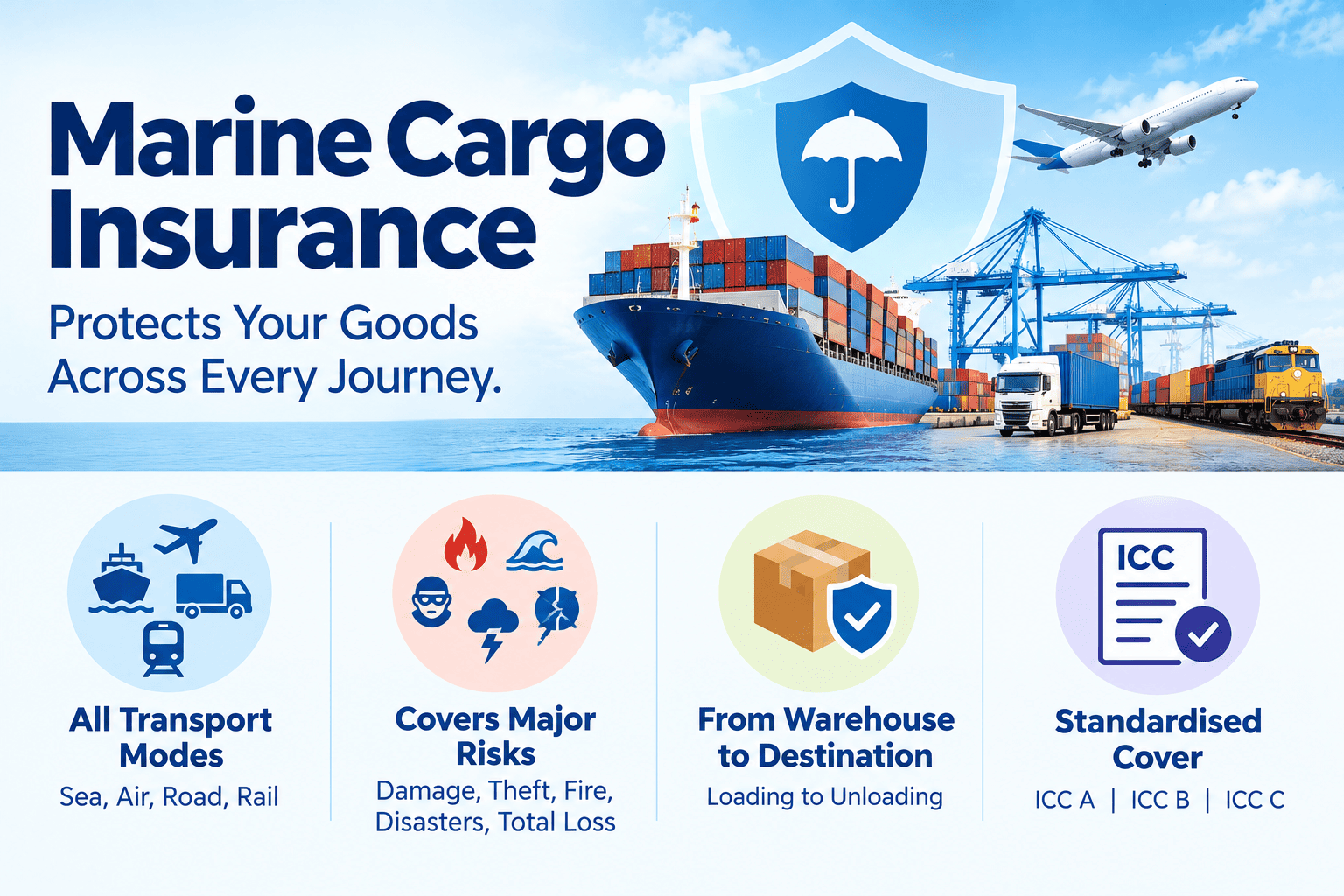
Why Marine Cargo Insurance Matters
No matter how robust a shipper’s loss-prevention strategy may be, it is reported that 30% of all freight damage in transit is unavoidable, and most losses occur on the way to or from the ports. Furthermore, cargo theft is estimated at up to $30 billion annually, with the majority taking place when goods are on the truck or in storage. Every shipment faces transit risk , and marine cargo insurance is the instrument that manages it. A single container lost at sea or damaged at port can wipe out months of working capital. Marine cargo insurance converts that catastrophic risk into a manageable, predictable premium cost, providing six critical protections that no trade finance or supply chain strategy can replace.
📊 Key Statistic
Premium rates for marine cargo insurance typically range from 0.05% to 0.5% of cargo value, making it one of the most cost-effective forms of business insurance. Most Letters of Credit issued by banks require the cargo to be insured under ICC (A) or (B) as a condition of payment.
The ICC Clauses: Understanding What is Covered
Marine cargo insurance policies follow internationally standardised Institute Cargo Clauses (ICC), developed by the London Institute of Underwriters. These clauses define precisely what perils are covered and come in three tiers.
| Clause | Coverage | Best For |
|---|
| ICC (A) , All Risk | The broadest cover available. Covers all accidental loss or damage to the insured cargo during the voyage unless specifically excluded. Includes theft, pilferage, leakage, breakage, contamination, sweat damage, and rough handling. | High-value, fragile, or theft-prone cargo; containerised shipments. |
| ICC (B) , Named Perils | Covers a specific list of named perils: fire, explosion, vessel stranding, sinking, capsizing, overturning, collision, earthquake, lightning, washing overboard, and water entry. Does not cover theft or breakage of fragile goods. | General cargo where theft risk is moderate; standard commercial shipments. |
| ICC (C) , Basic Perils | Minimum standard cover. Covers fire, explosion, vessel stranding, sinking, collision, and General Average sacrifice. Does not cover water damage, theft, or breakage. | Robust cargo unlikely to be stolen or broken; the absolute floor. |
📌 Practical Recommendation
For most exporters and importers, ICC (A) is strongly recommended , particularly for containerised cargo where theft, moisture, and handling damage are common risks. Treat ICC (C) as the absolute floor and upgrade to ICC (B) or ICC (A) for meaningful protection.
Policy Types & Coverage
Open Cover vs. Voyage Policy: Which is Right for Your Business?
Businesses that ship goods regularly should consider an Open Cover policy. Those that ship infrequently may prefer a Voyage Policy. The choice depends on shipment frequency and administrative capacity.
| Policy Type | Description | Best For |
|---|
| Open Cover (Floating/Blanket) | An annual master policy that automatically covers every shipment declared under it, up to the agreed maximum value per shipment. The exporter declares each shipment and receives a certificate of insurance. | Businesses with regular shipments (six or more per year); exporters using Letters of Credit. |
| Voyage Policy (Specific) | Covers a single shipment from a defined origin to a defined destination. | Infrequent shippers; high-value one-off imports; project cargo. |
| Annual/Turnover Policy | Designed for businesses that regularly ship goods; covers all shipments during the policy period. | High-volume traders seeking maximum administrative efficiency. |
What Marine Cargo Insurance Actually Covers
Marine cargo insurance provides several critical protections beyond basic physical loss or damage.
| Coverage | Description |
|---|
| Physical Loss or Damage | The core cover , pays for cargo damaged or lost during the voyage, whether by sea, air, road, or rail under a multimodal policy. |
| General Average Contribution | When a ship’s master jettisons some cargo to save the vessel and remaining cargo, all cargo owners must contribute proportionally to the loss. Insurance covers your share. |
| Salvage Charges | Costs incurred by third parties who save your cargo from a peril of the sea. Your insurer covers these charges up to the insured value. |
| Sue and Labour Charges | Reasonable costs you incur to prevent or minimise a covered loss , such as emergency repackaging at a transit port. |
| War and Strike Risks | Available as add-ons via the Institute War Clauses and Institute Strike Clauses. Essential for shipments to conflict-adjacent regions. |
| LC and Bank Compliance | Most Letters of Credit require cargo to be insured under ICC (A) or (B) as a condition of payment. An open cover policy with regular insurance certificates satisfies this requirement. |
What is Excluded Under Marine Cargo Insurance
Marine cargo insurance policies generally exclude the following. Always check your policy document carefully to understand exclusions.
- Improper or inadequate packing , damages caused by poor packaging.
- Abandonment of cargo , losses from voluntarily giving up the goods.
- Rejection by Customs or other governmental authorities.
- Failure to pay or collect , financial loss unrelated to physical damage.
- Inherent vice , natural deterioration of goods (e.g., fruit rotting).
- Wear and tear , normal deterioration over time.
- Losses due to war or terrorism , unless specifically covered by add-on clauses.
- Damages from delays in delivery, loss of market, or other consequential losses.
- Losses caused intentionally by the shipper or their employees.
- Unfit containers or temperature-sensitive goods , unless specifically covered.
How It Works
How Marine Cargo Insurance Works: Step by Step
Understanding the process helps businesses choose the right policy and ensure claims are paid promptly.
1
Assess Your Shipment
Determine the type of goods, cargo value, transportation mode (sea, air, road), and origin and destination points. These details determine the type of policy and the premium you’ll pay.
2
Choose the Right Policy
Select between single transit, open cover, or annual/turnover policy based