Best Alternatives to Made-in-China.com for Manufacturers & Buyers
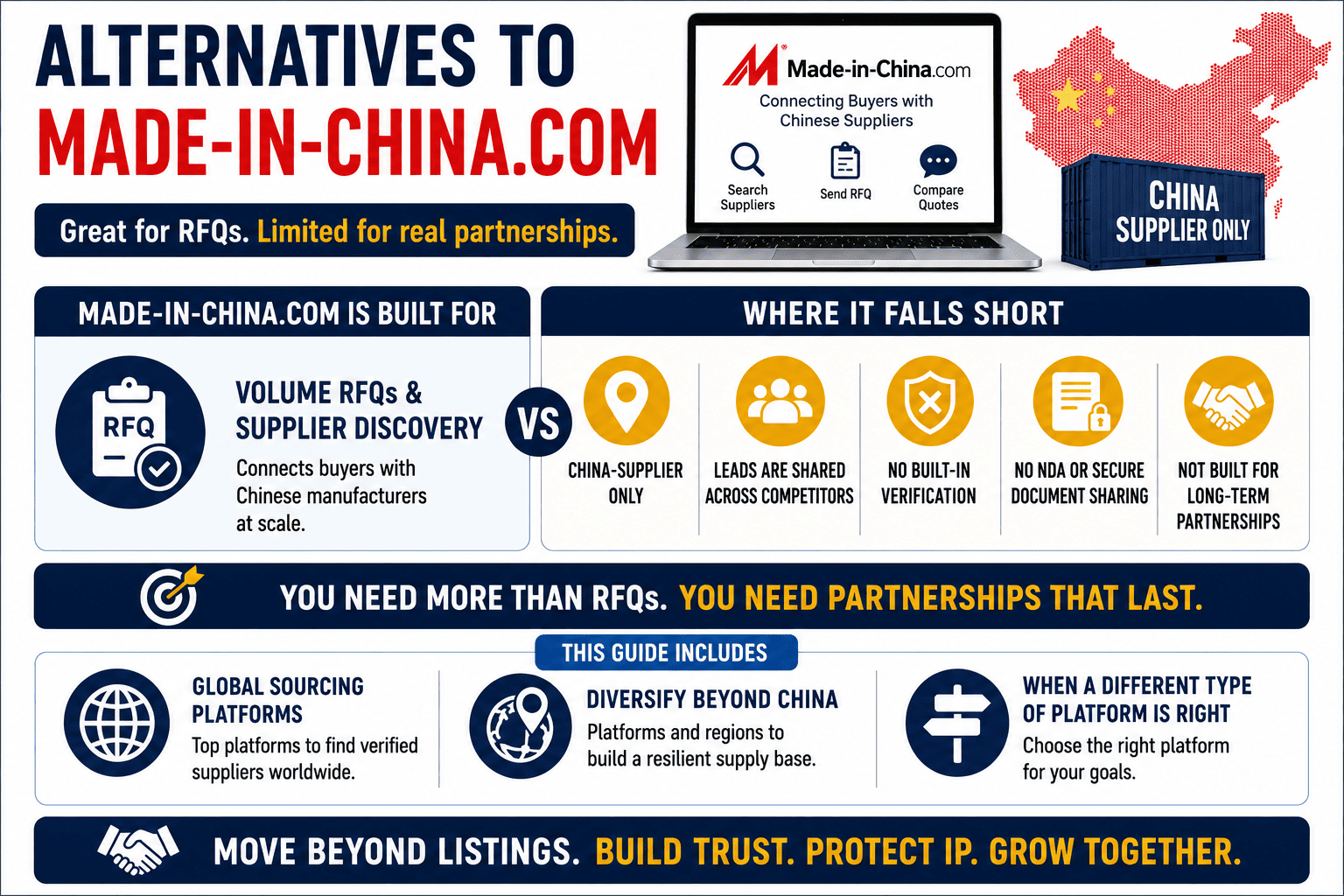
Made-in-China.com is one of the oldest and most established B2B sourcing directories built around Chinese manufacturers, and it does that job well for buyers running RFQs at volume. But it has real limits: it is China-supplier only, leads are shared across competing responders, and there is no built-in way to verify a company, protect a design under NDA, or manage a partnership that needs to last years rather than one purchase order. This guide covers the best alternatives, global sourcing platforms first, then options for diversifying sourcing beyond China, and separately explains when a different type of platform altogether is the right answer.
📅 Published September 1, 2026⏱ 15 min read✍️ GTsetu Editorial🔄 Updated September 1, 2026
Made-in-China.com has connected international buyers with Chinese factories since 1998, and it remains one of the largest supplier directories anchored specifically to Chinese manufacturing capacity. For buyers whose sourcing strategy begins and ends in China, it is a reasonable starting point. But sourcing teams and manufacturers are increasingly running into the same friction points: enquiries answered by dozens of competing suppliers at once, thin verification of who a “manufacturer” actually is, no framework for protecting product specs before a deal is signed, and, more recently, a genuine strategic need to diversify supply chains beyond a single country.
This guide is organised around two separate needs: finding a Made-in-China.com alternative that still centres on Chinese or broadly Asian supply, and finding an alternative for buyers actively trying to source manufacturing materials internationally and reduce single-country concentration risk. We also explain, separately, why some manufacturers, distributors, and raw material buyers are not looking for another sourcing directory at all, but for a structured platform to formalise long-term partnerships.
💡 How to read this guide
Sections 2 and 3 cover direct Made-in-China.com alternatives — other sourcing platforms and, separately, alternative manufacturing geographies. Section 5 explains the difference between sourcing directories and long-term collaboration platforms, and is worth reading if every directory keeps handing you the same shared-lead experience.
Section 1
Why Buyers Look for Made-in-China.com Alternatives
A few frustrations come up again and again, whether the buyer is an SME importer or a distributor sourcing for resale. Understanding them helps narrow down which alternative actually solves your problem, since different platforms solve different parts of it.
Shared, unranked enquiries. An RFQ submitted through the platform typically reaches many competing suppliers at once, so response quality varies wildly and price becomes the default differentiator rather than fit or capability.
Single-country concentration. Made-in-China.com’s supplier base is, by design, almost entirely China-based. Buyers trying to run a diversified sourcing strategy across multiple geographies need to run separate searches on separate platforms entirely.
Thin identity verification. Supplier badges and “verified” tags exist, but the underlying checks are inconsistent across categories, which raises real risk for first-time buyers placing large orders sight unseen.
Rising tariff and trade-policy exposure. Shifting tariff schedules and trade friction between China and Western markets have pushed many buyers toward actively managing trade compliance and building supplier relationships outside a single jurisdiction, something a China-only directory cannot help with directly.
No confidentiality infrastructure. There is no built-in NDA workflow or encrypted document exchange for sharing drawings, formulations, or pricing with a prospective factory before a relationship is confirmed.
Limited support for formal, ongoing partnerships. The platform is built for transaction-level sourcing, not for structuring a manufacturing partnership, distributor agreement, or supply arrangement meant to run for years.
📌 Key question before choosing an alternative
Are you looking for more supplier quotes (more of what Made-in-China.com already does), or a different kind of sourcing relationship, geographically diversified, verified, and built to last? The answer changes which platform is right for you. If it’s the former, Sections 2 and 3 cover the best alternatives. If it’s the latter, go directly to Section 5.
Section 2
Global B2B Sourcing Platform Alternatives
Directory & Marketplace Platforms
These platforms serve the same core function as Made-in-China.com, connecting buyers with suppliers through searchable directories and RFQ tools, but each has a distinct geographic focus, category strength, or verification model worth weighing.
1
Alibaba.com
World’s largest B2B marketplace · broadest global supplier and buyer base
Global ReachHigher Cost
Alibaba is the natural first alternative most buyers try, and for good reason: its supplier base and category breadth exceed Made-in-China.com’s, and its Trade Assurance escrow gives smaller buyers more payment protection than a typical directory enquiry. It still skews heavily toward Chinese manufacturing, so it solves the platform problem more than the diversification problem.
Strengths
Largest supplier and buyer traffic of any general B2B marketplace
Trade Assurance payment protection built into transactions
Broader category range than Made-in-China.com, including smaller MOQs
Verified supplier badges for premium members
Limitations
Still overwhelmingly China-centric supply base
Shared-lead RFQ model, same competitive-quoting dynamic
Premium visibility and commission costs add up for smaller suppliers
No NDA or confidential partnership-formation tools
🎯
Best for: Buyers who want a bigger, more general marketplace than Made-in-China.com but are comfortable continuing to source primarily from China.
2
Global Sources
Premium Asia-Pacific B2B · trade-show verified, US and EU buyer focus
Premium QualityHigh Entry Cost
Global Sources has operated since 1971, connecting Asian suppliers with buyers in North America and Europe. Its trade-show integration and screening standards give it a credibility edge over general directories, particularly for electronics, hardware, and OEM/ODM categories where the cost of a bad supplier match is high.
Strengths
Higher-quality buyer profiles, concentrated in the US and EU
Physical and virtual trade show integration
Strong for electronics, hardware, OEM and ODM categories
Higher entry cost than most general sourcing directories
Still primarily China and broader Asia-sourcing focused
No confidential document-sharing or NDA framework
🎯
Best for: Buyers in electronics, OEM, and industrial hardware who want more screened suppliers than a general directory, and are willing to pay a premium for it.
3
ThomasNet
North American industrial supplier directory · reshoring and domestic sourcing focus
North AmericaIndustrial Focus
ThomasNet is a long-established directory of North American manufacturers and industrial suppliers. It is the natural option for buyers actively reshoring or nearshoring, and its category depth in machining, metals, and industrial components is hard to match domestically. It is not a China alternative in the sourcing-region sense so much as a domestic-sourcing complement.
Strengths
Deep North American industrial and machining supplier base
Useful for buyers prioritising shorter lead times and lower logistics risk
Strong CAD and engineering-spec search tools for technical buyers
No cross-border shipping, customs, or currency complexity
Limitations
North America only, no help for buyers who still need offshore capacity
Domestic manufacturing costs generally higher than Asia-sourced alternatives
No partnership verification or NDA workflow
🎯
Best for: US and Canadian buyers reshoring part of their supply chain, or needing a domestic backup supplier alongside an offshore primary source.
4
EC21
Korea-headquartered global B2B directory · broad Asia-Pacific coverage
Asia-PacificBroad Categories
EC21 is a South Korea-based B2B directory covering suppliers across Korea, China, and broader Asia-Pacific markets. It is a useful supplementary channel for buyers who want Korean or Southeast Asian supplier options alongside their existing China sourcing, without the cost premium of Global Sources.
Strengths
Strong Korean supplier base not well represented on China-only directories
Broad Asia-Pacific category coverage
More affordable listing tiers than premium Western-facing platforms
Limitations
Lower overall traffic than Alibaba or Made-in-China.com
Verification standards vary by category and supplier tier
No confidential partnership-formation infrastructure
🎯
Best for: Buyers wanting to add Korean or broader Asia-Pacific supplier options as a supplementary channel to their existing China sourcing.
5
HKTDC Sourcing
Hong Kong Trade Development Council · government-backed trade platform
Government-BackedTrade Fairs
Run by Hong Kong’s official trade promotion body, HKTDC Sourcing combines a supplier directory with the organisation’s long-running trade fair network. Its government backing gives it a credibility signal that pure commercial directories lack, and it is a well-trodden route for buyers who want a more institutional sourcing channel into Greater China.
Strengths
Government-affiliated, which adds a layer of institutional credibility
Strong integration with major physical trade fairs
Useful entry point for buyers new to Greater China sourcing
Limitations
Lower digital-platform traffic than commercial marketplaces
Still concentrated in Greater China supply
No NDA or encrypted document infrastructure for partnership formation
🎯
Best for: Buyers who want an institutionally-backed sourcing channel and value trade-fair access alongside an online directory.
Section 3
Sourcing Alternatives Beyond China
Diversifying Manufacturing Geography
A different kind of “alternative to Made-in-China.com” is not another China-focused directory at all, but a shift in sourcing geography. Rising labour costs in coastal China, tariff exposure, and a general push toward supply-chain resilience have made a “China plus one” approach common among manufacturers and importers. The countries below are the ones most frequently cited as viable manufacturing alternatives, each with a genuinely different cost, quality, and speed profile.
1
India
Large, English-speaking workforce · diverse manufacturing base across sectors
English-SpeakingDiverse Base
India offers a young, large workforce, English as a common business language, and manufacturing depth across automotive, textiles, pharmaceuticals, and engineering goods. Sourcing directories like IndiaMART and TradeIndia are the typical entry point for buyers exploring Indian supply, though, as with Made-in-China.com, they are shared-lead directories rather than verified partnership platforms.
Strengths
Deep, diverse manufacturing base across many sectors
English widely used in business, easing communication
Meaningful cost advantage versus Western manufacturing
Limitations
Quality consistency varies more than in China; oversight matters
Logistics and regulatory complexity vary significantly by region
🎯
Best for: Buyers diversifying into a large, cost-competitive market with strong English-language communication, particularly for textiles, engineering goods, and pharmaceuticals.
2
Vietnam
Fast-growing manufacturing hub · strong in electronics, textiles, footwear
Fast GrowthChina-Adjacent
Vietnam is frequently cited as the most direct “China plus one” destination, thanks to lower labour costs, proximity to Chinese supply chains for component sourcing, and rapid growth in electronics and garment manufacturing. Import volumes from Vietnam into Western markets have grown substantially as buyers shift capacity out of China.
Strengths
Lower labour costs than China, with strong recent FDI growth
Geographic proximity to China eases component supply chains
Established strength in electronics, textiles, and footwear
Limitations
Smaller-scale manufacturing base than China overall
Worker turnover and periodic labour unrest in garment sectors
Slower customs and border-compliance processes than China
🎯
Best for: Buyers in electronics, textiles, or footwear looking for the closest like-for-like diversification from China, with minimal supply-chain disruption.
3
Mexico
Nearshoring gateway to North America · automotive and electronics strength
NearshoringNorth America Access
Mexico’s proximity to the US and Canada, combined with USMCA tariff advantages, makes it the leading nearshoring option for buyers serving North American markets. Its automotive, aerospace, and electronics manufacturing base is mature, and shorter shipping times materially reduce lead-time risk compared with transpacific freight.
Strengths
Dramatically shorter shipping times to the US and Canada
USMCA tariff advantages for qualifying goods
Established automotive, aerospace, and electronics capability
Limitations
Security concerns in certain regions can affect operations
Environmental and labour compliance costs can be significant
🎯
Best for: North American buyers prioritising short lead times and tariff advantages over the lowest possible unit cost.
Whichever geography you diversify into, the harder part is rarely finding a directory listing, it is verifying that the company on the other end is who they claim to be, and getting comfortable enough to share drawings, formulations, or pricing before a contract is signed. That verification and confidentiality gap shows up consistently, whatever country you’re sourcing from, and it’s the subject of Section 5.
Section 4
Side-by-Side Comparison
The table below compares all the platforms and geographies covered in this guide across the dimensions that matter most to buyers and manufacturers choosing between them.
Platform / Region
Primary Focus
Lead Model
Verification
Geographic Reach
Best For
Made-in-China.com
China suppliers
Shared RFQ
⚠ Inconsistent
✗ China only
High-volume China sourcing
Alibaba
Global, China-heavy
Shared RFQ
⚠ Paid option
✓ Largest globally
Broadest general sourcing
Global Sources
Asia-Pacific export
Buyer-led enquiry
⚠ Trade show
✓ US, EU strong
Industrial / OEM export to West
ThomasNet
North America domestic
Directory enquiry
⚠ Basic
✗ North America only
Reshoring / domestic sourcing
EC21
Korea / Asia-Pacific
Shared RFQ
⚠ Basic
⚠ Moderate
Korean supplier diversification
HKTDC Sourcing
Greater China
Directory + trade fairs
⚠ Institutional
⚠ Moderate
Institutional China entry point
India (IndiaMART / TradeIndia)
India domestic + export
Shared RFQ
⚠ Self-reported
⚠ Moderate
Diversification into South Asia
Vietnam sourcing directories
Vietnam domestic + export
Shared RFQ
⚠ Basic
⚠ Moderate
Closest China-adjacent diversification
Mexico sourcing directories
Mexico domestic + export
Shared RFQ
⚠ Basic
⚠ Moderate
Nearshoring for North America
💡 Pattern to notice
Every platform in the table above, and every regional directory beneath it, uses the same shared RFQ architecture: a buyer posts a request, multiple suppliers compete to respond. That model is legitimate for enquiry volume and can support a broader B2B networking and lead-generation strategy. But it was never built to verify a company’s registration, protect a design under NDA, or carry a relationship through years of ongoing supply. That’s a structurally different problem, covered next.
Section 5
Sourcing Directories vs. Long-Term Collaboration: A Different Need Entirely
Here is a distinction most platform comparisons skip: Made-in-China.com, Alibaba, Global Sources, and the regional directories covered above are all built for transaction-level sourcing. A buyer searches, requests a quote, suppliers respond, an order may follow. This is a legitimate, well-served need, and it works fine when a company is placing standard purchase orders.
But there is a different commercial need these directories are structurally unable to serve: finding and formalising a long-term manufacturing, supply, or distribution partnership that will run for years, not one purchase order.
A brand seeking a long-term contract manufacturer, a distributor seeking a principal manufacturer to represent in a new market, or a raw material buyer building a resilient cross-border manufacturing partnership, is not looking for a quotation. They are looking for a company they can trust for the long haul: verified, vetted against agreed partnership evaluation criteria, and willing to formalise the relationship through a proper business partnership contract with clear terms for dispute resolution and force majeure built in from the start.
Anonymous discovery, browse without revealing yourself
✗ Identity exposed from first enquiry
✓ Anonymous until mutual interest
NDA before sharing pricing, drawings, or formulations
✗ No framework exists
✓ Built-in NDA workflow
Encrypted document sharing with audit trail
✗ Email attachments or open links
✓ Encrypted workspace, full audit trail
Sourcing diversification across 100+ countries in one place
⚠ Fragmented across separate regional platforms
✓ Purpose-built for cross-border partnership
Zero commission on partnerships formed
⚠ Subscription and premium listing costs
✓ No success fee or broker commission
🤝 For Long-Term Industrial Partnerships
GTsetu: Purpose-Built for Manufacturers, Distributors, and Raw Material Suppliers Seeking Verified Long-Term Collaboration
If you are a manufacturer, distributor, or raw material buyer looking for a verified long-term trade partner rather than another sourcing quote, GTsetu is built specifically for that purpose. It is not a directory and not a marketplace. It is a structured partnership platform where every company is verified on 6 government-sourced points before engagement, where discovery is anonymous until mutual interest is confirmed, where NDAs are executed digitally before any commercial information changes hands, and where all document exchange happens through an encrypted workspace.
GTsetu is used by manufacturers, distribution companies, and raw material suppliers across 100+ countries to find, vet, and formally engage with trade partners for the long term, whether that means diversifying manufacturing capacity beyond China, formalising a technology partnership, or building a distributor network in a new market.
🏛️
6-Point Government-Sourced Verification
Name, Address, Registration Number, Company Status, Company Type, and Date of Incorporation, verified using government tie-ups before any engagement.
🕵️
Anonymous Discovery
Browse verified partner profiles across 100+ countries without revealing your own identity or sourcing strategy until you choose to engage.
📄
Built-In NDA Workflow
Digital NDA with timestamped signatures before any pricing, formulations, or product specs are shared. No sensitive information exposed without protection.
🔐
Encrypted Document Workspace
All commercial documents shared through encrypted channels with a full access audit trail, not email attachments.
🌍
100+ Countries
Verified manufacturers, distributors, and raw material suppliers across Asia, the Middle East, Europe, Africa, Australia, and the Americas.
🚫
Zero Commission
No success fee, no broker commission, ever. Your partnership economics remain entirely between you and your partner.
📌 GTsetu and sourcing directories are not competitors
Many manufacturers and buyers on GTsetu also use Made-in-China.com or Alibaba for transactional sourcing. These are complementary, not competing, activities. Sourcing directories handle inbound quotation volume and one-off purchase orders. GTsetu handles partnership-level engagement, verified long-term relationships in manufacturing, distribution, and raw materials supply, whether the goal is global expansion or simply reducing single-country sourcing risk. Most serious buyers use both.
Section 6
Which Platform Fits Your Goal?
Use this reference to match your commercial objective to the platform most aligned with it. Most buyers with more than one active sourcing goal end up using two or three platforms in combination.
🛒
Maximise inbound supplier quotes for China-based sourcing
You want more Chinese supplier options and a bigger marketplace than Made-in-China.com alone.
Alibaba + Global Sources
🏭
Reshore or nearshore part of your supply chain
You want shorter lead times and lower logistics risk, even at a higher unit cost.
ThomasNet (US) / Mexico directories
🌏
Diversify sourcing beyond China without leaving Asia
You want a “China plus one” strategy in electronics, textiles, or engineering goods.
Vietnam / India directories
🚀
Add supplier options without committing to a new region
You want a supplementary channel with different supplier coverage alongside your current sourcing.
EC21 / HKTDC Sourcing
🔬
Screen suppliers more carefully for OEM or industrial goods
You need trade-show-verified suppliers for electronics, hardware, or industrial components.
Global Sources
🤝
Find a verified long-term manufacturing or distribution partner
You need a serious partner for a lasting relationship, not a one-off quotation.
GTsetu
🏗️
Distributor or raw material buyer seeking a verified principal
You want a manufacturer or supplier whose identity and registration are independently verified.
GTsetu
🔒
Share sensitive commercial data securely with prospective partners
You need NDA protection and an encrypted workspace before sharing pricing, formulations, or product specs.
GTsetu (only platform with this)
FAQ
Frequently Asked Questions
QWhat is the best alternative to Made-in-China.com for sourcing?
It depends on what you’re trying to fix. For broader global supplier reach, Alibaba and Global Sources are the closest like-for-like alternatives. For North American buyer credibility, ThomasNet is a strong regional option. For diversifying away from China entirely, sourcing platforms and directories in India, Vietnam, and Mexico are worth exploring. For long-term manufacturing or distribution partnerships, where verification, confidentiality, and relationship depth matter more than enquiry volume, that is a different category of platform entirely, which is what GTsetu is built for.
QIs Alibaba better than Made-in-China.com?
Alibaba is the closest and largest alternative, with broader category coverage and a bigger international buyer base. Made-in-China.com tends to skew toward industrial, engineering, and B2B trade categories, while Alibaba spans both B2B and smaller-order sourcing. Neither is definitively better for every buyer, many source from both simultaneously. For long-term distributor partnerships or diversified sourcing outside China, both platforms share similar structural limitations: they are sourcing directories, not partnership platforms.
QWhat is the difference between a sourcing platform and a long-term collaboration platform?
Sourcing platforms like Made-in-China.com, Alibaba, and Global Sources are designed for buyers to discover many suppliers at once and request quotations quickly, optimising for volume and response speed. Long-term collaboration platforms like GTsetu are designed for manufacturers, distributors, and raw material suppliers to find, verify, and formally engage with partners they plan to work with for years, with features like government-sourced verification, anonymous discovery, NDA workflows, and encrypted document sharing that sourcing directories are not architected for.
QShould manufacturers diversify sourcing away from China entirely?
Many manufacturers and buyers are pursuing a “China plus one” approach rather than an outright exit, keeping some supply in China while building verified relationships in India, Vietnam, Mexico, or elsewhere. The right approach depends on tariffs, lead times, and the specific product category, and it’s worth running proper market research before committing. For finding and formally engaging verified partners in a new sourcing geography, GTsetu is purpose-built for that process, and can complement international business development consulting you may already be running.
QCan I use GTsetu alongside Made-in-China.com or Alibaba?
Yes, and that is the most common usage pattern among manufacturers and buyers who take sourcing risk seriously. Made-in-China.com and Alibaba handle transactional sourcing and one-off purchase orders. GTsetu handles a complementary and structurally different need: finding and formalising verified long-term partnerships, whether that’s a manufacturing partner, a raw material supplier, or a distributor entering a new market such as a Nigerian industrial and agro cluster. These are entirely different commercial activities that do not overlap or conflict.
QHow do I find verified international distributors instead of just sourcing suppliers?
Sourcing directories are built for buyers finding suppliers, not manufacturers finding international wholesale distributors to represent their products. For that, a purpose-built B2B matchmaking tool with government-sourced verification and NDA workflows, such as GTsetu, is the more direct route than adapting a sourcing directory to a use case it wasn’t built for. It also helps to check that any manufacturing partner you engage holds the right certifications for international trade before formalising an agreement.
Looking for Long-Term Collaboration, Not Just a Sourcing Quote?
GTsetu is purpose-built for manufacturers, distributors, and raw material suppliers seeking verified long-term trade partnerships, across 100+ countries, with government-sourced partner verification, built-in NDA workflows, and zero commission.
They represents the product, and research team behind GTsetu, a global B2B collaboration platform built to help companies explore cross-border partnerships with clarity and trust. The team focuses on simplifying early-stage international business discovery by combining structured company profiles, verification-led access, and controlled collaboration workflows.
With a strong emphasis on trust, and disciplined engagement, Team GTsetu shares insights on global trade, partnerships, and cross-border collaboration, helping businesses make informed decisions before entering deeper commercial discussions.