Best Alternatives to ThomasNet for Industrial Manufacturers
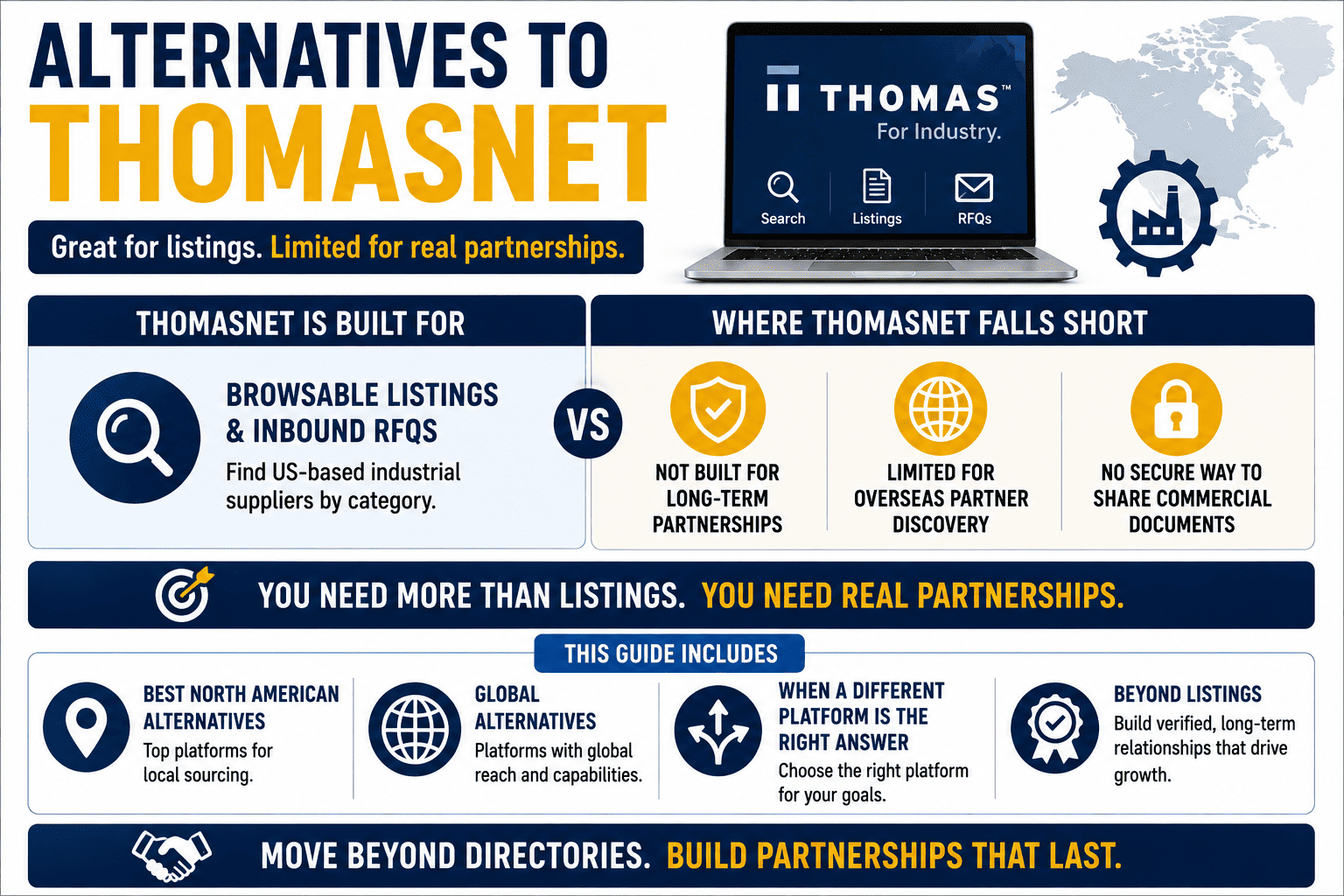
ThomasNet is the default industrial supplier directory in North America, but it is built around one thing: browsable listings and inbound RFQs. If you are a manufacturer or sourcing team looking for US-based industrial suppliers by category, it serves that well. But if you want to find a verified long-term manufacturing partner overseas, negotiate a cross-border distribution agreement, or share commercial documents securely with a prospective partner, ThomasNet’s directory model has real limits. This guide covers the best alternatives, broken into North American options and global platforms, and separately explains when a different type of platform altogether is the right answer.
📅 Published August 31, 2026⏱ 15 min read✍️ GTsetu Editorial🔄 Updated August 31, 2026
ThomasNet has played a real role in digitising North American industrial sourcing since it evolved from the historic Thomas Register. With more than 500,000 listed suppliers, it remains the default starting point for procurement teams and design engineers searching for US manufacturers, distributors, and service companies. But scale creates its own problems. Directory traffic has declined as buyers start their research on Google instead, listings are shared across competing suppliers responding to the same RFQ, and the platform’s architecture is fundamentally built for browsing and quotation requests, not for the kind of structured, confidential engagement that long-term distributor and manufacturing partnerships require. For manufacturers weighing whether directory listings still pay off, it helps to look at the same trade-offs sourcing teams face when planning a company’s global expansion more broadly.
This guide is organised around two separate needs: finding a ThomasNet alternative for North American sourcing, and finding one for international or global reach. We also explain, separately, why some manufacturers and distributors are not looking for another directory at all, but for a different type of commercial platform entirely.
💡 How to read this guide
Sections 2 and 3 cover direct ThomasNet alternatives, other supplier directories and sourcing marketplaces. Section 5 explains the difference between directory platforms and long-term collaboration platforms, and is worth reading if you are finding that every listing site gives you similar results.
Section 1
Why Manufacturers Look for ThomasNet Alternatives
The frustrations are consistent across categories and company sizes. Understanding them helps you pick the right alternative, because different alternatives solve different problems.
Shared and rented leads. RFQs submitted through ThomasNet often go to multiple competing suppliers at once, and the leads stop the moment a supplier stops paying for premium placement. It is a rented audience, not an owned one, which is why many manufacturers now invest in B2B networking and lead generation that builds a durable pipeline instead.
Category overcrowding. In popular segments, machining, fabrication, packaging, electronic components, hundreds of suppliers compete for the same buyers. Premium placement is expensive and does not guarantee better-quality enquiries.
Declining organic traffic. Buyers increasingly start sourcing research on Google or through their own supplier networks rather than browsing directories, which has eroded the volume of qualified engineers and procurement teams reaching listings organically.
Limited verified international reach. ThomasNet’s strength is domestic US and North American coverage. Manufacturers seeking verified international buyers or distributors in Europe, the Middle East, Africa, or Asia find the platform’s cross-border capabilities limited.
No confidentiality infrastructure. There is no NDA workflow, no encrypted document sharing, and no way to protect pricing, tooling specs, or drawings when engaging a prospective partner through the platform, a gap that becomes a real liability once you look at what a properly drafted business partnership contract actually requires before commercial information changes hands.
Self-reported profiles. Supplier identities and capabilities are largely self-declared, without systematic verification against government or regulatory registries. For high-value or export transactions, this creates meaningful risk, particularly once global trade compliance obligations enter the picture.
📌 Key question before choosing an alternative
Are you looking for more inbound RFQ enquiries (more of what ThomasNet does), or a different kind of commercial relationship, longer-term, verified, and more structured? The answer changes which platform is right for you. If you are looking for the former, Sections 2 and 3 cover the best alternatives. If the latter, go directly to Section 5.
Section 2
Alternatives to ThomasNet in North America
North American Supplier Directories
The following platforms serve manufacturers and sourcing teams seeking North American supplier reach, the primary function ThomasNet performs. Each has a distinct angle, category strength, or commercial model worth considering.
1
IndustryNet
US-focused industrial directory · manufacturer and supplier listings
North AmericaFree Listings
IndustryNet is one of ThomasNet’s most direct competitors, focused exclusively on the US manufacturing sector. It provides detailed information on hundreds of thousands of manufacturers and industrial suppliers, built by a research team that contacts companies periodically to keep listings current, a manual verification approach with the same limitations as ThomasNet’s own supplier-submitted data.
Strengths
Detailed coverage of US manufacturers across thousands of categories
Free basic listings for suppliers
Clean, straightforward category and geographic search
Long operating history with an established buyer base
Limitations
Same directory browsing model as ThomasNet, no workflow tools
US-only, no meaningful international reach
Data accuracy depends on periodic manual outreach, not real-time verification
No NDA, verification, or confidential engagement tools
🎯
Best for: Manufacturers wanting to supplement ThomasNet with an additional domestic listing. Most useful as a parallel channel rather than a replacement.
2
IQS Directory
North American OEM and industrial services directory
North AmericaOEM Focus
IQS Directory covers similar territory to ThomasNet: OEM manufacturers, industrial services, and geographic search across the US and Canada. It is a solid second directory to cross-reference a ThomasNet search against, particularly for niche industrial process categories, but it does not extend coverage internationally or add workflow beyond listings.
Strengths
Strong OEM and industrial process category depth
Useful for cross-referencing ThomasNet search results
Detailed company profiles with process and capability filters
Limitations
Domestic US industrial supply focus only
Does not extend international coverage or cross-industry reach
Best for: Sourcing teams who want a second directory in the same lane as ThomasNet, mainly for OEM and industrial process categories.
3
GlobalSpec
Engineering-focused search for components and technical products
EngineeringSpec-Driven
GlobalSpec positions itself as a single source for engineering search, helping design engineers and procurement teams find components, materials, and technical products by specification rather than category alone. It shares ThomasNet’s fundamental limitation, coverage depends on supplier participation, but its spec-driven search is genuinely useful for technical parts sourcing.
Strengths
Strongest for spec-driven technical component search
Engineering-audience focus with technical datasheets
Useful complement to ThomasNet for design engineers
Limitations
Primarily North American coverage with a technical skew
Data depends on supplier participation, same core limitation as ThomasNet
No partnership engagement or confidential document tools
🎯
Best for: Design engineers and technical buyers who need spec-driven component search rather than a general category directory.
4
MacRAE’s Blue Book
Legacy North American industrial directory · since 1893
Legacy DirectoryNorth America
MacRAE’s Blue Book has operated as an industrial directory since 1893, covering North American manufacturing and industrial distribution companies. Its long legacy gives it depth in older, established industrial categories, though its interface and discovery tools are more dated than newer sourcing platforms.
Strengths
Deep legacy coverage of established industrial categories
Long-standing trust among traditional manufacturing buyers
Straightforward category and company-name search
Limitations
Dated interface compared to modern sourcing tools
No international reach beyond North America
No verification, NDA, or structured engagement tools
🎯
Best for: Manufacturers in legacy industrial categories who want a long-established directory as a secondary listing channel.
MFG.com works differently from a browsable directory. Buyers upload a part file or specification and collect competing quotes from machine shops and factories, which suits one-off or short-run custom manufacturing needs better than long-form category browsing. It is a transaction-first alternative for teams that already know their spec and just need quotes fast.
Strengths
Fast quote turnaround for custom and short-run parts
Upload-a-spec workflow suits CAD-driven sourcing
Useful for machine shops and contract manufacturers specifically
Limitations
Narrow fit, best for discrete custom parts, not general industrial supply
Shared-quote model, multiple shops bid on the same spec
No long-term partnership, NDA, or verification infrastructure
🎯
Best for: Engineering teams with a finished CAD file or spec who want fast competitive quotes on custom or short-run parts.
Section 3
Global Alternatives to ThomasNet
International Sourcing Platforms
For manufacturers and sourcing teams looking beyond North America, the following global platforms are the most established options. Each serves a different type of international sourcing objective, and each one comes with its own regulatory and logistics considerations that are worth reviewing alongside a broader look at how to source manufacturing materials internationally.
1
Europages
European B2B directory · 3M+ listed companies across 26 languages
EuropeMultilingual
Europages is a European B2B directory with more than 3 million listed companies, indexed by product and activity across 26 languages. For buyers whose supply chain extends into the EU, or who find ThomasNet too US-centric, Europages is a natural complement for baseline discovery in manufacturing, wholesale, and industrial distribution.
Strengths
Deep European coverage across manufacturing and distribution
26-language support for genuinely pan-European search
Category browsing and basic lead forms built in
Limitations
Weak outside Europe, not a substitute for US or Asia sourcing
Self-reported listings, no systematic verification
No NDA or confidential document-sharing infrastructure
🎯
Best for: Manufacturers and distributors whose supply chain touches the EU and want a lightweight European directory to complement ThomasNet.
2
Kompass
Global company database · cross-industry, cross-border reach
Global ReachCompany Data
Kompass maintains a large global company database spanning most industrial and commercial sectors, useful for initial company-level due diligence before deeper outreach. It functions closer to a business information database than a lead-generation directory, which makes it a reasonable starting point for global market research before committing to a sourcing region.
Strengths
Broad cross-industry, cross-border company coverage
Useful for early-stage market and company research
Category and geography filters across most world regions
Limitations
Company database depth varies significantly by region
Not optimised for active RFQ or lead-generation workflows
No verification, NDA, or partnership formation tools
🎯
Best for: Early-stage research into potential suppliers or partners across multiple countries before narrowing down a shortlist.
3
Alibaba.com
World’s largest B2B marketplace · maximum international sourcing reach
Global ReachHigher Cost
Alibaba is the global benchmark for overseas manufacturing sourcing. For US and North American buyers looking to reach manufacturers in Asia, its traffic and supplier volume are unmatched. However, it is optimised for transaction-level enquiries and shared RFQs, not long-term manufacturing partnerships, and buyers still carry the full burden of vetting suppliers themselves.
Strengths
Largest overseas manufacturing supplier base of any platform
Trade Assurance payment protection for transactions
Verified supplier badge options for premium members
Strong for components, consumer goods, and private label manufacturing
Limitations
High cost, premium plans and commissions significant for SMEs
Not designed for ongoing distributor partnership engagement
🎯
Best for: Buyers sourcing overseas manufacturing at volume who can absorb higher platform costs and manage supplier vetting themselves.
4
Global Sources
Premium Asia-Pacific B2B · trade-show verified, US and EU buyer focus
Premium QualityHigh Entry Cost
Global Sources connects Asian manufacturers with buyers in North America and Europe, with trade show integration and verified supplier standards that give it a credibility premium over general directories. It is particularly strong for electronics, industrial components, and OEM manufacturing categories where buyer quality and intent matter more than raw enquiry volume.
Strengths
High-quality buyer and supplier profiles, US and EU focused
Trade show integration with physical and virtual events
Strong for electronics, industrial, OEM and ODM categories
Verified supplier standards and credibility signals
Limitations
Higher entry cost than most North American directories
Primarily Asia-sourcing focus, less useful for domestic US discovery
No partnership engagement framework or NDA tools
🎯
Best for: North American manufacturers in electronics, OEM, and industrial goods sourcing screened Asian suppliers, or seeking distribution in Asia-Pacific markets.
Section 4
Side-by-Side Comparison
The table below compares all the platforms covered in this guide across the dimensions that matter most to manufacturers and sourcing teams choosing between them.
Platform
Primary Market
Discovery Model
Verification
International Reach
Best For
ThomasNet
North America
Directory + RFQ
⚠ Self-reported
⚠ Limited
US industrial supplier discovery
IndustryNet
North America
Directory
⚠ Periodic manual
✗ US only
Supplementary domestic listing
IQS Directory
North America
Directory
⚠ Self-reported
✗ US/Canada only
OEM and process cross-referencing
GlobalSpec
North America
Spec-driven search
⚠ Self-reported
✗ Weak
Technical component sourcing
MFG.com
North America
RFQ marketplace
⚠ Basic
✗ Limited
Custom and short-run parts quoting
Europages
Europe
Directory
⚠ Self-reported
⚠ Europe only
EU supplier discovery
Kompass
Global
Company database
⚠ Basic
✓ Broad
Early-stage company research
Alibaba
Global
Shared RFQ
⚠ Paid option
✓ Largest globally
High-volume overseas sourcing
Global Sources
Asia-Pacific export
Buyer-led enquiry
⚠ Trade show
✓ US, EU strong
Industrial / OEM sourcing from Asia
💡 Pattern to notice
Every platform in the table above uses a directory browsing or shared RFQ model. They are all built around the same commercial architecture: a buyer searches or submits an enquiry, multiple suppliers compete to respond. If that model is producing the results you need, one of the platforms above is your answer. If it is not, if you need something structurally different, the next section explains why.
Section 5
Directory Platforms vs. Long-Term Collaboration: A Different Need Entirely
Here is a distinction that most platform comparisons do not make clearly enough: all of the platforms reviewed above, ThomasNet, IndustryNet, Alibaba, Global Sources, and the rest, are built for browsing and Request for Quotation (RFQ) workflows. A buyer searches, submits a request, suppliers compete, a transaction may follow. This is a legitimate and well-served commercial need, and one that matters even more when supply chains cross borders and depend on the kind of resilience discussed in guides on cross-border manufacturing partnerships and global supply chains.
But there is a different commercial need that directory platforms are structurally unable to serve: finding and formalising a long-term manufacturing or distribution partnership.
This is a fundamentally different process. A manufacturer seeking a distributor in Germany, or a distributor in Vietnam seeking a manufacturing principal in the US, is not looking for a quotation. They are looking for a company they can trust with their commercial relationship for years, a partner they need to verify against clear partnership evaluation criteria, align on terms with, exchange confidential documents with, and build a formal agreement with. The browsing, shared-lead model of directory platforms is not designed for this, and unresolved terms at the outset are exactly what lead to costly disputes in international contracts later.
What you need
Directory Platform (ThomasNet, Alibaba, etc.)
Long-term Collaboration Platform
Inbound RFQ enquiries at volume
✓ This is what they’re built for
✗ Not the purpose
Verified partner identity before engagement
✗ Self-reported profiles
✓ Government-sourced verification
Anonymous discovery, browse without revealing yourself
✗ Identity exposed from first listing
✓ Anonymous until mutual interest
NDA before sharing pricing or product specs
✗ No framework exists
✓ Built-in NDA workflow
Encrypted document sharing with audit trail
✗ Email attachments or open links
✓ Encrypted workspace, full audit trail
International distributor discovery (100+ countries)
⚠ Limited, unverified quality
✓ Purpose-built for cross-border partnership
Zero commission on partnerships formed
⚠ Subscription costs required for visibility
✓ No success fee or broker commission
🤝 For Long-Term Industrial Partnerships
GTsetu: A B2B Matchmaking Tool for Manufacturers, Distributors, and Raw Material Suppliers Seeking Verified Long-Term Collaboration
If you are a manufacturer, distributor, or raw material supplier in an industrial sector, and you are looking for a verified long-term trade partner rather than an inbound RFQ lead, GTsetu is built specifically for that purpose. It is not a directory. It is not a marketplace. It is a structured B2B matchmaking platform where every company is verified on 6 government-sourced points before engagement, where discovery is anonymous until mutual interest is confirmed, where NDAs are executed digitally before any commercial information changes hands, and where all document exchange happens through an encrypted workspace.
GTsetu is used by industrial manufacturers, distribution companies, and raw material suppliers across 100+ countries, including fast-growing regions like the Nigerian industrial and agro cluster, to find, vet, and formally engage with trade partners they intend to work with for the long term, not to generate quotation volume.
🏛️
6-Point Government-Sourced Verification
Name, Address, Registration Number, Company Status, Company Type, and Date of Incorporation, verified using government tie-ups before any engagement.
🕵️
Anonymous Discovery
Browse verified partner profiles across 100+ countries without revealing your own identity or sourcing strategy until you choose to engage.
📄
Built-In NDA Workflow
Digital NDA with timestamped signatures before any pricing, tooling specs, or drawings are shared. No sensitive information exposed without protection.
🔐
Encrypted Document Workspace
All commercial documents shared through encrypted channels with a full access audit trail, not email attachments.
🌍
100+ Countries
Verified manufacturers and distributors across Asia, the Middle East, Europe, Africa, Australia, and the Americas. Built for cross-border partnership formation, not enquiry volume.
🚫
Zero Commission
No success fee, no broker commission, ever. Your partnership economics remain entirely between you and your partner.
📌 GTsetu and directory platforms are not competitors
Many manufacturers on GTsetu also use ThomasNet or IndustryNet for domestic RFQ volume. These are complementary, not competing, activities. ThomasNet handles inbound quotation enquiries. GTsetu handles partnership-level engagement with verified companies in sectors like manufacturing, distribution, and raw materials supply, nationally and internationally, and often works alongside a company’s existing international business development consulting effort rather than replacing it. Most serious manufacturers who need both use both.
Section 6
Which Platform Fits Your Sourcing Goal?
Use this reference to match your commercial objective to the platform most aligned with it. Most manufacturers with more than one active sourcing goal use two or three platforms in combination.
🛠️
Maximise inbound RFQ enquiries from North American buyers
You want high-volume leads from procurement teams and engineers across US and Canadian cities for standard industrial categories.
ThomasNet + IndustryNet
📐
Source custom or short-run parts from a finished spec
You have a CAD file or drawing ready and want fast competitive quotes from machine shops and factories.
MFG.com
🇪🇺
Reach European manufacturers and distributors
Your supply chain extends into the EU and ThomasNet’s North American focus does not cover it deeply enough.
Europages + Kompass
🌏
Source overseas manufacturing at scale
You are an established buyer competing on price and can absorb Alibaba’s higher platform costs for global reach.
Alibaba + Global Sources
🔬
Technical or spec-driven component sourcing
You need components matched by technical specification rather than category browsing alone.
GlobalSpec
🤝
Find a verified long-term international distributor
You need a serious partner to represent your products in a foreign market, not a quotation lead.
GTsetu
🏭
Distributor seeking a verified manufacturing principal
You distribute in your market and want a manufacturer to represent whose identity and registration are verified.
GTsetu
🔒
Share sensitive commercial data securely with prospective partners
You need NDA protection and an encrypted workspace before sharing pricing, tooling specs, or drawings.
GTsetu (only platform with this)
FAQ
Frequently Asked Questions
QWhat is the best alternative to ThomasNet for industrial manufacturers?
It depends on what you need ThomasNet to do better. For direct US industrial directory coverage, IndustryNet and IQS Directory are the closest like-for-like alternatives. For European reach, Europages and Kompass are purpose-built. For custom or short-run parts, MFG.com’s upload-a-spec workflow is faster than browsing listings. For overseas manufacturing at scale, Alibaba and Global Sources provide the widest reach. For long-term distributor and manufacturing partnerships, where verification, confidentiality, and relationship structure matter, that is a different category of platform entirely, which is what GTsetu is built for in industrial sectors.
QIs IndustryNet better than ThomasNet?
For domestic US lead generation, IndustryNet and ThomasNet are broadly comparable, both large-scale directories with similar browsing and RFQ models. ThomasNet has higher traffic and a larger buyer base; IndustryNet is a reasonable secondary listing for additional visibility. Neither is definitively better for all manufacturers, many run both simultaneously to maximise domestic reach. For international distributor partnerships, both platforms have similar limitations: they are directories, not partnership platforms.
QWhat is the difference between a supplier directory and a long-term collaboration platform?
Directories like ThomasNet, IndustryNet, and Alibaba are designed for buyers to browse listings and request quotations from multiple suppliers simultaneously. They optimise for volume and response speed. Long-term collaboration platforms like GTsetu are designed for manufacturers, distributors, and industrial suppliers to find, verify, and formally engage with partners they plan to work with for years, with features like government-sourced partner verification, anonymous discovery, NDA workflows, and encrypted document sharing that directory platforms do not have and are not architected for.
QCan I use GTsetu alongside ThomasNet?
Yes, and that is the most common usage pattern among industrial manufacturers. ThomasNet and IndustryNet handle domestic inbound RFQ volume, a valid and ongoing commercial need. GTsetu handles a complementary and structurally different need: finding and formalising verified long-term trade partnerships, particularly cross-border ones. A manufacturer might use ThomasNet for domestic buyer enquiries and GTsetu to identify and formally engage with a distribution partner in Germany or Vietnam. These are entirely different commercial activities that do not overlap or conflict.
QWhat platforms are available for manufacturers seeking international distributors?
For international buyer discovery through a directory model, Alibaba, Global Sources, Europages, and Kompass are the main options, each with different cost profiles and geographic strengths. However, these are directory platforms: they surface enquiries and company data, not verified distributor partnerships. For manufacturers specifically seeking verified international distribution partners in sectors like manufacturing, distribution, and raw materials, GTsetu is purpose-built for that commercial objective, with government-sourced partner verification, anonymous discovery across 100+ countries, and a full NDA and document-sharing infrastructure.
QIs there a free alternative to ThomasNet?
IndustryNet, IQS Directory, and Europages all offer free basic listing tiers. Kompass has free basic company profiles. For meaningful visibility that generates consistent enquiries, most platforms including ThomasNet require paid subscription plans. GTsetu offers free registration and access to browse verified partner profiles, and charges zero commission on any partnership formed, so the platform cost model is structurally different from subscription-based directories.
Looking for Long-Term Collaboration, Not Just an RFQ?
GTsetu is purpose-built for manufacturers, distributors, and raw material suppliers in industrial sectors seeking verified long-term trade partnerships, across 100+ countries, with government-sourced partner verification, built-in NDA workflows, and zero commission.
They represents the product, and research team behind GTsetu, a global B2B collaboration platform built to help companies explore cross-border partnerships with clarity and trust. The team focuses on simplifying early-stage international business discovery by combining structured company profiles, verification-led access, and controlled collaboration workflows.
With a strong emphasis on trust, and disciplined engagement, Team GTsetu shares insights on global trade, partnerships, and cross-border collaboration, helping businesses make informed decisions before entering deeper commercial discussions.