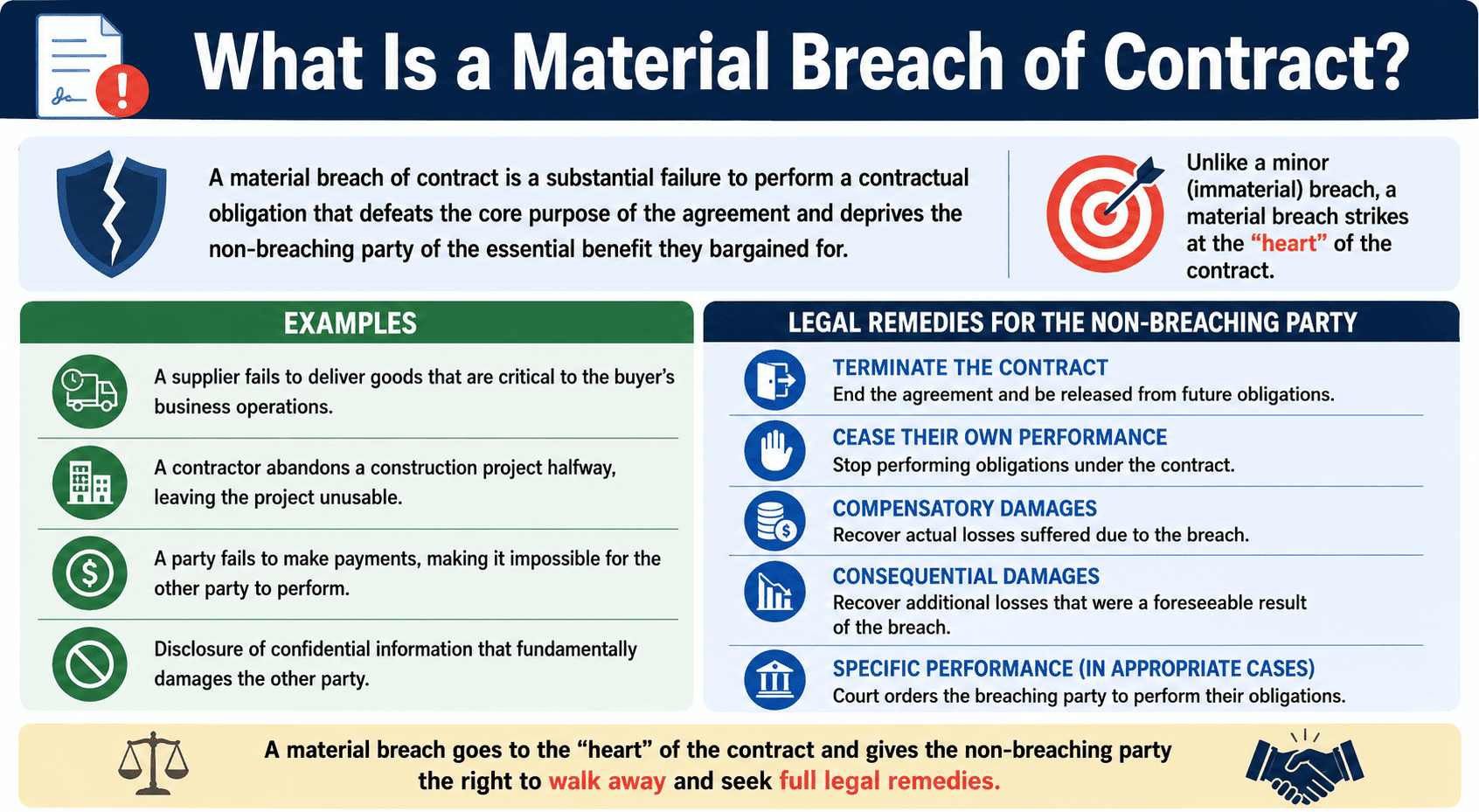
Why Material Breach Matters in Commercial Contracts
Every contract involves mutual promises, payment, delivery of goods, provision of services, confidentiality, etc. When one party fails to keep a promise, the other party needs to know their rights. The classification of a breach as material versus minor determines whether the non‑breaching party can walk away from the contract, claim substantial damages, or is instead required to continue performing while seeking compensation for the specific failure. Misclassifying a breach can lead to costly litigation, wrongful termination claims, or forfeiture of legal rights.
Under common law principles followed in India (Section 73 of the Contract Act, 1872, read with judicial precedents), as well as in the UK, US, and other common‑law jurisdictions, the concept of material breach serves as a critical risk‑allocation tool. It prevents a party from terminating a contract over trivial or curable failures while protecting a party whose legitimate expectations have been fundamentally undermined.
Common Commercial Scenarios
🏗️Construction Delay
A contractor abandons the project halfway or fails to complete by a “time is of the essence” deadline, making the building unusable for the intended purpose.
📦Supply Chain Failure
A supplier delivers the wrong grade of raw materials, rendering the buyer’s entire production line inoperable.
💻IT System Non‑performance
A software vendor deploys a system that lacks core required features, making it unusable for the business.
🔐Confidentiality Breach
A partner discloses trade secrets or customer data in violation of an NDA, causing irreparable harm to the other party’s competitive position.
⚡ Key principle
Not every breach is material. The test is whether the non‑breaching party has received substantially what they bargained for. If the essential purpose of the contract remains achievable despite the breach, the breach is likely minor and does not justify termination.
Material vs. Minor Breach
Material Breach vs. Minor (Immaterial) Breach
📛 Material Breach
- Defeats the contract’s core purpose
- Deprives non‑breaching party of essential benefit
- Non‑breaching party may terminate contract and cease performance
- Full range of damages available (including consequential)
- Example: Caterer fails to show up for a wedding reception
📌 Minor (Immaterial) Breach
- Deviation does not undermine essential purpose
- Substantial benefit of contract still received
- Non‑breaching party must continue performing
- Damages limited to actual loss caused by the deviation
- Example: Caterer arrives 30 minutes late but serves full meal
The classification has profound legal consequences. A party that incorrectly treats a minor breach as material and terminates the contract may themselves be held in material breach, exposing them to liability. Conversely, failing to recognize a material breach and continuing to perform may waive the right to later terminate.
| Factor | Material Breach | Minor Breach |
|---|
| Impact on contract purpose | Fundamental purpose defeated | Purpose still substantially achievable |
| Benefit received | Little or none of expected benefit | Substantial benefit despite deviation |
| Termination right | Yes, contract can be terminated | No, must continue performance |
| Cure opportunity | May be incurable; if curable, reasonable time allowed | Usually curable without major disruption |
| Damages available | Compensatory, consequential, sometimes punitive | Only direct losses caused by deviation |
Factors Courts Consider
How Courts Determine Materiality
Courts evaluate materiality based on the specific circumstances and established common law factors, largely drawn from the Restatement (Second) of Contracts and precedents such as the English case National Power Plc v. United Gas Company Ltd (1998) and multiple Indian Supreme Court rulings (e.g., Kailash Nath Associates v. DDA, where the court examined breach and forfeiture).
The following factors are typically weighed:
- Extent to which the injured party is deprived of expected benefit: Total or near‑total deprivation suggests materiality.
- Adequacy of monetary compensation: If money can make the injured party whole, the breach is less likely to be material.
- Forfeiture by the breaching party: Substantial completed performance or payments made weighs against materiality.
- Likelihood of cure: Willingness and ability to fix the failure within a reasonable time suggests immateriality.
- Good faith vs. bad faith conduct: Intentional, willful, or fraudulent breaches are more likely material.
- Contract language: Provisions that explicitly define material breach or state “time is of the essence” are highly influential.
- Non‑breaching party’s readiness to perform: The injured party must show they were willing and able to perform their own obligations.
📘 Indian perspective
Under Section 73 of the Indian Contract Act, 1872, compensation is recoverable for loss “which naturally arose in the usual course of things” or was “likely to result” from the breach. The concept of materiality aligns with the English common law approach: a breach that goes to the root of the contract. Courts also apply the principle from Hadley v. Baxendale to determine remoteness of damages. In practice, Indian courts examine the contract’s object and the parties’ intentions.
Examples Across Industries
Real‑World Examples of Material Breach
🏠
Construction
A builder fails to complete a house within the agreed timeframe, and the contract includes a “time is of the essence” clause. The buyer cannot move in and suffers additional housing costs. This is a material breach because timely completion was core to the agreement.
💼
Employment
An employee with a non‑compete clause joins a direct competitor and solicits the employer’s clients. This breaches a fundamental obligation of loyalty and confidentiality, constituting a material breach justifying immediate termination.
🏢
Commercial Lease
A tenant operates an unlicensed manufacturing business in a retail space, in violation of express use restrictions, exposing the landlord to regulatory liability. This defeats the landlord’s expectation of safe, lawful use, a material breach.
🤝
Exclusive Distribution
A distributor granted exclusive rights for a territory secretly sells competing products, diverting sales and damaging the manufacturer’s market position. The exclusivity was the essential benefit, material breach.
🔒
IT & Data Security
A SaaS provider suffers a data breach due to failure to implement agreed security measures, exposing customer data. Even if other services function, the security failure may be material where data protection is core to the agreement.
Consequences & Remedies
Remedies for Material Breach
When a material breach occurs, the non‑breaching party has powerful remedies. Importantly, the right to terminate and claim damages are cumulative unless the contract provides otherwise.
1. Contract Termination
The most significant remedy: the non‑breaching party may terminate the contract and is discharged from any further performance obligations. However, termination must be done properly, following any notice and cure provisions in the contract. Wrongful termination (treating a minor breach as material) itself constitutes a breach.
2. Damages
- Compensatory damages: Direct losses caused by the breach (e.g., cost of substitute goods or services).
- Consequential damages: Indirect losses that were foreseeable, such as lost profits or business interruption (following Hadley v. Baxendale).
- Nominal damages: Small sum awarded where breach is proven but no substantial loss shown.
- Liquidated damages: Pre‑agreed sum if the contract includes a valid liquidated damages clause.
3. Specific Performance
A court order requiring the breaching party to actually perform their contractual obligations. This remedy is equitable and available only where monetary damages are inadequate (e.g., contracts for unique goods, land, or personal services).
4. Rescission and Restitution
The contract is voided from the beginning, and the parties are returned to their pre‑contract positions. Restitution orders return any benefits conferred.
⚡ Important limitation
The non‑breaching party has a duty to mitigate damages. Even after a material breach, you cannot simply let losses accumulate, you must take reasonable steps to reduce the harm. Failure to mitigate reduces the damages you can recover.
Response & Prevention
What to Do When a Material Breach Occurs
01
Document everything
Preserve all communications, invoices, delivery records, photographs of defective goods, and your own records of compliance. Create a timeline of the breach and resulting losses.
02
Review the contract
Identify any materiality definitions, cure provisions, notice requirements, dispute resolution clauses, and limitation of liability provisions. Follow them precisely.
03
Send a formal notice of breach
Write a clear notice specifying the breached obligations, the resulting harm, and a cure deadline if applicable (and if cure is possible). Send via certified mail or contractually prescribed method.
04
Consult legal counsel
Material breach determinations are fact‑intensive and carry high stakes. An experienced contract attorney can assess whether the breach qualifies as material, advise on termination risks, and help pursue remedies.
05
Consider alternative dispute resolution
Litigation is expensive. Mediation or arbitration may resolve the dispute faster and preserve business relationships if the breach is not irreparable.
Preventing Material Breaches Through Better Contract Management
The best way to handle a material breach is to prevent it. Proactive contract management reduces risk significantly.
- Draft clear, specific obligations: Avoid ambiguous language. Define what constitutes “timely delivery”, “acceptable quality”, and “material breach”.
- Include cure provisions: Allow a reasonable period to fix non‑material failures before termination rights accrue.
- Expressly state “time is of the essence” where deadlines are critical.
- Monitor performance continuously: Use contract management tools (like CLM software) to track milestones, deliverables, and compliance.
- Maintain open communication with counterparties: Early notification of delays or issues often prevents escalation to material breach.
- Regular contract audits: Review key agreements periodically to ensure both sides are performing and to identify upcoming risks.
FAQ
Frequently Asked Questions
QCan a single late payment be a material breach?
Generally, a single late payment is considered a minor breach, especially if the delay is short and the rest of the contract is performing. However, repeated late payments or failure to pay a substantial amount can escalate to a material breach. Contracts may also expressly state that late payment (after a notice and cure period) constitutes material breach.
QWhat is an anticipatory breach (repudiation) and how is it different from material breach?
Anticipatory breach (or repudiation) occurs before performance is due, when one party clearly indicates they will not perform their obligations. A material breach occurs after performance is due (or during performance). Both can justify termination, but anticipatory breach allows the non‑breaching party to treat the contract as breached immediately without waiting for the performance deadline.
QIf I materially breach a contract, can the other party still sue me after terminating?
Yes. Termination for material breach does not waive the right to claim damages that have already accrued. The non‑breaching party can both terminate and sue for compensation for losses caused by the breach. The right to terminate is separate from the right to claim damages.