Why Termination for Convenience Matters in Contracts
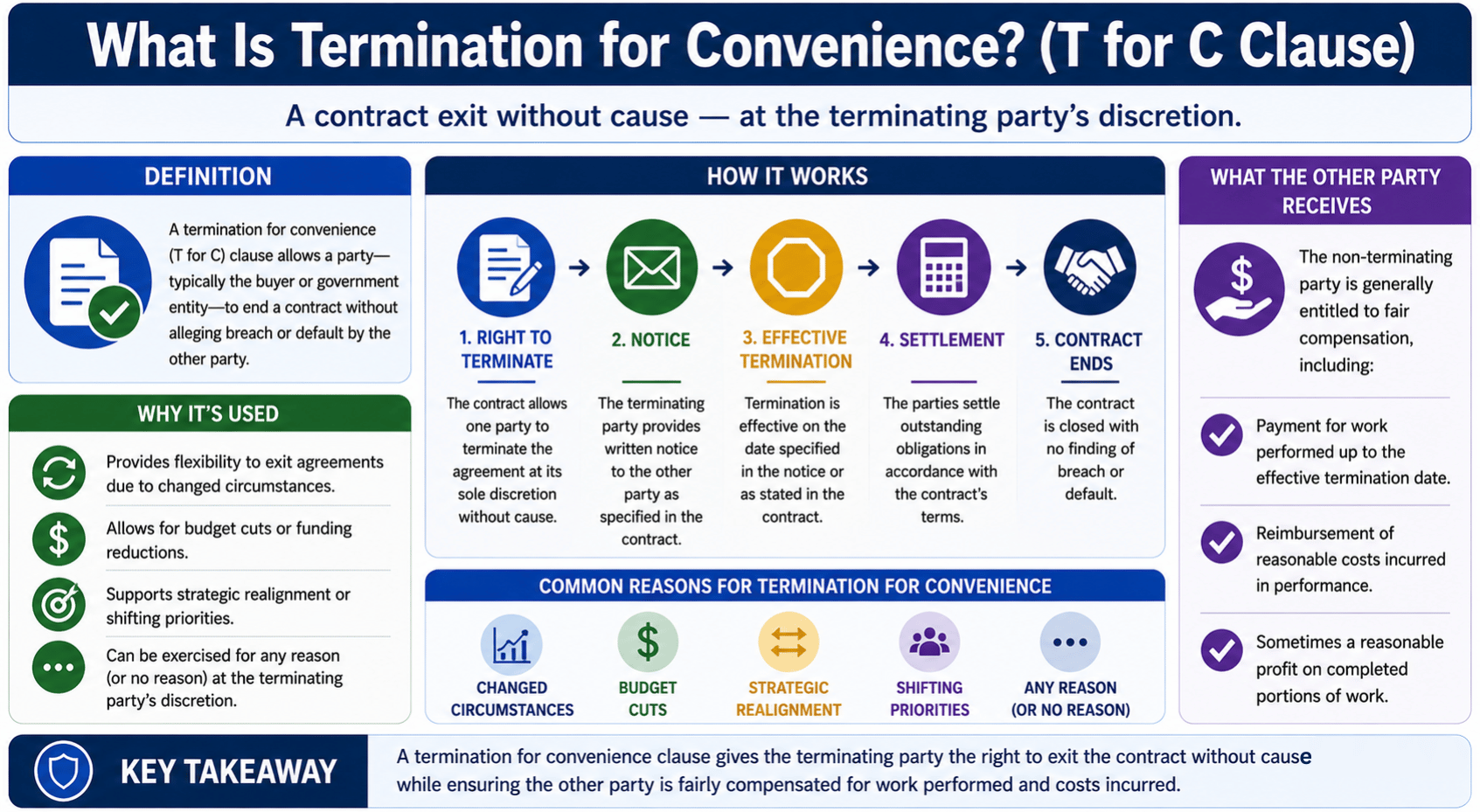
Long-term contracts, whether for government procurement, IT services, construction, or supply agreements, lock parties into commitments that may outlive their usefulness. A termination for convenience clause provides an escape valve: the buyer can exit without proving the contractor failed. This is essential for government agencies facing budget cuts or changing missions, and for commercial businesses adapting to market shifts, technology obsolescence, or internal reorganizations.
For the party receiving a T for C termination, the clause ensures fair compensation for work already done. Unlike termination for cause (where the breaching party may receive nothing), a convenience termination treats the contractor fairly, paying for completed work, work in progress, reasonable settlement costs, and sometimes profit. This balanced approach preserves business relationships and avoids the reputational harm of a default termination.
✨ Strategic Note
Termination for convenience is a unilateral right, typically only the buyer/government has it. However, mutual T for C clauses (allowing either party to terminate without cause on notice) are increasingly common in commercial contracts. If you are a supplier, negotiate for a mutual clause or, at minimum, clear compensation terms that include non-cancellable costs and a fair profit allowance.
Cause vs. Convenience
Termination for Cause vs. Termination for Convenience
The distinction between these two termination rights determines the remedies available and the consequences for the contractor. A termination for cause is punitive and typically follows a material breach; a termination for convenience is neutral and based on the buyer’s changing needs.
⚠️ Termination for Cause (Default)
- Trigger: Breach, default, poor performance, failure to meet specifications
- Compensation: None for unperformed work; buyer may claim excess re-procurement costs
- Contractor’s equipment: Buyer may use equipment left on site to complete work
- Future impact: Negative, may affect bonding capacity and reputation
- Right to cure: Often required before termination
✅ Termination for Convenience
- Trigger: Buyer’s convenience, budget cuts, changed priorities, no breach required
- Compensation: Work performed + costs incurred + reasonable profit on completed work + settlement costs
- Contractor’s equipment: Returned to contractor or purchased by buyer
- Future impact: Neutral or positive, preserves relationship
- Right to cure: Not applicable (no breach)
In government contracting under the FAR, termination for convenience is the standard method when the government no longer needs the supplies or services. The contractor submits a termination settlement proposal, and the government pays allowable costs plus a reasonable profit on work performed. Termination for cause is reserved for contractor default and carries severe consequences.
Key Elements & Compensation
Essential Elements of a T for C Clause
1
Notice Requirements
Written notice from the terminating party specifying the effective date and scope (complete or partial termination). Notice periods vary, commercial contracts often require 30–90 days; government contracts under the FAR take effect upon receipt of the Notice of Termination.
2
Compensation Formula
Specifies payment for: (a) completed and accepted work at contract price; (b) work in progress at cost (direct labour, materials, overhead); (c) settlement costs (subcontractor termination fees, inventory disposal); (d) sometimes a reasonable profit on completed work.
3
Stop-Work Obligations
Upon receiving a T for C notice, the contractor must immediately stop work, terminate relevant subcontracts, and preserve property. Failure to stop can make additional costs unrecoverable.
4
Settlement Proposal & Deadlines
The contractor must submit a detailed termination settlement proposal within a specified period (e.g., 1 year under FAR). The proposal includes costs, inventory schedules, and subcontractor settlements.
5
Limitations & Exceptions
Some T for C clauses carve out periods where termination is not allowed (e.g., during final acceptance testing). Others limit the terminating party’s right if it has already committed an uncured breach.
FAR 52.249-2 (Fixed-Price Contracts) – Example Clause
“(a) The Government may terminate performance of work under this contract in whole or, from time to time, in part if the Contracting Officer determines that a termination is in the Government’s interest. The Contracting Officer shall terminate by delivering to the Contractor a Notice of Termination specifying the extent of termination and the effective date.”
The FAR clause then details stop-work obligations, subcontractor termination, inventory schedules, settlement proposal deadlines (1 year), cost principles (FAR Part 31), and the contractor’s right to appeal the contracting officer’s determination.
Global Enforceability
Termination for Convenience Across Major Jurisdictions
| Jurisdiction | Enforceability & Key Issues |
|---|
| United States (Federal) | FAR Part 49 provides detailed T for C clauses for fixed-price (52.249-2) and cost-reimbursement (52.249-6) contracts. The government has broad discretion to terminate, and the Christian Doctrine implies mandatory FAR clauses even if omitted. Contractors recover allowable costs + reasonable profit. Commercial contracts: enforceable if clearly drafted; good faith not usually required. |
| United Kingdom | Enforceable if expressly provided. Under English law, T for C clauses are interpreted strictly. Some case law suggests an implied duty of good faith may apply if termination is exercised capriciously or to avoid existing obligations (e.g., Kellogg Brown & Root v Australian Aerospace). Draft clearly to avoid uncertainty. |
| Australia | Courts enforce clear T for C clauses (e.g., Thiess v Placer). However, an implied obligation of good faith may arise depending on context (e.g., termination during a dispute resolution process). Parties should express the right in unambiguous terms and avoid exercising it for improper purposes. |
| India | Under Section 14(1)(c) of the Specific Relief Act, a contract that is “determinable in nature” cannot be specifically enforced. Indian courts (e.g., Indian Oil Corp v Amritsar Gas Service) have held that a T for C clause makes the contract determinable, so no injunction can force continuation. However, the terminating party may be liable for compensation for the notice period or proven losses. State instrumentalities must act fairly and not arbitrarily (Article 14). |
| Canada | Courts recognise T for C clauses but apply the duty of honest performance (good faith). A party cannot exercise the right for a purpose unrelated to the contract or to evade existing obligations. The principle from Bhasin v Hrynew (2014 SCC) applies. |
📘 India Special Note, Specific Relief Act
Under Section 14(1)(c) of the Specific Relief Act 1963, a contract “which is in its nature determinable” cannot be specifically enforced. The Supreme Court in Indian Oil Corporation Ltd v Amritsar Gas Service (1991) held that a termination for convenience clause makes the contract determinable. Therefore, the non-terminating party cannot obtain an injunction to force the contract’s continuation. However, damages or compensation may still be claimed for losses during the notice period or for breach if the termination was arbitrary. Public sector undertakings must also comply with Article 14 (non-arbitrariness).
Settlement Process
What to Do When a Termination for Convenience is Issued
If you are the contractor receiving a T for C notice, immediate action protects your right to full compensation. Follow these steps:
1
Stop Work & Preserve Records
Cease all performance on the terminated portion. Secure all project records, timesheets, invoices, purchase orders, subcontractor agreements, and correspondence. Set up a dedicated cost code for termination-related expenses.
2
Terminate Subcontracts & Place No New Orders
Notify subcontractors and suppliers that work under the terminated portion is stopped. Negotiate fair termination settlements with them; those costs are generally recoverable from the terminating party.
3
Prepare Inventory Schedules
List all termination inventory, completed but undelivered items, work in process, raw materials, and purchased parts. The terminating party may direct you to sell the inventory or transfer title to them.
4
Submit a Detailed Settlement Proposal
Within the deadline (e.g., FAR: 1 year), submit a proposal with: (i) completed work at contract price; (ii) work in progress at cost; (iii) subcontractor settlement costs; (iv) reasonable settlement expenses (accounting, legal, storage); (v) profit claim on completed work.
5
Negotiate or Appeal
Work with the contracting officer or buyer to reach an agreed settlement. If no agreement, the government issues a unilateral determination, which the contractor may appeal under the Disputes clause. In commercial contracts, follow the dispute resolution procedure.
Risks & Misunderstandings
Common Risks & Drafting Pitfalls
🚩
Silent on Compensation Formula
Many T for C clauses merely state “the buyer may terminate for convenience” without specifying payment. This invites disputes. Always define recoverable costs, direct labour, materials, overhead allocable to the work, subcontractor termination costs, and profit.
🚩
No Deadline for Settlement Proposal
Without a deadline (e.g., “within 1 year”), the terminating party may delay settlement indefinitely. Government FAR clauses include strict deadlines; commercial contracts should as well.
🚩
Assuming Good Faith is Not Required
While many US cases hold that T for C clauses grant absolute discretion, Australian, Canadian, and some UK courts imply a duty of good faith, especially if termination is used to avoid existing obligations or during dispute resolution. Draft “may terminate for any reason in its sole discretion” to strengthen the clause.
🚩
Ignoring Partial Termination Effects
If only part of the contract is terminated, the price for the continued portion may become inequitable. Under FAR 52.249-2(l), the contractor can request an equitable adjustment. Commercial contracts should include a similar mechanism.
🚩
Failure to Address Consequential Damages
The non-terminating party may lose future profits or incur demobilisation costs. A well-drafted T for C clause expressly states whether such losses are recoverable. Under the FAR, lost profits on unperformed work are generally not allowed; contractors recover only costs incurred plus profit on work completed.
FAQ
Frequently Asked Questions
QCan a termination for convenience be exercised in bad faith?
It depends on the governing law. Under the US FAR and many US commercial contract precedents, the government or buyer has absolute discretion, bad faith is not a defence unless the contract expressly requires good faith. However, in Australia, Canada, and some UK cases, a duty of good faith may be implied, and exercising T for C to avoid an existing obligation (e.g., while a dispute is pending) could be challenged. Draft the clause with language like “in its sole and absolute discretion” to minimise implied duties.
QWhat is the difference between termination for convenience and a termination option?
A termination for convenience clause allows early exit before the natural contract end, usually with compensation for work performed. A termination option (often called an “early termination right”) typically allows a party to end the contract at a specified date (e.g., after 12 months) without cause, often by paying a fixed fee or liquidated damages. Both are “without cause” terminations, but T for C is broader and can be exercised at any time.
QDoes termination for convenience affect the contractor’s right to payment for completed work?
No. The contractor is entitled to payment for all work completed and accepted before the termination effective date, plus costs properly incurred for work in progress, plus reasonable settlement costs. Under FAR 52.249-2, the contractor receives the contract price for completed items, plus costs plus profit for terminated work-in-progress. However, the contractor does not receive anticipated profit on the unperformed portion of the contract.
QCan a termination for convenience clause be included in any contract?
Yes, as a matter of freedom of contract, parties may agree to a T for C clause in any commercial agreement. However, some jurisdictions (e.g., India) may treat the contract as “determinable” under Section 14(1)(c) of the Specific Relief Act, meaning specific performance (injunction to continue the contract) is not available. Damages remain available. In consumer contracts, T for C clauses may be subject to unfair terms regulations.
QWhat is the “Christian Doctrine” in US government contracts?
Under the Christian Doctrine (G.L. Christian & Associates v. United States, 1963), mandatory FAR clauses are automatically incorporated into government contracts even if the contracting officer omitted them. This includes the termination for convenience clause (FAR 52.249-2). The doctrine ensures that essential contract terms required by regulation are binding regardless of clerical errors.