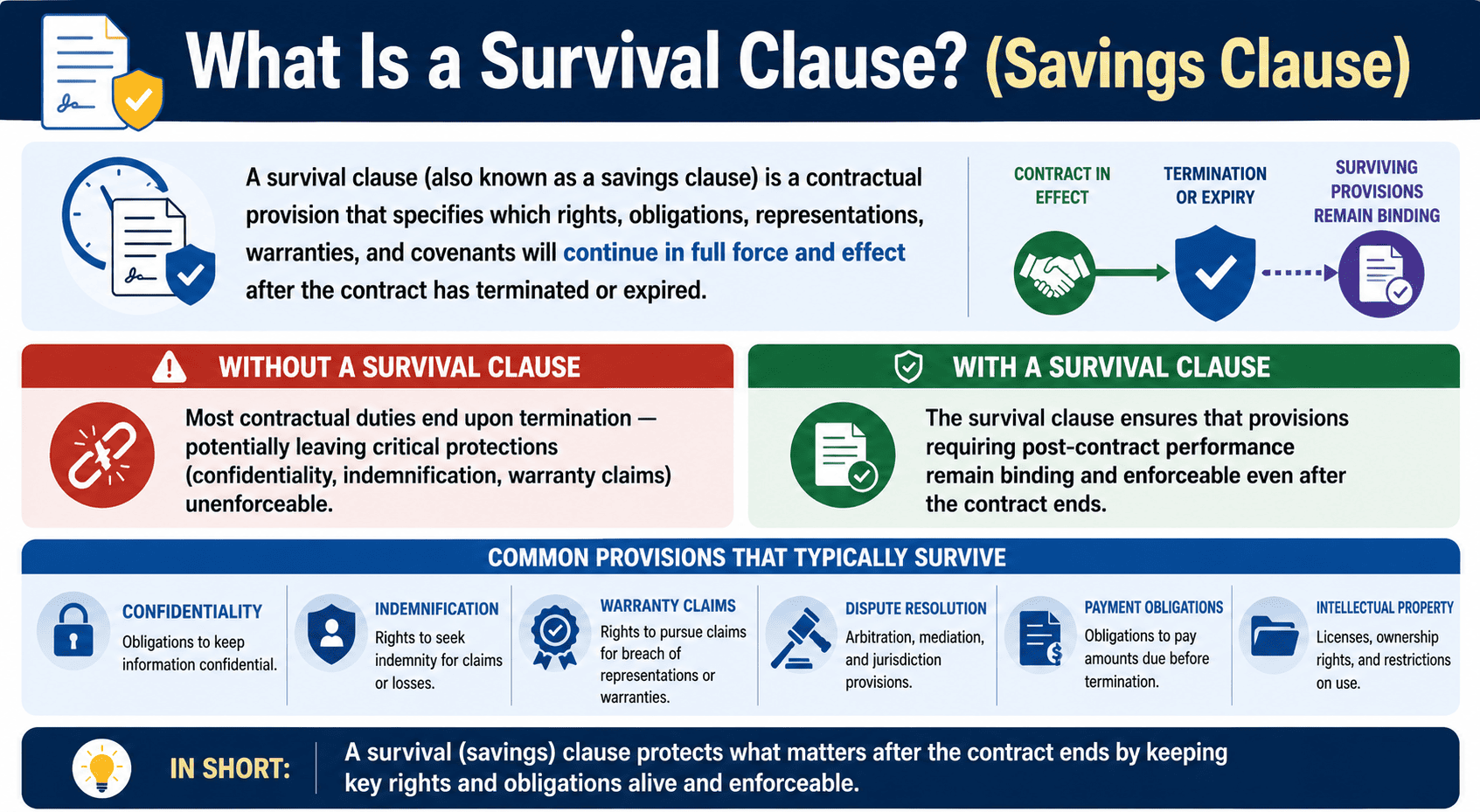
Why Survival Clauses Matter: Preserving Rights After Termination
Every contract comes to an end, by performance, expiration, or termination. The moment a contract ends, rights and obligations that are not expressly preserved may vanish. A survival clause answers a critical question: Which promises remain binding even after the contract is dead? This is not merely theoretical. Confidential information disclosed during the contract must remain secret after termination. Indemnification for past acts must remain available. Representations made at signing may give rise to claims that only surface months after closing.
Without an effective survival clause, a party may lose the ability to enforce key protections. Courts may imply survival for certain obligations (e.g., confidentiality, indemnity for completed acts), but this is uncertain and varies by jurisdiction. The only reliable approach is an express, carefully drafted survival clause that leaves no doubt about which provisions continue, for how long, and under what conditions.
✨ Strategic Note
In M&A and commercial contracts, survival clauses are heavily negotiated. Buyers want long survival periods for representations and warranties (often 2–3 years or the full statute of limitations). Sellers push for shorter periods (12–18 months) and want the clause to act as a contractual statute of limitations, requiring that a claim be asserted before the survival period expires, not just that the breach occurred earlier. The precise wording matters enormously.
Surviving vs. Non-Surviving Provisions
Which Provisions Typically Survive Contract Termination?
Survival clauses do not apply to all provisions uniformly. Performance obligations, delivery of goods, payment for services, naturally end with the contract. But certain obligations are designed to extend beyond the contract’s life. The following table distinguishes typical surviving and non-surviving provisions.
✅ Typically Survivin
- Confidentiality & Non-Disclosure, Trade secrets and proprietary information must remain protected.
- Indemnification, Rights to recover losses for past acts or breaches survive.
- Representations & Warranties, Usually survive for a defined period (e.g., 12–24 months).
- Dispute Resolution, Arbitration, governing law, jurisdiction, and mediation clauses survive.
- Limitations of Liability, Caps on damages and exclusions of consequential damages survive.
- Restrictive Covenants, Non-compete, non-solicitation, non-disparagement obligations.
- Payment Obligations, Accrued but unpaid fees survive termination.
- Return of Property, Obligation to return confidential materials or equipment survives.
❌ Typically Do NOT Survive
- Performance Obligations, Delivery of goods, provision of services, payment for future work.
- Exclusivity Arrangements, Tie to the term of the contract; end at termination.
- Most Covenants Requiring Ongoing Performance, Unless expressly stated to survive.
- License Grants, Licenses of IP or rights to use software typically terminate with the agreement.
Drafting Essentials
How to Draft an Effective Survival Clause: Key Components
1
Identify Surviving Provisions by Section Number
Explicitly list the sections that survive. Vague language like “provisions that by their nature should survive” invites litigation. Instead: “Sections 2.3 (Confidentiality), 4.1 (Indemnification), and Article IX (Dispute Resolution) shall survive termination.”
2
Specify Survival Periods for Representations & Warranties
General reps: 12–24 months post-closing. Fundamental reps (title, authority): full statute of limitations or indefinitely. Tax reps: often full statute of limitations. Indemnification and confidentiality: usually indefinite.
3
Define When a Claim is “Made” (Critical!)
A poorly drafted clause may bar claims if final resolution occurs after the survival period. Effective drafting: “…any claim for breach of a representation or warranty shall be barred unless the non-breaching party delivers written notice of such claim prior to the expiration of the survival period.” This preserves claims timely asserted even if final resolution takes longer.
4
Address Accrued Rights & Remedies
Make clear that termination does not affect any claim or remedy for breach occurring before termination. Example: “Termination shall not relieve either party of any liability for breach occurring prior to termination, and all rights and remedies shall survive termination.”
5
Include “Contractual Statute of Limitations” Language
To create a binding shorter limitations period, courts in many jurisdictions (including Ohio and other US states) require “unequivocal language” that the parties intend to modify the statute of limitations. Example: “The parties, intending to modify any otherwise applicable statute of limitations, agree that any claim for breach of a representation or warranty must be asserted in writing within 18 months after Closing, and any claim not so asserted shall be forever barred.”
6
Clarify the Effect on Related Agreements
If the contract references other documents (SOWs, exhibits), state whether their survival is separate or follows the master agreement. “The survival provisions of this Agreement shall apply to all SOWs and exhibits unless otherwise expressly provided.”
Sample Survival Clause (M&A Context, Limited Survival with Notice Cutoff)
“Section 9.1 Survival. (a) The representations and warranties of Seller contained in this Agreement (other than the Fundamental Representations) shall survive the Closing for a period of twelve (12) months (the “Survival Period”). The Fundamental Representations (Title, Authority, Capitalization) shall survive the Closing until the expiration of the applicable statute of limitations. (b) Any claim for breach of a representation or warranty shall be barred unless Buyer delivers written notice to Seller specifying the claim in reasonable detail prior to the expiration of the applicable Survival Period. The timely assertion of a claim shall preserve such claim (and only such claim) until finally resolved, regardless of when resolution occurs. (c) The parties, intending to modify any applicable statute of limitations, agree that the Survival Periods set forth in this Section 9.1 shall constitute a contractual statute of limitations, and any claim not timely asserted shall be irrevocably barred.”
Critical Court Decision: Bidwell v. Shape
The Pitfall You Must Avoid: Bidwell Family Corp. v. Shape Corp.
A recent Ohio federal court decision, Bidwell Family Corp. v. Shape Corp. (2024), highlights a common, and costly, drafting error. The asset purchase agreement stated that representations and warranties would survive for twelve months, and that “any claims asserted in good faith with reasonable specificity … prior to the expiration date of the applicable survival period shall not thereafter be barred.” The buyer gave no notice within twelve months. The court held that the clause did NOT unequivocally state that claims not noticed before expiration were barred. Under Ohio law, a contractual statute of limitations requires “unequivocal language” that claims are extinguished if not asserted within the period. The clause at issue only positively stated what survives (claims with timely notice) but did not unequivocally state that untimely claims are barred.
📘 The Lesson from Bidwell
If you intend a survival period to limit the time to bring claims (a contractual statute of limitations), you must state both: (1) claims timely noticed survive; AND (2) claims not timely noticed are permanently barred, waived, and extinguished. Use unequivocal language such as: “Any claim that is not asserted in writing prior to the expiration of the Survival Period shall be irrevocably and forever barred, and no party or its affiliates shall have any liability with respect to such claim.” This is essential under the laws of states that require explicit waiver of the statute of limitations.
Boilerplate vs Survival
Survival Clause vs. Boilerplate: Understanding the Difference
The terms “boilerplate” and “survival clause” are sometimes confused. Boilerplate refers to standard, form clauses that appear in nearly all contracts, such as notices, force majeure, assignment, governing law, entire agreement, and severability. A survival clause is one specific type of boilerplate, but not all boilerplate provisions survive termination. In fact, the survival clause itself is the provision that determines which other provisions (including many boilerplate clauses) remain effective after termination.
Typical boilerplate provisions like “Entire Agreement” or “Amendment” generally do NOT survive termination unless expressly listed. Conversely, “Governing Law” and “Dispute Resolution” almost always should survive, and a well-drafted survival clause will so provide.
Common Drafting Mistakes
Common Risks & Drafting Mistakes in Survival Clauses
🚩
Failing to List Specific Provisions
General language like “provisions that by their nature should survive” forces courts to guess intent. Result: uncertainty and litigation. Always list section numbers.
🚩
No Survival Period for Representations & Warranties
If the survival clause is silent on reps and warranties, they may terminate at closing (merger doctrine). In Delaware, pre-closing reps may “merge” into the closing unless expressly surviving. Buyers: include explicit survival. Sellers: ensure a finite period.
🚩
Ambiguity on the “Claim Made” Cutoff
Does a claim need to be asserted before the survival period ends, or finally resolved? If the latter, a diligent buyer could be barred by court delays. Draft: “asserted in writing prior to the expiration.”
🚩
No “Contractual Statute of Limitations” Wording
Simply saying a representation “survives for 12 months” may be interpreted as the period during which it remains alive, not a bar on claims arising after 12 months. Add explicit language that claims not brought within the period are barred, and that the parties intend to shorten the statute of limitations.
🚩
Overlooking Survival of Indemnity for Third-Party Claims
Third-party claims (lawsuits) may be asserted after the survival period expires. A robust clause provides that indemnity claims survive if the underlying third-party claim is noticed before the survival cutoff, even if the lawsuit later proceeds.
🚩
Inconsistent Survival Provisions Across Ancillary Documents
When a master agreement and exhibits or SOWs have different survival clauses, conflict arises. Draft a single controlling survival clause or cross-refer explicitly.
FAQ
Frequently Asked Questions
QWhat happens if a contract does not contain a survival clause?
Generally, rights and obligations under the contract terminate upon expiration or termination. Courts may imply survival for certain obligations, such as confidentiality, indemnity for past breaches, or dispute resolution, but this is uncertain and varies by jurisdiction. Without an express survival clause, a party may lose the ability to enforce critical post-termination rights. The safe course is always to include a carefully drafted survival clause.
QDo representations and warranties automatically survive closing?
Not automatically. Under the merger doctrine in many US states (including Delaware and New York), pre-closing representations are deemed to “merge” into the closing deed or instrument and do not survive unless expressly provided in the contract. In M&A transactions, survival clauses are essential to keep representations and warranties alive post-closing. Without an express survival clause, a buyer may have no post-closing remedy for breach of a representation.
QCan a survival clause shorten the statute of limitations?
Yes, in most jurisdictions, parties may agree to a shortened contractual limitations period. However, the clause must be clear and unequivocal. Some states (e.g., Ohio) require explicit language that the parties intend to modify the statute of limitations and that claims not brought within the agreed period are extinguished. Other states (e.g., New York) permit reasonable shortening as long as it is not unconscionable. Always check applicable law.
QHow long should representations and warranties survive?
Typical survival periods in M&A: general representations and warranties, 12 to 24 months; fundamental representations (title, authority, due organization), full statute of limitations (often 3–6 years) or indefinitely; tax representations, full statute of limitations; environmental and IP representations, variable, often 2–5 years. The period is heavily negotiated. Shorter periods favour sellers; longer periods favour buyers. Buyers should also ensure that claims timely asserted within the period survive until final resolution.
QDoes a survival clause need to be mutual?
Not necessarily, but it often is. In many contracts, both parties have reciprocal survival obligations, e.g., each party’s representations survive, each party’s indemnity obligations survive. However, in some agreements (e.g., an NDA where only one party discloses confidential information), survival may be one-sided. The key is clarity: specify which obligations of which party survive.