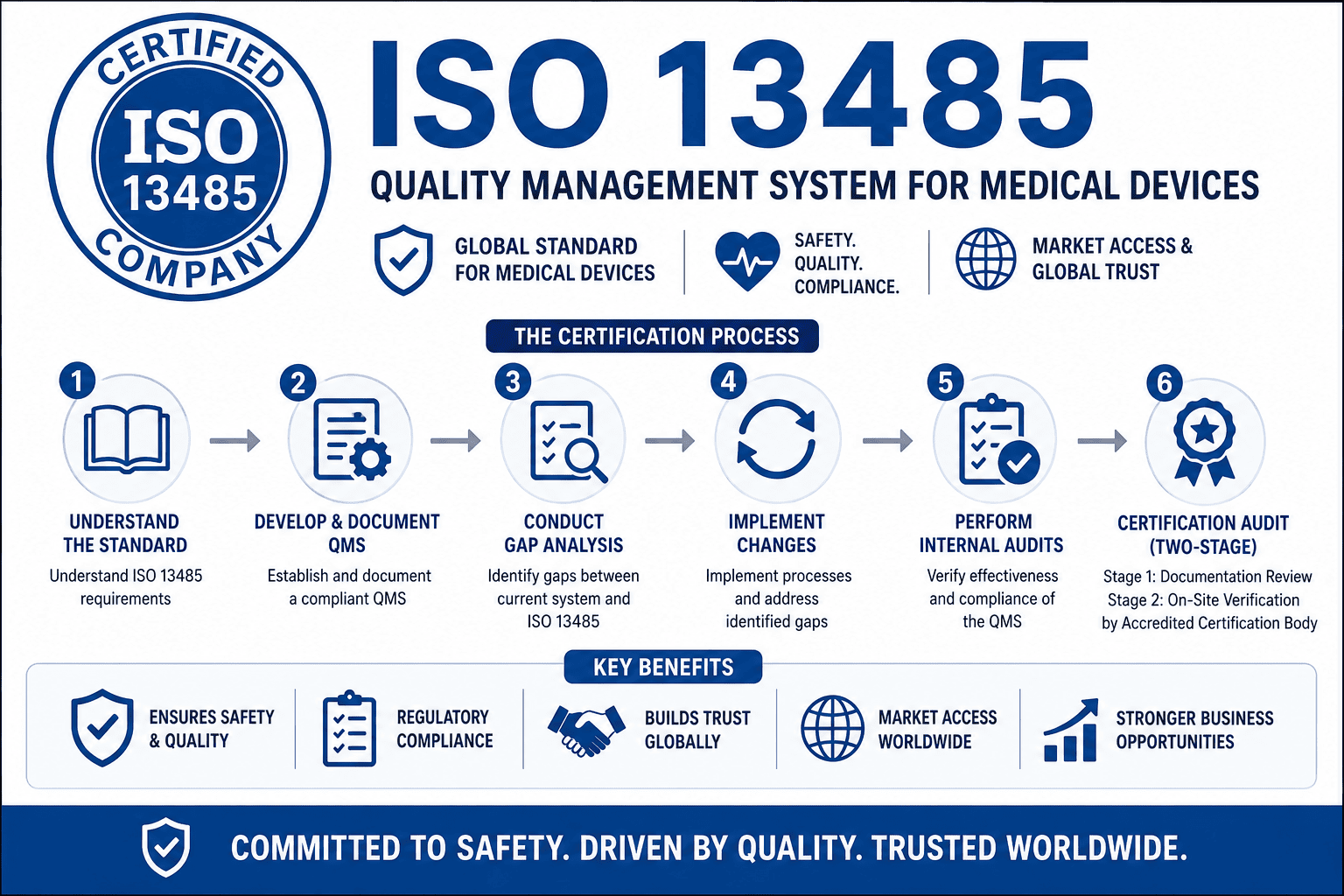
Direct Answer: ISO 13485 is the globally recognized standard for Quality Management Systems (QMS) specific to the medical device industry. Getting certified involves a structured process: understanding the standard’s requirements, developing and documenting a compliant QMS, conducting a gap analysis, implementing necessary changes, performing internal audits, and finally, undergoing a two-stage certification audit (Stage 1: Documentation Review, Stage 2: On-Site Verification) by an accredited certification body. Successful certification demonstrates your commitment to safety, quality, and regulatory compliance, and is often a prerequisite for market access and building trust with healthcare institutions and distributors worldwide.
📅 May 5, 2026⏱ 16 min read✍️ GT Setu Editorial Team🔄 Updated regularly
6
Key Steps to Certification
3
Year Certificate Validity
6–18
Months (Typical Timeline)
0%
GTsetu Broker Commission
ISO 13485 is the international standard that specifies requirements for a Quality Management System (QMS) specifically for the medical device industry. Developed and published by the International Organization for Standardization (ISO), it is the globally recognized benchmark for demonstrating an organization’s ability to provide medical devices and related services that consistently meet customer and applicable regulatory requirements.
For medical device manufacturers, suppliers, and service providers, ISO 13485 certification is often a mandatory requirement for market access, regulatory approval (such as CDSCO in India, EU MDR, or US FDA), and building trust with healthcare institutions, importers, and distributors. This guide covers the complete certification process, from understanding the standard through to the final certification audit, and provides practical, actionable advice for a smooth journey. See our related guides on partnership evaluation criteria and business verification to understand how ISO 13485 integrates with partner due diligence in the medical device sector.
🏥 Who Is This Guide For?
This guide is written for quality managers, regulatory affairs professionals, business owners, and anyone responsible for implementing or maintaining a Quality Management System in the medical device industry. It covers both the DIY approach (using toolkits and internal resources) and the consultant-led route. It is equally relevant for manufacturers seeking certification to enter new markets, and for distributors who need to ensure their suppliers meet international quality standards. For related partnership structures in the healthcare sector, see our guides on supplier collaboration platforms and technology partnerships.
SECTION 1
1 What Is ISO 13485 & Why Get Certified?
📋 The Medical Device Quality Standard
ISO 13485:2016 is the international standard for Quality Management Systems (QMS) for medical devices. It is specifically designed for organizations involved in the design, development, production, installation, and servicing of medical devices. Unlike ISO 9001 (which focuses on customer satisfaction), ISO 13485 places a stronger emphasis on regulatory compliance, product safety, risk management (mandatory), and traceability. Certification demonstrates that your organization has a robust QMS that ensures the consistent design, development, and delivery of safe and effective medical devices that meet customer and regulatory requirements. It is often a prerequisite for doing business in regulated medical device markets worldwide.
🌐
Globally Recognized Standard
ISO 13485 is recognized internationally as the benchmark for medical device quality management, facilitating market access and acceptance across 170+ countries.
📋
Regulatory Compliance
Certification demonstrates compliance with key regulatory frameworks, including CDSCO (India), EU Medical Device Regulation (MDR), and US FDA Quality System Regulation (QSR).
🛡️
Product Safety & Risk Management
The standard mandates risk management throughout the product lifecycle, ensuring a proactive approach to patient and user safety.
🔗
Supply Chain Confidence
Certification signals to suppliers, distributors, and healthcare providers that you have robust quality controls, building trust and strengthening business relationships.
SECTION 2
2 Key Benefits of ISO 13485 Certification
ISO 13485 certification delivers tangible benefits across operational, commercial, and regulatory dimensions. While the certification process requires investment, the return on that investment is well-documented across the medical device industry.
✅
Regulatory compliance with CDSCO, EU MDR, US FDA, often mandatory for market approval
📈
Enhanced global market access, credibility, and customer trust
🔄
Streamlined operations, reduced errors, and improved traceability across the supply chain
🏛️
Regulatory & Legal Compliance
Helps you meet mandatory requirements for medical device registration in India (CDSCO) and globally (EU MDR, US FDA), reducing the risk of regulatory action.
Compliance
🌍
Global Market Access
ISO 13485 certification is a prerequisite for doing business with most major healthcare institutions, distributors, and importers worldwide, enabling easier entry into new markets.
Commercial
🤝
Customer & Partner Trust
Builds confidence among healthcare institutions, patients, and business partners, demonstrating a commitment to quality, safety, and reliability.
Reputation
⚙️
Operational Efficiency
By systematically identifying and eliminating the root causes of errors and inefficiencies, certified organizations reduce waste, rework, and operational costs.
Operational
🔍
Risk Management & Product Safety
Mandates a structured approach to identifying, analyzing, and mitigating risks throughout the product lifecycle, enhancing patient and user safety.
Risk
🔗
Supplier & Supply Chain Control
Provides a framework for evaluating, selecting, and monitoring suppliers, ensuring quality and compliance throughout the supply chain.
Supply Chain
SECTION 3
3 ISO 9001 vs. ISO 13485: Key Differences
While both are quality management standards, ISO 9001 is a general standard applicable to any industry, whereas ISO 13485 is specifically tailored for the medical device sector. Understanding these differences is crucial for medical device companies, as ISO 13485 includes additional, more stringent requirements.
ParameterISO 13485ISO 9001
Purpose
Medical Device Quality Management
General Quality Management
Industry Focus
Medical device industry
All industries
Regulatory Requirement
Often mandatory for medical devices
Not mandatory
Primary Focus
Product safety & regulatory compliance
Customer satisfaction
Risk Management
Mandatory
Optional (Risk-based thinking)
Design Controls
Structured and documented
Less prescriptive
Traceability
Explicit requirements for implants and critical devices
Not specifically required
Complaint & Vigilance Handling
Detailed requirements for post-market surveillance
General requirements
🏥 Why ISO 13485 is Essential for Medical Device Makers
For companies manufacturing or distributing medical devices, ISO 13485 is not just a certification, it is a foundational requirement for doing business. It aligns with regulatory requirements of major markets (EU MDR, US FDA, CDSCO) and provides the framework for demonstrating product safety, performance, and traceability. While ISO 9001 is a good starting point for general quality management, it does not address the specific needs of the medical device industry, such as risk management, clinical evaluation, and post-market surveillance. See our guide on technology partnerships for how quality standards intersect with medical device co-development.
SECTION 4
4 Step 1: Understand the Requirements of ISO 13485
📖 Foundation: Know the Standard
Before you can begin the certification process, you must thoroughly understand the requirements outlined in the ISO 13485:2016 standard. This involves obtaining the official standard document from the ISO website or a national standards body and studying its requirements. The core requirements include having a documented QMS, establishing risk management procedures, ensuring regulatory compliance, and maintaining traceability. A solid understanding of the standard’s 10 clauses (from Scope to Improvement) is essential for developing a compliant and effective QMS.
📚
Obtain the Standard
Purchase the official ISO 13485:2016 document from the ISO website or your national standards body. This is the definitive source for the requirements.
🎓
Get Trained
Consider training for your implementation team. Courses like ISO 13485 Awareness, Implementation, and Internal Auditor training provide essential knowledge.
📋
Identify Key Clauses
Pay special attention to clauses related to risk management (Clause 6), design and development (Clause 7), and regulatory requirements (Clause 4, 8).
🔍
Understand Regulatory Links
Recognize how ISO 13485 requirements connect to specific regulatory frameworks like EU MDR, US FDA 21 CFR 820, and CDSCO in India.
SECTION 5
5 Step 2: Develop a Quality Management System
Developing a Quality Management System is the heart of ISO 13485 certification. A QMS is a set of policies, processes, and procedures that support quality and performance practices and meet regulatory requirements. For ISO 13485, the QMS must be specifically tailored to the medical device industry.
2.1
Identify Core Processes
Identify all processes required for your medical device operations, from design and development to production, installation, and servicing. Include management, resource, and measurement processes.
2.2
Document Processes & Procedures
Document each process and procedure, including their inputs, outputs, activities, resources, responsibilities, and controls. Create a Quality Manual, SOPs, Work Instructions, and Forms. See the documents section below for a detailed list.
2.3
Integrate Risk Management
As required by ISO 13485 (Clause 6), integrate risk management throughout your QMS. Use a structured approach (e.g., based on ISO 14971) for identifying, analyzing, and controlling risks.
2.4
Establish Traceability
Implement systems for traceability, especially for implantable and critical devices. This includes unique device identification (UDI) and maintaining records of components, processes, and distribution.
SECTION 6
6 Step 3: Conduct a Gap Analysis
🔍 Assessing Your Current State
Before you can fully develop your QMS or apply for certification, you need to know where you stand. A gap analysis involves comparing your current quality management system, practices, and documentation against the requirements of the ISO 13485 standard. This structured assessment helps you identify areas where you already comply, and more importantly, where gaps exist that need to be addressed. The gap analysis provides a roadmap for your implementation project, allowing you to prioritize efforts and allocate resources effectively.
📋
Review Current Documentation
Compare your existing quality manual, procedures, and records against ISO 13485 clauses. Identify missing, incomplete, or non-compliant documents.
🔄
Assess Implemented Processes
Evaluate whether your current operational processes (e.g., design control, purchasing, complaint handling) meet ISO 13485 requirements in practice.
📊
Identify Resource Gaps
Determine if you have the necessary resources (skilled personnel, equipment, infrastructure) to implement and maintain a compliant QMS.
📈
Create a Gap Action Plan
Document the identified gaps, assign responsibilities, and set target dates for closing each gap. This becomes your implementation roadmap.
SECTION 7
7 Step 4: Implement Changes
Based on the results of your gap analysis, you will need to implement changes to your QMS. This phase involves updating policies and procedures, providing training to employees, or investing in new equipment or technology. It is critical to document all changes and maintain thorough records of their implementation.
✏️
Update Documentation
Revise or create the quality manual, procedures, work instructions, and forms to address the gaps identified. Ensure documents are clear, practical, and comply with ISO 13485.
Documentation
🎓
Provide Employee Training
Train all employees on the new or revised processes, their roles and responsibilities in the QMS, and the importance of compliance. Include training on risk management and complaint handling.
Training
🔧
Invest in Infrastructure
If gaps identified resource or infrastructure needs (e.g., new equipment, software for document control or traceability), make the necessary investments.
Infrastructure
📁
Document All Changes
Maintain a clear record of all changes made, the reasons for them, and the date of implementation. This is a key audit trail for your certification body.
Records
SECTION 8
8 Step 5: Conduct Internal Audits
Before applying for certification, it is essential to conduct internal audits to ensure that your QMS is effective and complies with ISO 13485 requirements. Internal audits are a mandatory requirement of the standard and play a critical role in verifying compliance, identifying non-conformities, and driving improvement.
📋
Set Up an Audit Program
Develop an audit schedule covering all processes and departments. Define the scope, criteria, methods, and frequency of audits. Ensure auditors are objective and impartial.
👤
Appoint & Train Auditors
Select internal auditors with appropriate competence. They should be familiar with ISO 13485, auditing techniques, and your processes. Consider training for internal auditors.
🔍
Conduct the Audits
Perform audits according to the schedule. Use checklists to systematically verify compliance with ISO 13485 and your own procedures. Interview staff, observe processes, and review records.
✅
Address Non-Conformities
Document any non-conformities found. Implement corrective actions to address their root causes. Verify the effectiveness of corrective actions through follow-up reviews.
💡 Internal Audits as a Training Tool
Internal audits are not just for finding problems, they are a powerful tool for training and improvement. They help familiarize management and staff with the new processes, identify opportunities for streamlining, and build a culture of quality. Start auditing early, during the implementation phase, to catch and fix issues before the certification audit. This proactive approach reduces stress and increases your chances of a successful certification. For a framework on evaluating compliance aspects of partners, see Partnership Evaluation Criteria.
SECTION 9
9 Step 6: Choose a Certification Body & Get Certified
The final step is to choose an accredited certification body and undergo the certification audit. The audit is conducted in two stages, followed by ongoing surveillance audits to maintain your certificate.
Audit Stage
What Happens
Key Focus
Stage 1 Audit (Documentation Review)
The auditor reviews your QMS documentation (Quality Manual, procedures, etc.) to ensure they meet ISO 13485 requirements and that your organization is ready for the on-site audit.
Completeness and adequacy of documentation. Identification of any gaps or nonconformities that must be addressed before Stage 2.
Stage 2 Audit (On-Site Verification)
The auditor visits your facility to verify that your QMS is effectively implemented and working in practice. They will interview employees, observe processes, and review records.
Effective implementation of the QMS. Evidence that procedures are being followed and that the system is achieving its objectives. Verification of Stage 1 nonconformity resolutions.
Audit Report & Decision
Following Stage 2, the auditor prepares a report detailing findings. If no major nonconformities are found, or if corrective actions are successfully implemented, the certification body issues your ISO 13485 certificate.
Overall conformity assessment. The certificate is valid for three years from the date of issue.
Surveillance Audits
During the three-year certificate validity period, the certification body conducts annual surveillance audits to ensure your QMS remains compliant and effective.
Ongoing compliance. The auditor checks that the QMS is being maintained and that continuous improvement is taking place.
Recertification Audit
After three years, you must undergo a recertification audit to renew your certificate. This is typically a more comprehensive audit than surveillance audits.
Full system re-assessment. You must demonstrate that your QMS remains effective and has evolved to meet changing business needs and regulatory requirements.
🏥 Choosing a Certification Body
Select a certification body that is accredited by a recognized national accreditation body (e.g., NABCB in India, UKAS, ANAB, DAKKS). Look for one with specific experience in the medical device industry. TÜV Rheinland, for example, also offers ICMED 13485 certification in India, which includes additional requirements specific to the Indian market. Consider their reputation, auditor expertise, and customer support. The choice of registrar can impact the recognition of your certificate and the quality of your audit experience. For related partner evaluation, see Partnership Evaluation Criteria.
SECTION 10
10 Costs & Timeline: What to Expect
The cost and timeline for ISO 13485 certification vary significantly based on organization size, complexity, existing processes, and the resources you allocate to the project. Understanding these variables upfront helps in planning and budget setting.
Factor
Impact on Cost
Impact on Timeline
Organisation Size (Employees)
Small (1–50): $5,000–$15,000 Medium (50–250): $10,000–$25,000 Large (250+): $20,000+
More complex products (e.g., active implantable devices) require more detailed documentation and risk management, increasing cost.
Higher complexity extends the documentation, implementation, and audit phases.
Risk Class of Devices
Higher-risk devices (Class IIb/III) require more rigorous audits and often higher fees.
Higher risk = more audit days, potentially longer timeline.
Use of Toolkits / Consultants
Toolkits reduce consultant fees and internal time, lowering cost. Full consultant support adds $5,000–$20,000+.
Toolkits and consultants can significantly accelerate the timeline (by 30-50%) by providing expertise and templates.
Number of Sites
Multiple sites increase audit days and travel costs for the certification body.
More sites extend the audit schedule and coordination effort.
SECTION 11
11 Key Documents Required for ISO 13485
Documentation is the backbone of your QMS. ISO 13485 requires a specific set of documents and records to demonstrate compliance. Here is a comprehensive list:
📋
Core Documents
Quality Manual, Quality Policy, Quality Objectives, Organization Chart, Document Control Procedure, Control of Records Procedure.
📄
Procedures & Instructions
Standard Operating Procedures (SOPs), Work Instructions, Product Specifications, Design and Development Files, Risk Management Reports.
📊
Records & Reports
Process Validation Records, Equipment Calibration Reports, Customer Complaint Records, CAPA Records, Internal Audit Reports, Training Records.
🔗
Traceability & Control
Traceability Records (especially for implants), Supplier Evaluation Records, Management Review Meeting Minutes, Non-conforming Product Control Records, Purchasing Records.
SECTION 12
12 How GTsetu Supports Your ISO 13485 Certification Journey
🔗 GTsetu, Verified B2B Platform
Connect with Verified Partners & Build Quality Medical Device Supply Chains
ISO 13485 certification is a powerful tool for demonstrating quality and regulatory compliance in the medical device industry. GTsetu complements your certification by connecting you with verified manufacturers, suppliers, and distributors who meet rigorous quality standards. Our platform provides:
✅
Verified Company Profiles
Every company on GTsetu is verified on 6 key data points (Name, Address, Registration Number, Company Status, Company Type, Date of Incorporation) using government tie-ups, complementing your ISO 13485 due diligence.
🕵️
Anonymous Discovery
Browse verified partner profiles without revealing your identity until you’re ready to engage, protecting your sourcing strategy and commercial confidentiality.
📄
Built-In NDA Workflow
Digital mutual NDA with timestamped signatures, activated before any sensitive commercial or technical data is exchanged, supporting your IP protection and confidentiality commitments.
🔐
Encrypted Document Workspace
AES-256 encryption at rest, TLS in transit, role-based access controls, and full audit trail, ensuring the secure exchange of quality documentation and specifications with partners.
🚫
Zero Broker Commission
GTsetu charges zero commission on any partnership formed. All commercial value stays between you and your verified partner, supporting cost management objectives.
🌏
Global Network of Verified Partners
Access verified manufacturers, distributors, and suppliers across 100+ countries, supporting your supply chain quality objectives and enabling you to build a network of ISO 13485-aligned partners.
QWhat is ISO 13485 certification and why is it important for medical device companies?
ISO 13485 is the internationally recognized standard for Quality Management Systems (QMS) specific to the medical device industry. It specifies requirements for a QMS that demonstrates an organization’s ability to provide medical devices and related services that consistently meet customer and regulatory requirements. Certification is often mandatory for market access, regulatory compliance (CDSCO, EU MDR, US FDA), and building trust with healthcare institutions and distributors. For companies in the medical device supply chain, it is a critical differentiator. See also technology partnerships in the healthcare sector.
QWhat are the key steps to get ISO 13485 certified?
The key steps are: (1) Understand the requirements of ISO 13485. (2) Develop a Quality Management System (QMS) tailored to your medical device operations. (3) Conduct a gap analysis to compare your current system with ISO 13485 requirements. (4) Implement necessary changes and document them. (5) Conduct internal audits to verify effectiveness and compliance. (6) Choose an accredited certification body and undergo a two-stage certification audit (Stage 1: Documentation Review, Stage 2: On-Site Verification). Successful completion results in a 3-year certificate, with annual surveillance audits.
QHow long does it take to get ISO 13485 certification?
The timeline varies based on the complexity of your organization, the current state of your QMS, and the resources allocated. For a typical medical device company, the process can take anywhere from 6 to 18 months. This includes time for QMS development, gap analysis, implementation, internal audits, and the certification audit itself. Using documentation toolkits and experienced consultants can significantly reduce this timeline, sometimes to 6–9 months for smaller organizations.
QHow much does ISO 13485 certification cost?
The cost varies based on factors like company size, number of employees, complexity of the QMS, scope of certification, and the chosen certification body. Costs include: registrar fees (for the audit), consultant fees (if hired), internal resource time, and ongoing surveillance audit costs. A typical range for a small to medium company is $5,000-$20,000 for the initial certification, with annual surveillance audits costing $2,000-$6,000. Getting quotes from multiple accredited certification bodies is recommended.
QWhat is the difference between ISO 9001 and ISO 13485?
While both are quality management standards, ISO 9001 is a general standard applicable to any industry, focusing on customer satisfaction and continuous improvement. ISO 13485 is specifically designed for the medical device industry and includes additional, more stringent requirements related to regulatory compliance, product safety, risk management (mandatory), traceability, and specific processes like design controls and complaint handling. ISO 13485 is often mandatory for medical device manufacturers, whereas ISO 9001 is not. For medical device companies, ISO 13485 is the more relevant and essential certification.
QWhat documents are required for ISO 13485 certification?
Key required documents include: Quality Manual, Quality Policy and Objectives, Organization Chart, Standard Operating Procedures (SOPs), Work Instructions, Product Specifications, Risk Management Reports, Process Validation Records, Equipment Calibration Reports, Customer Complaint Records, CAPA Records, Internal Audit Reports, Training Records, Supplier Evaluation Records, Design and Development Files, Document Control Records, Management Review Meeting Minutes, and Traceability Records. The specific documents depend on your organization’s scope and processes. A comprehensive documentation toolkit can help ensure completeness.
Ready to Build a Quality-Driven Medical Device Supply Chain?
Connect with verified manufacturers, distributors, and suppliers on GTsetu, compliance-backed verification, anonymous discovery, built-in NDA workflows, and zero broker commissions. Find partners who share your commitment to quality and regulatory compliance.
They represents the product, and research team behind GTsetu, a global B2B collaboration platform built to help companies explore cross-border partnerships with clarity and trust. The team focuses on simplifying early-stage international business discovery by combining structured company profiles, verification-led access, and controlled collaboration workflows.
With a strong emphasis on trust, and disciplined engagement, Team GTsetu shares insights on global trade, partnerships, and cross-border collaboration, helping businesses make informed decisions before entering deeper commercial discussions.