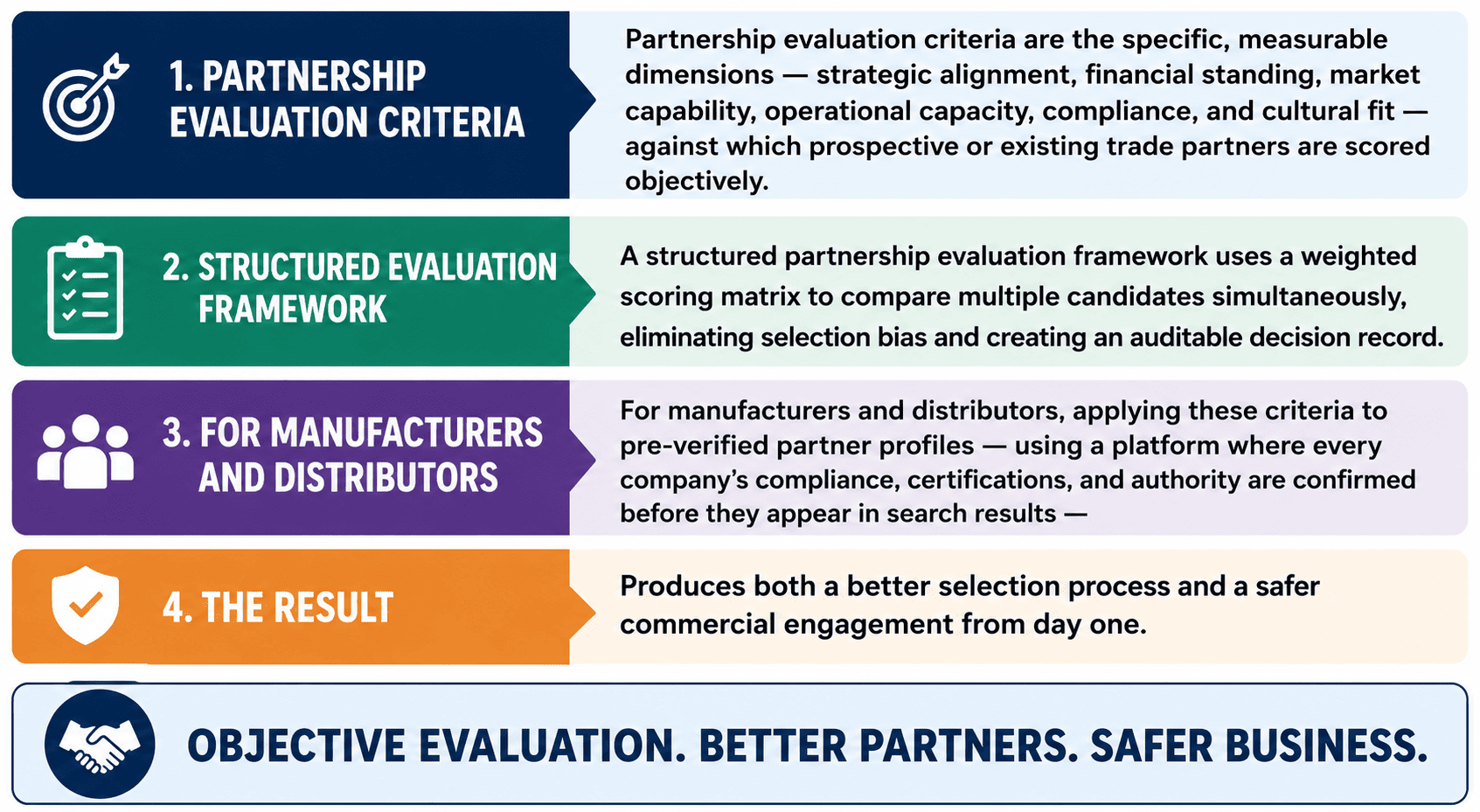
Direct Answer: Partnership evaluation criteria are the specific, measurable dimensions, strategic alignment, financial standing, market capability, operational capacity, compliance, and cultural fit, against which prospective or existing trade partners are scored objectively. A structured partnership evaluation framework uses a weighted scoring matrix to compare multiple candidates simultaneously, eliminating selection bias and creating an auditable decision record. For manufacturers and distributors, applying these criteria to pre-verified partner profiles accelerates evaluation. GTsetu provides government-verified company credentials: name, address, registration number, company status, company type, and date of certificate of incorporation, verified through official government ties, giving you a verified starting point for Dimension 5 (Compliance) of your evaluation framework.
📅 March 12, 2026⏱ 17 min read✍️ GTsetu Editorial Team🔄 Updated regularly
500+
Verified Companies
100+
Countries
6-Point
Govt Tie-Up Verification
0%
Broker Commission
Selecting the wrong trade partner, a distributor who overstates their market coverage, a manufacturer who understates their lead times, or a supplier who fabricates compliance certifications, is one of the most expensive mistakes a business can make. A poor partner selection can cost years of market entry time, millions in sunk distribution costs, and in regulated industries, genuine legal liability. Yet the majority of manufacturers and distributors still select partners based on first impressions, enthusiastic introductions, and self-reported credentials rather than a structured, repeatable evaluation process.
A partnership evaluation framework changes this. By defining evaluation criteria in advance, weighting them according to your actual priorities, and scoring every candidate on the same dimensions, you transform partner selection from a subjective judgment into an objective, auditable, repeatable process. This guide covers every element, from the core criteria dimensions and a ready-to-use business partnership evaluation matrix, to vendor tier assessment and ongoing partnership review frameworks, with particular focus on the contexts most relevant to manufacturers, distributors, and cross-border trade partnerships.
💡 Who Is This Guide For?
This guide is written for manufacturers evaluating prospective international distributors, distributors assessing new manufacturer principals, procurement teams scoring supplier candidates, business development leaders building a repeatable partner selection process, and any organisation that needs to evaluate partnership tiers offered by platform vendors or technology providers. It is also relevant to compliance officers and legal teams responsible for documenting the partner selection rationale for regulatory audit purposes.
SECTION 1
1 What Are Partnership Evaluation Criteria?
🎯 Definition
Partnership evaluation criteria are the specific, pre-defined, measurable dimensions against which a prospective or existing business partner is objectively assessed. They cover the full spectrum of commercial fit: strategic alignment, financial health, market and operational capability, compliance standing, values and cultural compatibility, and mutual commitment to the partnership’s success. Applying a consistent set of criteria to every candidate, rather than evaluating each one subjectively in isolation, enables objective comparison, reduces selection bias, and produces a documented rationale that is defensible to stakeholders and regulators alike.
Partnership Evaluation vs. Partner Due Diligence vs. Ongoing Assessment
Verification of credentials, financial health checks, legal standing, background screening
Legal, compliance, and finance teams
Ongoing Partnership Assessment
During the partnership, annually and on trigger events
Performance against KPIs, relationship health, strategic relevance, compliance status refresh
Account management / partner success
Partnership Exit Evaluation
When partnership underperforms or strategic context changes
Renewal vs. termination decision, wind-down obligations, transition planning
Senior commercial and legal leadership
All four processes are part of a complete partnership assessment framework, but partnership evaluation criteria specifically govern the pre-selection and ongoing assessment stages. This guide focuses primarily on pre-selection evaluation with a dedicated section on ongoing assessment. For the legal frameworks that govern what happens after selection, see our guides on business partnership contracts, termination clauses in trade agreements, and dispute resolution in international contracts.
SECTION 2
2 Why Structured Evaluation Matters in Trade Partnerships
The case for a structured partnership evaluation framework is not abstract, it is rooted in the specific commercial and legal risks that manufacturers and distributors face when partner selection decisions are made informally.
67%
of distribution partnerships fail within 3 years due to misaligned expectations identified during evaluation as resolvable
$1.8M
average cost of a failed international distribution partnership including sunk market entry costs
4×
longer time to first revenue when partner selected without structured evaluation vs. with one
The specific risks that structured evaluation prevents:
🎭
Identity and Credential Fraud
Unverified partners fabricate market coverage, certifications, client relationships, and financial standing. Structured evaluation includes independent verification, not just trust in self-reported claims.
🎯
Strategic Misalignment
A capable partner who pursues different market segments, prioritises different product categories, or has conflicting exclusivity obligations in adjacent territories creates channel conflict from day one.
💰
Financial Instability
A distributor who cannot meet minimum order volumes, invest in market activation, or maintain adequate inventory levels wastes the manufacturer’s market entry investment and time-to-market window.
⚖️
Regulatory and Compliance Exposure
In industries with export controls, product safety regulations, or anti-bribery requirements, engaging with an unverified or non-compliant partner creates legal liability for the selecting company. See: risk allocation in cross-border deals.
🏛️
Anti-Bribery and Corruption Risk
Regulators under FCPA and UK Bribery Act require documented evidence that third-party partner selection followed a structured due diligence process. Informal selection provides no such documentation.
🔄
Selection Bias and Relationship Decisions
Without a structured framework, partner selection is dominated by whoever was met first, whoever is most enthusiastic, or whoever has the strongest personal relationship, none of which correlates with commercial capability.
SECTION 3
3 The 7 Core Partnership Evaluation Criteria Dimensions
A comprehensive partnership evaluation framework organises evaluation criteria into seven primary dimensions. Each dimension covers a different aspect of partner fitness. The relative weight assigned to each dimension varies by partnership type, a distribution partnership weights market capability heavily; a manufacturing partnership weights operational capacity; a technology partnership weights innovation alignment. The criteria within each dimension, however, remain consistent.
🎯
Dimension 1, Strategic Alignment
Does the partner’s market focus, geographic coverage, target customer profile, and long-term growth direction align with yours? Strategic misalignment is the most common cause of partnership failure, two capable companies pulling in different directions. Key criteria: shared market vision, non-conflicting existing partner portfolio, compatible growth trajectory, and alignment on exclusivity and territory intent. See: market entry partnerships and joint venture vs strategic alliance.
Weight: 20–25%
💰
Dimension 2, Financial Health and Stability
Can the partner meet minimum volume commitments, invest in market activation, maintain adequate working capital, and sustain a multi-year commercial relationship without financial distress? Key criteria: audited financials, credit standing, current ratio, debt-to-equity ratio, and ability to meet stated MOQ and investment requirements. See: MOQ explained and advance payment vs LC vs open account.
Weight: 15–20%
🏭
Dimension 3, Market and Distribution Capability
Does the partner have the market access, sales infrastructure, customer relationships, and logistics capability to effectively distribute your product in their territory? Key criteria: existing customer base breadth, sales team size and quality, distribution network coverage, warehousing and cold chain capacity (where relevant), and historical sales volume in comparable product categories.
Weight: 20–30%
⚙️
Dimension 4, Operational Capacity and Track Record
Does the partner have the operational infrastructure to handle your product, meet lead time requirements, and manage supply chain complexity at the required volume? Key criteria: current operational capacity vs. headroom, handling experience with similar product categories, logistics and customs clearance capability, and documented track record with comparable partnerships. See: lead time vs production time and Incoterms explained.
Weight: 15–20%
⚖️
Dimension 5, Compliance, Legal Standing, and Regulatory Fitness
Is the partner legally registered, tax compliant, properly licenced for import/export in their market, and free from active legal disputes, sanctions exposure, or regulatory violations? Key criteria: business registration verification, tax compliance documentation, import/export licences, industry-specific certifications, sanctions screening, and anti-corruption due diligence. See: business verification guide and non-compete vs non-circumvention.
Weight: 15–20%
🤝
Dimension 6, Cultural Fit and Values Alignment
Do the partner’s business ethics, communication style, approach to conflict resolution, and commitment to quality align with yours? Cultural misalignment is systematically underweighted in formal evaluation, yet it determines whether day-to-day interaction is productive or exhausting. Key criteria: decision-making style, transparency in communication, track record of honouring commitments, approach to quality and compliance, and references from current partners.
Weight: 5–10%
🔥
Dimension 7, Commitment and Partnership Investment Intent
Is the partner genuinely committed to making this partnership succeed, willing to invest time, resources, and market access? Key criteria: willingness to execute exclusive or semi-exclusive arrangements, readiness to invest in product training and market activation, existing capacity headroom dedicated to new partnerships, and track record of multi-year partner retention. See: exclusivity clauses and volume commitments explained.
Weight: 5–10%
⚡ Weight Assignment Principle
The percentage weights assigned to each dimension should reflect your actual commercial priorities, not an equal split. A manufacturer entering a new geographic market through distribution should weight market capability (Dimension 3) and strategic alignment (Dimension 1) most heavily. A manufacturer seeking a contract manufacturer should weight operational capacity (Dimension 4) and compliance (Dimension 5) most heavily. Weights are context-specific, define them before evaluation begins, not after candidates have already impressed or disappointed.
SECTION 4
4 Building a Partnership Evaluation Framework
A partnership evaluation framework is the complete methodology, not just a list of criteria, but the structured process by which criteria are defined, weighted, applied, scored, and used to make and document selection decisions. Here is how to build one that is robust enough for high-value trade partnerships.
01
Define Your Ideal Partner Profile Before Evaluating Anyone
Document the specific attributes of your ideal trade partner before any candidate enters the evaluation process. Include: target geography, product category expertise required, minimum company size, distribution infrastructure required, financial standing thresholds, regulatory certifications needed, partnership type (exclusive, semi-exclusive, non-exclusive), and minimum volume commitment capability. This profile becomes the reference standard against which every candidate is measured, and it prevents your evaluation criteria from being unconsciously adjusted to fit candidates you like rather than candidates you need. See: how to find international distributors and distributors and manufacturers explained.
02
Select Your Evaluation Dimensions and Define Specific Criteria
Choose 5–8 evaluation dimensions from the seven core dimensions above, appropriate for your partnership type. Under each dimension, define 3–5 specific, measurable criteria with clear descriptions of what a score of 1 (poor fit) vs. 5 (excellent fit) looks like. Vague criteria, “good market presence”, produce inconsistent scores across evaluators. Precise criteria, “active distribution relationships with 50+ retail accounts in target territory”, produce consistent, comparable scores regardless of who conducts the evaluation.
03
Assign Weights to Each Dimension
Assign a percentage weight to each dimension so that the overall score reflects your actual priorities. Sum to 100%. Document the weighting rationale, why market capability is weighted at 30% for this partnership type but compliance at 20%. This documentation serves two purposes: it forces explicit thinking about priorities before the pressure of an impressive candidate, and it creates an audit trail for the selection rationale that satisfies ABAC due diligence documentation requirements.
04
Define Absolute Disqualifying Conditions
Before scoring begins, list the conditions that disqualify a candidate regardless of how well they score on other dimensions. Common disqualifiers: unverified or unverifiable business identity, active legal proceedings, sanctions list presence, unresolved compliance violations in the relevant sector, existing agreements with direct competitors creating irresolvable channel conflict, or financial distress signals suggesting inability to honour volume commitments. These are binary, present means disqualified, regardless of total score. See: risk allocation in cross-border deals.
05
Set Minimum Score Thresholds
Define the minimum overall weighted score required for a candidate to proceed to the due diligence and NDA stage. Also set dimension-level minimums, a candidate who scores 5/5 on market capability but 1/5 on compliance should not proceed regardless of their overall score, if compliance is a non-negotiable for your industry. Thresholds prevent the “halo effect”, where exceptional performance on one dimension compensates for disqualifying weakness on another.
06
Verify All Data Before Scoring
Never score a candidate based on self-reported information. Every data point used in scoring must be independently verified, business registration through official registries, financial data through audited accounts, market coverage through reference checks with existing customers, certifications through issuing bodies. On GTsetu, company identity verification (name, address, registration number, status, type, incorporation date) is completed through government ties before a company appears in the network, providing a verified data foundation for basic compliance evaluation. However, tax compliance, import licences, and industry certifications remain your responsibility to verify independently, or you may request these documents directly from partners through GTsetu’s encrypted workspace. See: why business verification is non-negotiable.
07
Document Decisions and Define Review Triggers
Record the evaluation scores, selection rationale, evaluator names, and date of assessment for every candidate, including rejected ones. Define the conditions under which the partnership will be formally re-evaluated: at minimum annually, and additionally when material changes occur (ownership change, key personnel departure, financial distress signals, market disruption, regulatory change, or persistent KPI underperformance). Documented evaluation supports both regulatory compliance and internal learning. See: licensing vs distribution agreements for post-selection agreement frameworks.
SECTION 5
5 The Partnership Evaluation Matrix: How to Score Candidates
A partnership evaluation matrix is a structured scoring tool that lists evaluation criteria in rows and partner candidates in columns, with weighted scores calculated for each candidate to produce a comparable overall score. It is the practical output of the evaluation framework, the instrument that turns criteria and weights into a ranked comparison of candidates.
Sample Partnership Evaluation Matrix: Manufacturer Seeking International Distributor
The following matrix illustrates how three distributor candidates, Candidate A, Candidate B, and Candidate C, would be scored using a weighted 5-point scale across the seven core dimensions. Scores are multiplied by dimension weight; highest weighted total wins.
Evaluation Dimension
Weight
Criteria (Score 1–5)
Candidate A
Candidate B
Candidate C
Strategic Alignment
20%
Market focus, territory fit, no channel conflict, exclusivity readiness
4 → 0.80
3 → 0.60
5 → 1.00
Financial Health
15%
Audited financials, credit standing, MOQ capacity, working capital
3 → 0.45
5 → 0.75
4 → 0.60
Market & Distribution Capability
25%
Customer base breadth, sales team, network coverage, logistics
5 → 1.25
3 → 0.75
4 → 1.00
Operational Capacity
15%
Capacity headroom, category handling, customs capability, track record
4 → 0.60
4 → 0.60
3 → 0.45
Compliance & Legal Standing
15%
Business registration, tax compliance, import licences, certifications
5 → 0.75
5 → 0.75
3 → 0.45
Cultural Fit & Values
5%
Communication style, ethics track record, quality commitment, references
Candidate A scores highest overall (4.20) driven by excellent market capability and compliance, but lower commitment (3) may require contractual minimum volume protections. Candidate C scores 4.00 with the strongest strategic alignment and commitment, making them the preferred partner if the slight gap in operational capacity (3) can be mitigated through structured onboarding. Candidate B’s financial strength (5) is attractive but weaker market coverage (3) is the critical gap. The matrix makes these trade-offs explicit, rather than discovering them 18 months into a failed partnership.
Scoring Scale Reference: What Each Score Level Means
Score
Meaning
Example, Market & Distribution Capability
5, Excellent
Exceeds requirement; best-in-class for this criterion
Active distribution to 200+ verified retail accounts in target territory; dedicated logistics team; proven category expertise
4, Good
Meets requirement comfortably; minor gaps manageable
Active distribution to 100+ accounts; capable logistics; some category experience with comparable products
30–50 retail accounts; third-party logistics; adjacent category experience only
2, Below Standard
Falls short of requirement; significant gaps
Fewer than 30 accounts; no dedicated logistics; no relevant category experience
1, Inadequate
Cannot meet requirement; fatal gap for this dimension
No active distribution network; no logistics capability; no relevant experience whatsoever
SECTION 6
6 Partnership Evaluation Template: Ready-to-Use Criteria Set
The following partnership evaluation template provides a ready-to-use criteria set that manufacturers and distributors can apply immediately. Adjust the weights to reflect your specific partnership type and priorities.
📋 Partnership Evaluation Template
Manufacturer–Distributor Partnership: Full Criteria Checklist
Score each criterion 1–5. Multiply by assigned dimension weight. Sum weighted scores for overall rating. Minimum proceed threshold: 3.5 / 5.0 overall; no dimension below 2.0.
Dimension & Criteria
Data Source
Score (1–5)
Notes
STRATEGIC ALIGNMENT (Weight: ____%)
Geographic coverage aligns with target market entry plan
Profile; territory map; reference check
__
No conflicting exclusivity with competing brand in same category
A strategic partnership evaluation framework extends beyond operational due diligence to assess the long-term strategic value a partnership creates, market access, competitive positioning, innovation potential, and risk portfolio diversification. It asks not just “can this partner do the job?” but “does this partner make us significantly stronger strategically over a 3–5 year horizon?”
Strategic vs. Operational Evaluation: What’s Different
Does this partner provide access to distribution channels, customer segments, or geographies that would be prohibitively expensive or time-consuming to build independently? See: global expansion advantages and disadvantages.
🛡️
Competitive Positioning
Does securing this partner prevent competitors from accessing the same routes to market? Does their exclusivity with you create a structural barrier to entry for competitors in their territory?
💡
Innovation and Market Intelligence
Does this partner’s front-line market access generate product development insights, consumer intelligence, or competitive data that improves our innovation pipeline? See: co-development partnerships explained.
🔗
Network and Ecosystem Value
Does this partner bring relationships, with retailers, regulators, industry bodies, or complementary brands, that enhance our market position beyond their direct distribution role?
📈
Growth Trajectory Alignment
Is the partner growing in the same direction and at a compatible pace? A hyper-growth partner may outgrow your supply capacity; a stagnant partner may be unable to activate new market segments. See: company global expansion guide.
8 How to Evaluate Partnership Tiers and Benefits with Platform Vendors
Many manufacturers and distributors engage B2B platform vendors, trade networks, matchmaking platforms, digital marketplaces, procurement tools, that offer tiered partnership programmes with different access levels, verification depths, feature sets, and pricing. Evaluating these vendor tiers requires a specific set of criteria distinct from evaluating trade partners.
Key Criteria for Evaluating Platform Vendor Partnership Tiers
Evaluation Criterion
What to Ask the Vendor
What “Good” Looks Like
Red Flag
Verification Depth at Each Tier
What exactly is verified at each tier, and by whom?
Government tie-up verification of core identity credentials: name, address, registration number, status, type, incorporation date.
“Verified” means only email confirmation or self-attestation; no government-backed source.
Commission and Fee Structure
Is any percentage of partnership value taken at any tier?
Zero commission on partnerships formed; flat subscription or access fee only
5–15% success fee on deal value, misaligned incentives and major cost at scale
Security Infrastructure
What encryption, access control, and audit trail is provided?
AES-256 at rest, TLS in transit, role-based access, full timestamped audit trail, built-in NDA workflow
How many verified companies in my target markets and industry sector?
Active, government-identity-verified members in your specific target geography and industry vertical
Large total member count but minimal verified presence in your actual target markets
Anonymous Discovery
Can I browse partner profiles without revealing my identity?
Full anonymous browsing until mutual interest is confirmed, your market strategy stays private
Your profile and browsing activity visible to all members from first login
NDA and Confidentiality Workflow
Is NDA execution built into the platform or manual?
Built-in digital NDA triggered before any data exchange; timestamped audit trail
NDAs handled externally; no structural confidentiality gate before data sharing
Ongoing Compliance Monitoring
Is verification a one-time onboarding event or ongoing?
Regular refreshes of core identity verification through government data sources
Point-in-time verification only, a company verified at onboarding may no longer be registered
Support and Account Management
What support is included at each tier, response time, dedicated account management?
Dedicated account management or customer success at higher tiers; documented SLA for support response
Ticket-only support with no SLA; no dedicated contact for enterprise tiers
Integration and API Access
Can the platform integrate with our CRM, ERP, or procurement system?
Documented API; native integrations with major CRM and ERP systems; SSO support
No API access; manual data export only; no system integration capability
⚠️ The Commission Trap in Platform Vendor Tiers
Platform vendors often make higher tiers attractive through feature unlocks, more verified contacts, better analytics, priority matching, while burying a 5–10% success commission in the tier terms. For a manufacturer forming a distribution agreement worth $500,000 per year, a 7% platform commission costs $35,000 annually, more than most SaaS platform subscriptions. Always calculate the total cost of each tier including success fees, and compare that against platforms with zero-commission models. GTsetu charges zero commission on any partnership formed at any tier. See: pricing structures in contract manufacturing.
Partnership evaluation does not end at selection. A structured annual assessment process, applied consistently to all active trade partners, identifies performance gaps before they become terminal, surfaces partnership renewal vs. exit decisions proactively, and ensures that the commercial relationship evolves as your strategy evolves.
Annual Partnership Assessment Framework
Assessment Area
Key Questions
Data Sources
Action If Below Standard
Commercial Performance
Are they hitting agreed volume commitments and revenue targets? What is their sell-through rate? Are they investing in market activation?
Your company’s strategic direction shifts, potentially making the partner’s territory or channel less relevant
SECTION 10
10 Red Flags That Should Disqualify a Partner Candidate
Certain conditions should automatically remove a candidate from consideration regardless of how impressive their other scores are. These are not “areas for improvement”, they are structural disqualifiers that indicate either dishonesty, legal risk, or fundamental misalignment that cannot be managed through contractual provisions alone.
🚩
Unverifiable Business Identity
If business registration, tax ID, or legal existence cannot be independently confirmed through official registries, disqualify immediately. Self-reported credentials without verifiable documentary evidence are insufficient for any high-value trade partnership.
🚩
Sanctions List Presence
Any presence on OFAC, EU, UN, or local sanctions lists is an absolute disqualifier with zero exceptions. Trading with a sanctioned entity creates criminal liability for the selecting company regardless of intent. See: risk allocation in cross-border deals.
🚩
Active Exclusivity with Direct Competitor
An existing, active exclusivity agreement between the candidate and a direct competitor in the same product category in your target territory is unresolvable without the competitor’s consent. Proceeding creates immediate channel conflict and potential tortious interference liability.
🚩
Refusal to Provide Audited Financials
A distributor who refuses to provide audited financial statements or a credible financial reference when asked during due diligence has something to hide. This is non-negotiable for any partnership involving volume commitments, advance payment, or exclusivity.
🚩
Resistance to Signing an NDA Before Commercial Discussions
A prospective partner who refuses to sign a mutual NDA before commercial information is shared is either inexperienced or deliberately avoiding legal confidentiality obligations. Neither is acceptable for a high-value trade relationship.
🚩
Materially Inconsistent Claims Across Information Sources
If claims made in the profile or first meeting are contradicted by reference checks, registry data, or site visits, even on a single material point, the candidate has demonstrated willingness to misrepresent. Terminate evaluation immediately.
🚩
Undisclosed Beneficial Ownership Conflicts
If the company’s beneficial ownership is connected to a competitor, a sanctioned individual, or a party with whom your company has an existing legal dispute, and this was not proactively disclosed, disqualify and review all information already shared.
🚩
Pressure to Skip Due Diligence or “Trust First, Verify Later”
Urgency manufactured by the candidate, “we need your decision this week or we will sign with your competitor”, is a manipulation tactic designed to bypass the evaluation process. Legitimate partners understand and welcome proper due diligence as a sign of a serious counterparty.
SECTION 11
11 How GTsetu Supports Verified Partner Evaluation
✅ Platform Spotlight, GTsetu
Government Tie-Up Verified Company Identities, Zero Commission
Applying a partnership evaluation framework is significantly faster and safer when the basic identity and registration status of every candidate have been verified through official government channels before you encounter them. GTsetu verifies every company on six core data points using government ties: Name, Address, Registration Number, Company Status, Company Type, and Date of Certificate of Incorporation. This verification happens before a company appears in the network, giving you a trusted foundation for Dimension 5 (Compliance & Legal Standing) of your evaluation framework. However, tax compliance, import/export licences, industry certifications, and financial standing are not verified by GTsetu, you must request these documents directly from partners and verify them independently, which you can do securely within GTsetu’s encrypted workspace.
🏛️
Government Tie-Up Verification
6-point verification through official government sources: Name, Address, Registration Number, Company Status, Company Type, Date of Certificate of Incorporation. Verified before any profile appears in search results.
🤖
AI-Assisted Match Scoring
GTsetu’s matching engine scores verified candidates by industry, geography, company size, product category, and partnership intent, pre-filtering candidates who do not meet basic alignment criteria before they appear in your results.
🕵️
Anonymous Discovery
Evaluate candidate profiles without revealing your identity or market strategy until you confirm mutual interest, protecting the confidentiality of your evaluation process itself.
📄
Built-In NDA Workflow
Digital NDA execution, covering scope, governing law, and audit trail, is triggered before any commercial information exchange, satisfying the legal security gate in your evaluation framework automatically.
🔐
Encrypted Due Diligence Workspace
Share evaluation materials, reference requests, and commercial proposals in an AES-256 encrypted, role-access-controlled workspace, with every access event logged for your audit trail. Request tax certificates, licences, and financial documents directly from partners in this secure space.
📋
Full Audit Trail for Compliance
The complete record of who accessed what, when, and what was shared satisfies ABAC due diligence documentation requirements and creates evidence in the event of a partner-initiated dispute.
🚫
Zero Commission
No success fee or broker commission on any partnership formed, your evaluation framework is not distorted by platform incentives to close deals faster or at higher values. See: global partner service guide.
🌍
100+ Countries
Government-verified candidates across Asia, Middle East, Europe, Africa, Australia, and the Americas, enabling evaluation of candidates in all your target markets from a single platform.
✓ Verified through government sources before profile appears
✗ Self-reported, your task to verify
Registered Address
✓ Verified against official registry data
✗ Self-reported, often unverified
Registration Number
✓ Cross-checked with issuing authority
✗ Claimed but unverified
Company Status (Active/Dissolved)
✓ Verified through ongoing government data sync
✗ Unknown, status may be outdated or misrepresented
Company Type (Ltd, Pvt Ltd, etc.)
✓ Verified against registration documents
✗ Self-reported without verification
Date of Certificate of Incorporation
✓ Verified from official certificate data
✗ Claimed but unverified
Tax Compliance, Licences, Certifications
Not verified by GTsetu, your responsibility to request and verify via encrypted workspace
✗ Self-reported, no verification layer
Time to complete basic identity verification
✓ Instant, already done before you browse
✗ 1–4 weeks of independent registry research per candidate
NDA before commercial data exchange
✓ Structural, built into workflow
✗ Manual, often skipped in enthusiasm
Commission on partnership formed
✓ Zero, always
~ Often 5–15% on deal value
📌 Important Note on GTsetu’s Verification Scope
GTsetu verifies six specific data points using government ties: Company Name, Address, Registration Number, Company Status, Company Type, and Date of Certificate of Incorporation. GTsetu does NOT verify tax compliance, import/export licences, industry certifications, financial standing, or authority of representatives. These remain your responsibility to verify independently, you may request these documents directly from partners and review them within GTsetu’s encrypted due diligence workspace.
FAQ
? Frequently Asked Questions
QWhat are partnership evaluation criteria?
Partnership evaluation criteria are the specific, measurable dimensions against which a prospective or existing business partner is objectively assessed, covering strategic alignment, financial standing, market and operational capability, compliance and legal standing, cultural fit, and mutual commitment to partnership success. A structured set of criteria, applied consistently to every candidate, enables objective comparison rather than selection based on first impressions or relationship familiarity, and creates an auditable record of the selection rationale for regulatory and internal governance purposes.
QWhat is a partnership evaluation framework?
A partnership evaluation framework is a complete, structured methodology for assessing prospective or existing trade partners across defined criteria. It includes: an ideal partner profile definition, evaluation dimensions and specific criteria, dimension weightings reflecting commercial priorities, a scoring matrix for candidate comparison, minimum score thresholds and absolute disqualifying conditions, independent data verification requirements, and decision documentation standards. The framework transforms partner selection from a subjective judgment into a repeatable, objective, auditable process. See our detailed framework guide earlier in this article, and our guide on business partnership contracts for what comes after selection.
QWhat is a partnership evaluation matrix?
A partnership evaluation matrix is a structured scoring tool that lists evaluation criteria in rows and partner candidates in columns, assigning weighted scores to each criterion for each candidate. The weighted totals produce comparable overall scores that support objective selection decisions. The matrix eliminates the cognitive bias of evaluating partners sequentially (where the most recent candidate benefits from recency bias) and creates an auditable record of the selection rationale. A sample matrix for manufacturer–distributor selection is included in Section 5 of this guide.
QWhat is a strategic partnership evaluation framework?
A strategic partnership evaluation framework extends beyond operational due diligence to assess the long-term strategic value a partnership creates over a 3–5 year horizon. It asks not just “can this partner distribute our product?” but “does this partnership create lasting competitive advantage, market access, or innovation potential?” Key dimensions include market access value, competitive positioning, network and ecosystem value, innovation and market intelligence contribution, growth trajectory alignment, and IP and technology alignment. Strategic evaluation is applied to partnerships that represent significant revenue commitment, market entry investment, or structural competitive positioning decisions. See: joint venture vs strategic alliance and global collaboration examples.
QHow do you evaluate partnership tiers and benefits with platform vendors?
Evaluating platform vendor partnership tiers requires assessing: (1) the depth of verification at each tier, what is actually checked, by whom, and how often; (2) the full fee structure including any success commission on partnerships formed; (3) the security infrastructure provided, encryption, NDA workflows, audit trails; (4) geographic and sector coverage of verified participants in your actual target markets; (5) whether anonymous discovery is available; (6) support and account management levels at each tier; and (7) integration capability with your existing systems. Always calculate total cost of each tier including any success fees, not just subscription cost, a 7% commission on a $500,000 distribution agreement costs $35,000 in a single year. GTsetu charges zero commission at all tiers.
QWhat does GTsetu verify exactly?
GTsetu verifies six specific data points using government ties: Company Name, Registered Address, Registration Number, Company Status (Active/Dissolved), Company Type (Ltd, Pvt Ltd, etc.), and Date of Certificate of Incorporation. GTsetu does NOT verify tax compliance, import/export licences, industry certifications, financial standing, or authority of representatives. Those remain your responsibility to request from partners and verify independently, which you can do securely within GTsetu’s encrypted due diligence workspace.
QHow often should partnerships be formally evaluated?
Partnerships should be formally evaluated at three intervals: (1) pre-partnership, before any commercial agreement is signed, using the full evaluation matrix; (2) annually, a structured performance review against agreed KPIs during the partnership; and (3) trigger-based, when a material change occurs such as a change of ownership, financial distress signals, regulatory change, persistent KPI underperformance, or a force majeure event materially impacting capabilities. See: termination clauses in trade agreements and force majeure in global trade for the legal frameworks governing what happens when assessment triggers an exit decision.
QWhat are the most important partnership evaluation criteria for international distributors?
For international distributor evaluation, the most important criteria, in approximate priority order, are: (1) market capability: active distribution network breadth and depth in target territory, verified through reference calls and site visits; (2) compliance: business registration, import licences, tax compliance, and sanctions screening, all independently verified; (3) strategic alignment: no conflicting exclusivity with competing brands in the target territory; (4) financial health: ability to meet MOQ, fund market activation, and maintain adequate working capital; and (5) operational capacity: logistics capability, customs clearance experience, and headroom for onboarding a new principal. For the full criteria template, see Section 6 of this guide. Also see: how to find international distributors and territory rights in international agreements.
Start with Verified Company Identities, Then Dig Deeper
GTsetu verifies the six core identity credentials of every company through government ties before they appear in your results. Tax compliance, licences, and certifications? You request those directly from partners in our encrypted workspace. Zero broker commissions on any partnership you form.
They represents the product, and research team behind GTsetu, a global B2B collaboration platform built to help companies explore cross-border partnerships with clarity and trust. The team focuses on simplifying early-stage international business discovery by combining structured company profiles, verification-led access, and controlled collaboration workflows.
With a strong emphasis on trust, and disciplined engagement, Team GTsetu shares insights on global trade, partnerships, and cross-border collaboration, helping businesses make informed decisions before entering deeper commercial discussions.