Technology Partnership: Complete Guide for Industrial Manufacturers, Distributors & Suppliers
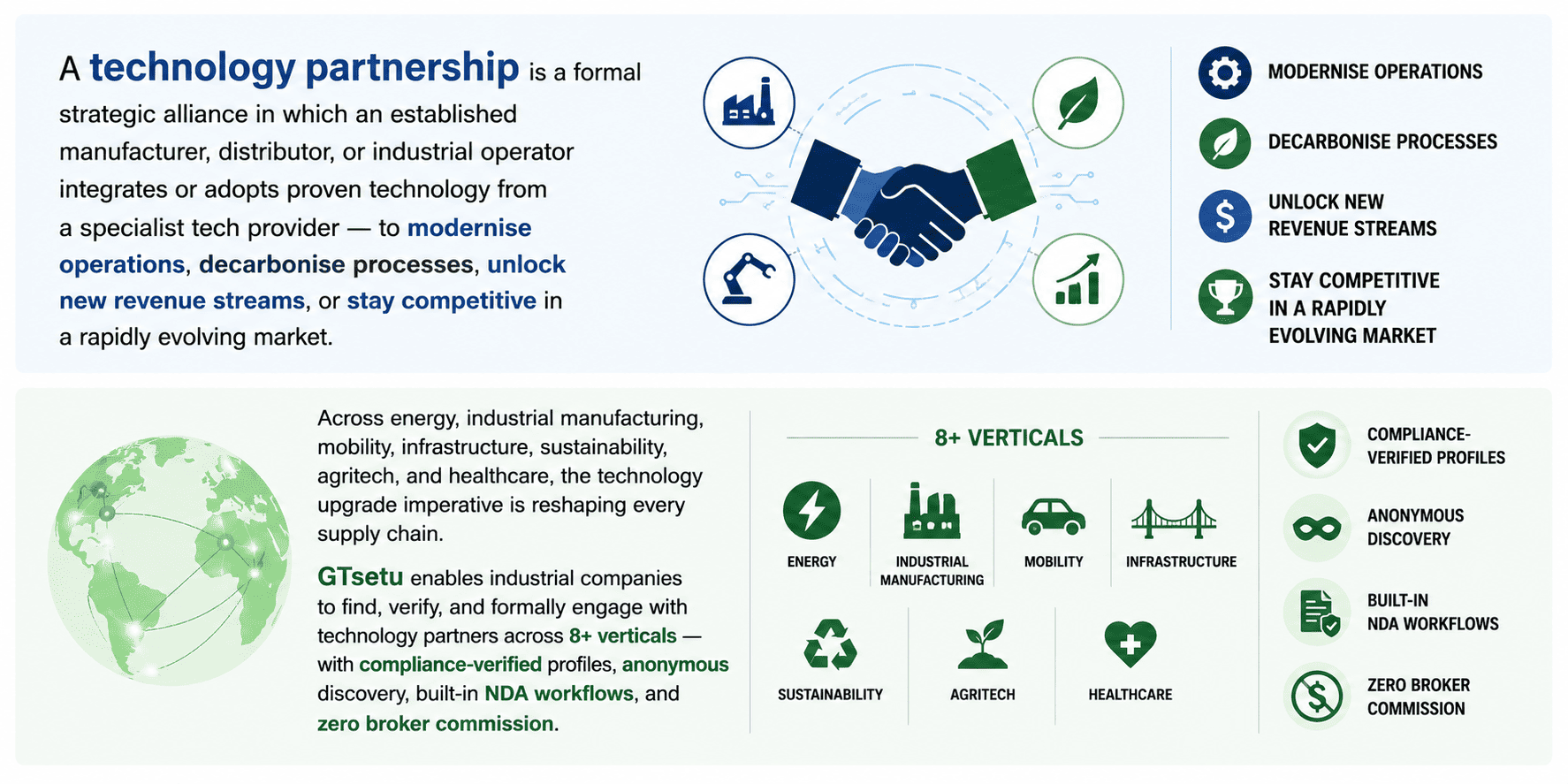
Direct Answer: A technology partnership is a formal strategic alliance in which an established manufacturer, distributor, or industrial operator integrates or adopts proven technology from a specialist tech provider, to modernise operations, decarbonise processes, unlock new revenue streams, or stay competitive in a rapidly evolving market. Across energy, industrial manufacturing, mobility, infrastructure, sustainability, agritech, and healthcare, the technology upgrade imperative is reshaping every supply chain. GTsetu enables industrial companies to find, verify, and formally engage with technology partners across 8+ verticals, with profiles verified on 6 key data points (Name, Address, Registration Number, Company Status, Company Type, Date of Certificate of Incorporation) via government tie-ups, anonymous discovery, built-in NDA workflows, and zero broker commission.
📅 February 19, 2026⏱ 17 min read✍️ GTsetu Editorial Team🔄 Updated regularly
500+
Verified Companies
8+
Industry Verticals
100+
Countries
0%
Broker Commission
Industrial manufacturers, distributors, and suppliers are under mounting pressure to modernise, not in five years, but now. Customer expectations, regulatory mandates, and competitive dynamics are converging to make technology adoption a survival imperative, not an optional upgrade cycle. Yet the challenge is not knowing that technology is needed. The challenge is finding the right technology partner: one with a proven solution, a verified business, and a commercial structure that works for both sides.
This guide explains what technology partnerships are, the different models available, the sectors where the technology upgrade opportunity is most acute, how to build a technology partnership strategy, and how GTsetu creates the verified, secure infrastructure for industrial companies to find and formalise these partnerships across 100+ countries.
💡 Who Is This Guide For?
This article is written for manufacturers, distributors, and suppliers in energy, industrial, mobility, infrastructure, technology, environmental, agriculture, and healthcare sectors who are seeking technology partners to upgrade their operations, as well as for technology companies seeking industrial partners to deploy and scale their solutions. It covers both sides of the technology partnership relationship.
SECTION 1
1 What Is a Technology Partnership?
🎯 Definition
A technology partnership is a formal, structured alliance between two businesses in which one party, typically an established manufacturer, distributor, or industrial operator, adopts, integrates, or co-develops technology from another party to improve its operations, products, or market position. Unlike a standard vendor-buyer transaction, a technology partnership involves mutual investment, shared objectives, and a formal agreement governing scope, IP rights, integration responsibilities, and commercial terms.
Technology partnerships are distinct from simple technology procurement. When a factory purchases software licences as a commodity, that is a transaction. When the same factory works with a technology company to integrate industrial IoT sensors across its production line, co-trains its maintenance team on predictive analytics, and builds a joint roadmap for expanding the deployment, that is a technology partnership.
Dimension
Technology Transaction
Technology Partnership
Relationship structure
Buyer-seller; one-time or subscription
Strategic alliance; ongoing collaboration
IP and integration
Standard licence; off-the-shelf deployment
Custom integration; often joint IP development
Duration
Licence term; renewable but non-relational
Multi-year; mutual investment in success
Commercial terms
Published pricing; no exclusivity
Negotiated terms; often territorial or sector exclusivity
Knowledge transfer
Minimal; documentation only
Structured training, co-development, shared data
Risk sharing
Buyer bears implementation risk alone
Both parties share implementation and outcome risk
The word “partnership” in technology partnership is not marketing language, it has structural meaning. It implies mutual obligations, shared risk, and a governance framework. An industrial company that treats its technology partnership as a procurement exercise will consistently underperform compared to one that builds it as a genuine strategic alliance with joint business planning and defined success metrics.
SECTION 2
2 Why Industrial Companies Need Technology Partnerships Now
The convergence of decarbonisation mandates, digital transformation pressure, and competitive globalisation has created a technology adoption imperative across every industrial sector. Manufacturers who built their competitive advantage on operational efficiency alone are finding that advantage increasingly fragile without a technology layer on top of it.
78%
of industrial manufacturers say technology partnerships are “critical” or “very important” to their growth strategy
3.2×
faster technology adoption through partnerships versus internal R&D for established manufacturers
$12T
estimated global market for industrial technology upgrades across energy, manufacturing, and infrastructure by 2030
The specific drivers forcing manufacturers and distributors to seek technology partnerships include:
🌱
Decarbonisation Mandates
Carbon neutrality commitments, scope 3 emissions reporting requirements, and customer sustainability demands are forcing manufacturers to replace legacy energy systems with clean technology they do not have the R&D capacity to develop internally. Technology partnerships with green hydrogen, BESS, and energy optimisation providers are the fastest path to compliance.
ESG Pressure
🤖
Automation and AI Imperative
Labour costs, quality consistency requirements, and competitive pressure from automated competitors are making industrial AI and IoT adoption unavoidable for manufacturers who wish to remain price-competitive. Partnering with proven IIoT and AI-driven optimisation providers delivers capability in months rather than years.
Competitiveness
📊
Data-Driven Operations
Manufacturers and distributors sitting on years of operational data are realising that without the analytical tools to turn that data into decisions, they are leaving significant efficiency gains and revenue opportunities unrealised. Technology partnerships with analytics SaaS and digital twin providers unlock this latent value.
Efficiency
🔗
Supply Chain Resilience
Post-pandemic supply chain disruptions exposed the fragility of linear, opaque supply chains. Technology partnerships in supply chain traceability, predictive logistics, and supplier risk monitoring are being adopted not as efficiency plays but as business continuity investments.
Resilience
🏛️
Regulatory and Compliance Requirements
ESG reporting frameworks, product carbon footprint requirements, and digital product passport mandates are creating compliance obligations that manufacturers cannot meet with existing infrastructure. Technology partnerships with ESG software and carbon accounting platform providers are becoming operationally necessary.
Compliance
💰
Capital Efficiency
Building technology capabilities in-house requires R&D investment, specialist talent acquisition, and years of development time. Technology partnerships access proven solutions with known performance data, spreading technology investment risk and delivering time-to-value in months rather than years.
ROI
SECTION 3
3 Types of Technology Partnerships
Technology partnerships come in several structurally distinct forms. Understanding the different types is essential for selecting the right model for your specific technology need, commercial objectives, and IP situation.
🔌
Technology Integration Partnership
One party embeds or integrates the technology provider’s solution into its existing systems or products. The manufacturer/operator gets enhanced capability; the tech provider gets a deployed reference site. Common in IIoT, API-first SaaS, and smart building solutions. See also: industrial business collaboration.
📜
Technology Transfer Partnership
Proprietary technology, know-how, or IP is formally transferred or licensed from the originating company to a manufacturing or commercial partner. Common in pharma, clean energy, advanced materials, and defence. Governed by a formal technology transfer agreement.
🤝
Co-Development Partnership
Both parties jointly invest in developing a new technology, product, or solution, sharing R&D costs, IP ownership, and commercialisation rights. High-commitment, high-return model. See our guide to co-development partnerships for structure and IP considerations.
🛠️
Technology Service Partnership
An industrial company partners with a technology service provider to deliver a specific technical capability, engineering services, software development, systems integration, on an ongoing basis rather than through a one-off project. Structured as a formal business partnership contract.
🌐
Technology Distribution Partnership
A distributor or industrial operator gains the right to commercialise and resell a technology solution in a defined geography or market segment. The tech company gets market reach without building its own distribution infrastructure. Governed by a licensing or distribution agreement.
🏗️
Strategic Technology Alliance
A long-term, multi-dimensional relationship where both parties co-invest in a shared technology roadmap, market positioning, and joint customer engagement. Common between large industrial corporates and scale-up technology companies. Related: joint venture vs strategic alliance.
🏭
OEM Technology Partnership
A manufacturer embeds a technology provider’s component or system into its own products as Original Equipment Manufacturer. The tech company’s technology ships inside the manufacturer’s branded product. Distinct from OEM vs ODM vs EMS arrangements in manufacturing.
🔬
R&D and Innovation Partnership
Structured around exploratory technology development, often involving universities, research institutions, or deep-tech startups. May not have an immediate commercial output, the objective is technology readiness uplift. Often supported by public funding and structured as a co-development framework.
SECTION 4
4 Technology Partnership Opportunities by Sector
The technology upgrade imperative varies by sector, but it is present across all of them. Below are the eight core industry verticals where GTsetu facilitates technology partnerships between established industrial operators and verified technology companies. Each sector shows the highest-growth technologies being adopted and the types of technology partners being onboarded to the platform.
GTsetu actively onboards verified technology companies across all eight sectors above. If your technology company fits any of these categories, you can create a verified profile on GTsetu and be discoverable by industrial manufacturers, distributors, and operators across 100+ countries, all of whom are pre-verified on 6 key company data points using government tie-ups. Join the network →
SECTION 5
5 Building a Technology Partnership Strategy
A technology partnership strategy is not a list of technology companies you want to engage. It is a structured framework that defines what technology capabilities you need, what partnership model best fits each need, how you will evaluate and select partners, and how you will govern and evolve the relationship over time.
The Five Elements of an Effective Technology Partnership Strategy
01
Technology Needs Assessment, What Are You Actually Solving?
Before approaching any technology partner, map your operational gaps precisely: Where are your largest efficiency losses? Which processes are most exposed to regulatory compliance risk? Which customer demands can you not currently meet? Which competitors are winning because of a technology capability you lack? This needs assessment should produce a prioritised list of specific technology requirements, not generic aspirations like “we want to digitise.”
02
Partnership Model Selection, Build, Buy, or Partner?
For each technology need, evaluate whether you should build in-house, purchase as a commodity, or partner. The partnership model is right when: the technology is specialised enough that in-house development would take too long; the required investment is too large for a one-time procurement; and the ongoing relationship between your operations and the technology provides more value than a standard licence. Map each need to the right type of technology partnership.
03
Partner Landscape Mapping, Who Exists and Where?
Systematically map the technology provider landscape for each priority need: who has proven technology at the required maturity level? Which providers have relevant deployment experience in your sector? Are there geographic considerations, do you need a partner with local implementation capability or regulatory expertise? Verified platforms like GTsetu provide access to technology companies verified on 6 key data points via government sources, dramatically accelerating this mapping exercise.
04
Exclusivity and IP Strategy, What Do You Own?
Define your position on exclusivity and IP before entering any technology partnership negotiation. Do you want exclusive access to the technology in your market, and are you prepared to pay for it through volume commitments or upfront investment? Who will own IP developed jointly during the partnership? What happens to integration work if the partnership is terminated? These questions are easier to answer before engagement than after. See our guides on exclusivity clauses, IP ownership, and non-compete vs non-circumvention provisions.
05
Governance and Performance Framework, How Will You Manage It?
Technology partnerships require active governance: joint steering committees, agreed KPIs, regular roadmap reviews, and escalation paths for disputes. Define these governance mechanisms in the technology partnership agreement before signing. Partnerships that lack explicit governance frameworks tend to drift into transactional relationships, losing the strategic value that justified the partnership model in the first place. Related reading: dispute resolution in international contracts.
SECTION 6
6 What a Technology Partnership Agreement Should Cover
The technology partnership agreement is the legal and commercial foundation of the relationship. A poorly drafted agreement, or the absence of one, is one of the most frequent causes of technology partnership disputes and failures. These are the provisions that a robust technology partnership agreement must address.
Agreement Clause
What It Governs
Key Consideration for Cross-Border Deals
Technology Definition & Scope
Precisely defines what technology is included in the partnership; excludes what is not
Vague scope definitions are the most common source of disputes; be exhaustive in defining what’s covered
IP Ownership
Specifies who owns pre-existing IP, jointly developed IP, and integration work product
Critical to resolve before development begins; once joint IP is created without a clear agreement, separation is extremely costly. See: IP ownership in contract manufacturing
Licence Terms
Exclusive or non-exclusive; territory; duration; sublicencing rights
For international deployments, defining whether the licence covers specific countries or regions prevents later channel conflict
Exclusivity Provisions
Whether the tech company can partner with competitors of the industrial partner
Exclusivity has real commercial value and should be priced accordingly, either through fee uplift or volume commitments. See: exclusivity clauses
Commercialisation Terms
Revenue sharing, royalty structures, milestone payments, or flat licensing fees
For technology transfer arrangements, royalty structures must be aligned with the commercial model of the receiving party’s market
Implementation Obligations
Which party is responsible for integration, customisation, testing, and ongoing maintenance
Implementation responsibility is often ambiguous; the agreement must assign it precisely with timelines and acceptance criteria
Confidentiality & NDA
Protection of both parties’ technical information, trade secrets, and commercial data
A robust mutual NDA should be executed before any technical information is shared, not as part of the main agreement but as a precondition to entering negotiations. GTsetu’s built-in NDA workflow addresses this
Which jurisdiction’s laws apply; whether disputes go to litigation, arbitration, or expert determination
For cross-border technology partnerships, neutral jurisdictions (Singapore, UK, Switzerland) with strong IP enforcement frameworks are preferred. See: dispute resolution in international contracts
Force Majeure
Protection for both parties in the event of events beyond their reasonable control
Technology partnerships with cross-border implementation often require broader force majeure provisions covering export control, sanctions, and supply chain disruption. See: force majeure in global trade
⚠️ The Most Common Agreement Failure
In technology partnerships, the most common agreement failure is not in the commercial terms, it is in the IP ownership clause. Companies that begin co-development without explicit agreement on who owns what are creating a dispute that will surface at exactly the wrong moment: when the technology becomes commercially valuable. Define IP ownership before the first line of code is written or the first joint prototype is produced.
SECTION 7
7 How to Select the Right Technology Partner
Technology partner selection is one of the highest-stakes decisions an industrial company makes. The wrong partner, one with promising technology but poor implementation capability, or strong IP but weak financial standing, can set back a technology programme by years. These are the criteria that matter most:
Selection Criterion
Why It Matters
How to Verify
Red Flag
Technology Maturity Level
Determines implementation risk and time-to-value
Request Technology Readiness Level (TRL) evidence; reference deployments; performance data from operational sites
Technology that exists only in lab conditions or pilot stage with no commercial deployment
Business Registration & Legal Standing
Ensures you are engaging with a real, legally registered company
Check official registries or use a platform like GTsetu that verifies Name, Address, Registration Number, Company Status, Company Type, and Date of Incorporation via government tie-ups
Company registered only weeks before engagement; no verifiable registration in claimed jurisdiction
Financial Stability
A technology partner that becomes insolvent mid-deployment creates severe operational risk
Request financial summary; review funding history (for startups); check payment history with existing clients
Inability to provide any financial evidence; entirely unfunded with no commercial revenue
Implementation Track Record
Technology that works in theory but fails in industrial-scale implementation is worthless
Request detailed case studies; speak directly with reference customers; site visits where possible
References are unavailable or refused; case studies are anonymised with no verifiable details
IP Ownership Clarity
Ensures the technology partner actually owns what they are licensing to you
Request IP ownership declarations; check patent filings; confirm no third-party IP encumbrances
Technology partially sourced from open-source libraries without proper licensing; unclear ownership history
Integration Capability
Determines how disruptive the technology adoption will be to your existing operations
Technical architecture review; API documentation quality; integration experience with comparable industrial environments
Technology requires complete replacement of existing infrastructure; no API or integration documentation exists
Regulatory Compliance
In regulated sectors (energy, healthcare, food), the technology must meet sector-specific standards
Request relevant certifications; check compliance with standards applicable in your deployment market
“We will get the certification” rather than “we hold the certification”
Strategic Alignment
A technology partner whose long-term roadmap diverges from your needs will leave you stranded
Review the technology company’s product roadmap; assess their funding and growth trajectory
Roadmap driven by investor pressure rather than customer need; pivoting frequently without direction
Technology Partner Selection Checklist
Business registration and legal entity verified through official registries or a platform using government tie-ups
Technology maturity level (TRL) confirmed with operational deployment evidence
At least two verifiable reference customers in comparable industrial contexts
Financial stability assessment, adequate funding runway for a multi-year partnership
IP ownership confirmed, technology partner owns what they are licensing, free of third-party claims
Sector-specific regulatory certifications valid and in-scope
Integration architecture reviewed, clear API / interface documentation available
Mutual NDA executed before any technical specifications or commercial pricing is shared
Technology partnership agreement reviewed by qualified legal counsel before signing
Strategic roadmap reviewed, long-term development direction aligned with your operational needs
Governance framework agreed, joint steering committee, KPI structure, and escalation path defined
Exit provisions reviewed, IP return, data deletion, and transition support clearly specified
SECTION 8
8 The Technology Partnership Journey on GTsetu
Here is how an industrial manufacturer, distributor, or supplier finds and formalises a technology partnership on GTsetu, from anonymous discovery of companies verified on 6 key data points to a signed partnership agreement, with security controls active at every stage.
🔍
Define Need
Identify the specific technology gap to be addressed.
Internal step
🕵️
Browse Anonymously
Discover tech companies verified on 6 points (Name, Address, Reg. No., Status, Type, Inc. Date).
🔐 Anon mode
✅
Verify Credentials
Review the 6 verified data points from government sources.
🔐 Govt. tie-up
🤝
Mutual Interest
Both parties confirm interest. Identities revealed simultaneously.
🔐 Gated reveal
📄
NDA Executed
Digital mutual NDA signed before any technical data is shared.
🔐 Legal gate
📁
Secure Evaluation
Tech specs, performance data, and pricing exchanged in encrypted workspace.
💡 Why Secure Discovery Matters for Tech Partnerships
Technology partnerships involve some of the most sensitive IP exchanges that exist in commercial life: proprietary formulations, unreleased product data, performance benchmarks, integration architectures, and R&D roadmaps. When these are shared before any NDA is in place, via cold email, LinkedIn outreach, or trade show business card follow-ups, you have created a legal and commercial exposure with no audit trail and no recourse. GTsetu’s built-in NDA workflow and encrypted document workspace solve this by making secure exchange the default, not an afterthought. See our full guide to B2B secure collaboration for the complete security framework.
SECTION 9
9 How GTsetu Connects Industry with Verified Tech Partners
⚡ Platform Spotlight, GTsetu
The Verified Platform for Industrial Technology Partnerships Across 100+ Countries
GTsetu was built for exactly this challenge: industrial manufacturers, distributors, and suppliers need to find proven technology partners, but the discovery, verification, and commercial engagement process is broken. Cold outreach leads to unverified companies. Trade shows are expensive and infrequent. Directories are self-reported. GTsetu fixes this by verifying every company on 6 key data points (Name, Address, Registration Number, Company Status, Company Type, Date of Certificate of Incorporation) using government tie-ups, and providing the secure commercial infrastructure to go from discovery to signed agreement without exposing sensitive IP along the way.
🏛️
6-Point Company Verification
Using government tie-ups, we verify: Name, Address, Registration Number, Company Status, Company Type, and Date of Certificate of Incorporation.
⚡
8+ Industry Verticals
Sector-organised access to verified technology companies across energy, manufacturing, mobility, infrastructure, electronics, sustainability, agritech, and healthcare.
🕵️
Anonymous Discovery
Browse verified technology partner profiles without revealing your identity. Your technology strategy stays private until you are ready to engage.
📄
Built-In NDA Workflow
Digital mutual NDA execution with timestamped signatures and full audit trail, mandatory before any technical or commercial information is shared.
🔐
Encrypted IP Exchange
All technical specifications, performance data, and commercial documents shared via AES-256 encrypted workspace, no email attachments or open links.
📋
Full Audit Trail
Every document view, NDA signature, and communication event logged with timestamp, downloadable for compliance and legal purposes.
🌍
100+ Countries
Active network spanning Asia, Middle East, Europe, Africa, Australia, and the Americas, technology companies and industrial operators alike.
🚫
Zero Commission
GTsetu takes no success fee on any partnership formed. Technology deal economics stay entirely between the two partnering companies.
A technology partnership is a formal strategic alliance between two businesses in which one party, typically an established manufacturer, distributor, or industrial operator, adopts, integrates, or co-develops technology from another party to improve its operations, products, or competitive position. Unlike a standard technology purchase, a technology partnership involves mutual investment, shared development objectives, and a formal agreement governing IP rights, integration scope, exclusivity, commercial terms, and governance mechanisms. The defining characteristic is that both parties are invested in the success of the technology deployment, not just the commercial transaction.
Q What are the different types of technology partnerships?
The main types of technology partnerships are: (1) Technology integration partnerships, embedding a tech provider’s solution into existing systems; (2) Technology transfer partnerships, formally licensing or transferring proprietary technology between organisations; (3) Co-development partnerships, jointly creating new technology with shared IP and investment; (4) Technology service partnerships, outsourcing a technical capability to a specialist partner on an ongoing basis; (5) Technology distribution partnerships, gaining the right to commercialise a technology solution in a defined market; (6) Strategic technology alliances, long-term, multi-dimensional relationships with joint roadmap investment; and (7) OEM technology partnerships, embedding a technology provider’s components inside the manufacturer’s own branded products.
Q Why do manufacturers and distributors need technology partnerships?
Manufacturers and distributors face mounting pressure to decarbonise, automate, and digitise their operations, but building these capabilities in-house is prohibitively slow and capital-intensive for most industrial companies. Technology partnerships allow them to access proven solutions in industrial IoT, AI-driven predictive maintenance, energy optimisation, smart infrastructure, carbon accounting, and precision agriculture without the R&D burden. The result is faster time-to-value, lower capital outlay, shared implementation risk, and competitive differentiation through technology they could not have developed alone within a commercially relevant timeframe.
Q What is a technology transfer partnership?
A technology transfer partnership is a structured arrangement in which one party, typically a technology developer, research institution, or manufacturer with proprietary technology, formally transfers the right to use, manufacture, or commercialise that technology to another party. Transfer mechanisms include exclusive or non-exclusive licensing, joint ventures, know-how agreements, technical assistance agreements, and in some cases full assignment of IP. Technology transfer partnerships are common in pharmaceuticals, advanced manufacturing, clean energy, and defence, where regulatory requirements or manufacturing scale necessitate formal IP transfer rather than simple SaaS access. A well-drafted technology transfer agreement is essential to protect both parties’ rights throughout the transfer process.
Q What should a technology partnership agreement include?
A technology partnership agreement should cover: (1) Precise technology scope and definition, what is included and what is not; (2) IP ownership for pre-existing IP, jointly developed IP, and integration work; (3) Licence terms including exclusivity, territory, duration, and sublicencing rights; (4) Commercial terms, revenue sharing, royalties, or licensing fees; (5) Implementation obligations and timelines; (6) Performance milestones and KPIs with remedies for underperformance; (7) Confidentiality and mutual NDA provisions; (8) Termination conditions with IP return and data deletion clauses; and (9) Governing law and dispute resolution mechanism. For cross-border arrangements, the choice of governing jurisdiction is critical for enforceability.
Q How can a manufacturer find verified technology partners?
Manufacturers can find verified technology partners through GTsetu, which verifies every technology company on 6 key data points (Name, Address, Registration Number, Company Status, Company Type, Date of Certificate of Incorporation) using government tie-ups. The platform is organised by sector, energy, industrial manufacturing, mobility, infrastructure, electronics, sustainability, agritech, and healthcare, enabling manufacturers to filter for technology companies operating in their specific domain. Anonymous discovery protects the manufacturer’s technology strategy until mutual interest is confirmed. Built-in NDA workflows and encrypted document sharing ensure sensitive IP is protected throughout the evaluation process, with zero broker commission on any partnership formed.
Q What is a technology partnership strategy?
A technology partnership strategy is a structured framework that defines: what technology capabilities your organisation needs but cannot build in-house within the required timeframe; which partnership model (integration, transfer, co-development, distribution, alliance) fits each need; how you will evaluate and select partners against defined criteria; what your position is on exclusivity, IP ownership, and commercial structure; and how you will govern and evolve partnerships over time. A technology partnership strategy is distinct from a list of technology vendors, it defines the organisational approach to accessing external technology as a competitive capability, not just a procurement exercise.
Q What sectors have the biggest technology partnership opportunities in 2026?
The sectors with the most active technology partnership activity in 2026 are: Energy and Utilities (green hydrogen, BESS, smart grid optimisation); Industrial Manufacturing (IIoT, AI-driven predictive maintenance, digital twins); Mobility and Logistics (EV infrastructure, warehouse automation, drone inspection); Environment and Sustainability (carbon accounting platforms, advanced water treatment, circular economy tech); and Agriculture and Food Systems (precision agriculture IoT, vertical farming, supply chain traceability). Healthcare and Life Sciences (AI diagnostics, medical devices, telemedicine) and Infrastructure and Built Environment (smart buildings, BIM, construction management SaaS) are also experiencing significant technology partnership acceleration.
Q What is the difference between a technology partnership and a joint venture?
A technology partnership is a contractual alliance where both parties maintain their independent legal identities and collaborate around a specific technology integration, transfer, or co-development objective. A joint venture involves creating a new, separate legal entity that is jointly owned and operated by both parties. Technology partnerships are more common than joint ventures because they require less capital commitment, less corporate restructuring, and can be structured with more flexible entry and exit terms. However, when the technology partnership is intended to produce a significant, long-term shared commercial outcome, a joint venture structure may be more appropriate. See our full comparison: joint venture vs strategic alliance.
Find Verified Technology Partners for Your Industry, Across 100+ Countries
Join 500+ verified manufacturers, distributors, and technology companies building industrial technology partnerships on GTsetu, with verification on 6 key company data points using government tie-ups, anonymous discovery, zero broker fees, and built-in NDA workflows to protect your most sensitive IP.
They represents the product, and research team behind GTsetu, a global B2B collaboration platform built to help companies explore cross-border partnerships with clarity and trust. The team focuses on simplifying early-stage international business discovery by combining structured company profiles, verification-led access, and controlled collaboration workflows.
With a strong emphasis on trust, and disciplined engagement, Team GTsetu shares insights on global trade, partnerships, and cross-border collaboration, helping businesses make informed decisions before entering deeper commercial discussions.