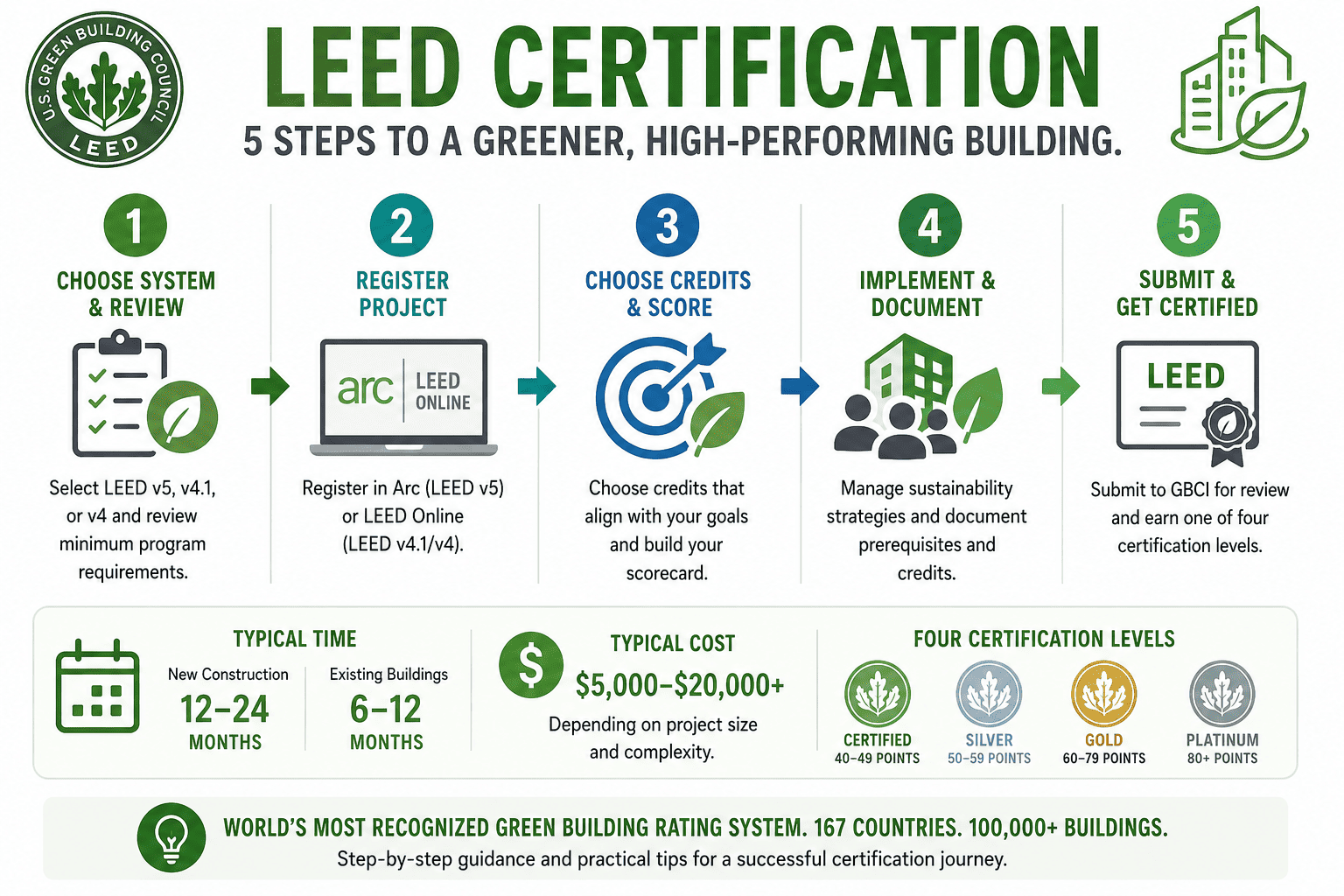
Direct Answer: LEED (Leadership in Energy and Environmental Design) is the world’s most widely recognized green building rating system, with nearly 100,000 commercial buildings certified or awaiting certification across 167 countries. Getting certified involves a structured 5-step process: Determine the appropriate LEED rating system and version (LEED v5, v4.1, or v4) and review minimum program requirements, Register the project in Arc (LEED v5) or LEED Online (LEED v4.1/v4), Choose credits that align with your project goals and build your scorecard, Manage implementation of sustainability strategies with your project team and document achievement of prerequisites and credits, and Submit documentation for review by GBCI to receive certification at one of four levels: Certified (40-49 points), Silver (50-59 points), Gold (60-79 points), or Platinum (80+ points). The process typically takes 12-24 months for new construction and 6-12 months for existing buildings, with costs ranging from $5,000 to $20,000+ depending on project size and complexity. This guide walks you through every step, with practical tips for a successful certification journey.
📅 July 6, 2026⏱ 18 min read✍️ GT Setu Editorial Team🔄 Updated regularly
100K
Certified Buildings Globally
5
Key Steps to Certification
12-24
Months (Typical Timeline)
0%
GTsetu Broker Commission
LEED (Leadership in Energy and Environmental Design) is the most widely recognized green building rating system in the world. Developed and administered by the U.S. Green Building Council (USGBC), LEED provides a framework for healthy, efficient, and cost-effective green buildings. It serves as a globally recognized symbol of sustainability leadership, supported by a committed community of organizations and individuals driving market transformation. Today, nearly 100,000 commercial buildings in 167 countries have been granted or are awaiting LEED certification.
For building owners, developers, architects, and facility managers, LEED certification demonstrates a commitment to environmental responsibility, occupant health, and operational efficiency. It is increasingly required for corporate ESG reporting, government contracts, and attracting premium tenants. This guide covers the complete certification process, from selecting the appropriate rating system through to the final review and certification, and provides practical, actionable advice for a successful journey. See our related guides on ISO 14001 environmental management and ISO 9001 quality management to understand how LEED integrates with broader sustainability and quality frameworks.
🌿 Who Is This Guide For?
This guide is written for building owners, developers, architects, engineers, facility managers, sustainability consultants, and anyone responsible for pursuing LEED certification for a building project. It covers the full certification process from initial registration to final certification, and is applicable to new construction, interior fit-outs, operations and maintenance, and neighborhood development projects. For related partnership structures, see our guides on supplier collaboration and environmental management systems.
SECTION 1
1 What Is LEED Certification & Why Get Certified?
🌿 The Standard Explained
LEED (Leadership in Energy and Environmental Design) is the most widely recognized green building rating system in the world. It was developed by the U.S. Green Building Council (USGBC), established in 1993 after architect Bob Berkebile petitioned the American Institute of Architects (AIA) to embrace environmental design. LEED certification offers a comprehensive framework for healthy, efficient, and cost-effective green buildings, providing environmental and social benefits. The system addresses everything from energy and water use to materials selection, waste management, and indoor environmental quality through a series of credit categories tailored for each rating system. To achieve LEED certification, a project must first complete all prerequisites and then earn points by selecting and satisfying credit requirements. Projects go through a verification and review process by the Green Business Certification Inc. (GBCI) and are awarded points that correspond to a level of LEED certification: Certified, Silver, Gold, and Platinum.
🌐
Globally Recognized Standard
LEED is recognized in over 167 countries, making it the most widely accepted green building certification globally. It provides a common framework for sustainability across international building projects.
🏛️
Market Access & Competitive Advantage
Many corporations, government agencies, and institutional investors require LEED certification for buildings they occupy or invest in. It differentiates properties in the marketplace and commands higher rents and occupancy rates.
💚
Environmental & Health Benefits
LEED-certified buildings demonstrate 34% lower CO2 emissions, 25% lower energy consumption, and 11% lower water consumption. They also improve indoor air quality and occupant health outcomes.
💰
Financial Returns & ROI
LEED-certified office buildings command 11% higher sale prices and 15-18% higher rental rates compared to non-certified buildings, with 4% lower vacancy rates. Certification delivers strong return on investment.
SECTION 2
2 Key Benefits of LEED Certification
LEED certification delivers tangible benefits across environmental, economic, and human health dimensions. The certification process requires investment, but the return on that investment is well-documented across the building industry.
34%
Lower CO2 emissions compared to standard buildings (USGBC study)
25%
Reduction in energy consumption for LEED-certified projects
15-18%
Higher rental rates for LEED-certified office buildings
🌍
Environmental Performance
LEED-certified buildings achieve measurable environmental improvements: average 34% reduction in CO2 emissions, 25% reduction in energy consumption, 11% reduction in water consumption, and 80 million tons of waste diverted from landfills.
Environmental
💲
Economic Value & ROI
LEED buildings command premium rents and sale prices: 11% average premium in sale price, 15-18% higher rental rates, and 4% lower vacancy rates. Operational savings from energy, water, and waste reduction deliver $1.2 billion+ in documented savings.
Economic
🏥
Human Health & Wellbeing
LEED-certified spaces prioritize indoor air quality, access to natural light, and healthy materials, reducing the risk of asthma, allergies, and mood disorders while improving worker productivity, recruitment, and retention.
Health
📊
ESG & Investor Confidence
LEED certification provides third-party verification of sustainability performance, meeting the growing demands of ESG investors for measurable environmental and social performance in real estate assets.
Compliance
🏢
Tenant Attraction & Retention
LEED-certified buildings attract premium tenants seeking sustainable spaces, with higher occupancy rates and stronger tenant retention. Certification signals operational excellence and reduced environmental risk.
Commercial
SECTION 3
3 LEED Rating Systems & Project Types
LEED certification is available for five distinct building project types, and it can also be obtained for larger areas such as neighborhoods and communities. The LEED rating system operates on a point-based mechanism, evaluating sustainable systems and design elements employed in building projects. A maximum of 110 points can be awarded, enabling buildings to attain LEED certification at four distinct levels.
🏗️
Building Design & Construction (BD+C)
For new construction projects and major renovations of existing buildings. This is the most comprehensive rating system, addressing everything from site selection to energy performance and materials.
🛋️
Interior Design & Construction (ID+C)
For commercial interior fit-outs and tenant improvements. Focuses on the sustainability of interior spaces, including lighting, materials, and indoor environmental quality.
🔧
Operations & Maintenance (O+M)
For existing buildings that are already in operation. Focuses on ongoing operational performance, energy and water efficiency, waste management, and occupant experience.
🏘️
Neighborhood Development
For large-scale development projects at the neighborhood or community level. Addresses smart location, design, and connectivity, as well as environmental and social outcomes.
🏠
Homes
For residential projects, including single-family homes, multifamily buildings, and affordable housing. Focuses on energy efficiency, indoor air quality, and sustainable design for residential occupancy.
🔄
LEED Recertification & LEED Zero
LEED Recertification provides buildings with the opportunity to maintain their LEED credentials and uphold sustainable performance over time. LEED Zero supports projects striving for net zero goals in carbon emissions and other critical resources.
💡 LEED v5 vs. v4.1 vs. v4
LEED v5 is the latest version, setting a new standard for sustainable building with emphasis on decarbonization, human health, and equity. It is currently available for BD+C, ID+C, and O+M. LEED v4.1 is an update to v4 that offers more flexibility, improved performance pathways, and simplified documentation. LEED v4 is the previous version with established rating systems. For projects starting in 2026, LEED v5 is recommended, though v4.1 and v4 remain viable options. Choose the version that best aligns with your project goals and timeline.
SECTION 4
4 LEED Certification Levels & Points
LEED certification has four levels based on points earned across credit categories. A maximum of 110 points can be awarded, enabling buildings to attain four distinct levels of certification. The point system is based on the LEED credit library, which is utilized to track the environmental aspects addressed by the LEED project.
Certification Level
Points Required
Key Attributes
LEED Certified
40-49 points
Entry-level certification demonstrating fundamental sustainability practices and commitment to green building principles.
LEED Silver
50-59 points
Recognizes achievement across multiple sustainability categories, including energy efficiency, water conservation, and materials selection.
LEED Gold
60-79 points
Advanced certification demonstrating significant sustainability leadership and best practices in building design, construction, and operations.
LEED Platinum
80+ points
The highest level of LEED certification, representing exceptional sustainability leadership and achievement across all performance categories.
🌿 Key Credit Categories
LEED projects earn points across several credit categories: Site Sustainability (location, transportation, ecosystem protection), Water Efficiency (water conservation, rainwater management), Energy & Atmosphere (energy performance, renewable energy, emissions reduction), Materials & Resources (sustainable materials, waste management, circular economy), Indoor Environmental Quality (air quality, daylighting, occupant comfort), and Innovation (exceptional performance, pilot credits). Each category has specific prerequisites and credits that project teams must address to earn points toward certification.
SECTION 5
5 Step 1: Determine Rating System & Register
🏗️ Foundation & Registration
The first step in the LEED certification journey is to determine the appropriate LEED rating system and version for your project. LEED v5, LEED v4.1, and LEED v4 are available for different project types. Review the minimum program requirements and prerequisites for credit categories related to your chosen rating system. Once you have selected the appropriate system, register your project in Arc (for LEED v5) or LEED Online (for LEED v4.1 and LEED v4).
1.1
Identify Your Project Type
Determine whether your project is new construction, interior fit-out, existing building operations, neighborhood development, or residential. This will guide you to the appropriate LEED rating system (BD+C, ID+C, O+M, Neighborhood Development, or Homes). The rating system choice determines the prerequisites, credit categories, and documentation requirements for your project.
1.2
Choose LEED Version
Select the LEED version that best aligns with your project goals and timeline: LEED v5 (recommended for projects starting in 2026, available for BD+C, ID+C, and O+M), LEED v4.1 (offering flexibility and simplified documentation), or LEED v4 (the established version with proven pathways). Consider project team experience, documentation requirements, and carbon performance goals when selecting a version.
1.3
Review Minimum Program Requirements
Before proceeding, ensure your project meets all minimum program requirements (MPRs) for the selected rating system. These include requirements for site boundaries, building size, and compliance with local regulations. The Guide to LEED Certification provides a clear overview of the steps and processes needed to achieve certification under the LEED rating system.
1.4
Register Your Project
For LEED v5, register your project in Arc, USGBC’s digital platform for project management and documentation. For LEED v4.1 and v4, register in LEED Online. Registration initiates the certification process and provides access to project management tools, credit templates, and GBCI review services. Registration fees range from $1,500 to $3,500 depending on project type and USGBC membership status.
💡 Pro Tip: Engage Your Team Early
Early engagement of the project team is critical for LEED certification success. Involve the architect, engineer, contractor, and sustainability consultant in the rating system selection and registration process. Early engagement allows for more cost-effective design integration and prevents costly retrofits later. The same principle applies when building a quality management system, start with a clear plan and engage stakeholders early.
SECTION 6
6 Step 2: Choose Credits & Build Scorecard
Once your project is registered, the next step is to choose the credits that align with your project’s goals and build your LEED project scorecard. The LEED credit library provides detailed information about each credit, including requirements, documentation, and points available. This phase requires strategic decision-making to optimize points while managing costs and implementation complexity.
Credit Category
Key Credits
Points Available
Strategic Consideration
Site Sustainability
Location, Transportation, Ecosystem Protection
Up to 15 points
Site selection has significant environmental impact. Prioritize brownfield redevelopment, proximity to public transit, and preservation of natural habitats.
Water Efficiency
Water Conservation, Rainwater Management
Up to 12 points
Implement water-efficient fixtures, rainwater harvesting, and efficient irrigation. Water conservation measures are cost-effective with strong ROI.
Energy & Atmosphere
Energy Performance, Renewable Energy, GHG Emissions
Up to 35 points
This category offers the most points and significant environmental impact. Optimize building envelope, HVAC systems, and renewable energy generation. Use ENERGY STAR scoring.
Specify materials with environmental product declarations (EPDs), recycled content, and responsible sourcing. Construction waste diversion is achievable with proper planning.
Indoor Environmental Quality
Air Quality, Daylighting, Occupant Comfort
Up to 15 points
Enhance occupant health with improved ventilation, low-VOC materials, access to daylight, and thermal comfort. This category is highly valued by tenants.
Innovation
Exceptional Performance, Pilot Credits
Up to 6 points
Earn points for innovative design approaches or exceptional performance above standard requirements. Consider certification under additional rating systems (e.g., LEED Zero).
💡 Strategic Credit Selection
DO: Prioritize credits with the highest environmental impact and strongest ROI (e.g., energy efficiency and water conservation). Use integrative design to combine multiple credits efficiently. Consider synergies between credit categories (e.g., daylighting reduces lighting energy while improving indoor environmental quality).
DON’T: Pursue credits that are not well-aligned with your project type, climate, or local context. Avoid over-documentation by selecting credits that are achievable and manageable for your team. Focus on credits that support your overarching sustainability goals and market positioning. The same strategic approach applies when selecting quality management objectives, choose what matters most to your business.
SECTION 7
7 Step 3: Implement Sustainability Strategies
Implementation is where your sustainability strategies become reality. This phase involves managing the implementation of sustainability strategies with your project team, assigning credits to team members, and documenting the achievement of prerequisites and credits. Effective implementation requires integration of sustainable design into the design and construction processes.
♻️
Energy Efficiency Implementation
Building electrification prepares buildings for a future powered by renewable energy. Transition to electric heating systems and appliances, integrate on-site renewable energy generation and battery storage. Simple upgrades like LED lighting, improved insulation, and double-paned windows can significantly enhance energy efficiency.
Energy
💧
Water Conservation Measures
Incorporate low-water-use appliances and fixtures, implement rainwater recycling systems, and use native, drought-tolerant plants in landscaping. These strategies reduce water consumption by an average of 11% in LEED-certified buildings.
Water
🌱
Materials & Resource Selection
Embrace natural materials that are free from adverse health impacts. Be mindful of potential health risks associated with certain materials commonly found in paints, synthetic carpets, and cleaning supplies. Prioritize sustainable material choices and avoid sources of indoor air pollution.
Materials
🌿
Ecosystem & Wildlife Protection
Implement measures such as bird-proofing buildings, establishing rooftop gardens, incorporating native plants, and creating permeable landscapes that support wildlife. These practices preserve and enhance local ecosystems.
Ecosystem
🏥
Indoor Environmental Quality
Focus on maintaining good indoor air quality to reduce the risk of asthma, allergies, mood disorders, and stress. Ensure proper ventilation, control pollutants, and utilize sustainable materials to create healthier indoor environments.
Health
♻️
Construction Waste Management
Incorporate recycled materials into construction to reduce environmental impact. Implement construction waste diversion plans to reduce waste sent to landfills. LEED-certified buildings have diverted 80 million tons of waste from landfills.
Waste
SECTION 8
8 Step 4: Document & Submit for Review
Documentation and submission is the formal review phase of the LEED certification process. Project teams must submit thorough documentation to demonstrate compliance with detailed standards in key areas. The submission process involves uploading documentation through LEED Online (for v4/v4.1) or Arc (for v5), followed by a review by GBCI reviewers.
Documentation Type
What to Include
Key Consideration
Project Registration Information
Project details, contact information, selected rating system and version
Ensure accuracy and completeness. This information is used throughout the certification process.
Credit Documentation
Narratives, calculations, drawings, specifications for each pursued credit
Follow the LEED credit library templates for each credit. Provide clear, concise, and verifiable evidence.
Prerequisite Documentation
Documentation of compliance with all mandatory prerequisites
Prerequisites are mandatory and must be fully satisfied before certification is awarded. Include all required forms and calculations.
Product Data & Material Certifications
Environmental Product Declarations (EPDs), Health Product Declarations, recycled content documentation
Gather and organize product documentation early in the design process. Maintain a materials database for easy access.
Energy & Water Calculations
Energy models, water use calculations, performance reports
Energy modeling is required for many energy credits. Ensure modeling is conducted by qualified professionals using approved software.
Indoor Air Quality Testing
IAQ test results, ventilation system verification, occupant surveys
Conduct IAQ testing during construction and before occupancy. Follow testing protocols specified in the credit requirements.
Track waste diversion throughout construction. Maintain accurate records of waste streams and diversion rates.
💡 Documentation Best Practices
DO: Start documentation early and maintain it throughout the project lifecycle. Assign documentation responsibilities to specific team members. Use templates provided in LEED Online or Arc. Be thorough but concise in narratives. Include clear calculations and visual evidence.
DON’T: Wait until the end of the project to start documentation. Provide incomplete or unclear evidence. Use outdated or incorrect templates. Forget to document deviations from credit requirements or exemptions.
Review Process: GBCI reviews typically take 20-25 business days for preliminary review and 10-15 business days for final review. Plan for potential revisions and resubmissions. The same careful approach to documentation is critical when building an ISO 9001 QMS, maintain thorough records and evidence.
SECTION 9
9 Step 5: Receive Certification & Promote
The final step in the LEED certification process is receiving your certification and promoting your achievement. Once GBCI reviewers have verified that your project meets all requirements and credits, your certification is awarded at the appropriate level (Certified, Silver, Gold, or Platinum). Once a project earns certification, showcase the achievement with LEED certificates, signage, and a press release.
📜
Receive Certificate & Credentials
Once your certification is awarded, you will receive a LEED certificate and digital credentials. These can be used to promote your project’s sustainability achievement to investors, tenants, and the public. The certificate demonstrates your project’s commitment to the highest level of sustainability.
🪧
Install LEED Signage
Display LEED signage prominently at your building. This communicates your sustainability commitment to occupants, visitors, and the community. LEED signage is available for purchase from USGBC and provides visible recognition of your achievement.
📰
Issue a Press Release
Announce your LEED certification to the public through a press release. Highlight the environmental and health benefits, financial returns, and community impact of your project. This builds your reputation and supports ESG reporting.
📈
Leverage for Business Advantage
Use LEED certification to attract premium tenants, command higher rents, and differentiate your property in the marketplace. Certification can also help you access government incentives, tax credits, and other financial benefits for sustainable buildings.
🔄
Plan for Recertification
For existing buildings, consider LEED Recertification to maintain your LEED credentials and uphold your sustainable performance over time. For new construction, maintain your commitment to sustainability through ongoing operations and maintenance, and consider LEED Zero for net zero goals.
💚
Drive Continuous Improvement
Use LEED certification as a foundation for ongoing sustainability improvement. Monitor energy and water performance, engage occupants in sustainability practices, and pursue additional certifications like LEED Zero or WELL Building Standard to further enhance your building’s performance.
SECTION 10
10 Costs & Timeline: What to Expect
The cost and timeline for LEED certification vary based on project type, size, complexity, selected rating system, and the resources you allocate to the certification process. Understanding these variables upfront helps in planning and budget setting.
Higher certification levels require more credits and more complex documentation, extending the timeline.
LEED Version
LEED v5: comparable to v4 LEED v4.1: may have lower documentation costs LEED v4: established pathways
LEED v5 may require learning curve for teams; v4.1 offers simplified pathways for some credits.
Consultant Engagement
Full consultant: $20,000-$100,000+ Partial consultant: $10,000-$40,000 DIY: lower consulting costs
Consultants can accelerate the process and reduce documentation errors, potentially shortening timeline.
USGBC Membership
Members receive discounted registration and certification fees (typically 15-20% savings)
Membership provides access to resources and support that can streamline the process.
📋 Fee Breakdown
Registration Fees: $1,500-$3,500 (depending on project type and USGBC membership status). Certification Fees: $2,500-$15,000+ (depending on square footage and project type). Annual Surveillance Fees: For O+M projects, annual recertification fees apply. Consultant Fees: $20,000-$100,000+ depending on scope and services. Software/Tools: Arc subscription fees for LEED v5 projects. Budget for these components early in the project planning phase.
SECTION 11
11 LEED Professional Credentials
A LEED credential denotes proficiency in today’s sustainable design, construction, and operations standards. More than 203,000 professionals have earned a LEED credential to help advance their careers. Showcase your knowledge, experience, and credibility in the green building marketplace as a LEED professional. The credentials demonstrate expertise in green building and LEED rating systems, validating field expertise in sustainability.
🌱
LEED Green Associate
A foundational professional credential signifying core competency in green building principles. The exam measures general knowledge of green building practices and how to support others working on LEED projects. Ideal for those new to green building or seeking to demonstrate foundational knowledge.
🏆
LEED AP with Specialty
An advanced professional credential signifying expertise in green building and a specific LEED rating system. To earn a LEED AP with specialty, candidates must first pass the LEED Green Associate exam. The exams measure knowledge about green building, a specific LEED rating system, and the certification process. Ideal for individuals actively working on green building and LEED projects.
⭐
LEED Fellow
LEED Fellows are LEED APs who have acquired significant technical knowledge and skills—and they have a history of exemplary leadership, impactful commitment, service, and advocacy in green building and sustainability. LEED Fellows are nominated by their peers, undergo an extensive portfolio review, must have at least 10 years of experience in the green building industry, and hold a LEED AP with specialty credential.
📋
Continuing Education (CE) Requirements
To maintain and renew the credential, all LEED professionals must earn and report continuing education (CE) hours within a 2-year cycle. A LEED Green Associate must earn and report 15 CE hours (3 must be LEED-specific). LEED APs with specialty must earn and report 30 CE hours (6 must be LEED-specific).
💡 Advancing Your LEED Career
LEED credentials can significantly advance your career in the green building industry. Green jobs are in demand, and passing a LEED exam sets you apart by validating your field expertise. Studying for a LEED exam provides fundamental knowledge of green building concepts, including transportation, energy, water, air quality, and decarbonization. You also join an international community of professionals committed to better building, design, and operations. For building a career in sustainability, consider also ISO 14001 certification to broaden your environmental management expertise.
SECTION 12
12 How GTsetu Supports Your Sustainability Journey
🌿 GTsetu, Verified B2B Platform
Connect with Verified Partners & Build Sustainable Supply Chains
LEED certification is a powerful tool for demonstrating sustainability leadership. GTsetu complements your certification by connecting you with verified manufacturers, distributors, and suppliers who meet rigorous sustainability and quality standards. Our platform provides:
✅
Verified Company Profiles
Every company on GTsetu is verified on 6 key data points using government tie-ups, supporting your sustainable supply chain due diligence and ensuring partners meet your environmental and quality standards.
🕵️
Anonymous Discovery
Browse verified partner profiles without revealing your identity until you’re ready to engage, protecting your sourcing strategy and maintaining control over your sustainable supply chain development.
📄
Built-In NDA Workflow
Digital mutual NDA with timestamped signatures, activated before any sensitive commercial or technical data is exchanged, protecting your sustainable design, materials sourcing, and partnership confidentiality.
🔐
Encrypted Document Workspace
AES-256 encryption at rest, TLS in transit, role-based access controls, and full audit trail, ensuring the secure exchange of sustainability documentation, material certifications, and project specifications.
🚫
Zero Broker Commission
GTsetu charges zero commission on any partnership formed. All commercial value stays between you and your verified partner, supporting the cost management objectives of your LEED certification.
🌏
Global Network of Verified Partners
Access verified manufacturers, distributors, and suppliers across 100+ countries, supporting your sustainable sourcing goals and enabling you to build a supply chain aligned with LEED materials and resources requirements.
QWhat is LEED certification and why is it important?
LEED (Leadership in Energy and Environmental Design) is the most widely recognized green building rating system in the world. It provides a framework for healthy, efficient, and cost-effective green buildings. Certification demonstrates that a building project has met rigorous standards for sustainability, energy efficiency, water conservation, materials selection, and indoor environmental quality. It is a globally recognized symbol of sustainability leadership and is often required for corporate ESG reporting, government contracts, and tenant attraction. For building owners and developers, LEED certification provides competitive advantage and is a key factor in environmental management and sustainability reporting.
QWhat are the 5 main steps to get LEED certified?
The 5 main steps are: (1) Determine the appropriate LEED rating system and version (LEED v5, v4.1, or v4) and review minimum program requirements. (2) Register the project in Arc (LEED v5) or LEED Online (LEED v4.1 and v4). (3) Choose credits that align with project goals and build your LEED project scorecard. (4) Manage implementation of sustainability strategies with your project team, assign credits, and document achievement of prerequisites and credits. (5) Submit documentation for review by GBCI, receive certification, and promote your achievement. This structured approach is similar to building any management system, start with a solid foundation and build methodically.
QWhat are the LEED certification levels?
LEED certification has four levels based on points earned: Certified (40-49 points), Silver (50-59 points), Gold (60-79 points), and Platinum (80+ points). Projects earn points by selecting and satisfying credit requirements across categories like energy efficiency, water conservation, materials selection, and indoor environmental quality. The rating system covers up to 110 points total. Higher certification levels demonstrate greater sustainability achievement and market differentiation.
QHow long does it take to get LEED certification?
The timeline varies based on project complexity, rating system, and team experience. For new construction projects (BD+C), the process typically takes 12-24 months from registration to certification. For existing buildings pursuing Operations and Maintenance (O+M) certification, it may take 6-12 months. For interior fit-outs (ID+C), it typically takes 6-12 months. The timeline includes design phase documentation, construction implementation, and the GBCI review process, which typically takes 20-25 business days for preliminary review and 10-15 business days for final review. Using digital tools like Arc can streamline the process.
QHow much does LEED certification cost?
LEED certification fees vary based on project type, size, and certification level. For Building Design and Construction (BD+C) projects, registration fees range from $1,500 to $3,500, and certification fees range from $2,500 to $15,000 depending on square footage and project type. Additional costs include: LEED consulting services ($20,000-$100,000+), documentation and compliance costs, and potential costs for sustainable design and materials. USGBC members receive discounted fees (typically 15-20% savings). The total investment for a typical mid-size project can range from $5,000 to $20,000+ in direct fees, plus consulting costs.
QWhat is the difference between LEED v5, v4.1, and v4?
LEED v5 is the latest version, setting a new standard for sustainable building with emphasis on decarbonization, human health, and equity. It is currently available for BD+C, ID+C, and O+M. LEED v4.1 is an update to v4 that offers more flexibility, improved performance pathways, and simplified documentation. LEED v4 is the previous version with established rating systems. Projects can choose the version that best fits their goals, though v5 is recommended for new projects starting in 2026. The choice of version affects the credit requirements, documentation, and review process.
QWhat documents are required for LEED certification?
Key required documentation includes: project registration information, credit documentation (narratives, calculations, drawings, specifications), prerequisite documentation, product data and material certifications, energy models and water calculations, indoor air quality testing results, and construction waste diversion reports. The documentation must be submitted through LEED Online (v4/v4.1) or Arc (v5) for review by GBCI. Using templates can help ensure completeness and reduce the burden of starting from scratch, much like using a documentation framework saves time in quality management.
QWhat are LEED professional credentials?
There are two main LEED professional credentials: LEED Green Associate (a foundational credential signifying core competency in green building principles) and LEED AP with specialty (an advanced credential signifying expertise in a specific LEED rating system). To earn a LEED AP with specialty, candidates must first pass the LEED Green Associate exam. More than 203,000 professionals have earned a LEED credential worldwide. Credentials must be maintained through continuing education: 15 CE hours for Green Associates (3 LEED-specific) and 30 CE hours for LEED APs (6 LEED-specific) within a 2-year cycle. The selection process should mirror the rigor you would apply when using partnership evaluation criteria to choose any business partner.
QWhat happens during the LEED certification review process?
The review process involves the submission of documentation through LEED Online (v4/v4.1) or Arc (v5), followed by a review by GBCI reviewers. The review is conducted in stages: Preliminary Review (20-25 business days) where reviewers assess documentation and provide feedback on each credit. Final Review (10-15 business days) where reviewers verify that all comments have been addressed and make a final determination. Projects may need to resubmit with revised documentation if credits are not awarded. Once all credits are approved, the certification is awarded at the appropriate level. Successful completion results in the issuance of your LEED certificate, which is valid indefinitely (though O+M projects require recertification).
Connect with verified manufacturers, distributors, and suppliers on GTsetu, compliance-backed verification, anonymous discovery, built-in NDA workflows, and zero broker commissions. Find partners who share your commitment to sustainability and quality.
They represents the product, and research team behind GTsetu, a global B2B collaboration platform built to help companies explore cross-border partnerships with clarity and trust. The team focuses on simplifying early-stage international business discovery by combining structured company profiles, verification-led access, and controlled collaboration workflows.
With a strong emphasis on trust, and disciplined engagement, Team GTsetu shares insights on global trade, partnerships, and cross-border collaboration, helping businesses make informed decisions before entering deeper commercial discussions.