How to Get ISO 27001 Certification: Complete Process & Guide
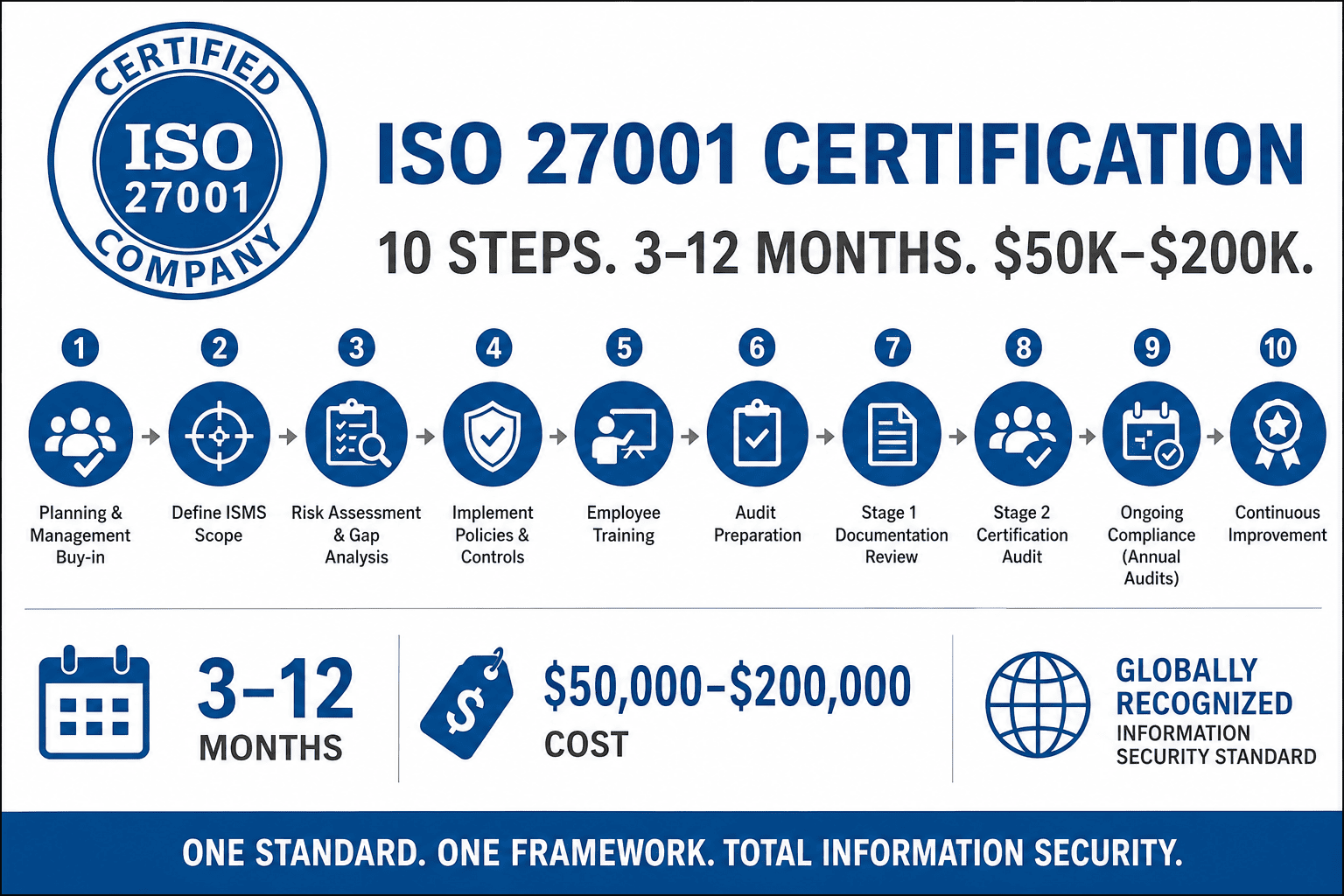
Direct Answer: ISO 27001 certification is a globally recognized validation that your organization operates a comprehensive and auditable framework for managing information security (an ISMS). The certification process involves 10 key steps: planning and management buy-in, defining your ISMS scope, conducting a risk assessment and gap analysis, implementing missing policies and controls, employee training, audit preparation, a Stage 1 documentation review, a Stage 2 certification audit, and establishing ongoing compliance with annual surveillance audits. The process typically takes 3–12 months and costs between $50,000 and $200,000, depending on your organization’s size and existing security posture. GTsetu connects you with verified business partners across 100+ countries, with zero broker commissions.
📅 June 23, 2026⏱ 22 min read✍️ GT Setu Editorial Team🔄 Updated regularly
3–12 mo.
Typical Certification Timeline
$50k–$200k
Certification Investment Range
3 yrs
Certification Validity (with surveillance audits)
0%
GTsetu Broker Commission
ISO 27001 is the world’s best-known and most respected information security management standard. Tens of thousands of organizations across every industry sector have implemented it, not just to meet compliance requirements, but to build a systematic, risk-based approach to protecting sensitive data. For manufacturers, distributors, technology companies, and service providers, ISO 27001 certification has become a prerequisite for winning enterprise contracts, entering regulated markets, and demonstrating trust to customers and partners.
But the path to certification can feel daunting. The standard’s requirements are detailed, the ISMS implementation is organization-wide, and the audit process has strict documentation and evidence demands. This guide breaks down the entire ISO 27001 certification process into clear, manageable steps, covering everything from initial planning and scope definition through to the Stage 1 and Stage 2 audits, annual surveillance, and recertification. It also explains how GTsetu’s verified B2B platform supports your compliance journey by connecting you with pre-verified business partners across 100+ countries. For broader business context, see our guides on industrial business collaboration and global expansion strategy.
🔒 Who Is This Guide For?
This guide is written for information security professionals, compliance managers, business owners, and technology leaders who are planning to implement ISO 27001 and achieve certification for the first time. It is also relevant for organizations evaluating whether ISO 27001 is the right framework for their needs, or comparing it to other standards like SOC 2 or NIST. If you are looking for certified partners or need to demonstrate your own certification to potential business partners, GTsetu’s verified platform can help you find and engage with compliance-ready companies across 100+ countries.
SECTION 1
1 What Is ISO 27001 Certification?
🏛️ Overview
ISO 27001 certification is a globally recognized validation that an organization operates a comprehensive and auditable framework for managing information security, known as an Information Security Management System (ISMS). It demonstrates adherence to systematic processes for protecting sensitive data, reducing risks, and meeting industry and regulatory expectations. The certification is issued by an accredited certification body following a successful audit, confirming that the organization’s ISMS meets the requirements of ISO/IEC 27001:2022.
The standard is published by the International Organization for Standardization (ISO) and the International Electrotechnical Commission (IEC). The latest version, ISO/IEC 27001:2022, was published in October 2022 and includes updated Annex A controls and a stronger emphasis on cloud security, threat intelligence, and information security incident management. Organizations certified under the previous 2013 version typically transition to the 2022 version during their next recertification cycle.
20%
Global growth rate of ISO 27001 certifications year-over-year
78%
Year-on-year increase in ISO 27001 certifications in the US
114
Annex A controls in ISO 27001:2022
Key Requirements for ISO 27001 Certification
🛡️
Information Security Management System (ISMS)
A structured, risk-based system for managing information security risk and protecting the confidentiality, integrity, and availability of information held by an organization. The ISMS is the core framework of ISO 27001, encompassing policies, procedures, controls, and processes.
📊
Frequent Risk Assessments
A documented, repeatable risk assessment process that identifies threats to information assets, evaluates their likelihood and potential impact, and decides how to address them. The risk assessment drives the selection of controls and the entire ISMS.
📋
Security Policies & Procedures
Formal, documented policies covering information security, access control, incident management, business continuity, and other key areas. Policies must be communicated to all employees and enforced through procedures.
🔄
Risk Management Processes
Systematic processes for identifying, evaluating, treating, and monitoring information security risks. Includes the Risk Treatment Plan and Statement of Applicability (SOA).
📈
ISMS Effectiveness Reviews
Regular management reviews, internal audits, and performance monitoring to ensure the ISMS is operating effectively and achieving its objectives. The foundation of the “continuous improvement” requirement.
👥
Employee Training & Awareness
Evidence that all employees understand their role in maintaining information security, including security awareness training, reporting procedures, and daily best practices.
SECTION 2
2 Why Get ISO 27001 Certified? Key Benefits
ISO 27001 certification is far more than a compliance checkbox. It is a strategic investment that delivers tangible business benefits, from winning new customers to reducing security risk to streamlining regulatory compliance. Here are the key benefits that organizations gain from certification.
🛡️
Enhanced Security Posture
A structured ISMS, formal policies, access controls, and regular training reduce the chances of security incidents. ISO 27001 provides a systematic framework for identifying and mitigating information security risks, strengthening defenses against cyber threats.
Security
🤝
Improved Customer Trust
ISO 27001 certification demonstrates a company’s dedication to safeguarding sensitive information, earning trust from customers, partners, and stakeholders. In enterprise B2B sales, certification is often a prerequisite for vendor approval.
Trust
⚖️
Legal & Regulatory Compliance
Compliance with ISO 27001 helps organizations meet legal and regulatory requirements related to information security, including GDPR, HIPAA, and data breach notification laws. The standard’s risk-based approach aligns well with regulatory expectations.
Compliance
🏆
Competitive Advantage
Certification differentiates organizations in the marketplace, giving them a competitive edge over non-certified competitors. Many government and enterprise RFPs require ISO 27001 certification from vendors.
Differentiation
💰
Reduced Reputational Risk
Lower likelihood of breaches helps maintain customer confidence and public trust. The financial and reputational costs of a data breach are often far higher than the investment in ISO 27001 certification.
Risk Reduction
🌱
A Security-First Culture
Regular audits, reviews, and awareness programs build consistent security behaviour across teams. ISO 27001 embeds security into the organization’s processes and culture, not just a one-time compliance exercise.
Culture
💡 The Business Case for ISO 27001
For technology companies, SaaS providers, and manufacturers serving enterprise customers, ISO 27001 certification is no longer optional. It is increasingly a vendor qualification requirement, particularly for companies handling sensitive data or supplying regulated industries. The investment in certification, typically $50,000-$200,000, is often recouped through the first large enterprise contract that would have been impossible without the certification. See our guides on international business development consulting and global partner service for how certification supports commercial growth.
SECTION 3
3 How to Prepare for ISO 27001 Certification
Preparing for ISO 27001 certification involves more than just drafting policies—it requires embedding security into your organization’s processes, culture, and risk management strategy. The goal is to build a resilient ISMS that not only meets the standard’s requirements but also supports long-term operational integrity. Here is a pre-certification checklist to ensure you are ready.
01
Secure Management Buy-In
ISO 27001 is not just an IT initiative—it’s an organization-wide effort. Get the top management on board early to secure buy-in from other stakeholders. The implementation team should typically include: CISO or Head of Security (owns the ISMS strategy), IT Manager (technical controls), Compliance Officer (documentation and regulatory alignment), Department Heads (operational workflows), and a Project Manager (coordination and timelines).
02
Define Your ISMS Scope
Outline all processes, systems, people, and technology that will undergo assessment. Narrowing down the scope expedites the certification process and saves costs. The organization must also provide a rationale for all scope inclusions and exclusions for the certification audit. For some companies, the scope includes their entire organization; for others, only a specific department, system, or product line.
03
Conduct a Risk Assessment & Gap Analysis
A detailed risk assessment gives you an overview of your business’s security posture, identifying vulnerabilities and prioritizing them by the risk they pose. At the same time, a gap analysis shows how your current security practices compare against ISO 27001 requirements, helping you prioritize remediation efforts before the audit. Consider using a compliance automation platform to turn risk work into a structured workflow.
04
Design and Implement Policies and Controls
Based on your risk assessment, decide how your organization will respond to each risk—modify (new controls), avoid (prevent the scenario), transfer (e.g., cyber insurance), or accept (cost of remediation outweighs potential harm). Produce a Statement of Applicability (SOA) summarizing which Annex A controls are relevant, and a Risk Treatment Plan recording how you will respond to identified threats. Implement policies and controls in response to identified risks.
05
Complete Employee Training
ISO 27001 requires evidence that all employees understand their role in maintaining information security. Training should cover security awareness, reporting procedures, and daily best practices. Documentation of training sessions and completion rates is important audit evidence. This ensures everyone within your organization understands the importance of data security.
06
Document and Collect Evidence
Auditors will want to see proof that your policies and controls are not only documented but also operating effectively. Common evidence includes: ISMS scope, information security policy, risk assessment and treatment processes, Statement of Applicability, security objectives, incident response plans, access logs, training records, audit programs, management review evidence, and Annex A control implementation evidence. Collecting and organizing all of this evidence can be extremely time-consuming.
07
Select an Accredited Certification Body
Choose a certification body accredited by a recognized accreditation body (e.g., ANAB in the US, UKAS in the UK, DAkkS in Germany). Look for experience with organizations of your size and sector. Before engaging, ask about their audit methodology, team qualifications, and timeline availability. Some organizations also choose to work with an ISO 27001 consultant or use compliance automation platforms backed by expert support.
SECTION 4
4 Step-by-Step ISO 27001 Certification Process
📋 The 10-Step Process
The ISO 27001 certification process follows a structured sequence of steps, from initial planning through to ongoing compliance. Most organizations complete the process in 3–12 months, depending on their size, existing security posture, and available resources. Here is the complete step-by-step framework.
01
Plan Your ISO 27001 Process Map
Define a visual process map containing: specific processes broken down into tasks and milestones, responsibilities for each task, time and resources necessary for each process, and procedural interdependencies. ISO 27001 requires cross-department collaboration because the controls go beyond the IT team’s responsibilities. Secure management buy-in before starting to ensure adequate resource allocation.
02
Define Your ISMS Scope
Clearly outline the components of your management system that will be scoped by the audit, including: information assets, specific employees, physical locations, and business processes. Document the scope statement with a clear rationale for inclusions and exclusions. Use our contract templates to structure your documentation approach.
03
Initiate Risk Assessment and Gap Analysis
Perform a formal risk assessment in six stages: define your methodology (qualitative, quantitative), outline metrics and scales, inventory all in-scope IT assets, identify all threats and vulnerabilities, assign risk scores based on impact and likelihood, and define risk treatment measures. Pay special attention to vendor and third-party risks, and how you manage those risks ongoingly.
04
Implement Missing ISMS Policies and Controls
Bridge identified gaps by: creating policies and documentation, conducting employee security training, and establishing data access policies. The time and resources necessary to implement these controls depend mainly on your current security posture but typically take up considerable space in the overall certification process. Build a framework for implementing patches and policies to track progress and identify blockers.
05
Conduct Employee Training Measures
Implement comprehensive security training covering: comprehensive security materials (policies, best practices), security guidelines regarding base-level measures (authentication, social engineering attack prevention), and information security event reporting guidelines. Training should be conducted ongoingly to account for changes in the organization’s risk landscape.
06
Prepare for the Certification Audit Process
After bridging any gaps, prepare your organization for the formal certification process. Find a reputable auditor with extensive experience in ISO 27001 certification. Schedule the audit and inform key stakeholders about necessary deadlines. Conduct internal compliance audits, control documentation, and evidence collection. Make sure the internal auditor is independent of the functioning of the ISMS.
07
Go Through a Pre-Certification Readiness Assessment
Conduct a readiness assessment to make the certification process as smooth as possible and avoid extensive back-and-forth. Review final internal audit results to ensure there are no gaps, make evidence of control implementation readily available, and map out the specific certification steps with your team. Your chosen auditor can help with this step.
08
Undergo the Stage 1 Audit (Documentation Review)
The Stage 1 audit requires a comprehensive documentation review. Key documents include: ISMS scope, Statement of Applicability, definition of security roles and responsibilities, information security policy, security objectives, risk assessment process and methodology, internal risk assessment report, and Risk Treatment Plan. If the auditor identifies nonconformities, address them before moving to Stage 2.
09
Pass the Stage 2 Audit (Certification Audit)
This is the Main or Certification assessment, where the auditor examines your ISMS to ensure you’ve implemented all necessary controls. The audit is performed on-site or remotely. Key areas reviewed include: risk management (recorded risks, treatment plans), asset management (IT assets, third-party contracts), and incident management (trigger events, reporting process). If the certification auditor is satisfied and identifies no major nonconformities, they process your ISO 27001 certification.
10
Establish Procedures for Ongoing Compliance
After obtaining certification, you’ll undergo: surveillance audits in years one and two, and a recertification audit during year three. Set up adequate measures and processes for continuous compliance management. Surveillance audits are much simpler than the initial certification audit, especially if you continuously monitor control effectiveness and maintain your evidence.
SECTION 5
5 The ISO 27001 Audit Process: Stage 1 & Stage 2
🔍 The Audit Journey
The formal ISO 27001 audit happens in two main stages. Stage 1 is the ISMS Design Review, where the auditor examines your documentation to verify it aligns with ISO 27001 requirements. Stage 2 is the Certification Audit, where the auditor tests whether your policies and controls are actually being followed in practice. Once Stage 1 and Stage 2 are successfully completed, your ISO 27001 certification is valid for three years.
Audit Phase
What Is Reviewed
Duration
Outcome
Stage 1: ISMS Design Review
Documentation review: ISMS scope, Statement of Applicability, risk assessment process, security policies, risk treatment plan, internal audit results, and corrective actions taken. Auditor confirms required activities are completed or scheduled.
Typically 1–2 days on-site or remote
Auditor determines if organization is ready to move forward. Nonconformities or improvement areas identified; may require a second Stage 1 audit if significant issues are found.
Stage 2: Certification Audit
Testing of conformance: interviews with staff, inspection of documented evidence, observation of processes. Key areas: risk management, asset management, incident management, control effectiveness, fairness and suitability of controls for your risk profile.
Typically 2–5 days on-site or remote
If no major nonconformities, certification is issued. Major nonconformities must be remediated before certificate can be issued. Valid for three years, contingent on successful surveillance audits.
Surveillance Audits (Years 1–2)
Sampled set of controls to ensure ongoing compliance. Checks that nonconformities from certification audit have been addressed. Shorter in time and scope than Stage 2.
Typically 1–2 days
Maintains certification; confirms ISMS is still effective and being maintained.
Recertification Audit (Year 3)
Full system audit, similar to Stage 2, to renew certification for another three years. Does not typically repeat Stage 1 documentation review.
2–4 days
Renewal of certification for another three-year cycle.
🔒 Pre-Assessment Option for First-Time Applicants
For organizations undergoing the certification process for the first time, a pre-assessment (also called a readiness assessment) is available on an as-needed basis. The certification body simulates the actual certification audit by reviewing your entire management system—scope, policies, procedures, and processes—to identify gaps that should be evaluated prior to undergoing the formal certification process. This phase can give your organization a head-start by revealing oversights or potential weaknesses ahead of the actual audit, allowing you to act on areas that require remediation or attention.
SECTION 6
6 Cost & Timeline: What to Expect in 2026
Understanding the investment required for ISO 27001 certification is essential for budgeting and planning. In 2026, certification costs typically range from $50,000 to $200,000, with the timeline usually spanning 3–12 months from start to certification. Here is a detailed breakdown.
Cost Component
Typical Range
Description
Consulting & Implementation Support
$20,000 – $100,000
External consultants or compliance automation platforms to guide ISMS implementation, risk assessment, policy development, and audit preparation.
Certification Body Audit Fees
$10,000 – $30,000
Fees for the Stage 1 and Stage 2 audits, paid to the accredited certification body. Varies by scope, complexity, and auditor location.
Internal Staff Time & Resources
$15,000 – $70,000
Internal time spent on policy development, control implementation, evidence collection, and employee training. Opportunity cost of staff diverted from other projects.
Technology & Software Costs
$5,000 – $20,000
Compliance automation platforms, ISMS software, risk management tools, and security monitoring solutions implemented as part of the certification program.
Surveillance & Recertification (Annual)
$5,000 – $15,000/year
Annual surveillance audit fees and ongoing compliance program maintenance costs.
📊
3–6 Months, Small Organizations
Smaller organizations with simple systems and a strong existing security posture can often complete certification in under 6 months, especially with compliance automation. Typical cost: $50,000–$80,000.
📈
6–12 Months, Medium to Large Enterprises
Organizations with complex infrastructures, multiple locations, or diverse product lines typically take 6–12 months. Typical cost: $80,000–$200,000.
⚡
Weeks with Compliance Automation
Using compliance automation platforms like Sprinto or Vanta, some clients are able to become audit-ready in weeks rather than months, by automating evidence collection, risk assessment, and policy mapping. Timeline: 4–12 weeks.
SECTION 7
7 Annex A Controls: The 114 Controls Explained
Annex A of ISO 27001:2022 lists 114 controls across 4 control categories that organizations can implement as part of their ISMS. Not all controls are mandatory—each organization selects applicable controls based on its risk assessment. The Statement of Applicability (SOA) documents which controls are selected and the rationale for each selection or exclusion.
👥Annex A Control Category
Organizational Controls (37 controls)
Policies, procedures, roles, responsibilities, and management-level controls. Includes: information security policy, segregation of duties, NDAs, supplier security, incident management, and business continuity.
Controls related to personnel: pre-employment screening, onboarding and offboarding, security awareness training, disciplinary processes, and remote working.
Key controls: 6.1–6.8, Screening, training, remote working, disciplinary process
💻Annex A Control Category
Physical Controls (14 controls)
Physical security controls: secure perimeters, entry controls, office and facility security, equipment security, and environmental protection.
Not all 114 controls are relevant to every organization. The selection process should be driven by your risk assessment: identify the risks that matter most to your business, then select the controls that mitigate those risks. The Statement of Applicability (SOA) must include a justification for every control selected, and a justification for every control not selected (e.g., “not applicable because the organization does not use third-party cloud services for processing personal data”). An incomplete or poorly justified SOA is a common source of nonconformities in Stage 1 audits. Using a compliance automation platform can help map risk assessment outcomes to relevant controls.
SECTION 8
8 ISO 27001 vs SOC 2, NIST, HIPAA
Many organizations evaluating information security frameworks wonder how ISO 27001 compares to other standards. While each framework has its strengths, ISO 27001 stands out for its emphasis on organizational behavior, continuous improvement, and embedding security into everyday operations. Here is how the key frameworks compare.
Aspect
ISO 27001
SOC 2
NIST CSF
HIPAA
Primary Focus
ISMS and risk-based information security
Trust principles (security, availability, etc.)
Cybersecurity risk management
Healthcare data privacy and security
Global Applicability
✅ Yes, globally recognized
❌ Mostly US-based
❌ Primarily US-based
❌ US-specific
Certification Available
✅ Yes (accredited certification)
❌ No (attestation by CPA firm)
❌ No (self-assessment or third-party audit)
❌ No (but audits may be required)
Cultural Impact
Promotes org-wide security awareness and ownership
Often treated as a point-in-time assessment
Depends on implementation strategy
Focused more on compliance than culture
Update Frequency
Regularly updated (latest: 2022)
Varies by auditor
Evolving, tied to NIST updates
Periodically aligned with legal revisions
🔒 Which Framework Should You Choose?
If you need a globally recognized certification that demonstrates a comprehensive ISMS, ISO 27001 is the right choice. If your customers are US-based service organizations and you need to demonstrate security, availability, and confidentiality, SOC 2 is more relevant. Many organizations use both: ISO 27001 provides the management system framework, while SOC 2 provides specific attestation for the trust principles relevant to their services. For government contractors in the US, NIST CSF compliance is often required. See our guide on B2B secure collaboration for how these frameworks support secure data exchange with partners.
ISO 27001 certification is not a one-time event—it requires ongoing commitment to maintaining and improving your ISMS. The three-year certification cycle includes annual surveillance audits in years one and two, and a recertification audit in year three.
01
Surveillance Audits (Years 1 & 2)
These are annual reviews conducted by your certification body to ensure you’re still compliant and maintaining your ISMS and Annex A controls properly. They are shorter in time and scope than the initial Stage 2 audit and test a sampled set of controls. Surveillance auditors also check that any nonconformities or exceptions noted during the certification audit have been addressed.
02
Internal Audits (Ongoing)
Your organization must conduct internal audits on a scheduled basis (typically annually) to spot weaknesses before the external auditor does. The internal auditor must be independent of the functioning of the ISMS to ensure objectivity.
03
Management Reviews (Ongoing)
Regular management reviews of ISMS performance, security metrics, incident reports, and audit findings are required. These reviews ensure that the ISMS remains aligned with business objectives and that resources for maintenance are being allocated appropriately.
04
Recertification Audit (Year 3)
In the last year of the three-year certification term, a recertification audit assesses your ISMS and Annex A controls for compliance with the current version of the standard. This is a full system audit, similar to Stage 2, but organizations typically do not need to go through the Stage 1 documentation review again. Successful recertification renews your certification for another three years.
💡 Continuous Compliance Strategy
The most efficient approach to maintaining ISO 27001 certification is to embed compliance into everyday operations rather than treating it as a periodic exercise. Use compliance automation tools to continuously monitor control health, evidence, and ownership. When systems, people, and vendors evolve, catch changes early and review what moved—keeping the program current instead of waiting for the next audit cycle to discover drift. This continuous compliance approach dramatically reduces the effort and cost of surveillance and recertification audits.
SECTION 10
10 Common Challenges & How to Overcome Them
The ISO 27001 certification journey can be complex, and most organizations encounter challenges along the way. Being aware of these common pitfalls and having a plan to address them will significantly improve your chances of a smooth certification process.
📋
Inadequate Risk Treatment Plans
This issue is particularly common in large organizations with complex risk profiles. As threats evolve, you must continuously update your risk treatment plan to account for them, which can be laborious and time-consuming.
Solution: Treat risk assessment as a continuous process, not a one-time exercise. Use risk management software to track changes and regularly review your treatment plans.
📁
Inconsistent or Insufficient Evidence
Evidence collection is among the most painstaking compliance activities, and it can be particularly challenging if you use manual and/or disparate documentation systems. Risk of failing to provide sufficient evidence of control implementation and effectiveness.
Solution: Use compliance automation platforms that continuously collect and organize evidence. Maintain a single source of truth for all ISMS documentation.
⚖️
Balancing Compliance with Operations
ISO 27001 certification often takes months and can hinder the day-to-day activities of involved departments. This can result in productivity drops and delayed deliverables.
Solution: Assign a dedicated project manager, integrate compliance tasks into sprint planning, and use automation to reduce manual workload. Communicate benefits of certification to maintain team motivation.
🎯
Scope Creep
Defining the ISMS scope too broadly can dramatically increase the cost and timeline of certification, making the project unmanageable. Defining it too narrowly may not cover the systems that matter most to your customers.
Solution: Start with a focused scope covering the most critical systems, customers, and processes. Plan to expand the scope in future certification cycles as your program matures.
👥
Lack of Management and Employee Buy-In
Without active management support and employee engagement, the ISMS becomes a compliance exercise rather than a cultural change. Resistance to new processes and policies can undermine the effectiveness of controls.
Solution: Build the business case for certification from the start, linking it to revenue opportunities and customer trust. Communicate successes and involve employees in the design of new processes.
🔍
Selecting the Wrong Certification Body
Not all certification bodies are equal. Some have limited experience with your industry or size, leading to a more difficult audit experience or a certificate that is not as valuable to your customers.
Solution: Research certification bodies thoroughly. Look for accreditation (e.g., ANAB in the US, UKAS in the UK) and ask for references from organizations similar to yours. Consider using a compliance platform with a partner network to find experienced auditors.
SECTION 11
11 How GTsetu Supports Your Compliance Journey
🔒 GTsetu, Verified B2B Platform for Compliance-Ready Partnerships
Connect with Verified Business Partners, ISO 27001 Ready
ISO 27001 certification is often a prerequisite for partnering with enterprise customers, especially in technology, finance, and regulated industries. GTsetu helps you find and engage with verified business partners who meet your compliance standards—with zero broker commissions. Every company on GTsetu is verified against 6 key data points (legal name, registration number, registered address, incorporation date, company type, and active status) using government tie-ups. While ISO 27001 certification is not verified by GTsetu, the platform provides a secure, compliant environment for partner discovery, NDA execution, and encrypted document exchange.
🏛️
Multi-Layer Compliance Verification
Every partner verified against government registries for legal name, address, registration number, status, type, and incorporation date. A secure starting point for your compliance due diligence.
🕵️
Anonymous Discovery
Browse verified partner profiles without revealing your own identity or compliance posture. Protect your sourcing strategy and market entry plans until you choose to engage.
📄
Built-In NDA Workflow
Digital mutual NDA with timestamped signatures—activated before sensitive commercial or compliance data is exchanged. Protects your proprietary information during partner discovery.
🔐
Encrypted Document Workspace
AES-256 encryption at rest, TLS in transit. Securely share compliance documentation, certifications, and audit reports with role-based access controls and full audit trails.
📊
Compliance-Ready Partner Discovery
Find partners who meet your ISO 27001 compliance requirements. Request and verify compliance documentation through the platform’s secure workspace.
🚫
Zero Broker Commission
GTsetu charges zero commission on any partnership formed. All commercial economics stay between you and your verified partner—always.
How GTsetu Supports Your ISO 27001 Compliance Journey
CapabilityGTsetuUnverified Directories / Open Marketplaces
Business identity verification
✓ 6-point government-tie-up verification
✗ Self-reported; unverified profiles
Anonymous partner discovery
✓ Identity protected during browsing
✗ Identity exposed from first contact
NDA before data exchange
✓ Platform-enforced; jurisdiction options
✗ No mechanism, fully manual
Encrypted document sharing
✓ AES-256 + TLS, no email attachments
✗ Email-based, uncontrolled forwarding
Full audit trail
✓ Every access and exchange logged
✗ No record beyond chat/email
Compliance documentation exchange
✓ Secure workspace for certification sharing
✗ Manual email attachments
Broker / lead commission
✓ Zero, always
✗ Pay-per-lead or success fee
FAQ
? Frequently Asked Questions
QWhat is ISO 27001 certification and why is it important?
ISO 27001 certification is a globally recognized validation that an organization operates a comprehensive and auditable framework for managing information security (an ISMS). It demonstrates adherence to systematic processes for protecting sensitive data, reducing risks, and meeting industry and regulatory expectations. Certification is essential for organizations that collect, process, or store sensitive data—especially AI-first companies, cloud-native businesses, and SaaS providers looking to demonstrate trust, meet regulatory requirements, and scale securely. For international businesses, certification is often a prerequisite for international business development and winning enterprise contracts.
QWhat are the key steps to get ISO 27001 certified?
The key steps are: (1) Plan your certification process and secure management buy-in; (2) Define your ISMS scope; (3) Conduct a risk assessment and gap analysis; (4) Implement missing ISMS policies and controls; (5) Conduct employee training; (6) Prepare for the certification audit; (7) Go through a pre-certification readiness assessment; (8) Undergo the Stage 1 audit (documentation review); (9) Pass the Stage 2 audit (certification audit); (10) Establish procedures for ongoing compliance, including surveillance audits and recertification. Many organizations use compliance automation platforms to accelerate steps 3–6. See our guide on B2B secure collaboration for how secure data exchange supports evidence collection.
QHow long does ISO 27001 certification take and how much does it cost?
The ISO 27001 certification process typically takes 3 to 12 months. Smaller organizations with simple systems can often complete it in under 6 months, while large enterprises with complex infrastructures may take closer to a year. Using compliance automation can reduce timelines to just a few weeks. Costs typically range from $50,000 to $200,000, depending on organization size, current security posture, scope of the audit, and chosen certification body. Smaller startups often fall near the lower end, while large enterprises can expect costs toward the higher end. This investment is often recouped through the first enterprise contract won using the certification. See our partnership evaluation criteria for how certification affects partner selection.
QWhat is the difference between the Stage 1 and Stage 2 ISO 27001 audits?
Stage 1 is the ISMS Design Review, where the auditor examines your documentation (ISMS scope, Statement of Applicability, risk assessment, policies) to verify it aligns with ISO 27001 requirements. They may identify nonconformities or improvement areas before moving forward. Stage 2 is the Certification Audit, where the auditor tests whether your policies and controls are actually being followed in practice through interviews, inspection of documented evidence, and observation of processes. If both stages are successful, you receive an ISO 27001 certification valid for three years. This structure ensures both design (Stage 1) and implementation (Stage 2) are validated. See our contract templates for structuring compliance evidence sharing with partners.
QWhat is an ISMS and why is it central to ISO 27001?
An ISMS (Information Security Management System) is a structured, risk-based system for managing information security risk and protecting the confidentiality, integrity, and availability of information held by an organization. It is the core framework of ISO 27001, encompassing policies, procedures, controls, and processes. Implementing an ISMS requires defining its scope, conducting regular risk assessments, developing security policies, carrying out risk management, and reviewing ISMS effectiveness. The ISMS must be audited and maintained continuously. A well-implemented ISMS is central to building supply chain partner trust and industrial business collaboration.
QWhat is a surveillance audit and how often does it occur?
Surveillance audits are annual reviews conducted by your certification body during the three-year certification period to ensure you’re still compliant and maintaining your ISMS and Annex A controls properly. They are shorter in time and scope than the initial Stage 2 audit and test a sampled set of controls. Surveillance auditors also check that any nonconformities or exceptions noted during the certification audit have been addressed. At the end of the three-year term, a recertification audit is required to renew your certification. Maintaining certification is essential for international wholesale distributor relationships and global partner service credibility.
QWhat are the key ISO 27001 Annex A controls?
Key Annex A controls include: (1) Access control measures (role-based access, MFA, least privilege); (2) Asset and information classification; (3) Cryptography and data protection controls; (4) Logging, monitoring, and incident management; (5) Secure development and change management practices; (6) Supplier and third-party security requirements; (7) Physical security and environmental safeguards. Organizations must select applicable controls based on their risk assessment and document them in the Statement of Applicability (SOA). These controls support B2B secure collaboration and supplier collaboration platforms integration.
Ready to Build Your Compliance-Ready Partner Network?
Connect with verified business partners on GTsetu, government-tie-up verification, anonymous discovery, built-in NDA workflows, encrypted document sharing, and zero broker commissions on every partnership you form.
They represents the product, and research team behind GTsetu, a global B2B collaboration platform built to help companies explore cross-border partnerships with clarity and trust. The team focuses on simplifying early-stage international business discovery by combining structured company profiles, verification-led access, and controlled collaboration workflows.
With a strong emphasis on trust, and disciplined engagement, Team GTsetu shares insights on global trade, partnerships, and cross-border collaboration, helping businesses make informed decisions before entering deeper commercial discussions.