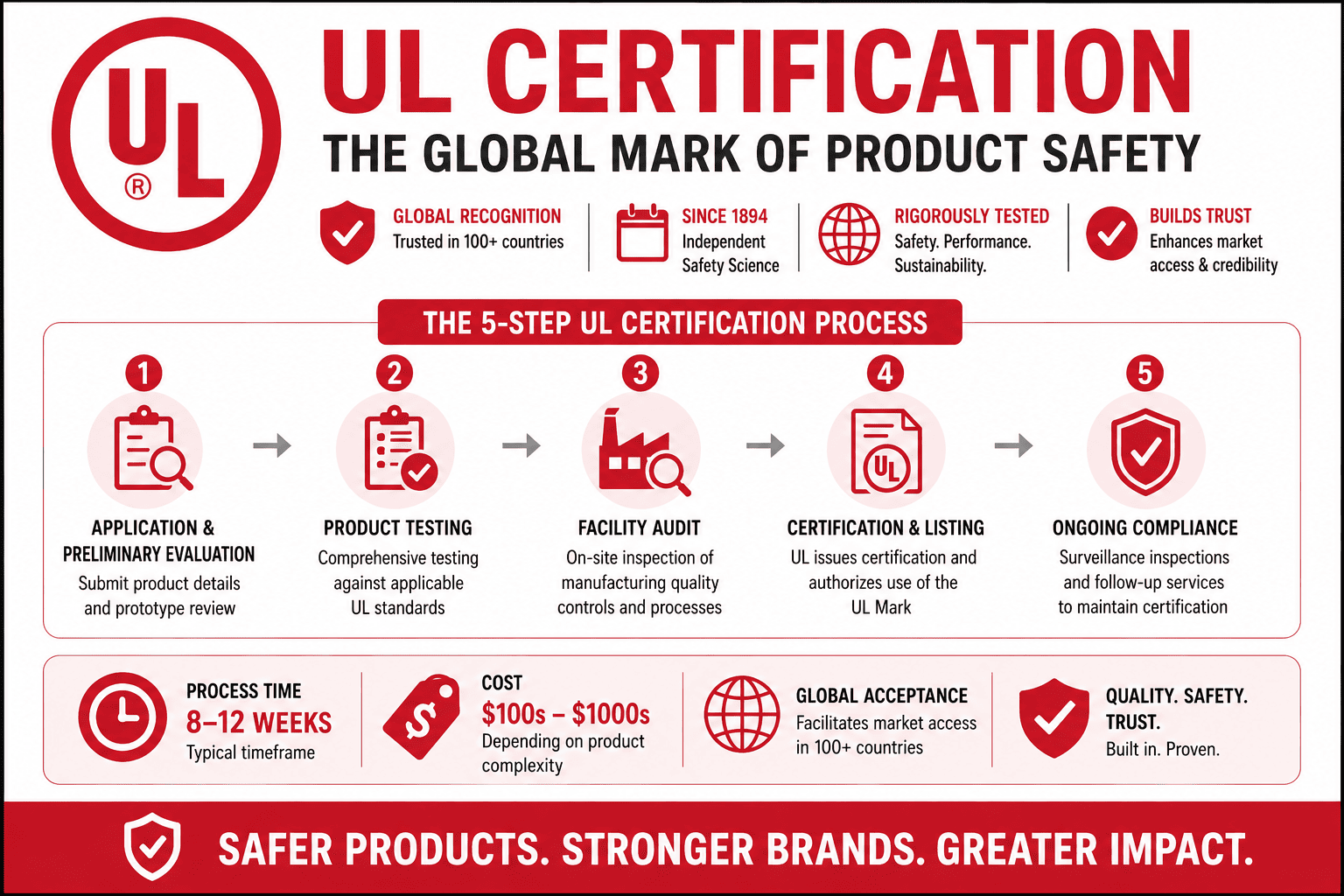
Direct Answer: UL certification is a globally recognized mark of product safety, issued by Underwriters Laboratories (UL), an independent safety science company founded in 1894. It validates that a product, component, or system has been rigorously tested and evaluated against specific safety, performance, and sustainability standards. Getting certified involves a 5-step process: Application & Preliminary Evaluation (submitting product details and prototype review), Product Testing (comprehensive testing against applicable UL standards), Facility Audit (on-site inspection of manufacturing quality controls and production processes), Certification & Listing (UL issues certification and authorizes use of the UL mark), and Ongoing Compliance (surveillance inspections and follow-up services to maintain certification). The process typically takes 8-12 weeks, with costs ranging from a few hundred to several thousand dollars depending on product complexity. This guide walks you through every step, with practical tips for a smooth certification journey.
📅 July 6, 2026⏱ 15 min read✍️ GT Setu Editorial Team🔄 Updated regularly
130+
Years of UL Safety Science History
5
Key Steps to Certification
8–12
Weeks (Typical Timeline)
0%
GTsetu Broker Commission
UL certification is the benchmark for product safety in the United States and a globally recognized mark of trust and reliability. Underwriters Laboratories (UL), founded in 1894, is a safety science company that has been testing and certifying products for over 130 years. The UL mark, seen on everything from household appliances to industrial control panels, signifies that a product, component, or system has been rigorously tested and evaluated against specific safety, performance, and sustainability standards.
For manufacturers, industrial component suppliers, and engineering firms, UL certification is often a prerequisite for doing business in the U.S. and many international markets. It is required by many local building codes, insurance companies, and large buyers in sectors like oil & gas, infrastructure, renewable energy, and MEP (mechanical, electrical, plumbing). This guide covers the complete UL certification process, from initial application through to the facility audit and ongoing surveillance, and provides practical, actionable advice for a smooth journey. See our related guides on ISO 9001, ISO 14001, and ISO 45001 to understand how quality, environmental, and health & safety management systems integrate with product safety certification.
🛡️ Who Is This Guide For?
This guide is written for manufacturers of electrical and electronic products, industrial component suppliers, quality managers, engineering firms, and anyone responsible for obtaining UL certification. It covers the entire certification lifecycle, from product design and pre-assessment through to ongoing compliance. It is equally relevant for companies seeking new market access, responding to customer requirements, or demonstrating commitment to product safety and quality. For related standards, see our guides on ISO 9001, ISO 13485, and ISO 27001.
SECTION 1
1 What Is UL Certification?
🛡️ The Gold Standard in Product Safety
UL certification is a globally recognized mark issued by Underwriters Laboratories (UL), a safety science company founded in 1894. It signifies that a product, component, or system has been rigorously tested and evaluated against specific safety, performance, and sustainability standards. UL is accredited as a Nationally Recognized Testing Laboratory (NRTL) by the U.S. Occupational Safety and Health Administration (OSHA), and its certification is frequently required by local building codes, insurance companies, and large buyers. The UL mark indicates that the product has been tested for hazards such as fire, electric shock, and mechanical failure, and that it is manufactured under a quality control program that ensures ongoing compliance.
🔬
Independent Third-Party Testing
UL certification is conducted by an independent, accredited third party, not self-declared. This ensures objectivity, scientific rigor, and credibility in the eyes of regulators, insurers, and buyers.
🏛️
OSHA NRTL Recognition
UL is a Nationally Recognized Testing Laboratory (NRTL) recognized by OSHA. This means UL-certified products meet the testing requirements for workplace safety in the U.S., a critical requirement for many industrial applications.
🌐
Global Market Access
UL certification is recognized and accepted in over 110 countries, including the U.S., Canada, and many other markets. It is often a prerequisite for selling to large buyers in sectors like oil & gas, infrastructure, and renewable energy.
📋
Over 1,000 UL Standards
UL has developed over 1,000 standards covering a wide range of products, systems, and services. These standards define the requirements for safety, performance, and sustainability across industries.
SECTION 2
2 Key Benefits of UL Certification
UL certification delivers tangible benefits across safety, market access, regulatory compliance, and commercial credibility. For manufacturers and industrial suppliers, the UL mark is a powerful differentiator that opens doors to new business opportunities and builds trust with customers and regulators.
22B+
Products tested and certified by UL annually
14,000+
UL employees globally
143
Countries where UL certification is recognized
🛡️
Safety Assurance & Risk Reduction
UL-certified products undergo rigorous testing for fire, electric shock, and mechanical hazards. This reduces the risk of accidents, liability claims, and costly product recalls, protecting your employees, customers, and assets.
Safety
🏷️
Regulatory Compliance & Market Access
UL certification is recognized by OSHA, local building codes, and insurance companies. It is often a prerequisite for selling in the U.S. and many international markets, especially in sectors like oil & gas, infrastructure, and renewable energy.
Compliance
🏆
End-User Trust & Brand Credibility
The UL mark is trusted by consumers, regulators, and industry professionals. It signals that your product has been independently verified for safety and quality, building confidence in your brand and products.
Reputation
📈
Competitive Differentiation
In a crowded marketplace, UL certification sets your products apart from non-certified competitors. It is often a requirement in RFPs and tenders from major buyers and government agencies.
Commercial
📋
Insurance & Liability Benefits
Many insurance companies mandate UL-certified products for installation in critical infrastructure. Using UL-certified equipment often results in lower insurance premiums and fewer liability concerns for project owners and contractors.
Risk
🔍
Design & Quality Improvement
UL’s rigorous testing and feedback process often identifies design improvements and material efficiencies. Manufacturers benefit from these controlled assessments to enhance product quality and reliability.
Quality
🔗
Supply Chain Qualification
UL certification is increasingly required by major buyers, EPC contractors, and distributors as a condition of supply. Certification opens doors to partnership opportunities that are closed to non-certified manufacturers.
Partnership
SECTION 3
3 UL Marks: Listed, Recognized, Classified & More
UL offers several types of certification marks, each with a specific meaning and application. Understanding the differences is essential for selecting the right certification for your product and for communicating the certification correctly to customers and regulators.
UL Mark Type
What It Means
Typical Application
UL Listed Mark
Complete, stand-alone products that have been tested as a whole for safety in their end-use application. Most comprehensive testing.
Components or materials intended for use within a larger product or system. Evaluated for specific properties, not for standalone use.
Circuit boards, switches, wiring, transformers, motors, and other factory-floor components.
UL Classified Mark
Products evaluated with respect to specific properties, hazards, or performance criteria (not full product safety). Often used for components or products with a specific scope of evaluation.
Products tested for specific properties like fire resistance, security, or limited performance characteristics.
UL Performance Verified Mark
Products tested and evaluated against a specific performance standard, either national/international industry performance standards, manufacturer’s proprietary standards, or UL requirements.
Products where performance (not just safety) is the key selling point, e.g., energy efficiency, durability.
UL Certified Mark
Part of UL’s enhanced marking system. Used for products certified under UL’s Listing and Classification services, including geography-specific certifications. Often includes a QR code for traceability.
Products that carry the UL mark under the enhanced system, increasingly common for consumer electronics.
cUL / C-UL Mark
Indicates compliance with Canadian standards (CSA standards) under the U.S.-Canada Mutual Recognition Agreement (MRA). Product meets both UL and CSA requirements.
Products sold in both the U.S. and Canadian markets, particularly electrical products.
💡 Choosing the Right Mark
Selecting the correct UL mark depends on your product type and target market. If you manufacture a complete, stand-alone product, you need UL Listing. If you manufacture components that are intended for use within a larger system, you need UL Recognition. If you sell in both the U.S. and Canada, you may need the cUL mark. For products with unique performance claims, UL Classification or UL Performance Verified may be appropriate. Consult with UL early to determine the correct certification path. This aligns with the approach recommended in our guides on ISO 9001 and ISO 14001, define the scope and requirements from the start.
SECTION 4
4 Key UL Standards for Industrial Manufacturing
UL has developed over 1,000 standards covering a wide range of products, systems, and services. For industrial manufacturing, several standards are particularly relevant. The applicable standard depends on your product type, industry, and target market.
UL Standard
Product Category
Key Requirements
UL 508A
Industrial Control Panels
Design and installation requirements for industrial control panels. Covers enclosures, drives, switches, circuit protection, transformers, and other components. Ensures safe and effective integration of components.
UL 1741
Inverters, Converters, Controllers for Distributed Energy
Requirements for power conversion equipment used in renewable energy systems (solar, wind, etc.). Includes safety, performance, and grid interconnection requirements.
UL 98B
Enclosed and Dead-Front Switches for Photovoltaic Systems
Requirements for switches used in photovoltaic (solar) systems, handling voltages up to 1500 VDC. Covers design, construction, and testing for safety and reliability.
UL 60335-2-40
Refrigerant Systems (Low-GWP)
Testing parameters, certification requirements, and advisory statements for refrigerant motor and compressor components using low-GWP (global warming potential) refrigerants.
UL 207
Refrigerant Motor-Compressors
Safety and performance requirements for refrigerant motor-compressors used in refrigeration and air conditioning equipment.
Requirements for circuit breakers and enclosures used in industrial and commercial applications. Covers construction, performance, and safety testing.
UL 197
Commercial Electric Cooking Appliances
Safety and performance requirements for commercial electric cooking equipment, ovens, ranges, fryers, etc. Often bundled with NSF certification for food service equipment.
UL 60730
Automatic Electrical Controls
Requirements for automatic electrical controls used in appliances and industrial equipment. Includes switches, thermostats, timers, and other control devices.
💡 Identifying Your Standard
Identifying the correct UL standard is the first step in the certification process. UL’s website provides a comprehensive database of standards and product categories. If you are unsure which standard applies to your product, you can request a preliminary evaluation from UL, a service where UL engineers review your prototype designs and help determine the applicable requirements. This pre-testing advice is cost-effective and can often offset final testing costs by identifying issues early. This is similar to the “gap analysis” approach recommended in our ISO 9001 certification guide.
SECTION 5
5 Step 1: Application & Preliminary Evaluation
📋 Starting Your Certification Journey
The first step in obtaining UL certification is submitting an application and, if desired, requesting a preliminary evaluation. This phase sets the foundation for a successful certification project by identifying the applicable standards, understanding the testing requirements, and resolving potential design issues early. Engaging with UL early in the product development process, before finalizing designs, is one of the most effective ways to reduce costs, avoid delays, and ensure a smooth certification process.
1.1
Submit Application & Product Details
Submit a certification application to UL, providing comprehensive product details, including design specifications, materials of construction, component information, and intended use. The application can be submitted online through UL’s digital platform. Provide as much detail as possible to enable accurate scoping and quoting.
1.2
Request a Preliminary Evaluation (Optional)
UL offers a preliminary evaluation service where engineers review prototype designs and assist in pre-production product conformance. This helps determine which UL criteria apply, identifies potential design or material issues, and informs the testing scope. Pre-testing advice is cost-effective and can often offset final testing costs.
1.3
Identify Applicable UL Standards
Based on the product information, UL will identify the applicable standards (e.g., UL 508A, UL 1741) and define the scope of testing. If you are unsure which standard applies, UL’s engineers will guide you based on your product’s function, use, and target market.
1.4
Receive Quotation & Agree on Scope
UL provides a formal quotation detailing the testing and evaluation services required, including costs, timelines, and required samples. Review the quotation carefully to ensure it covers all necessary testing and aligns with your expectations. This is also the time to discuss bundling services if applicable.
💡 Design for Certification from the Start
The most successful UL certification projects are those where safety and compliance are built into the product from the beginning, not retrofitted after the design is finalized. Key design principles for UL certification include: selecting components with existing UL Recognition to simplify the process; designing for accessibility (for inspection and testing); ensuring adequate clearances and insulation; and using materials that are UL-compliant. Engaging with UL early, at the concept or preliminary design stage, is a proven way to reduce certification costs and accelerate time to market. This proactive approach is similar to the principles outlined in our ISO 9001 and ISO 13485 guides.
SECTION 6
6 Step 2: Product Testing
Product testing is the core of UL certification. It involves submitting product samples to UL’s laboratories for comprehensive testing against the requirements of the applicable standard. Testing covers safety, performance, and construction, ensuring that the product is safe for its intended use and manufactured to consistent quality standards.
Testing Area
What Is Evaluated
Key Criteria
Electrical Safety
Protection against electric shock, short circuits, overcurrent, and other electrical hazards. Includes testing of insulation, grounding, clearances, and creepage distances.
Products must meet dielectric strength, insulation resistance, and grounding requirements. Temperature rise under load must not exceed limits. Components must be properly rated and protected.
Fire & Thermal Hazard
Protection against fire hazards from overheating, arcing, or component failure. Includes flammability testing of materials and evaluation of temperature limits.
Materials must meet specific flammability ratings (e.g., UL 94 V-0). Enclosures must contain potential fire. Ventilation must prevent hazardous heat buildup.
Mechanical Hazards
Protection against mechanical failure, moving parts, and structural integrity issues. Includes testing for impact resistance, vibration, and durability under normal and abnormal use.
Products must be robust enough for industrial use. Moving parts must be adequately guarded. Components must be securely mounted and not become loose under vibration or stress.
Performance & Functional Testing
Verification that the product performs as claimed and meets the performance requirements of the applicable standard. Includes functional tests under normal and abnormal conditions.
Products must meet minimum performance standards defined in the applicable UL standard. Exceeding minimum requirements demonstrates superior product performance.
Construction & Design Review
Review of product construction, materials, and design against the requirements of the standard. Includes evaluation of component selection, assembly, and accessibility.
Construction must be robust, accessible for inspection, and manufactured with consistent quality. Components must be appropriately rated and selected.
💡 Preparing for Product Testing
To ensure a smooth product testing process: (1) Provide complete product samples that are representative of production units. (2) Submit all required technical documentation, design drawings, component data, materials of construction, and any existing test reports. (3) If your product contains UL Recognized components, provide the component certifications to streamline the evaluation. (4) Be prepared for re-testing if design modifications are required to address test findings. (5) Consider UL’s pre-testing advice service to identify and resolve issues before formal testing begins. This preparation is similar to the documentation requirements in ISO 9001 and ISO 13485, thorough documentation saves time and cost.
SECTION 7
7 Step 3: Facility Audit
The facility audit is an essential component of UL certification. A UL auditor visits your manufacturing facility to verify that quality control systems, production processes, and manufacturing documentation ensure that the products you produce match the samples that were tested and certified. The audit confirms that your manufacturing operations are capable of consistently producing certified products.
🔍
Quality Management System Review
The auditor reviews your quality management system, including incoming material inspections, in-process inspections, final product testing, and control of non-conforming products.
📋
Production Process Verification
Verifies that the products you manufacture match the samples tested for certification. This includes checking materials of construction, component suppliers, and manufacturing processes.
📄
Documentation & Traceability
Reviews your documentation to ensure that production records, supplier certifications, and material traceability are maintained and available for audit.
🔄
On-Site Inspection
The auditor conducts an on-site inspection of your manufacturing facility, observing processes, interviewing staff, and verifying that quality controls are implemented and effective.
📊
Corrective Action Review
If any non-conformities are identified during the audit, you will need to implement corrective actions and provide evidence to UL. This is similar to the corrective action requirements in quality management systems like ISO 9001.
✅
Audit Report & Findings
Following the audit, UL provides a detailed report outlining findings. If no major non-conformities are found, or if corrective actions are successfully implemented, the audit is considered successful.
💡 Preparing for the Facility Audit
To ensure a smooth facility audit: (1) Ensure your quality management system is documented and operational, similar to the requirements for ISO 9001 and ISO 45001. (2) Have all production records, material certifications, and supplier documentation organized and readily accessible. (3) Train your staff on the audit process and what to expect. (4) Conduct an internal audit (pre-audit) to identify and address any gaps before the UL auditor arrives. (5) Be transparent about any issues, UL auditors appreciate honesty and proactive corrective action.
SECTION 8
8 Step 4: Certification & Listing
Once product testing and the facility audit are complete, UL reviews all evidence, test reports, audit findings, and any corrective actions, to make the certification decision. If all requirements are met, UL issues the certification and authorizes your use of the appropriate UL mark.
📋
Review of All Evidence
UL reviews all test reports, audit findings, technical documentation, and corrective action evidence. This is a thorough technical review to ensure that every requirement of the applicable standard has been met.
Review
🏷️
Certification Issuance & Mark Authorization
If all criteria are met, UL issues the certification and authorizes your use of the UL mark (Listed, Recognized, Classified, etc.). You will receive a certification agreement, certificate, and listing in UL’s online public database.
Approval
🌐
Public Listing & Market Access
Your certified product is listed in UL’s online public listings, viewed by inspectors, regulators, specifiers, and buyers around the world. This listing provides market exposure and verification of your certification.
Marketing
📄
Certification Agreement & Follow-Up
You will enter into a follow-up service agreement with UL, including annual fees for ongoing compliance and surveillance. This agreement outlines your obligations for maintaining certification and using the UL mark.
Compliance
SECTION 9
9 Step 5: Ongoing Compliance & Follow-Up
UL certification is not a one-time event, it requires ongoing compliance to maintain the certification and the right to use the UL mark. UL conducts periodic follow-up inspections (unannounced or with notice) of your manufacturing facility and may conduct product testing to verify that your products continue to meet certification requirements. This ensures the integrity of the certification program and maintains trust in the UL mark.
Surveillance Activity
Frequency
Key Focus
Follow-Up Inspections (Unannounced)
Periodic (typically 1-4 times per year, depending on product risk)
UL auditors conduct unannounced visits to your manufacturing facility to verify that you are continuing to produce certified products that match the tested samples. Reviews quality records, process controls, and materials.
Product Testing
Periodic (as needed)
UL may purchase and test products from the market to verify they continue to meet standard requirements. This includes safety and performance testing.
Documentation & Record Review
During each follow-up inspection
Reviews production records, supplier certifications, and quality control documentation to ensure ongoing compliance.
Design Change Notification
As needed
You are required to notify UL of any changes to product design, materials, or manufacturing processes that could affect certification. Significant changes may require re-testing or re-audit.
Recertification
Depends on product and standard (typically 3-5 years)
Your certification must be renewed periodically through a formal recertification process, which may include full product re-testing and re-audit of your facility.
🔄 Maintaining Certification
Ongoing compliance is a commitment to safety and quality. To maintain your UL certification, you must: (1) Respond promptly to follow-up inspections and provide auditors with access to all relevant records and processes. (2) Notify UL of any product changes that could affect certification. (3) Pay annual follow-up service fees. (4) Address any non-conformities identified during inspections with corrective actions. (5) Maintain documentation of your quality system and production records. This continuous improvement approach is similar to the requirements for ISO 9001, ISO 14001, and ISO 45001 certification.
SECTION 10
10 Costs & Timeline: What to Expect
The cost and timeline for UL certification vary significantly based on product complexity, number of models, testing requirements, and the current state of your quality management system. Understanding these variables upfront helps in planning and budgeting.
Cost Component
Typical Range
Description
Application & Administration Fees
$500 – $2,000
Initial application fee, project management, and administrative costs for setting up your certification project with UL.
Product Testing Fees
$2,000 – $20,000+
Laboratory testing for safety, performance, and construction. Varies by product type and complexity of testing required. Complex or multi-component products may require higher testing fees.
Facility Audit Fees
$1,500 – $5,000
On-site audit of your manufacturing facility to verify quality systems and production processes. Cost depends on travel, auditor time, and facility size.
Annual Follow-Up Service Fees
$1,000 – $6,000
Annual fee for maintaining your certification and follow-up inspections. Covers surveillance program costs and administration.
Preliminary Evaluation (Optional)
$500 – $3,000
Pre-testing review of prototype designs to identify issues early and reduce final testing costs. Highly recommended for complex products.
Consultant / Support Services (Optional)
$2,000 – $10,000+
If you engage an expert or consultant to guide you through the process, conduct pre-assessments, or prepare documentation.
Total Initial Certification (Typical)
$4,000 – $20,000+
Approximate total for initial certification of a single product model. Additional models or variations may increase costs.
8–12
Weeks, Typical timeline for standard product certification
4–8
Weeks, Testing and evaluation phase
1–2
Weeks, Facility audit and certification decision
💰 Cost Optimization Strategies
To optimize your UL certification investment: (1) Use UL’s preliminary evaluation service to identify issues early, this is often the most cost-effective way to avoid costly redesigns and re-testing. (2) Use UL Recognized components in your product, this can significantly reduce testing requirements for those components. (3) Ensure your quality management system is robust before the facility audit, this reduces audit time and cost. (4) Maintain thorough documentation from the start to streamline the audit process. (5) Consider family grouping if you have multiple similar models, UL may allow reduced testing for variations of the same design. This approach aligns with the cost management principles discussed in our ISO 9001, ISO 14001, and ISO 45001 guides.
SECTION 11
11 UL vs. ETL: What’s the Difference?
UL and ETL are both Nationally Recognized Testing Laboratories (NRTLs) recognized by OSHA. Both marks indicate that a product has been tested and certified to applicable safety standards. However, there are some key differences in their recognition, process, and market perception.
FeatureUL CertificationETL Certification
History & Legacy
Founded in 1894, over 130 years of history. Widely recognized as the “gold standard” in product safety.
Originally founded in 1896 as Electrical Testing Laboratories. Acquired by Intertek in 2004.
Recognition & Trust
Extremely high brand recognition among consumers, regulators, and specifiers. Often the default requirement in RFPs.
Well-recognized and accepted by regulators and specifiers, but slightly lower brand recognition than UL.
Standards Development
UL writes and publishes its own safety standards (UL standards) through a rigorous consensus process.
ETL does not write standards, it tests products to existing standards (UL, ANSI, CSA, etc.).
Process & Timeline
Well-established process, but can be perceived as more rigorous and time-consuming. Comprehensive documentation requirements.
Often perceived as faster and more flexible. May be a better fit for companies seeking speed to market.
Cost
Generally perceived as having higher testing and certification costs due to rigor and brand value.
Often more competitively priced than UL, making it attractive for smaller manufacturers.
Market Preference
Preferred by many large buyers, government agencies, and in industries with high safety stakes (e.g., oil & gas, infrastructure).
Widely accepted, but some buyers still specify UL, particularly in contracts or tenders.
💡 Which One Should You Choose?
The choice between UL and ETL depends on your target market, customer requirements, and priorities. Choose UL if: your customers specifically require UL, you are targeting markets where UL is the default standard, or you need the brand value of the UL mark. Choose ETL if: cost and speed are your top priorities, your customers accept ETL, and you are looking for a more streamlined process. In many cases, both are equally valid from a regulatory standpoint, both are OSHA-recognized NRTLs. The key is to understand your customer’s requirements and the expectations in your target market. This decision-making process is similar to choosing between different certification bodies in our ISO 9001 and ISO 14001 guides.
SECTION 12
12 Common Mistakes & How to Avoid Them
🏗️
Designing Without Considering UL Requirements
Creating products with inadequate clearances, incorrect component ratings, or materials that don’t meet flammability requirements. This can lead to test failures, costly redesigns, and delays.
Avoid: Engage with UL early in the design process, use the preliminary evaluation service. Review the applicable standard’s requirements before finalizing designs. Use UL Recognized components to simplify the process.
📄
Poor Documentation & Quality Records
Incomplete or disorganized documentation can cause delays during the facility audit and result in non-conformities. The auditor needs to see clear, complete records.
Avoid: Establish a robust documentation system from the start. Maintain complete records of materials, suppliers, production processes, and quality controls. Organize records by requirement so they are easily accessible during the audit. This aligns with the documentation principles discussed in our ISO 9001 and ISO 45001 guides.
🔍
Not Engaging UL Early Enough
Waiting until product development is complete or near completion to engage with UL. This often results in redesigns, re-testing, and delays when issues are identified late in the process.
Avoid: Contact UL at the concept or early design phase. Use the preliminary evaluation service to identify potential issues before they are built into the product. This is similar to the “preparation” phase recommended in our ISO 9001, ISO 14001, and ISO 45001 guides.
🔄
Making Changes Without Notifying UL
Changing product design, materials, or manufacturing processes without notifying UL. This can invalidate your certification and result in the loss of the UL mark if the changes affect compliance.
Avoid: Establish a formal change control process. Notify UL of any changes that could affect certification before implementing them. UL will assess whether the changes require additional testing or re-audit.
⚙️
Assuming Certification Is a One-Time Event
Treating UL certification as a one-time achievement rather than an ongoing commitment. This leads to non-compliance during unannounced follow-up inspections.
Avoid: Treat certification as a continuous quality commitment. Maintain your quality system, keep documentation current, and be prepared for unannounced inspections. This continuous improvement mindset is central to ISO 9001, ISO 14001, and ISO 45001 and should be embedded in your operational culture.
📋
Incomplete Supplier Documentation
Not maintaining complete supplier certifications and material traceability. During audits, you must be able to prove that materials and components meet the required UL standards.
Avoid: Require suppliers to provide material certifications and specifications. Maintain a supplier documentation system with all certifications, test reports, and compliance statements. This is similar to the purchasing and supplier management requirements in ISO 9001.
SECTION 13
13 How GTsetu Supports Your UL Certification Journey
🔗 GTsetu, Verified B2B Platform
Connect with Verified Partners & Build Safe, Compliant Supply Chains
UL certification demonstrates your commitment to product safety and quality. GTsetu complements your certification by connecting you with verified manufacturers, distributors, and suppliers who meet rigorous quality and compliance standards. Our platform provides:
✅
Verified Company Profiles
Every company on GTsetu is verified on 6 key data points (Name, Address, Registration Number, Company Status, Company Type, Date of Incorporation) using government tie-ups—complementing your UL certification due diligence for partners.
🕵️
Anonymous Discovery
Browse verified partner profiles without revealing your identity until you’re ready to engage—protecting your sourcing strategy and commercial confidentiality.
📄
Built-In NDA Workflow
Digital mutual NDA with timestamped signatures—activated before any sensitive commercial or technical data is exchanged, supporting your IP protection and confidentiality commitments.
🔐
Encrypted Document Workspace
AES-256 encryption at rest, TLS in transit, role-based access controls, and full audit trail—ensuring the secure exchange of technical specifications, test reports, and quality documentation with partners.
🚫
Zero Broker Commission
GTsetu charges zero commission on any partnership formed. All commercial value stays between you and your verified partner—supporting the cost management objectives of your certification project.
🌏
Global Network of Verified Partners
Access verified manufacturers, distributors, and suppliers across 100+ countries—supporting your supply chain quality objectives and enabling you to build a network of UL and ISO-compliant partners.
QWhat is UL certification and why is it important?
UL certification is a globally recognized mark issued by Underwriters Laboratories (UL), a safety science company founded in 1894. It signifies that a product, component, or system has been rigorously tested and evaluated against specific safety, performance, and sustainability standards. UL certification is critical for industrial manufacturing as it validates product safety, ensures regulatory compliance (often required by OSHA and local codes), reduces liability risks, enhances market credibility, and is frequently a prerequisite for doing business in the U.S. and other global markets. For manufacturers, it is often a requirement for selling to large buyers in sectors like oil & gas, infrastructure, and renewable energy. See also our guides on ISO 9001, ISO 14001, and ISO 45001 for complementary quality, environmental, and health & safety management systems.
QWhat is the difference between UL Listed and UL Recognized?
UL Listed applies to complete, stand-alone products that have been tested as a whole for safety in their end-use application. The UL Listed mark is commonly seen on consumer goods like appliances and electronics. UL Recognized applies to components or materials that are intended for use within a larger product or system. These components are evaluated for specific properties and are not intended for standalone use. UL Recognized marks are typically found on factory-floor components like circuit boards, switches, and wiring. UL Listed requires more comprehensive testing than UL Recognized. For more on selecting the right certification, see our guides on ISO 9001 and ISO 13485.
QWhat are the key UL standards for industrial manufacturing?
Key UL standards for industrial manufacturing include: UL 508A (Industrial Control Panels), covers design and installation requirements for control panels, ensuring safe integration of components like drives, switches, and circuit protection. UL 1741 (Inverters, Converters, Controllers for Distributed Energy), important for renewable energy systems. UL 98B (Enclosed and Dead-Front Switches for Photovoltaic Systems), for switches handling up to 1500 VDC. UL 60335-2-40 (Refrigerant Systems), for low-GWP refrigerant use. UL 207 (Refrigerant Motor-Compressors). The applicable standard depends on your product category. UL’s preliminary evaluation service can help you identify the correct standard for your product.
QHow long does it take to get UL certification?
The timeline for UL certification varies based on product complexity and the manufacturer’s readiness. A typical timeline is approximately 8-12 weeks from application to certification for straightforward products. More complex products may take several months. The process includes: application submission, preliminary evaluation, product testing, facility audit, and final approval. Using UL’s preliminary evaluation and pre-testing services can help identify issues early and prevent delays. For products with complex designs or multiple models, expect a longer timeline. This is similar to the timelines discussed in our ISO 9001, ISO 14001, and ISO 45001 guides.
QHow much does UL certification cost?
The cost of UL certification varies significantly based on product complexity, testing requirements, and the scope of certification. Costs can range from a few hundred to several thousand dollars. Key cost factors include: product complexity (more complex products require more testing), engineering hours for test preparation and design modifications, facility inspection fees, and ongoing follow-up service and inspection costs. A typical budget for a single product model is $4,000–$20,000+ for initial certification, with annual follow-up service fees of $1,000–$6,000. Businesses should view UL certification as a strategic investment that enhances market access, safety, and credibility, often paying for itself through improved sales and reduced liability. For cost optimization strategies, see our guides on ISO 9001, ISO 14001, and ISO 45001 certification costs.
QIs UL certification mandatory for industrial products?
UL certification is not always legally mandatory, but it is often a de facto requirement for market access, especially in the U.S. and Canada. OSHA requires that electrical products used in the workplace be tested by a Nationally Recognized Testing Laboratory (NRTL), UL is a prominent NRTL. Many local building codes, insurance companies, and large buyers (e.g., in oil & gas, infrastructure, and MEP sectors) mandate UL certification. For manufacturers seeking to export to the U.S. or work with large contractors, UL certification is essential. In some cases, ETL certification (also NRTL recognized) may be accepted, but UL remains the most widely specified mark.
QWhat happens during a UL facility audit?
The UL facility audit is an on-site inspection of your manufacturing facility to verify that quality control systems, production processes, and manufacturing documentation ensure that the products you produce match the samples that were tested and certified. The auditor reviews: your quality management system and controls; production processes and materials; supplier certifications and material traceability; documentation and records; and conducts an on-site inspection of manufacturing operations. If non-conformities are found, you will need to implement corrective actions and provide evidence to UL. The audit is similar to the internal audits required for ISO 9001, ISO 14001, and ISO 45001 certifications.
QWhat is the difference between UL and ETL certification?
UL and ETL are both Nationally Recognized Testing Laboratories (NRTLs) recognized by OSHA. UL was founded in 1894 and is widely recognized as the “gold standard” in product safety. UL writes and publishes its own standards. ETL (originally Electrical Testing Laboratories, now part of Intertek) tests products to existing standards (UL, ANSI, CSA, etc.). ETL is often perceived as faster and more flexible, and can be more competitively priced. However, UL has higher brand recognition and is more frequently specified in contracts and RFPs. The choice between UL and ETL depends on your target market, customer requirements, and priorities, both are valid from a regulatory standpoint. This is similar to choosing between different certification bodies in our ISO 9001 and ISO 14001 guides.
Connect with verified manufacturers, distributors, and suppliers on GTsetu, compliance-backed verification, anonymous discovery, built-in NDA workflows, and zero broker commissions. Find partners who share your commitment to product safety and quality.
They represents the product, and research team behind GTsetu, a global B2B collaboration platform built to help companies explore cross-border partnerships with clarity and trust. The team focuses on simplifying early-stage international business discovery by combining structured company profiles, verification-led access, and controlled collaboration workflows.
With a strong emphasis on trust, and disciplined engagement, Team GTsetu shares insights on global trade, partnerships, and cross-border collaboration, helping businesses make informed decisions before entering deeper commercial discussions.