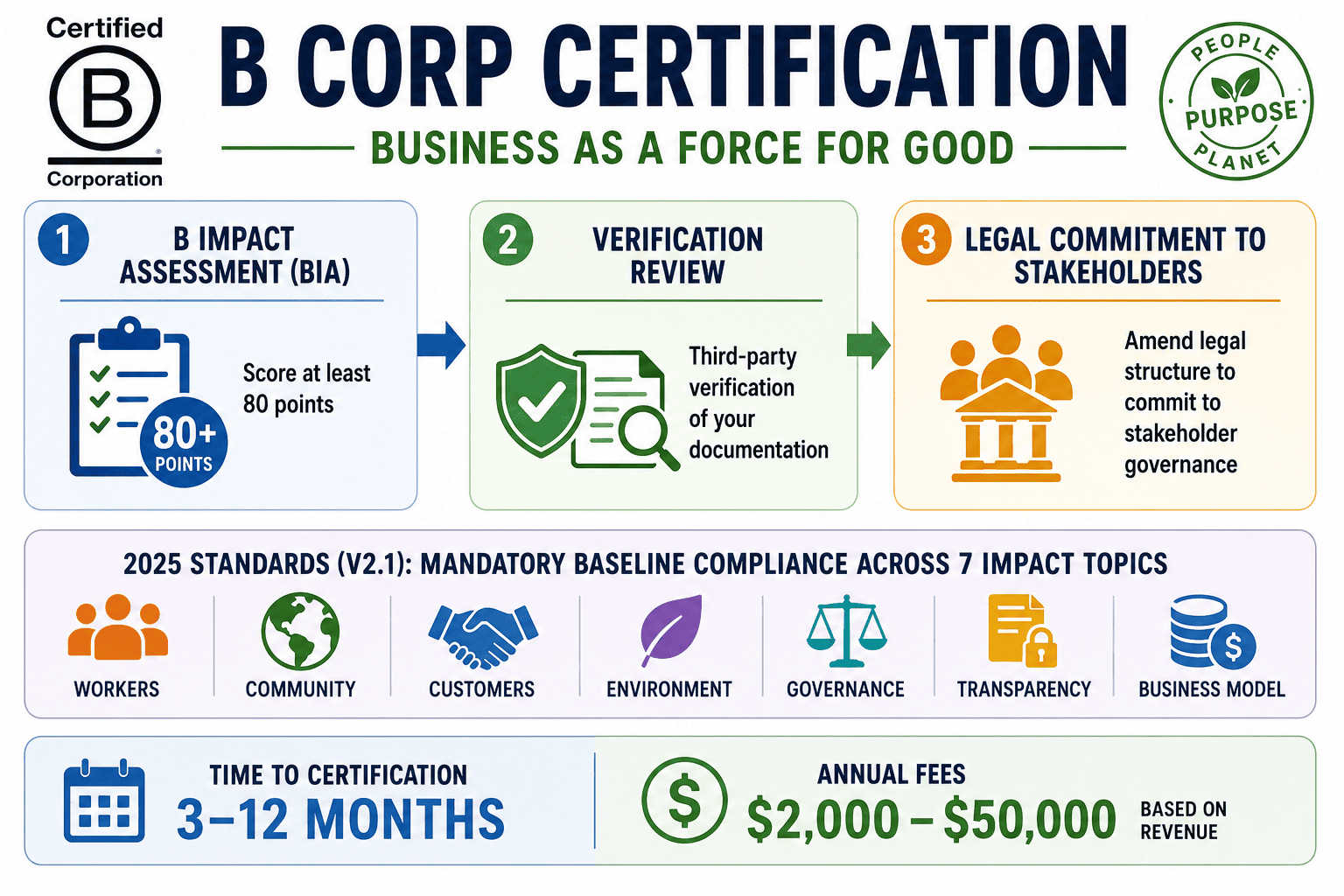
Direct Answer: B Corp Certification is a rigorous, third-party verified designation awarded by B Lab to for-profit companies meeting the highest standards of social and environmental performance, transparency, and legal accountability. The process involves completing the B Impact Assessment (BIA) to score at least 80 points, undergoing a verification review of your documentation, and amending your legal structure to commit to stakeholder governance. The updated 2025 standards (V2.1) now require mandatory baseline compliance across seven impact topics. The journey from starting the BIA to certification typically takes 3-12 months, with annual fees ranging from $2,000 to $50,000 depending on revenue.
📅 July 6, 2026⏱ 12 min read✍️ GT Setu Editorial Team🔄 Updated regularly
9,900+
Certified B Corps Globally
103
Countries with B Corps
80
Minimum BIA Score Required
0%
GTsetu Broker Commission
B Corp Certification is more than a seal of approval—it’s a global movement of businesses committed to using their power as a force for good. The certification, awarded by the non-profit B Lab, is the gold standard for companies that balance purpose and profit, demonstrating a deep commitment to social and environmental responsibility alongside financial success.
This guide provides a complete roadmap to achieving B Corp Certification. We cover the updated 2025 standards, the B Impact Assessment, the verification process, legal requirements, and the ongoing commitment to continuous improvement. Whether you are a small startup or a multinational corporation, this guide will equip you with the actionable steps needed to join the community of over 9,900 B Corps worldwide.
🌍 Who Is This Guide For?
This guide is designed for sustainability managers, founders, CEOs, and leaders in for-profit companies who are considering B Corp Certification. It covers the entire journey, from the initial eligibility check to the final certification and beyond. It is relevant for companies of all sizes and sectors, including those in manufacturing, tech, retail, and professional services, who are looking to formalize their commitment to sustainable business practices. For related frameworks on environmental management and quality, see our guides on ISO 14001 and ISO 9001.
SECTION 1
1 What Is B Corp Certification & Why Get Certified?
📋 The Certification Explained
B Corp Certification is a designation that signifies a for-profit company has met rigorous standards of social and environmental performance, transparency, and accountability. It is the only certification that assesses a company’s entire social and environmental impact, not just a single product or practice. The certification is built on three core pillars: Performance (measured against B Lab’s standards across governance, workers, community, environment, and customers), Transparency (publicly posting impact reports on B Lab’s website), and Accountability (legally committing to consider the impact of decisions on all stakeholders). In April 2025, B Lab launched V2.1 of its standards, the biggest update in its history, moving from a points-based system to mandatory requirements across seven key impact topics.
✅
Third-Party Verified Credibility
Unlike self-assessed sustainability claims, B Corp Certification is independently audited and verified by B Lab, providing a trusted and credible signal to stakeholders that your impact claims are legitimate.
📈
Holistic Impact Assessment
The B Impact Assessment evaluates your company’s performance across five key areas (Governance, Workers, Community, Environment, and Customers), providing a comprehensive view of your strengths and opportunities for improvement.
⚖️
Stakeholder Governance & Legal Accountability
B Corps amend their governing documents to legally commit to considering all stakeholders (employees, communities, customers, suppliers, and the environment), not just shareholders. This protects your mission as you grow.
🤝
Community of Like-Minded Leaders
Certification connects you to a global network of over 9,900 purpose-driven businesses across 103 countries, offering unparalleled peer learning, collaboration, and collective action opportunities.
SECTION 2
2 Key Benefits of B Corp Certification
B Corp Certification delivers a wide range of tangible benefits that strengthen your brand, operations, and stakeholder relationships. It is a powerful tool for differentiating your company and driving long-term value.
1 in 4
Consumers have heard of B Corps (B Corp Brand Awareness Report, 2024)
In a market wary of greenwashing, the B Corp logo is a trusted, third-party verified signal of your commitment to sustainability and ethical practices, helping you stand out from competitors.
Reputation
👥
Attract & Retain Top Talent
Employees, especially younger generations, increasingly seek purpose-driven employers. B Corp Certification demonstrates your values, boosting engagement and making it easier to recruit and retain mission-aligned talent.
People
💼
Access to Capital & Partners
Investors and partners are increasingly prioritizing ESG (Environmental, Social, Governance) factors. Certification can make your company more attractive for investment and facilitate partnerships with other B Corps and impact-focused organizations.
Commercial
📊
Operational Improvement & Efficiency
The BIA identifies areas for improvement across your business, helping you optimize processes, reduce waste, and manage risks. The recertification cycle ensures you continue to improve over time.
Operational
🔗
Supply Chain Due Diligence
B Corp standards now include rigorous requirements across supply chain topics like human rights, fair work, and climate action. Certification helps you build a more sustainable and resilient supply chain.
Supply Chain
🏛️
Protect Your Mission
By embedding stakeholder governance into your legal structure, you protect your company’s mission from being compromised by future leadership changes or shareholder pressure, ensuring your values endure.
Governance
SECTION 3
3 Eligibility Criteria: Who Can Apply?
Most for-profit companies are eligible to apply for B Corp Certification. B Lab has established clear criteria to ensure that certified companies align with their mission of using business as a force for good. Understanding these criteria is the critical first step before beginning the assessment process.
💼
For-Profit Business
Your company must operate as a for-profit entity. Non-profits, charities, and most government agencies are not eligible for certification, as the certification is designed for businesses that generate profit.
📅
12+ Months in Operation
Full certification requires your company to have been in operation for at least 12 months. Startups can apply for ‘Pending B Corp’ status, committing to the standards while working towards certification.
🌍
Legal Incorporation
Your company must be legally incorporated in a country or territory that B Lab currently serves. B Lab supports companies in most countries across the globe.
🚫
Not in an Excluded Industry
Companies in certain industries are ineligible. These include fossil fuel extraction, gambling, pornography, tobacco, weapons manufacturing, and private detention facilities. Less than 1% of revenue can come from these activities.
⚠️ Important: The 2025 Risk-Based Approach
Under the new V2.1 standards, even companies not in excluded industries must complete a risk profile. This screening checks for ownership, governance, and revenue sources that could pose a risk. Companies associated with practices considered risky but not ineligible may still proceed but must complete extra due diligence to identify and mitigate their negative impacts.
SECTION 4
4 Step 1: Assemble Your B Team
🏗️ Build Your Core Team
B Corp Certification is a cross-functional effort. The first step is to assemble a dedicated “B Team” from across your organization to lead the process. Since the B Impact Assessment covers five impact areas—Governance, Workers, Community, Environment, and Customers—it is vital to have a range of expertise represented to gather the necessary data and drive improvements.
1.1
Identify Key Stakeholders
Include colleagues from relevant departments: sustainability, HR, legal, finance, procurement, marketing, and senior leadership. A senior sponsor (e.g., CEO or Sustainability Director) is crucial for authority and resource allocation.
1.2
Define Roles & Responsibilities
Assign a project lead to coordinate the effort and keep the team on track. Delegate ownership of specific impact areas to team members with relevant expertise (e.g., HR leads on Workers, Legal leads on Governance).
1.3
Secure Executive Support
Ensure the senior leadership team is fully committed. Certification requires a significant investment of time and resources. Document this support and ensure it is communicated throughout the organization to build engagement.
💡 Pro Tip: Start with a Kick-Off Meeting
Schedule a kick-off meeting to explain the B Corp process, outline the timeline, and assign tasks. This aligns the team, builds momentum, and ensures everyone understands the scope of the work ahead. This structured approach to project management is a key success factor in all certifications, as seen in our ISO 9001 guide.
SECTION 5
5 Step 2: Register & Start the B Impact Assessment
The B Impact Assessment (BIA) is the cornerstone of the certification process. It is a free, confidential, online tool that measures your company’s impact across the five key areas. Registering on the BIA portal is the first formal action on your certification journey.
📝
Create Your BIA Account
Visit the B Lab website and create a free account. You will be guided through a company profile, which will help tailor the BIA questions to your specific business size, sector, and geography.
Portal
📋
Explore the Preliminary Questions
The BIA begins with a set of foundational questions to confirm your eligibility. This includes checking your business structure, industry, and operations. Completing this phase provides a clear “go/no-go” decision point.
Eligibility
🔍
Access the Full Assessment
Once you pass the preliminary checks, you will gain access to the full BIA. The tool will present questions specific to your company. You can save your progress and return at any time, making it a flexible, self-paced process.
Self-Assessment
SECTION 6
6 Step 3: Gather Data & Documentation
Before you can complete the BIA, you will need to gather substantial evidence to support your answers. The BIA is not a “best guess” exercise; it requires documented proof of your policies, practices, and performance. This step is often the most time-consuming but is critical for a successful verification.
Impact Area
Examples of Required Evidence
Where to Find It
Governance
Articles of incorporation, minutes from board meetings, mission statement, policies on stakeholder engagement.
Legal files, board packs, company website, HR policies.
Workers
Employee handbooks, payroll records, benefit summaries, training records, diversity and inclusion data, employee engagement survey results.
HR department, payroll systems, internal surveys.
Community
Supplier codes of conduct, community investment records, diversity of suppliers, charitable giving documentation, volunteer policies.
Procurement department, finance records, marketing and community engagement teams.
Use a shared drive or project management tool to organize all your evidence. Create a folder structure that mirrors the five impact areas. This will make it easier to answer questions in the BIA and will save you considerable time when it comes to the verification stage, where B Lab will ask for additional documentation. This principle of evidence-based certification is common to many standards, such as ISO 27001.
SECTION 7
7 Step 4: Complete the B Impact Assessment
With your evidence gathered, you can now systematically complete the BIA. This is a deep dive into your company’s operations. The goal is to provide clear, accurate, and documented answers to each question. It is normal for this process to take several weeks.
7.1
Answer the Questions Accurately
Work through each section of the BIA carefully. Be honest and rigorous in your responses. If a practice is not yet implemented, state this truthfully—the BIA is a tool for improvement, not just a test to pass.
7.2
Use the BIA’s Guidance
The assessment tool provides helpful guidance and definitions for each question. Use these resources to ensure you understand what is being asked and what evidence is required. This is a valuable learning resource.
7.3
Coordinate Your Team
Given the breadth of the assessment, close collaboration is essential. One person should manage the master responses, while team members provide data for their specific area. Set deadlines to keep the process moving.
7.4
Submit the Assessment
Once all sections are complete, submit your BIA. You will then receive an initial score. The BIA tool will also generate a report showing your performance across the five impact areas, helping you identify strengths and opportunities.
SECTION 8
8 Step 5: Improve Your BIA Score If Necessary
📊 Achieving the 80-Point Threshold
To be eligible for B Corp certification, your company must achieve a minimum verified score of 80 points out of 200 on the B Impact Assessment. However, it is very common for companies not to reach this threshold on their first attempt. The BIA’s “Improvement Report” is a powerful tool that provides a roadmap for increasing your score by identifying high-impact areas for change.
📈
Use the Improvement Report
This report, generated after your initial submission, highlights the most effective actions you can take to boost your score. It prioritizes improvements, allowing you to focus your efforts where they will have the greatest impact on your score.
Prioritization
🔄
Implement Targeted Improvements
Focus on “quick wins” and high-impact areas to increase your score. This could involve formalizing informal policies (e.g., a parental leave policy), starting a new initiative (e.g., an employee volunteer program), or improving data collection.
Action
🏛️
Consider External Support
A sustainability consultant with expertise in B Corp certification (like Nexio Projects) can provide a strategic roadmap to efficiently boost your score and navigate the complexities of the process, helping you avoid common pitfalls.
Consulting
SECTION 9
9 Step 6: Evaluation & Verification
Once you have achieved a BIA score of 80 or higher and are confident in your documentation, you can submit your application for evaluation. This is where your claims are put to the test. B Lab’s evaluation team will review your submission in detail, request additional documentation, and verify that your practices meet their standards.
Verification Stage
Description
Key Activity
1. Submission & Initial Review
You submit your BIA score, disclosure questionnaire, and supporting evidence. The evaluation team confirms you’ve met the eligibility requirements.
Pay the application fee ($150+) and submit your application.
2. Document Review
B Lab’s analysts review your evidence for each response in the BIA. They will ask for missing documents or clarification on your answers.
Promptly provide all requested information to avoid delays.
3. Assessment & Interview
This may include a phone or video interview to discuss your practices. The analyst will assess if your score is accurate based on the evidence.
Prepare your B Team for potential questions on your policies and practices.
4. Score Finalization
Your score may be adjusted up or down during this process. It is very common for the verified score to differ from the initial self-assessment score.
Be open to the process and ready to provide further detail if necessary.
5. Transparency & Background Checks
B Lab will conduct background checks on your company, including reviewing any fines, sanctions, or controversial practices.
Ensure any past issues are disclosed in the disclosure questionnaire.
6. Final Decision
If your final score remains at 80+ and no issues are flagged, the evaluator recommends certification. The process can take up to seven months.
Celebrate your success! You will receive your official B Corp certificate.
💡 Be Prepared for the Verification Stage
This is a detailed and rigorous process. B Lab analysts are thorough. Keep all your evidence organized and easily accessible. Be prepared for your score to change. The verification stage is a true test of your commitment to transparency and continuous improvement. This detailed due diligence process is similar to the partner verification we facilitate at GTsetu.
SECTION 10
10 Step 7: Meet Legal Requirements & Certify
The final step before formal certification is meeting the B Corp Legal Requirement. This involves amending your company’s governing documents to embed stakeholder governance—the commitment to consider all stakeholders in your decisions. This is a defining feature of B Corp certification and protects your mission for the long term.
10.1
Understand the Legal Requirement
This requirement varies by jurisdiction. It involves incorporating language into your articles of incorporation or bylaws that expands your fiduciary duty to include workers, communities, customers, suppliers, and the environment, in addition to shareholders.
10.2
Consult with Legal Counsel
This is a critical legal step. Work with a lawyer familiar with B Corp requirements and your local corporate laws. They will draft the necessary amendments for your specific corporate structure (e.g., LLC, C-Corp, LLP).
10.3
Obtain Approval & File
For many companies, this requires approval from your board of directors and shareholders. Once approved, the amendments must be filed with the relevant government body (e.g., Secretary of State in the US, Companies House in the UK).
10.4
Sign the B Corp Agreement
Once your legal structure is updated, you will sign the B Corp Agreement with B Lab. This formalizes your commitment to the community, and you will receive your official B Corp Certification.
📋 Timeline for Legal Amendment
Companies with 49 or fewer employees are required to make this change at the time of certification. Companies with 50 or more employees have a grace period of up to one year to complete the legal amendment.
SECTION 11
11 Costs & Timeline: What to Expect
The cost and timeline for B Corp Certification depend heavily on your company’s size, complexity, and current level of preparedness. Understanding these factors upfront is essential for effective planning.
Larger companies face more complex verification, extending the timeline by several months.
Complexity of Operations
Multi-national, multi-site operations require more documentation and a broader verification scope, increasing cost.
Assessing complex supply chains and multiple sites takes more time.
Current Preparedness
Companies with mature ESG programs may have lower internal costs than those building programs from scratch.
Starting with robust data and policies can significantly shorten the assessment and improvement phases.
Use of Consultants
Consultant fees can range from $5,000 to $50,000+ depending on the scope of support.
A consultant can accelerate the process by providing a clear strategy and managing the project.
Verification Wait Times
N/A
The verification process can take up to 7 months, depending on B Lab’s current workload and the quality of your submission.
Recertification Cycle
Annual fees are ongoing. Recertification every three years incurs a similar verification process and fee.
Ongoing. Continuous improvement is a requirement.
📋 Equity Discounts
B Lab offers equity discounts on annual fees for entrepreneurs who face systemic barriers. Check the B Lab website for more details on eligibility.
SECTION 12
12 Common Mistakes & How to Avoid Them
📄
Underestimating the Documentation Effort
Failing to gather sufficient, organized evidence for the BIA is a major source of delays and frustration. The verification team will request proof, and gaps will lower your score.
Avoid: Start data collection early. Create a centralized evidence repository. Involve all departments from the start. This is a common challenge in all compliance certifications.
⚖️
Ignoring the Legal Requirement
Leaving the legal amendment to the last minute can cause significant delays. It often requires board and shareholder approvals, which take time and can be complex.
Avoid: Consult with legal counsel early in the process. Understand the specific requirements for your jurisdiction and corporate structure. Begin the approval process as soon as you have a high-level timeline.
🏛️
Lack of Executive Support
Without visible commitment from the top, the initiative can lose momentum. Employees will not prioritize a project that leadership doesn’t champion.
Avoid: Secure a senior sponsor from the start. Regularly brief leadership on progress. Clearly communicate the business case for certification to the whole team.
🎯
Treating It as a One-Time Project
B Corp is a commitment to continuous improvement. Companies that view certification as a finish line often fail to recertify and miss out on the ongoing benefits.
Avoid: Integrate B Corp thinking into your operational processes. Use the BIA as an annual health check, not just a pre-certification task. Plan for the 3-year recertification cycle from day one.
📊
Ignoring the Supply Chain
The 2025 standards place a strong emphasis on supply chain due diligence, including human rights and climate action in your value chain. A narrow focus on internal operations is no longer sufficient.
Avoid: Map your supply chain. Engage with key suppliers. Assess their practices and integrate them into your own compliance program. This aligns with the principles of responsible sourcing found in ISO 14001.
🔍
Overlooking the Risk Profile
The new V2.1 standards require a mandatory risk profile. Failing to take this seriously or hiding past issues can lead to a rejection of your application.
Avoid: Be transparent in your disclosure questionnaire. Address any potential risks proactively. If your company operates in a controversial area, be prepared for extra due diligence.
SECTION 13
13 How GTsetu Supports Your Sustainability Journey
🔗 GTsetu, Verified B2B Platform
Connect with Verified & Sustainable Business Partners
Building a sustainable and ethical supply chain is a core component of B Corp Certification. GTsetu simplifies partner due diligence by connecting you with verified companies that meet rigorous standards. Our platform is designed to help you find and collaborate with partners who share your commitment to social and environmental responsibility.
✅
Verified Company Profiles
Every company on GTsetu is verified on 6 key data points (Name, Address, Registration Number, Company Status, Type, Incorporation Date) using government tie-ups—supporting your supply chain due diligence for B Corp’s Governance and Community impact areas.
🕵️
Anonymous Discovery
Browse verified partner profiles without revealing your identity until you’re ready to engage—protecting your business strategy and commercial confidentiality during the B Corp risk assessment process.
📄
Built-In NDA Workflow
Digital mutual NDA with timestamped signatures—activated before any sensitive environmental or supply chain data is exchanged, supporting your B Corp transparency and governance commitments.
🔐
Encrypted Document Workspace
AES-256 encryption at rest, TLS in transit, role-based access controls, and full audit trail—ensuring the secure exchange of supplier assessments, contracts, and other sensitive business data with your partners.
🚫
Zero Broker Commission
GTsetu charges zero commission on any partnership formed. All commercial value stays between you and your verified partner—supporting the cost management objectives of your B Corp journey.
🌏
Global Network of Verified Partners
Access verified companies across 100+ countries—supporting your supply chain due diligence for B Corp certification and enabling you to build a sustainable, responsible value chain.
QWhat is B Corp certification and why is it important?
B Corp certification is a designation awarded by B Lab to for-profit companies that meet rigorous standards of social and environmental performance, transparency, and legal accountability. It is important because it signals to customers, employees, and investors that your company is committed to balancing profit with purpose, and it provides a credible, third-party verified framework for measuring and improving your impact on all stakeholders. The 2025 standards update (V2.1) has made the certification even more rigorous.
QWhat are the 7 key steps to get B Corp certified?
The key steps are: (1) Assemble a B Team to lead the process. (2) Register on the B Impact Assessment (BIA) portal. (3) Gather data and documentation. (4) Complete the BIA and achieve a score of at least 80. (5) Improve your score if necessary. (6) Undergo the evaluation and verification process by B Lab. (7) Meet the legal requirements and sign the B Corp Agreement to finalize certification.
QHow long does it take to get B Corp certification?
The timeline varies based on company size and readiness. For a small company, completing the BIA can take a few hours to a few weeks. After submission, the verification process can take up to 7 months, depending on wait times and the complexity of your application. The overall journey from starting the BIA to receiving certification typically ranges from 3 to 12 months.
QHow much does B Corp certification cost?
There is a $150 application fee, though larger companies may incur extra costs for additional processes. Ongoing annual fees are based on your company’s gross annual revenue, ranging from $2,000 a year for companies under $4.9 million USD to $50,000 a year for companies over $750 million USD. B Lab provides equity discounts for entrepreneurs who face systemic barriers.
QWhat are the eligibility criteria for B Corp certification?
Most for-profit companies are eligible. Key criteria include: operating as a for-profit business, being legally incorporated in a country B Lab serves, having been in operation for at least 12 months, not being significantly involved in excluded industries (e.g., fossil fuels, gambling, tobacco), and being willing to measure and improve social and environmental impact. The new V2.1 standards also include a risk profile for all applicants.
QWhat is the B Impact Assessment (BIA) and what score do I need?
The B Impact Assessment (BIA) is a comprehensive online tool that measures your company’s performance against B Lab’s standards across five impact areas: Governance, Workers, Community, Environment, and Customers. To be eligible for certification, your company must achieve a minimum verified score of 80 out of 200 points on the BIA.
QWhat are the 2025 changes to B Corp standards?
In April 2025, B Lab launched the biggest update to its standards (V2.1). The new framework moves away from a purely points-based scoring model to mandatory minimum requirements across every critical impact area. Companies applying from 2026 must meet baseline compliance in all seven impact topics, including governance, fair work, justice/equity/diversity/inclusion, human rights, climate action, environmental stewardship, and government affairs. The new approach also includes a mandatory risk assessment for all applicants.
Ready to Build a Sustainable & Responsible Partner Network?
Connect with verified companies that share your commitment to social and environmental impact on GTsetu—compliance-backed verification, anonymous discovery, built-in NDA workflows, and zero broker commissions. Find partners to strengthen your supply chain and support your B Corp journey.
They represents the product, and research team behind GTsetu, a global B2B collaboration platform built to help companies explore cross-border partnerships with clarity and trust. The team focuses on simplifying early-stage international business discovery by combining structured company profiles, verification-led access, and controlled collaboration workflows.
With a strong emphasis on trust, and disciplined engagement, Team GTsetu shares insights on global trade, partnerships, and cross-border collaboration, helping businesses make informed decisions before entering deeper commercial discussions.