Quality Control in Overseas Manufacturing: Complete Guide for Global Buyers | GTsetu
Home ›
Blogs ›
Quality Control in Overseas Manufacturing
🏭 Manufacturing Quality & Supplier Management
Quality Control in Overseas Manufacturing: Complete Guide for Global Buyers
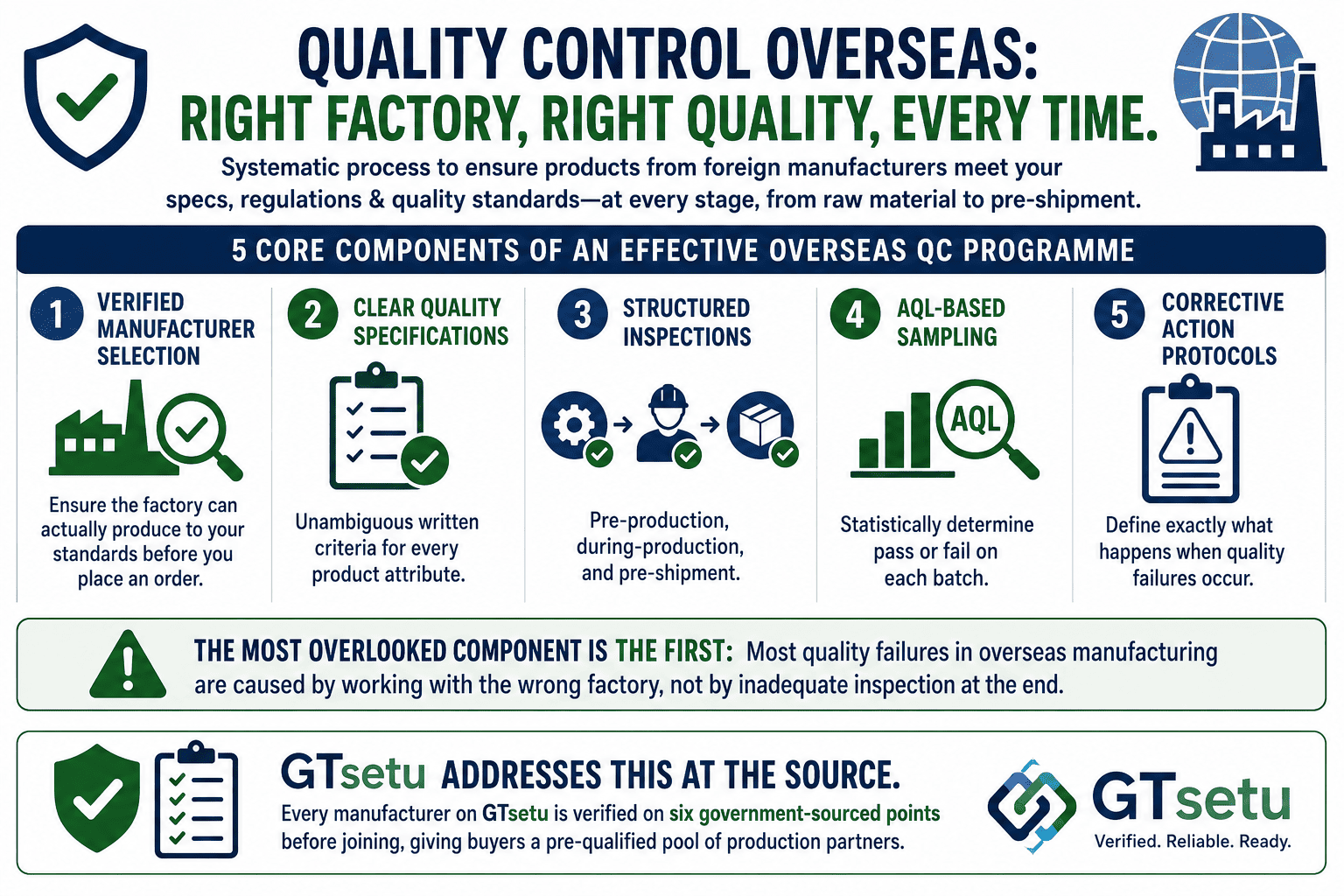
Direct Answer: Quality control in overseas manufacturing is the systematic process of verifying that products made by a foreign manufacturer meet your specifications, regulatory requirements, and quality standards, at every stage of production, from raw material sourcing to pre-shipment inspection. An effective overseas QC programme has five core components: verified manufacturer selection (ensuring the factory can actually produce to your standards before you place an order); clear quality specifications (unambiguous written criteria for every product attribute); structured inspections at each production stage (pre-production, during-production, and pre-shipment); AQL-based sampling to statistically determine pass or fail on each batch; and corrective action protocols that define exactly what happens when quality failures occur. The most overlooked component is the first, most quality failures in overseas manufacturing are caused by working with the wrong factory, not by inadequate inspection at the end of the process. GTsetu’s verified matchmaking platform addresses this at the source: every manufacturer on GTsetu is verified on six government-sourced points before joining, giving buyers a pre-qualified pool from which to select production partners.
📅 June 20, 2026⏱ 23 min read✍️ GTsetu Editorial Team🔄 Updated regularly
5
Inspection Types Covered
40%
QC Failures Traced to Wrong Factory Selection
AQL
ISO 2859-1 Sampling Standard
0%
GTsetu Partner Commission
Sourcing production overseas offers compelling cost advantages, but it introduces quality risks that are structurally different from those faced in domestic manufacturing. Geographic distance removes direct visibility over the production process. Cultural and communication differences create ambiguity in specifications. Contractual enforcement across jurisdictions is slower and more expensive. And the supplier’s incentive to manage quality precisely to your standards, rather than to a locally acceptable standard, requires active, structured management rather than assumption.
The companies that manage overseas manufacturing quality successfully do not rely on inspecting quality into the finished product. They engineer quality into the process, starting with selecting the right manufacturer, building unambiguous quality specifications, conducting inspections at every relevant production stage, and responding to failures with documented corrective action rather than ad hoc renegotiation. This guide covers every dimension of that process in the depth required to actually implement it. For related topics on the broader overseas manufacturing relationship, see our guides on cross-border business partnerships, business partnership contracts, and who owns tooling and moulds.
💡 Who This Guide Is For
This guide is written for importers, brand owners, distributors, and procurement managers who source or are considering sourcing production from overseas manufacturers in Asia, Eastern Europe, South Asia, Southeast Asia, the Middle East, or other international manufacturing markets. It covers both first-time buyers setting up an overseas QC programme and experienced buyers who want to review and strengthen an existing one. For the contractual framework that supports a QC programme, see: contract between manufacturer and distributor.
SECTION 1
1 What Is Quality Control in Overseas Manufacturing?
🎯 Definition
Quality control in overseas manufacturing is the systematic set of processes, inspections, audits, and contractual mechanisms by which a buyer verifies that products manufactured by a foreign factory meet the buyer’s specifications, the applicable regulatory standards, and the expected quality level, at every stage of the production lifecycle. It encompasses supplier qualification before the first order, specification documentation before production begins, inspection at each production stage, statistical sampling to determine batch acceptance or rejection, and corrective action management when quality standards are not met. Effective overseas QC does not attempt to inspect quality into a finished product, it builds quality into the production process through verified manufacturer selection, unambiguous specifications, and structured oversight at each stage where quality can be influenced.
The distinction between quality control (QC) and quality assurance (QA) matters in this context. Quality control is reactive and detection-focused: it identifies defects in units that have already been produced. Quality assurance is proactive and prevention-focused: it creates the systems, standards, and processes that prevent defects from occurring in the first place. An effective overseas manufacturing quality programme needs both, QA to set the conditions for quality production, and QC to verify that those conditions are actually being met. Neither substitutes for the other.
The Overseas Manufacturing Quality Lifecycle
🏭
Manufacturer Selection
Verified factory qualification before any order.
🏛️ Foundation
📋
Quality Spec
Unambiguous written specification agreed before production.
📄 Pre-Production
🔍
Pre-Production
Raw materials and components verified before production starts.
🔍 PPI
⚙️
During Production
Mid-production check when 10–40% complete.
🔍 DUPRO
✅
Pre-Shipment
Final inspection before goods leave the factory.
🔍 PSI
🚢
Shipment & Arrival
Loading inspection and destination sampling if required.
✓ Complete
SECTION 2
2 Why Quality Control Is Harder Overseas
Quality control in overseas manufacturing is not simply a scaled version of domestic QC. It involves structural challenges that do not exist when the manufacturing facility is in your own country, challenges that require deliberate, specialised process design to manage effectively.
📏
Challenge 1, Specification Ambiguity Across Language and Context
A quality specification that seems precise in English may be interpreted differently by a manufacturer whose team is working from a translated version, whose production engineers apply different tolerances as a default, or whose understanding of “acceptable” cosmetic finish reflects local rather than export market standards. Every ambiguity in a specification becomes a quality problem at production scale. Specifications must be written in explicit, measurable, visually illustrated terms, with physical golden samples wherever possible, not narrative descriptions that depend on shared contextual understanding the parties do not have.
High Risk
🌐
Challenge 2, Geographic Distance Removes Direct Visibility
A domestic buyer can visit a production facility at any point in the production process. An overseas buyer typically cannot. Without scheduled, structured inspection checkpoints, quality is managed entirely by what the manufacturer chooses to report and the buyer chooses to accept on the basis of photos, samples, and shipping documents, none of which provide reliable quality evidence for a full production run. Distance-independent QC requires third-party inspection infrastructure, not reliance on the manufacturer’s self-reporting.
Structural
⚖️
Challenge 3, Contractual Enforcement Is Slower and More Expensive Across Jurisdictions
When a domestic manufacturer delivers non-conforming goods, legal remedies are relatively accessible. When an overseas manufacturer delivers a defective shipment, enforcing contractual remedies requires cross-border legal action, which is slow, expensive, and uncertain in many jurisdictions. This makes prevention vastly more important than cure in overseas manufacturing. The cost of a failed shipment of non-conforming goods, including return freight, re-inspection, rework, missed delivery windows, and customer consequences, almost always exceeds the cost of a comprehensive pre-shipment QC programme. See: common red flags in international partnerships.
High Cost
🏭
Challenge 4, Subcontracting Without Disclosure
Overseas manufacturers sometimes subcontract production to third-party factories, often without the buyer’s knowledge or approval, when their own capacity is fully committed or when the product requires capabilities they do not hold in-house. The quality standards, worker welfare practices, and IP protection that the buyer assessed in the primary factory may not apply to the undisclosed subcontractor. The supplier contract must explicitly prohibit undisclosed subcontracting and require written approval for any partial or complete subcontracting of the buyer’s orders. See: business partnership contract guide.
Hidden Risk
📦
Challenge 5, Material Substitution After Sample Approval
A common quality failure pattern: the buyer approves a sample that meets all specifications. Production begins. Partway through the run, the manufacturer substitutes a lower-cost material or component, either to reduce cost, because the specified material became unavailable, or because the production team did not adequately communicate the specification to the relevant suppliers. The substitution is not disclosed, and the buyer receives goods that do not match the approved sample. During-production inspections that explicitly check material conformance to specification, not just finished product appearance, are the primary defence against this pattern.
Frequent
📊
Challenge 6, Misaligned Quality Standards and Expectations
What constitutes an acceptable product in the domestic market of the manufacturing country may differ from what is acceptable in the buyer’s market. Cosmetic standards, packaging durability requirements, safety testing thresholds, and regulatory compliance requirements all vary by destination market. The buyer cannot assume that a manufacturer experienced in exporting has the same understanding of destination-market requirements as the buyer, particularly for products subject to specific regulatory frameworks such as food contact materials, electrical safety standards, children’s products, or pharmaceutical packaging. The quality specification must explicitly reference all applicable destination-market regulatory requirements, not just product attributes.
Systemic
SECTION 3
3 The Five Types of Quality Inspections
A robust overseas QC programme uses inspections at multiple points in the production lifecycle, not just a single pre-shipment check. Each inspection type catches different categories of problems at the stage when they can be corrected most efficiently. Catching a material non-conformance before production begins costs dramatically less than catching it in a completed shipment.
📦
Pre-Production Inspection
PPI
Verifies raw materials, components, and factory readiness before production begins. Checks that materials match approved specifications and that the correct production team and equipment are in place.
Before production starts
⚙️
During Production Inspection
DUPRO
Conducted when 10–40% of units are complete. Identifies production issues early enough to correct without scrapping the entire run. Checks workmanship, dimensions, and functional performance on early units.
10–40% production complete
✅
Pre-Shipment Inspection
PSI
The most common inspection type. Conducted when 80–100% of production is complete and before goods leave the factory. AQL sampling determines batch pass or fail based on defect counts across a statistically representative sample.
80–100% production complete
🚢
Container Loading Inspection
CLI
Monitors the physical loading of goods into shipping containers. Verifies that the correct goods are loaded, that packaging is undamaged, that container condition is acceptable, and that the load matches the packing list and purchase order.
During container loading
🏭
Factory Audit
FA
A comprehensive assessment of the manufacturer’s facility, management systems, quality procedures, certifications, workforce, and equipment, conducted before placing the first order or periodically during an ongoing relationship.
All new manufacturer relationships; existing relationships annually
💡 Minimum QC for a First Order from a New Overseas Manufacturer
For any first order from a new overseas manufacturer, the minimum QC programme should include: a Factory Audit before placing the order; a Pre-Production Inspection to confirm material conformance; and a Pre-Shipment Inspection with AQL sampling before the goods are released for shipment. Adding a During-Production Inspection for complex products or long runs substantially reduces the risk of discovering major quality failures only at the PSI stage, when the cost of correction is highest. For the contractual framework that supports this programme, see: business partnership contract guide.
SECTION 4
4 AQL Sampling: How Statistical Inspection Works
AQL, Acceptable Quality Limit, is the international statistical sampling standard (ISO 2859-1, formerly MIL-STD-1916) used to determine how many units to inspect from a production batch and how many defects are acceptable before the batch is rejected. AQL is not a measure of the expected quality of the product, it is a risk management tool that balances the cost of inspection against the probability of accepting a defective batch.
📊 AQL Defined
AQL defines two numbers for any inspection: the sample size (how many units to pull from the batch for inspection) and the acceptance number (the maximum number of defective units found in the sample before the entire batch is rejected). Sample size is determined by the total batch quantity and the inspection level (General Inspection Level II is the most common default). The AQL value determines the acceptance number: a lower AQL value means a lower tolerance for defects, AQL 0 means any defect found in the sample fails the batch; AQL 2.5 means a small number of defects in the sample is acceptable before rejection is triggered.
Common AQL Levels and When to Apply Them
🚨
Critical Defects
AQL 0
Zero tolerance. Any critical defect found in the sample fails the entire batch. Applied to defects that pose a safety hazard or create regulatory non-compliance, exposed wiring, toxic material migration, missing safety warning labels, structural failures in load-bearing products.
⚠️
Major Defects
AQL 1.0–2.5
Low tolerance. A small number of major defects in the sample triggers batch rejection. Applied to defects that affect functionality, durability, or core product performance and would cause a reasonable consumer to return or reject the product.
✅
Minor Defects
AQL 4.0
Moderate tolerance. A higher number of minor defects in the sample is acceptable before rejection. Applied to cosmetic imperfections that do not affect function, durability, or consumer satisfaction in most cases, small colour variation, minor surface marks.
Ac = Acceptance number (maximum defects found before acceptance). Re = Rejection number (minimum defects that trigger batch rejection). Table based on ISO 2859-1 / ANSI/ASQ Z1.4, General Inspection Level II. Always verify against current standard. This is for reference only.
⚠️ AQL Is Not a Quality Guarantee, It Is a Sampling Risk Tool
A batch that passes AQL inspection does not contain zero defects, it contains a level of defects that the sampling statistics consider acceptable at the chosen AQL level. AQL 2.5 on a batch of 3,200 units means that up to 7 defects in a sample of 200 is considered a passing result, implying a potential defect rate of approximately 2.5% across the batch. For consumer-facing products, this means educating your customer service team, building buffer stock, and establishing a clear consumer return procedure. AQL is not a substitute for improving manufacturing processes, it is a risk management tool that operates within the context of an ongoing quality improvement programme. See: the true cost of global expansion for how quality failure costs compound in international operations.
SECTION 5
5 Defect Classification: Critical, Major, and Minor
AQL sampling only produces meaningful results when the defects being counted are correctly classified. The defect classification system, what constitutes a critical, major, or minor defect for your specific product, must be agreed with the manufacturer and documented in the quality specification before production begins. Disputes about whether a specific non-conformance is a critical or major defect are extremely common and are almost always the result of ambiguous pre-production documentation.
Defect Category
Definition
Consumer Impact
AQL Applied
Examples
Critical
Defect that creates a safety hazard to the user or third parties, or makes the product legally non-compliant in the destination market
Personal injury, regulatory seizure, recall, product liability claim
AQL 0, zero tolerance; any critical defect found fails the batch
Exposed wiring in electrical products; sharp edges accessible to children; toxic material migration above regulatory limits; missing mandatory safety warnings; structural failure under rated load
Major
Defect that affects the product’s functionality, durability, or core performance characteristics and would cause a reasonable consumer to reject, return, or complain about the product
Product returns, negative reviews, loss of consumer trust, warranty claims
AQL 1.0 to 2.5, low tolerance; small defect count triggers batch rejection
Seams splitting on first use; zips that fail to close; incorrect label information; wrong colour sent vs ordered; dimensions outside specified tolerance; water ingress into waterproof product
Minor
Cosmetic or aesthetic imperfection that does not affect the product’s function, durability, or core performance, and is unlikely to cause most consumers to reject the product
Small proportion of consumers may notice; unlikely to drive returns or complaints at low incidence
AQL 4.0, moderate tolerance; higher defect count before batch rejection
Small thread pull on a garment visible only on close inspection; slight colour variation within an agreed tolerance range; minor surface mark on a non-visible surface; small packaging cosmetic imperfection
⚡ Build a Product-Specific Defect Reference Book
The most effective way to eliminate ambiguity in defect classification is to create a visual defect reference book for your product: photographs of each defect type at the critical/major/minor boundary, measurement criteria for dimensional defects, and specific pass/fail examples for each inspection point. This reference book becomes part of the quality specification provided to the manufacturer and to any third-party inspection company. Inspectors who have a visual reference produce consistent results; inspectors who are working from text descriptions produce variable results that generate disputes. See: partnership evaluation criteria for how to assess whether a manufacturer has the capability to work with this level of specification precision.
SECTION 6
6 Factory Audits: Qualifying the Manufacturer Before Production
A factory audit is a comprehensive, structured assessment of a manufacturer’s facility, processes, management systems, workforce, and certifications, conducted before placing the first order with a new supplier, and periodically (typically annually) during an ongoing relationship. It is the single most important quality risk reduction activity available to an overseas buyer, because it determines whether the factory is actually capable of producing to your standards before any money changes hands or production begins.
🏭 Factory Audit Purpose
A factory audit answers three questions: Can this factory produce what I need to the quality I require? (capability assessment) Does this factory have the systems to consistently produce to that quality? (quality management system assessment) Does this factory meet the ethical, environmental, and regulatory standards I must comply with? (compliance assessment). All three must be answered satisfactorily before production is committed.
Factory Audit Types
🔧
Quality Management System (QMS) Audit
Assesses whether the factory has documented, implemented, and maintained quality management processes, including incoming material inspection, in-process quality checks, final inspection, non-conformance management, and corrective action procedures. ISO 9001 certification provides a third-party baseline, but the audit verifies implementation, not just certification.
⚙️
Capability Audit
Verifies that the factory has the specific equipment, tooling, technical expertise, and production capacity to manufacture your product to your specification. Confirms whether the factory has produced similar products before, what their typical defect rates are, and whether their stated production capacity matches your order volumes.
👷
Social / Ethical Audit
Assesses labour conditions, working hours, wages, health and safety standards, child labour compliance, and freedom of association, against frameworks such as SA8000, SMETA (Sedex Members Ethical Trade Audit), BSCI, or the buyer’s own code of conduct. Required by most major retailers and increasingly by regulatory frameworks in importing countries.
🌿
Environmental Audit
Assesses the factory’s environmental management practices, waste disposal, chemical handling, energy consumption, and compliance with applicable environmental regulations. ISO 14001 certification provides a baseline. Increasingly required as part of supply chain ESG (Environmental, Social, and Governance) due diligence programmes.
🔒
Security Audit (C-TPAT / AEO)
Assesses physical security, personnel security, information security, and access controls at the facility, against standards such as C-TPAT (US Customs-Trade Partnership Against Terrorism) or AEO (Authorised Economic Operator in the EU). Required for importers seeking fast-track customs clearance in key markets.
📋
Full Supplier Qualification Audit
A combined audit covering QMS, capability, social, and often environmental dimensions, the standard first-order audit for a new overseas manufacturer relationship. Typically conducted by the buyer’s QA team, a third-party inspection company, or a combination of both. Results in a formal supplier qualification status (approved, conditionally approved, or rejected).
Factory Audit Checklist: Key Areas Assessed
Factory registration, legal status, and ownership structure, verified against official records
Production facility size, layout, and infrastructure (power supply, ventilation, storage conditions)
Equipment list: type, age, calibration status, and maintenance records for all relevant production equipment
Quality control equipment: measuring instruments, testing equipment, calibration records and schedules
Workforce: total headcount, technical staff qualifications, quality inspector ratio, training records
Incoming material inspection process: how raw materials and components are checked on receipt
In-process quality control: frequency, method, documentation, and response to in-process failures
Final inspection procedure: what is checked, by whom, at what frequency, and with what documentation
Non-conformance management: how quality failures are recorded, investigated, and corrected
Certifications: copies of all claimed certifications, their scope, issuing body, and expiry dates
Subcontracting: whether any production is subcontracted, to whom, and under what controls
Previous client references: two or three buyers currently or recently supplied, available for contact
Social compliance: working hours records, wage records, health and safety compliance evidence
IP protection: access controls to buyer’s design files, tooling storage, and visitor management procedures
SECTION 7
7 Writing an Effective Quality Specification Document
The quality specification document, sometimes called a product technical file, inspection criteria document, or product quality standard, is the single most important document in an overseas manufacturing quality programme. It defines exactly what a conforming product looks like, how it is measured, and what testing it must pass. Without a complete, unambiguous quality specification, every inspection is a judgment call, every dispute has no objective reference point, and the manufacturer cannot be held accountable to a standard they were never explicitly given.
01
Product Description and Scope
A precise written description of the product: its purpose, target market, intended end user, and the applicable regulatory framework in the destination market. Include the product’s trade name, model number, all applicable SKUs, and reference to any previous product versions this specification supersedes. Define the scope of the specification, which production batches, which components, and which product variants it applies to.
02
Bill of Materials and Approved Materials List
A complete bill of materials listing every component and material by grade, specification, supplier, and approved alternative. Include specific gravity, tensile strength, chemical composition, or other relevant material properties where applicable. Explicitly state that no material substitutions are permitted without written buyer approval. This is the primary defence against the material substitution failure pattern described in Section 2. See: who owns tooling and moulds for how tooling and materials documentation interrelate.
03
Dimensional Specifications and Tolerances
All critical dimensions with explicit tolerances stated in measurement units. Include a dimensioned technical drawing for any product where shape, size, or fit is a functional or aesthetic requirement. Specify the measuring instruments to be used, the frequency of measurement, and the documentation required. State explicitly whether measurements are to be taken on finished, packaged, or assembled products, and under what conditions (temperature, pressure, pre-treatment).
04
Visual Quality Standards with Reference Samples
A comprehensive visual inspection checklist covering all surfaces (A-surfaces visible to consumer, B-surfaces visible on close inspection, C-surfaces not normally visible), colour standards referenced to specific Pantone or RAL codes or physical colour standards, and acceptable/unacceptable ranges for every visible quality attribute. Supplement with high-resolution photographs of conforming units and of each borderline defect type. Physical golden samples, approved by the buyer and countersigned by the manufacturer, are the gold standard for visual quality references.
05
Functional Testing Requirements
Every functional performance test that a conforming product must pass: load tests, cycle tests, waterproof tests, electrical safety tests, chemical resistance tests, durability tests, and any other functional verification. For each test, specify the test method (reference the relevant standard, ISO, EN, ASTM, JIS, etc.), the test conditions, the sample size, the pass criteria, and whether third-party laboratory testing is required or in-factory testing is acceptable. For regulated products, list all mandatory third-party test reports required before shipment.
06
Packaging and Labelling Requirements
Complete specifications for every packaging element: outer carton dimensions and burst strength; inner packaging materials and configuration; unit packaging artwork (with approved PDF or print-ready files); mandatory labelling (country of origin, materials composition, regulatory symbols, barcodes, lot codes, and any destination-market mandatory declarations); and palletisation instructions where applicable. Packaging failures are among the most common causes of pre-shipment inspection failures, and the most avoidable when specifications are explicit.
07
AQL Levels, Defect Classification, and Inspection Protocol
The specific AQL levels to be applied for critical, major, and minor defects; the inspection level (General II is standard); the defect classification list for this product with examples for each category; the inspection procedure to be followed; and the documentation required from the inspection, inspection report format, photographs, measurement records, and the pass/fail result and its consequences. This section makes the QC programme contractually enforceable and removes ambiguity from the inspection process.
SECTION 8
8 Corrective Action: What Happens When Quality Fails
Even with a comprehensive QC programme, quality failures will occur. The defining difference between buyers who manage overseas manufacturing successfully and those who do not is not whether failures happen, it is how failures are responded to. A corrective action system that produces documented root cause analysis, verifiable remediation, and process changes that prevent recurrence is what converts individual quality incidents into continuous quality improvement.
Failure Scenario
Immediate Response
Corrective Action Required
Timeline
Escalation if Unresolved
PPI fails, wrong materials found before production
Correct materials sourced, re-inspected, and confirmed before production restart
24–72 hours for minor material issues; longer for supply chain corrections
If compliant materials cannot be sourced within agreed timeline, consider alternative manufacturer
DUPRO fails, defects found in early production
Stop affected production line. Quarantine completed units. Issue NCR to manufacturer.
Root cause analysis within 48 hours. Rework plan for produced units. Process correction for remaining production.
48 hours for root cause; 5–7 days for rework plan execution
If root cause cannot be corrected mid-production, assess whether shipment delay is preferable to proceeding with defective units
PSI fails, batch rejected pre-shipment
Do not authorise container loading. Issue formal rejection notice. Request rework or replacement proposal from manufacturer.
Manufacturer to rework defective units and request re-inspection, or replace non-conforming units. Re-inspection at manufacturer’s cost.
5–14 days for rework; immediate re-inspection booking
If rework cannot achieve conformance, assess options: partial shipment of conforming units; price renegotiation for non-conforming units; cancellation with cost recovery
Defects found at destination after shipment
Quarantine affected stock. Document defects with photographs. Notify manufacturer immediately with evidence package.
Determine responsibility. Manufacturer to propose remediation: replacement units, credit note, or rework at destination.
Immediate notification; resolution within agreed contractual timeline
If manufacturer disputes responsibility or fails to remediate, pursue contractual remedies as defined in the supply agreement. See: ending a business partnership contract
The Eight Disciplines (8D) Corrective Action Framework
The 8D (Eight Disciplines) corrective action framework is the most widely used structured problem-solving methodology for manufacturing quality failures. Requiring suppliers to complete an 8D report for any significant quality failure creates a documented root cause analysis and prevention plan that is defensible, auditable, and far more likely to prevent recurrence than an informal verbal commitment to “improve.” For significant failures, this should be a contractual requirement in the supplier agreement. See: business partnership contract for how to structure this requirement contractually.
👥
D1, Form the Team
Identify the cross-functional team responsible for the corrective action, including quality, production, and supply chain representatives from the manufacturer and the buyer’s QA contact.
Initiation
📋
D2, Describe the Problem
Define the problem in precise, measurable terms: what the defect is, how many units are affected, when it was detected, and what the impact is on the buyer and end consumer.
Definition
🛡️
D3, Implement Containment
Immediate actions to contain the impact: quarantine affected stock, stop further production of the defective specification, and protect the customer from receiving additional defective units.
Containment
🔍
D4, Identify Root Cause
Determine the fundamental cause of the defect, not just the symptom. Use 5-Why analysis, fishbone diagrams, or process mapping to trace the failure to its origin in materials, process, equipment, measurement, or human factors.
Root Cause
✅
D5, Choose Permanent Corrective Action
Select the corrective action that addresses the root cause, not just the symptom. Verify that the chosen action will eliminate the root cause without creating new problems elsewhere in the production process.
Planning
🔧
D6, Implement and Validate Corrective Action
Execute the corrective action, verify its effectiveness through measurement, and confirm that the root cause has been eliminated from the production process before resuming normal operations.
Execution
📊
D7, Prevent Recurrence
Update standard operating procedures, work instructions, quality control checklists, and training materials to prevent the root cause from recurring, in this product and in any similar products or processes at the facility.
Prevention
🎉
D8, Recognise Team Effort and Close
Document the complete corrective action, close the NCR with a verified solution, and recognise the team’s contribution. Archive the 8D report in the supplier’s quality file for future reference and trend analysis.
Closure
SECTION 9
9 Key Certifications and What They Actually Mean
Manufacturer certifications are widely referenced and frequently misunderstood. A certificate proves that a specific audit or test was passed at a specific point in time, it does not guarantee ongoing compliance, and it does not substitute for product-specific inspections and testing. Understanding what each major certification actually verifies, and what it does not, is essential for accurate supplier qualification.
Certification
What It Verifies
What It Does NOT Verify
How to Validate
ISO 9001
The factory has implemented a documented Quality Management System meeting ISO 9001 requirements, processes for quality planning, customer focus, continual improvement, and non-conformance management
Does not verify the quality of any specific product the factory produces; does not verify that the QMS is actually functioning as documented
Verify certificate via the issuing certification body’s public registry. Check scope of certification matches your product category. Confirm certificate expiry date and last surveillance audit date.
ISO 14001
The factory has implemented an Environmental Management System, waste disposal, chemical handling, energy use, and environmental compliance procedures
Does not verify actual environmental impact or compliance with specific environmental regulations in your jurisdiction
Verify via issuing certification body. Supplement with your own environmental audit questions during factory qualification.
SA8000
The factory meets Social Accountability International’s standard for labour conditions, working hours, wages, health and safety, freedom of association, and anti-discrimination
Does not guarantee all subcontractors and supply chain tiers meet the same standards; does not verify conditions between audits
Verify via SAI’s public database. Supplement with your own social audit or SMETA audit for higher-risk supply chains.
CE Marking
The product meets EU harmonised legislation requirements for health, safety, and environmental protection, manufacturer’s declaration of conformity, not a third-party certification in most categories
CE marking is self-declared in most categories, it does not prove the product has been independently tested; does not apply outside the EU/EEA
Request the Declaration of Conformity and the technical file references. For higher-risk product categories, request third-party test reports from an accredited EU laboratory.
BSCI / SMETA
Social compliance audit against the Business Social Compliance Initiative or Sedex Members Ethical Trade Audit framework, working conditions, health and safety, environmental practices, and business ethics
Does not guarantee conditions are maintained between audits; audit results reflect a single point-in-time assessment
Request the audit report directly, not just the certificate. Verify via Sedex platform (for SMETA) or BSCI platform.
GMP (Good Manufacturing Practice)
The factory’s processes meet Good Manufacturing Practice requirements for the relevant sector (food, pharmaceutical, cosmetic), cleanliness, process control, documentation, and traceability
GMP certification standards vary by issuing body; does not guarantee product safety for any specific formulation or product you are sourcing
Verify the issuing authority and the specific GMP standard referenced. For pharmaceutical and food contact materials, verify with the relevant national regulatory authority in the destination market.
⚠️ Fraudulent Certificates Are Common, Always Verify Directly
Fraudulent certification documents are a known problem in overseas manufacturing sourcing. A certificate that looks genuine may be expired, may have been issued for a different facility at a different address, may cover a different product scope than the products you are buying, or may be entirely fabricated. Always verify certifications directly with the issuing body, most major certification bodies maintain public databases where certificates can be validated by number, company name, and facility address. Never accept a scanned certificate as proof without independent verification. This applies equally to test reports and laboratory certifications. See: common red flags in international partnerships for the warning signs that a manufacturer’s documentation may be misrepresented.
SECTION 10
10 Common Quality Control Mistakes in Overseas Manufacturing
40%
of overseas manufacturing quality failures are traceable to inadequate manufacturer qualification before the first order
3–8×
higher cost to correct a quality failure post-shipment vs pre-shipment, excluding customer impact costs
62%
of buyers who have experienced a major overseas quality failure report they did not conduct a factory audit before placing the first order
🚩
Relying on a Sample Approval as Quality Assurance
The sample represents what the factory can produce when motivated to impress. Production represents what the factory produces at volume, speed, and cost pressure. Sample approval is necessary but never sufficient. A DUPRO and PSI are required for every production order.
🚩
No Written Quality Specification, Only Verbal Agreement
Verbal agreements on quality standards are legally unenforceable and practically impossible to manage. Every quality standard, dimension, colour, material, and test requirement must be in writing, signed by both parties, before production begins. See: business partnership contract guide.
🚩
Skipping the Factory Audit to Save Cost
A factory audit costs a fraction of a single failed shipment. Buyers who skip the pre-production audit on the grounds of cost consistently report that the decision costs them far more in quality failures than the audit would have. Qualification is not optional, it is the highest-leverage QC investment available.
🚩
Conducting Only a Pre-Shipment Inspection
PSI catches defects after they have been produced. A DUPRO at 10–40% production catches the same defects at the point where they can still be corrected without scrapping the entire run. For any order over a few hundred units, a DUPRO is almost always economically justified.
🚩
Accepting a Failed Inspection to Meet a Shipping Deadline
Deadline pressure is the most common reason buyers authorise shipment of a batch that has failed inspection. The goods arrive and fail at the consumer level. The cost of consumer returns, destruction, and brand damage is almost always higher than the cost of the shipping delay and rework. See: the true cost of global expansion.
🚩
No Corrective Action Follow-Through
A quality failure that is resolved through informal discussion and a verbal commitment to “do better” will recur. Every significant quality failure must produce a documented corrective action with a root cause analysis, a specific remedy, a timeline, and a verification step, or the same failure will appear in the next production run.
SECTION 11
11 How Verified Manufacturer Matching Reduces Quality Risk
The most effective quality control intervention is not inspection, it is manufacturer selection. Working with a verified, qualified, commercially aligned manufacturer reduces quality risk at the source, before any production begins. GTsetu’s verified B2B matchmaking platform provides manufacturers and distributors with a pre-qualified pool of verified trading partners, addressing the single largest driver of overseas manufacturing quality failure.
🤝 Platform Spotlight, GTsetu
Find Verified Manufacturers Before Quality Becomes a Problem
The most expensive quality control programme cannot fully compensate for working with the wrong manufacturer. GTsetu addresses quality risk at the most fundamental level: by verifying manufacturer credentials before any commercial relationship begins. Every company on GTsetu is verified using government tie-ups on six key points, Name, Address, Registration Number, Company Status, Company Type, and Date of Certificate of Incorporation, before joining the platform. AI-assisted matching then surfaces manufacturers with the right product category expertise, certifications, geographic location, and partnership intent for your specific sourcing requirements.
🏛️
6-Point Govt. Verification
Every manufacturer verified on Name, Address, Registration Number, Company Status, Company Type, and Date of Incorporation, before they can be matched with buyers.
🤖
AI-Assisted Matching
Multi-criteria scoring by industry, product category, geography, company size, and certifications, surfacing manufacturers with the right capability profile for your requirements.
🕵️
Anonymous Discovery
Assess potential manufacturer partners without revealing your product concept, specification, or market strategy until you are ready to engage under NDA protection.
📄
Built-In NDA Workflow
Quality specifications, test reports, and design files are shared only after both parties have digitally signed a timestamped NDA, protecting your IP throughout the qualification process.
🔐
Encrypted Document Workspace
AES-256 encrypted workspace for sharing quality specifications, product technical files, audit reports, and test data, with full role-based access controls and audit trail.
🚫
Zero Commission
No broker fee or success commission on any partnership formed. Your manufacturing economics remain between you and your production partner.
🌍
100+ Countries
Verified manufacturers across Asia, Southeast Asia, Middle East, Eastern Europe, and beyond, discoverable from a single platform, with equal verification quality regardless of geography.
📋
Full Audit Trail
Every communication, NDA signature, and document exchange timestamped and logged, creating a defensible record of the supplier qualification and specification agreement process.
Cannot be easily verified through marketplace listings or cold contact
Certificate verification can be built into the platform qualification process; see: common red flags guide
IP protection during qualification
Specifications often shared by email without NDA, no legal protection
Built-in NDA workflow before encrypted workspace unlocks, specifications protected from first exchange
Time to first qualified conversation
Weeks of outreach, filtering, and manual research
Days, pre-verified, pre-matched, mutual interest confirmed before contact
Audit trail for dispute resolution
Email threads with no structured record
Full timestamped log of all document exchanges and communications
FAQ
? Frequently Asked Questions
QWhat is quality control in overseas manufacturing?
Quality control in overseas manufacturing is the systematic process of verifying that products made by a foreign manufacturer meet the buyer’s specifications, applicable regulatory requirements, and expected quality standards, at every stage of the production lifecycle. It encompasses manufacturer qualification (factory audits before the first order), quality specification documentation (written criteria for every product attribute), structured inspections at each production stage (pre-production, during-production, and pre-shipment), statistical AQL sampling to determine batch acceptance or rejection, and corrective action management when quality failures occur. Effective overseas QC does not rely on inspecting quality into finished goods, it builds quality into the production process through verified manufacturer selection and structured oversight at every stage where quality can be influenced. See also: cross-border business partnerships for the broader commercial framework.
QWhat are the main types of quality inspections in overseas manufacturing?
The five main types of quality inspections are: (1) Pre-Production Inspection (PPI), verifying raw materials and factory readiness before production begins, catching material non-conformances before they become production defects; (2) During Production Inspection (DUPRO), conducted when 10–40% of units are complete, catching workmanship issues early enough to correct without scrapping the entire run; (3) Pre-Shipment Inspection (PSI), the most common type, conducted when 80–100% of production is complete, using AQL sampling to make a batch pass/fail determination before goods leave the factory; (4) Container Loading Inspection (CLI), monitoring the loading process to verify correct goods, quantities, and packaging are loaded in acceptable condition; and (5) Factory Audit, a comprehensive pre-qualification assessment of the manufacturer’s capability, quality management systems, certifications, and compliance standards. For a first order from a new overseas manufacturer, a minimum programme should include a Factory Audit, a PPI, and a PSI.
QWhat is AQL in manufacturing quality control?
AQL (Acceptable Quality Limit) is the international statistical sampling standard (ISO 2859-1) used in manufacturing quality inspections. It determines two key numbers for any inspection: (1) the sample size, how many units to pull from the production batch for inspection, based on total batch quantity and inspection level; and (2) the acceptance number, the maximum number of defective units that can be found in the sample before the entire batch is rejected. AQL is not a guarantee that the batch is defect-free, it is a statistical risk management tool. Common AQL levels are: AQL 0 for critical defects (zero tolerance, any critical defect found fails the batch); AQL 1.0–2.5 for major defects (low tolerance, small defect count triggers rejection); and AQL 4.0 for minor defects (moderate tolerance, higher defect count before rejection). The AQL levels to be applied must be defined in the quality specification document and agreed with the manufacturer and inspection company before production begins.
QWhat is the difference between critical, major, and minor defects?
Critical defects are defects that pose a safety hazard to the user or render the product legally non-compliant in the destination market, AQL 0 is applied, meaning zero tolerance and any critical defect found fails the batch. Examples include: exposed electrical wiring, sharp edges accessible to children, toxic material migration above regulatory limits, and missing mandatory safety warnings. Major defects are defects that affect the product’s functionality, durability, or core performance and would cause a reasonable consumer to reject or return the product, typically inspected at AQL 1.0 to 2.5. Examples include: seams splitting on first use, incorrect colour vs purchase order, and dimensions outside specified tolerance. Minor defects are cosmetic or aesthetic imperfections that do not affect function and are unlikely to cause most consumers to reject the product, typically inspected at AQL 4.0. Examples include: small surface marks on non-visible surfaces and minor colour variation within an agreed tolerance range. The defect classification must be defined product-specifically in the quality specification document and agreed with the manufacturer before production begins.
QHow do you conduct a factory audit for an overseas manufacturer?
A factory audit for an overseas manufacturer covers six key areas: (1) capability assessment, verifying that the factory has the equipment, tooling, technical expertise, and production capacity to manufacture your specific product to your specification; (2) quality management system assessment, reviewing documented QC procedures, incoming inspection processes, in-process quality checks, final inspection protocols, and non-conformance management; (3) certification verification, reviewing all claimed certifications (ISO 9001, GMP, CE, etc.) and verifying them directly with the issuing certification body; (4) social compliance assessment, reviewing working hours records, wage records, health and safety standards, and freedom of association compliance; (5) subcontracting policy, confirming whether any production is subcontracted and under what controls; and (6) IP protection, assessing access controls to design files, tooling storage, and visitor management. Factory audits are conducted by the buyer’s own QA team, a third-party inspection company, or both. For supplier qualification criteria, see: partnership evaluation criteria.
QHow does GTsetu help with quality control in overseas manufacturing?
GTsetu helps with quality control in overseas manufacturing at the most fundamental level: by verifying manufacturer credentials before any commercial relationship begins. Every manufacturer on GTsetu is verified using government tie-ups on six key points, Name, Address, Registration Number, Company Status, Company Type, and Date of Certificate of Incorporation, before joining the platform. This addresses the single largest driver of overseas manufacturing quality failure: working with an unverified manufacturer whose actual capability, legitimacy, and operational status have not been confirmed. AI-assisted matching then surfaces manufacturers with the right product category expertise, certifications, geographic location, and partnership intent. GTsetu’s built-in NDA workflow ensures that quality specifications, product technical files, and test requirements shared during supplier qualification are protected by a signed confidentiality agreement before the encrypted document workspace opens. The full audit trail of all document exchanges and communications provides a defensible record of the specification agreement process, valuable if quality disputes arise later. See: B2B matchmaking tool guide.
Start with a Verified Manufacturer, Reduce Quality Risk at the Source
Join 500+ verified manufacturers and distributors across 100+ countries on GTsetu. Government-sourced verification, AI-assisted matching by product category and certifications, built-in NDA for specification sharing, encrypted workspace, and zero broker commissions, because the best quality control programme starts with choosing the right manufacturer.
They represents the product, and research team behind GTsetu, a global B2B collaboration platform built to help companies explore cross-border partnerships with clarity and trust. The team focuses on simplifying early-stage international business discovery by combining structured company profiles, verification-led access, and controlled collaboration workflows.
With a strong emphasis on trust, and disciplined engagement, Team GTsetu shares insights on global trade, partnerships, and cross-border collaboration, helping businesses make informed decisions before entering deeper commercial discussions.