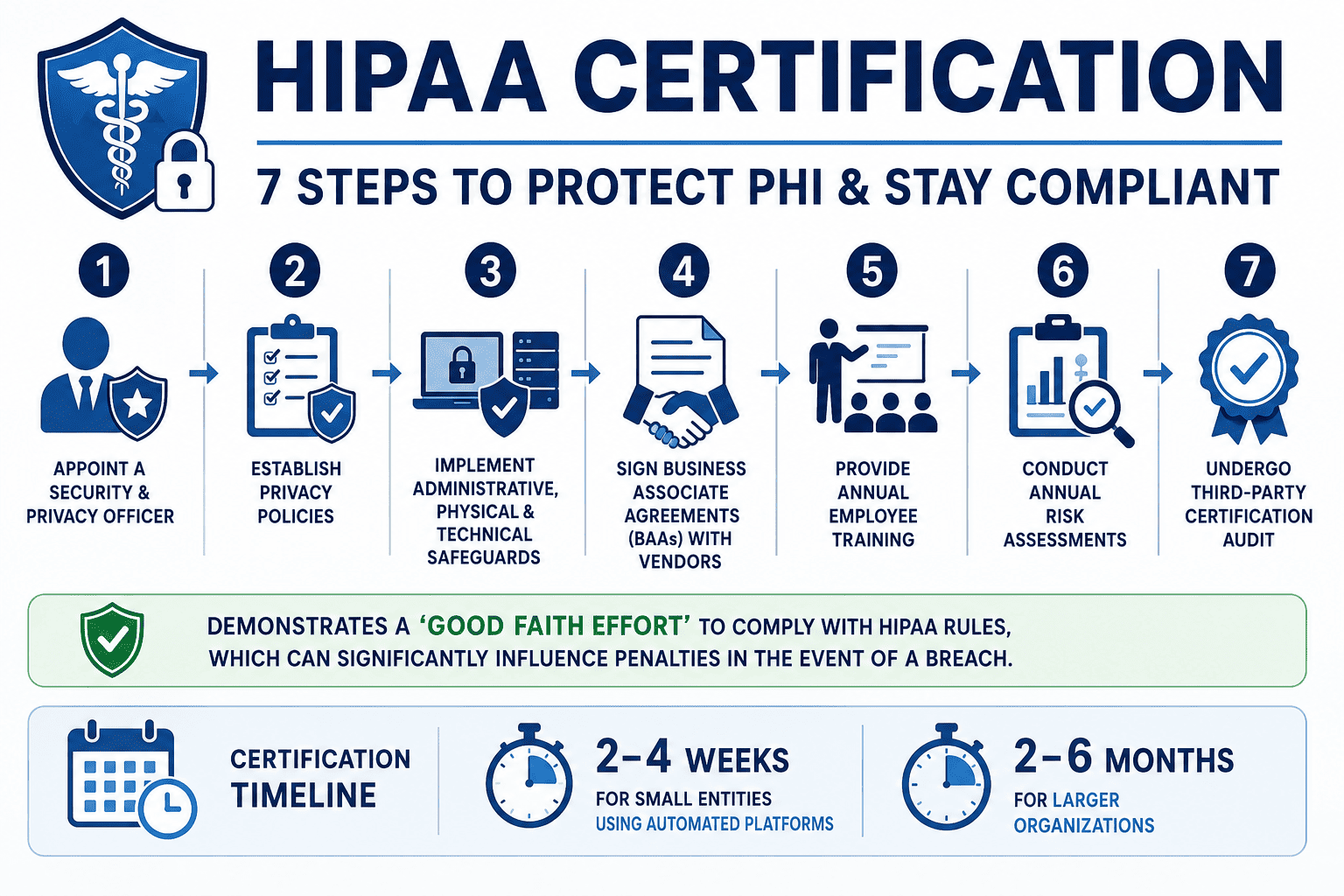
Direct Answer: HIPAA (Health Insurance Portability and Accountability Act) certification validates that an individual or organization has met the rigorous training and compliance standards to protect Protected Health Information (PHI). The process involves a structured 7-step program: Appoint a Security & Privacy Officer, Establish Privacy Policies, Implement Administrative, Physical, and Technical Safeguards, Sign Business Associate Agreements (BAAs) with vendors, Provide Annual Employee Training, Conduct Annual Risk Assessments, and Undergo a Third-Party Certification Audit. The certification demonstrates a ‘good faith effort’ to comply with HIPAA Rules, which can significantly influence penalties in the event of a breach. The timeline for certification typically ranges from 2-4 weeks for small entities using automated platforms to 2-6 months for larger organizations.
📅 July 6, 2026⏱ 15 min read✍️ GT Setu Editorial Team🔄 Updated regularly
$15M+
In HIPAA Violation Settlements (2023)
7
Key Steps to Certification
2–6
Months (Typical Timeline)
0%
GTsetu Broker Commission
The Health Insurance Portability and Accountability Act (HIPAA) of 1996 is a cornerstone of U.S. healthcare regulation, designed to protect sensitive patient health information from being disclosed without patient consent or knowledge. For healthcare providers, health plans, and their business associates, HIPAA compliance is not just a legal obligation—it’s a fundamental component of maintaining patient trust, ensuring privacy, and avoiding potentially devastating financial and legal penalties.
This guide provides a comprehensive roadmap to achieving HIPAA certification, covering everything from understanding the core regulations to implementing a robust compliance program and preparing for a third-party audit. Whether you are a hospital, a small medical practice, a health IT vendor, or a billing company, this guide will equip you with the actionable steps needed to protect PHI and demonstrate your commitment to compliance.
🛡️ Who Is This Guide For?
This guide is designed for compliance officers, privacy and security officials, healthcare administrators, IT managers, and business owners in the healthcare sector. It covers the end-to-end process of HIPAA certification, from the initial appointment of a compliance officer to the final certification audit. It is equally relevant for covered entities (hospitals, clinics, insurers) and business associates (IT vendors, billing companies, cloud providers) who handle PHI. For related frameworks, see our guides on ISO 27001 for information security and ISO 13485 for medical device quality.
SECTION 1
1 What Is HIPAA & Why Get Certified?
📋 The Law Explained
HIPAA, the Health Insurance Portability and Accountability Act, is a U.S. federal law enacted in 1996. Its primary goal is to reform the healthcare industry by reducing costs and simplifying administrative processes. However, its most recognized component today is the set of rules designed to protect the privacy and security of patients’ health information. This is achieved through three main rules: the Privacy Rule, which establishes national standards for protecting PHI; the Security Rule, which sets standards for securing electronic PHI (ePHI); and the Breach Notification Rule, which requires covered entities to notify affected individuals and HHS in the event of a breach. HIPAA certification is a voluntary but powerful way to demonstrate compliance with these rules, showing that your organization has implemented the necessary safeguards and training to protect patient data.
⚖️
Legal & Regulatory Compliance
HIPAA compliance is mandatory. Certification demonstrates a ‘good faith effort’ to adhere to the Privacy, Security, and Breach Notification Rules, which can be crucial in mitigating penalties during an investigation.
🛡️
Protection Against Data Breaches
A robust compliance program, guided by certification, helps identify and mitigate vulnerabilities before they can be exploited, significantly reducing the risk of costly data breaches.
🤝
Build Patient & Partner Trust
Certification signals to patients and business partners that you take data privacy and security seriously, fostering trust and strengthening professional relationships.
📈
Competitive Advantage
As healthcare organizations increasingly require their vendors to be HIPAA-compliant, certification can be a key differentiator, opening doors to new business opportunities and partnerships.
SECTION 2
2 Key Benefits of HIPAA Certification
Achieving HIPAA certification provides benefits that extend far beyond simple legal compliance. It builds a framework of trust, security, and operational efficiency that protects both the organization and its patients.
$4.3M
Highest individual HIPAA violation penalty in 2023 (OCR enforcement)
100-50K
Civil penalty range per violation, depending on the tier of negligence
250K
Maximum criminal penalty for wrongful disclosure of PHI under HIPAA
🛡️
Demonstrate “Good Faith” Compliance
In the event of an OCR investigation or a breach, a HIPAA certification serves as concrete evidence that your organization took reasonable steps to comply with the rules, which can significantly influence the outcome and reduce penalties.
Legal
🔒
Enhance Data Security Posture
The certification process requires a thorough risk assessment and the implementation of robust administrative, physical, and technical safeguards, directly improving your organization’s security and reducing the risk of breaches.
Security
🤝
Strengthen Partner & Patient Trust
Certification acts as a powerful signal to patients, partners, and regulators that you are committed to protecting their sensitive information, which is essential for building and maintaining strong relationships.
Trust
🚀
Gain a Competitive Market Advantage
Many healthcare organizations and business associates now require HIPAA compliance as a prerequisite for partnerships. Certification makes your services more attractive and can reduce friction in deal-making with covered entities.
Commercial
🧑⚕️
Build a Stronger Compliance Culture
Certification mandates comprehensive training for all staff, fostering a culture of compliance where every employee understands their role in protecting PHI and the consequences of non-compliance.
People
📋
Streamline & Document Compliance
The certification process helps you develop and maintain essential documentation, including policies, procedures, risk assessments, and training records, which are critical for ongoing compliance and audit readiness.
Documentation
SECTION 3
3 Who Needs HIPAA Certification?
HIPAA certification is crucial for any individual or organization that creates, receives, maintains, or transmits Protected Health Information (PHI). This includes a wide range of roles and entities within the healthcare ecosystem.
🏥Covered Entities
Healthcare Providers
Hospitals, clinics, physicians, nurses, therapists, pharmacists, and any healthcare professional who treats patients and has access to their medical records.
Primary HIPAA Obligation
💼Covered Entities
Health Plans & Insurers
Insurance companies, HMOs, Medicare, Medicaid, and other entities that provide or pay for healthcare services and thus handle PHI for claims and coverage.
Handle PHI for Claims
🔄Covered Entities
Healthcare Clearinghouses
Entities that process non-standard health information they receive from another entity into a standard format (or vice versa), acting as intermediaries in the healthcare data chain.
Data Processing Intermediaries
🤝Business Associates
Vendors & Service Providers
Cloud hosting providers, EHR vendors, billing agencies, IT support, transcription services, analytics vendors, and any third party that handles PHI on behalf of a covered entity.
Must Sign a BAA
🧑💻Workforce & Staff
Administrative & IT Teams
Medical records staff, billing/coding personnel, front-desk staff, IT and security teams, and any employee or volunteer who interacts with PHI as part of their role.
Require Role-Based Training
💡 Pro Tip: Don’t Forget the Business Associates
Many HIPAA violations occur due to oversight of business associates. A covered entity is ultimately responsible for its vendors’ compliance. Ensure that every vendor that touches PHI signs a Business Associate Agreement (BAA) and undergoes a security vetting process. This is a critical and non-negotiable step in the certification process. The same principle of rigorous partner vetting is covered in our ISO 27001 certification guide.
SECTION 4
4 Step 1: Appoint a Security & Privacy Officer
🏛️ Leadership & Accountability
The HIPAA Security Rule mandates that every organization appoint a Security Official and the Privacy Rule requires a Privacy Official. This is the foundational step for building a compliance program. The designated officer(s) will be responsible for developing, implementing, and overseeing the organization’s privacy and security policies, making them the central point of accountability for all HIPAA-related matters.
1.1
Identify the Right Person
Choose an individual with the authority and knowledge to lead the compliance effort. This can be an existing employee (e.g., a compliance officer, HR director, or IT manager) or a new hire. For many organizations, one person can serve in both the Security and Privacy roles.
1.2
Define Roles & Responsibilities
Clearly document the officer’s responsibilities. These include developing policies, conducting risk assessments, overseeing training, managing business associate agreements, and serving as the primary point of contact for breaches and patient privacy inquiries.
1.3
Provide Authority & Resources
The officer must have the organizational authority to enforce policies and the resources needed to implement the compliance program. This includes access to management, budget for training and security tools, and support for audits.
📋 HIPAA Requirement
This is a direct mandate of the HIPAA Security Rule (45 CFR § 164.308(a)(2)). The Security Officer must be designated to develop and implement the policies and procedures required by the Rule. Similarly, the Privacy Officer is required by the Privacy Rule (45 CFR § 164.530(a)).
SECTION 5
5 Step 2: Establish Privacy Policies & Procedures
With leadership in place, the next step is to develop and implement a comprehensive set of privacy policies and procedures. These documents are the blueprint for your organization’s HIPAA compliance, detailing how PHI is to be handled, protected, and disclosed in accordance with the Privacy Rule. They must be tailored to your organization’s specific size, structure, and operations.
Policy Area
Description
Key Consideration
Privacy Policy
Outlines how PHI can be used and disclosed. It defines the “Minimum Necessary” standard and the rights of individuals regarding their health information.
Must be in writing and made available to patients. It forms the basis of the Notice of Privacy Practices (NPP).
Security Policy
Details the administrative, physical, and technical safeguards for protecting ePHI. It covers access controls, audit logging, and data encryption.
Should be specific to your organization’s IT environment and be regularly reviewed and updated.
Breach Notification Policy
Defines procedures for detecting, investigating, and reporting a data breach to affected individuals, HHS, and the media, as required by the Breach Notification Rule.
Must be clear, actionable, and include a timeline for notification (within 60 days of discovery).
Incident Response Plan
Describes the steps to take during and after a security incident, including containment, investigation, and recovery procedures.
Should be tested regularly to ensure effectiveness. Roles and responsibilities must be clearly defined.
Business Associate Agreement (BAA) Policy
Outlines the process for vetting and signing BAAs with vendors, ensuring they are also compliant and will safeguard PHI.
Establishes a formal process for due diligence before PHI is shared with any third party.
Workforce Training Policy
Defines the mandatory training requirements for all staff, including initial and annual refresher training, and how training records will be maintained.
Training must be role-based and documented for a minimum of six years.
Disposal Policy
Specifies how PHI in both physical and electronic form must be securely destroyed when no longer needed.
Includes methods like shredding for paper and data wiping or degaussing for electronic media.
💡 Documentation is Key
HIPAA requires that all policies and procedures be maintained in writing and retained for at least six years from the date of their creation or the date they were last in effect. Use a centralized, secure document management system to keep all your policies, procedures, and records organized and easily accessible for audits. This principle of maintaining robust documentation is also a cornerstone of ISO 9001 certification.
The HIPAA Security Rule requires organizations to implement a comprehensive set of safeguards to protect ePHI. These safeguards fall into three main categories: administrative, physical, and technical. Each category addresses different aspects of data protection, from policies and procedures to physical access controls and cybersecurity measures. Implementing these safeguards is a core requirement for certification.
📋
Administrative Safeguards
The foundation of the Security Rule, these are documented policies and procedures that manage the selection, development, and implementation of security measures. Key elements include a security management process, risk analysis, and the designation of a Security Officer.
🏢
Physical Safeguards
Controls to protect the physical facilities, workstations, and devices that store or transmit ePHI. This includes facility access controls, workstation security, and device and media controls (e.g., secure disposal, reuse, and accountability).
💻
Technical Safeguards
The technology and related policies that protect ePHI and control access to it. This includes access control (unique user IDs and passwords), audit controls, data encryption, and transmission security to protect data in transit.
🔐
Access Control (Technical)
Implement unique user identification, emergency access procedures, automatic logoff, and encryption to ensure that only authorized personnel can access ePHI.
Technical
📊
Audit Controls (Technical)
Implement hardware, software, and/or procedural mechanisms to record and examine activity in information systems that contain or use ePHI.
Technical
🔏
Data Encryption (Technical)
Encrypt ePHI at rest and in transit whenever feasible. While “addressable,” encryption is a critical best practice and is strongly encouraged for robust security.
Technical
🚪
Facility Access Controls (Physical)
Limit physical access to facilities where ePHI is stored, including policies for visitor access, building security, and secure work areas.
Physical
🖥️
Workstation & Device Security (Physical)
Implement policies and procedures to secure workstations and devices that access ePHI, including physical safeguards and proper disposal of media.
Physical
📝
Security Management Process (Administrative)
Conduct a thorough risk analysis to identify threats and vulnerabilities to ePHI, and implement security measures to reduce those risks to a reasonable and appropriate level.
Administrative
👥
Workforce Security (Administrative)
Implement policies and procedures to ensure that all members of the workforce have appropriate access to ePHI and that they are trained on security and privacy practices.
Administrative
SECTION 7
7 Step 4: Sign Business Associate Agreements (BAAs)
🤝 Managing Third-Party Risk
A Business Associate Agreement (BAA) is a legally binding document required under HIPAA. It mandates that a business associate (a third-party vendor) will implement safeguards to protect the PHI it receives or creates on behalf of a covered entity. The BAA clearly defines the responsibilities of both parties concerning PHI, making the business associate directly responsible for its compliance. Without a signed BAA, sharing PHI with a vendor is a violation of HIPAA.
7.1
Identify All Business Associates
Create a comprehensive list of all vendors, service providers, and partners that create, receive, maintain, or transmit PHI on your behalf. This can include IT hosting, billing, legal, and consulting services.
7.2
Vet Vendors for Compliance
Before signing a BAA, conduct due diligence. This often includes sending a vendor questionnaire to assess their security and privacy controls, ensuring they have a robust compliance program in place.
7.3
Execute the BAA
Sign a BAA with each compliant vendor before any PHI is shared. The BAA should clearly state the permitted uses and disclosures of PHI, and require the vendor to report any breaches to the covered entity.
7.4
Maintain an Accurate Log
Keep a current, organized log of all BAAs. This log is a critical document for audits and demonstrates that you are actively managing third-party risk, a key component of both HIPAA and ISO 27001 certification.
⚠️ Common Mistake
The most common and costly mistake is assuming that a “standard” BAA from a vendor is sufficient. Ensure the BAA is specific and legally sound, and don’t skip the vendor vetting process. A signed BAA does not guarantee a vendor is secure—it only holds them accountable if they are not.
SECTION 8
8 Step 5: Provide Annual Employee Training
Your organization’s HIPAA compliance is only as strong as your employees’ understanding and adherence to the rules. HIPAA explicitly requires that all members of the workforce receive training on the organization’s privacy and security policies and procedures. This is not a one-time event but an ongoing obligation that requires regular refresher training.
🎓
Initial Training
All new employees, volunteers, and trainees must receive comprehensive training on HIPAA basics, their role-specific responsibilities, and your organization’s policies. This should be completed as part of the onboarding process.
Onboarding
🔄
Annual Refresher Training
Provide mandatory annual training to reinforce key concepts, update staff on any policy changes, and address new or evolving threats (e.g., social engineering, ransomware). This keeps compliance top-of-mind.
Ongoing
📝
Role-Based Training
Tailor training to specific roles. A clinician needs training on patient rights and secure disclosure, an IT admin needs deep-dive Security Rule training, and a billing clerk needs training on the Minimum Necessary Standard.
Specialized
✅
Document All Training
Maintain rigorous records of all training, including a signed confirmation of completion from each attendee. This is a mandatory requirement (document retention for six years) and is a key piece of evidence for auditors.
Documentation
💡 Leverage Training Resources
Utilize professional, up-to-date training materials. Organizations like HIPAATraining.com, Accountable HQ, and others offer engaging, role-based courses that make training easier to administer and track. Many offer group discounts, making it cost-effective for larger teams. The U.S. Department of Health and Human Services (HHS) also provides free foundational training materials on its website.
SECTION 9
9 Step 6: Conduct Annual Risk Assessments
A security risk assessment (SRA) is the cornerstone of an effective HIPAA compliance program. It is a thorough, documented process for identifying and evaluating risks to the confidentiality, integrity, and availability of ePHI. The SRA must be conducted annually and whenever there are significant changes to the organization’s IT environment or operations. The findings of the SRA inform the implementation of appropriate security measures.
Risk Assessment Phase
Description
Key Output
1. Identify Data & Assets
Comprehensively inventory all locations where ePHI is stored, received, maintained, or transmitted. This includes data on servers, workstations, mobile devices, and cloud storage.
A complete data flow map and asset inventory.
2. Identify Threats & Vulnerabilities
Document all reasonably anticipated threats (e.g., cyberattacks, natural disasters, human error) and vulnerabilities (e.g., lack of encryption, weak passwords, unpatched software).
A comprehensive threat and vulnerability list.
3. Assess Current Security Measures
Evaluate the effectiveness of your current administrative, physical, and technical safeguards in mitigating the identified risks.
An analysis of existing controls and their efficacy.
4. Determine Risk Levels
For each risk, assign a likelihood and impact level to prioritize which risks need immediate attention. This creates a risk register.
A prioritized risk register with a risk score for each item.
5. Develop a Remediation Plan
Create a detailed plan to address each high-priority risk. This should include specific actions, responsible parties, and a timeline for completion.
An actionable, documented remediation plan.
6. Document & Review
Document the entire risk assessment process, including the methodology, findings, and the remediation plan. This document is essential for demonstrating compliance.
A comprehensive and signed-off risk assessment report.
📋 The Result
A well-executed risk assessment is the most critical document in your compliance portfolio. It provides a clear roadmap for your security program, demonstrates due diligence to auditors, and can be a powerful tool in mitigating penalties in the event of a breach.
The final step in the HIPAA certification process is a formal audit by a reputable third-party organization. This audit provides an independent, objective assessment of your compliance program. A successful audit validates that your policies, safeguards, and procedures meet the requirements of the Privacy, Security, and Breach Notification Rules, resulting in an official HIPAA certification that you can share with partners, clients, and regulators.
Audit Component
What is Reviewed
How to Prepare
Documentation Review
Privacy and Security Policies, BAAs, Training Records, Risk Assessment Reports, and Incident Response Plans.
Ensure all documents are current, complete, and easily accessible in a centralized repository.
Security & Privacy Controls
Implementation of administrative, physical, and technical safeguards. This includes interviews with staff and a review of system configurations.
Conduct a pre-audit self-assessment to identify and fix any gaps. Ensure your safeguards are fully implemented and documented.
Training Verification
Review of training records and may include interviews with staff to confirm their knowledge of HIPAA policies.
Ensure all training is up-to-date and records are retained. Engage staff in the preparation process.
Breach & Incident Management
Review of your Breach Notification Policy, Incident Response Plan, and any documented incidents or breaches.
Test your incident response plan and ensure all protocols are clear and well-documented.
Ongoing Monitoring
Many certification bodies will require ongoing monitoring or annual surveillance audits to maintain certification.
Plan for continuous compliance and be prepared for periodic reviews of your program.
💡 Selecting a Third-Party Auditor
Choose a reputable organization with deep expertise in HIPAA compliance and healthcare IT. Look for a provider that offers a comprehensive audit service and a clear path to certification. A good auditor will not only find gaps but also provide guidance on how to remediate them, making your compliance program stronger. For related partner and vendor risk management, also see our guide on ISO 27001 certification.
SECTION 11
11 Costs & Timeline: What to Expect
The cost and timeline for HIPAA certification are highly variable. They depend on the size and complexity of your organization, the current state of your compliance, and whether you use a consultant or an automated compliance platform.
Factor
Impact on Cost
Impact on Timeline
Organisation Size
Small (1-50): $10,000–$25,000 Medium (50-250): $25,000–$75,000 Large (250+): $75,000–$150,000+
More PHI = more complex safeguards, increased audit scope, and higher cost.
More complexity extends the assessment and implementation phases.
IT Environment Complexity
Complex on-premise systems, multiple cloud providers, and diverse mobile devices increase the cost of technical safeguards and assessments.
IT audits and remediation take longer for complex environments.
Use of Compliance Automation
Platforms like Sprinto can significantly reduce manual effort, lowering overall cost.
Can cut timeline by 30-50% by automating risk assessments, evidence collection, and policy management.
Number of Business Associates
Vetting and managing BAAs for many vendors increases administrative overhead and cost.
Reviewing and signing BAAs with numerous vendors is a significant administrative task.
Consultant Involvement
Full-service consultants can cost $10,000–$50,000+; basic training and template packages are more affordable.
A consultant can accelerate the timeline by providing expertise and project management.
📋 Digital & Low-Cost Certification Options
Several providers offer digital HIPAA compliance and certification platforms, such as Sprinto, Accountable HQ, and HIPAATraining.com. These solutions provide a guided, automated approach to building your compliance program. Subscription models can start at a few hundred dollars per month for training and basic tools, with more comprehensive certification packages costing more. This makes certification more accessible to smaller organizations that may find traditional consulting fees prohibitive.
SECTION 12
12 Common Mistakes & How to Avoid Them
🤝
Overlooking Business Associates
Failing to vet and sign BAAs with all vendors who handle PHI is one of the most common and costly mistakes. It creates a major compliance gap and legal liability.
Avoid: Create a comprehensive vendor inventory. Ensure a signed BAA is in place before any PHI is shared and conduct security vetting on all new vendors.
🎓
Inadequate or Generic Training
Providing generic, one-size-fits-all training or failing to track and document it properly is a common pitfall that leaves staff ill-equipped to handle PHI.
Avoid: Implement role-based, engaging training. Use a Learning Management System (LMS) to track completion and retention. Include real-world scenarios.
📄
Treating Certification as the End Goal
Obtaining certification is just the beginning. A common mistake is to let the compliance program stagnate after certification, ignoring the need for ongoing vigilance.
Avoid: Treat compliance as a continuous cycle. Conduct regular risk assessments, update policies, provide annual training, and maintain a culture of security.
🔍
Ignoring the Risk Assessment
Conducting a risk assessment just to “check the box” and failing to address the findings is a critical error that leaves your organization vulnerable.
Avoid: Use the risk assessment as a roadmap. Prioritize and act on the findings. Document your remediation plan and track its implementation. This principle is a core requirement of ISO 9001 as well.
🕵️
Not Having a Clear Incident Response Plan
Reacting to a breach without a clear plan leads to delays, missteps, and potentially severe penalties.
Avoid: Develop and document a detailed incident response plan. Conduct regular tabletop exercises to test the plan and ensure everyone knows their role.
📝
Poor Documentation
Failing to maintain thorough, organized records of policies, training, risk assessments, and BAAs is a common oversight that makes audits difficult and exposes you to risk.
Avoid: Implement a centralized, secure system for managing all HIPAA documentation. Regularly review and update documents to keep them current.
SECTION 13
13 How GTsetu Supports Your HIPAA Compliance Journey
🔗 GTsetu, Verified B2B Platform
Connect with Verified & Compliant Healthcare Partners
HIPAA compliance is critical, and ensuring your business associates are also compliant is a key part of the process. GTsetu simplifies partner due diligence by connecting you with verified healthcare and business partners who meet rigorous standards. Our platform provides:
✅
Verified Company Profiles
Every company on GTsetu is verified on 6 key data points (Name, Address, Registration Number, Company Status, Type, Incorporation Date) using government tie-ups—complementing your HIPAA Business Associate vetting process.
🕵️
Anonymous Discovery
Browse verified partner profiles without revealing your identity until you’re ready to engage—protecting your business strategy and commercial confidentiality during due diligence.
📄
Built-In NDA Workflow
Digital mutual NDA with timestamped signatures—activated before any sensitive PHI-related or commercial data is exchanged, supporting your HIPAA Security Rule and confidentiality commitments.
🔐
Encrypted Document Workspace
AES-256 encryption at rest, TLS in transit, role-based access controls, and full audit trail—ensuring the secure exchange of BAAs, compliance documentation, and other sensitive data with partners.
🚫
Zero Broker Commission
GTsetu charges zero commission on any partnership formed. All commercial value stays between you and your verified partner—supporting the cost management objectives of your compliance program.
🌏
Global Network of Verified Partners
Access verified healthcare providers, technology vendors, and business associates across 100+ countries—supporting your supply chain due diligence and enabling you to build a network of HIPAA-aligned partners.
QWhat is HIPAA certification and why is it important?
HIPAA certification refers to the formal validation that an individual or organization has met the training and compliance requirements of the Health Insurance Portability and Accountability Act (HIPAA). It demonstrates that healthcare professionals, covered entities, and business associates understand and can implement the Privacy, Security, and Breach Notification Rules to protect Protected Health Information (PHI). Certification is crucial for legal compliance, building patient trust, and reducing the risk of costly violations, which in 2023 alone totaled over $15 million in settlements.
QWhat are the 7 key steps to get HIPAA certified?
The 7 key steps are: (1) Select a Security & Privacy Officer to lead the program. (2) Establish comprehensive privacy policies and procedures. (3) Implement administrative, physical, and technical safeguards to secure PHI. (4) Sign Business Associate Agreements (BAAs) with all vendors that handle PHI. (5) Provide annual HIPAA training to all staff members. (6) Conduct annual risk assessments to identify and mitigate vulnerabilities. (7) Engage a third-party certification body for a formal compliance audit.
QHow long does it take to get HIPAA certification?
The timeline varies based on your organization’s size, complexity, and current compliance posture. For a small practice or business associate, the process can take 2-4 weeks if you use a structured, automated compliance platform. For larger organizations with more complex systems, the process may take 2-6 months. This timeline includes policy development, safeguard implementation, training, risk assessment, and the final certification audit.
QHow much does HIPAA certification cost?
The cost of HIPAA certification varies significantly. Individual training and certification courses range from $10 to $30. For organizations, the cost of a comprehensive compliance program and third-party certification can start at $10,000 and exceed $150,000 depending on the complexity and size of the organization. Factors influencing cost include the number of employees, the volume of PHI handled, the complexity of IT systems, and the use of compliance automation software.
QWhat are the key documents required for HIPAA certification?
Key required documents include: a Privacy Policy and Security Policy, a Risk Assessment and Risk Management Plan, a Breach Notification Policy, an Incident Response Plan, a Business Associate Agreement (BAA) template, Employee Training Records, and a Disaster Recovery/Business Continuity Plan. These documents demonstrate a proactive approach to safeguarding PHI and meeting regulatory requirements.
QIs HIPAA certification mandatory by law?
No, HIPAA certification is not mandatory under the law. The U.S. Department of Health and Human Services (HHS) does not recognize or issue official HIPAA certifications. However, it is a voluntary best practice that demonstrates a ‘good faith effort’ to comply with the HIPAA Rules. In the event of a breach or an OCR investigation, having a certification from a reputable third-party can significantly influence the outcome, potentially reducing penalties by showing that your organization took compliance seriously.
QWho needs HIPAA certification?
HIPAA certification is essential for anyone who creates, views, sends, or stores Protected Health Information (PHI). This includes: (1) Covered Entities: Healthcare providers (doctors, nurses, hospitals), health plans, and healthcare clearinghouses. (2) Business Associates: Any vendor that handles PHI on behalf of a covered entity, such as cloud hosting providers, EHR vendors, billing agencies, and IT support companies. (3) Staff: Administrative staff, medical records personnel, billing and coding teams, IT and security teams, and even healthcare students and volunteers who have access to PHI.
Connect with verified healthcare providers, technology vendors, and business associates on GTsetu—compliance-backed verification, anonymous discovery, built-in NDA workflows, and zero broker commissions. Find partners who share your commitment to protecting patient data.
They represents the product, and research team behind GTsetu, a global B2B collaboration platform built to help companies explore cross-border partnerships with clarity and trust. The team focuses on simplifying early-stage international business discovery by combining structured company profiles, verification-led access, and controlled collaboration workflows.
With a strong emphasis on trust, and disciplined engagement, Team GTsetu shares insights on global trade, partnerships, and cross-border collaboration, helping businesses make informed decisions before entering deeper commercial discussions.