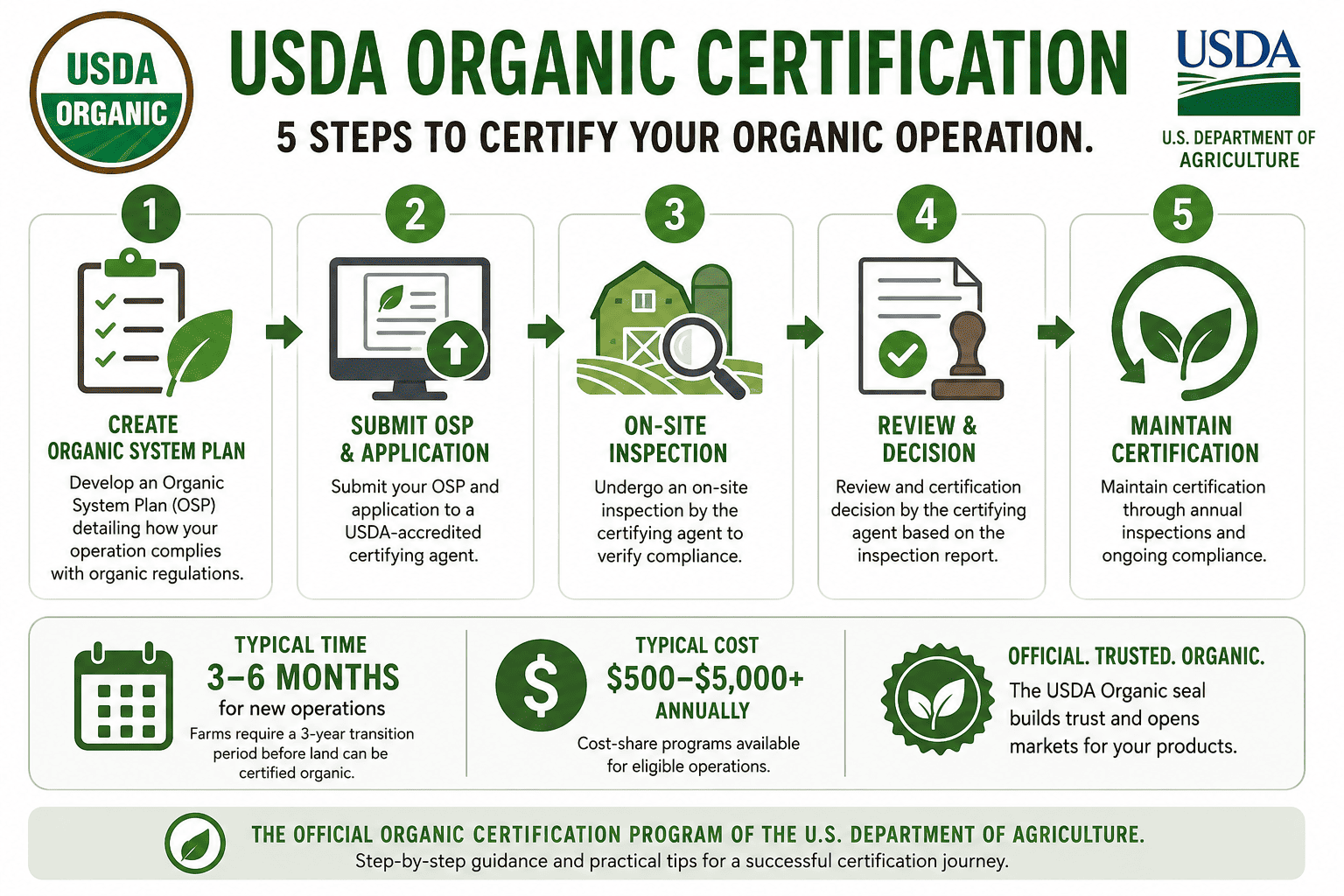
Direct Answer: USDA Organic certification is the official organic product certification program of the US Department of Agriculture, developed under the Organic Foods Production Act of 1990 and administered by the National Organic Program (NOP). Getting certified involves a structured 5-step process: Create an Organic System Plan (OSP) detailing how your operation complies with organic regulations, Submit the OSP and application to a USDA-accredited certifying agent, Undergo an on-site inspection by the certifying agent to verify compliance, Review and certification decision by the certifying agent based on the inspection report, and Maintain certification through annual inspections and ongoing compliance. The process typically takes 3-6 months for new operations, with farms requiring a 3-year transition period before land can be certified organic. Costs range from $500 to $5,000+ annually, with cost-share programs available for eligible operations. This guide walks you through every step, with practical tips for a successful certification journey.
📅 July 6, 2026⏱ 16 min read✍️ GT Setu Editorial Team🔄 Updated regularly
$350B+
Global Organic Market Value
5
Key Steps to Certification
3-6
Months (Typical Timeline)
0%
GTsetu Broker Commission
USDA Organic certification is the official organic product certification program of the US Department of Agriculture. It was developed in response to passage of the Organic Foods Production Act of 1990 (OFPA) and is administered by the National Organic Program (NOP). The NOP is a federal regulatory program that develops and enforces consistent national standards for organically produced agricultural products sold in the United States. The first organic products appeared in the marketplace with the USDA Organic seal in 2002.
For farmers, processors, handlers, and businesses in the organic supply chain, USDA Organic certification demonstrates a commitment to ecological balance, biodiversity conservation, and resource cycling. It is essential for accessing the growing organic market, valued at over $350 billion globally, and for building consumer trust through third-party verification. This guide covers the complete certification process, from creating your Organic System Plan through to maintaining certification with annual inspections, and provides practical, actionable advice for a successful journey. See our related guides on ISO 14001 environmental management and ISO 9001 quality management to understand how organic certification integrates with broader sustainability and quality frameworks.
🌱 Who Is This Guide For?
This guide is written for farmers, ranchers, food processors, handlers, importers, exporters, and any business involved in the organic supply chain seeking USDA Organic certification. It covers the full certification process from creating an Organic System Plan through to maintaining certification with annual inspections. It is relevant for operations of all sizes, from small farms to large processing facilities, and for businesses seeking to enter the growing organic market. For related partnership structures, see our guides on supplier collaboration and environmental management systems.
SECTION 1
1 What Is USDA Organic Certification & Why Get Certified?
🌱 The Standard Explained
USDA Organic certification is the official organic product certification program of the US Department of Agriculture. It verifies that farms or handling facilities comply with USDA organic regulations, ensuring products are produced without prohibited pesticides, synthetic fertilizers, antibiotics, or GMOs. The certification is administered by the National Organic Program (NOP), a federal regulatory program that develops and enforces consistent national standards for organically produced agricultural products sold in the United States. NOP also accredits third-party organizations (certifying agents) to certify that farms and businesses meet the national organic standards. These certifiers and USDA work together to enforce the standards, ensuring a level playing field for producers and protecting consumer confidence in the integrity of the USDA Organic Seal.
🌎
Globally Recognized Standard
USDA Organic standards are recognized by Canada, the European Union, Switzerland, the United Kingdom, Japan, South Korea, and Taiwan through equivalency arrangements, facilitating international trade of organic products.
🏛️
Regulatory & Market Access
Certification is required to sell, label, or represent products as organic in the U.S. market. It is essential for accessing the growing organic market and meeting retailer, consumer, and export requirements.
💰
Price Premiums & Market Value
Organic products command significant price premiums compared to conventional products, and certification enables access to the $350+ billion global organic market.
🌱
Environmental & Health Benefits
Organic farming promotes ecological balance, biodiversity conservation, soil health, and water quality. It reduces exposure to synthetic chemicals for farmers, workers, and consumers.
SECTION 2
2 Key Benefits of USDA Organic Certification
USDA Organic certification delivers tangible benefits across commercial, regulatory, and environmental dimensions. The certification process requires investment, but the return on that investment is well-documented across the organic sector.
$350B+
Global organic market value (growing annually)
40%
U.S. share of the global organic market
20-50%
Typical price premium for organic products
💰
Market Access & Price Premiums
Organic certification enables access to the growing organic market, with products typically commanding significant price premiums. Certification is required to sell, label, or represent products as organic in the U.S. market.
Commercial
🏛️
Regulatory Compliance & Consumer Trust
Certification demonstrates compliance with federal organic regulations and builds consumer trust through third-party verification. The USDA Organic Seal is a powerful symbol of quality and integrity.
Compliance
🌱
Environmental Stewardship
Organic certification promotes ecological balance, biodiversity conservation, soil health, water quality, and energy conservation. It supports sustainable farming practices and resource cycling.
Environmental
🏥
Health & Safety Benefits
Organic products are produced without synthetic pesticides, fertilizers, antibiotics, or GMOs, reducing exposure to potentially harmful substances for farmers, workers, and consumers.
Health
🌍
International Trade Access
USDA Organic standards are recognized through equivalency arrangements with Canada, the EU, Switzerland, the UK, Japan, South Korea, and Taiwan, facilitating export opportunities.
Trade
🤝
Supply Chain Integrity
Certification requires strict physical separation of organic products from non-certified products, detailed recordkeeping (audit trail), and transparency throughout the supply chain.
Supply Chain
SECTION 3
3 USDA Organic Standards & Requirements
USDA organic standards outline the specific requirements that must be verified by a USDA-accredited certifying agent to allow a product to be labeled as organic. The standards differ depending on the product type, including crop requirements, livestock and poultry requirements, and handling requirements. Any organic operation violating the USDA organic regulations faces enforcement actions, which can include financial penalties or suspension/revocation of their organic certificate.
Production Type
Key Requirements
Prohibited Practices
Crop Production
Land must be free from prohibited substances for 3+ years. Soil fertility must be maintained by approved organic methods. Use of organic seeds and planting stock. Buffer zones from conventional farms required.
100% organic feed (with USDA-approved vitamin/mineral supplements). Access to pasture (for ruminants). Natural living conditions. Preventive health practices. Humane treatment standards.
Antibiotics, growth hormones, confinement without access to pasture, mammalian/avian byproducts in feed
Handling & Processing
Strict physical separation from non-organic products. Protection from contamination and commingling. Use of substances on National List of Allowed and Prohibited Substances.
Synthetic additives, artificial flavors/colors/preservatives, irradiation, GMOs, non-organic ingredients (except those on National List)
🌱 Key Principles of Organic Production
USDA organic standards are built on several key principles: No synthetic chemicals, the use of synthetic fertilizers, herbicides, and pesticides is not allowed; Non-GMO, genetically modified organisms are not allowed; Animal welfare, products of animal origin must meet humane treatment standards, including access to pasture and organically produced feed; Ecological balance, operations must maintain or improve soil and water quality while conserving natural ecosystems; Traceability, detailed production and sales records (audit trail) must be maintained from farm to table.
SECTION 4
4 Step 1: Create an Organic System Plan (OSP)
📋 The Foundation of Certification
The Organic System Plan (OSP) is the foundation of the USDA organic certification process. It is a detailed document that describes how your operation complies with organic regulations based on its specific activities, products, and production methods. The OSP provides a clear, honest picture of your organic operation, from seed to sale, showing your commitment to integrity, sustainability, and trust in every product you offer.
1.1
Describe Your Operation
Provide details about who you are, what you produce, and where your products are grown or made. Include the land’s history, the seeds and inputs you use, and how you build healthy, fertile soil. For handlers and processors, describe how organic products are kept separate and protected from contamination during processing, storage, and packaging.
1.2
Document Production Methods
Explain your methods for managing pests and weeds, maintaining soil fertility, and implementing conservation practices. For livestock operations, describe animal housing, feed, health care practices, and pasture management. For processing operations, detail handling procedures, cleaning protocols, and contamination prevention measures.
1.3
List All Inputs & Materials
Identify all substances used in production, including fertilizers, pesticides, feed, additives, and cleaning agents. Ensure all inputs are approved for use in organic production and are on the National List of Allowed and Prohibited Substances. Document the source and composition of all materials.
1.4
Describe Recordkeeping & Labeling
Include your recordkeeping practices to ensure transparency and traceability, along with how your products are labeled and marketed. Detail the audit trail from input receipt to final product sale. Describe how you will maintain organic integrity through the supply chain.
1.5
Establish Monitoring & Documentation
Define how you will monitor compliance with your OSP and document all activities. Include procedures for maintaining records, tracking inputs, and demonstrating that organic standards are met throughout the production cycle. This documentation is essential for the annual inspection.
💡 Pro Tip: Start Early and Be Thorough
An incomplete or outdated Organic System Plan is one of the most common reasons for certification delays. Start developing your OSP early in the certification process, and be thorough in documenting all aspects of your operation. A well-prepared OSP streamlines the inspection process and helps avoid costly delays. The same principle applies when building a quality management system, start with a solid foundation and maintain comprehensive documentation.
SECTION 5
5 Step 2: Submit Application to Certifying Agent
Once your Organic System Plan is complete, the next step is to submit your application to a USDA-accredited certifying agent. USDA Organic Certification is issued by accredited certifying agents, including private, state, and foreign organizations. These agents are responsible for verifying that organic standards are met throughout the operation.
Certifying Agent Type
Description
Key Considerations
Private Certifying Agents
Independent, third-party organizations accredited by USDA to certify organic operations. Examples include SCS Global Services, QAI (NSF), and CCOF.
May offer additional services (e.g., Non-GMO, Fair Trade, sustainability certification). Compare fees, reputation, and industry experience. Consider their market recognition and logo value.
State Certifying Agents
State government agencies accredited by USDA to certify organic operations. Examples include the California Department of Food and Agriculture.
Often serve specific state-level requirements. May be cost-effective for in-state operations. Understand their scope and reciprocity with other states.
Foreign Certifying Agents
Accredited certifying agents outside the U.S. that certify operations exporting organic products to the U.S.
Required for international operations seeking to export organic products to the U.S. Must be accredited by USDA for equivalency or compliance with NOP standards.
💡 Choosing a Certifying Agent
When selecting a certifying agent, consider: Accreditation status, ensure they are USDA-accredited; Industry experience, choose agents with expertise in your specific crop, livestock, or processing sector; Market recognition, some certifier logos have high consumer recognition value; Cost, compare fees and understand what is included; Customer support, evaluate their responsiveness and technical expertise. Many certifiers also offer bundled services (e.g., Non-GMO verification, food safety audits) that can save time and money. The selection process should mirror the rigor you would apply when using partnership evaluation criteria to choose any business partner.
SECTION 6
6 Step 3: Undergo On-Site Inspection
A certifying agent conducts on-site inspections of all operations involved in the certification process. Inspections vary depending on the scope of production and may include evaluation of soil health, pest management practices, water systems, storage areas, and equipment. The inspector conducts a physical inspection, reviews records, interviews personnel, and conducts an exit interview.
🔍
Physical Inspection
The inspector visits fields, facilities, storage areas, and equipment to verify that organic practices are being implemented as described in the OSP. They check for buffer zones, contamination risks, and physical separation from non-organic operations.
📋
Record Review
Inspectors review production and sales records to verify traceability and compliance. They check input receipts, application logs, harvest records, sales invoices, and pest management documentation. Detailed records are essential for successful inspection.
🗣️
Personnel Interviews
Inspectors interview key personnel to verify understanding of organic practices and compliance with the OSP. Be prepared to demonstrate that all staff understand their roles in maintaining organic integrity.
📄
Report of Findings
After the audit, the inspector prepares a Report of Findings comparing observed practices with the approved Organic System Plan. The report also includes risk assessments, contamination prevention measures, and identification of potential non-compliance areas.
🔄
Corrective Actions
If any non-compliances are identified, the certifying agent will work with you to complete the corrective action process. Address identified issues promptly to ensure certification can be granted without significant delays.
📆
Annual Inspection Requirement
Audits must be conducted annually to maintain certification. Plan ahead and schedule inspections early to avoid certification lapses. Annual inspections are required by USDA regulation and are the foundation of ongoing compliance.
SECTION 7
7 Step 4: Review & Certification Decision
Based on the inspection report and documentation review, the certifying agent determines whether the operation complies with USDA organic standards and issues the organic certificate accordingly. If any non-compliances are identified, the certifying agent will work with you to complete the corrective action process.
Review Stage
What Happens
Key Focus
Documentation Review
The certifying agent reviews your OSP and all supporting documentation to ensure it meets USDA organic requirements and is ready for on-site verification.
Completeness and adequacy of the OSP. Identification of any gaps or nonconformities that must be addressed before inspection.
Inspection Report Review
The certifying agent evaluates the inspector’s report and compares observed practices with the approved OSP. They assess risk, contamination prevention, and potential non-compliance areas.
Verification that implemented practices match the OSP. Assessment of compliance with organic standards and regulatory requirements.
Certification Decision
Based on the documentation and inspection report, the certifying agent determines whether the operation complies with USDA organic standards and issues the organic certificate accordingly.
Overall conformity assessment. The certificate is issued when all requirements are met and any non-compliances are resolved.
Certificate Issuance
When certification is granted, a certificate is issued. Once certified, you can reinforce your brand with the USDA Organic seal and the certifying agent’s logo.
Certificate details the scope of certification (products, activities, locations). Valid for one year, subject to annual inspection.
💡 Preparing for the Certification Decision
DO: Ensure your OSP is complete and up-to-date before the inspection. Prepare all required records and documentation for review. Address any non-compliances promptly and thoroughly. Maintain open communication with your certifying agent throughout the process.
DON’T: Wait until the inspection to prepare records. Ignore non-compliances identified during the inspection. Assume that what is not documented doesn’t need to be tracked. Forget to update your OSP when changes occur.
The same careful approach to documentation is critical when building an ISO 9001 QMS, maintain thorough records and evidence of compliance.
To maintain certification, operations must undergo annual inspections and continuously comply with USDA organic certification requirements. Organic certification is an ongoing commitment to maintaining organic integrity, not a one-time achievement. Operations must continuously review and update their Organic System Plan and daily practices to ensure ongoing compliance.
📅
Annual Inspections
Schedule and prepare for annual inspections well in advance. Inspections include physical review of operations, record verification, and personnel interviews. Annual inspections are required by USDA regulation and are the foundation of maintaining certification.
Compliance
📋
Maintain Records & Audit Trail
Maintain detailed production and sales records to ensure traceability from input to final product. Keep input receipts, application logs, harvest records, sales invoices, and pest management documentation. Records must be retained for a defined period and be accessible for inspection.
Records
🔄
Update OSP & Practices
Continuously update your Organic System Plan to reflect changes in operations, inputs, or production methods. Ensure that daily practices align with the approved OSP. Training and education help ensure all staff understand and follow current certification and handling requirements.
Continuous
📊
Monitor Regulatory Changes
Regularly monitor USDA updates and guidance to ensure certification remains valid. Organic regulations may change over time, and staying updated is essential to maintain certification and avoid non-compliance. The Strengthening Organic Enforcement (SOE) rule, for example, introduced significant changes to certification requirements.
Monitoring
🎓
Training & Education
Free training resources are available through the Organic Integrity Learning Center for organic professionals. Continuous education helps ensure that all staff understand and follow current certification and handling requirements. Training is essential for preventing common errors and maintaining certification.
Training
🌱
Implement Corrective Actions
If non-compliances are identified during inspections or self-audits, implement corrective actions promptly. Document the root cause, corrective action, and verification of effectiveness. This continuous improvement cycle is essential for maintaining organic integrity.
Improvement
SECTION 9
9 Costs & Timeline: What to Expect
The cost and timeline for USDA Organic certification vary based on operation type, size, complexity, and the certifying agent. Understanding these variables upfront helps in planning and budget setting. Many eligible operations can receive partial reimbursement through USDA organic certification cost-share programs, reducing the net financial burden for organic certification.
Cost Component
Description
Typical Range
Application Fee
Paid when submitting the Organic System Plan and supporting documents. Covers initial processing and review.
$100 – $500
Inspection Fee
Covers the on-site inspection, often based on inspector time and travel. Higher for larger or more complex operations or remote locations.
$500 – $3,000+
Certification & Annual Review Fee
Charged each year to maintain active certification. Covers ongoing oversight, record review, and certification administration.
$200 – $1,500+
Additional Costs
Laboratory residue testing or extra inspections when risks are identified. May include travel expenses for inspectors.
Varies
Total Annual Cost
Total cost for maintaining organic certification. Cost-share programs may reimburse up to 75% of eligible costs (up to $750 per certification scope).
$500 – $5,000+
📋 Timeline for Certification
New Operations: The process typically takes 3-6 months from application to certification, assuming all requirements are met. Transitioning Farms: Conventional farmland must undergo a 3-year organic transition period before land can be certified organic. During this period, organic practices must be implemented, but products cannot be labeled as organic. Annual Inspections: To maintain certification, operations must undergo annual inspections. Plan ahead and schedule inspections early to avoid certification lapses.
SECTION 10
10 Organic Labeling & Marketing Guidelines
Organic products are divided into four categories, each with its own set of labeling requirements. Labeling requirements are based on the percentage of organic ingredients in a product. In general, any multi-ingredient product labeled as organic must identify each organically produced ingredient in the ingredient statement on the information panel. The name of the certifying agent of the final product must be displayed on the information panel for 100%, organic, and “made with” products.
Labeling Category
Organic Content
USDA Organic Seal
Labeling Requirements
100% Organic
100% organically produced ingredients (excluding water and salt)
✅ Allowed
May use “100% Organic” on main display panel. Must identify each organically produced ingredient in ingredient statement. Certifier name on information panel.
Organic
At least 95% organically produced ingredients (excluding water and salt). Up to 5% may be from National List of allowed non-organic substances.
✅ Allowed
May use “Organic” on main display panel. Must identify each organically produced ingredient in ingredient statement. Certifier name on information panel.
Made with Organic (specified ingredients)
70-95% organically produced ingredients (excluding water and salt). Up to 3 ingredients or food groups may be named.
❌ Not Allowed
May use “Made with Organic [specified ingredients]” on main display panel. Cannot use USDA Organic Seal. Must identify each organically produced ingredient in ingredient statement. Certifier name on information panel.
Organic Ingredients
Less than 70% organic ingredients by weight (excluding water and salt)
❌ Not Allowed
Cannot use organic claims on main display panel. May identify specific organic ingredients in the ingredient list only. No USDA Organic Seal.
💡 Small Producer Exemption
Producers who sell less than $5,000 per year in organic products are exempt from certification but must meet organic standards to label the product as “organic.” They cannot use the USDA Organic Seal. This exemption is designed to reduce the burden on very small-scale producers while maintaining organic integrity for the products they sell.
SECTION 11
11 Strengthening Organic Enforcement (SOE) Rule
Recent updates under the Strengthening Organic Enforcement (SOE) rule have tightened oversight across the organic supply chain to improve transparency for all USDA certified organic products and prevent fraud under the USDA’s National Organic Program. These updates align U.S. rules more closely with international organic certification standards for trade and imports.
🔄
Expanded Certification Scope
More entities such as brokers, traders, importers, and exporters must now hold organic certification if they handle organic products. This ensures that all participants in the organic supply chain are subject to the same rigorous standards and oversight.
🔍
Stronger Traceability Requirements
Certified operations must maintain detailed records that track products through every stage of production, handling, and sale. Enhanced traceability improves transparency and accountability throughout the supply chain.
📄
Mandatory Electronic Import Certificates
All organic products entering the U.S. must be accompanied by a valid electronic import certificate issued by an accredited certifier. This digital system improves verification and reduces fraud risk.
⏰
Stricter Import Enforcement Timelines
From 2025 onward, shipments lacking proper certification documentation may be rejected, re-exported, or destroyed rather than corrected after arrival. This emphasizes the importance of proper documentation and compliance.
⚖️
International Alignment
These changes align U.S. organic regulations more closely with international standards, facilitating trade and ensuring that organic products entering the U.S. meet the same high standards as domestically produced products.
🛡️
Enhanced Market Confidence
These updates make certification more rigorous but also strengthen market confidence in certified organic products. The strengthened enforcement protects consumers, honest producers, and the integrity of the USDA Organic Seal.
📋 Compliance with SOE Rule
To ensure compliance with the Strengthening Organic Enforcement rule, organic operations should: Review certification scope, ensure all required entities (including brokers, traders, importers) hold appropriate certification; Strengthen recordkeeping, maintain detailed traceability records throughout the supply chain; Verify import documentation, ensure all organic imports have valid electronic certificates; Stay updated, monitor USDA guidance on SOE implementation and compliance deadlines.
SECTION 12
12 How GTsetu Supports Your Organic Certification Journey
🌱 GTsetu, Verified B2B Platform
Connect with Verified Partners & Build Sustainable Supply Chains
USDA Organic certification is a powerful tool for demonstrating commitment to sustainability and quality. GTsetu complements your certification by connecting you with verified manufacturers, distributors, and suppliers who meet rigorous sustainability and quality standards. Our platform provides:
✅
Verified Company Profiles
Every company on GTsetu is verified on 6 key data points using government tie-ups, supporting your organic supply chain due diligence and ensuring partners meet your sustainability and quality standards.
🕵️
Anonymous Discovery
Browse verified partner profiles without revealing your identity until you’re ready to engage, protecting your sourcing strategy and maintaining control over your organic supply chain development.
📄
Built-In NDA Workflow
Digital mutual NDA with timestamped signatures, activated before any sensitive commercial or technical data is exchanged, protecting your organic certification documentation and supply chain relationships.
🔐
Encrypted Document Workspace
AES-256 encryption at rest, TLS in transit, role-based access controls, and full audit trail, ensuring the secure exchange of organic certification documentation, supply chain records, and product specifications.
🚫
Zero Broker Commission
GTsetu charges zero commission on any partnership formed. All commercial value stays between you and your verified partner, supporting the cost management objectives of your organic certification.
🌏
Global Network of Verified Partners
Access verified manufacturers, distributors, and suppliers across 100+ countries, supporting your organic sourcing goals and enabling you to build a supply chain aligned with USDA Organic requirements.
QWhat is USDA Organic certification and why is it important?
USDA Organic certification is a federal regulatory program under the National Organic Program (NOP) that verifies that farms or handling facilities comply with USDA organic regulations. It ensures products are produced without prohibited pesticides, synthetic fertilizers, antibiotics, or GMOs. Certification demonstrates a commitment to ecological balance, biodiversity conservation, and resource cycling. It is essential for accessing the growing organic market, building consumer trust, and commanding price premiums. For businesses in the organic supply chain, certification is a key factor in quality management and sustainability positioning.
QWhat are the 5 main steps to get USDA Organic certified?
The 5 main steps are: (1) Create an Organic System Plan (OSP) detailing how your operation complies with organic regulations. (2) Submit the OSP and application to a USDA-accredited certifying agent. (3) Undergo an on-site inspection by the certifying agent to verify compliance. (4) Review and certification decision by the certifying agent based on the inspection report. (5) Maintain certification through annual inspections and ongoing compliance with USDA organic standards. This structured approach is similar to building any management system, start with a solid foundation and build methodically.
QWhat are the USDA Organic labeling categories?
There are four labeling categories: “100% Organic”, products must contain only organically produced ingredients and can use the USDA Organic Seal. “Organic”, products must contain at least 95% organic ingredients and can use the USDA Organic Seal. “Made with Organic (specified ingredients)”, products must contain 70-95% organic ingredients and cannot use the USDA Organic Seal but can list up to 3 ingredients. “Less than 70% Organic”, products may identify specific organic ingredients in the ingredient list only. Understanding these categories is essential for compliance and quality management.
QHow long does it take to get USDA Organic certification?
The timeline varies based on operation type, size, and the certifying agent. For new operations, the process typically takes 3-6 months from application to certification, assuming all requirements are met. For farms transitioning from conventional to organic, a 3-year transition period is required before the land can be certified organic. During this transition period, organic practices must be implemented, but products cannot be labeled as organic. Annual inspections are required to maintain certification. The timeline is similar to ISO certification timelines for small to medium operations.
QHow much does USDA Organic certification cost?
USDA Organic certification costs vary based on operation size, complexity, and chosen certifying agent. Cost components include: application fee (paid when submitting the Organic System Plan), inspection fee (covers on-site inspection, based on inspector time and travel), certification and annual review fee (charged each year to maintain active certification), and additional costs for laboratory testing or extra inspections. Many eligible operations can receive partial reimbursement through USDA organic certification cost-share programs. Typical costs range from $500 to $5,000+ annually for small to medium operations. Similar to ISO certification, cost-sharing and support programs can reduce the financial burden.
QWhat is an Organic System Plan (OSP)?
An Organic System Plan (OSP) is the foundation of the USDA organic certification process. It is a detailed document that describes how your operation complies with organic regulations, including: land history, seeds and inputs used, methods for managing pests and weeds, how organic products are kept separate and protected from contamination, recordkeeping practices, and how products are labeled and marketed. The OSP provides a clear, honest picture of your organic operation from seed to sale. It is similar to the quality management documentation required for ISO certification.
QWhat is the Strengthening Organic Enforcement (SOE) rule?
The Strengthening Organic Enforcement (SOE) rule is a recent update to USDA organic regulations that tightens oversight across the organic supply chain to improve transparency for all USDA certified organic products and prevent fraud. Key changes include: expanded certification scope (more entities like brokers, traders, importers must now hold certification), stronger traceability requirements (detailed records tracking products through every stage), mandatory electronic import certificates for all organic products entering the U.S., and stricter import enforcement timelines (from 2025, shipments lacking proper certification may be rejected, re-exported, or destroyed). These updates strengthen market confidence in certified organic products and align with international standards. Like ISO standards, USDA organic standards are subject to ongoing updates and improvements.
QWhat materials and practices are prohibited under USDA Organic standards?
Prohibited substances and practices under the USDA National Organic Program include: most synthetic pesticides, fertilizers, and additives; genetically modified organisms (GMOs); ionizing radiation; sewage sludge; and excluded methods (e.g., genetic engineering). For livestock, practices such as using antibiotics, growth hormones, and confined feeding operations without access to pasture are prohibited. The list of allowed and prohibited substances is maintained in the National List and is regularly updated. For related guidance on prohibited materials in other standards, see our guide on ISO 14001 environmental management.
Ready to Build a Sustainable Organic Supply Chain?
Connect with verified manufacturers, distributors, and suppliers on GTsetu, compliance-backed verification, anonymous discovery, built-in NDA workflows, and zero broker commissions. Find partners who share your commitment to organic integrity and sustainability.
They represents the product, and research team behind GTsetu, a global B2B collaboration platform built to help companies explore cross-border partnerships with clarity and trust. The team focuses on simplifying early-stage international business discovery by combining structured company profiles, verification-led access, and controlled collaboration workflows.
With a strong emphasis on trust, and disciplined engagement, Team GTsetu shares insights on global trade, partnerships, and cross-border collaboration, helping businesses make informed decisions before entering deeper commercial discussions.