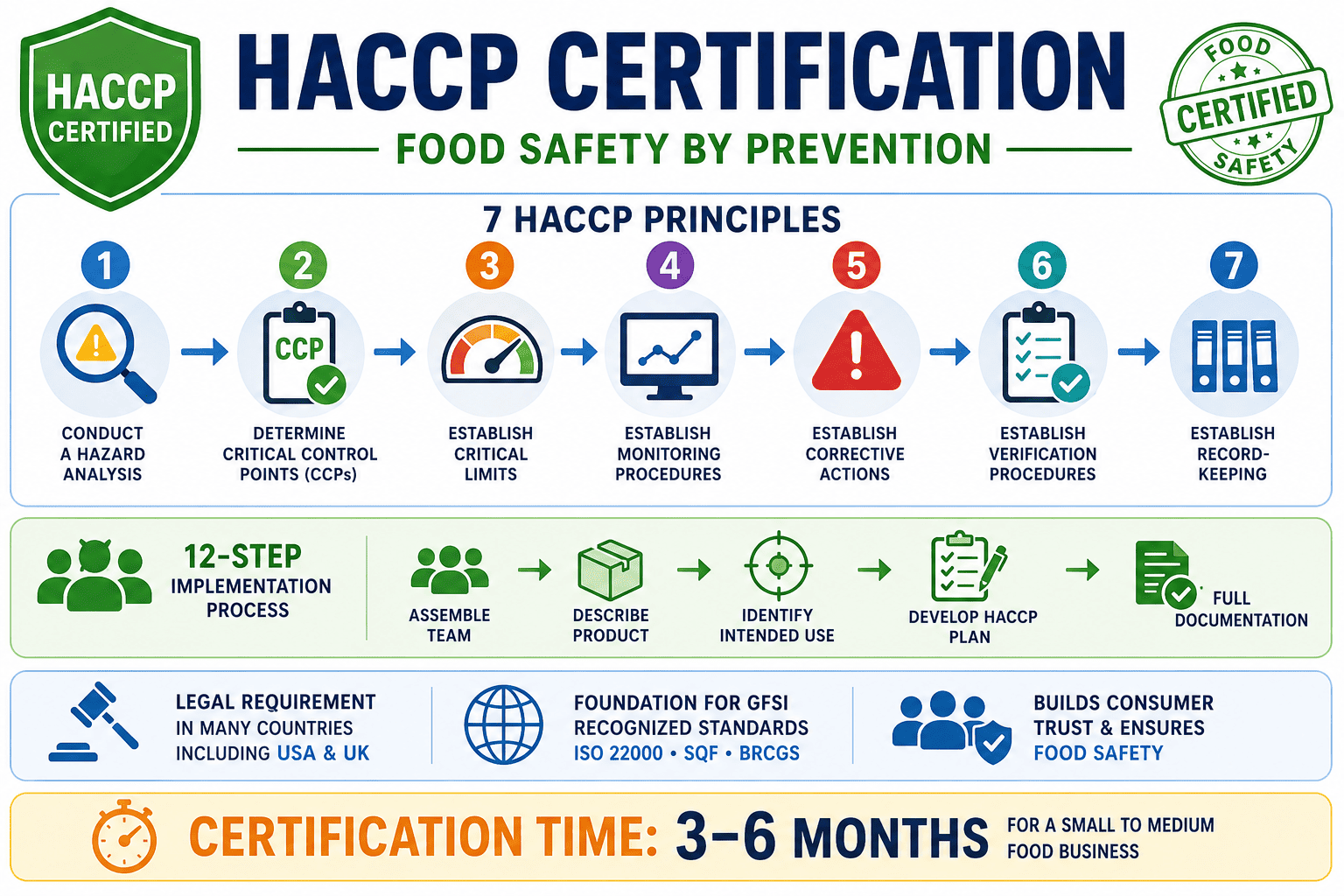
Direct Answer: HACCP (Hazard Analysis and Critical Control Points) is the most internationally recognized system for ensuring food safety through a preventative approach. Getting certified involves implementing a systematic framework based on 7 principles: (1) Conduct a hazard analysis, (2) Determine Critical Control Points (CCPs), (3) Establish critical limits, (4) Establish monitoring procedures, (5) Establish corrective actions, (6) Establish verification procedures, and (7) Establish record-keeping. The 12-step implementation process guides you from assembling a team to full documentation. HACCP is a legal requirement in many countries, including the USA and UK, and is the foundation for GFSI-recognized standards like ISO 22000, SQF, and BRCGS. Certification typically takes 3-6 months for a small to medium food business.
📅 July 6, 2026⏱ 15 min read✍️ GT Setu Editorial Team🔄 Updated regularly
7
HACCP Principles
12
Implementation Steps
3-6
Months (Typical Timeline)
0%
GTsetu Broker Commission
Hazard Analysis and Critical Control Points (HACCP) is the most internationally recognized system for ensuring food safety through a preventative approach. Developed by the Codex Alimentarius Commission (jointly by FAO and WHO), HACCP provides a systematic, science-based framework to identify, evaluate, and control biological, chemical, and physical hazards throughout the food production process. It is a legal requirement in several countries, including the USA and UK, and is the foundation for Global Food Safety Initiative (GFSI) recognized standards such as ISO 22000, SQF, and BRCGS.
For food businesses, from farms and fisheries to processors and restaurants, HACCP certification demonstrates a real commitment to food safety. It transforms your brand, acts as an effective entry-to-market tool, and opens up new business opportunities around the world. This guide covers the complete certification process, from understanding the 7 principles and 12 steps through to training, implementation, and audit, with practical advice for a successful journey. See our related guides on ISO 9001, ISO 14001, ISO 13485, ISO 27001, and ISO 45001 to understand how food safety standards integrate with other management systems.
🍽️ Who Is This Guide For?
This guide is written for food business operators (FBOs), quality assurance managers, food safety professionals, and anyone responsible for implementing or maintaining a HACCP-based food safety system. It is relevant for organizations directly or indirectly involved in the food chain, farms, fisheries, dairies, meat processors, food service providers (canteens, restaurants, caterers, hospitals, hotels), and distributors. For related partnership structures, see our guides on supplier collaboration platforms and distributors and manufacturers.
SECTION 1
1 What Is HACCP & Why Is It Important?
🍽️ The Global Food Safety Standard
HACCP (Hazard Analysis and Critical Control Points) is a preventive food safety system developed to identify and control biological, chemical, and physical hazards in food production. It is recognized internationally and is the foundation of global food safety management systems. HACCP is based on 7 principles and a 12-step implementation process that guides organizations from assembling a HACCP team to full documentation and verification. The system is a legal requirement in several countries, including the USA and UK, at all levels of the food chain. Demonstrating a real commitment to food safety through HACCP compliance can transform your brand and act as an effective entry-to-market tool.
🌐
Internationally Recognized
HACCP is endorsed by the Codex Alimentarius Commission (FAO/WHO) and is recognized globally as the most effective means of controlling foodborne disease. It is a requirement for international food trade.
⚖️
Legal Requirement
HACCP-based systems are legally required in many countries, including the USA, UK, and increasingly in India under FSSAI regulations. Compliance is essential for market access.
🛡️
Preventative Approach
HACCP focuses on preventing hazards rather than relying on end-product testing. This proactive approach is more effective and cost-efficient for ensuring food safety.
📋
Foundation for GFSI Standards
HACCP is the basis for all Global Food Safety Initiative (GFSI) recognized standards, including ISO 22000, SQF, BRCGS, and FSSC 22000. It is essential for supply chain credibility.
SECTION 2
2 Key Benefits of HACCP Certification
HACCP certification delivers tangible benefits across operational, commercial, and regulatory dimensions. Here’s what organizations that implement HACCP consistently report.
90%
Reduction in food safety investigation time with a proper HACCP system
100%
Compliance with legal and regulatory requirements in the food chain
✅
Global recognition as a reputable supplier, certification opens doors
🏷️
Market Access & Credibility
Certification is often a prerequisite for supplying to major retailers, food service chains, and international buyers. It signals your commitment to food safety and builds trust with customers and regulators.
Commercial
💰
Cost Reduction & Efficiency
By preventing unsafe production, HACCP reduces waste, rework, and costly recalls. It also enables more efficient use of resources and reduces investigation time for food safety breaches.
Operational
⚖️
Legal & Regulatory Compliance
HACCP helps you meet statutory and regulatory requirements, reducing the risk of fines, legal action, and reputational damage. It ensures compliance with FSSAI, FDA, USDA, and other regulatory bodies.
Compliance
🛡️
Risk Management & Consumer Protection
HACCP systematically identifies and controls hazards, reducing the risk of foodborne illness. This protects consumers, builds trust, and reduces the risk of costly product recalls.
Risk
🤝
Customer & Stakeholder Trust
Certification demonstrates your commitment to food safety, building trust with customers, regulators, and business partners. It is a key differentiator in competitive food markets.
Trust
🌍
Global Trade & Supply Chain Integration
HACCP reduces barriers to international trade and is recognized across global supply chains. It enables smoother collaboration with international partners and meets the requirements of global standards.
Global
SECTION 3
3 The 7 Principles of HACCP
The HACCP system is built on seven core principles that provide a systematic framework for ensuring food safety. These principles are the foundation of any HACCP plan and are recognized globally by regulatory authorities and certification bodies.
1️⃣
Conduct a Hazard Analysis
Identify potential biological, chemical, and physical hazards that could occur at each step of the food production process. Assess the likelihood and severity of each hazard to determine which ones need to be controlled.
2️⃣
Determine Critical Control Points (CCPs)
Identify the specific points in the process where hazards can be prevented, eliminated, or reduced to acceptable levels. A CCP is a step where control is essential to ensure food safety.
3️⃣
Establish Critical Limits
Define measurable standards for each CCP (e.g., cooking temperature, pH level, time). These limits distinguish between safe and unsafe conditions and must be achievable and verifiable.
4️⃣
Establish Monitoring Procedures
Define how and when each CCP will be monitored to ensure it stays within critical limits. This includes specifying who will monitor, what method will be used, and how often monitoring will occur.
5️⃣
Establish Corrective Actions
Define the actions to be taken when monitoring indicates a deviation from critical limits. Corrective actions must be documented, implemented, and verified to ensure they are effective.
6️⃣
Establish Verification Procedures
Confirm that the HACCP system is working as intended. Verification includes audits, tests, and reviews to ensure that critical limits are being met and that the system is effective.
7️⃣
Establish Record-Keeping & Documentation
Maintain comprehensive records of hazard analysis, CCPs, monitoring, corrective actions, and verification. Documentation is essential for demonstrating compliance and is a key focus of audits.
SECTION 4
4 Types of Food Safety Hazards
A hazard is something that is dangerous. A food hazard is something that could make food unsafe or unfit to eat. It’s important to identify those stages in your food business where hazards could be present so they can be removed or reduced to safe levels. There are three main types of food safety hazards.
🦠Biological Hazards
Microbiological Contamination
Involves harmful bacteria (e.g., Salmonella, E. coli, Listeria), viruses, parasites, and fungi that can cause foodborne illness. Biological hazards are the leading cause of foodborne disease outbreaks and require careful temperature control and sanitation.
Example: Salmonella in poultry
🧪Chemical Hazards
Chemical Contamination
Includes cleaning agents, pesticides, food additives, heavy metals, and toxins that can cause illness or injury. Chemical hazards often result from improper storage, inadequate rinsing, or contamination during processing.
Example: Cleaning agent residue in packaging
🔧Physical Hazards
Physical Contamination
Involves foreign objects entering food, such as glass, metal, plastic, wood, or stones. Physical hazards can cause injury to consumers and are often the result of equipment wear, packaging defects, or poor handling.
Example: Metal fragments from processing equipment
SECTION 5
5 The 12-Step HACCP Implementation Process
The Codex Alimentarius guidelines establish a 12-step process for implementing a HACCP system. These steps incorporate the 7 principles and provide a structured approach to developing and implementing a HACCP plan tailored to your specific food business.
Step
Description
Key Action
1. Assemble the HACCP Team
Gather a multidisciplinary team with expertise in food safety, production, quality, and engineering. The team will be responsible for developing, implementing, and maintaining the HACCP system.
Include personnel from operations, quality, maintenance, and management.
2. Describe the Product
Document the product’s composition, processing methods, packaging, shelf life, and storage conditions. Include details about the raw materials, ingredients, and distribution methods.
Create a comprehensive product description covering all aspects.
3. Identify Intended Use
Define how the product will be used by the end-user or consumer. Consider whether the product will be consumed as-is or will undergo further processing or cooking.
Identify consumer groups, especially vulnerable populations.
4. Construct a Flow Diagram
Create a detailed flow diagram that shows each step in the process, from receiving raw materials to final distribution. Include all steps, including holding, storage, and packaging.
Verify the flow diagram by walking through the actual process.
5. Verify the Flow Diagram
Confirm the flow diagram is accurate by physically observing and walking through the entire process. This step ensures that no steps are missing and that the diagram reflects actual operations.
Conduct a walk-through with the HACCP team.
6. Conduct a Hazard Analysis (Principle 1)
Identify potential hazards at each step of the process. Determine which hazards are significant and what controls are needed. This is the first and most critical principle.
Use a hazard analysis worksheet to document findings.
7. Determine Critical Control Points (Principle 2)
Identify steps in the process where hazards can be prevented, eliminated, or reduced to acceptable levels. Use a decision tree to help identify CCPs.
Apply the CCP decision tree to each significant hazard.
8. Establish Critical Limits (Principle 3)
Define measurable standards for each CCP. Critical limits must be achievable, verifiable, and based on scientific evidence (e.g., temperature, time, pH).
Set limits that distinguish between safe and unsafe conditions.
9. Establish Monitoring Procedures (Principle 4)
Define monitoring methods, frequency, and responsibilities for each CCP. Monitoring must be continuous where possible and documented.
Develop monitoring records and checklists.
10. Establish Corrective Actions (Principle 5)
Define actions to take when monitoring shows a deviation from critical limits. Ensure corrective actions are documented and verified.
Create a corrective action plan with specific steps.
Confirm the HACCP system is working. Verification includes audits, tests, and reviews. Verify that critical limits are being met and the system is effective.
Maintain comprehensive records of the HACCP plan, monitoring, corrective actions, and verification. Documentation is essential for demonstrating compliance.
Implement a record-keeping system for all HACCP activities.
SECTION 6
6 Step 1: Assemble the HACCP Team & Prepare
👥 Building Your Foundation
The first step in HACCP implementation is assembling a competent, multidisciplinary team. The HACCP team is responsible for developing, implementing, and maintaining the HACCP system. It should include personnel with knowledge of food safety, production, quality assurance, engineering, and management. The team leader should have formal training in HACCP principles and application. This phase also involves describing the product, identifying its intended use, and constructing a flow diagram.
1.1
Assemble Your HACCP Team
Select team members who bring diverse expertise. Include representatives from operations, quality, maintenance, and management. Ensure the team leader has HACCP training. For small businesses, external consultants can augment internal team capabilities.
1.2
Document Your Product & Process
Create a detailed product description including ingredients, composition, processing methods, packaging, shelf life, and storage conditions. Identify the intended use of the product, particularly any special handling or cooking requirements for consumers.
1.3
Construct & Verify the Flow Diagram
Map every step in your process from receiving raw materials to final distribution. Walk through the process to verify the diagram’s accuracy. Include all steps, such as holding, storage, and packaging. This is critical for accurate hazard analysis.
1.4
Conduct a Product Description Review
Ensure the product description, intended use, and flow diagram are complete and accurate. This documentation forms the foundation of your HACCP plan and will be reviewed during certification audits. See our guide on ISO 9001 for documentation best practices.
SECTION 7
7 Step 2: Develop the HACCP Plan
The HACCP plan is the central document of your food safety system. It records the application of the 7 principles to your specific processes and serves as the guide for your HACCP team. The plan must be comprehensive, practical, and based on sound scientific principles.
1️⃣
Conduct a Hazard Analysis
Identify all potential biological, chemical, and physical hazards at each step of your process. Assess the likelihood and severity of each hazard. Determine which hazards are significant and what preventive measures are needed.
Principle 1
2️⃣
Determine Critical Control Points (CCPs)
Apply the CCP decision tree to each significant hazard to identify where control is essential. Examples of CCPs include cooking, chilling, and metal detection. Document your CCP determination process.
Principle 2
3️⃣
Establish Critical Limits
Set measurable, verifiable limits for each CCP. Critical limits must be based on scientific evidence (e.g., cooking poultry to 75°C internal temperature). Ensure limits are achievable in your operation.
Principle 3
4️⃣
Establish Monitoring Procedures
Define what, how, and when each CCP will be monitored. Assign monitoring responsibilities. Develop monitoring records and checklists. Ensure monitoring is continuous where feasible.
Principle 4
5️⃣
Establish Corrective Actions
Define specific actions for when monitoring shows a deviation from critical limits. Corrective actions should address the deviation, prevent unsafe product from reaching consumers, and eliminate the cause of the deviation.
Principle 5
6️⃣
Establish Verification Procedures
Develop procedures to verify that the HACCP system is working effectively. Verification includes internal audits, calibration checks, product testing, and review of monitoring records. Document verification activities.
Principle 6
7️⃣
Establish Record-Keeping & Documentation
Implement a comprehensive documentation system. This includes the HACCP plan, hazard analysis, CCP records, monitoring records, corrective action records, and verification records. Documentation is critical for audit compliance.
Principle 7
💡 Use Templates to Streamline Development
Using standardized HACCP plan templates and worksheets can significantly reduce the time and effort required to develop your HACCP plan. Look for templates that include: hazard analysis worksheets, CCP identification decision trees, monitoring records, corrective action logs, and verification checklists. Many training providers and online resources offer editable templates. This approach is similar to using contract templates, start with a proven structure and customize for your specific needs.
SECTION 8
8 Step 3: Implement & Train
Implementation transforms your HACCP plan from a document into a functioning system. This phase involves integrating the HACCP procedures into your daily operations, training all employees, and ensuring the system is properly maintained. Training is critical, everyone from line workers to management must understand their role in food safety.
🎓
Provide Comprehensive Training
Train all employees on the HACCP system, their specific responsibilities, and the importance of food safety. Include training on hazard awareness, CCP monitoring, and corrective actions. Use a mix of classroom and on-the-job training.
Training
📋
Integrate HACCP into Daily Operations
Roll out the HACCP plan systematically. Start with a pilot area or process, learn from the experience, and then expand to the rest of the operation. Use visual aids, checklists, and standard operating procedures (SOPs) to support implementation.
Implementation
📁
Establish Prerequisite Programs (PRPs)
Implement and maintain prerequisite programs that provide the foundation for HACCP. These include GMP (Good Manufacturing Practices), SSOPs (Sanitation Standard Operating Procedures), pest control, and training. PRPs must be in place before HACCP can be effective.
Prerequisites
📊
Monitor & Document
Begin monitoring CCPs according to your plan. Document all monitoring results, corrective actions, and verification activities. Consistent documentation is essential for demonstrating compliance and is a key focus of audits.
Monitoring
🔄
Conduct Internal Audits
Perform internal audits to verify the effectiveness of your HACCP system. Use internal audits as a tool to identify areas for improvement and ensure the system is operating as intended. This is a mandatory requirement for certification.
Verification
SECTION 9
9 Step 4: Audit & Certification
The certification audit is the final step in the HACCP certification process. It is conducted by an independent, third-party auditor from an accredited certification body. The audit verifies that your HACCP system is fully implemented, documented, and effective. Successful completion results in the issuance of your HACCP certificate.
Audit Stage
What Happens
Key Focus
Stage 1 Audit (Documentation Review)
The auditor reviews your HACCP plan, prerequisite programs, and other documentation to ensure they meet the requirements of the standard and that your system is ready for on-site verification.
Completeness and adequacy of the HACCP plan and documentation. Identification of any gaps or nonconformities that must be addressed before Stage 2.
Stage 2 Audit (On-Site Verification)
The auditor visits your facility to verify that your HACCP system is effectively implemented and working in practice. They will observe operations, interview employees, and review records.
Effective implementation of the HACCP system. Evidence that procedures are being followed and that the system is achieving its objectives. Verification of Stage 1 nonconformity resolutions.
Audit Report & Decision
Following Stage 2, the auditor prepares a report detailing findings. If no major nonconformities are found, or if corrective actions are successfully implemented, the certification body issues your HACCP certificate.
Overall conformity assessment. The certificate is valid for one year (with annual surveillance audits) or three years, depending on the standard and certification body.
Surveillance Audits (Annually)
During the certificate validity period, the certification body conducts annual surveillance audits to ensure your HACCP system remains compliant and effective.
Ongoing compliance. The auditor checks that the HACCP system is being maintained and that continuous improvement is taking place.
Recertification Audit (Every 3 Years)
After the certificate validity period (typically 3 years), you must undergo a recertification audit to renew your certificate. This is a comprehensive audit similar to the initial Stage 2 audit.
Full system re-assessment. You must demonstrate that your HACCP system remains effective and has evolved to meet changing business needs.
🍽️ Choosing a Certification Body
Select a certification body that is accredited by a recognized national accreditation body (e.g., NABCB in India, UKAS, ANAB). Look for a certification body with experience in the food industry and specific expertise in HACCP. Consider their reputation, auditor competence, and customer support. Many food safety certification bodies also offer integrated audits combining HACCP with ISO 22000 or other standards. See our guide on ISO 9001 for more on selecting a registrar.
SECTION 10
10 HACCP Training Options
Proper training is essential for anyone involved in the HACCP system. The level and depth of training required depends on your role in the food business. Here are the main training options available in 2026.
Training Level
Description
Typical Duration
Cost Range
HACCP Level 1 (Awareness)
Basic understanding of HACCP principles and food safety fundamentals. Suitable for all food handlers and general staff. Covers hazard awareness, personal hygiene, and the importance of food safety.
1-2 hours
$49 – ₹500
HACCP Level 2 (Foundation)
Intermediate-level training on HACCP principles and their application. Suitable for supervisors, team leaders, and quality assurance staff. Covers the 7 principles and how to apply them in a food business.
4-8 hours
$100 – ₹2,000
HACCP Level 3 (Certified HACCP Practitioner)
Comprehensive training covering the 7 principles and 12-step implementation. Suitable for HACCP team members, food safety managers, and those responsible for developing and implementing HACCP plans. 18-hour accredited training is required for certification.
18 hours
$299 – $499 (₹14,000 – ₹25,000)
HACCP Level 4 (Advanced / Auditor)
Advanced training for those who will lead HACCP teams, conduct audits, or provide consultancy. Covers advanced HACCP principles, auditing techniques, and regulatory requirements. Often aligned with ISO 22000.
3 days
₹14,000 – ₹25,000+
💡 Choosing Your Training Provider
Look for training providers that are accredited by recognized bodies. The International HACCP Alliance (IHA) provides accreditation for HACCP training courses, ensuring they meet international standards. In India, FICSI, IGMPI, and FSSAI-approved trainers offer recognized HACCP courses. Online options from providers like eHACCP.org and Great Learning offer flexible, cost-effective training. For group training, look for providers that offer discounts for multiple attendees, many provide 20% off for groups of 5 or more. For related learning resources, see our blog.
SECTION 11
11 HACCP Certification: Costs & Timeline
The cost and timeline for HACCP certification vary based on organization size, complexity, existing food safety systems, and the resources you allocate to the project. Understanding these variables upfront helps in planning and budget setting.
Factor
Impact on Cost
Impact on Timeline
Organization Size & Scope
Small (1-50): $1,500-$3,000 Medium (50-250): $3,000-$7,000 Large (250+): $7,000-$15,000+
Reduces consultant fees and internal time, significantly lowering cost.
Can cut timeline by 30-50% by streamlining documentation and implementation.
Number of Sites
Multiple sites increase audit days and travel costs.
More sites extend the audit schedule and coordination effort.
SECTION 12
12 HACCP vs ISO 22000 vs GFSI
HACCP is the foundational system for food safety. ISO 22000 and GFSI-recognized standards (like SQF, BRCGS, and FSSC 22000) are built on HACCP principles but include additional requirements for management systems, supply chain management, and continuous improvement. Understanding the differences helps you choose the right certification for your food business.
StandardBest ForKey Differentiator
HACCP (Hazard Analysis Critical Control Points)
All food businesses, farms, processors, distributors, restaurants
Foundation of food safety; legally required in many countries; focused on hazard control
ISO 22000 (Food Safety Management System)
Food businesses seeking a comprehensive management system
Integrates HACCP with ISO management system approach; includes management review, continuous improvement, and supply chain management
FSSC 22000 (Food Safety System Certification)
Food manufacturers and processors
GFSI-recognized; builds on ISO 22000 with additional requirements for sector-specific PRPs and category-specific schemes
SQF (Safe Quality Food)
Food manufacturers, processors, and distributors
GFSI-recognized; comprehensive food safety and quality management system; widely used in retail and food service supply chains
BRCGS (British Retail Consortium Global Standard)
Food manufacturers, suppliers to retail
GFSI-recognized; focused on supplier to retailer; includes food safety, quality, and legal compliance; widely used in European and global retail
📋 Which Standard Is Right for You?
Start with HACCP if you need a food safety system for compliance, market access, or supplier requirements. It’s the most practical and cost-effective starting point for most food businesses. Progress to ISO 22000 if you need a comprehensive management system that integrates with other ISO standards (ISO 9001, ISO 14001). Choose a GFSI-recognized standard (SQF, BRCGS, FSSC 22000) if your customers specifically require it, or if you supply to major retailers and need the highest level of recognition. Many businesses start with HACCP certification and then upgrade to ISO 22000 or GFSI standards as their business grows. See our guide on ISO 9001 for integrating quality management with food safety.
SECTION 13
13 How GTsetu Supports Your HACCP Journey
🔗 GTsetu, Verified B2B Platform
Connect with Verified Partners & Build Food Safety Supply Chains
HACCP certification demonstrates your commitment to food safety and quality. GTsetu complements your certification by connecting you with verified manufacturers, distributors, and suppliers who meet rigorous food safety and quality standards, across HACCP, ISO 22000, ISO 9001, and more. Our platform provides:
✅
Verified Company Profiles
Every company on GTsetu is verified on 6 key data points (Name, Address, Registration Number, Company Status, Company Type, Date of Incorporation) using government tie-ups, complementing your HACCP supplier due diligence.
🕵️
Anonymous Discovery
Browse verified partner profiles without revealing your identity until you’re ready to engage, protecting your sourcing strategy and commercial confidentiality.
📄
Built-In NDA Workflow
Digital mutual NDA with timestamped signatures, activated before any sensitive commercial or technical data is exchanged, supporting your IP protection and confidentiality commitments.
🔐
Encrypted Document Workspace
AES-256 encryption at rest, TLS in transit, role-based access controls, and full audit trail, ensuring the secure exchange of food safety documentation, specs, and contracts with partners.
🚫
Zero Broker Commission
GTsetu charges zero commission on any partnership formed. All commercial value stays between you and your verified partner, supporting your cost management objectives.
🌏
Global Network of Verified Partners
Access verified manufacturers, distributors, and suppliers across 100+ countries, supporting your food safety supply chain and enabling you to build a network of HACCP-aligned partners.
QWhat is HACCP certification and why is it important?
HACCP (Hazard Analysis and Critical Control Points) is the most internationally recognized system for ensuring food safety through a preventative approach. It provides a systematic framework to identify, evaluate, and control biological, chemical, and physical hazards throughout the food production process. Certification demonstrates a commitment to food safety, is a legal requirement in many countries (including the USA and UK), and is often a prerequisite for supplying to major retailers and food service chains. For food businesses, it is the foundation of any credible food safety management system. See also ISO 9001 for quality management principles.
QWhat are the 7 principles of HACCP?
The 7 principles are: (1) Conduct a hazard analysis, (2) Determine Critical Control Points (CCPs), (3) Establish critical limits for each CCP, (4) Establish monitoring procedures for CCPs, (5) Establish corrective actions when monitoring indicates a deviation, (6) Establish verification procedures to confirm the system is working, and (7) Establish record-keeping and documentation procedures. These principles are recognized globally and form the foundation of all food safety management systems.
QWhat are the 12 steps to implement a HACCP system?
The 12 steps are: (1) Assemble the HACCP team, (2) Describe the product, (3) Identify its intended use, (4) Construct a flow diagram, (5) Verify the flow diagram, (6) Conduct a hazard analysis (Principle 1), (7) Determine Critical Control Points (Principle 2), (8) Establish critical limits (Principle 3), (9) Establish monitoring procedures (Principle 4), (10) Establish corrective actions (Principle 5), (11) Establish verification procedures (Principle 6), and (12) Establish record-keeping and documentation (Principle 7). This process is outlined in the Codex Alimentarius guidelines and is the standard approach for HACCP implementation.
QHow long does it take to get HACCP certified?
The timeline varies based on organization size and existing food safety practices. The HACCP training itself typically takes 18 hours (for Level 3 certification). Full system implementation and certification audit can take 3-6 months for a small to medium food business. Using digital tools and templates can significantly reduce the time. Larger organizations or those with multiple sites may take 6-12 months. Like ISO 9001, starting with a gap analysis helps streamline the timeline.
QHow much does HACCP certification cost?
Costs vary widely. Online HACCP training courses range from $49 to $699 depending on level and accreditation. The certification audit cost depends on the size and complexity of your operation, typically ranging from $1,500 to $5,000+ for initial certification. Surveillance audits are required annually and cost less than the initial audit. Additional costs include consultant fees (if hired), internal resource time, and implementation of prerequisite programs. Using templates and digital tools can reduce costs significantly.
QIs HACCP a legal requirement?
Yes, a HACCP-based food safety management system is a legal requirement in several countries, including the USA and UK, at all levels of the food chain. In India, the Food Safety and Standards Authority of India (FSSAI) strongly encourages and, in some cases, mandates HACCP-based systems for food businesses. Many global food safety standards (GFSI, ISO 22000) are also based on HACCP principles. Compliance with HACCP is essential for regulatory approval and market access in most developed countries.
Connect with verified manufacturers, distributors, and suppliers on GTsetu, compliance-backed verification, anonymous discovery, built-in NDA workflows, and zero broker commissions. Find partners who share your commitment to food safety and quality.
They represents the product, and research team behind GTsetu, a global B2B collaboration platform built to help companies explore cross-border partnerships with clarity and trust. The team focuses on simplifying early-stage international business discovery by combining structured company profiles, verification-led access, and controlled collaboration workflows.
With a strong emphasis on trust, and disciplined engagement, Team GTsetu shares insights on global trade, partnerships, and cross-border collaboration, helping businesses make informed decisions before entering deeper commercial discussions.