Company Global Expansion: Complete Guide for Manufacturers & Distributors
Direct Answer: Company global expansion is the deliberate process of entering international markets to grow revenue, diversify risk, and access new customers, through strategies including distribution agreements, licensing, joint ventures, contract manufacturing, or direct export. For manufacturers, the most capital-efficient path is appointing verified international distributors who bring existing market relationships, regulatory knowledge, and local infrastructure. GTsetu makes this possible without broker intermediaries, connecting verified manufacturers and distributors across 100+ countries with 6-point government identity verification (Name, Address, Registration Number, Company Status, Company Type, Date of Certificate of Incorporation), built-in NDA workflows, and zero commission on every partnership formed. Note: GTsetu does NOT verify tax compliance, import/export licences, industry certifications, financial standing, or authority of representatives.
📅 February 19, 2026⏱ 20 min read✍️ GTsetu Editorial Team🔄 Updated regularly
500+
Verified Companies
100+
Countries
6-Point
Govt Identity Verification
0%
Broker Commission
For a manufacturer whose domestic market is saturated, or a distributor seeking new principals to represent, global expansion is not a distant ambition, it is a commercial imperative. The companies growing fastest today are not waiting for their home market to recover. They are systematically entering new geographies, building verified partnerships, and compounding revenue across multiple markets simultaneously.
But global expansion is not a single action. It is a multi-stage process spanning market selection, entry model choice, partner identification and verification, contractual negotiation, and ongoing relationship management, each stage with its own risks, costs, and best practices. This guide covers all of it: what global expansion means, why companies pursue it, the specific benefits and difficulties, the strategies that work for manufacturers and distributors, and how GTsetu makes the entire process faster, safer, and more affordable.
💡 Who Is This Guide For?
This article is written for manufacturers considering international distribution, distributors seeking manufacturer principals in new product categories, business development teams evaluating market entry partnerships, and SME owners exploring the advantages and disadvantages of global expansion before committing to a strategy.
SECTION 1
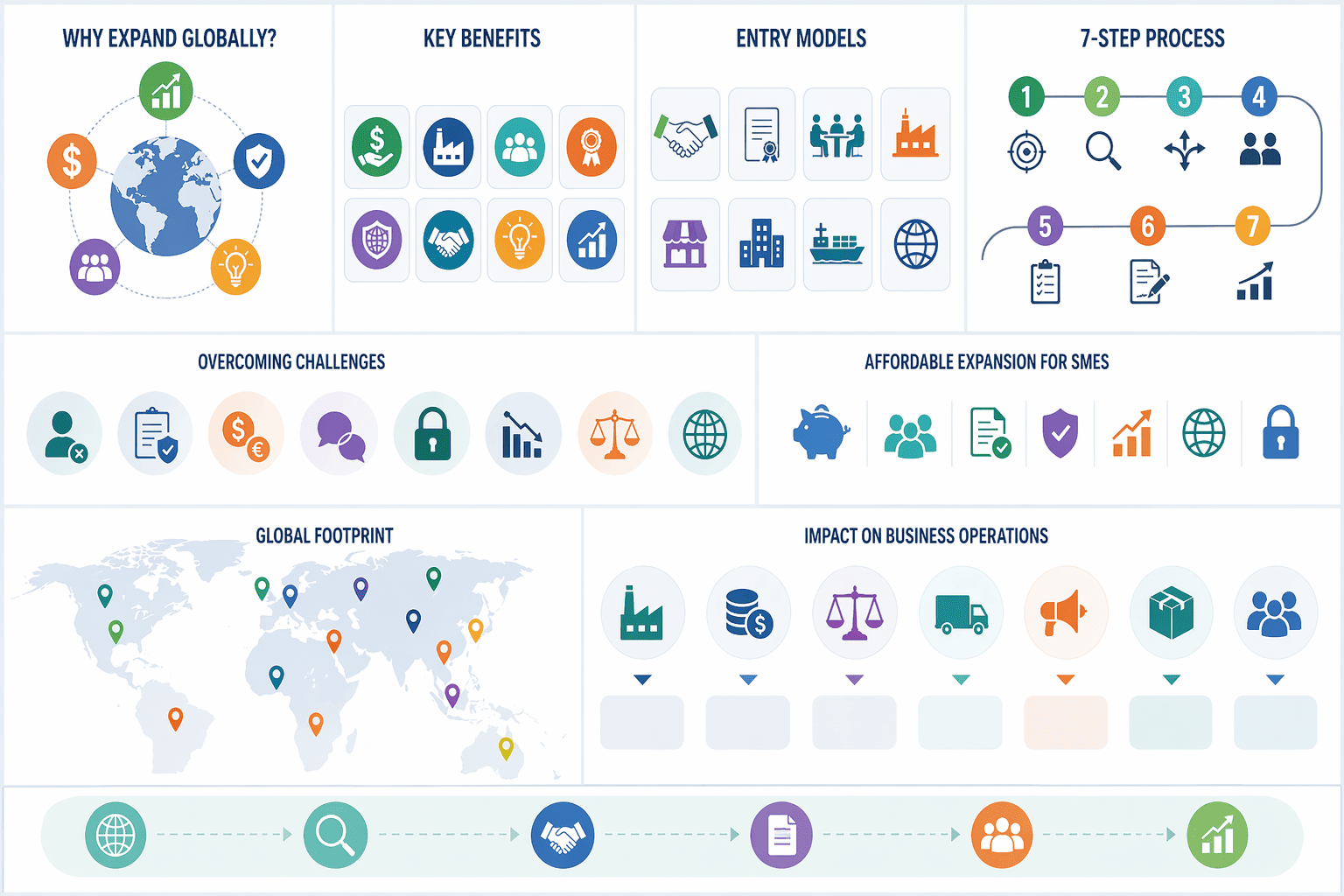
1 What Is Global Expansion? Definition & Meaning
🎯 Definition
Global expansion is the process by which a company deliberately enters one or more international markets to sell products or services, source manufacturing, or build commercial partnerships beyond its domestic market. In the context of manufacturers and distributors, global expansion means establishing verified distribution agreements, licensing arrangements, joint ventures, or direct market presence in new countries, with the goal of growing revenue, diversifying commercial risk, accessing new demand, and building an internationally recognised brand.
The global expansion definition encompasses everything from a small manufacturer appointing its first overseas distributor to a multinational corporation establishing wholly-owned subsidiaries across continents. What all forms share is the same fundamental intention: to grow beyond the ceiling of a single domestic market by accessing the demand, talent, manufacturing capacity, and commercial infrastructure of international markets.
Global Expansion vs. International Trade: The Key Distinction
Higher upfront, mitigated by structured agreements
SECTION 2
2 Why Companies Pursue Global Expansion
The reasons companies seek global expansion are not abstract aspirations, they are concrete commercial pressures. Understanding why your competitors are expanding globally is often the most compelling argument for doing so yourself.
📉
Domestic Market Saturation
When growth in the home market flattens, international markets provide the incremental revenue that sustains business momentum and justifies continued investment in production capacity.
📦
Economies of Scale
Higher production volumes driven by international demand reduce per-unit costs. Companies that expand globally find that international revenue subsidises domestic pricing competitiveness. See: pricing structures in contract manufacturing.
🌱
Extended Product Life Cycles
Products that have reached maturity in developed markets often find strong growth in emerging markets. Global expansion extends commercial life without requiring new product development.
🛡️
Risk Diversification
Companies with revenue across multiple markets are less vulnerable to domestic economic downturns, regulatory changes, or competitive disruption in a single geography. Multiple markets act as a natural hedge.
When competitors expand internationally, domestic-only companies face a future where rivals enjoy scale advantages that cannot be matched from a single market. Global expansion is often a defensive necessity, not just a growth strategy.
💡
Innovation & Talent Access
Global expansion through partnerships in technology-forward markets provides access to manufacturing innovations and talent pools that may not exist domestically. See: co-development partnerships.
💰
Investor Expectations
Investors and acquirers consistently value internationally operating businesses at higher multiples than domestic-only equivalents, reflecting the larger addressable market and demonstrated operational maturity.
SECTION 3
3 Key Benefits of Global Expansion for Businesses
The benefits of global expansion for firms are well-documented, but their magnitude depends entirely on how expansion is executed. A company that expands through verified, contractually structured partnerships captures these benefits efficiently. A company that expands through unverified intermediaries often experiences costs without benefits.
2.3×
average revenue multiple for internationally active manufacturers vs. domestic-only peers
40%
reduction in per-unit cost achievable through international production volume scale
67%
of SMEs report international partnerships were their primary growth driver over 3 years
💰
Benefit 1, Revenue Diversification
Multiple international markets create revenue streams that are not perfectly correlated. A recession in one market is offset by growth in another, producing more stable total revenue over economic cycles.
Core Benefit
📦
Benefit 2, Production Economies of Scale
International demand allows manufacturers to increase production runs, reducing per-unit fixed costs, improving procurement leverage with raw material suppliers, and enabling investment in more efficient production technology.
Manufacturing
🌍
Benefit 3, Access to New Customer Segments
International markets expose manufacturers to customer profiles, use cases, and product requirements that do not exist at home, often triggering product innovations that then strengthen domestic competitiveness.
Growth
🔄
Benefit 4, Extended Product Life Cycles
Products reaching maturity in developed markets find strong growth in emerging markets. Global expansion through distribution or licensing agreements extends revenue-generating life without new R&D investment.
Strategic
🏆
Benefit 5, International Brand Recognition
An internationally recognised brand commands pricing premiums, attracts better distribution partners, and creates barriers to entry for competitors who remain domestically focused. Brand globalisation is a compounding asset.
Operating in multiple regulatory environments reduces exposure to any single government’s policy decisions, tariff changes, sector regulations, or trade restrictions, that could materially damage a domestically concentrated business.
The key benefits of successful global expansion for domestic organisations are not limited to international revenue itself. The production scale, brand positioning, partnership relationships, and operational capabilities built through global expansion typically strengthen the domestic competitive position as well, making global expansion a multiplier of domestic performance, not merely an addition to it.
SECTION 4
4 Global Expansion Entry Models: Which Is Right for You?
The methods of global expansion vary dramatically in capital requirement, risk, control, and speed. Choosing the right entry model is the most consequential strategic decision in any global expansion plan, because it determines how much the expansion costs, how quickly revenue can be generated, and how easily the strategy can be adjusted if the market underperforms.
Proven, large-scale markets; deep international experience
Direct Export
🟢 Very Low
🟢 Immediate
🟢 High
🟢 Low
Testing market response; B2B products with direct buyer relationships
⚡ The Distribution Partnership Advantage
For most manufacturers beginning global expansion, the international distribution agreement is the optimal starting point: minimal capital investment, fast time to market, leveraged access to the distributor’s existing customer relationships and regulatory knowledge, and limited downside risk if the market does not perform. The key variable, and the greatest source of risk, is partner quality. This is why partner verification before commitment is the single most important step in any distribution-led global expansion. See our full guide on how to find international distributors.
SECTION 5
5 Global Expansion Strategies: A Practical Framework
A global expansion strategy is the combination of target market selection, entry model, partner type, pricing approach, and risk management framework that guides how a company enters and builds presence in international markets. The best global expansion strategies for companies are not the most aggressive, they are the most disciplined.
The Four Core Global Expansion Strategies
🎯
Concentrated Market Strategy
Enter one or two markets deeply and profitably before expanding further. Best for companies with limited bandwidth, high-complexity products, or markets requiring significant local investment. Risk: slow overall growth rate.
🌐
Diversified Market Strategy
Enter multiple markets simultaneously with lower commitment per market. Best for standardised products with broad applicability and companies with strong operational infrastructure. Risk: stretched management attention.
🔗
Partnership-Led Strategy
Rely on verified local partners, distributors, agents, or licensees, to manage market presence. Capital-efficient and fast. Risk: partner dependency requires strong selection, contractual protections, and ongoing performance management.
🏗️
Graduated Commitment Strategy
Begin with distribution agreements, prove the market, then deepen commitment through licensing, joint ventures, or direct presence. The most common successful approach. Requires patience but minimises irreversible capital commitments.
Global Expansion Strategy by Business Type
Business Type
Recommended Strategy
Preferred Entry Model
Key Success Factor
GTsetu Use Case
Branded Manufacturer
Partnership-led, concentrated first
Exclusive distribution per territory
Distributor market coverage and brand alignment
Find government-identity-verified distributors in target territories
Connect with government-identity-verified licensees to commercialise IP
SECTION 6
6 Steps to Global Expansion: The 7-Stage Process
The companies that execute global expansion successfully do not improvise. They follow a systematic process that moves from objective clarity through market selection, partner finding, contractual structure, and performance management.
01
Define Your Global Expansion Objectives
Before selecting a market or a strategy, define what success looks like. Are you expanding for revenue growth, risk diversification, economies of scale, or competitive defence? Are you seeking a distributor, a manufacturing partner, or a licensee? Objectives determine everything: which markets to prioritise, which entry model to choose, and which partner profile to seek. Companies that skip this step consistently over-invest in the wrong markets and underinvest in the right ones.
02
Select Target Markets with Systematic Criteria
Evaluate potential markets against consistent criteria: addressable market size, demand growth trajectory, competitive intensity, regulatory complexity, cultural distance, and, critically, the availability of qualified local partners. For manufacturers, the last criterion is often most decisive: a well-developed market with no qualified distributor prospects is harder to enter than a smaller market with strong partner options. Start with one to three markets before scaling. See our analysis of advantages and disadvantages of global expansion.
03
Choose Your Market Entry Model
Match the entry model to your capital, risk tolerance, product complexity, and strategic ambition. Most manufacturers expanding internationally for the first time should begin with a distribution partnership, capital-efficient, fast to market, and reversible if the market does not perform. Explore: licensing vs distribution, joint ventures vs strategic alliances, franchise models, and toll manufacturing.
04
Find, Shortlist, and Verify Partners
This is the step where most global expansion efforts succeed or fail, and the step that takes longest through traditional methods. Trade shows, cold outreach, and broker intermediaries are slow, expensive, and expose you to unverified counterparty risk. GTsetu’s platform pre-verifies all companies on 6 government identity points before they can engage, giving you a pool of identity-verified partners to browse anonymously before revealing your own identity. Note: GTsetu does NOT verify tax compliance, import/export licences, industry certifications, or financial standing. See: business verification & ID in B2B.
05
Execute NDA and Structured Due Diligence
Before sharing pricing, product specifications, or commercial strategy, execute a mutual NDA. Then conduct structured due diligence: verify the partner’s financial standing (your responsibility, GTsetu does not verify financials), customer relationships, import/export licences (your responsibility), and operational infrastructure. The NDA protects your commercial intelligence during this phase. See: mutual vs one-way NDA and B2B secure collaboration guide.
Execute market launch with defined KPIs, sales volumes, distribution coverage, brand visibility milestones. Monitor performance against commitments. The termination clause and exclusivity conditions in the agreement provide the commercial leverage to intervene if a partner underperforms. Once the first market is operating profitably, replicate the process in the next target market.
SECTION 7
7 Global Expansion Difficulties & How to Overcome Them
The difficulties of global expansion are real, but most are consequences of avoidable mistakes: poor market selection, unverified partners, inadequate contractual protections, and underestimation of regulatory complexity. Understanding the most common failure modes is the first step to avoiding them.
🚩
Engaging Unverified or Fraudulent Partners
The most costly and preventable difficulty. A distributor with fabricated credentials or no real customer base can consume years of commercial investment with no return. Solution: Use GTsetu’s 6-point government identity-verified partner network where all companies’ core identity is checked before engagement. Note: GTsetu does NOT verify business credentials beyond these 6 points.
🚩
Regulatory & Compliance Complexity
Each market has unique import regulations, certification requirements, labelling laws, and contract frameworks. Solution: Engage local legal counsel before finalising agreements; allocate regulatory compliance risk to the distributor contractually.
🚩
Currency and Payment Risk
Currency depreciation can erode margins without any change in sales volume. Solution: Structure payment terms carefully, see advance payment vs LC vs open account; include currency adjustment clauses in long-term agreements.
🚩
Cultural and Communication Barriers
Misaligned expectations around business practices and negotiation styles cause partnership friction invisible in financial metrics until late-stage. Solution: Invest in relationship building before signing; use structured engagement platforms that create clear communication records.
🚩
IP Leakage and Counterfeiting
In markets with weaker IP enforcement, product formulations and brand identities shared with partners can be misappropriated. Solution: Register IP in target markets before engagement; include IP protections and audit rights in agreements. See: IP ownership in contract manufacturing.
🚩
Distributor Underperformance
A distributor who secures exclusivity but fails to develop the market is one of the most expensive expansion failures. Solution: Tie exclusivity to measurable volume commitments. See: exclusivity clauses in distribution agreements.
🚩
Inadequate Dispute Resolution
Without a specified governing law and dispute mechanism, cross-border disputes become multi-year legal nightmares. Solution: Specify international arbitration and governing law in every agreement. See: dispute resolution in international contracts.
🚩
Force Majeure and Geopolitical Risk
Sanctions, tariff changes, and political instability can disrupt markets with little warning. Solution: Include explicit force majeure clauses; diversify across multiple markets. See: force majeure in global trade.
SECTION 8
8 Affordable Global Expansion for Small Businesses
The most persistent myth about global expansion is that it requires large capital budgets, dedicated international teams, and expensive consulting engagements. For manufacturers and distributors pursuing partnership-led expansion, none of these are true. The most affordable global expansion strategies for small businesses rely on leveraging verified partner relationships rather than building direct market infrastructure.
$0
broker commission on partnerships formed through GTsetu
Days
to find identity-verified distributor prospects on GTsetu vs. months through traditional methods
100+
countries with government-identity-verified manufacturer and distributor companies on GTsetu
The Low-Cost Global Expansion Toolkit for Manufacturers
Use a verified partner platform like GTsetu instead of expensive broker intermediaries, zero commission means full deal economics stay between you and your partner
Start with a non-exclusive distribution agreement in your first target market, minimise upfront commitment while proving demand
Use standard international distribution agreement templates adapted with local legal counsel, avoid starting from scratch for each market
Structure payment terms that protect your cash flow, advance payment or letter of credit for first orders. See: advance payment vs LC vs open account
Choose Incoterms that transfer risk at the most practical point, typically EXW or FOB for manufacturers with limited logistics infrastructure. See: Incoterms explained
Leverage the distributor’s existing market infrastructure, their customer relationships, warehouse network, and regulatory relationships, rather than building your own
Use anonymous discovery on GTsetu to assess the partner landscape before revealing your expansion plans to the market
Set realistic volume commitments with annual review milestones rather than locking into multi-year exclusivities without performance gates. See: volume commitments explained
Protect your IP from the first engagement, execute NDA before sharing product data and register trademarks in target markets early
9 How Global Expansion Impacts Business Operations
Global expansion does not only impact revenue. It reshapes how a company operates across every function, from product development and production to finance, legal, and organisational structure. Understanding these operational impacts before expansion begins allows businesses to prepare rather than react.
:Higher volumes require capacity planning; international certifications may be required (CE, FDA, ISO); packaging and labelling must be localised
Business Function
Impact of Global Expansion
Preparation Required
Production & Manufacturing
Capacity assessment; regulatory certification for target markets; localised packaging design
Finance & Treasury
Multi-currency invoicing; transfer pricing documentation; withholding tax management; FX hedging for significant currency exposures
Multi-currency accounting system; tax adviser in key markets; FX policy
Legal & Compliance
Multiple jurisdictions of contract law; IP registration in new territories; export control compliance; data protection obligations
Local legal counsel per market; IP registration programme; export control compliance check
Logistics & Supply Chain
International freight management; customs compliance; lead time variability; Incoterm selection affects responsibility and cost. See: lead time vs production time
Market requirements analysis before finalising product specifications for each territory
Leadership & Strategy
Global expansion changes the strategic planning horizon, organisational priorities, and talent requirements; it also impacts investor valuation multiples
Updated strategic plan with international markets integrated; governance framework for international partnerships
💡 How Global Expansion Impacts Strategic Planning
Global expansion fundamentally changes the strategic planning process. A domestic-only business plans around a single regulatory environment, currency, and competitive landscape. An internationally operating business must integrate market-specific scenarios, currency assumptions, regulatory change planning, and partner performance variables into every strategic cycle. The businesses that manage this complexity most effectively are those that have standardised their expansion process, using consistent partner verification, contract frameworks, and performance monitoring across all markets.
SECTION 10
10 Finding & Verifying Global Partners
For manufacturers pursuing distribution-led global expansion, finding the right partner is both the most important decision and the most time-consuming challenge. The traditional methods, trade shows, chamber of commerce referrals, broker intermediaries, and cold email outreach, are slow, expensive, and leave critical verification gaps.
✓ Mandatory 6-point government identity verification (Name, Address, Registration Number, Company Status, Company Type, Incorporation Date)
Your identity during discovery
✗ Exposed from first contact
✓ Anonymous until you choose to engage
NDA before information exchange
✗ Often skipped or delayed
✓ Built-in workflow, structural requirement
Cost of finding partners
✗ Trade shows $10k–$50k+; broker 5–15% of deal value
✓ Zero broker commission
Geographic coverage
~ Limited by event or broker network
✓ 100+ countries, active verified network
Document exchange security
✗ Unencrypted email attachments
✓ End-to-end encrypted workspace
Audit trail for compliance
✗ Email thread only
✓ Full timestamped audit trail
📌 Important Note on GTsetu’s Verification Scope
GTsetu verifies six specific data points using government ties: Company Name, Registered Address, Registration Number, Company Status, Company Type, and Date of Certificate of Incorporation. GTsetu does NOT verify tax compliance, import/export licences, industry certifications, financial standing, or authority of representatives. These remain your responsibility to verify independently as part of your due diligence process. GTsetu provides an encrypted workspace where you can request these documents from partners and review them securely.
The Identity-Verified Global Expansion Platform for Manufacturers & Distributors
GTsetu is the B2B platform built specifically for the global expansion challenge that manufacturers and distributors actually face: finding government-identity-verified international partners without expensive broker intermediaries, protecting commercial intelligence during negotiation, and building distribution or manufacturing partnerships across 100+ countries at zero commission. GTsetu verifies 6 points using government ties: Name, Address, Registration Number, Company Status, Company Type, and Date of Certificate of Incorporation. Note: GTsetu does NOT verify tax compliance, import/export licences, industry certifications, financial standing, or authority of representatives. Those remain your responsibility.
🏛️
6-Point Government Identity VerificationCompany Name, Address, Registration Number, Company Status, Company Type, Date of Certificate of Incorporation, verified against official registries using government ties.
🕵️
Anonymous DiscoveryBrowse verified manufacturer and distributor profiles across 100+ countries without revealing your identity or expansion plans. Your market entry strategy stays private until you choose to engage.
📄
Built-In NDA WorkflowDigital NDA execution with timestamped signatures triggered automatically before sensitive commercial information, pricing, product specs, market strategy, can be shared.
🔐
Encrypted Document WorkspaceAll documents encrypted in transit and at rest. No unprotected email attachments. No uncontrolled file sharing links. Your commercial intelligence stays in a controlled, auditable environment.
📋
Full Audit TrailEvery access event, NDA signature, document view, and communication logged with timestamps, satisfying documentation requirements for your partner selection process.
🚫
Zero CommissionGTsetu takes no success fee, broker commission, or percentage of deal value. The full economics of every partnership remain entirely between you and your partner.
🌍
100+ CountriesActive verified network of manufacturers and distributors across Asia, Middle East, Europe, Africa, Australia, and the Americas, making genuine global expansion accessible from a single platform.
⚖️
NDA-Protected EngagementEvery commercial discussion begins with a mutual NDA, protecting your product data and pricing strategy before any assets are shared.
DimensionGTsetuBroker / Trade Show / Cold Outreach
Partner identity verification
✓ Mandatory 6-point government identity verification
✗ None or self-reported only
Trade credentials (tax, licences, certs)
Not verified (your responsibility)
✗ Self-reported, unverified
Time to shortlist
✓ Days
✗ Months
Cost to find partners
✓ Zero commission
✗ 5–15% of deal value + event costs
Geographic coverage
✓ 100+ countries
~ Limited by network
NDA before info exchange
✓ Built into platform flow
✗ Manual, often skipped
Your identity protection
✓ Anonymous until you choose
✗ Exposed from first contact
Conflict of interest
✓ None, platform, not broker
✗ Broker earns more on bigger deals
FAQ
? Frequently Asked Questions
QWhat is global expansion?
Global expansion is the process by which a company deliberately enters one or more international markets to sell its products or services, source manufacturing, or build commercial partnerships beyond its domestic market. For manufacturers and distributors, it means establishing verified distribution agreements, licensing arrangements, joint ventures, or direct market presence in new countries, with the goal of growing revenue, diversifying risk, accessing new demand, and building an internationally recognised brand. The global expansion definition encompasses everything from a manufacturer’s first overseas distributor appointment to a multinational’s network of wholly-owned international subsidiaries.
QWhat are the key benefits of global expansion for businesses?
The key benefits of global expansion include: revenue diversification across multiple economic environments; production economies of scale that reduce per-unit costs; access to new customer segments closed off by domestic saturation; extended product life cycles by selling mature products in emerging markets; international brand recognition that commands pricing premiums; regulatory risk diversification across multiple political environments; and innovation access through international manufacturing and distribution partnerships. For domestic organisations, these benefits compound, international scale improvements typically strengthen domestic competitiveness as well, making global expansion a multiplier of total business performance.
QWhat are the most common global expansion strategies for manufacturers?
The main difficulties of global expansion are: engaging unverified or fraudulent partners (the most preventable and costly); regulatory and compliance complexity in each target market; currency and payment risk; cultural and communication barriers; IP leakage in markets with weaker enforcement; distributor underperformance against exclusivity commitments; inadequate dispute resolution when partnerships fail; and geopolitical risks including sanctions and tariff changes. Most are avoidable through systematic partner verification, well-structured contractual agreements, and appropriate risk allocation before engagement begins.
QHow can small businesses approach global expansion affordably?
Small businesses can pursue affordable global expansion by: using international distribution agreements rather than establishing foreign legal entities; using verified B2B platforms like GTsetu to find government-identity-verified partners without broker fees; starting with one target market before scaling; using standard contract templates adapted with local legal counsel; structuring payment terms that protect cash flow; and leveraging the distributor’s existing market infrastructure. The zero-commission model on GTsetu is particularly valuable for SMEs, a broker taking 5–15% of deal value on a $500,000 annual distribution agreement represents $25,000–$75,000 in recurring annual costs that disappear entirely through direct partnership. Note: GTsetu verifies identity only; tax, licences, certifications, and financials remain your responsibility.
QWhat is the purpose of global expansion in business?
The purpose of global expansion in business is to grow beyond the ceiling of a single domestic market, accessing new customers, increasing production volumes, reducing dependence on one economic environment, extending the commercial life of existing products, and building international brand recognition that supports long-term competitive advantage. For manufacturers specifically, global expansion also serves to defend domestic market position against globally expanding competitors by establishing international presence before rivals do, making expansion both a growth strategy and a competitive defence mechanism.
QHow does global expansion impact strategic planning?
Global expansion fundamentally changes the strategic planning process. It introduces multiple currencies, regulatory environments, competitive landscapes, and partner performance variables into every planning cycle. It extends the planning horizon, international market development typically requires 3–5 years to compound into significant revenue. It changes talent and capability requirements. And it changes how the business is valued by investors, who consistently apply higher revenue multiples to internationally operating businesses than to domestic-only equivalents. The businesses that manage this complexity most effectively are those with standardised expansion processes, consistent partner verification, contract frameworks, and performance monitoring that can be replicated across markets.
QWhat does GTsetu actually verify about potential partners?
GTsetu verifies six specific data points using government ties: Company Name, Registered Address, Registration Number, Company Status (Active/Dissolved), Company Type (Ltd, Pvt Ltd, etc.), and Date of Certificate of Incorporation. GTsetu does NOT verify tax compliance, import/export licences, industry certifications, financial standing, or authority of representatives. Those remain your responsibility to verify independently. GTsetu provides an encrypted workspace where you can request these documents from partners and review them securely, with full audit trail.
QHow does GTsetu support company global expansion?
GTsetu is a verified B2B platform connecting manufacturers and distributors across 100+ countries with 6-point government identity verification, anonymous discovery, built-in NDA workflows, encrypted document sharing, and zero broker commission. For companies pursuing distribution-led global expansion, GTsetu eliminates two time-consuming challenges: finding qualified partners and verifying their identity (6 points). The identity-verified partner pool reduces time from expansion decision to qualified shortlist from months to days. The zero-commission model ensures the full economics of every partnership remain between the parties. Note: Tax, licences, certifications, and financials are not verified by GTsetu and remain your responsibility.
QWhat is the difference between global expansion and globalisation?
Globalisation is a macro-economic and cultural phenomenon, the increasing integration of world economies through trade, investment, and technology. Global expansion is a company-level strategy, the deliberate decision by a specific business to enter international markets and build commercial partnerships beyond its home country. Globalisation creates the conditions that make global expansion increasingly accessible and valuable; global expansion is how individual companies capture the opportunities that globalisation produces.
QWhat are the steps to global expansion for a manufacturer?
The seven steps to global expansion for a manufacturer are: (1) define your expansion objectives; (2) select target markets using systematic criteria including partner availability; (3) choose your market entry model, distribution, licensing, joint venture, or contract manufacturing; (4) find and verify qualified partners using a platform like GTsetu (for identity verification); (5) execute NDA and conduct structured due diligence (including verifying tax, licences, certifications, and financials independently); (6) negotiate and sign a comprehensive partnership agreement covering territory, pricing, volume commitments, IP protections, and exit terms; and (7) launch with defined KPIs, monitor performance, and scale to additional markets once the first partnership is operating profitably.
Start Your Global Expansion with Government-Identity-Verified Partners in 100+ Countries
Join 500+ verified manufacturers and distributors on GTsetu, with 6-point government identity verification (Name, Address, Registration Number, Company Status, Company Type, Date of Certificate of Incorporation), anonymous discovery, built-in NDA workflows, and zero broker commissions. Note: Tax compliance, licences, certifications, and financials are not verified by GTsetu and remain your responsibility. The fastest, most affordable path to international distribution partnerships.
They represents the product, and research team behind GTsetu, a global B2B collaboration platform built to help companies explore cross-border partnerships with clarity and trust. The team focuses on simplifying early-stage international business discovery by combining structured company profiles, verification-led access, and controlled collaboration workflows.
With a strong emphasis on trust, and disciplined engagement, Team GTsetu shares insights on global trade, partnerships, and cross-border collaboration, helping businesses make informed decisions before entering deeper commercial discussions.