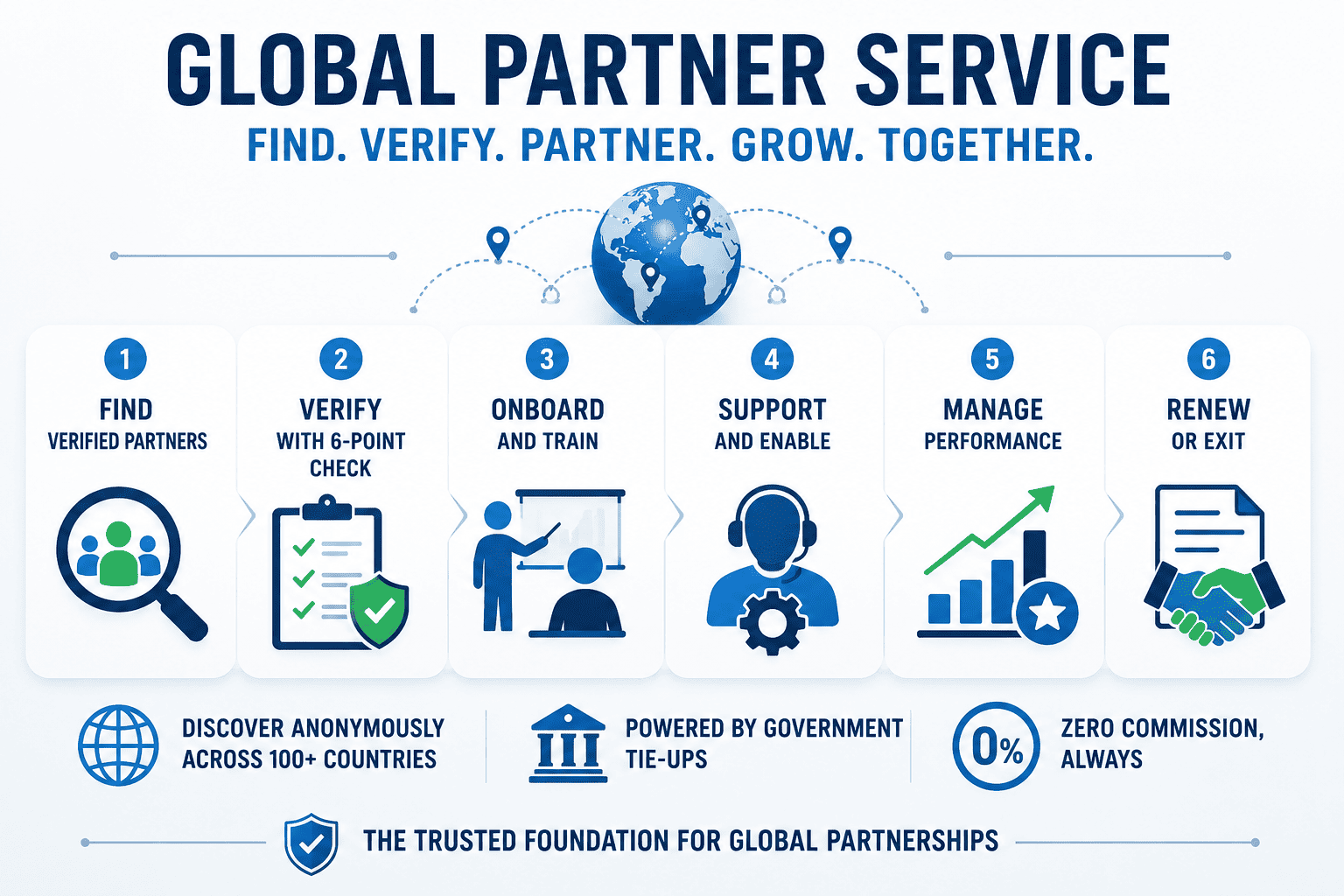
Global Partner Service: Complete Guide for Manufacturers & Distributors
Direct Answer: A global partner service is the structured framework through which manufacturers, brand owners, and technology companies recruit, onboard, train, support, and manage commercial partners, distributors, agents, resellers, or licensees, across international markets. It spans the full partnership lifecycle: from verified partner discovery through joint business planning, operational support, performance management, and exit or renewal. For manufacturers and distributors, the foundation of any global partner service is engaging with verified counterparties, which is why GTsetu’s 6-point verification (Name, Address, Registration Number, Company Status, Company Type, Date of Certificate of Incorporation) using government tie-ups, anonymous discovery across 100+ countries, and zero-commission structure form the essential starting point before any global partnership program begins.
📅 February 19, 2026⏱ 20 min read✍️ GT Setu Editorial Team🔄 Updated regularly
8
Partnership Models
100+
Countries Covered
6-Point
Govt. Tie-Up Verification
0%
Broker Commission
Every manufacturer that wants to grow internationally faces the same fundamental challenge: you cannot be everywhere at once. You cannot know every market, speak every language, navigate every regulatory system, or manage relationships with thousands of end customers across dozens of countries from a single headquarters. That is why global partner services exist.
A global partner service is not simply a list of distributors. It is a complete operational and commercial framework that determines how international partnerships are found, verified, structured, activated, managed, and, when necessary, ended. The quality of that framework is the single most important factor determining whether an international expansion succeeds or fails.
This guide covers every dimension of global partner services for manufacturers and distributors: what a global partnership is and what models exist, how to structure a partner service framework, how to onboard and train partners, how global partner operations work, how to manage performance, and how GTsetu addresses the foundational challenge that underlies all of it, finding and engaging with verified, trustworthy partners across 100+ countries without broker commissions.
💡 Who Is This Guide For?
This article is written for manufacturers building international distribution networks, distributors evaluating global principal relationships, business development managers designing partner programs, and commercial teams managing multi-territory trade relationships. It is also relevant to anyone involved in cross-border business partnerships, market entry partnerships, or industrial business collaboration.
SECTION 1
1 What Is a Global Partner Service?
🎯 Definition
A global partner service is the structured operational and commercial framework through which a company, typically a manufacturer, brand owner, or technology provider, recruits, verifies, onboards, trains, supports, and manages commercial partners across multiple international markets. It encompasses the full partnership lifecycle: from initial discovery and verification through joint business planning, operational support, performance measurement, and lifecycle management including renewal, expansion, or exit.
The term “global partner service” is used in two related but distinct ways in international business. First, it describes the internal program that a principal company (typically a manufacturer) builds to manage its network of international partners. Second, it describes the service-oriented relationship itself, the ongoing support, operational coordination, and commercial collaboration that the principal provides to its partners to enable their success.
Both meanings are valid and interconnected. A well-designed global partner service program delivers genuine service value to partners, in the form of training, marketing support, product information, logistics coordination, and commercial terms, while simultaneously providing the principal with the governance and performance infrastructure needed to manage a complex international network.
Global Partner Service vs. Simple Distribution: The Difference That Matters
DimensionSimple Distribution ArrangementGlobal Partner Service Program
Relationship structure
Transactional, buy and sell
Strategic, co-investment in market success
Partner selection
Ad hoc, whoever is available
Structured, criteria-based with verification
Onboarding
Minimal, product brochure and price list
Comprehensive, training, certification, toolkits
Support provided
Reactive, only when problems arise
Proactive, ongoing commercial and technical support
Performance tracking
Revenue only, lagging indicator
Multi-KPI, leading and lagging indicators
Commercial governance
Informal, verbal agreements
Formal, documented in partner agreement
Partner verification
✗ Typically absent, high fraud risk
✓ 6-point government tie-up verification
Scalability
✗ Limited, each relationship ad hoc
✓ High, standardised playbook across markets
SECTION 2
2 What Is a Global Partnership?
🎯 Definition
A global partnership is a formal commercial relationship between two or more companies from different countries, structured to achieve shared commercial objectives, typically market access, revenue growth, cost efficiency, or technology transfer, across international borders. It is distinguished from domestic partnerships by its multi-jurisdictional legal complexity, cross-cultural management requirements, and the operational challenge of coordinating activities across different markets, languages, regulatory systems, and time zones simultaneously.
The concept of a global partnership has evolved significantly with the acceleration of international trade. In earlier eras, a “global” partnership meant having a single authorised agent in each major export market. Today, global partnerships operate across highly integrated supply chains, shared digital platforms, co-development programs, and simultaneous multi-market launches, requiring a level of structural sophistication that simple agency agreements cannot support.
78%
of manufacturers cite finding verified international partners as their top market entry challenge
3.4×
higher revenue growth for manufacturers with structured global partner service programs vs. ad hoc distribution
67%
of global partnership failures are attributed to insufficient due diligence during partner selection
Understanding what makes a global partnership work requires understanding the fundamentals: what types of global partnerships exist, what each requires from both parties, and how the structure chosen at the outset determines the risks and rewards of the relationship. See our related guide on the advantages and disadvantages of global expansion for the broader strategic context.
SECTION 3
3 8 Types of Global Partnership Models
A global partner service program must be built around a clear understanding of the partnership model being used. Each model allocates rights, responsibilities, and commercial risk differently, and each requires a different service framework to succeed.
🏪
Most Common
Distribution Partnership
The distributor purchases goods from the manufacturer and resells them in a defined territory. The distributor bears commercial and inventory risk; the manufacturer provides product, pricing frameworks, and brand standards.
The licensor grants the partner rights to use intellectual property, technology, brand, patents, in exchange for royalties. The licensee manufactures or sells under the IP; the licensor retains ownership and quality oversight.
Two or more companies create a new legal entity to pursue a shared commercial objective. Risk, investment, and profit are shared according to equity participation. Requires deep governance structures and exit planning from day one.
The brand owner engages a manufacturer to produce goods to specification. The manufacturer provides production capability; the brand owner retains IP, quality standards, and commercial relationships.
Two companies jointly develop a new product, technology, or market offering. IP ownership, investment contribution, and commercialisation rights must be explicitly agreed before work begins.
The franchisor grants the franchisee the right to operate under a proven business system and brand in a defined territory, in exchange for fees and adherence to operating standards.
The manufacturer produces goods that the partner sells under their own brand. The brand owner controls the go-to-market; the manufacturer focuses on production without direct customer contact.
The client supplies raw materials; the toll manufacturer provides processing capability and returns finished goods. The client retains ownership of materials and finished product throughout.
The choice of partnership model determines everything downstream: the service framework you need, the contractual structure you must build, the compliance obligations you face, and the risk profile you carry. See our complete guide to cross-border business partnerships for a full decision framework on which model suits each market entry scenario. For OEM vs ODM comparisons, see OEM vs ODM vs EMS explained.
SECTION 4
4 The 7 Components of a Global Partner Service Framework
A global partner service framework is the operational architecture that makes a global partnership program repeatable, scalable, and manageable. Without it, even excellent individual partner relationships become difficult to govern across a multi-territory network. The seven components below form the minimum viable framework for any serious global partner service program.
🔍
1. Partner Discovery and Verification
The systematic process for identifying potential partners in target markets and verifying their legitimacy via government records. GTsetu performs this verification on 6 key data points (Name, Address, Registration Number, Company Status, Company Type, Date of Certificate of Incorporation) using government tie-ups before any company can appear in the network. This is the most critical component because it cannot be remedied after engagement begins. See: how to find international distributors and business verification & ID.
Foundation
📋
2. Partner Agreement and Commercial Governance
The contractual framework that defines territory rights, pricing structures, exclusivity conditions, volume commitments, IP usage, and termination provisions. See: exclusivity clauses, territory rights, and volume commitments.
Legal
🎓
3. Partner Onboarding and Training (Global Partnership Training)
The structured program that brings a new partner from signed agreement to fully operational, covering product knowledge, compliance requirements, brand standards, and sales processes. This is what most people mean by “global partnership training.”
Enablement
🚚
4. Global Partner Operations and Logistics
The operational infrastructure supporting the partnership, order management, supply chain coordination, Incoterm execution, quality management, and customs compliance. See: Incoterms explained, lead time vs production time, and MOQ explained.
The system for tracking partner performance against agreed KPIs, conducting structured reviews, addressing underperformance, and recognising achievement, including the escalation process for persistent shortfalls against volume or exclusivity conditions.
Governance
🔄
7. Partner Lifecycle Management
The process for managing partner agreements through their full lifecycle, annual renewal decisions, territory expansion, product line extension, and where necessary, structured exits. See: termination clauses in trade agreements.
Lifecycle
SECTION 5
5 Global Partner Tiers and Program Structures
Most mature global partner service programs organise partners into tiers based on commercial commitment, strategic importance, and performance. Tiering is not about creating hierarchy for its own sake, it is about aligning the investment the principal makes in a partner relationship with the commercial return that relationship generates or has the potential to generate.
🥉
Registered Partner
Entry-level status. Verified, onboarded, and authorised to sell. No exclusivity. Standard pricing. Basic training and product access.
Bronze
🥈
Certified Partner
Completed full training certification. Access to improved pricing, co-marketing programs, and priority support. Defined volume commitment.
Silver
🥇
Preferred Partner
Consistent performance track record. Exclusive territory rights. Market development fund access. Joint business planning. Dedicated account management.
Gold
💎
Strategic Partner
Highest tier. Regional or national exclusivity. Co-investment in infrastructure or product development. Executive relationships. Long-term contract with renewal guarantees.
Platinum
What Each Tier Requires in a Global Partner Service Program
Service Element
Registered
Certified
Preferred
Strategic
Verification
✓ 6-point via govt. tie-ups
✓ 6-point via govt. tie-ups
✓ Enhanced review
✓ Full due diligence
Onboarding Program
Standard
Full certification
Advanced + specialist
Executive + custom
Territory Rights
Non-exclusive
Non-exclusive
Exclusive (volume-conditional)
Exclusive (guaranteed)
Pricing Tier
Standard list
Improved margin
Best standard pricing
Negotiated strategic pricing
Commercial Support
Standard materials
Co-marketing access
MDF allocation
Co-investment budget
Account Management
Self-service + portal
Shared manager
Dedicated manager
Executive sponsor
Business Planning
Annual review only
Semi-annual review
Quarterly joint planning
Monthly strategic review
Product Roadmap Access
Announced products
Pipeline visibility
Early access programs
Co-development input
⚡ Tiering and the Non-Compete Question
Partner tiers must be carefully coordinated with non-compete and non-circumvention clauses. A strategic partner with exclusive territory rights requires stronger non-compete protections than a registered partner in a non-exclusive market. See our guide on non-compete vs. non-circumvention for how to structure these provisions correctly for each partner tier.
SECTION 6
6 Partner Onboarding and Global Partnership Training
Global partnership training is one of the most frequently underestimated components of a global partner service program. The moment a partner agreement is signed is not when the partnership begins performing, that happens weeks or months later, once the partner’s team has been properly trained, has internalised brand standards, and understands exactly how to sell and support the product in their market.
A well-designed global partnership training program covers four distinct domains simultaneously:
1
Product and Technical Training
Deep product knowledge, specifications, applications, competitive differentiation, and troubleshooting. Technical training must be market-specific: the sales arguments that resonate in Germany may be completely irrelevant in Indonesia. Ensure training materials are available in the partner’s working language and that certification assessments are meaningful rather than cosmetic.
2
Compliance and Regulatory Training
Every market has compliance requirements that the partner must understand: import regulations, product labelling standards, anti-bribery obligations (UK Bribery Act, FCPA), and industry-specific certifications. Compliance failures by the partner can create liability for the principal, making this training domain commercially and legally critical. See also: IP ownership in contract manufacturing.
3
Commercial and Sales Enablement Training
How to position the product against local competition, how to navigate the partner’s own customer base, how pricing and discount structures work, and how the principal’s sales support infrastructure operates. This is where global partnership training directly creates revenue, or fails to. Partners who cannot confidently articulate value propositions in their market will underperform regardless of product quality.
4
Brand and Operational Process Training
How the brand must be presented, what the principal’s order management and logistics processes require, how escalations are handled, and what reporting the partner is expected to provide. This domain is often called “working together” training, and it prevents the operational friction that drains commercial energy from otherwise strong partnerships. See: B2B secure collaboration.
5
Legal and Contractual Obligations Training
Partners must understand their contractual commitments, exclusivity conditions, minimum volume obligations, territory boundaries, IP usage rights, and the conditions under which the agreement can be terminated. Many partnership failures occur because a partner was unclear about their obligations. See: mutual vs. one-way NDA and non-compete vs. non-circumvention.
✅ The Onboarding Timeline Standard
A minimum viable global partnership onboarding should take 30–90 days, depending on product complexity and market requirements. Rushing onboarding to accelerate first order placement is the most common cause of early partnership failure, a partner who is commercially active before they are fully trained will make avoidable errors that damage both the relationship and the principal’s market position. Build the timeline into the partner agreement itself: define when the partner is considered “fully onboarded” and what certification milestones must be achieved before exclusivity conditions activate.
SECTION 7
7 Global Partner Operations and Logistics
Global partner operations is the component of the global partner service framework that most directly affects day-to-day commercial performance. No amount of strategic planning, training, or contractual sophistication compensates for an operational infrastructure that fails to deliver products on time, to specification, and with the compliance documentation the partner’s market requires.
Key Operational Elements in a Global Partner Service
Operational Element
What It Covers
Common Failure Points
Service Standard
Order Management
How partners place orders, receive confirmation, track status, and manage lead times
Lead time uncertainty creating inventory risk for the partner
Clear order-to-shipment timeline; alerts for delays; minimum lead time commitments. See: lead time vs. production time
MOQ and Volume Flexibility
Minimum order quantities, volume tier pricing, and flexibility for market development phases
MOQ too high for partner’s market development stage; penalises early-stage partners
The operational quality of a global partner service program is ultimately judged by its supplier collaboration platform infrastructure, the digital tools and processes that allow manufacturers and distributors to share order data, quality documentation, compliance certificates, and commercial information securely and efficiently across jurisdictions.
SECTION 8
8 Performance Management in Global Partnerships
Performance management is the component of global partner services that most directly determines whether partnerships create long-term value or quietly decay into transactional orders below potential. Without structured, data-driven performance management, even initially strong partnerships tend to underperform, because neither party has the visibility or the shared accountability to address drift before it becomes permanent.
The Global Partner Service KPI Framework
KPI Category
Specific Metrics
Review Cadence
Consequence of Persistent Shortfall
Commercial Performance
Revenue vs. target, volume vs. MOQ commitment, market share growth, new customer acquisition rate
Monthly (revenue); quarterly (share and acquisition)
Exclusivity review; pricing tier adjustment; performance improvement plan
Operational Performance
Order fulfilment accuracy, on-time delivery rate, return and defect rate, inventory turnover
Monthly, leading indicator for commercial performance
The most common failure in global partner service performance management is conducting reviews but not acting on them. Principals who identify underperformance and then take no action, because the conversation is uncomfortable, or because they lack an alternative, teach their partner network that performance commitments are unenforceable. This systematically degrades the quality of the entire partner program. Act on performance data: implement improvement plans, adjust tier status, and, when necessary, exercise the termination rights that the agreement provides. See: termination clauses in trade agreements and dispute resolution in international contracts.
SECTION 9
9 Partner Verification: The Foundation Before Everything Else
Every component of a global partner service program assumes one thing is true: that your partner is a legitimate, legally registered business with the authority, capability, and intent to perform. When that assumption is wrong, which happens far more frequently in cross-border trade than most manufacturers anticipate, the entire service framework collapses into an expensive dispute or, worse, a fraud.
🚩
Fraudulent Registration Documents
A “distributor” presents fabricated business registration documents from a real-sounding but non-existent company. The agreement is signed; products are shipped; payment never arrives and the entity cannot be traced.
🚩
Misrepresented Market Coverage
A distributor claims coverage of a territory they do not actually have the infrastructure, relationships, or regulatory licences to serve. Market entry fails; the manufacturer’s brand is damaged in the territory.
🚩
Undisclosed Competitor Connection
The “independent” distributor has a beneficial ownership connection to a competing manufacturer. All product data, pricing, and commercial strategy shared during onboarding flows directly to the competition.
🚩
No Signing Authority
The individual who signs the distribution agreement lacks the authority to bind the company. The entire agreement, including exclusivity commitments, volume obligations, and IP licences, may be unenforceable.
🚩
Fabricated Industry Certifications
A partner claims certifications, industry memberships, or regulatory approvals they do not hold, critical in regulated industries like food, pharma, medical devices, and chemicals where compliance is mandatory.
🚩
Sanctions List Exposure
Engaging with a partner on OFAC, EU, or UN sanctions lists, even unknowingly, creates criminal exposure for the manufacturer. No contractual clause provides protection against sanctions violations.
⚡ The Minimum Verification Standard
Before any global partnership conversation begins, the minimum verification standard requires confirming a company’s Name, Address, Registration Number, Company Status, Company Type, and Date of Certificate of Incorporation using government tie-ups. GTsetu performs this 6-point verification via official government registries before any company can appear in the network. This is not optional due diligence, it is the minimum required before any commercial discussion. See: business verification & ID in B2B.
SECTION 10
10 How GTsetu Powers Global Partner Services
🔐 Platform Spotlight, GTsetu
The Verified Platform Where Global Partner Services Begin
GTsetu was built for manufacturers and distributors who understand that the most dangerous risk in any global partner service program is not market complexity or operational challenge, it is engaging with an unverified counterparty. Before any partnership framework is designed, before any training is delivered, before any operational infrastructure is built, GTsetu eliminates the counterparty risk that undermines most global partnership programs at source.
🏛️
6-Point Government Tie-Up Verification
Every company is verified on Name, Address, Registration Number, Company Status, Company Type, and Date of Certificate of Incorporation using official government registries.
🕵️
Anonymous Discovery Mode
Browse verified partner profiles across 100+ countries without revealing your market expansion strategy or current supply relationships. Your identity and competitive intelligence stay private until you choose to engage.
📄
Built-In NDA Workflow
Digital NDA execution with timestamped signatures before any sensitive commercial information is exchanged, protecting product data, pricing structures, and partner program details during due diligence. See: mutual vs. one-way NDA.
🔐
Encrypted Document Workspace
All compliance documents, commercial proposals, and partner agreements exchanged through end-to-end encrypted channels. No plaintext email exposure of sensitive commercial information.
🌍
100+ Countries, Verified Network
Active network of verified manufacturers and distributors across Asia, Middle East, Europe, Africa, Australia, and the Americas. Every partner on the platform has passed 6-point government tie-up verification before gaining access.
📋
Full Audit Trail
Every engagement, document exchange, and NDA signature logged with timestamps, providing the compliance documentation required for ABAC due diligence in partner selection processes.
⚖️
Business Registration Verified
Every company’s registration status, type, and incorporation date confirmed via official government records before they can engage on the platform.
🚫
Zero Broker Commission
GTsetu takes no success fee or broker commission on deals formed on the platform. All commercial terms, including partner program economics, remain entirely between the parties.
Browse verified profiles without revealing your strategy.
🔐 Private
✅
Verify Partner
6-point govt. tie-up verification confirmed before engagement.
🔐 GTsetu
📄
Execute NDA
Legal protection before any data is shared.
🔐 Timestamped
🤝
Negotiate Terms
Encrypted workspace for commercial discussions.
🔐 Encrypted
📜
Sign Agreement
Full partnership framework in place.
🔐 Audit trail
🚀
Launch & Operate
Partner service program activated across market.
🔐 0% fees
SECTION 11
11 Common Mistakes in Global Partner Service Programs
Global partner service programs fail in predictable ways. The most expensive mistakes are not strategic errors, they are structural omissions that were avoidable with the right framework from the start.
❌
Skipping Partner Verification
The single most costly mistake. No contractual framework protects against fraud by an unverified counterparty. Verification must precede engagement, not follow it. GTsetu makes this mandatory for every company on the platform via 6-point government tie-up verification.
❌
Granting Exclusivity Without Volume Conditions
Exclusive territory rights granted without volume performance conditions lock the manufacturer out of their own market if the distributor underperforms. Always condition exclusivity on measurable volume targets. See: exclusivity clauses explained.
❌
No Governing Law or Dispute Mechanism
Without a specified governing law and arbitration clause, the most carefully constructed partner program becomes unenforceable across jurisdictions. See: dispute resolution in international contracts.
❌
Inadequate Force Majeure Provisions
Partnerships that lack clear force majeure clauses, particularly those that don’t address geopolitical disruption, sanctions, and pandemic scenarios, leave both parties exposed when unavoidable disruptions occur. See: force majeure in global trade.
❌
Treating All Markets as Identical
A global partner service program must be adapted to each market’s regulatory environment, commercial culture, and customer expectations. Copy-pasting the same partner agreement and training materials across all territories is a reliable path to underperformance.
❌
No IP Protection Before Sharing Proprietary Data
Sharing product specifications, formulations, or technology with a potential partner before an NDA is executed and IP ownership is clearly documented creates irreversible competitive exposure. See: IP ownership in contract manufacturing.
What Successful Global Partner Service Programs Do Differently
✅
Verify Before Engaging
Every partner goes through 6-point verification using government tie-ups before any commercial discussion. GTsetu makes this the entry requirement for all platform companies.
✅
Invest in Training as a Revenue Driver
Treat global partnership training as a commercial investment, not an administrative step. Certified partners consistently outperform uncertified partners in revenue, compliance, and retention.
✅
Align Incentives Through Tier Structure
Use tier progression, from registered to strategic, to align principal investment with partner commercial commitment. Reward performance; protect the program from free-riders.
✅
Build Operational Excellence as the Partnership Foundation
On-time delivery, accurate documentation, and responsive support are the non-negotiable foundations of global partner service quality. Strategic relationships cannot survive operational failure.
✅
Act on Performance Data
Review regularly, but, critically, act on what reviews reveal. Performance management without consequences is not management; it is the illusion of governance while the program deteriorates.
✅
Plan Exits Before You Need Them
The best time to design the exit provisions of a global partnership is before the partnership begins, when both parties are motivated to be fair. See: termination clauses in trade agreements.
FAQ
? Frequently Asked Questions
Q
What is a global partner service?
A global partner service is the structured operational and commercial framework through which a company, typically a manufacturer, brand owner, or technology provider, recruits, verifies, onboards, trains, supports, and manages commercial partners across multiple international markets. It spans the full lifecycle of the global partnership: from initial partner discovery and verification through joint business planning, operational support, performance management, and eventual lifecycle decisions including renewal, expansion, or exit. The quality of a global partner service framework is the primary determinant of whether an international distribution or manufacturing network achieves its commercial potential.
Q
What is a global partnership?
A global partnership is a formal commercial relationship between two or more companies from different countries, structured to achieve shared commercial objectives, typically market access, revenue growth, cost efficiency, or technology transfer, across international borders. Global partnerships take multiple forms: distribution agreements, licensing arrangements, joint ventures, technology transfer agreements, co-development partnerships, franchise structures, and contract manufacturing relationships. What distinguishes a global partnership from a domestic one is its multi-jurisdictional legal complexity, cross-cultural management requirements, and the operational challenge of coordinating activities across different markets, legal systems, and regulatory environments simultaneously.
Q
What are global partnership services?
Q
What is global partnership training?
Global partnership training is the structured educational program through which a principal brings new international partners to full commercial readiness. It covers five domains: product and technical training (product knowledge, specifications, applications); compliance and regulatory training (import regulations, anti-bribery, certifications); commercial and sales enablement (positioning, competitive differentiation, pricing); brand and operational process training (brand standards, order management, reporting); and legal and contractual obligations training (understanding partnership terms, exclusivity conditions, IP usage rights). Effective global partnership training is the single most important determinant of early-stage partner performance and long-term partnership retention.
Q
What is global partner operations?
Q
What is the difference between a global partner and a local distributor?
Q
What makes GTsetu different from other global partner platforms?
Q
How do you build a global partner service program?
Building a global partner service program requires seven steps: (1) define your ideal partner profile for each target market, commercial, operational, and compliance criteria; (2) establish a verification and due diligence process before any engagement; (3) structure the partnership agreement with clear commercial terms, exclusivity conditions, volume commitments, and exit provisions; (4) design a comprehensive onboarding and global partnership training program; (5) create a joint business planning framework with shared KPIs and review cadences; (6) build operational support infrastructure for logistics, compliance, and product support; and (7) implement a performance management system with tier progression, co-investment criteria, and escalation protocols for underperformance.
Q
What are the main risks in a global partner service program?
risk allocation in cross-border deals.
Q
How does a global partner service program differ across different regions?
Build Your Global Partner Service on a Foundation of Verified Partners
Join 500+ verified manufacturers and distributors building global partnerships on GTsetu, with 6-point government tie-up verification, anonymous discovery across 100+ countries, built-in NDA workflows, and zero broker commissions. Start your global partner service program with the right foundation.
They represents the product, and research team behind GTsetu, a global B2B collaboration platform built to help companies explore cross-border partnerships with clarity and trust. The team focuses on simplifying early-stage international business discovery by combining structured company profiles, verification-led access, and controlled collaboration workflows.
With a strong emphasis on trust, and disciplined engagement, Team GTsetu shares insights on global trade, partnerships, and cross-border collaboration, helping businesses make informed decisions before entering deeper commercial discussions.