International Wholesale Distributors: How to Find Verified Suppliers Globally | GTsetu
Home ›
Blogs ›
International Wholesale Distributors
🌐 Global Sourcing & Verified Suppliers
International Wholesale Distributors: How to Find Verified Suppliers Globally
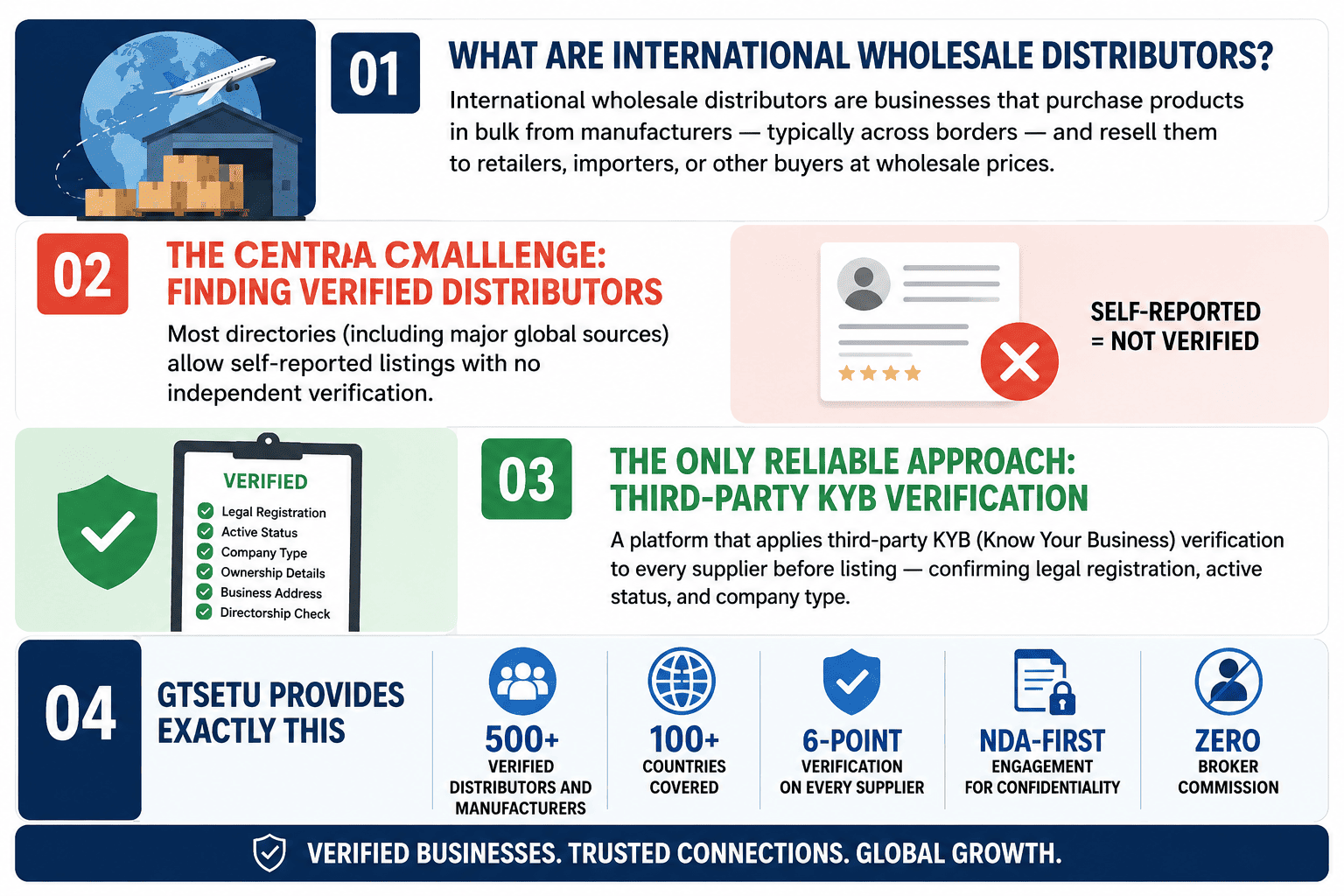
Direct Answer: International wholesale distributors are businesses that purchase products in bulk from manufacturers, typically across borders, and resell them to retailers, importers, or other buyers at wholesale prices. Finding verified ones is the central challenge: most directories (including major global sources) allow self-reported listings with no independent verification. The only reliable approach is a platform that applies third-party KYB (Know Your Business) verification to every supplier before listing, confirming legal name, registration number, registered address, incorporation date, company type, and active status against official government registries. GTsetu provides exactly this: 500+ verified distributors and manufacturers across 100+ countries, all 6-point government-sourced verified, with NDA-first engagement and zero broker commission.
📅 May 18, 2026⏱ 18 min read✍️ GTsetu Editorial Team🔄 Updated regularly
68%
of businesses suffered losses from unverified suppliers (Deloitte 2024)
500+
Verified Partners on GTsetu
100+
Countries in GTsetu Network
0%
Broker Commission on GTsetu
Every retail business, e-commerce operator, brand owner, and manufacturer that sources internationally faces the same core problem: finding wholesale suppliers and distributors whose identity, capability, and legitimacy are genuine, not self-reported on a paying directory listing. The gap between a verified supplier and an unverified one is the difference between a reliable supply chain and a costly fraud, a delayed shipment, or a quality disaster.
This guide covers the full landscape of international wholesale distributors, what they are, how the market is structured, what “verified” actually means in practice, how global source directories fall short, how the US market works for international buyers, and how GTsetu’s verified B2B platform solves the sourcing verification problem that directories have never resolved.
💡 Who Is This Guide For?
This article is for retailers, e-commerce sellers, importers, brand owners, and procurement teams who need to find international wholesale distributors, verified suppliers, or verified custom manufacturers, whether sourcing from Asia, Europe, the Americas, or anywhere in the global supply chain. It is also relevant for manufacturers who want to understand how to position themselves as verified partners in international wholesale markets. For the distributor-building side, see our dedicated guide on distributor networks.
SECTION 1
1 What Are International Wholesale Distributors?
🎯 Definition
International wholesale distributors are businesses that purchase products in large quantities from manufacturers, typically across national borders, and resell them to retailers, importers, other wholesalers, or end-business customers at wholesale prices. They bridge global production and local markets: buying where goods are made cheaply or where manufacturers need distribution reach, and selling where demand exists. Unlike agents (who earn commissions without taking ownership), wholesale distributors take title to the goods they buy, carrying inventory risk and reward themselves.
The international wholesale distribution landscape is vast and fragmented. It spans everything from large multinational trading companies that move container-loads of electronics between continents, to specialist regional distributors handling pharmaceutical ingredients between India and Europe, to FMCG wholesale networks moving consumer goods between manufacturing clusters in China and retailers across Southeast Asia.
$47T+
estimated value of global wholesale trade annually, the backbone of international commerce
60–70%
typical retailer purchase price from wholesale suppliers, the margin distributors pass on to market
30%
faster delivery times for businesses using verified supplier networks vs. unverified sources (Deloitte)
What International Wholesale Distributors Do
📦
Bulk Purchasing & Inventory
Purchase large quantities from manufacturers, often at MOQs that individual retailers cannot meet, and break those bulk orders into smaller, commercially viable quantities for their customers.
🚢
Import & Logistics
Handle international shipping, customs clearance, import duties, and last-mile logistics, converting a foreign factory’s production into locally available stock. See our guide on Incoterms for how risk transfers.
💰
Pricing & Credit
Set wholesale prices that allow retailers to add their own margin. Manage payment terms, often providing 30–60 day credit to established retail customers, funded by their own working capital or trade finance.
📋
Regulatory Compliance
Manage country-specific import regulations, product certifications, labelling requirements, and customs documentation, removing these burdens from retailers and manufacturers unfamiliar with local requirements.
🔄
Market Feedback
Act as a critical information conduit, relaying customer preferences, competitive intelligence, pricing signals, and demand patterns from the local market back to the manufacturer.
🛠️
After-Sales Support
For technical and industrial products, distributors often provide the service network, warranty fulfilment, spare parts, technical support, that makes the product viable in the market. See our guide on distributor service networks.
SECTION 2
2 Types of International Wholesale Suppliers
Not all international wholesale suppliers are the same, and knowing which type you are dealing with fundamentally affects your pricing, quality control, and supply chain risk. One of the most persistent problems in international sourcing is misidentifying a trading company as a factory, or a middleman as a direct supplier. Understanding the categories eliminates this confusion.
🏭
Direct Manufacturer (Factory)
Produces goods directly, lowest price, highest MOQ, longest lead times, and deepest capability. A verified custom manufacturer can produce to your specific design or formulation. For OEM/ODM structures, see our OEM vs. ODM guide.
Best for: custom products, high volume, brand owners
🏢
Trading Company / Export House
Aggregates products from multiple factories and sells them to international buyers. Higher prices than direct factory but lower MOQs and broader product range. Frequently misrepresent themselves as manufacturers on directories.
Best for: variety sourcing, smaller order quantities
🌍
Master / National Wholesale Distributor
Holds distribution rights for a product or brand across an entire country or region. Buys from manufacturers in large volumes and sub-distributes locally. The primary partner for entering a new geographic market.
Best for: market entry, exclusive territory arrangements
🏪
Regional / Speciality Wholesaler
Covers a specific sub-territory or product niche. Deep relationships with local retailers in their area. Lower volume than national distributors but higher market penetration within their coverage zone.
Best for: regional distribution, niche product categories
📦
Drop-Ship Wholesale Supplier
Holds inventory and ships directly to your end customer on your behalf, you never touch the stock. Higher per-unit cost but zero inventory risk. Common in e-commerce. Verification of the actual supplier identity is even more critical in drop-ship arrangements.
Best for: e-commerce, low-capital sourcing models
🔄
Exclusive Importer / Agent
Holds exclusive rights to import a specific foreign brand into a target country. Does not manufacture but controls market access. Pricing typically higher than direct sourcing; value is in regulatory compliance and market relationships.
Best for: licensed brands, regulated products, market access
⚠️ The Trading Company Disguise, The Most Costly Sourcing Mistake
On major international directories including Global Sources and Alibaba, a significant percentage of companies listed as “manufacturers” are actually trading companies, middlemen who add 15–40% margin between the actual factory and you. You pay more, have less quality control, and have no direct relationship with the factory producing your goods. A genuine manufacturer’s business registration will include terms like “production” or “manufacturing” in its registered business scope. GTsetu displays the company type as recorded in official government registries, helping you distinguish manufacturers from traders based on verified data, not self-description.
SECTION 3
3 What “Verified Supplier” Actually Means, and Why It Matters
“Verified” is one of the most abused words in international wholesale sourcing. Directories use it to mean anything from “paid membership” to “uploaded a photo ID.” Genuine supplier verification, the kind that actually reduces fraud and sourcing risk, means something specific and requires third-party confirmation of documented facts against official government registries.
✅
Level 4, True KYB Verification (GTsetu Standard)
Legal entity name, government registration number, registered address, incorporation date, company type, and active status, all confirmed against official government business registries using government tie-ups. This is what “verified” actually means on GTsetu.
Supplier uploads business licence, legal person ID, and sometimes a physical audit report. Documents are reviewed but not independently confirmed against government registries. Better than nothing, forgeable with effort.
Partial Protection
💳
Level 2, Paid Membership Verification
Supplier pays a subscription fee, which some platforms interpret as “verification.” A paying customer is not a verified business. Payment capability proves financial access, not legal legitimacy.
Supplier fills in their own profile with whatever they choose, no documents required, no third-party check, no registry confirmation. This is the default state of most B2B directories.
No Protection
The 6 Points GTsetu Verifies for Every Supplier (Using Government Tie-Ups)
Legal Entity Name — Exact registered business name confirmed against official government registry records
Registration Number — Government-issued business registration or incorporation number independently matched
Registered Address — Physical business address confirmed as the address on file with government registries
Date of Incorporation — Business operational history verified, no newly formed shell companies masquerading as established suppliers
Company Type — Confirms the registered legal form of the business (e.g., Private Limited, LLC, Sole Proprietorship) from official records
Active Status — Business confirmed as legally active and currently operating on the date of verification, no dormant, dissolved, or suspended entities
✅ Why Verification Changes Everything
Businesses using verified supplier networks report 30% faster delivery times and significantly better order accuracy compared to those sourcing from unverified directories (Deloitte Global Supply Chain Survey). The reason is simple: verified suppliers have reputational and legal stakes in their business identity, they are accountable in ways that self-reported listings are not. For the full verification and due diligence framework, see our guide on business verification and ID.
SECTION 4
4 Global Sources, Alibaba & Directories, The Verification Gap
Global Sources, Alibaba, IndiaMart, and TradeIndia are the dominant international wholesale supplier directories. They provide access to enormous supplier pools, which is genuinely valuable. But understanding their verification limitations is essential before trusting any supplier listing you find on them.
~ Document upload (self-submitted, not independently confirmed)
✓ 6-point verification against government registries using government tie-ups
Company type confirmation (factory vs. trader)
✗ Self-reported, frequently misrepresented
✓ Company type displayed from government registry data (users must still validate manufacturing capability independently)
Active business status confirmed
✗ Listings persist after business closure
✓ Active status verified at onboarding against government records
Confidentiality before enquiry
✗ RFQ sent openly, no NDA, no anonymity
✓ Anonymous browse + mandatory NDA before any sharing
Your product idea protected during sourcing
✗ RFQ details visible to multiple unverified suppliers
✓ Specification shared only after NDA, to one verified partner at a time
Commission or transaction fees
~ Subscription / listing fees; Trade Assurance on transactions
✓ Zero commission on any partnership formed
Audit trail of supplier interactions
✗ No structured access log
✓ Complete timestamped log, downloadable for compliance
The key insight is not that directories are useless, they offer broad discovery. The problem is relying on them as verification. Using a global source directory to discover suppliers and then independently verifying them through GTsetu or dedicated KYB services is a more robust workflow than trusting a directory’s own verification labels. For a detailed comparison, see our articles on GTsetu as an alternative to Alibaba, alternative to IndiaMart, and alternative to TradeIndia.
SECTION 5
5 International Distributors in the USA, How the US Market Works
The United States is one of the world’s largest import markets and one of the most competitive environments for international wholesale distribution. Whether you are a foreign manufacturer seeking US distributors, or a US buyer seeking international wholesale suppliers, understanding how the US distribution market is structured is essential to operating in it effectively.
Scenario
What You Need
Key Considerations
GTsetu Connects You With
Foreign manufacturer entering the USA
Verified US wholesale distributor with existing retail relationships, warehousing, and import capability
FDA, CPSC, or FTC compliance depending on product; US labelling requirements; customs classification (HTS codes)
✅ Verified US importers and distributors seeking international brands
US retailer / brand seeking international wholesale suppliers
Verified international wholesale distributors or manufacturers offering wholesale terms into the USA
Section 301 tariffs on Chinese goods (ongoing in 2026); import documentation; country of origin compliance
✅ Verified global manufacturers and distributors in 100+ countries offering USA supply
US e-commerce seller / Amazon FBA sourcing internationally
Verified wholesale suppliers with compliant invoicing, consistent quality, and Amazon-compatible documentation
✅ Verified manufacturers who provide compliant wholesale documentation and direct-to-warehouse capability
US importer seeking verified custom manufacturer
A factory-level verified custom manufacturer who can produce to your specification, not a trading company
Factory audit requirements; tooling ownership; IP protection; payment terms (LC vs. TT vs. OA)
✅ Verified manufacturers (company type confirmed from government registry; users must audit production capability separately)
⚡ 2026 Tariff Context for US Sourcing
US tariffs on Chinese-origin goods, expanded significantly in 2025 and 2026, have increased landed costs for many wholesale product categories imported from China. International buyers sourcing for the US market should: review HTS codes and applicable tariff rates before supplier selection, consider diversification to non-tariffed source countries (Vietnam, India, Mexico, Bangladesh, Eastern Europe), and use Incoterms that correctly allocate tariff cost between buyer and seller. GTsetu’s verified supplier network spans all major non-China manufacturing hubs, enabling effective supply chain diversification without losing verification standards.
SECTION 6
6 Finding a Verified Custom Manufacturer vs. a Wholesale Distributor
One of the most important decisions in international sourcing is whether you need a verified custom manufacturer or an international wholesale distributor, because these are fundamentally different types of business relationships with different commercial structures, different pricing logic, and different risk profiles.
Many international businesses need both types simultaneously: a verified custom manufacturer to produce their product, and international wholesale distributors to carry and sell it in target markets. GTsetu serves both, connecting the full value chain from production to market in a single verified B2B ecosystem. See our guide on distributors and manufacturers for how these relationships work together.
SECTION 7
7 How to Find and Vet International Wholesale Distributors
The right process for finding international wholesale distributors has changed significantly in 2026. The “browse a directory and send an email” approach is not only inefficient, it exposes your sourcing strategy, product ideas, and commercial terms to an uncontrolled audience of unverified suppliers. Here is the current best-practice process.
01
Define What You Actually Need, Manufacturer, Distributor, or Both?
Before searching for any partner, clarify your actual requirement: do you need someone to produce a product (verified custom manufacturer), someone to carry and distribute a finished product (international wholesale distributor), or both? Mixing these up wastes months engaging the wrong type of partner. If you need custom production, focus on factory-type suppliers in your product’s manufacturing hub. If you need distribution, focus on established importers with retail relationships in your target market.
02
Use a Platform with Real Verification, Not Just a Directory
Start your search on a platform that applies genuine third-party verification to every supplier before listing them. GTsetu’s network of 500+ verified partners across 100+ countries has been KYB-verified using government tie-ups, confirming every company’s legal name, registration number, address, incorporation date, company type, and active status against official registries. You can browse these profiles anonymously, your product concept and company identity are not revealed to suppliers during your search. This is fundamentally different from sending RFQs on unverified directories.
03
Review Company Type from Verified Registry Data
When reviewing any international wholesale supplier or manufacturer profile on GTsetu, the company type is displayed from verified government registry data, not from self-description. This helps you distinguish between registered manufacturers and trading companies. However, note that verification confirms what is on the government record, it does not independently audit a factory’s production capacity or quality systems. Always supplement platform verification with your own due diligence: request samples, conduct factory audits (physical or virtual), and verify certifications independently.
04
Execute an NDA Before Sharing Any Product or Pricing Information
Before sharing your product specification, target pricing, formulation, or sourcing strategy with any international wholesale supplier, execute a mutual NDA. This creates legal confidentiality obligations from the moment of first technical disclosure, protecting your idea, design, and commercial intelligence. On GTsetu, NDA execution takes under 2 minutes and happens automatically before the encrypted document workspace unlocks. For a detailed NDA framework, see our guide on mutual vs. one-way NDAs.
05
Conduct Product and Financial Due Diligence
After NDA execution, conduct systematic due diligence: request product samples and independent lab testing, verify relevant certifications (ISO, FDA, CE, GMP, or sector-specific), review the supplier’s financial standing (ability to sustain inventory and honour commitments), request trade references from existing international customers, and, for manufacturers, validate production capacity against your volume requirements. Document everything in a structured supplier assessment record.
06
Negotiate and Formalise the Relationship in a Written Agreement
Once a supplier or distributor is selected, formalise every commercial term in a written agreement before placing any order or transferring any payment. For distributors: territory, exclusivity, pricing, minimum commitments, performance targets, and termination provisions. For manufacturers: production specifications, quality standards, IP ownership, tooling title, payment terms, and dispute resolution. For payment structure guidance, see our guide on advance payment vs. LC vs. open account.
07
Start Small, Validate, Then Scale
For any new international wholesale supplier relationship, begin with a pilot order, below your standard MOQ if possible, or at the minimum qualification quantity, before committing to large volumes. Validate product quality, documentation accuracy, shipping timelines, customs compliance, and communication reliability. Only after a successful pilot should you negotiate volume pricing, extended payment terms, or exclusivity arrangements. Scaling a bad supplier relationship only compounds the damage.
SECTION 8
8 Red Flags When Sourcing from International Wholesale Suppliers
🚩
Prices Far Below Market Rate
If a supplier’s wholesale price is 30–50% below every other quote you’ve received, it is almost always a signal of counterfeit goods, quality compromise, misrepresented specifications, or advance payment fraud. Legitimate manufacturing has real cost floors.
🚩
Requests for Advance Payment via Wire Transfer to Personal Accounts
Legitimate international wholesale suppliers accept standard trade payment terms, LC, escrow, or company bank account TT. Requests for payment to personal accounts, cryptocurrency wallets, or unrelated third parties are a near-universal fraud signal.
🚩
Inability or Reluctance to Provide Business Registration Documents
Any legitimate supplier should be able to provide their business registration certificate, tax ID, and operating licences without hesitation. Reluctance, delay, or provision of documents that don’t match the company name on the enquiry is a serious red flag.
🚩
Claimed Certifications Without Documentation
A supplier who claims ISO, FDA, CE, GMP, or other certifications but cannot provide the original certificate with issuing body, scope, and expiry date, or whose certificate number cannot be verified with the issuing body, is likely misrepresenting their status.
🚩
Excessively Broad Product Range
A true factory specialises. If a “manufacturer” lists electronics, clothing, food products, and industrial chemicals in the same catalogue, they are almost certainly a trading company aggregating from multiple factories, not a verified custom manufacturer producing any of those categories themselves.
🚩
No Physical Address or Verifiable Presence
A legitimate wholesale supplier has a verifiable physical location, a factory, warehouse, or commercial office, that can be confirmed via satellite imagery, Google Maps, or third-party inspection. A virtual office or residential address for a claimed manufacturer is a significant red flag.
🚩
Resistance to NDA Before Technical Discussion
A legitimate supplier engaged in genuine commercial dialogue should have no objection to signing a mutual NDA before detailed specifications are exchanged. Resistance to this standard practice suggests they intend to use your information without accountability.
🚩
No References from International Customers
An established international wholesale distributor or manufacturer should be able to provide trade references from other international buyers, companies you can contact to verify the quality of goods, reliability of shipments, and honesty of commercial dealings. Inability to provide a single verifiable reference is a serious gap.
SECTION 9
9 GTsetu, The Verified Alternative to Global Directories
✅ GTsetu, Verified Global B2B Platform
International Wholesale Distributors & Verified Suppliers, All 6-Point Government-Sourced Verified
GTsetu is the verified B2B platform purpose-built to solve the problem that international wholesale directories have never solved: supplier fraud, identity misrepresentation, and the complete absence of confidentiality infrastructure before your sourcing enquiry is sent. Every company in the GTsetu network is 6-point verified using government tie-ups against official registries (Name, Address, Registration Number, Company Status, Company Type, Date of Certificate of Incorporation) before listing. Every engagement begins with an NDA. Every document exchange happens in an encrypted workspace with a full audit trail. And zero commission is charged on any partnership you form, ever.
✅
6-Point Government-Sourced Verification
Legal name, registration number, registered address, incorporation date, company type, and active status, verified against official government registries using government tie-ups. Not self-reported. Not document-uploaded. Independently confirmed.
🏭
Verified Company Type from Registry Data
Company type displayed from government registry records. You can see whether a business is registered as a manufacturer, trader, or distributor. However, users must independently validate actual production capability through samples and audits.
🌍
100+ Countries
Verified wholesale distributors and manufacturers across Asia, Middle East, Europe, Africa, Australia, and the Americas, including major sourcing hubs for US buyers seeking supply chain diversification.
🕵️
Anonymous Browsing
Explore verified supplier profiles without revealing your company name, product category, or sourcing intent. Your competitive strategy stays private until you choose to engage.
📄
NDA in 2 Minutes
Auto-generated mutual NDA, digitally signed before any product specification, formulation, or pricing is shared. Your IP is protected from the first technical conversation.
🔐
Encrypted Document Workspace
Product specs, formulations, pricing, and contracts shared via AES-256 encrypted workspace, never via open email or unprotected file links. Every access event is logged.
📋
Full Audit Trail
Every document access, message, and NDA signature timestamped and logged, providing legal evidence and compliance documentation for every supplier relationship you build.
🚫
Zero Commission, Always
GTsetu charges zero commission on any partnership formed. No success fees, no percentage of order value, no transaction charges. Your wholesale economics stay entirely between you and your verified partner.
Here is how finding and engaging an international wholesale distributor or verified custom manufacturer works on GTsetu, from first search to signed agreement, with every security gate in place.
📝
Register & Verify
6-point government-sourced verification confirms your business identity
🔐 Verified
🔍
Browse Anonymously
Filter verified suppliers by type, country, sector
🔐 Strategy private
🤝
Mutual Interest
Gated reveal, both parties confirmed before identities shared
🔐 Pre-vetted
📄
NDA in 2 Min
Legal protection before any spec or pricing is shared
🔐 IP protected
🔐
Secure Exchange
Encrypted workspace, specs, pricing, contracts
🔐 AES-256
✅
Partnership Closed
Supply or distribution agreement signed, zero commission
🔐 0% fee
FAQ
? Frequently Asked Questions
Q
What are international wholesale distributors?
International wholesale distributors are businesses that purchase products in large quantities from manufacturers, typically across national borders, and resell them to retailers, importers, or other businesses at wholesale prices. They take legal title to the goods they handle (unlike agents, who earn commissions without ownership), and they manage the logistics, customs, and in-market distribution that connects foreign production with local consumption. They are a critical layer of the global supply chain, enabling manufacturers to reach markets they cannot serve directly and enabling buyers to access international goods without building their own import operations.
Q
How do I find verified international wholesale distributors?
The most reliable method is using a B2B platform that applies genuine third-party verification to every supplier before listing them, not just self-reported profiles. GTsetu provides 500+ verified distributors and manufacturers across 100+ countries, all confirmed through 6-point verification using government tie-ups against official registries (Name, Address, Registration Number, Company Status, Company Type, Date of Certificate of Incorporation). You can browse profiles anonymously, execute an NDA in under 2 minutes, and engage directly, without brokers or directory middlemen. For the complete process, see our guide on how to find international distributors.
Q
What does it mean for a supplier to be “verified” on Global Sources or Alibaba?
On Global Sources and Alibaba, “verified” or “Gold Supplier” typically means the supplier has paid for a premium listing, uploaded business documents, and may have received a third-party physical audit. The documents are reviewed but not independently confirmed against government registries, and audits are point-in-time checks that may not reflect the supplier’s current status. This is meaningfully better than no verification, but it is not the same as third-party KYB verification against live government business registries, which confirms legal name, registration number, registered address, company type, and active status independently of what the supplier self-reports. GTsetu applies government-sourced KYB-level verification to every partner before listing, the standard that global sourcing platforms have not yet reached at scale.
Q
How do I find international wholesale distributors in the USA specifically?
For finding verified wholesale distributors and suppliers operating in or serving the USA, use GTsetu’s geo-filtered search for US-based and US-importing companies. Supplement this with product-specific approaches: for regulated products (food, pharma, cosmetics), check FDA import alert databases and authorised importer lists; for electronics, look at FCC-authorised importer registrations; for general merchandise, industry trade associations often maintain distributor directories. US import trade data (available through platforms like ImportYeti or Panjiva) reveals actual shipping records, the most reliable indicator of a distributor’s real-world activity. Always cross-verify any US distributor candidate’s legal registration through your state’s Secretary of State business registry.
Q
What is a verified custom manufacturer and how is it different from a wholesale distributor?
A verified custom manufacturer is a company whose business registration confirms they are registered for manufacturing activities (company type includes production/manufacturing scope). They transform raw materials into finished products to your specifications, design, or formulation. A wholesale distributor purchases finished goods in bulk and resells them, they do not produce anything. The distinction matters enormously for pricing (manufacturers offer factory-gate prices; distributors add margin), customisation (manufacturers can produce to your spec; distributors sell existing goods), IP risk (manufacturers need your technical IP to produce; distributors don’t), and contract structure (manufacturing agreements vs. distribution agreements). GTsetu displays the company type as recorded in government registries, helping you distinguish manufacturers from traders. However, users must independently verify actual production capability through samples and audits.
Q
How do I protect my product idea when approaching international wholesale suppliers?
Never share your product formulation, design, pricing target, or sourcing strategy with any international supplier before executing a mutual NDA. The NDA must cover the pre-contract phase, not just the supply agreement period, because the highest IP leak risk is during the initial enquiry when you are sharing specifications with multiple suppliers simultaneously. On GTsetu, the NDA workflow is built into the engagement process and executes automatically before the encrypted document workspace unlocks. For the full framework, see our guides on mutual vs. one-way NDAs and B2B secure collaboration.
Q
Why is GTsetu better than Global Sources, Alibaba, IndiaMart, or TradeIndia for international sourcing?
The four key differences: (1) Verification, GTsetu applies 6-point verification using government tie-ups against official registries; directories allow self-reporting with document uploads that are not independently confirmed. (2) Confidentiality, GTsetu’s anonymous browsing and mandatory NDA workflow protect your sourcing strategy; directories expose your RFQ to all respondents simultaneously. (3) Company type clarity, GTsetu displays company type from government registry data; directories routinely have trading companies listed as manufacturers based on self-description. (4) Commission, GTsetu charges zero commission on any partnership; directory models earn revenue from supplier subscriptions that create misaligned incentives. For detailed comparisons, see our articles on alternative to Alibaba, alternative to IndiaMart, and alternative to TradeIndia.
Q
What payment terms should I use when buying from international wholesale distributors?
Payment terms should be calibrated to the stage of the supplier relationship and the risk profile of the transaction. For a new supplier relationship: use a Letter of Credit (LC) or escrow service that releases payment only upon confirmed shipment and documentation compliance. For an established, verified relationship with a track record: negotiate open account terms (net 30/60 days) once trust is proven. Never pay 100% advance via wire transfer to an unverified supplier, this is the payment method of choice for wholesale fraud. As you scale, also consider trade finance instruments that protect both parties. For the full payment framework, see our guide on advance payment vs. LC vs. open account.
Find Verified International Wholesale Distributors & Suppliers, Zero Commission
500+ verified manufacturers and distributors across 100+ countries, all 6-point government-sourced verified, all engageable through anonymous discovery and NDA-first workflows, all at zero broker commission. Start for free.
They represents the product, and research team behind GTsetu, a global B2B collaboration platform built to help companies explore cross-border partnerships with clarity and trust. The team focuses on simplifying early-stage international business discovery by combining structured company profiles, verification-led access, and controlled collaboration workflows.
With a strong emphasis on trust, and disciplined engagement, Team GTsetu shares insights on global trade, partnerships, and cross-border collaboration, helping businesses make informed decisions before entering deeper commercial discussions.