Distributor Network: Complete Guide to Building, Managing & Scaling Globally
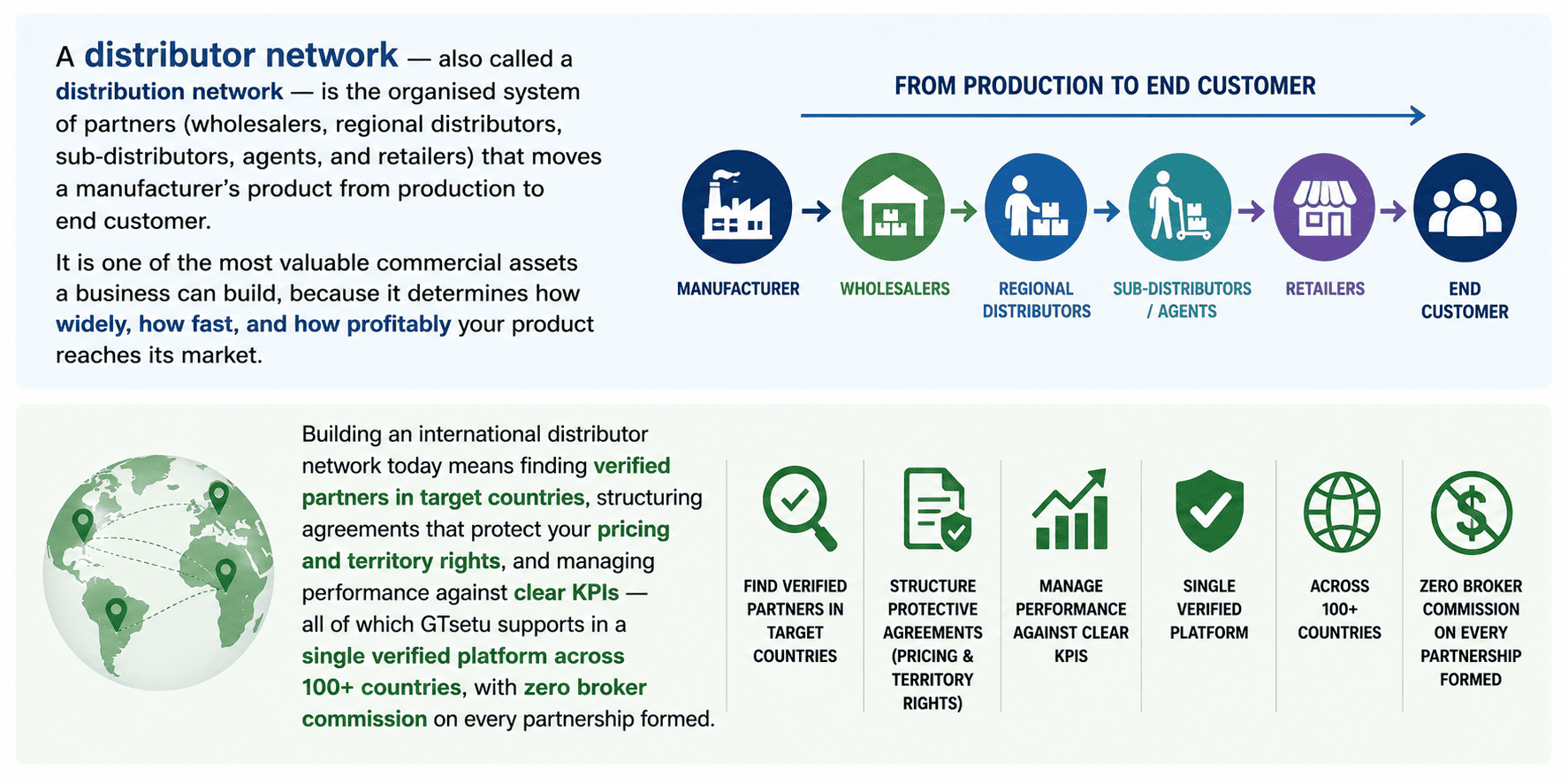
Direct Answer: A distributor network, also called a distribution network, is the organised system of partners (wholesalers, regional distributors, sub-distributors, agents, and retailers) that moves a manufacturer’s product from production to end customer. It is one of the most valuable commercial assets a business can build, because it determines how widely, how fast, and how profitably your product reaches its market. Building an international distributor network today means finding verified partners in target countries, structuring agreements that protect your pricing and territory rights, and managing performance against clear KPIs. GTsetu helps with the first step: discovery. Every distributor in GTsetu is 6-point business verified (Name, Address, Registration Number, Company Status, Company Type, Date of Certificate of Incorporation) using government ties. All other verification (tax, licences, certifications, financial standing) remains your responsibility to complete independently. GTsetu provides secure tools for that due diligence. And GTsetu charges zero broker commission on every partnership formed.
📅 May 17, 2026⏱ 18 min read✍️ GTsetu Editorial Team🔄 Updated regularly
500+
Verified Companies
100+
Countries
6-Point
Govt Tie-Up Verification
0%
Commission on Any Partnership
A product without distribution is a product without a market. No matter how good your manufacturing, formulation, or technology is, your commercial success is determined by how well your distributor network carries your product to the people who want to buy it. The best-performing brands in every category share one underappreciated advantage: they built exceptional distributor networks before they needed them.
Yet for most manufacturers, especially those expanding internationally, building a reliable network of distributors is the hardest commercial problem they face. Finding the right partners in unfamiliar markets, verifying their capabilities, structuring agreements that protect pricing and territory, and managing performance across geographies requires infrastructure that most businesses lack.
This guide covers everything you need to know about distributor networks: what they are, how they work, the different types, how to build and manage one internationally, and how GTsetu, the global B2B platform, connects manufacturers with government-identity-verified (6 points) distributors across 100+ countries in a single secure ecosystem with zero broker commission.
💡 Who Is This Guide For?
This article is written for manufacturers, brand owners, exporters, and startups who need to build or expand a distributor network, domestically or internationally. It is also relevant for distributors seeking to join manufacturer networks, and for anyone evaluating how to structure distribution agreements, manage channel partners, or find distributor partners in new markets. For a practical starting point, see our guide on how to find international distributors.
SECTION 1
1 What Is a Distributor Network?
🎯 Definition
A distributor network (also called a distribution network or distributors network) is the organised system of businesses and partners, including wholesalers, regional distributors, sub-distributors, agents, and retailers, through which a manufacturer moves its products from the point of production to the end customer. It is the commercial infrastructure that determines how widely, how fast, and at what cost your product reaches its market. A well-structured distributor network is a durable competitive advantage. A poorly managed one is a revenue bottleneck.
Unlike a single distributor relationship, a distributor network is a system of multiple, coordinated partnerships, each covering a defined territory, customer segment, or product category. The network as a whole determines your market coverage, your brand’s availability, and your ability to respond to demand fluctuations across geographies.
The Key Entities in a Distributor Network
Network Entity
Role in the Network
Relationship to Manufacturer
Typical in Which Models
Manufacturer / Brand Owner
Creates the product; sets pricing, positioning, and distribution policy; owns the brand
Principal, defines network structure and terms
All distribution models
Master / National Distributor
Holds exclusive or primary rights for an entire country or large territory; may sub-distribute
Direct contractual partner; highest commercial responsibility
Exclusive and selective networks
Regional Distributor
Covers a specific geographic sub-territory; carries stock and manages local sales
Direct or via master distributor
Large territory networks, FMCG
Independent Distributor
Self-funded, self-operating business that purchases and resells products independently
Arms-length commercial relationship; no employment dependency
Intensive and non-exclusive networks
Wholesaler
Buys in bulk from manufacturer or master distributor; sells to retailers at discounted prices
Typically non-exclusive; volume-focused
FMCG, industrial products, pharma
Agent / Sales Representative
Facilitates sales on commission without taking title to goods; does not carry stock
Typically non-exclusive; paid on performance
B2B industrial, high-value products
Retailer
Sells directly to end consumers; the last link before the customer
Often no direct relationship with manufacturer; buys from distributor
Consumer goods, electronics, FMCG
SECTION 2
2 Why Your Distributor Network Is Your Most Valuable Commercial Asset
A manufacturer’s product can be imitated. Pricing can be matched. But a well-established distributor network, built over years with trusted partners who have deep local market relationships, is extremely difficult for competitors to replicate. It is, in the truest sense, a strategic moat.
73%
of manufacturers say distribution reach is their primary growth constraint in new international markets
3–5×
faster market penetration achieved by manufacturers with pre-qualified distributor partners vs. those building from scratch
60%
of cross-border distribution partnerships fail in year one due to inadequate partner verification and contractual clarity
🌍
Market Access Without Infrastructure
A strong distributor network gives you coverage in markets where you have no physical presence, warehousing, last-mile delivery, customer relationships, and regulatory compliance all managed by established local partners.
💰
Revenue Without Fixed Cost
Distributors carry the inventory risk and working capital burden of in-market stock. You receive revenue from product sales without building the local infrastructure yourself, a fundamentally capital-efficient growth model.
🏃
Speed to Market
An established network distributor has existing retailer relationships, logistics infrastructure, and regulatory clearances. Plugging your product into an established network is dramatically faster than building your own channels.
🛡️
Local Market Intelligence
Network distributors give you real-time intelligence about customer preferences, competitor activity, regulatory changes, and pricing dynamics in their territory, intelligence that would take years to develop independently.
📈
Scalable Growth Architecture
Adding a new territory means adding a new verified distributor, not building new infrastructure. A distributor network scales geographically in a way that direct sales operations cannot.
🤝
Distributor Service Network Effects
In technical and industrial products, your distributor service network, the after-sales, repair, and support capability your distributors carry, directly drives product adoption. Customers buy where service is available.
SECTION 3
3 Types of Distributor Networks
The right distribution network model depends on your product category, price point, target customer, and market strategy. There is no universally superior model, but there is a right model for each specific commercial situation. Understanding the options is the first step to designing an effective network.
🏅
Exclusive Distributor Network
One distributor per territory holds sole rights to sell your product in that area. No competition between distributors in the same territory. Distributors invest heavily because their returns are protected.
Best for: premium brands, industrial equipment, pharma
🎯
Selective Distributor Network
A limited number of chosen distributors per market, more than one, but not available to all applicants. Balances coverage with quality control. Distributors are selected on capability criteria.
Best for: technical products, branded goods, speciality chemicals
📡
Intensive Distributor Network
Maximum market coverage, your product is available through as many distributors and retailers as possible. Prioritises availability and volume over channel control. Distributors are largely independent.
Best for: FMCG, commodities, everyday consumer goods
🌐
Hub-and-Spoke Network
A central warehouse or master distributor (the hub) supplies multiple regional points (spokes). Efficient for inventory management; enables fast replenishment across a large territory from a single stocking point.
Best for: large territory coverage, e-commerce, perishables
🔗
Independent Distributor Network
Network of self-funded, self-operating independent distributors with no direct employment relationship to the manufacturer. Low overhead for the manufacturer; distributors carry full commercial risk and reward.
Best for: MLM, direct sales models, regional specialists
🔄
Hybrid Distribution Network
Combines multiple models, for example, exclusive distributors in key markets, selective distribution in secondary markets, and direct sales online. The most common model for scaling manufacturers.
Best for: established brands with complex multi-market strategies
⚡ Choosing Your Network Model
The choice between exclusive, selective, and intensive distribution is one of the most consequential strategic decisions a manufacturer makes when entering a new market. It affects distributor motivation, pricing control, brand positioning, and the contractual terms of every distribution agreement. For a detailed framework, see our guides on exclusivity clauses in distribution agreements and territory rights in international agreements.
SECTION 4
4 Key Components of a Distributor Network
A functioning distributor network is more than a list of partners. It is a coordinated commercial system with clearly defined components, each of which must be designed, documented, and managed for the network to perform.
🗺️
Territory Structure & Coverage Map
A clear definition of which distributor covers which geographic area, with no overlaps, no gaps, and explicit rules for border cases. Territory structure determines distributor motivation and prevents channel conflict. See our guide on territory rights.
Strategic
💲
Pricing Architecture & Margin Structure
The tiered pricing structure from manufacturer to master distributor to regional distributor to retailer, defining who earns what margin at each level. Must be designed to keep every level commercially motivated while maintaining end-market price competitiveness. See our guide on pricing structures.
Commercial
📋
Distribution Agreements
Legally binding contracts covering: territory, exclusivity status, pricing and margin, minimum purchase commitments, performance targets, brand compliance, IP usage, termination provisions, and dispute resolution. The legal foundation of the network. See our guide on licensing vs. distribution agreements.
Legal
📦
Inventory Management & Logistics
How stock is ordered, moved, stored, and replenished across the network. Includes minimum order quantity (MOQ) policies, safety stock requirements, lead time management, and Incoterms governing risk and cost transfer at each shipment point.
Operational
📊
Performance Metrics & KPI Framework
Agreed targets for each distributor: sales volume, market coverage, new account acquisition, product mix, customer satisfaction, and reporting frequency. KPIs create accountability and provide the basis for network reviews, incentive programmes, and termination decisions.
Management
💳
Payment Terms & Financial Framework
How distributors pay for goods: advance payment, letters of credit, open account terms, or payment on delivery. Payment structures affect distributor cash flow, your receivables risk, and the commercial relationship dynamic. See our guide on advance payment vs. LC vs. open account.
Financial
SECTION 5
5 How to Build an International Distributor Network
Building an international distributor network, from identifying target markets to closing your first distribution agreements, is a structured process that most manufacturers get wrong by rushing. The single most common mistake is approaching potential distributors before doing the foundational work: market selection, ideal partner profiling, and information security. Here is the right sequence.
01
Define Your Target Markets and Distribution Model
Before approaching a single distributor, determine which markets to enter and what type of distribution model fits each one. A premium industrial product requires a different network design than an FMCG brand. Use a market prioritisation matrix: market size, regulatory complexity, competition intensity, and cultural proximity to your existing markets. Define exclusive vs. selective vs. intensive distribution for each priority market. For guidance on structuring your market entry, see our market entry partnerships guide and global expansion advantages and disadvantages.
02
Define Your Ideal Distributor Profile
An ideal distributor partner is not just anyone willing to carry your product. Define specific criteria: minimum annual turnover, existing product portfolio (complementary, not competing), geographic coverage within the territory, warehouse and logistics capability, sales force size, customer base (retailer access, key accounts), financial stability, and relevant regulatory licences. Being precise about this profile saves months of time engaging with unsuitable candidates.
03
Source Distributor Candidates
Finding distributor candidates who meet your profile is the critical step most manufacturers handle worst. Trade directories provide unverified self-reported listings. Trade fairs expose your product to competitors before any agreement is in place. GTsetu gives you access to government-identity-verified (6 points) partners across 100+ countries, browsable anonymously, and engageable through a built-in NDA workflow before any commercial information is shared. Note: GTsetu verifies Name, Address, Registration Number, Company Status, Company Type, and Date of Certificate of Incorporation only. Tax compliance, import/export licences, industry certifications, and financial standing must be verified by you independently. GTsetu provides encrypted tools to request and review these documents securely.
04
Execute NDA Before Sharing Pricing or Commercial Terms
Before discussing transfer pricing, margin structures, volume commitments, or market strategy with any distributor candidate, execute a mutual NDA. This is the non-negotiable security gate that prevents your commercial intelligence from reaching competitors. On GTsetu, NDA execution takes under 2 minutes, with digital signatures, timestamps, and full audit trail. For a detailed guide on NDA types and requirements, see our article on mutual vs. one-way NDAs.
05
Conduct Distributor Due Diligence
Verify your shortlisted distributor candidates against your ideal profile: confirm their actual territory coverage, check their existing customer accounts, review their financial standing (GTsetu does not verify financial standing), verify relevant licences and certifications (your responsibility), and speak with references. Red flags include: inflated coverage claims, reluctance to provide financial information, existing competing product lines, or unclear ownership structures. See our guide on business verification and ID checks for a detailed due diligence framework. You can request tax certificates, licences, and financial documents through GTsetu’s encrypted workspace.
06
Negotiate and Execute Distribution Agreements
Once a distributor is selected, negotiate and formalise a comprehensive distribution agreement covering: territory and exclusivity, product pricing and margin, minimum purchase commitments (and their consequences), performance targets, brand compliance requirements, IP usage rights, sub-distribution restrictions, payment terms, dispute resolution, and termination provisions. For detailed guidance on the legal framework, see our guides on volume commitments, termination clauses, and business partnership contracts.
07
Onboard, Train, and Launch
Effective distributor onboarding, product training, pricing education, brand guidelines, ordering procedures, and technical support access, is the single biggest determinant of first-year distributor performance. Distributors who are well-equipped at launch outperform those who are left to figure things out independently by a factor of 2–3x in first-year volume. Budget for onboarding as a commercial investment, not an operational cost.
08
Manage, Review, and Optimise Continuously
Building the network is the beginning, not the end. Distributor network management requires: quarterly performance reviews against KPIs, regular market visit programmes, pricing compliance monitoring, active conflict management between channel partners, periodic territory reassignments where performance is consistently below target, and an ongoing pipeline of potential replacement or expansion partners for each market.
SECTION 6
6 Distributor Network Management, Best Practices
Distributor network management is the ongoing commercial discipline of maximising the performance of every partner in your network, while maintaining pricing integrity, brand standards, and market coverage across all territories. It is, in practice, the most important determinant of long-term distribution success.
Management Dimension
What Good Looks Like
What Poor Looks Like
Impact of Getting It Right
Performance Monitoring
Monthly sales reports by SKU and territory; comparison vs. agreed targets; early warning triggers for underperformance
Annual reviews based on total sales; no SKU-level visibility; reactive response to problems
30–50% improvement in distributor performance through proactive management vs. reactive
Prevents distributor exits and protects network stability in key markets
Network Renewal
Ongoing pipeline of qualified potential distributors; proactive replacement of underperformers; expansion as market develops
No backup pipeline; reluctance to replace underperformers due to lack of alternatives
Network quality improves continuously rather than degrading to lowest-performing partners
🔑 The Network Distributor Mindset
The most effective manufacturers treat their network distributors as strategic partners, not transactional customers. A networking distributor who feels genuinely invested in by the manufacturer will prioritise your brand over competing lines, share market intelligence, invest in their own sales capabilities, and defend your market position. The partnership dynamic begins with how you structure the relationship from day one, see our guide on B2B secure collaboration for the security and trust infrastructure that underpins strong distributor relationships.
SECTION 7
7 Common Challenges in Managing a Distributor Network
🚩
Distributor Underperformance
A distributor who covers a territory but consistently misses volume targets, and who cannot be easily replaced due to exclusivity provisions without contractual consequences, is the most common and costly network management problem.
🚩
Channel Conflict
Two distributors competing in the same territory, due to ambiguous boundaries, e-commerce, or cross-border selling, creates pricing wars, customer confusion, and distributor resentment that damages the entire network.
🚩
Price Erosion & Grey Market
Distributors selling below agreed price floors, or third parties importing products from lower-priced markets, undermine brand positioning and erode margins for compliant network partners.
🚩
Distributor Dependency Risk
Over-reliance on a single distributor for a major market creates catastrophic revenue risk if that relationship ends. A well-structured distributor service network should have no single partner representing more than 20–25% of total revenue.
🚩
Non-Compete Violations
A distributor carrying your product while also promoting a directly competing brand, sometimes in violation of your agreement’s non-compete provisions. See our guide on non-compete vs. non-circumvention clauses.
🚩
Force Majeure Disruptions
Distributors unable to fulfil their obligations due to supply chain disruptions, regulatory changes, or market shocks, without clear provisions for handling delays, volume shortfalls, or temporary territory reallocation. See our guide on force majeure in global trade.
🚩
Termination Disputes
Ending a distributor relationship, especially an exclusive one in a market where the distributor has invested in brand-building, creates legal and commercial risk without properly drafted termination provisions. See our guide on termination clauses.
🚩
Inadequate Partner Verification
Engaging a distributor who misrepresented their market coverage, financial standing, or existing customer base, discovered only after the agreement is signed and products are shipped. The cost of inadequate upfront verification routinely exceeds the cost of rigorous due diligence by 10–20x.
SECTION 8
8 Distributor Network vs. Direct Sales, Which Model Fits?
The choice between building a distributor network and selling directly to customers or retailers is one of the most consequential go-to-market decisions a manufacturer makes. Most growing companies use both, but understanding the trade-offs determines how you allocate resources across channels.
DimensionDistributor NetworkDirect Sales
Market coverage speed
✓ Fast, leverage existing relationships
✗ Slow, build from scratch
Upfront capital requirement
✓ Low, distributor carries inventory
✗ High, own warehousing, logistics, sales force
Margin per unit
✗ Lower, distributor margin shared
✓ Higher, no channel margin given away
Customer relationship control
✗ Indirect, via distributor
✓ Direct, own the customer relationship
Market intelligence quality
~ Depends on distributor reporting
✓ Direct, real-time first-party data
Brand control
~ Contractual, requires compliance monitoring
✓ Full, direct execution of brand standards
Geographic scalability
✓ High, add territories via partner recruitment
✗ Limited, requires physical infrastructure per market
Risk of channel conflict
~ Requires territory management discipline
✓ None, single channel
Best suited for
International expansion, new geographies, capital-efficient growth, products requiring local service networks
Home market, large accounts, high-margin products, direct B2B relationships
SECTION 9
9 How GTsetu Builds Your Distributor Network, Government-Identity-Verified, Secure, Zero Commission
🌐 Platform Spotlight, GTsetu
The Global Platform for Building Your Distributor Network with Verified Identities
GTsetu helps manufacturers discover and securely engage potential distributor partners. Every distributor on GTsetu undergoes 6-point government tie-up verification: Name, Address, Registration Number, Company Status, Company Type, and Date of Certificate of Incorporation. This verification is completed before a profile appears in search results. What GTsetu does NOT verify: tax compliance, import/export licences, industry certifications, financial standing, or authority of representatives. These remain your responsibility to verify independently, and GTsetu provides an encrypted workspace to request and review these documents securely. All partnerships formed on GTsetu incur zero commission, no success fees, no broker charges.
✅
6-Point Government Identity Verification
Every company verified against official registries on Name, Address, Registration Number, Company Status, Company Type, and Date of Certificate of Incorporation. No unverified or self-reported profiles.
🔍
Smart Partner Discovery
Filter by territory, sector, company size, and partnership type. Find potential distributors for your product category in any of 100+ countries, without cold outreach or trade directory guesswork.
🕵️
Anonymous Discovery
Browse distributor profiles across 100+ countries without revealing your company name, product range, or pricing strategy. Your market expansion plans stay private until you are ready to engage.
📄
NDA in 2 Minutes
Auto-generated, jurisdiction-aligned mutual NDA, digitally signed before any pricing, commercial terms, or product specifications are shared. The security gate your distributor network needs from day one.
🔐
Encrypted Workspace
Share pricing structures, distribution agreements, due diligence requests (tax certificates, licences, financials), and commercial proposals through an AES-256 encrypted workspace, with full access logging and version control.
📋
Full Audit Trail
Every message, document access, NDA signature, and collaboration event is timestamped and logged, providing legal evidence and compliance documentation for every distributor relationship you build.
🌍
100+ Countries
Distributors spanning Asia, Middle East, Europe, Africa, Australia, and the Americas, covering every major trading market. Build your global distributor network from a single platform.
🚫
Zero Commission, Always
GTsetu charges zero commission on any distributor partnership formed, no success fee, no percentage of deal value, no profit share. Your distribution economics belong entirely to you and your distributor.
Not verified by GTsetu, you request via encrypted workspace
Your pricing & strategy protected during discovery
✗ Exposed from first conversation
✓ Anonymous browse + NDA before any sharing
Time to find qualified distributor candidates
~ 3–12 months of outreach
✓ Days, government-identity-verified pool with smart filters
NDA before pricing discussion
✗ Manual, frequently skipped
✓ Built-in workflow, triggered automatically
Commercial document security
✗ Email attachments, unencrypted
✓ AES-256 encrypted workspace
Audit trail of all distributor interactions
✗ Email threads, no access log
✓ Complete timestamped log, downloadable
Commission on partnerships formed
✗ 5–15% broker fee on deal value
✓ Zero, always
Alternative to traditional B2B directories
✗ Alibaba, IndiaMart, unverified listings
✓ GTsetu, verified identity, NDA-protected, zero commission. See: alternative to Alibaba
📌 Important Note on GTsetu’s Verification Scope
GTsetu verifies six specific data points using government ties: Company Name, Registered Address, Registration Number, Company Status, Company Type, and Date of Certificate of Incorporation. GTsetu does NOT verify tax compliance, import/export licences, industry certifications, financial standing, or authority of representatives. These remain your responsibility to verify independently. GTsetu provides an encrypted workspace where you can request these documents from partners and review them securely, with full audit trail.
SECTION 10
10 The Distributor Network Journey on GTsetu
Here is how a manufacturer builds and scales their distributor network on GTsetu, from first search to a signed distribution agreement, with every security gate in place.
📝
Register & Verify
6-point government identity verification unlocks platform access
🔐 Identity confirmed
🔍
Browse Anonymously
Filter distributors by territory, sector, type
🔐 Strategy private
🤝
Mutual Match
Both parties confirm interest, gated identity reveal
🔐 Pre-vetted identity
📄
NDA in 2 Min
Legal gate before pricing or terms are shared
🔐 IP protected
🔐
Negotiate Securely
Encrypted workspace, terms, pricing, territory, plus due diligence document exchange
🔐 E2E encrypted
✅
Agreement Signed
Distribution contract closed, zero commission
🔐 0% fee
SECTION 11
11 Key Contracts in a Distributor Network
Every relationship in a distributor network must be governed by a written agreement. The specific documents required depend on the type of relationship and the jurisdictions involved, but these are the core legal instruments that form the contractual backbone of any distributor network. For a deeper exploration of how distribution agreements fit into the broader landscape of trade structures, see our guide on industrial business collaboration and cross-border business partnerships.
Contract Type
Purpose
Key Provisions
GTsetu Guide
Mutual NDA
Protects confidential information before and during negotiations, the first document executed in any distributor relationship
Scope of confidentiality, permitted use, duration, governing law, return/destruction
Force majeure clause, defining obligations and relief during extraordinary events
Governing law and dispute resolution, international arbitration preferred for cross-border networks
Sub-distribution rights, explicit provision on whether the distributor may appoint sub-distributors
FAQ
? Frequently Asked Questions
Q
What is a distributor network?
A distributor network (also called a distribution network or distributors network) is the organised system of businesses, wholesalers, regional distributors, sub-distributors, agents, and retailers, through which a manufacturer’s product moves from production to end customer. It determines market coverage, speed of product availability, brand consistency across territories, and the cost efficiency of reaching customers at scale. A well-structured distributor network is one of the most durable competitive advantages a manufacturer can build, because local distribution relationships, trust, and market knowledge take years to accumulate and cannot be instantly replicated by competitors.
Q
What is the difference between a distributor and a distribution network?
A distributor is a single business entity that purchases your product and resells it within a defined territory or customer segment. A distribution network, or distributor network, is the coordinated system of multiple distributors, each covering a different territory, channel, or customer segment, collectively providing your total market coverage. A single distributor is a point-to-point relationship. A distributor network is a strategic infrastructure, designed, managed, and continuously optimised across geographies.
Q
What are the main types of distributor networks?
The six main types are: exclusive distribution (one partner per territory with sole rights), selective distribution (limited chosen partners per market), intensive distribution (maximum coverage through as many partners as possible), hub-and-spoke (central warehouse supplying regional points), independent distributor networks (self-funded, self-operating distributors with no employment dependency on the manufacturer), and hybrid networks (combining multiple models across different markets). The right model depends on your product, price point, brand strategy, and the specific characteristics of each target market. For more on structuring territory and exclusivity, see our guides on territory rights and exclusivity clauses.
Q
What is distributor network management?
Distributor network management is the ongoing commercial discipline of maximising performance across all partners in your distribution network, through performance monitoring, pricing compliance, incentive programmes, market visit programmes, conflict resolution, and periodic network restructuring. Effective management transforms a collection of distribution agreements into a coordinated commercial system. Key practices include monthly performance tracking at SKU level, quarterly structured reviews, active channel conflict management, and maintaining an ongoing pipeline of qualified replacement or expansion partners for every territory.
Q
How do I find international distributors for my product?
GTsetu helps manufacturers discover potential distributor partners. Every distributor on GTsetu undergoes 6-point government identity verification (Name, Address, Registration Number, Company Status, Company Type, Date of Certificate of Incorporation). You can browse anonymously across 100+ countries without revealing your company identity or pricing. When mutual interest is confirmed, an NDA is executed in under 2 minutes before any commercial information is shared. Note: GTsetu does NOT verify tax compliance, import/export licences, industry certifications, or financial standing. These remain your responsibility to verify independently, and you can request these documents through GTsetu’s encrypted workspace. GTsetu charges zero commission on any partnership formed. For the full approach to finding distributors globally, see our guide on how to find international distributors.
Q
What is an independent distributor network?
An independent distributor network is a system of self-funded, self-operating distribution businesses that carry and sell a manufacturer’s product without being employees or franchisees of the manufacturer. Each independent distributor operates as a separate commercial entity, purchasing products at wholesale prices, carrying their own inventory risk, and building their own customer relationships within their territory. This model minimises the manufacturer’s overhead and capital deployment; the trade-off is lower direct control over how the product is sold, priced, and positioned in the market.
Q
What is the difference between a distributor network and a B2B business network?
A distributor network is a specific subset of a broader B2B business network, focused specifically on the commercial channel through which products move from manufacturer to market. A B2B business network is broader, encompassing suppliers, manufacturers, technology providers, logistics partners, and distributors. GTsetu is a B2B business network that includes a distributor network as its most prominent function, connecting manufacturers with government-identity-verified distribution partners globally.
Q
How do I protect my pricing when approaching distributors in a new market?
The most important protection is executing a mutual NDA before sharing any pricing, margin structures, or commercial terms with a distributor candidate. A properly drafted NDA covers the scope of confidential information, prohibits disclosure to third parties, specifies permitted use (evaluation of the potential partnership only), survives contract termination, and includes remedies for breach. On GTsetu, NDA execution is built into the platform workflow and takes under 2 minutes, ensuring your pricing is legally protected before the first commercial conversation. Additionally, use anonymous discovery to browse distributor profiles without revealing your product or market intent. For detailed guidance, see our mutual vs. one-way NDA guide and our article on B2B secure collaboration.
Q
How is GTsetu different from Alibaba, IndiaMart, or TradeIndia for finding distributors?
The fundamental differences are verification scope, security, and commission. Traditional directories allow any company to pay for a listing and self-report credentials, with no third-party verification. GTsetu requires 6-point government identity verification before a company can engage. Traditional directories expose your product enquiry and pricing to all respondents simultaneously, with no NDA, no anonymity, and no security. GTsetu provides anonymous discovery, mandatory NDA workflows, and encrypted document exchange. Traditional directories earn revenue from listing fees or transaction commissions that create misaligned incentives. GTsetu charges zero commission, always. Note: GTsetu verifies 6 identity points only; tax, licences, certifications, and financial standing are not verified by GTsetu. For a detailed comparison, see our articles: alternative to Alibaba, alternative to IndiaMart, and alternative to TradeIndia.
Q
What does GTsetu actually verify?
GTsetu verifies six specific data points using government ties: Company Name, Registered Address, Registration Number, Company Status (Active/Dissolved), Company Type (Ltd, Pvt Ltd, etc.), and Date of Certificate of Incorporation. GTsetu does NOT verify tax compliance, import/export licences, industry certifications, financial standing, or authority of representatives. Those remain your responsibility to verify independently. GTsetu provides an encrypted workspace where you can request these documents from partners and review them securely, with full audit trail.
Q
What should I look for in a global distributor partner?
An ideal global distributor partner combines market reach, financial stability, and commercial alignment with your brand. Specifically, look for: verified legal registration and active business status in the target territory (GTsetu provides this 6-point verification); existing customer base that matches your target segment; geographic coverage that covers the territory you are assigning; logistics and warehousing capability appropriate for your product; no directly competing product lines (or explicit carve-out provisions); financial standing sufficient to carry inventory and support 30–60 day payment terms (your responsibility to verify); relevant regulatory licences for your product category (your responsibility to verify); and a track record of growing international brands in their market. For the full due diligence framework, see our guide on business verification and ID and our global partner service guide.
Build Your Global Distributor Network, Government-Identity-Verified Partners, Zero Commission
Join 500+ manufacturers and distributors building cross-border partnerships on GTsetu. Anonymous discovery, NDA-first engagement, encrypted document workspace for your due diligence, and zero broker fees, across 100+ countries. Note: GTsetu verifies 6 identity points; tax, licences, certifications, and financial standing remain your responsibility.
They represents the product, and research team behind GTsetu, a global B2B collaboration platform built to help companies explore cross-border partnerships with clarity and trust. The team focuses on simplifying early-stage international business discovery by combining structured company profiles, verification-led access, and controlled collaboration workflows.
With a strong emphasis on trust, and disciplined engagement, Team GTsetu shares insights on global trade, partnerships, and cross-border collaboration, helping businesses make informed decisions before entering deeper commercial discussions.