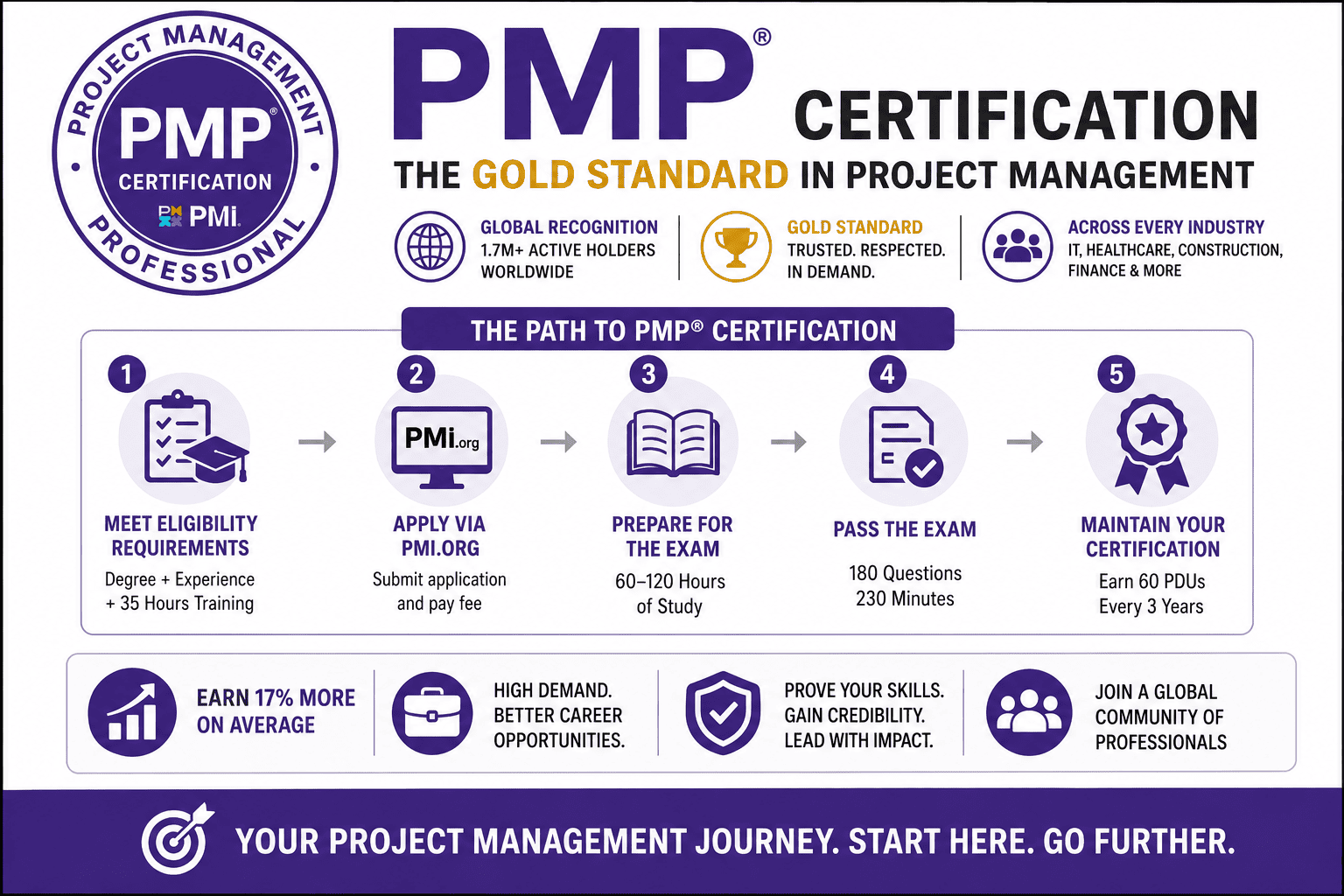
Direct Answer: The Project Management Professional (PMP)® certification from PMI is the gold standard in project management, with over 1.7 million active holders worldwide. Earning your PMP involves a clear path: meet eligibility requirements (degree + experience + 35 hours training), apply via PMI.org, prepare for the exam (60-120 hours of study), pass the 180-question exam (230 minutes), and maintain certification by earning 60 PDUs every 3 years. PMP-certified professionals earn 17% more on average and are in demand across IT, healthcare, construction, finance, and every industry. This guide walks you through every step, from eligibility to exam day to maintaining your credential.
📅 July 6, 2026⏱ 18 min read✍️ GT Setu Editorial Team🔄 Updated regularly
1.7M+
Active PMP Holders Worldwide
17%
Higher Median Salary
2-6
Months (Typical Study Time)
0%
GTsetu Broker Commission
The Project Management Professional (PMP)® certification is the world’s leading project management credential. Awarded by the Project Management Institute (PMI), it is recognized globally across all industries and is often a requirement for senior project management roles. In 2026, PMP remains the gold standard, validating your ability to lead projects in any way of working: predictive, agile, or hybrid. With 1.7+ million active certification holders, the PMP community is a powerful network of project leaders driving organizational success worldwide.
For project managers, team leads, and aspiring leaders, PMP certification signals to employers and clients that you have the skills to manage complex projects, navigate uncertainty, and deliver results. This guide covers the complete certification process, from eligibility and application through exam prep and maintenance, with practical advice for a successful journey. See our related guides on ISO 9001, ISO 14001, ISO 13485, ISO 27001, and ISO 45001 to understand how quality and project management standards work together.
📋 Who Is This Guide For?
This guide is written for project managers, aspiring PMP candidates, team leads, and anyone responsible for leading projects in any industry, IT, healthcare, construction, manufacturing, finance, and beyond. It covers both the PMI-route and the practical preparation needed to succeed. For related partnership structures, see our guides on supplier collaboration platforms and distributors and manufacturers.
SECTION 1
1 What Is PMP Certification & Why Get It?
🏛️ The Gold Standard in Project Management
The Project Management Professional (PMP)® is a globally recognized certification from the Project Management Institute (PMI). It validates a professional’s ability to lead and manage projects across any industry, using any methodology, predictive, agile, or hybrid. The PMP demonstrates competence in three domains: People (42%), Process (50%), and Business Environment (8%). With over 1.7 million active holders worldwide, it is the most sought-after project management credential and is often a prerequisite for senior project leadership roles. The certification is valid for 3 years and requires 60 Professional Development Units (PDUs) for renewal.
🌐
Globally Recognized Credential
The PMP is recognized in over 200 countries and is the most widely accepted project management certification. It provides a common language for project leadership across industries and geographies.
📈
Career Advancement & Job Prospects
PMP-certified professionals are preferred for senior project roles. PMI projects 2.2 million new project management jobs annually through 2027, PMP holders are first in line.
💰
Higher Salary & ROI
PMP holders earn 17% more on average than non-certified peers, up to 33% more in the US. The certification delivers strong return on investment, often recouped within months.
🔄
Agile & Hybrid Proficiency
The PMP exam covers predictive, agile, and hybrid approaches, ensuring you’re prepared for any project environment. Half the exam tests agile/hybrid knowledge.
SECTION 2
2 Key Benefits of PMP Certification
PMP certification delivers measurable benefits across career, financial, and professional development dimensions. Here’s what the data shows.
17%
Higher median salary for PMP holders (PMI Salary Survey)
2.2M
New project management jobs needed annually through 2027
67%
Certified professionals report increased compensation within 1 year
🏷️
Enhanced Market Credibility
PMP signals to employers, clients, and peers that you have the skills, experience, and commitment to lead complex projects. It’s a mark of excellence and professional maturity.
Career
💼
Expanded Job Opportunities
Many organizations require PMP for senior project roles. Certification opens doors to new industries, geographies, and leadership positions that may otherwise be inaccessible.
Opportunity
🧠
Enhanced Project Leadership Skills
Prep for the PMP exam significantly improves proficiency in project management processes, leadership, communication, and strategic alignment, making you a better project leader.
Skills
🛡️
Risk Management Expertise
PMP provides in-depth knowledge in identifying, assessing, and mitigating risks. These skills are critical for project success and are a key differentiator for certified professionals.
Risk
🤝
Professional Network & Community
PMP connects you to a global community of over 1.7 million certified professionals. PMI chapters, events, and online forums provide ongoing support and learning.
Network
🌍
Global Mobility & Recognition
PMP is recognized internationally, making it easier to pursue project leadership roles across borders. It’s a portable credential that travels with your career.
Global
SECTION 3
3 PMP Eligibility Requirements
Before applying for the PMP exam, you must meet one of three sets of eligibility requirements based on your education and experience. These requirements ensure that PMP candidates have the foundational project management experience needed to understand and apply the exam content.
Education Level
Project Management Experience
Project Management Education
Secondary Degree (High School Diploma, Associate’s, or global equivalent)
Minimum 60 months (5 years) of project leadership experience within the past 8 years
35 hours of project management education or CAPM® certification
Bachelor’s Degree or global equivalent
Minimum 36 months (3 years) of project leadership experience within the past 8 years
35 hours of project management education or CAPM® certification
Bachelor’s Degree from a GAC-accredited program
Minimum 24 months (2 years) of project leadership experience within the past 8 years
GAC core project management coursework is pre-approved (meets the 35-hour requirement)
💡 What Counts as Project Management Experience?
PMI defines project management experience as leading and directing projects, you must have worked in a role where you were responsible for project activities such as initiating, planning, executing, monitoring, and closing. Experience must be non-overlapping and earned within the last 8 years. For each project, you’ll need to document: project title, organization, your role, responsibilities, and the project’s duration. The 35 hours of education must be specifically in project management topics (not general business or leadership).
SECTION 4
4 PMP Exam Format & Domains
Understanding the PMP exam format and content domains is essential for effective preparation. Here’s what you need to know about the exam structure, question types, and domain distribution.
Two 10-minute breaks (after the first 60 questions and after the next 60 questions)
Question Types
Multiple-choice, multiple-response, matching, hotspot, and limited fill-in-the-blank
Domains
People (42%), Process (50%), Business Environment (8%)
Methodology Split
~50% Predictive (Waterfall), ~50% Agile/Hybrid
Passing Score
PMI uses a psychometric scoring model, not a fixed percentage. Typically, 60-70% is considered passing range.
Testing Options
Available at testing centers or online proctored (from home/office)
👥
People (42%)
Leading and building teams, managing conflict, supporting virtual teams, mentoring, and stakeholder engagement. Focuses on the soft skills and leadership aspects of project management.
⚙️
Process (50%)
Managing budgets, scheduling, change management, quality, risk, and determining the best methodology for the project. Covers the technical and methodological aspects of project delivery.
📊
Business Environment (8%)
Compliance, delivering value, supporting organizational change, and understanding how projects align with business strategy. Focuses on the strategic and organizational context of projects.
SECTION 5
5 Step 1: Meet the PMP Requirements
✅ Preparing Your Application
Before you can apply, ensure you meet the eligibility requirements documented in Section 3. Gather supporting documentation for your education, project experience, and training. The application process requires you to document specific projects, you’ll need details like project title, organization, your role, responsibilities, and duration. PMI may audit your application, so keep records of your experience and training in case you’re selected for verification.
1.1
Review Eligibility Requirements
Confirm that you meet one of the three eligibility paths (secondary degree + 60 months, bachelor’s + 36 months, or GAC-accredited degree + 24 months). Ensure your experience is within the last 8 years and includes leading and directing projects.
1.2
Complete 35 Hours of Education
Earn 35 hours of project management education. This can be through PMI Authorized Training Partners (ATPs), online courses, university programs, or in-person bootcamps. The training must be specifically in project management topics.
1.3
Document Your Project Experience
For each project you’ll list, document: project title, organization, your role, responsibilities, and the duration. Be specific about your leadership contributions, PMI will verify these details if you’re audited.
1.4
Check for Other Requirements
If you’re a CAPM holder, the 35-hour education requirement is waived. If you’re a GAC-accredited program graduate, the 35-hour requirement may be met by your core coursework. Confirm these details before applying.
SECTION 6
6 Step 2: Apply for the PMP Exam
The application process is conducted online through the PMI website. It requires you to submit your education, experience, and training details. The application is reviewed by PMI before you can schedule your exam.
2.1
Create a PMI Account
Visit PMI.org and create a free account. This will be your portal for the application, exam scheduling, and ongoing certification management.
2.2
Complete the Online Application
Fill out the application with your educational background, project experience, and training details. For each project, provide the required information and be prepared for a potential audit.
2.3
Pay the Exam Fee
Pay the exam fee: $555 for non-members, $405 for PMI members. PMI membership costs $139/year, which also provides access to resources and discounts. You can pay via credit card or other accepted methods.
2.4
Application Review & Audit
PMI will review your application. You may be selected for a random audit, if so, you’ll need to provide supporting documentation for your experience and training. Keep records handy to speed up this process.
SECTION 7
7 Step 3: Prepare for the PMP Exam
Effective preparation is the key to passing the PMP exam. Most candidates dedicate 2-6 months of study, spending 10-15 hours per week. PMI recommends a combination of structured training, self-study, and practice exams.
📖
Study the PMBOK® Guide
The PMBOK Guide is the foundational reference for the exam. Focus on the 7th edition, which emphasizes principles, performance domains, and models rather than just processes. While not a standalone prep guide, it provides essential context.
Foundation
🎓
Take a Structured Course
PMI Authorized Training Partners (ATPs) offer courses that align with the exam content outline. These courses often include practice exams, study guides, and instructor support. Many are available online or in-person.
Training
🧪
Practice with Simulated Exams
Take full-length practice exams to familiarize yourself with the format, timing, and question types. Use a variety of practice exams to cover different topics and approaches. This builds exam stamina and identifies weak areas.
Practice
📚
Use Supplemental Study Materials
In addition to the PMBOK Guide, use exam prep books, study guides, and online resources. Many successful candidates use a combination of books, video courses, and flashcards to reinforce learning.
Supplement
📝
Create a Study Plan & Stick to It
Set a realistic study schedule. Most candidates need 60-120 hours of dedicated study. Break down topics by week, set milestones, and track your progress. Consistency is key, daily study is more effective than cramming.
Planning
👥
Join a Study Group
PMI chapters and online communities offer study groups that provide support, accountability, and diverse perspectives. Discussing concepts with peers can deepen your understanding and highlight different approaches.
Community
💡 Study Tips for Success
Focus on Domains: Allocate study time proportionally to the domain weights, spend more time on Process (50%) and People (42%). Practice, Practice, Practice: Take at least 3-5 full practice exams. Understand, Don’t Memorize: The PMP exam tests application and situational judgment, not rote memorization. Review Incorrect Answers: Understand why you got a question wrong and review the underlying concept. Study Agile/Hybrid: About half the exam covers agile/hybrid approaches, ensure you’re comfortable with these concepts.
SECTION 8
8 Step 4: Take the PMP Exam
Once your application is approved, you’ll have one year to take the exam. You can schedule your exam at a testing center or take it online via proctored remote testing. Here’s what to expect on exam day.
Exam Aspect
Details
Scheduling
Schedule via your PMI account. Choose a date within your one-year eligibility window. Consider time of day, schedule when you’re most alert.
Testing Center vs. Online
Testing centers offer a controlled environment with on-site proctors. Online proctored exams allow you to test from home/office but require a quiet, private space and a stable internet connection.
Exam Day Preparation
Get a good night’s sleep, eat a light meal, and arrive early (for in-person) or log in early (for online). Bring valid, government-issued ID for identity verification.
Exam Environment
The exam is 230 minutes with two 10-minute breaks. Use the breaks to recharge. The exam interface allows you to flag questions for review and navigate between questions.
After the Exam
You’ll receive a preliminary pass/fail result immediately after completing the exam. Official results and score reports are available in your PMI account within a few days.
Retake Policy
If you don’t pass, you can retake the exam up to 2 more times within your one-year eligibility period. Retake fees: $375 (non-member), $275 (member). After three attempts, you must wait one year before reapplying.
SECTION 9
9 Step 5: Maintain Your PMP Certification
PMP certification is valid for three years. To maintain it, you must earn 60 Professional Development Units (PDUs) within each 3-year cycle and submit a renewal application with the associated fee. PDUs demonstrate your ongoing commitment to professional development in project management.
📚
Education PDUs
Earned through formal learning activities: courses, webinars, conferences, reading, and self-study. A minimum of 35 PDUs must be from education. At least 8 PDUs must be in each of the three skill areas: Ways of Working, Power Skills, and Business Acumen.
🤝
Giving Back PDUs
Earned through professional service: volunteering, content creation, and working as a practitioner. Up to 25 PDUs can be from giving back activities. This includes serving as a mentor, writing articles, or leading project management initiatives.
📋
Tracking & Reporting
Use the PMI Continuing Certification Requirements (CCR) system to track your PDUs. Log activities as you complete them, don’t wait until the end of your cycle. PMI may audit your PDU records, so keep supporting documentation.
🔄
Renewal Process
After earning 60 PDUs, submit your renewal application and pay the renewal fee: $60 for PMI members, $150 for non-members. Renewal can be completed online through your PMI account. Your certification will be renewed for another three-year cycle.
💡 PDU Earning Strategies
Spread PDU earning throughout the cycle, don’t wait until the last month. Attend PMI chapter events, many offer free or low-cost PDUs. Read project management books and articles, self-study counts for education PDUs (record time spent). Volunteer, serving on a PMI chapter committee or mentoring a colleague earns giving back PDUs. Use a PDU tracking app to monitor your progress and ensure you meet the requirements.
SECTION 10
10 PMP Costs & Timeline: What to Expect in 2026
Understanding the costs and timeline for PMP certification helps you plan and budget effectively. The investment includes exam fees, training costs, and study materials. Here’s a detailed breakdown.
Cost Category
Typical Range
Notes
PMP Exam Fee (Non-Member)
$555
Includes one exam attempt. Retakes are additional.
PMP Exam Fee (Member)
$405
PMI membership ($139/year) provides this discount and other benefits.
PMI Membership
$139/year
Optional but recommended, provides exam discount and access to resources.
Exam Retake Fee (Non-Member)
$375
For second and third attempts (within the one-year eligibility period).
Exam Retake Fee (Member)
$275
Member rate for retakes.
Renewal Fee (Member)
$60
Every 3 years, after earning 60 PDUs.
Renewal Fee (Non-Member)
$150
Every 3 years.
Training & Prep Courses
$500 – $3,000
Varies by provider (bootcamps, online courses, self-study).
Study Materials (Books, Practice Exams)
$100 – $500
Optional but recommended. Includes PMBOK Guide, exam prep books, and practice tests.
Total Investment (Typical)
$1,000 – $4,000
Includes exam fee, training, and materials. ROI is often achieved within months of certification.
SECTION 11
11 PMP vs Other Project Management Certifications
The PMP is the most recognized project management certification, but it’s not the only option. Depending on your career stage, industry, or methodology preference, other certifications may be more appropriate. Here’s how PMP compares to other popular certifications.
No experience required, foundational project management
CSM (Certified Scrum Master)
Agile practitioners / Scrum teams
Focus specifically on Scrum, lightweight, team-oriented
AgilePM®
Agile project delivery
Framework for agile project management, less role-specific
SAFe® (Scaled Agile Framework)
Enterprise-scale agile transformations
For large organizations, multiple teams, program level
📋 Which Certification Is Right for You?
Choose PMP if you have 3-5 years of project experience and want the most recognized credential for senior project leadership roles. Choose CAPM if you’re just starting out and need to build foundational knowledge. Choose CSM or AgilePM if your organization uses agile/Scrum and you want a methodology-specific credential. Choose SAFe if you’re working in a large-scale agile transformation and need program-level skills. PMP remains the gold standard for career advancement across all industries.
SECTION 12
12 PMP Across Industries: Where Certified Professionals Drive Success
PMP certification is relevant across virtually every industry. Certified professionals bring structured project management, risk management, and leadership skills that drive results in IT, healthcare, construction, finance, manufacturing, and beyond. Here’s how PMP holders contribute across key sectors.
💻IT & Software
Managing Agile & Digital Transformations
PMP holders bridge the gap between multiple stakeholders, ensuring clear communication and timely delivery of software development projects. They integrate agile principles with PMP methodologies to drive successful digital transformations.
🏗️Construction
Overseeing Complex Infrastructure
PMP-certified project managers in construction ensure that large-scale projects, bridges, highways, skyscrapers, are executed efficiently, within budget, and with strict adherence to safety and compliance regulations.
🏥Healthcare
Implementing Critical Systems & Clinical Trials
PMP professionals manage hospital IT implementations, clinical trials, and process improvements. They ensure compliance with stringent regulations and contribute to streamlined operations and improved patient outcomes.
🏭Manufacturing
Streamlining Production & Supply Chains
PMP-certified professionals in manufacturing optimize production lines, implement Lean principles, and manage supply chain disruptions. Their structured approach reduces costs and improves operational efficiency.
💰Finance & Banking
Leading Mergers, Acquisitions & Digital Banking
PMP holders manage high-stakes financial projects like mergers, acquisitions, and digital banking transformations. Their risk management and compliance skills are critical in this regulated environment.
⛽Oil & Gas / Energy
Managing High-Risk, Resource-Intensive Projects
PMP professionals in oil, gas, and renewable energy handle drilling operations, pipeline installations, and sustainable energy projects. Their expertise in cost control, risk mitigation, and environmental compliance is essential.
SECTION 13
13 How GTsetu Supports Your PMP Journey
🔗 GTsetu, Verified B2B Platform
Connect with Verified Partners & Build Project-Ready Supply Chains
PMP certification demonstrates your leadership and project management excellence. GTsetu complements your certification by connecting you with verified manufacturers, distributors, and suppliers who meet rigorous quality standards, across ISO 9001, ISO 14001, ISO 13485, ISO 27001, ISO 45001, and more. Our platform provides:
✅
Verified Company Profiles
Every company on GTsetu is verified on 6 key data points (Name, Address, Registration Number, Company Status, Company Type, Date of Incorporation) using government tie-ups, complementing your project partner due diligence.
🕵️
Anonymous Discovery
Browse verified partner profiles without revealing your identity until you’re ready to engage, protecting your sourcing strategy and commercial confidentiality.
📄
Built-In NDA Workflow
Digital mutual NDA with timestamped signatures, activated before any sensitive commercial or technical data is exchanged, supporting your IP protection and confidentiality commitments.
🔐
Encrypted Document Workspace
AES-256 encryption at rest, TLS in transit, role-based access controls, and full audit trail, ensuring the secure exchange of project documentation, specs, and contracts with partners.
🚫
Zero Broker Commission
GTsetu charges zero commission on any partnership formed. All commercial value stays between you and your verified partner, supporting your project cost management objectives.
🌏
Global Network of Verified Partners
Access verified manufacturers, distributors, and suppliers across 100+ countries, supporting your global project supply chain and enabling you to build a network of compliance-aligned partners.
QWhat is PMP certification and why is it important?
PMP (Project Management Professional) is a globally recognized certification from PMI that validates a professional’s ability to lead and manage projects across any industry. It demonstrates competence in project leadership, strategic management, and delivery. Certification can lead to higher salaries (17% more on average), better job prospects, and enhanced credibility. For project managers, it’s often the key to advancing to senior leadership roles and is a requirement for many enterprise and government projects.
QWhat are the eligibility requirements for PMP certification?
You need either: (1) a 4-year degree, 36 months of project leadership experience, and 35 hours of project management education, or (2) a secondary degree, 60 months of experience, and 35 hours of education. The 35-hour training can be waived if you hold a CAPM certification. Experience must be within the last 8 years and involve leading and directing projects. Your application details may be audited by PMI, so keep supporting documentation.
QHow long does it take to prepare for the PMP exam?
Most candidates dedicate 2 to 6 months of study, spending 10-15 hours per week. The PMI recommends at least 35 hours of formal prep. Success rates are higher for those who use a combination of PMBOK Guide, practice exams, and structured training courses. A good rule of thumb is 60-120 hours of total study time. Use a study plan and stick to it, consistency beats cramming.
QHow much does PMP certification cost?
The exam fee for non-members is $555, and for members it is $405. PMI membership costs $139/year and also provides access to resources and discounts. Retake fees are $375 (non-member) and $275 (member). Additional costs include exam prep courses (from $500 to $3,000), books, and practice exams. The total investment typically ranges from $1,000 to $4,000, but the ROI is often achieved within months of certification due to higher earning potential.
QWhat is the format of the PMP exam?
The PMP exam has 180 questions, 230 minutes to complete, and includes two 10-minute breaks. The questions are multiple-choice, multiple-response, matching, hotspot, and fill-in-the-blank. Exam content is divided into three domains: People (42%), Process (50%), and Business Environment (8%). About half of the exam covers predictive (Waterfall) approaches and half covers agile/hybrid approaches. The exam is available at testing centers or online proctored.
QHow do I maintain my PMP certification?
PMP certification is valid for 3 years. To maintain it, you must earn 60 Professional Development Units (PDUs) in each 3-year cycle. PDUs can be earned through education (courses, webinars, reading), at least 35 PDUs, with a minimum of 8 in each of the three skill areas, and giving back (volunteering, content creation, working as a practitioner), up to 25 PDUs. Use the PMI CCR system to track PDUs, and submit your renewal application with the renewal fee ($60 for members, $150 for non-members) every 3 years.
QWhat happens if I fail the PMP exam?
If you fail the PMP exam, you can retake it up to two more times within your one-year eligibility period. There are fees for retakes: $375 for non-members and $275 for members. After three unsuccessful attempts, you must wait one year before you can reapply. Use the experience of a failed attempt to identify weak areas, adjust your study plan, and practice more before retaking. Many candidates who fail the first time pass on their second attempt.
Connect with verified manufacturers, distributors, and suppliers on GTsetu, compliance-backed verification, anonymous discovery, built-in NDA workflows, and zero broker commissions. Find partners who share your commitment to quality and project excellence.
They represents the product, and research team behind GTsetu, a global B2B collaboration platform built to help companies explore cross-border partnerships with clarity and trust. The team focuses on simplifying early-stage international business discovery by combining structured company profiles, verification-led access, and controlled collaboration workflows.
With a strong emphasis on trust, and disciplined engagement, Team GTsetu shares insights on global trade, partnerships, and cross-border collaboration, helping businesses make informed decisions before entering deeper commercial discussions.