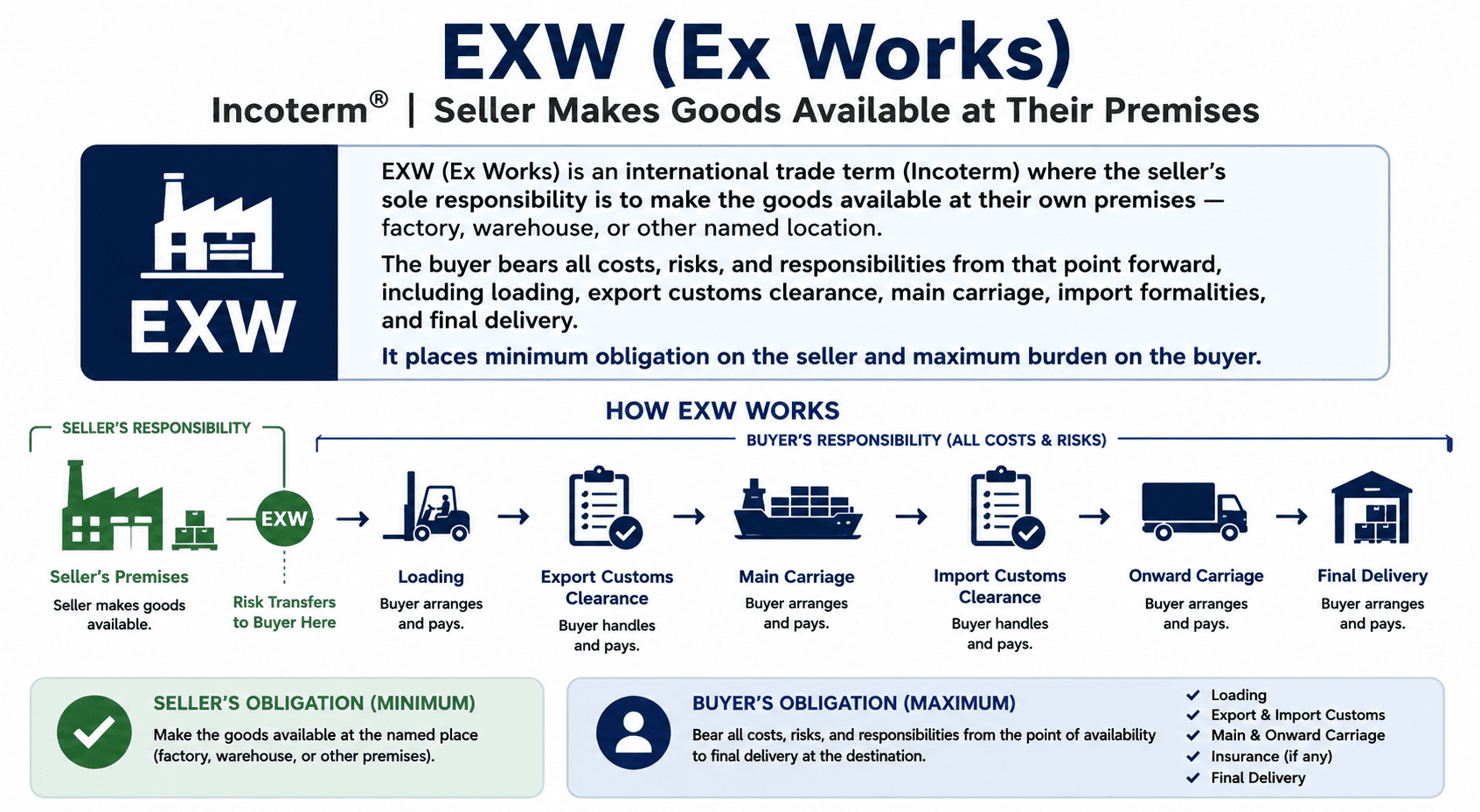
What is EXW and Why Is It Used?
EXW (Ex Works) is one of the 11 Incoterms® 2020 rules published by the International Chamber of Commerce (ICC). It is often referred to as “factory delivery” because the seller simply prepares the goods at their own premises. In cross-border transactions, EXW is used when a buyer has an established logistics network, a local agent in the seller’s country, or wants full control over the entire supply chain. Sellers favor EXW because it minimizes their risk, administrative burden, and export compliance obligations.
However, EXW creates significant challenges for buyers, especially in international trade. The buyer must act as the exporter of record, which is impossible in most jurisdictions unless they have a locally registered entity. For this reason, many professionals advise using FCA (Free Carrier) for export shipments instead of EXW.
⚡ Key Principle
Under EXW, risk transfers from seller to buyer when the goods are made available, not when they are loaded or handed over. The seller does not even need to load the goods onto the buyer’s truck unless explicitly agreed in the contract.
Seller vs Buyer Obligations
EXW Seller and Buyer Obligations (Incoterms 2020)
✅ SELLER’S LIMITED OBLIGATIONS
- Make goods available at named place (factory/warehouse) on agreed date
- Provide commercial invoice, packing list, and basic documentation
- Pack and mark goods appropriately for transport
- Give buyer notice that goods are ready for collection
- Assist buyer with export documents (at buyer’s cost and risk) if requested
⚠️ BUYER’S EXTENSIVE OBLIGATIONS
- Load goods onto collecting vehicle (seller not obliged to load)
- Arrange and pay for all transport: pre-carriage, main carriage, onward delivery
- Clear goods for export (act as exporter of record in seller’s country)
- Pay all export duties, taxes, and customs fees
- Arrange import clearance and pay import duties/taxes in destination country
- Obtain insurance (seller has no insurance obligation)
- Bear all risk of loss or damage once goods are made available
- Reimburse seller for any assistance with formalities
✨ Practical Guidance
If the seller agrees to load the goods, this must be explicitly stated in the sales contract, and the buyer should assume the cost and risk of loading. Without that clause, the seller may refuse to load. For cross-border shipments, FCA is almost always a safer choice than EXW because the seller clears the goods for export.
Risks & Hidden Traps
Major Risks and Misunderstandings with EXW
🚩
Buyer Cannot Act as Exporter of Record
Most countries require the exporter to be a legally registered local entity. A foreign buyer cannot typically clear goods for export. This makes EXW impossible for many international transactions unless a local agent or freight forwarder acts as exporter.
🚩
Seller May Refuse to Load the Goods
Under strict EXW rules, the buyer is responsible for loading. If the buyer’s carrier arrives without equipment or labour, or if the seller’s safety rules prohibit third-party loading, the shipment may be delayed or cancelled.
🚩
VAT/GST Complications for Sellers
If the seller cannot prove the goods were exported, tax authorities may treat the sale as domestic, requiring the seller to charge VAT/GST. The buyer, being foreign, cannot reclaim that tax.
🚩
Letter of Credit (LC) Incompatibility
Banks typically require a transport document (bill of lading, air waybill) for LC payments. Under EXW, the seller never receives such documents, making LC transactions extremely difficult. Open account terms are required.
🚩
Seller May Be Wrongly Listed as Exporter
Carriers sometimes incorrectly show the seller as “shipper” or “exporter” on bills of lading. This can expose the seller to liabilities for demurrage, detention, or regulatory fines even though they have no control after delivery.
EXW vs FCA vs DAP vs DDP
Comparison: EXW vs Other Key Incoterms
| Incoterm | Seller’s Responsibility | Risk Transfer Point | Export Clearance | Import Clearance |
|---|
| EXW | Make goods available at premises | At seller’s premises (not loaded) | Buyer | Buyer |
| FCA | Load goods and clear for export, deliver to carrier | When handed to carrier at named place | Seller | Buyer |
| DAP | Deliver goods ready for unloading at named destination | At named destination (buyer unloads) | Seller | Buyer |
| DDP | Deliver goods to named destination, cleared for import | At named destination after import clearance | Seller | Seller |
📌 Recommendation for Exporters & Importers
For international trade, avoid EXW unless the buyer has a registered office or agent in the seller’s country. Use FCA instead, the seller clears export, the buyer arranges main carriage, and risk transfers when goods are handed to the carrier. This avoids the fatal flaw of EXW.
When EXW Makes Sense
When Should You Use EXW? Practical Scenarios
01
Domestic Trade Within Same Country
EXW works seamlessly when buyer and seller are in the same country. No export/import formalities, and the buyer can easily collect goods.
02
Buyer Has Local Subsidiary or Agent
If the foreign buyer owns a local entity in the seller’s country, that entity can act as exporter of record, making EXW viable.
03
Buyer Consolidating Multiple Shipments
Buyers sourcing from several local suppliers in one country can use EXW to control all logistics and combine goods for cheaper consolidated freight.
04
Seller Has No Export Experience
A small manufacturer lacking export licenses or compliance resources may prefer EXW to avoid legal risks, provided the buyer can manage export formalities.
FAQ
Frequently Asked Questions about EXW
QIs EXW suitable for international trade?
Generally no. Most countries require the exporter of record to be a locally registered entity. Since the buyer is usually a foreign company, they cannot legally clear goods for export. EXW is best for domestic transactions or when the buyer has a local subsidiary. For cross-border, FCA is strongly recommended.
QWho pays freight under EXW?
The buyer pays all freight costs: from the seller’s premises to the final destination, including any pre-carriage, main carriage, and on-carriage.
QDoes EXW include insurance?
No. The seller has no obligation to insure the goods. The buyer may choose to insure the goods at their own cost, but it is not required under EXW rules.
QWho is responsible for loading under EXW?
Officially, the buyer is responsible for loading. However, in practice, the seller often loads the goods at the buyer’s cost and risk. This must be explicitly agreed in the sales contract; otherwise, the seller has no duty to load.
QWhat is the difference between EXW and FCA?
Under FCA, the seller loads the goods onto the buyer’s vehicle and clears the goods for export. Under EXW, the seller does neither. FCA removes the two biggest risks of EXW (loading and export clearance) and is almost always preferable for international trade.