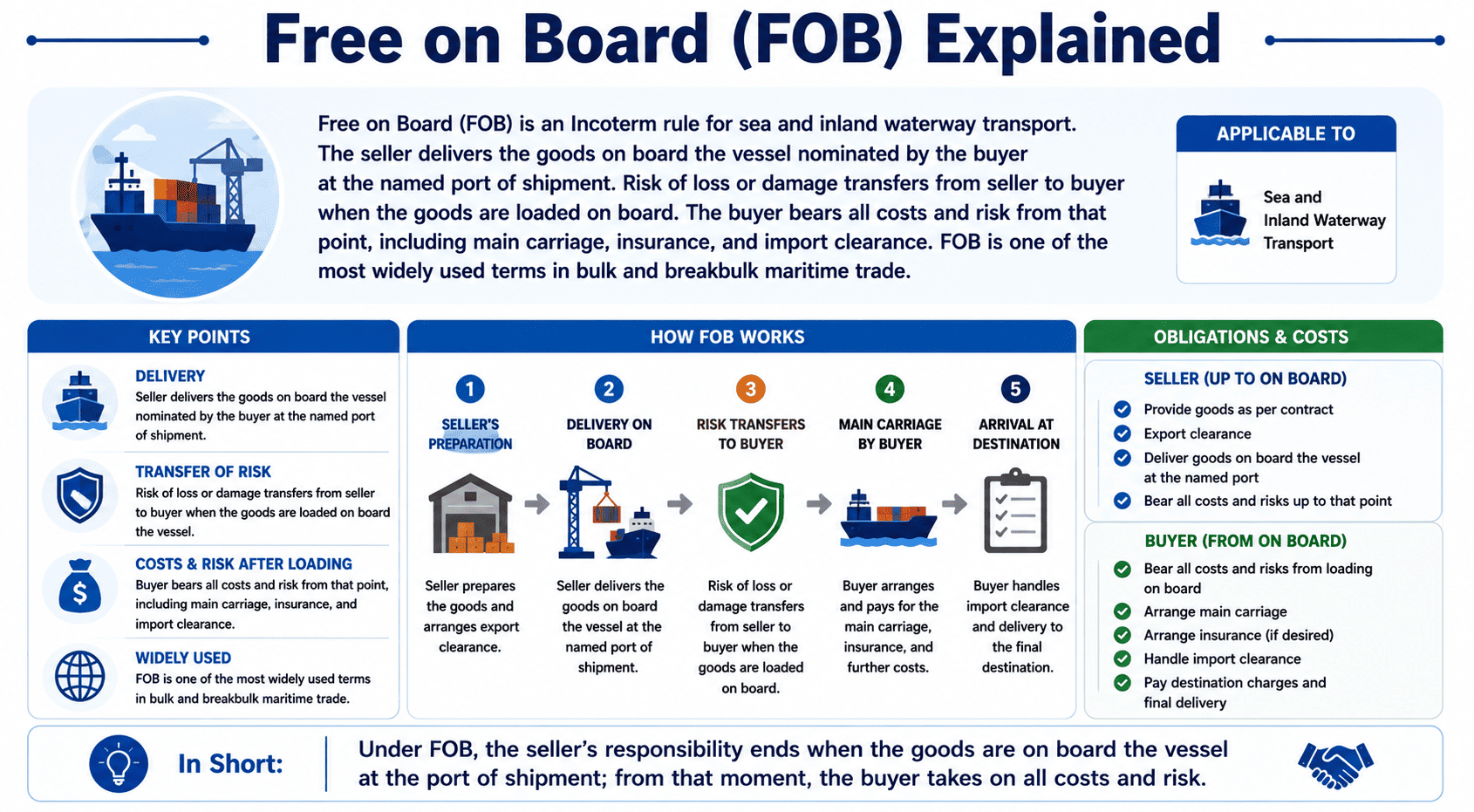
Why FOB Matters in Global Trade
FOB creates a clean risk transfer point: the ship’s rail (now “on board” under Incoterms 2020). For exporters, it limits liability once cargo is loaded. For importers, it grants control over carrier selection, freight rates, and insurance. Over 80% of seaborne container contracts still reference FOB, although alternative terms like FCA are recommended for containerised cargo.
📌 Core Principle
Under FOB, the seller pays export handling, terminal charges and loading. The buyer pays ocean freight, insurance, discharge, and import duties. The critical moment: once the goods are on the vessel, the buyer carries all risk.
Seller & Buyer Responsibilities Under FOB
| Party | Key Obligations |
|---|
| Seller | Export packaging, delivery to named port of shipment, export licenses & customs clearance, loading charges, pre-carriage to port, risk until goods are onboard, commercial invoice, proof of delivery. |
| Buyer | Main carriage (ocean freight), insurance, unloading, import clearance & duties, on-carriage to final destination, cost of pre-shipment inspection (if required). |
FOB Origin vs FOB Destination (Domestic vs Incoterms)
In North American domestic freight, FOB is often split into FOB Origin (buyer assumes risk at pickup) and FOB Destination (seller assumes risk until delivery). However, under international Incoterms 2020, FOB always refers to the named port of shipment. Confusion between these frameworks leads to disputes. Below are the four common US domestic variations, but for ocean trade, stick to the Incoterms definition.
| FOB Term (Domestic US) | Ownership Transfer | Freight Payment |
|---|
| FOB Origin, Freight Collect | At origin (buyer assumes risk at pickup) | Buyer pays freight |
| FOB Origin, Freight Prepaid | At origin (buyer assumes risk) | Seller pays freight |
| FOB Destination, Freight Collect | At destination (seller bears risk in transit) | Buyer pays freight |
| FOB Destination, Freight Prepaid | At destination (seller bears risk) | Seller pays freight |
⚠️ Critical mistake, Containerised cargo
Using FOB for containerised goods is risky under Incoterms. Since containers are typically delivered to a terminal and loaded by the carrier, risk should transfer when goods are handed to the carrier at the terminal, not when loaded onto the vessel. Use FCA (Free Carrier) instead for containerised freight. FOB remains correct for bulk, breakbulk, or project cargo where seller loads directly onto the vessel.
Common Risks & Misunderstandings with FOB
⚠️
Using FOB for containerised / multimodal shipments
FOB legally transfers risk only when cargo is “on board” the vessel. For container freight that rolls onto a Ro-Ro or is loaded by terminal, FCA or CIP/CIF are more suitable.
⚠️
Unclear named port of shipment
The contract must specify the exact port (e.g., “FOB Shanghai”). Without it, the seller can choose an expensive port, causing cost disputes.
⚠️
Buyer assumes risk but has no control over vessel nomination
If the buyer fails to nominate a vessel or cancels, the seller may incur storage or demurrage. The LOI should cover this.
⚠️
Insufficient insurance coverage during main carriage
Risk passes to buyer at loading, so the buyer must arrange marine cargo insurance immediately. Many small buyers skip this, leading to six-figure losses.
FOB in practice
FOB Transaction Flow: Step by Step
1
Seller prepares & exports
Seller packages goods, obtains export license, clears export customs, and delivers to the named port of shipment.
2
Loading onto vessel
Seller loads goods onto the vessel nominated by the buyer. Risk transfers to buyer exactly at on-board moment.
3
Buyer arranges main carriage & insurance
Buyer pays ocean freight, insurance, and monitors cargo during transit.
4
Import clearance & final delivery
Buyer handles import customs, pays duties, arranges inland transport to warehouse.
📦 Real-world example, Textiles from Bangladesh to UK
A UK importer buys garments from Bangladesh under FOB Chittagong. The Bangladeshi seller delivers to the port, clears export, and loads onto the vessel nominated by the UK buyer. Once goods are on board, the UK buyer pays ocean freight, insurance, and handles customs clearance in Southampton. If the container is lost at sea, the buyer bears the loss unless they purchased marine insurance.
Alternatives to FOB: CIF, CFR, FCA
| Incoterm | Risk Transfer | Seller covers main carriage? | Seller covers insurance? |
|---|
| FOB | On board vessel at port of shipment | No | No |
| CFR | On board vessel (seller pays freight to destination port) | Yes | No |
| CIF | On board vessel | Yes | Yes (minimum cover) |
| FCA | When goods handed to carrier at seller’s premises or terminal | No | No |
FAQ
Frequently Asked Questions, FOB Incoterms
QIs FOB the same as Freight on Board?
Yes, in everyday shipping language, Free on Board (FOB) and Freight on Board are used interchangeably. The official Incoterms designation remains “Free on Board,” but both terms refer to the same basic arrangement: seller delivers goods onto vessel at origin port.
QWhen should I avoid using FOB?
Avoid FOB for containerised goods that are loaded at a container terminal rather than directly by the seller. Also avoid FOB when the buyer has no experience arranging ocean freight, or when the political or port risk in the origin country is high, in that case consider CIF or EXW.
QWho pays for loading under FOB?
Under Incoterms 2020, the seller pays all costs up to and including loading the goods on board the vessel. Any terminal handling charges (THC) prior to loading are also for the seller’s account. After loading, all costs shift to the buyer.
QDoes FOB include insurance?
No, FOB does not require the seller to arrange insurance. The buyer is responsible for marine cargo insurance from the point the goods are on board the vessel. This is a critical difference from CIF where the seller provides minimum cover insurance.