Why CFR (Cost and Freight) Matters in International Trade
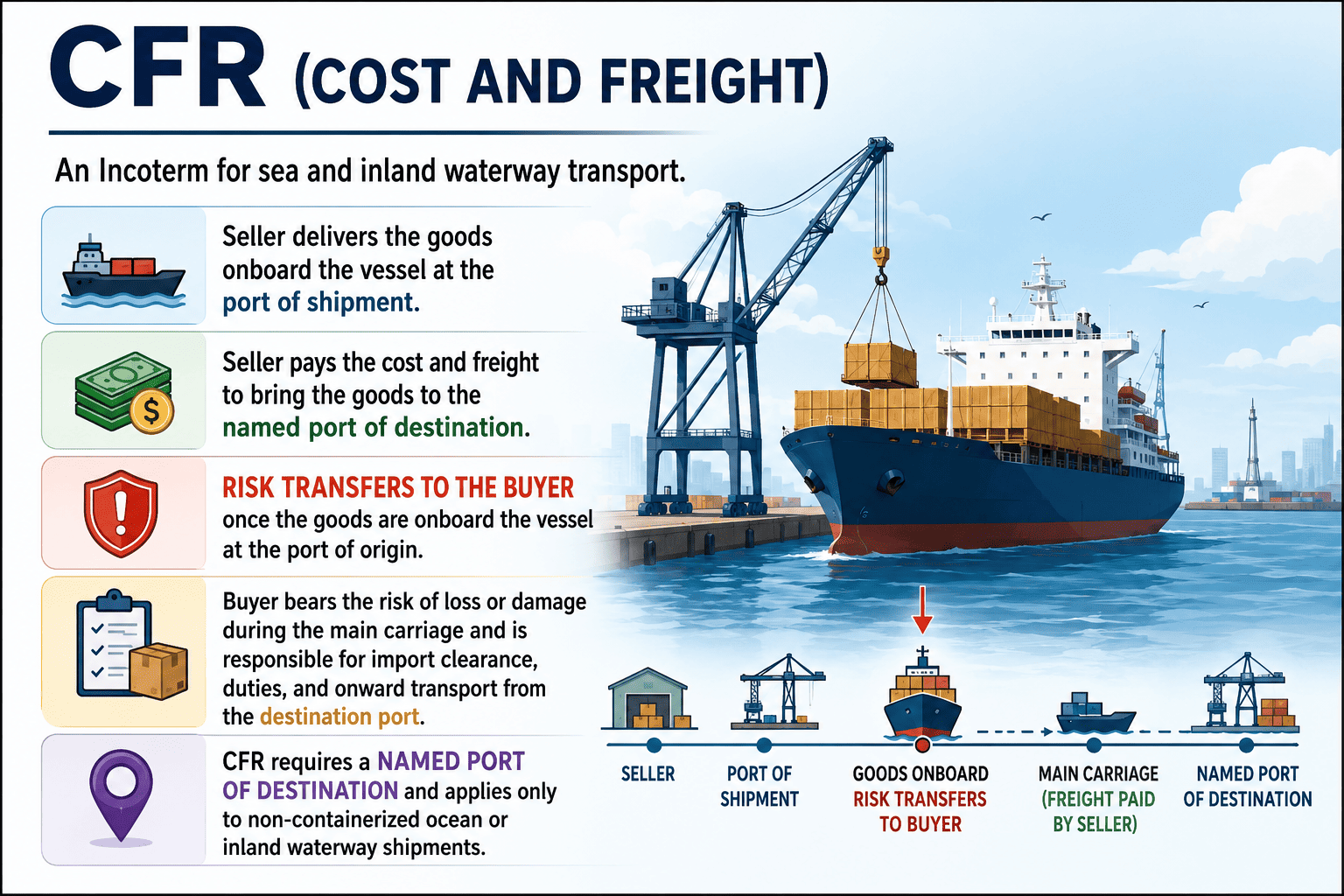
CFR is one of the most widely used Incoterms in ocean freight, particularly for bulk cargo, breakbulk, and non-containerized shipments. It provides clarity on a fundamental question in any export transaction: who arranges and pays for the main carriage, and at what point does risk pass? Under CFR, the seller takes responsibility for getting the goods to the destination port, but the buyer assumes risk as soon as the goods are onboard the vessel. This split between cost and risk is the defining characteristic of CFR and a common source of confusion for first-time exporters and importers. Understanding CFR is essential for accurate costing, insurance planning, and dispute avoidance in cross-border trade.
📊 Key Point
Under CFR, the seller pays freight to the destination port, but risk passes to the buyer at the port of shipment. If the goods are lost or damaged during the ocean voyage, the buyer bears the loss—even though the seller arranged and paid for the carriage. This is why buyers under CFR should arrange their own cargo insurance.
CFR Shipping: Seller and Buyer Obligations
Incoterms 2020 clearly allocates responsibilities between the seller and the buyer under CFR. The table below summarises the key obligations of each party.
| Obligation | Seller | Buyer |
|---|
| Goods & Documentation | Provide goods and commercial invoice conforming to the contract; supply proof of delivery and transport document. | Pay for goods as specified in the sales contract. |
| Export Packaging & Marking | Package and mark the goods appropriately for the intended transport. | — |
| Export Licenses & Customs | Obtain export licenses and complete export customs formalities. | — |
| Pre-Carriage & Delivery | Arrange and pay for pre-carriage to the port of shipment and deliver the goods onboard the vessel. | — |
| Loading Charges | Bear loading charges at the port of shipment. | — |
| Main Carriage / Freight | Pay the cost and freight to bring the goods to the named port of destination. | — |
| Risk Transfer | Bears risk until goods are onboard the vessel at the port of shipment. | Assumes risk from the moment the goods are onboard the vessel at the port of shipment. |
| Insurance | Not obligated to purchase insurance (unlike CIF). | Should arrange own cargo insurance; not obligated but strongly advised. |
| Discharge & Onward Carriage | — | Bear discharge costs and arrange onward carriage from the destination port. |
| Import Formalities & Duties | — | Complete import formalities and pay import duties and taxes. |
| Pre-Shipment Inspection | Pay the cost of pre-shipment inspection (where required for export). | Pay the cost of pre-shipment inspection for import clearance. |
📌 Note on Insurance
Because risk passes to the buyer at the port of shipment under CFR, the buyer has a significant exposure during the ocean voyage. Although the seller is not obligated to provide insurance under CFR, the buyer should arrange cargo insurance covering the full value of the goods. If the buyer requires the seller to procure insurance, CIF (Cost, Insurance and Freight) is the more appropriate Incoterm.
CFR vs CIF vs CPT
CFR vs CIF vs CPT: Understanding the Differences
CFR is often confused with CIF (Cost, Insurance and Freight) and CPT (Carriage Paid To). Each term serves a different purpose and allocates risk and cost differently.
| Incoterm | Mode of Transport | Freight Paid By | Insurance | Risk Transfer Point |
|---|
| CFR (Cost and Freight) | Sea and inland waterway only | Seller | Not required (buyer arranges) | When goods are onboard the vessel at the port of shipment |
| CIF (Cost, Insurance and Freight) | Sea and inland waterway only | Seller | Seller must obtain minimum cover marine insurance in buyer’s favour | When goods are onboard the vessel at the port of shipment |
| CPT (Carriage Paid To) | Any mode (multimodal) | Seller | Not required (buyer arranges) | When goods are handed over to the first carrier |
📌 Important Note on Containerised Cargo
CFR and CIF are designed for non-containerised cargo (bulk, breakbulk, project cargo) where goods are delivered onboard the vessel. For containerised cargo that is delivered to a terminal, CPT or CIP (Carriage and Insurance Paid To) are the more appropriate Incoterms, as risk passes when the goods are handed to the first carrier, not when loaded onboard the vessel.
Risk & Cost Transfer
The Critical Split: Risk vs Cost Under CFR
The defining feature of CFR is that cost and risk transfer at different points. The seller pays for the main carriage to the destination port, but the buyer bears the risk of loss or damage from the moment the goods are onboard the vessel at the port of shipment. This split has important implications for insurance, claims, and dispute resolution.
1
Seller Delivers Goods Onboard
The seller completes export clearance, delivers the goods onboard the vessel at the named port of shipment, and obtains a transport document (e.g., bill of lading).
2
Risk Transfers to Buyer
At the moment of onboard delivery, risk of loss or damage passes from seller to buyer. From this point, the buyer bears the risk during the entire ocean voyage.
3
Seller Pays Freight to Destination
Despite risk having passed, the seller remains responsible for paying the cost and freight to the named port of destination, as agreed in the contract of carriage.
4
Buyer Handles Destination
Once the goods arrive at the destination port, the buyer bears discharge costs, import clearance, duties, and onward carriage. The buyer is also responsible for any insurance claims for loss or damage during the voyage.
Contractual & Legal Context
Key Contractual Clauses Related to CFR Shipments
CFR transactions are governed by a sales contract that must clearly specify the Incoterm, the named port of destination, and related obligations. The following contractual clauses are particularly relevant to CFR shipments.
| Clause | How It Relates to CFR |
|---|
| Master Services Agreement (MSA) | Provides the overarching framework for recurring shipments, including standard Incoterms, payment terms, and liability allocation between trading partners. |
| Warranty Clause | Guarantees that goods meet contractual specifications and quality standards; breach of warranty may be relevant where damage or defects arise during CFR shipments. |
| Material Breach | Defines serious failures (e.g., failure to deliver onboard the vessel, shipping to the wrong port) that entitle the aggrieved party to terminate and claim damages. |
| Termination for Convenience | Allows either party to exit a long-term supply agreement without cause, relevant where CFR shipments form part of an ongoing trading relationship. |
| Indemnification Clause | Shifts liability for third-party claims (e.g., cargo damage, customs penalties) between seller and buyer, particularly where risk and cost are split under CFR. |
| Exclusivity Clause | May restrict the seller from supplying competing buyers or the buyer from sourcing from competing sellers, relevant in exclusive distribution arrangements. |
| Breach of Contract | Defines the consequences when a party fails to perform its CFR obligations, including failure to ship, failure to pay, or delivery to the wrong destination. |
| Consequential Damages | Indirect losses from a CFR breach (e.g., lost profits from delayed shipment, business interruption), often waived or capped in commercial contracts. |
| Commercial Due Diligence | Includes assessing the trading partner’s logistics capabilities, financial stability, and track record in managing CFR shipments. |
| Due Diligence | Comprehensive due diligence covers the counterparty’s export compliance, insurance arrangements, and trade documentation before entering CFR transactions. |
| Asset Purchase Agreement | Relevant where a CFR shipment involves the transfer of equipment, inventory, or assets as part of a broader asset acquisition transaction. |
| Market Entry Partnerships | Requires careful selection of Incoterms and logistics partners when entering new markets, ensuring CFR obligations align with local capabilities. |
Real-World Example
CFR in Practice: Bulk Steel Shipment from India to Germany
The following scenario illustrates how CFR works in a typical ocean freight transaction, highlighting the split between cost and risk.
📄 CFR Transaction: Steel Coils from Mumbai to Hamburg
Contract: CFR Hamburg (Incoterms 2020). Seller is an Indian steel manufacturer; buyer is a German distributor.
Seller’s Obligations: Clear goods for export from India, deliver 500 MT of steel coils onboard the vessel at Nhava Sheva port, pay ocean freight to Hamburg, and provide the bill of lading and commercial invoice.
Risk Transfer: Risk passes to the buyer when the steel coils are loaded onboard the vessel at Nhava Sheva. If the vessel encounters a storm and the coils are damaged, the buyer bears the loss.
Buyer’s Obligations: Arrange cargo insurance from Nhava Sheva to Hamburg, pay discharge costs at Hamburg, complete EU import clearance, pay customs duties and VAT, and arrange onward transport to the buyer’s warehouse.
Key Point: Although the seller paid the freight to Hamburg, the buyer bore the risk during the entire voyage—illustrating the CFR split between cost and risk.
Risks & Mitigation
Common Risks in CFR Shipments & How to Mitigate Them
⚠️
Buyer Uninsured During Ocean Voyage
Mitigation: Buyers under CFR should arrange cargo insurance covering the full value of the goods from the port of shipment. Do not assume the seller’s freight arrangement includes insurance.
⚠️
Confusion Between Risk and Cost Transfer
Mitigation: Clearly document in the sales contract that risk passes onboard at the port of shipment, while freight is paid to destination. Train commercial teams on the CFR distinction to avoid disputes.
⚠️
Incorrect Use for Containerised Cargo
Mitigation: Use CFR only for non-containerised ocean or inland waterway shipments. For containerised cargo delivered to a terminal, use CPT instead, where risk passes when goods are handed to the first carrier.
⚠️
Vague Named Port of Destination
Mitigation: Always specify the named port of destination precisely (e.g., “CFR Hamburg, Germany” not just “CFR Germany”). Ambiguity over the destination port can lead to freight cost disputes and delivery to the wrong location.
FAQ
Frequently Asked Questions About CFR (Cost and Freight)
QWhat is the difference between CFR and CIF?
The key difference between CFR and CIF is insurance. Under CFR (Cost and Freight), the seller is not obligated to purchase cargo insurance for the buyer. Under CIF (Cost, Insurance and Freight), the seller must obtain and pay for minimum cover marine insurance in the buyer’s favour. In both terms, risk transfers to the buyer once the goods are onboard the vessel, and the seller pays freight to the named destination port.
QWhen does risk transfer from seller to buyer under CFR?
Under CFR, risk transfers from the seller to the buyer when the goods are delivered onboard the vessel at the port of shipment. This is a critical point: although the seller pays the freight to the destination port, the buyer bears the risk of loss or damage to the goods during the main carriage. The buyer should therefore arrange its own cargo insurance.
QWhat are the seller’s obligations under CFR?
Under CFR, the seller must: provide goods and commercial invoice conforming to the contract; clear the goods for export and handle export customs formalities; package and mark the goods appropriately; deliver the goods onboard the vessel at the named port of shipment; pay the cost and freight to bring the goods to the named port of destination; and provide the buyer with the usual proof of delivery and transport document.
QWhat are the buyer’s obligations under CFR?
Under CFR, the buyer must: pay for the goods as specified in the sales contract; assume risk from the moment the goods are onboard the vessel at the port of shipment; arrange cargo insurance (recommended though not obligated); bear discharge and onward carriage costs from the destination port; complete import formalities and pay import duties and taxes; and pay the cost of pre-shipment inspection for import clearance where applicable.
QCan CFR be used for containerised cargo?
CFR is designed for non-containerised ocean or inland waterway transport, such as bulk cargo, breakbulk, and project cargo. For containerised cargo that is delivered to a terminal, CPT (Carriage Paid To) is the more appropriate Incoterm, as risk passes when the goods are handed to the first carrier rather than when loaded onboard the vessel. Using CFR for containerised cargo can create ambiguity about when risk transfers.
QWhat happens if the goods are damaged during the ocean voyage under CFR?
Under CFR, the buyer bears the risk from the moment the goods are onboard the vessel at the port of shipment. If the goods are damaged during the ocean voyage, the buyer must pursue a claim under its own cargo insurance policy or against the carrier. The seller is not liable for damage occurring after the goods have been loaded onboard, even though the seller arranged and paid for the freight.