Contract Between Manufacturer and Distributor: Complete Guide, Key Clauses & Templates
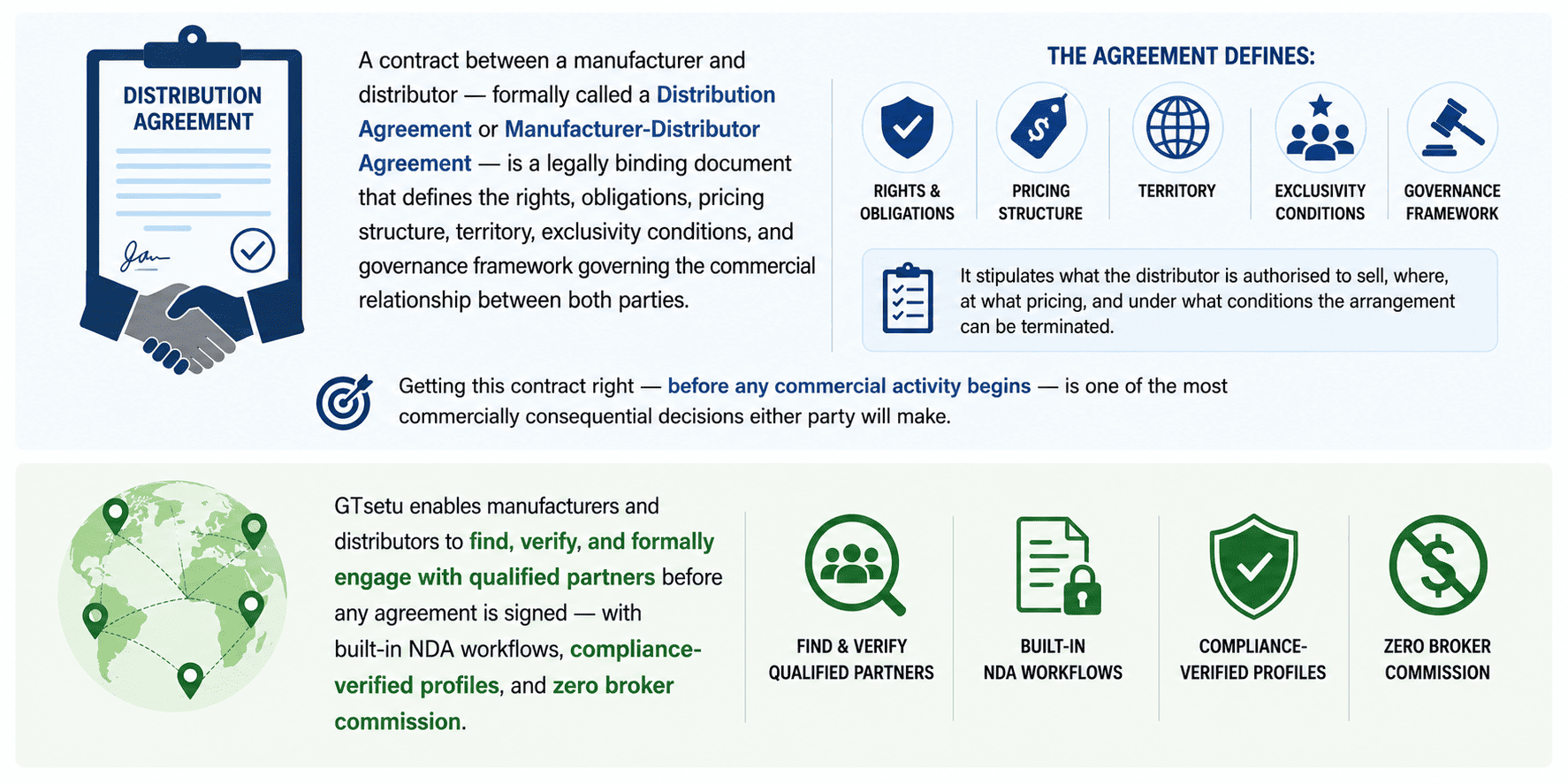
Direct Answer: A contract between a manufacturer and distributor, formally called a Distribution Agreement or Manufacturer-Distributor Agreement, is a legally binding document that defines the rights, obligations, pricing structure, territory, exclusivity conditions, and governance framework governing the commercial relationship between both parties. It stipulates what the distributor is authorised to sell, where, at what pricing, and under what conditions the arrangement can be terminated. Getting this contract right, before any commercial activity begins, is one of the most commercially consequential decisions either party will make. GTsetu enables manufacturers and distributors to find, verify, and formally engage with qualified partners before any agreement is signed, with built-in NDA workflows, government‑verified company credentials (legal name, address, registration number, status, type, incorporation date), and zero broker commission.
📅 February 19, 2026⏱ 17 min read✍️ GTsetu Editorial Team🔄 Updated regularly
15+
Key Contract Clauses
500+
Verified Partners
100+
Countries
0%
Broker Commission
Every manufacturer-distributor relationship is governed by a contract. The quality of that contract, how precisely it defines territory, pricing, obligations, exclusivity, and exit conditions, determines whether the relationship succeeds commercially or collapses in a costly dispute. Yet in practice, a significant proportion of international distribution agreements are either absent entirely, built from generic templates that do not reflect the specific arrangement, or signed without adequate due diligence on the counterparty’s credentials.
This guide explains everything: what the contract is formally called, what it stipulates, every clause it must include, how exclusive and non-exclusive agreements differ, what an international distributor agreement template needs to address that a domestic one does not, how to negotiate effectively, and crucially, what should happen before the contract is signed to ensure both parties are what they claim to be.
💡 Legal Disclaimer
This guide provides commercial and structural guidance for understanding manufacturer-distributor agreements. It is not legal advice. Distribution agreements, particularly international ones, should always be drafted and reviewed by qualified legal counsel familiar with the relevant jurisdictions, product categories, and regulatory context before execution.
SECTION 1
1 What Is a Contract Between Manufacturer and Distributor Called?
🎯 Direct Answer
A contract between a manufacturer and distributor is formally called a Distribution Agreement or Distributor Agreement. It may also be referred to as a Manufacturer-Distributor Agreement, a Wholesale Distribution Agreement, or in cross-border contexts, an International Distribution Agreement. When it grants the distributor exclusive rights in a defined territory, it becomes an Exclusive Distribution Agreement. All of these names refer to the same type of legally binding commercial contract governing the distribution relationship.
The specific name used in practice often depends on the industry, jurisdiction, and commercial context. In technology channels, “Reseller Agreement” or “Channel Partner Agreement” is common. In FMCG and pharmaceuticals, “Distribution Agreement” is standard. In industrial and manufacturing sectors, “Manufacturer-Distributor Agreement” is widely used. The name matters less than what the document contains, but understanding the nomenclature is important for legal research, template selection, and regulatory compliance in jurisdictions where specific types of distribution contracts trigger mandatory legal protections for the distributor.
📋
Distribution Agreement
Most widely used term across industries and jurisdictions. The standard legal name.
🤝
Distributor Agreement
Common in technology and channel distribution contexts. Functionally identical.
🏭
Manufacturer-Distributor Agreement
Used in industrial, manufacturing, and B2B product sectors. Specifies both parties explicitly.
🌍
International Distribution Agreement
For cross-border arrangements. Requires additional provisions for import/export compliance and governing law.
🔒
Exclusive Distribution Agreement
Grants one distributor sole rights in a defined territory. The most commercially significant variant.
🏪
Wholesale Distribution Agreement
Common in consumer goods, food, and FMCG. Emphasises bulk purchasing and trade-buyer resale.
💡 What the Document Is Prepared By
In most manufacturer-distributor arrangements, the initial draft of the distribution agreement is prepared by the manufacturer, since the manufacturer is defining the terms under which they authorise the distributor to sell their products. However, in practice, the distributor may propose amendments, and the final executed document is the result of negotiation between both parties. In some jurisdictions (notably EU member states), locally mandatory distributor protections may apply regardless of what the prepared document says, making legal review by counsel in the distributor’s jurisdiction essential before signing.
SECTION 2
2 Why the Distribution Agreement Is Your Most Important Contract
The distribution agreement is not a standard commercial contract that can be treated as a procurement formality. It governs a relationship that typically generates a significant proportion of the manufacturer’s revenue in a given market, and which, once established, can be difficult and expensive to exit if it underperforms. The distributor’s investment in the relationship, in staff, infrastructure, market development, and working capital, makes them equally dependent on the agreement’s protection.
73%
of international distribution disputes arise from ambiguous or absent contract provisions, not commercial disagreement
$240K
average cost of terminating an improperly structured exclusive distribution agreement in a jurisdiction with mandatory distributor protections
18 mo
average time lost when a distribution relationship fails and the manufacturer must restart partner selection from scratch in a target market
💰
Pricing Protection
Without a contract, nothing prevents a distributor from undercutting your MSRP, selling into other channels, or sharing your pricing structure with competitors.
🗺️
Territory Enforcement
Without a territory rights clause, distributors can sell anywhere, creating channel conflict that damages relationships with other partners and undermines your pricing strategy.
🛡️
Brand Protection
Without a contract governing trademark use, the distributor can use your brand in ways that damage your reputation, misrepresent products, or create counterfeit exposure.
⚖️
Exit Rights
Without clear termination clauses, ending a distribution relationship that is underperforming can expose you to significant damages claims, particularly in jurisdictions with mandatory distributor compensation laws.
🔐
IP Security
Without a confidentiality provision and NDA structure, proprietary pricing, product specifications, and market strategy shared during the distribution relationship can be misused after termination.
📊
Performance Accountability
Without agreed minimum purchase commitments and KPIs, a distributor can hold an exclusive territory indefinitely without developing it, blocking you from appointing a more active partner.
SECTION 3
3 What a Manufacturer-Distributor Agreement Stipulates
An agreement between a manufacturer and a distributor stipulates, at its core, the authorisation and conditions under which the distributor may purchase, market, sell, and sometimes service the manufacturer’s products within a defined territory or market segment. But beyond that core, a well-structured agreement stipulates the complete commercial and operational framework of the relationship.
What the Agreement Stipulates
In Practice, This Means
Consequence If Absent
Grant of distribution rights
The distributor is authorised to sell specific products in a defined territory, exclusively or non-exclusively
Unclear whether the distributor has any binding rights, or the manufacturer can appoint others in the same territory without notice
Product scope
Specific products or product lines covered; what is excluded; how new products are handled
Distributor claims rights over new products not yet launched; manufacturer disputes scope of authorisation
Pricing and commercial terms
Distributor purchase price, discount schedule, payment terms, currency, invoicing process
Pricing disputes on every order; no basis for resolving disagreements about applicable rates
Minimum purchase commitments
Annual volume the distributor must purchase to maintain their rights (especially exclusivity)
Sales data, inventory levels, market intelligence, customer feedback, frequency and format
Manufacturer has no visibility into market performance; cannot make informed commercial decisions
Confidentiality obligations
What information is confidential, how it must be handled, what happens to it on termination
Pricing, product data, and market strategy exposed to competitors after termination with no legal recourse
Termination conditions
Grounds for termination with and without cause; notice periods; stock buyback; IP return
Costly and legally complex termination process; potential for significant damages claims
Dispute resolution
Governing law; arbitration or litigation; jurisdiction; expert determination for specific matters
Disputes litigated in the wrong jurisdiction; unenforceable judgements; years of legal cost
SECTION 4
4 The 15 Key Clauses Every Distribution Contract Must Include
These are the 15 clauses that every contract between a manufacturer and distributor must contain to be commercially robust and legally enforceable. Each clause is rated by priority level, Critical (absence creates immediate legal or commercial exposure), High (absence creates operational or commercial risk), or Standard (important but resolvable if absent through conduct or general law).
1
🏢
Parties & Recitals
Who is contracting and on what basis
Critical
Identifies both parties by their full legal name, registered address, and company registration number, not just trading names. The recitals set out the background and purpose of the arrangement: that the manufacturer wishes to appoint the distributor, and the distributor wishes to be appointed, for the distribution of specified products.
This clause is foundational, errors in party identification can invalidate the entire agreement or make it unenforceable against the intended counterparty. Always verify the counterparty’s full legal name against their official company registration. See: business verification and ID.
💡GTsetu’s government‑tie‑up verification confirms legal name, registered address, registration number, company status, type, and incorporation date for every company, eliminating the risk of contracting with an incorrectly identified entity.
2
🔑
Grant of Distribution Rights
What the distributor is authorised to do
Critical
Specifies exactly what the manufacturer is authorising the distributor to do: purchase, market, sell, and (if applicable) service the manufacturer’s products. It defines whether this authorisation is exclusive or non-exclusive, and establishes the foundational commercial relationship. Without this clause, the distributor has no defined legal basis for their market activity.
The grant of rights clause should explicitly state whether the distributor may appoint sub-distributors, and if so, under what conditions. For the distinction between licensing and distribution arrangements, the grant clause is where the fundamental difference lies: a distribution agreement grants commercial sell-through rights; a licence agreement grants rights to use IP. The two are often confused, and sometimes combined in the same agreement.
3
🗺️
Territory Definition
Where the distributor may sell
Critical
Defines precisely the geographic scope of the distributor’s authorisation: specific countries, regions, cities, or market segments. The more precisely this is defined, the less room for dispute when a distributor sells outside their intended scope or a manufacturer appoints a second distributor in overlapping territory.
For international arrangements, territory definition interacts with import licensing, regulatory compliance, and local competition law. A distributor’s territory clause is meaningless if they do not hold valid import licences for all countries specified. Our guide to territory rights in international agreements covers the legal and commercial dimensions in detail. Related: exclusivity clauses and how they interact with territory definitions.
💡Always match territory to verified import licence coverage, not just the distributor’s claimed market reach. GTsetu’s verification focuses on core company credentials; distributors are responsible for maintaining their own licences and should present them during negotiations.
4
📦
Product Scope
What products are covered
Critical
Specifies exactly which products, product lines, or product categories the agreement covers, and what is explicitly excluded. It should address how new products launched by the manufacturer during the contract term are handled: are they automatically added to the agreement, subject to separate negotiation, or excluded unless agreed in writing?
Vague product scope is one of the most litigated provisions in distribution agreements. If the agreement covers “the manufacturer’s product range,” disputes arise the moment a new product is launched. Specificity, including model numbers, SKUs, or product category codes, prevents this. See also: OEM vs ODM product distinctions if the distributor is involved in any private-label or rebrand arrangement.
5
📅
Contract Term & Renewal
Duration and how the agreement continues
Critical
Specifies the initial contract term (typically 1–3 years for a new relationship, 3–5 years for an established one), the conditions for renewal (automatic renewal with notice period, or explicit mutual consent), and what happens when the term expires without a renewal being agreed.
In some jurisdictions, distribution agreements with indefinite terms or automatic renewal provisions trigger stronger distributor protections on termination than fixed-term agreements. Legal counsel should advise on the interaction between the chosen term structure and local mandatory law. For exclusivity arrangements, the term is the period during which the manufacturer cannot appoint another distributor, making it commercially significant for both parties.
6
🔒
Exclusivity Provisions
Whether the distributor has sole rights
Critical
Defines whether the distribution arrangement is exclusive (sole distributor in the territory), non-exclusive (other distributors may also be appointed), or selective (limited number of approved distributors). If exclusive, it should specify whether the manufacturer retains the right to sell directly to certain key accounts in the territory.
Exclusivity has real commercial value, the distributor is investing in a market without the risk of the manufacturer appointing a competing partner. That value should be reflected in the distributor’s pricing, volume commitment, or upfront investment obligations. Our comprehensive guide to exclusivity clauses in distribution agreements covers structure, pricing, and enforcement in detail.
💡Exclusivity without minimum purchase commitments is commercially dangerous for the manufacturer, the distributor can hold an exclusive territory without developing it. Always link exclusivity to volume performance.
7
💲
Pricing, Discount Structure & Payment Terms
The commercial economics of every transaction
Critical
Specifies the distributor purchase price (or discount off list price), volume-based discount thresholds, currency of invoicing and payment, payment terms (net days), accepted payment methods, and the process for price changes. It should also address how pricing for new products is set and communicated.
Pricing provisions must be consistent with the manufacturer’s internal pricing systems, the ERP, eCommerce platform, and contract must all reflect the same commercial terms. See: pricing structures and advance payment vs LC vs open account for the payment structure decision. For the logistics and risk transfer dimensions, Incoterms selection should be documented in this clause or a related schedule.
8
📊
Minimum Purchase Commitments & Performance KPIs
Volume obligations that justify exclusivity
Critical
Specifies the minimum annual purchase volume the distributor must achieve, in units, value, or both, along with the consequence of underperformance: typically a right for the manufacturer to convert an exclusive arrangement to non-exclusive, reduce the territory, or terminate for cause.
Minimum purchase commitments are the manufacturer’s primary commercial protection in an exclusive distribution arrangement. Without them, the distributor holds a territory monopoly without accountability. Our guide to volume commitments in distribution agreements covers how to structure realistic targets and what remedies to include. KPIs beyond volume, market development activity, customer account growth, service standards, can also be documented here.
9
®️
Intellectual Property & Trademark Licence
How the manufacturer’s IP may be used
High
Grants the distributor a limited, non-exclusive licence to use the manufacturer’s trademarks, logos, and promotional materials solely for the purpose of marketing and selling the products in the agreed territory. It specifies brand usage standards, approval requirements for new marketing materials, and what happens to any IP-related materials on termination.
The IP licence in a distribution agreement is categorically different from a technology licence or IP assignment, it is a narrow, use-limited permission that exists solely to enable the distribution activity. For arrangements that involve the distributor creating product adaptations, private label versions, or localised packaging, IP ownership provisions require explicit treatment. See also: white label vs private label manufacturing for relevant IP distinctions.
10
🔐
Confidentiality & Non-Disclosure
Protection of commercial information throughout and after the relationship
Critical
Defines what constitutes confidential information (pricing, product data, customer lists, market strategy), how it may be used (solely for the purpose of the distribution relationship), who within each party may access it, and what happens to it on termination (return or destruction with written confirmation).
Critically, confidentiality obligations should survive termination of the agreement for a defined period, typically 2–5 years. A confidentiality clause that ends with the contract provides no protection for the commercially sensitive information shared during the relationship once the relationship ends. Our guide to mutual vs one-way NDA structures is directly relevant, the NDA that should be executed before contract negotiations begin (see Section 8) is the precursor to the confidentiality clause in the main agreement. For B2B secure collaboration during the pre-contract evaluation phase, GTsetu’s built-in NDA workflow provides this protection automatically.
11
🚫
Non-Compete & Non-Circumvention
Preventing competitive conflicts of interest
High
Restricts the distributor from distributing directly competing products during the term of the agreement (and potentially for a defined period after termination). May also include a non-circumvention provision preventing the distributor from approaching the manufacturer’s other partners or customers directly.
Non-compete provisions must be carefully scoped, overly broad restrictions may be unenforceable in many jurisdictions, and may deter capable distributors who carry complementary product ranges. The restriction should be limited to products that genuinely compete with the manufacturer’s offering, not extended to the distributor’s entire business. See: non-compete vs non-circumvention clauses for the structural distinction.
12
📈
Reporting & Market Intelligence
Data the distributor must provide to the manufacturer
High
Specifies the sales data, inventory levels, customer account information, competitive intelligence, and market feedback the distributor must provide, including the format, frequency, and consequences of non-compliance. This is the manufacturer’s primary mechanism for maintaining market visibility.
Reporting obligations are frequently underspecified in distribution agreements, leaving manufacturers dependent on the distributor’s goodwill for market insight. An adequately specified reporting clause should include: monthly sales volumes by product; quarterly inventory levels; annual market forecasts; and immediate notification of any material adverse event affecting the distributor’s ability to perform. Data provided under this clause interacts with the confidentiality clause, the manufacturer’s internal data remains confidential; the distributor’s market data does not automatically flow back to the manufacturer.
13
🚪
Termination Clauses
How the agreement ends and what happens next
Critical
Specifies the grounds for termination with cause (material breach, insolvency, change of control, performance failure), termination without cause (typically with a defined notice period), and the consequences of each type. Post-termination provisions should address: stock buyback obligations; IP and trademark licence termination; return or destruction of confidential information; transition support obligations; and any compensation provisions required by applicable law.
Termination clauses interact directly with the governing law choice, many jurisdictions impose mandatory compensation requirements on termination of exclusive distribution agreements regardless of what the contract says. Our guide to termination clauses in trade agreements covers the key legal considerations by jurisdiction. See also: risk allocation in cross-border deals.
💡In EU member states, commercial agents have mandatory compensation rights on termination under the Commercial Agents Directive. Where a distributor structure is used to avoid this, courts may sometimes reclassify. Always take local legal advice on termination provisions before signing.
14
⚡
Force Majeure
Events beyond reasonable control
High
Specifies the events, natural disasters, pandemics, war, sanctions, export control restrictions, supply chain disruption, that excuse a party from performance obligations without constituting a breach. It should define notification requirements, the duration of force majeure protection, and what happens if the force majeure event continues beyond a defined period.
Post-pandemic and geopolitical disruptions have made force majeure clauses considerably more scrutinised than they once were. Supply chain-specific force majeure provisions, covering raw material shortages, logistics disruption, and export control changes, are increasingly standard in international distribution agreements. See: force majeure in global trade for the complete guide to this provision.
15
⚖️
Governing Law & Dispute Resolution
Which legal system applies and how disputes are resolved
Critical
Specifies which country’s law governs the interpretation and enforcement of the agreement, and the mechanism for resolving disputes, litigation in a named jurisdiction, international commercial arbitration under a specified ruleset (ICC, LCIA, SIAC), or expert determination for specific technical matters.
For international distribution agreements, the choice of governing law and jurisdiction is one of the most consequential decisions in the entire contract. Manufacturers typically prefer the law of their home jurisdiction; distributors prefer their own. Neutral jurisdictions, Singapore, England and Wales, Switzerland, are frequently used in international commercial contracts for their established commercial law frameworks and enforceability of judgements across signatory states. See: dispute resolution in international contracts for a full comparison of litigation vs. arbitration options.
💡Never leave the governing law and jurisdiction blank or agree to “tbd”, disputes that arise when there is no agreed governing law are significantly more expensive and slower to resolve than those with a clear contractual framework.
SECTION 5
5 Exclusive vs. Non-Exclusive Distribution Agreements
One of the most commercially significant decisions in any manufacturer-distributor agreement is whether to grant exclusive or non-exclusive distribution rights. The choice determines the commercial obligations of both parties, the compensation risk on termination, and the competitive dynamics in the target market.
Dimension
Exclusive Distribution Agreement
Non-Exclusive Distribution Agreement
Distributor’s right
Sole authorised distributor in the defined territory, manufacturer cannot appoint others
Authorised to distribute, but manufacturer may appoint additional distributors in the same territory
Distributor’s investment obligation
Higher, exclusive rights require market development investment to justify exclusivity
Lower, no guarantee of protected market position reduces investment motivation
Minimum purchase commitment
Typically high, exclusivity must be earned through volume performance
Typically absent or low, distributor carries less commercial responsibility
Manufacturer’s risk
Higher, locked into one distributor per territory; underperformance is costly to correct
Lower, can appoint additional distributors or direct channels without contractual constraint
Pricing control
Easier, single distribution channel per territory; price consistency maintained
Harder, multiple distributors may compete on price, driving market price down
Termination risk
Higher, exclusive distributors often have stronger legal protections in many jurisdictions
Lower, non-exclusive distributors generally have fewer termination compensation rights
Best suited for
New market entry; premium products; technically complex products requiring specialist selling; markets requiring significant investment to develop
Commoditised products; established markets with existing distribution; products needing maximum availability
✅ The Middle Ground: Selective Distribution
Selective distribution, appointing a limited number of approved distributors in a territory without full exclusivity, is a commercially attractive middle path. The manufacturer maintains quality control over who sells their products, limits price competition between distributors, and retains the flexibility to appoint additional partners if needed. Common in B2B industrial, luxury consumer goods, and professional equipment sectors. See our full guide to exclusivity clauses for selective distribution structuring.
SECTION 6
6 International Distributor Agreement: Template Structure & Key Differences
An international distributor agreement contains all the elements of a domestic distribution agreement, plus additional provisions that address the specific legal, commercial, and operational complexity of cross-border trade. Simply adding a territory clause to a domestic template is not sufficient for an international arrangement.
Additional Clauses Required in International Distributor Agreements
📜
Import/Export Compliance
The agreement must allocate responsibility for import licensing, customs documentation, product registration in the destination country, and compliance with applicable export control regulations. Neither party should assume this falls to the other without explicit contractual allocation.
💱
Currency & Exchange Rate
International agreements must specify the invoicing currency, whether exchange rate risk is shared or allocated to one party, and the mechanism for price adjustments if exchange rate movements exceed defined thresholds.
🏛️
Local Regulatory Compliance
The distributor must comply with all local laws governing the sale, marketing, and after-sales of the products in their territory, including product safety regulations, consumer protection law, data protection requirements (GDPR if EU-involved), and sector-specific regulations.
🌐
Language & Translation
Where the agreement is executed in multiple languages, the controlling language version should be specified. If local law requires the agreement to be in the local language for enforceability, translation must be completed and reviewed before signing.
🚫
Sanctions & Anti-Bribery
International distribution agreements should include explicit sanctions screening compliance warranties and anti-bribery/anti-corruption (ABAC) provisions. Failure to include these in high-risk jurisdictions creates serious legal exposure under FCPA, UK Bribery Act, and local equivalents.
🔄
Cross-Border Termination Provisions
Termination of international distribution agreements is subject to local mandatory law in many jurisdictions. EU commercial agency rules, specific distributor protection statutes, and local compensation requirements often override contractual termination provisions. Local legal advice is essential.
International Distributor Agreement Template: Core Structure
📋 International Distribution Agreement, Structural Outline
Preamble
Full legal names, registration details, and addresses of both parties; recitals describing the commercial intent and the parties’ respective roles.
Article 1, Definitions
“Confidential Information,” “Territory,” “Products,” “Contract Year,” “Minimum Purchase Commitment,” “Net Sales,” “Effective Date”, all defined terms used throughout the agreement.
Article 2, Appointment & Grant of Rights
Appointment of the Distributor as [exclusive / non-exclusive] distributor for the Products in the Territory; scope of rights granted; right to appoint sub-distributors (if any); reservation of direct sales rights by the Manufacturer.
Article 3, Term & Renewal
Initial term (e.g., 3 years from Effective Date); renewal conditions; effect of non-renewal.
Annual minimum purchase volumes; measurement period; consequence of underperformance (conversion to non-exclusive / territory reduction / for-cause termination right).
Articles 6–8, Distributor Obligations
Market development obligations; marketing and brand standards compliance; reporting requirements; after-sales service obligations; customer data handling; compliance with local regulations.
Articles 9–10, Manufacturer Obligations
Supply obligations; product quality warranties; provision of marketing materials and training; notification of product changes.
Articles 11–12, IP, Trademarks & Confidentiality
IP ownership (manufacturer retains all IP); trademark licence scope; confidentiality obligations; post-termination confidentiality survival.
Articles 13–14, Non-Compete & Non-Circumvention
Scope of competing product restrictions; post-termination non-compete period and geographic scope; non-circumvention of manufacturer’s other partners.
Article 15, Import/Export & Regulatory Compliance
Allocation of import licensing responsibility; product registration obligations in Territory; export control compliance; sanctions screening warranty.
Articles 16–17, Termination & Post-Termination
Termination for cause and for convenience; notice periods; stock buyback; IP return; transition support; compensation provisions (if required by local law).
Articles 18–20, Force Majeure, Liability & Indemnification
Force majeure events and consequences; limitation of liability; mutual indemnification provisions; product liability allocation.
Articles 21–22, Governing Law & Dispute Resolution
Governing law (e.g., Laws of England and Wales); dispute resolution mechanism (ICC arbitration, SIAC arbitration, or English courts); language of proceedings; enforceability provisions.
Schedules / Exhibits
Exhibit A: Product List and Pricing Schedule. Exhibit B: Territory Definition (with map where relevant). Exhibit C: Minimum Purchase Commitment Schedule. Exhibit D: Brand Usage Guidelines.
⚠️ Template Warning
Generic international distributor agreement templates available online are starting points only. They do not account for: local mandatory distributor protection laws (which override the contract in many jurisdictions); sector-specific regulatory requirements; the specific commercial risk profile of your arrangement; or the particular legal requirements of the Distributor’s country. Always engage qualified legal counsel in both the manufacturer’s and distributor’s jurisdictions before executing an international distribution agreement.
SECTION 7
7 How to Negotiate a Manufacturer-Distributor Agreement
Contract negotiation between manufacturers and distributors is not a zero-sum exercise. The objective is an agreement that both parties will perform against willingly, not one that extracts maximum advantage for one side at the expense of the other. Agreements that are heavily one-sided tend to generate disputes, underperformance, and eventual termination.
01
Define Your Commercial Objectives Before Opening Negotiation
Before sharing any draft, each party should internally clarify: what territory and exclusivity structure they require; what volume commitment is commercially realistic; what pricing structure leaves both parties viable margins; and what their non-negotiable positions are on IP, confidentiality, and termination. Entering negotiation without this clarity leads to drift, delays, and concessions made for the wrong reasons.
02
Verify the Counterparty Before Sharing a Draft
Never share a draft distribution agreement, which contains your pricing structure, territory strategy, and commercial terms, with a party whose credentials you have not verified. At minimum, confirm legal entity name and registration, authority of the negotiating representative, and that the company holds the import licences relevant to the proposed territory. GTsetu’s business verification framework (government tie-ups for legal name, address, registration number, status, type, incorporation date) makes this verification a precondition of engagement, not an afterthought.
03
Execute a Mutual NDA Before Sharing Any Commercial Data
A mutual NDA should be in place before any pricing, product specifications, territory strategy, or commercial terms are discussed. The NDA is the legal precondition to safe pre-contract engagement, it is not a formality to defer until later in the process. GTsetu’s built-in NDA workflow makes this the default first step in any platform engagement.
04
Address the Commercial Terms Before the Legal Terms
Pricing, territory, exclusivity, volume commitments, and term, agree these commercial fundamentals first, often in a short Heads of Terms document. Legal drafting of the full agreement follows commercial alignment. Starting with a full legal draft before commercial terms are agreed generates expensive legal review cycles before the fundamental commercial questions are resolved.
05
Engage Legal Counsel in Both Jurisdictions
For international distribution agreements, legal review in the distributor’s jurisdiction is as important as review in the manufacturer’s. Local counsel advises on mandatory distributor protections, enforceability of non-compete provisions, required language versions, and any regulatory approvals needed for the agreement to take legal effect. This cost is insurance against a far larger cost if the agreement is later found unenforceable.
06
Plan the Relationship Governance from Day One
The contract is not the relationship, it is the framework for the relationship. Before signing, agree on the governance structure: how frequently will performance reviews be held? Who are the named relationship managers on each side? What is the escalation path if a commercial disagreement arises? These governance arrangements should be documented in the contract or an accompanying letter of intent, not left undefined. For complex international partnerships, consider whether a joint venture or strategic alliance structure might provide stronger governance than a pure distribution agreement.
SECTION 8
8 Before the Contract: Finding & Verifying the Right Partner
The most sophisticated distribution agreement in the world cannot fix a fundamentally bad partner selection decision. Before any commercial terms are discussed or any document is prepared, the manufacturer and distributor each need confidence that their counterparty is a real, legally registered business with verified credentials, genuine market capability, and the financial standing to honour a multi-year commercial commitment.
Pre-Contract Step
What It Verifies
Why It Matters for the Contract
How GTsetu Helps
Business registration verification
The legal entity you are contracting with actually exists and is properly registered
Contracts with incorrectly identified or non-existent legal entities are unenforceable
GTsetu verifies legal name, address, registration number, status, type, and incorporation date via government tie-ups
Authority letter / signatory confirmation
The individual negotiating and signing has legal authority to bind the company
Agreements signed by unauthorised individuals may be voidable by the company
Authority letter required as part of GTsetu onboarding
Import licence verification
The distributor holds valid import licences for your product category in the proposed territory
A distribution agreement covering a territory the distributor cannot legally import into is commercially worthless
GTsetu does not verify import licences; distributors must present these directly to manufacturers during due diligence
Industry certification check
The distributor holds sector-specific certifications required to handle your product (pharmaceutical wholesale licence, food trading licence, hazardous goods handling)
Distributing through an uncertified partner can create regulatory liability for the manufacturer
GTsetu does not verify industry certifications; these must be reviewed by the manufacturer independently
Financial standing assessment
The distributor has adequate working capital to fund inventory investment under the proposed MOQ and payment terms
A distributor who cannot fund the inventory commitment specified in the agreement will default on their minimum purchase obligations
Financial documentation review as part of GTsetu onboarding process(仅限于公司状态和类型,非财务审计)
Mutual NDA execution
Confidentiality protections are in place before any pricing, product data, or commercial terms are shared
Pre-contract information shared without NDA protection creates commercial exposure that persists even if no agreement is reached
Built-in NDA workflow on GTsetu, executed before encrypted document workspace is unlocked
SECTION 9
9 How GTsetu Supports the Pre-Contract Journey
⚖️ Platform Spotlight, GTsetu
Government‑Tied Verification, Secure Pre‑Contract Engagement, Zero Commission
GTsetu is the B2B platform where every company is verified through direct government tie‑ups across six essential credentials: legal name, registered address, registration number, company status, company type, and date of certificate of incorporation. Anonymous discovery protects your commercial strategy during the search phase. Built‑in NDA workflows and encrypted document exchange ensure that no pricing or commercial data is shared before confidentiality is formally in place. GTsetu does not perform compliance‑backed verification of import licences, industry certifications, or financial audits; those remain the responsibility of the negotiating parties to exchange and validate directly.
🏛️
Government‑Tied Verification
Legal name, registered address, registration number, company status, company type, and incorporation date – verified via official government sources.
📜
Trade Licence & Certification
GTsetu does not verify import licences or industry certificates. These must be shared and validated directly between manufacturer and distributor.
👤
Authority Letter Verification
Confirms the signatory has legal authority to bind their company, eliminating the most commonly missed pre-contract verification step.
🕵️
Anonymous Discovery
Browse verified potential distribution partners without revealing your identity or commercial strategy until you are ready to engage.
📄
Built‑In NDA Workflow
Mutual NDA digitally executed with timestamped signatures before any pricing, product data, or commercial terms are exchanged.
🔐
Encrypted Document Exchange
Pricing schedules, product specifications, draft terms – shared in AES‑256 encrypted workspace with role‑based access and audit trail.
🌍
100+ Countries
Verified manufacturers and distributors across Asia, Middle East, Europe, Africa, Australia, and the Americas.
🚫
Zero Broker Commission
GTsetu takes no success fee on any partnership formed. Your distribution agreement economics belong entirely to you and your partner.
Q What is a contract between a manufacturer and distributor called?
A contract between a manufacturer and distributor is formally called a Distribution Agreement or Distributor Agreement. It may also be referred to as a Manufacturer-Distributor Agreement, Wholesale Distribution Agreement, or, for cross-border arrangements, an International Distribution Agreement. When exclusivity is granted, it becomes an Exclusive Distribution Agreement. All of these names refer to the same type of legally binding commercial document that governs the rights, obligations, pricing structure, territory, and exit conditions of the distribution relationship between the two parties.
Q What does an agreement between a manufacturer and a distributor stipulate?
An agreement between a manufacturer and a distributor stipulates: the grant of distribution rights (exclusive or non-exclusive) to sell specified products in a defined territory; the commercial terms governing the distributor’s purchase price, discount structure, and payment conditions; the minimum annual purchase volumes the distributor must achieve; how the manufacturer’s trademarks may be used; the distributor’s market development and reporting obligations; confidentiality obligations covering pricing, product data, and commercial information; termination conditions with associated consequences; and the governing law and dispute resolution mechanism for the relationship.
Q Who prepares the contract between a manufacturer and distributor?
In most manufacturer-distributor arrangements, the initial draft of the distribution agreement is prepared by the manufacturer, since it is the manufacturer’s products and commercial framework that form the basis of the arrangement. The manufacturer’s legal counsel typically prepares a draft that the distributor then reviews and negotiates. However, some distributors, particularly large ones with significant bargaining power, may insist on starting from their own standard form. In either case, the final executed document reflects the outcome of negotiation between both parties, and both sides’ legal counsel should review the agreed text before signing.
Q What is the difference between an exclusive and non-exclusive distribution agreement?
An exclusive distribution agreement grants the distributor sole rights to sell the manufacturer’s products in a defined territory – the manufacturer cannot appoint other distributors in that territory during the agreement term. In exchange, the exclusive distributor typically accepts higher minimum purchase commitments and greater market development obligations. A non-exclusive distribution agreement authorises the distributor to sell but allows the manufacturer to appoint additional distributors in the same territory. Non-exclusive arrangements involve lower commitment from both sides but also provide less commercial protection for the distributor’s market investment.
Q What additional clauses does an international distributor agreement need?
An international distributor agreement requires additional provisions beyond a domestic agreement: import and export compliance responsibility allocation; currency and exchange rate risk provisions; local regulatory compliance obligations in the distributor’s market; language and translation specifications (including which version governs in a conflict); sanctions screening and anti-bribery warranties; and cross-border termination provisions accounting for mandatory local distributor protections. The choice of governing law and arbitration venue is also more consequential in international agreements, neutral jurisdictions like Singapore, England and Wales, or Switzerland are commonly selected for their recognised commercial law frameworks and enforceability of judgements.
Q What should happen before the distribution agreement is signed?
Before a distribution agreement is signed, both parties should: verify the counterparty’s legal entity registration against official registries; confirm the signing representative’s authority to bind the company; verify the distributor holds valid import licences for the proposed territory; check sector-specific certifications where required; execute a mutual NDA to protect all pre-contract commercial information exchanges; agree commercial heads of terms (territory, exclusivity, pricing, volume commitments) before instructing lawyers on the full agreement; and engage qualified legal counsel in both parties’ jurisdictions for review of the full agreement. GTsetu’s government‑tied verification (6 points) and built‑in NDA workflow facilitate parts of this process; import licences and certifications must be exchanged directly between the parties.
Q How does GTsetu help manufacturers and distributors before they sign an agreement?
GTsetu verifies six key business credentials for every company on the platform through direct government tie-ups: legal name, registered address, registration number, company status, company type, and date of certificate of incorporation. This ensures manufacturers and distributors start from a verified baseline when evaluating potential partners. The platform also provides anonymous discovery to protect commercial strategy, built‑in NDA workflows and encrypted document exchange before any sensitive data is shared, and zero broker commission on any partnership formed. GTsetu does not verify import licences, industry certifications, or financial standing; those must be exchanged and assessed directly by the negotiating parties.
Find Verified Distribution Partners, Before You Sign a Single Contract
Join 500+ verified manufacturers and distributors building international distribution relationships on GTsetu, with government‑tied verification of six core company credentials, built‑in NDA workflows, and zero broker commission on any agreement reached.
They represents the product, and research team behind GTsetu, a global B2B collaboration platform built to help companies explore cross-border partnerships with clarity and trust. The team focuses on simplifying early-stage international business discovery by combining structured company profiles, verification-led access, and controlled collaboration workflows.
With a strong emphasis on trust, and disciplined engagement, Team GTsetu shares insights on global trade, partnerships, and cross-border collaboration, helping businesses make informed decisions before entering deeper commercial discussions.