Free for a limited time·Profile verification free·First collaboration free·100+ Companies Onboarded·15+ Collaborations Closed This Month!·No Commission & No Profit Share·Free for a limited time·Profile verification free·First collaboration free·100+ Companies Onboarded·15+ Collaborations Closed This Month!·No Commission & No Profit Share·Free for a limited time·Profile verification free·First collaboration free·100+ Companies Onboarded·15+ Collaborations Closed This Month!·No Commission & No Profit Share·
How to Expand Your Manufacturing & Industrial Automation Business to China: Complete Entry Guide 2026 | GTsetu
How to Expand Your Manufacturing & Industrial Automation Business to China
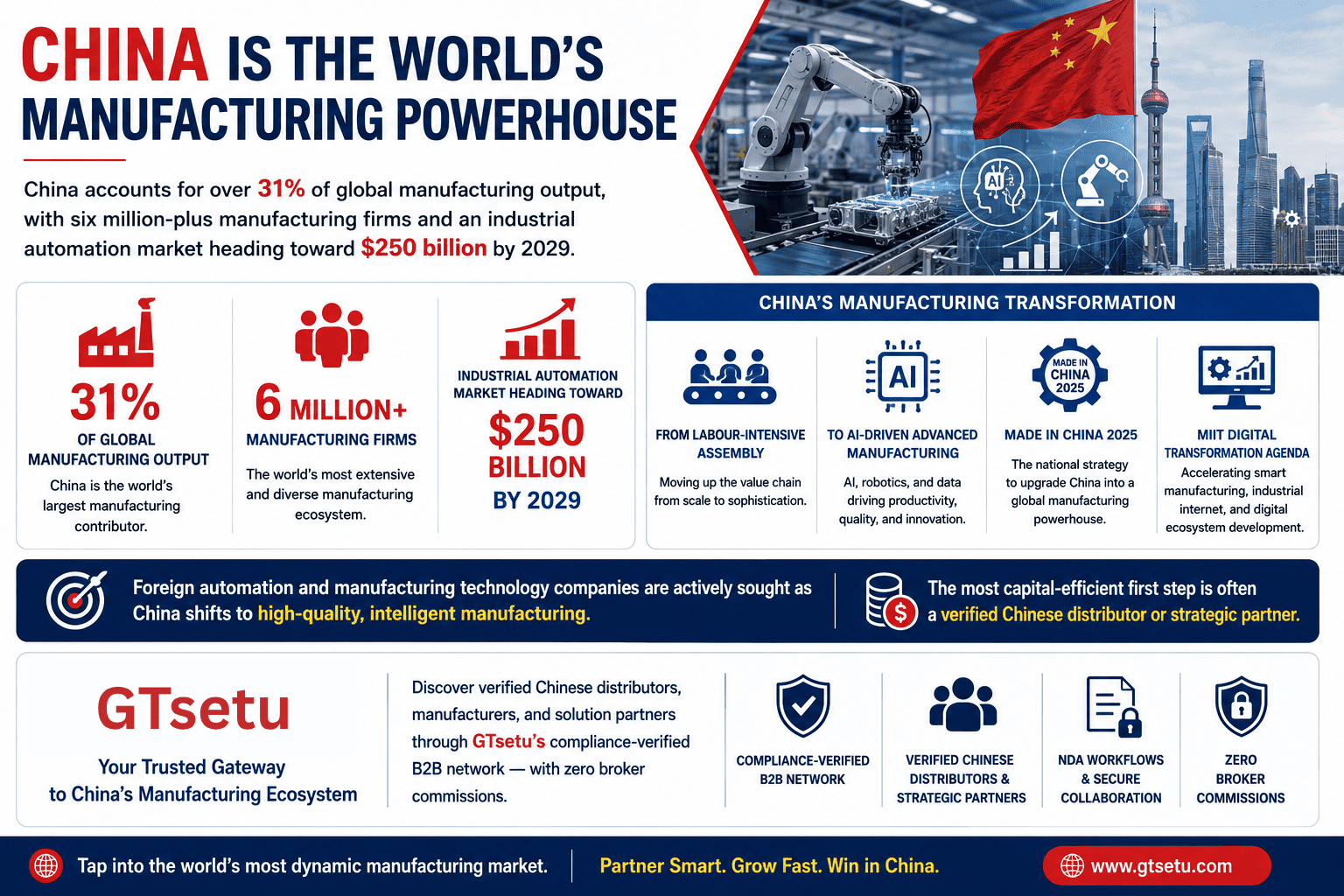
Direct Answer: China accounts for over 31% of global manufacturing output, with six million-plus manufacturing firms and an industrial automation market heading toward $250 billion by 2029. Foreign automation and manufacturing technology companies are actively sought as China shifts from labour-intensive assembly to AI-driven advanced manufacturing under Made in China 2025 and MIIT’s digital transformation agenda. The most capital-efficient first step is often a verified Chinese distributor or strategic partner — discoverable through GTsetu‘s compliance-verified B2B network with zero broker commissions.
📅 April 5, 2026⏱ 18 min read✍️ GT Setu Editorial Team🔄 Updated regularly
31%
Global Manufacturing Output Share
$250B
Automation Market by 2029
6M+
Manufacturing Firms in China
5.4%
Industrial Production Growth (YoY)
China is no longer just the world’s cheapest factory — it is rapidly becoming its smartest one. With over six million manufacturing firms and a sector accounting for more than 31% of global manufacturing output, China presents an unparalleled opportunity for companies in manufacturing and industrial automation. Yet the same scale that makes it attractive also makes it complex.
Whether you are an OEM looking to understand OEM vs. ODM vs. EMS structures, an automation equipment supplier seeking distribution, or a high-tech firm evaluating full market entry, this guide walks you through every critical dimension — from policy frameworks and entry structures to partnership models, supply chain dynamics, and digital strategy.
🇨🇳 Who Is This Guide For?
International manufacturers, industrial automation OEMs, robotics and control system providers, and technology integrators evaluating China market entry — via WFOE, joint venture, distribution, contract manufacturing, or strategic alliance. Planning other markets too? See our country expansion guides below.
SECTION 1
1 Why China for Manufacturing & Industrial Automation?
🎯 The Strategic Case
China’s industrial dominance is structural: decades of infrastructure investment, a massive skilled-labour pool, and tightly integrated supply chains. What increasingly sets China apart is its policy-led push from labour-intensive assembly to AI-driven, data-intensive advanced manufacturing — creating sustained demand for foreign automation technology.
🏭
Scale & Ecosystem Depth
The Pearl River Delta, Yangtze River Delta, and Bohai Rim form self-reinforcing clusters where virtually any component or sub-assembly is accessible within hours.
🤖
The Automation Demand Surge
China has the world’s largest installed base of industrial robots. Demand outpaces supply in intelligent manufacturing, DCS, lifecycle platforms, and precision vision — foreign technology is actively sought.
🏛️
Government Incentives
SEZs, high-tech parks, R&D tax incentives, and preferential land-use policies reward firms aligned with AI, robotics, green manufacturing, and semiconductor independence.
“The factory automation and industrial controls market is already large — estimated at nearly USD 150 billion — with significant growth expected, potentially reaching upwards of USD 250 billion by 2029.”
— Asian Insiders, Industrial Automation Market China, 2024
SECTION 2
2 The Policy Landscape: Made in China 2025 & Beyond
No business plan for China is complete without understanding the policy frameworks that shape market access, competitive dynamics, and investment incentives.
“Made in China 2025”
Launched in 2015, MIC 2025 set a roadmap to transform China into a technology-intensive industrial power. Ten priority sectors include next-generation IT, high-end CNC and robotics, aerospace, marine engineering, advanced rail, energy-saving vehicles, power equipment, agricultural machinery, new materials, and biomedicine. For foreign automation firms, this translates into sustained, policy-backed demand across every vertical.
MIIT’s 2025 Digital Transformation Blueprint
In September 2025, MIIT published its Scenario-based and Graph-based Reference Guide for Promoting Digital Transformation in Key Industries — mapping digital tools to production scenarios across 14 industries including steel, petrochemicals, robotics, NEVs, medical equipment, and lithium batteries.
The “one map, four lists” framework structures transformation around:
Data elements — production parameters, equipment state, energy consumption, quality inspection data
Knowledge models — process models, optimisation algorithms, AI inference models
Talent and skills — automation engineering, data science, industrial software development
The guide acknowledges capability gaps — reliance on foreign industrial AI, image recognition, and high-precision robotics — that represent entry points for overseas suppliers. See our guides on technology transfer agreements and technology partnerships.
“The guide clarifies where regulatory alignment, policy support, and sustained demand are most likely to converge as China pushes its manufacturing base toward productivity-led growth.”
— China Briefing, MIIT Manufacturing Upgrade Plan 2026
New Quality Productive Forces (NQPF)
The successor concept to MIC 2025 emphasises high-tech, high-efficiency production driven by innovation. Industrial digital transformation is its primary implementation vehicle — making MIIT’s blueprint a de facto national standard for where investment should flow.
SECTION 3
3 High-Opportunity Sectors for Automation Entry
🚗NEV Leader
Automotive & NEV
China leads global EV production. Automation reduces assembly errors, overcomes labour constraints, and improves safety across massive EV gigafactories.
💻Strategic
Electronics & Semiconductors
Circuit packaging, wafer fabrication, and chip test demand precision automation domestic suppliers cannot yet fully provide.
🏭
Steel & Heavy Industry
Blast furnace intelligent control, predictive maintenance, and carbon asset management are MIIT 2025 priority scenarios.
⚕️
Medical Equipment
Lifecycle traceability, recall management, and compliance-grade digital platforms are urgently needed as China scales medical device exports.
🛢️
Oil, Gas & Petrochemicals
Refining optimisation, upstream process control, and emissions compliance create upstream and downstream automation demand.
🔋
Lithium Batteries & Energy Storage
Cell manufacturing precision, formation processes, and quality inspection are critical bottlenecks where foreign automation excels.
Full management control and clear IP ownership — preferred when you will not share proprietary technology. Requires registration, capital injection, and sector licences. Understand IP ownership in contract manufacturing contexts as well.
02
Joint Venture (JV)
JVs with SOEs or large private manufacturers accelerate access and regulatory approvals. Critical risk: technology dilution — define IP ownership, non-compete and non-circumvention clauses, and termination rights clearly.
Leverage Chinese factory capacity without building your own. Anchor with contract manufacturing terms on pricing, MOQ, and lead times.
05
Strategic Alliance & Co-Development
R&D collaboration with universities or industry leaders. Formalise via NDA agreements and defined co-development terms.
SECTION 5
5 Regulatory & Compliance Essentials
China’s regulatory environment for foreign manufacturers is layered and sector-specific. A misstep can delay market entry by months or years.
📋
Industry-Specific Licensing
Identify lead regulators early: MIIT (electronics/automation), NMPA (medical devices), SAMR (business registration), MEE (environmental permits). Engage qualified local counsel.
🌐
Trade Controls & Export Restrictions
Dual compliance for US/EU export controls and China’s Export Control Law (ECL) and data security rules affecting industrial data flows.
🔒
Data Security & Cybersecurity
Cybersecurity Law, Data Security Law, and PIPL govern how industrial and process data is collected, stored, and transferred.
♻️
Environmental & Carbon Compliance
Carbon asset management and emissions traceability are becoming embedded requirements — automation with carbon tracking wins state tenders.
⚖️
Dispute Resolution
Specify CIETAC or HKIAC arbitration or litigation jurisdiction. Address force majeure explicitly in all contracts.
SECTION 6
6 Building the Right Partnerships in China
No foreign company succeeds in China alone. The question is how to structure partnerships that accelerate growth without compromising control or technology security.
Industry Cluster Integration
Engaging Pearl River Delta electronics, Yangtze River Delta automotive/aerospace, or Hunan–Jiangxi EV battery corridors dramatically shortens sales cycles through exhibitions, associations, and government matchmaking.
State-Owned vs. Private Partners
SOEs provide regulatory navigation and state-project access; private Tier-1 automation firms offer agility and hunger for foreign technology. Weight evaluation criteria by target customer segment.
Supplier Collaboration Platforms
Purpose-built supplier collaboration platforms with secure B2B workflows reduce coordination overhead and IP leakage through informal channels.
“Having a partner with local connections and expertise can ensure you avoid potential obstacles. The segment is developing rapidly and any company related to manufacturing and automation with global aspirations needs to be present in the market.”
— Asian Insiders, Industrial Automation Market in China
Foreign Firms Already Succeeding in China
Schneider Electric, Honeywell, Emerson, Rockwell Automation, and ABB are deeply embedded. ABB’s USD 150 million fully automated flexible robotics factory in Shanghai demonstrates the “build in China, for China” strategy — the market is open to foreign expertise when entry is thoughtful and locally anchored.
SECTION 7
7 Supply Chain Strategy & Location Selection
🌊 Coastal Provinces
Guangdong, Jiangsu, Zhejiang, Fujian — mature supply chains, ports, and foreign business communities. Higher labour cost, highest supplier density.
Shenzhen, Guangzhou, Shanghai, Suzhou, Ningbo
🏔️ Inland Provinces
Sichuan, Hubei, Hunan, Chongqing — lower costs and government incentives; less infrastructure depth for highly technical products.
Chengdu, Chongqing, Wuhan
🏭 Industrial Parks & SEZs
NHTIDZs and export processing zones offer tax incentives, fast-track approvals, and co-location with compatible firms.
MIIT smart factory pilots often run through designated zones
🚂 Belt & Road Logistics
China–Europe Railway Express: 10–18 days vs. 25–35 by sea — roughly 2× sea cost, lower carbon footprint, greater schedule predictability.
Conduct local site visits and systematic supplier verification. Structure contracts with clear incoterms and payment terms before scaling volumes.
SECTION 8
8 Digital Strategy: Your Online Presence in China
Even in B2B industrial markets, digital presence matters — but China’s internet operates under fundamentally different rules.
🌐
Why Foreign Websites Fail in China
Google APIs, YouTube, and many CDNs are blocked. A 1.5s load in Europe may mean 20+ seconds in Shanghai.
📄
ICP Licensing & Local Hosting
Mainland hosting requires an ICP licence from MIIT — faster loads and better Baidu ranking, but blocked third-party dependencies must still be replaced.
🔍
Baidu SEO & WeChat
Baidu uses different ranking signals than Google. A verified corporate WeChat Official Account is essential for credible B2B engagement.
📝
Localising Industrial Content
Simplified Chinese technical docs, China-specific case studies, and GB standard references improve credibility and inbound lead quality.
Dongguan factories adopted automation to upgrade product quality and enter higher-margin segments — not merely to replace workers. That pattern now replicates across China’s manufacturing heartland.
Domestic Competition is Rising
Chinese automation brands have closed much of the gap in robots, DCS, and PLCs — but advanced AI inference, ultra-precision robotics, and complex simulation remain differentiated foreign strengths.
From Automation to Intelligence
MIIT’s 2025 guide signals demand for integrated industrial intelligence — OT-IT integration, carbon data platforms, and AI across value chains. Standard PLC offerings without a digital layer face commoditisation pressure.
SECTION 10
10 Pre-Entry Checklist for Manufacturing & Automation Companies
Market validation: Map customer pain points against MIIT priority scenarios; benchmark foreign and domestic incumbents.
Legal structure: Choose WFOE, JV, distributor, or contract manufacturing based on IP sensitivity and capital. Consult China corporate lawyers early.
IP protection: Register trademarks, patents, and trade secrets in China before announcing entry (first-to-file system).
Partner screening: Use verified B2B networks; require NDAs before sharing specifications.
Regulatory mapping: Build realistic 6–18 month timelines for licences and certifications.
Localisation plan: Define product, pricing, and documentation requirements for the Chinese market.
Digital presence audit: Test site performance from China; plan ICP, Baidu, and WeChat before commercial launch.
Supply chain structure: Select locations on total landed cost and ecosystem quality; structure risk allocation in contracts.
Finance & FX planning: Understand RMB repatriation, transfer pricing, and high-tech enterprise tax incentives.
Long-term commitment: China rewards a 5–10 year horizon with local relationships, talent, and consistent localisation.
SECTION 11
11 How GTsetu Connects You with Verified Chinese Partners
🇨🇳 GTsetu — Verified B2B Platform for China Market Entry
Discover Verified Chinese Manufacturers & Distributors — No Broker Commission
GTsetu provides international manufacturing and industrial automation companies with direct access to compliance-verified Chinese manufacturers, distributors, system integrators, and technology partners — across every industrial sector and major manufacturing region. Every company in GTsetu’s China network has been verified through business registration, tax documentation, import/export licences, industry certifications, and authority confirmation before appearing on the platform. You discover, qualify, and engage — without broker intermediaries taking a cut of your commercial economics.
🏛️
Multi-Layer Compliance Verification
Every Chinese partner on GTsetu has been verified: business registration, tax ID, import licences, certifications — by GTsetu’s compliance team. Eliminates fraud risk and due diligence workload.
🕵️
Anonymous Discovery
Browse verified Chinese partner profiles without revealing your identity. Protect your China market entry strategy until you choose to engage.
📄
Built-In NDA Workflow
Digital mutual NDA with timestamped signatures activated before sensitive technical or commercial data can be exchanged.
🔐
Encrypted Document Workspace
AES-256 encryption at rest, TLS in transit. Role-based access controls and full audit trail — never exchange specs via unprotected email.
🚫
Zero Broker Commission
GTsetu charges zero commission on any partnership formed between international manufacturers and Chinese distributors or partners.
🌏
100+ Countries Including China
GTsetu’s verified network supports your China entry today and expansion into India, Vietnam, and Germany tomorrow. See all country expansion guides.
QIs China still a good destination for manufacturing expansion in 2025–2026?
Yes — particularly for advanced manufacturing, automation technology, and industrial intelligence. While some labour-cost-driven production has shifted to Southeast Asia, China’s ecosystem advantages (supplier density, infrastructure, skilled engineers, domestic market scale) remain unmatched. The government’s active digitalisation agenda creates additional demand specifically for foreign technology expertise.
QHow do I protect my intellectual property in China?
Register all IP (patents, trademarks, design rights) in China before market entry — China operates a first-to-file system. In contracts, ensure IP ownership is explicitly defined, use mutual or one-way NDAs appropriately, include non-compete and non-circumvention clauses, and structure technology sharing to minimise unnecessary disclosure. A WFOE structure offers stronger IP control than a JV for most technology companies.
QWhat is the difference between a WFOE and a Joint Venture in China?
A WFOE (Wholly Foreign-Owned Enterprise) is 100% foreign-owned, giving full management control and cleaner IP ownership but requiring higher upfront investment. A Joint Venture involves a Chinese partner — accelerating regulatory approvals and market access but introducing shared governance, profit distribution, and potential IP exposure.
QWhich cities or regions are best for industrial automation businesses?
The Pearl River Delta (Shenzhen, Guangzhou, Dongguan) is ideal for electronics and consumer goods automation. The Yangtze River Delta (Shanghai, Suzhou, Hangzhou, Ningbo) suits automotive, aerospace, and high-tech manufacturing. Chengdu and Chongqing are growing hubs for semiconductor and electronics assembly. Tianjin and Shenyang serve heavy industry and aerospace in the north.
QHow long does market entry into China typically take?
For a straightforward WFOE registration in a standard industry, 3–6 months is typical. For industries requiring additional product certifications (medical devices, telecoms equipment, certain automation components), 12–24 months from initiation to first revenue is realistic. Established industrial parks and experienced local advisors can compress timelines.
QHow do I find reliable distributors or manufacturing partners in China?
Go beyond generic directories — use verified B2B platforms like GTsetu, sector trade exhibitions (Canton Fair, CIIF, SEMICON China), industry associations, and government investment promotion agencies. Always conduct in-person factory audits and independent background checks before signing. See how to find international distributors and alternatives to Alibaba for B2B sourcing.
Ready to Expand Your Manufacturing Business to China?
Connect with verified Chinese manufacturers, distributors, and technology partners on GTsetu — compliance-backed verification, anonymous discovery, built-in NDA workflows, and zero broker commissions.
They represents the product, and research team behind GTsetu, a global B2B collaboration platform built to help companies explore cross-border partnerships with clarity and trust. The team focuses on simplifying early-stage international business discovery by combining structured company profiles, verification-led access, and controlled collaboration workflows.
With a strong emphasis on trust, and disciplined engagement, Team GTsetu shares insights on global trade, partnerships, and cross-border collaboration, helping businesses make informed decisions before entering deeper commercial discussions.