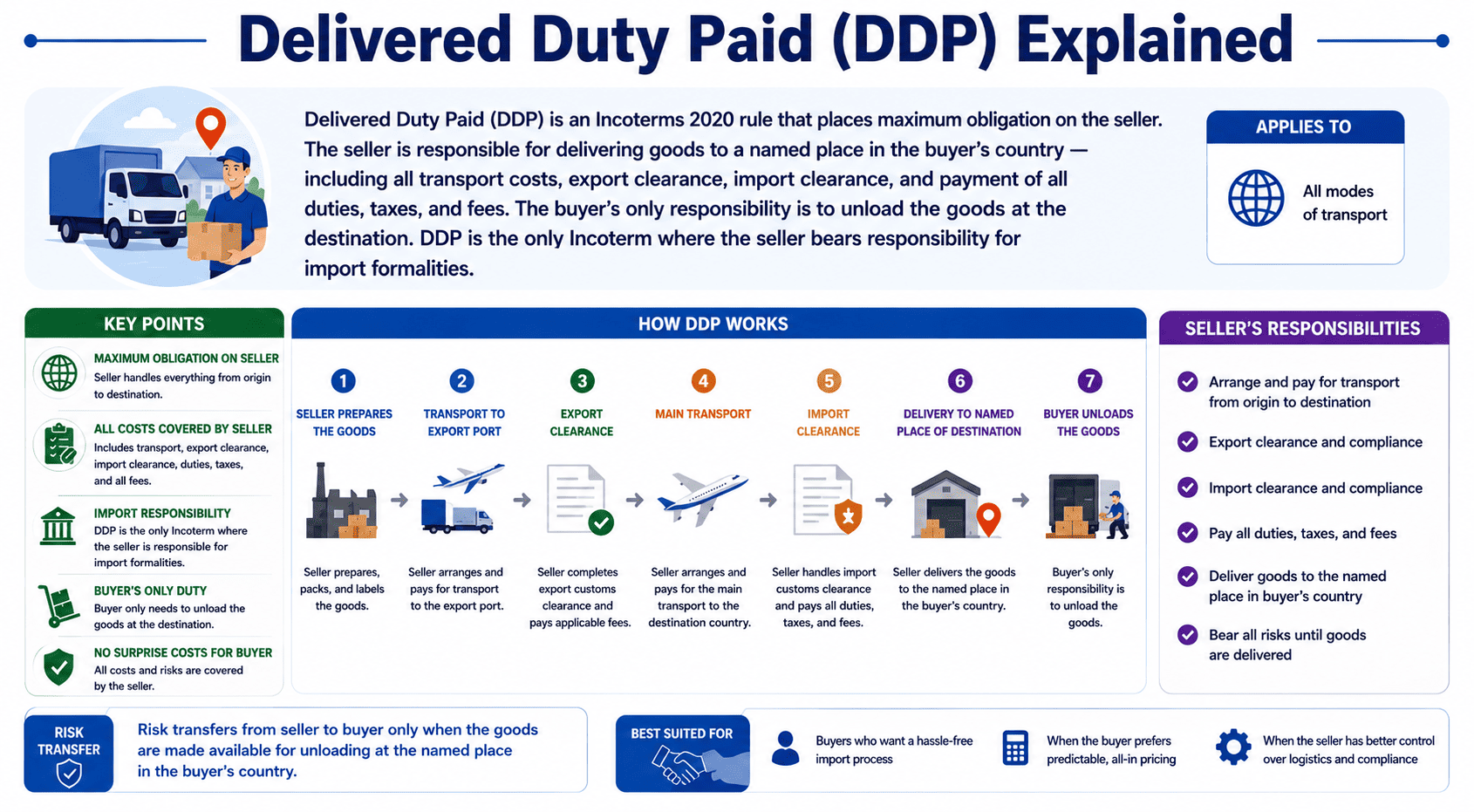
What DDP Means in Practice
Under DDP, the seller assumes full responsibility for delivering goods to the buyer’s premises or another named destination in the buyer’s country. The seller arranges and pays for all transportation, from the seller’s warehouse to the final destination. Crucially, the seller also completes import customs clearance in the destination country and pays all import duties, VAT/GST, and other taxes or fees.
For the buyer, DDP creates a seamless purchasing experience similar to a domestic transaction. The buyer knows the exact total cost at checkout (product price + shipping + duties + taxes), and no additional fees are due upon delivery. This makes DDP particularly popular in cross-border e-commerce, where unexpected customs bills cause cart abandonment and delivery refusals.
However, DDP carries significant risks and costs for sellers. The seller must be able to act as importer of record in the destination country, which may require a local entity, tax registration, or import license. If the seller cannot recover VAT/GST paid on import, those costs become permanent losses. For these reasons, many experts advise using DAP (Delivered at Place) instead unless the seller has a well-established local presence.
⚠️ Critical Warning
Before agreeing to DDP, sellers must verify they can legally act as importer of record in the destination country. Many countries require foreign importers to have a local registered entity, tax ID, or licensed customs broker. Failure to comply can result in goods being seized, fines, or delivery failures. When in doubt, use DAP (Delivered at Place) instead.
Seller vs Buyer Obligations
Who Does What Under DDP
- All export packaging and marking
- Export licenses and customs clearance
- Pre-carriage from seller’s warehouse to port of export
- Loading charges at origin
- Main carriage (ocean, air, rail, or road freight)
- Insurance (optional, but at seller’s own risk)
- Destination terminal handling charges (DTHC)
- Import customs clearance and all formalities
- Payment of all import duties, taxes, and fees
- Post-carriage to named place of destination
- Proof of delivery to buyer
- All costs and risk until goods are delivered, ready for unloading
- Payment for goods as specified in sales contract
- Unloading the goods at the named destination
- Assisting seller (if requested) with obtaining import documents or information
- No responsibility for import duties, taxes, or customs clearance
- No risk of loss or damage during transit
- No obligation to arrange carriage or insurance
✨ E-Commerce Best Practice
For cross-border online retail, DDP creates superior customer experience. Use a carrier or platform that calculates landed cost (product + shipping + duties + taxes) at checkout. This eliminates surprise bills, reduces cart abandonment, and prevents delivery refusals. DHL, UPS, and other global carriers offer DDP shipping solutions for e-commerce sellers.
Cost Allocation
Which Party Pays for What Under DDP
Export packagingSeller
Export customs clearanceSeller
Origin terminal handling (OTHC)Seller
Main carriage / freightSeller
Transport insuranceSeller (optional)
Destination terminal handling (DTHC)Seller
Import customs clearanceSeller
Import duties and taxesSeller
Post-carriage to final destinationSeller
Unloading at destinationBuyer
Risk Transfer Point
When Risk Transfers from Seller to Buyer
Under DDP, the seller bears all risk of loss or damage to the goods until they are delivered to the named place of destination, ready for unloading. This is the latest possible risk transfer point among all Incoterms. The seller remains responsible even if goods are damaged during ocean transit, at the destination port, or on the final truck to the buyer’s premises.
Once the goods arrive at the agreed destination (e.g., the buyer’s warehouse loading dock) and the seller has made them available for unloading, risk transfers to the buyer. The buyer then assumes responsibility for unloading and any subsequent handling. Unlike some other Incoterms, the seller is not required to unload the goods.
1
Seller’s Risk Period
From warehouse to destination, export clearance, main carriage, import clearance, all transport
2
Transfer Point
Goods arrive at named destination, ready for unloading (e.g., buyer’s dock)
3
Buyer’s Risk Period
After goods are made available, unloading and onward handling
DDP vs Other Incoterms
DDP Compared: DDP vs DAP vs EXW
| Responsibility | DDP (Seller Max) | DAP (Delivered at Place) | EXW (Seller Min) |
|---|
| Export clearance | Seller | Seller | Buyer |
| Main carriage | Seller | Seller | Buyer |
| Import clearance | Seller | Buyer | Buyer |
| Import duties & taxes | Seller | Buyer | Buyer |
| Delivery to destination | Seller (including post-carriage) | Seller (including post-carriage) | Buyer arranges all |
| Risk transfer point | At destination, ready for unloading | At destination, ready for unloading | At seller’s warehouse |
| Best for buyer experience | Excellent (no surprises) | Good (buyer pays import fees) | Poor (buyer handles everything) |
| Seller’s administrative burden | Maximum | Moderate | Minimum |
When to Use DDP (and When to Avoid It)
When DDP Makes Sense, and When It Doesn’t
✅ Best Uses for DDP
- Cross-border e-commerce (B2C): Customers expect transparent, all-inclusive pricing with no surprise customs bills. DDP eliminates delivery refusals and improves conversion rates.
- High-value, low-volume goods: Where duties and taxes are predictable and margins absorb the costs.
- Seller has local presence in destination country: If the seller already has a subsidiary, branch, or registered entity in the buyer’s country, import clearance and VAT recovery become manageable.
- Trade within a customs union (e.g., EU): When the seller and buyer are in the same customs union, import formalities are simplified or eliminated, making DDP less burdensome.
- Customer retention is a priority: For subscription services or recurring B2B deliveries, DDP builds trust and reduces friction.
❌ When to Avoid DDP
- Seller cannot act as importer of record: Many countries require a local tax ID or licensed customs broker for import clearance. Without these, DDP is impossible.
- Low-margin products: Duties, taxes, and clearance fees can consume 20–40% of product value, making DDP unprofitable.
- Complex or unpredictable duty regimes: Some countries apply anti-dumping duties, additional tariffs, or product-specific fees that are difficult to calculate in advance.
- Buyer can reclaim VAT/GST: In B2B transactions where the buyer is a registered business that can reclaim import VAT, DAP is more efficient (buyer pays but reclaims).
- Restricted or regulated goods: Pharmaceuticals, weapons, certain chemicals, or food products may require import licenses that only the buyer can obtain.
- First-time export to a new market: Without established customs brokers and legal advice in the destination country, the risk of error is high.
📊 DDP Profitability Checklist for Sellers
Before offering DDP: (1) Calculate landed cost including estimated duties, taxes, broker fees, and transport to final destination. (2) Confirm you can legally act as importer of record. (3) Determine if you can recover any VAT/GST paid. (4) Compare total DDP cost against competitor pricing. (5) Consider whether DAP with clear communication of duties might achieve similar conversion rates at lower risk.
Practical Implementation
How DDP Works Step by Step
01
Contract & Destination Specified
Sales contract specifies DDP [named place of destination]. The destination must be precise, e.g., “DDP, 123 Main Street, Chicago, IL, USA, Suite 400, Attn: Receiving Dock.”
02
Seller Calculates Landed Cost
Seller calculates product price + export packaging + all freight + insurance (optional) + import duties + VAT/GST + customs broker fees + destination delivery.
03
Seller Arranges Export Clearance
Seller obtains export license (if required), files export declaration, and clears goods for export in the country of origin.
04
Main Carriage to Destination Country
Seller contracts carrier (ocean, air, rail, truck). Seller bears all risk and cost during transit. Seller may but is not required to insure goods.
05
Seller Handles Import Clearance
Upon arrival, seller (or its customs broker) files import entry, pays duties and taxes, and obtains release from customs. Seller acts as importer of record.
06
Post-Carriage to Final Destination
After customs release, seller arranges final delivery to the named place. Goods arrive at buyer’s dock or specified location.
07
Buyer Unloads & Takes Delivery
Buyer unloads goods at its own cost and risk. Risk transfers from seller to buyer at this point. Seller provides proof of delivery.
FAQ
Frequently Asked Questions
QWhat is the difference between DDP and DAP?
Under DAP (Delivered at Place), the seller is responsible for delivering goods to a named destination and paying all transport costs, but the buyer is responsible for import clearance and payment of duties and taxes. Under DDP, the seller also pays import duties and handles customs clearance in the destination country. DAP was formerly known as DDU (Delivered Duty Unpaid). For cross-border e-commerce, DDP creates a better customer experience; for B2B where the buyer can reclaim VAT, DAP is often more efficient.
QIs DDP risky for sellers?
Yes, DDP carries significant risk for sellers. The seller must be able to handle import formalities in the buyer’s country, which may require a local entity or registration for tax purposes. The seller also bears all risk of loss or damage until delivery at the named place. Additionally, the seller may not be able to recover VAT/GST paid on import. Many experts recommend using DAP instead unless the seller has a local presence in the destination country and has calculated landed costs accurately.
QWho pays customs duties under DDP?
Under DDP, the seller pays all customs duties, taxes, and fees associated with importing the goods into the destination country. This includes import tariffs, VAT/GST, and any other governmental charges. The buyer pays nothing at the border. This is the key distinction between DDP and all other Incoterms. The seller may either absorb these costs into their margin or pass them to the buyer in the product price.
QCan any seller use DDP for any country?
No. Many countries require the importer of record (the seller under DDP) to have a local registered entity, tax identification number, or licensed customs broker. Some countries also restrict DDP for certain product categories or require import licenses that only a local buyer can obtain. Before offering DDP, sellers must research destination country requirements. Common problem countries include Brazil, Russia, India, China, and many in South America where import rules are complex.
QHow do I calculate DDP landed cost?
Landed cost = Product price + export packaging + freight to destination country + insurance (if any) + destination terminal charges + customs broker fees + import duty (duty rate × customs value) + VAT/GST (dutiable value × VAT rate) + local delivery to final destination. Use a duty and tax calculator (DHL, UPS, or government customs websites) to estimate rates. Be aware that customs value may include freight and insurance (CIF value) depending on the country’s valuation rules.
QWhat happens if the buyer refuses to unload under DDP?
The seller remains responsible for the goods until the buyer unloads them. If the buyer refuses to unload without valid reason, the seller may have a claim for breach of contract. However, practically, this creates a difficult situation, the goods may sit on a truck incurring detention/demurrage charges. The sales contract should specify what constitutes “ready for unloading” and the buyer’s obligation to accept delivery within a reasonable time. Some contracts include a provision that if the buyer fails to unload within X days, the seller may treat it as a default.