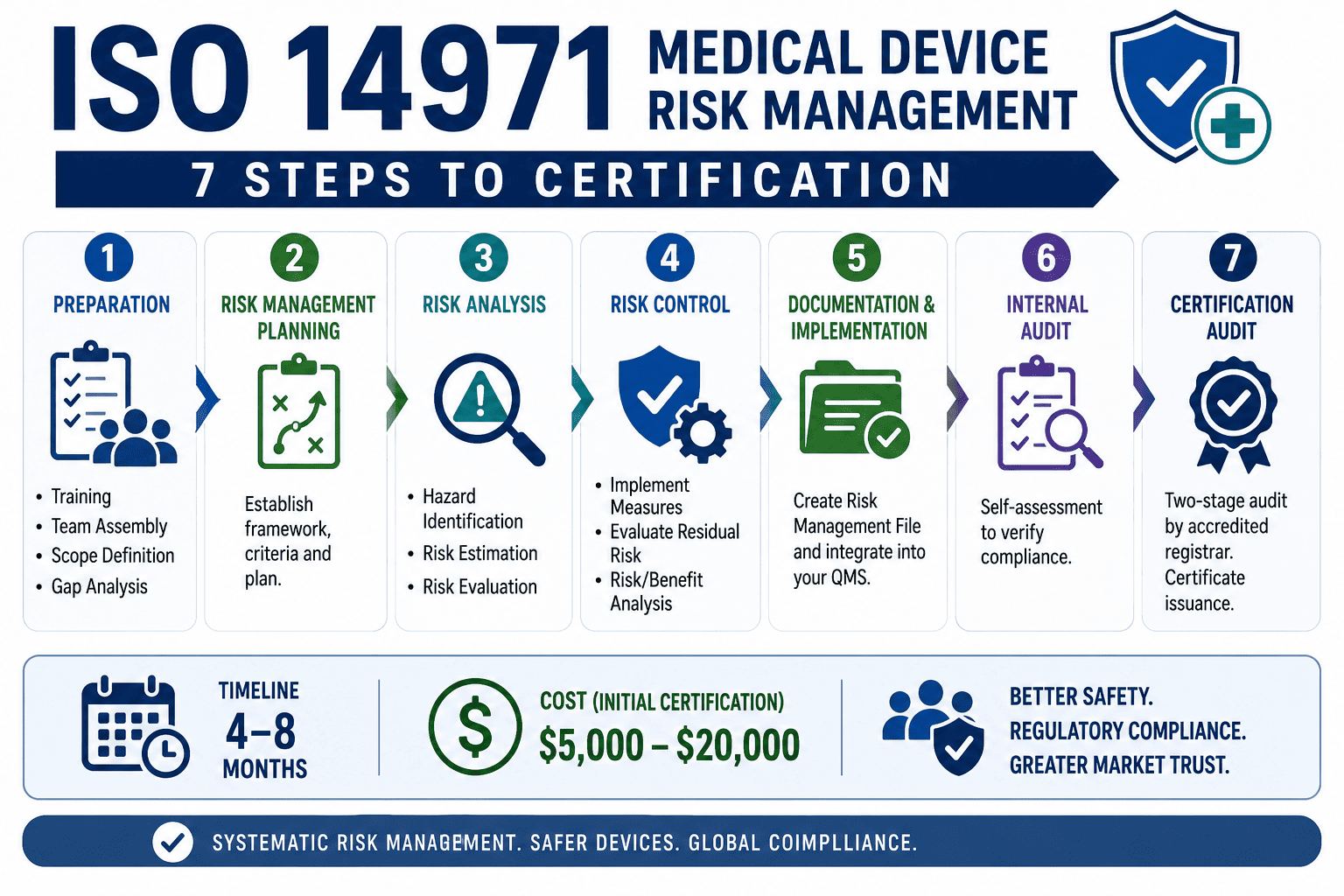
Direct Answer: ISO 14971 is the globally recognized standard for medical device risk management, providing a systematic framework for identifying, analyzing, evaluating, and controlling risks throughout the device lifecycle. Getting certified involves a structured process: Preparation (training, team assembly, scope definition, and gap analysis), Risk Management Planning (establishing the framework, criteria, and plan), Risk Analysis (hazard identification, risk estimation, and evaluation), Risk Control (implementing measures, evaluating residual risk, and risk/benefit analysis), Documentation & Implementation (creating the risk management file and integrating into your QMS), Internal Audit (self-assessment to verify compliance), and Certification Audit (two-stage audit by an accredited registrar, followed by certificate issuance). For a small to medium medical device manufacturer, the process typically takes 4–8 months, with costs ranging from $5,000–$20,000 for initial certification. This guide walks you through every step, with practical tips for a smooth certification journey and compliance with global regulatory requirements.
📅 August 9, 2026⏱ 16 min read✍️ GT Setu Editorial Team🔄 Updated regularly
100+
Countries Recognizing ISO 14971
7
Key Steps to Certification
4–8
Months (Typical Timeline)
0%
GTsetu Broker Commission
ISO 14971 is the internationally recognized standard for medical device risk management. Developed and published by the International Organization for Standardization (ISO), it specifies the requirements for a risk management system that enables medical device manufacturers to identify, analyze, evaluate, and control risks associated with their products throughout the entire lifecycle. The current version is ISO 14971:2019, which is the definitive standard for medical device risk management, providing a structured framework that is essential for regulatory compliance in major markets including the EU, US, and many others.
For medical device manufacturers, suppliers, and distributors, ISO 14971 certification is a critical requirement for market access. It is a prerequisite for CE marking under the MDR and IVDR, and a key element of compliance with FDA QSR (21 CFR 820). The standard is also a normative reference for ISO 13485 (medical device quality management systems), meaning that an organization cannot be fully compliant with ISO 13485 without implementing a risk management system that meets ISO 14971 requirements. This guide covers the complete certification process, from initial preparation through to the final certification audit, and provides practical, actionable advice for a smooth journey. See our related guides on ISO 9001 quality management and ISO 13485 medical device QMS to understand how these standards integrate with ISO 14971.
🏥 Who Is This Guide For?
This guide is written for quality managers, regulatory affairs professionals, risk management specialists, R&D engineers, and anyone responsible for implementing or maintaining a risk management system for medical devices. It covers both the DIY approach (using templates and internal resources) and the consultant-led route. It is equally relevant for manufacturers seeking certification to meet regulatory requirements, and for suppliers who need to demonstrate risk management to their medical device manufacturing clients. For related partnership structures, see our guides on supplier collaboration platforms and distributors and manufacturers.
SECTION 1
1 What Is ISO 14971 & Why Get Certified?
🏥 The Standard Explained
ISO 14971 is the international standard that defines the requirements for a risk management system for medical devices. It is the definitive standard for medical device risk management, providing a structured framework for identifying, analyzing, evaluating, and controlling risks throughout the entire lifecycle of a medical device. The current version, ISO 14971:2019, includes the concept of “overall residual risk” and requires a comprehensive risk management process that is integrated into the organization’s quality management system. The standard is recognized in over 100 countries and is a key requirement for regulatory compliance, including CE marking under the EU MDR and IVDR, and FDA QSR (21 CFR 820). Certification demonstrates that your organization has implemented a robust risk management system that meets international standards, ensuring patient safety, regulatory compliance, and market access.
🌐
Globally Recognized Standard
ISO 14971 is recognized in over 100 countries, making it the most widely accepted risk management standard for medical devices globally. It provides a common framework for risk management across international medical device supply chains.
📋
Regulatory Compliance
ISO 14971 is a prerequisite for CE marking under the EU MDR and IVDR, and is a key requirement for FDA QSR (21 CFR 820). Certification supports compliance with global regulatory requirements and streamlines market access.
🔄
Lifecycle Risk Management
ISO 14971 provides a systematic framework for managing risks throughout the entire device lifecycle, from design and development through production, post-production, and eventual decommissioning, ensuring ongoing patient safety.
🏥
Patient Safety & Trust
Certification signals to regulators, healthcare providers, and patients that your organization has robust risk management controls and a commitment to patient safety, building trust and strengthening market position.
SECTION 2
2 Key Benefits of ISO 14971 Certification
ISO 14971 certification delivers tangible benefits across regulatory, operational, and commercial dimensions. While the certification process requires investment, the return on that investment is well-documented across the medical device industry.
100%
Essential for CE marking under EU MDR/IVDR
60%
Reduction in post-market surveillance issues with proper risk management
50%
Faster regulatory clearance with documented risk management
⚖️
Regulatory Compliance & Market Access
ISO 14971 is a mandatory requirement for CE marking under the EU MDR and IVDR, and is a key element of FDA QSR compliance. Certification streamlines regulatory submissions and accelerates market access in major global markets.
Regulatory
🛡️
Patient Safety & Risk Reduction
By systematically identifying, analyzing, and controlling risks, ISO 14971 significantly reduces the likelihood of patient harm, adverse events, and product recalls. This protects patients and reduces organizational liability.
Safety
🔗
Integration with ISO 13485
ISO 14971 is a normative reference for ISO 13485, the medical device quality management standard. Implementing ISO 14971 supports ISO 13485 compliance and can be pursued together for a comprehensive QMS.
Integration
📊
Data-Driven Decision Making
The standard requires systematic hazard identification, risk estimation, and risk evaluation, enabling evidence-based decisions about product safety and risk control measures throughout the device lifecycle.
Analytical
👥
Stakeholder Confidence
Certification demonstrates your commitment to patient safety and quality, building confidence among regulators, healthcare providers, patients, investors, and business partners. It is a key differentiator in competitive markets.
Trust
📋
Post-Market Surveillance Efficiency
A well-implemented risk management system provides a structured framework for post-market surveillance, enabling more efficient identification, analysis, and response to adverse events and product issues.
Post-Market
SECTION 3
3 The ISO 14971 Risk Management Framework
ISO 14971 establishes a structured risk management framework that is applied throughout the medical device lifecycle. The framework is based on a systematic process that includes risk analysis, risk evaluation, risk control, and overall residual risk evaluation. Understanding this framework is essential for implementing a risk management system that delivers genuine value and meets regulatory requirements.
🔍
1. Risk Analysis
Identify and describe hazards, estimate risks for each hazardous situation, and evaluate risks to determine which require treatment. This is the foundation of the risk management process and requires systematic hazard identification.
🎯
2. Risk Evaluation
Compare estimated risks against risk acceptability criteria. Determine if risks are acceptable without further controls, or if risk control measures are required. Document the risk evaluation for each hazardous situation.
🛠️
3. Risk Control
Implement risk control measures to reduce risks to acceptable levels. Verify the effectiveness of controls and evaluate residual risk. Conduct a risk/benefit analysis if residual risks remain unacceptable.
📊
4. Overall Residual Risk Evaluation
Evaluate the overall residual risk after all risk control measures have been implemented. Determine if the overall residual risk is acceptable based on criteria established in the risk management plan.
📋
5. Risk Management Report
Document the results of the risk management process in a comprehensive risk management report. This report summarizes all activities and findings and is a key document for regulatory submissions.
🔄
6. Production & Post-Production Activities
Monitor and review risk management information throughout the device lifecycle. Use feedback from production and post-market surveillance to identify new hazards, update risk assessments, and improve the device.
📋 Key Terminology
Hazard: Potential source of harm (e.g., electrical shock, infection, mechanical failure). Hazardous Situation: Circumstance where a hazard can cause harm (e.g., a patient being exposed to an electrical hazard). Risk: Combination of the probability of occurrence of harm and the severity of that harm. Risk Control: Process to reduce risk to acceptable levels. Residual Risk: Risk remaining after risk control measures have been implemented. Overall Residual Risk: The total residual risk from all hazards after all risk control measures are considered.
SECTION 4
4 Step 1: Preparation, Foundation & Planning
🏗️ Building the Foundation
The preparation phase sets the foundation for your entire ISO 14971 certification project. The goal is to ensure you have the knowledge, resources, and support in place before beginning the detailed work of risk management planning and analysis. This phase typically takes 2–4 weeks for a small organization, longer for larger or more complex operations.
1.1
Get Trained on ISO 14971
If you are managing the certification process, you need to understand the standard’s requirements and how to apply them to medical device risk management. Consider an ISO 14971 implementer training course, online or in-person, to build foundational knowledge. Many training providers, including TÜV SÜD, ASQ, BSI Group, and The Knowledge Academy, offer comprehensive courses on ISO 14971:2019 and ISO/TR 24971:2020 guidance.
1.2
Secure Executive Support
Top management commitment is critical. They must “walk the talk” by allocating resources, supporting the project, and communicating its importance. Provide executives with a concise overview of ISO 14971’s role in regulatory compliance and patient safety, and the benefits certification will deliver.
1.3
Assemble Your Risk Management Team
Form a multidisciplinary team with expertise in design engineering, quality assurance, regulatory affairs, clinical evaluation, and manufacturing. The team should include a designated risk management responsible person with knowledge of ISO 14971 and the specific device types.
1.4
Define Scope & Conduct Gap Analysis
Define the scope of your risk management system: which devices, processes, and lifecycle phases will be covered? Conduct a gap analysis to assess current compliance against ISO 14971 requirements and identify areas needing improvement. This helps you prioritize efforts and create a more accurate project plan.
1.5
Create a Simple Project Plan
Plan your implementation steps, milestones, target dates, and responsibilities. Define who will be the ISO 14971 point person responsible for achieving and maintaining certification. Include activities for risk management planning, analysis, control, documentation, and audit preparation.
1.6
Generate Employee Awareness
Inform your staff about the ISO 14971 project early to prevent rumors and build engagement. Explain how certification benefits the company and individual employees, addressing concerns about job security and work processes. This creates buy-in and transforms staff into stakeholders in the project’s success.
💡 Pro Tip: Start with a Pilot Device
For organizations with multiple devices, consider a phased approach. Start with a pilot implementation for one device or product family, learn from the experience, and then roll out to the rest of your product portfolio. This reduces risk and allows you to refine your approach based on real-world feedback. The same principle applies when building a B2B network, start with a focused approach and scale.
SECTION 5
5 Step 2: Risk Management Plan, Establishing the Framework
The risk management plan is a critical document that establishes the framework for all risk management activities. It defines the scope, responsibilities, criteria, and processes for risk management throughout the device lifecycle. The plan must be approved by top management and maintained as a controlled document.
Plan Element
Description
Key Consideration
Scope & Objectives
Define the scope of the risk management activities, including which devices, product families, and lifecycle phases are covered. State the objectives of the risk management process.
Ensure the scope is comprehensive and aligns with regulatory requirements. Consider including all devices in the product portfolio.
Risk Management Team
Identify team members, their roles, responsibilities, and qualifications. Include representatives from design, quality, regulatory, clinical, and manufacturing.
Ensure the team has the necessary expertise and authority to make decisions about risk control and acceptability.
Risk Acceptability Criteria
Define the criteria for risk acceptability, including the risk matrix or scoring system used to evaluate risks. Establish the acceptable risk levels for your organization.
Criteria should be documented, justified, and reviewed regularly. Consider industry norms and regulatory expectations when setting criteria.
Risk Analysis Methods
Specify the methods to be used for hazard identification and risk estimation, such as FMEA, FTA, HACCP, or other recognized techniques.
Choose methods appropriate for the device type and complexity. Ensure team members are trained in the selected methods.
Risk Control & Verification
Define the process for identifying, selecting, and implementing risk control measures. Specify the methods for verifying effectiveness of controls.
Consider the hierarchy of risk control (inherent safety, protective measures, information for safety). Verification must be documented.
Overall Residual Risk Evaluation
Define the process for evaluating overall residual risk after all risk control measures have been implemented. Establish criteria for overall risk acceptability.
Overall residual risk must be evaluated and documented. Consider risk/benefit analysis if overall residual risk is not acceptable.
Risk Management Review & Update
Define the process for reviewing and updating the risk management file based on production and post-production feedback, regulatory changes, or design changes.
Risk management is a lifecycle process. Establish regular review cycles and triggers for ad-hoc updates.
Traceability & Documentation
Define the documentation requirements for risk management activities, including the risk management file, risk analysis records, and risk control records.
Ensure traceability from hazard identification to risk control to risk management report. Documentation must be clear, complete, and accessible.
💡 Best Practices for Risk Management Planning
DO: Involve the full multidisciplinary team in plan development. Use ISO/TR 24971:2020 as guidance for interpretation and implementation. Ensure the plan is approved by top management. Review the plan periodically and update as needed.
DON’T: Create a generic plan that doesn’t reflect your specific devices and processes. Set risk acceptability criteria without proper justification. Forget to include post-market surveillance activities in the plan.
Consider using templates: Pre-written risk management plan templates designed for medical devices can save time and ensure completeness. Ensure templates are tailored to your specific device types and regulatory requirements. This approach is also effective when drafting manufacturer-distributor contracts, start with a proven template and customize.
Risk analysis is the core of ISO 14971. It involves systematically identifying hazards, estimating the associated risks, and evaluating whether those risks are acceptable. The goal is to identify all potential sources of harm associated with the medical device and characterize the risk for each hazardous situation.
🔍
Hazard Identification
Systematically identify all potential hazards associated with the medical device throughout its lifecycle, including design, manufacturing, labeling, use, and disposal. Consider electrical, mechanical, biological, chemical, and software hazards.
Analysis
📊
Risk Estimation
For each hazard, estimate the risk by combining the probability of occurrence of harm with the severity of that harm. Use a risk matrix or scoring system defined in the risk management plan. Document the basis for risk estimation.
Estimation
📋
Risk Evaluation
Compare estimated risks against the risk acceptability criteria defined in the risk management plan. Determine which risks are acceptable without further controls and which require risk control measures. Document the risk evaluation.
Evaluation
📝
Documentation of Risk Analysis
Maintain comprehensive records of all risk analysis activities, including hazard identification, risk estimation, and risk evaluation. The risk analysis records are a key component of the risk management file and are required for regulatory submissions.
Documentation
🏥 Risk Analysis Methods
Common methods include: Failure Mode and Effects Analysis (FMEA), systematic analysis of potential failure modes and their effects; Fault Tree Analysis (FTA), top-down analysis of causes of a specific event; Hazard Analysis and Critical Control Points (HACCP), systematic analysis of hazards and control points; Preliminary Hazard Analysis (PHA), early identification of hazards in the design phase; and Hazard and Operability Study (HAZOP), systematic review of process deviations. The choice of method depends on the device type, complexity, and regulatory expectations. For many medical devices, a combination of methods is appropriate. ISO/TR 24971:2020 provides guidance on selecting and applying risk analysis methods.
Risk control is the process of identifying, selecting, and implementing measures to reduce risks to acceptable levels. The goal is to eliminate or reduce risks associated with the medical device to a level that is acceptable given the benefits of the device. ISO 14971 establishes a hierarchy of risk control measures: (1) inherent safety by design, (2) protective measures in the device or manufacturing process, and (3) information for safety (e.g., labeling, instructions). Risk controls must be verified for effectiveness and the residual risk must be evaluated.
🛡️
Inherent Safety by Design
Eliminate or reduce hazards through design changes. This is the most effective risk control measure. Examples: using low-voltage components, eliminating sharp edges, or designing failsafe mechanisms.
🔒
Protective Measures
Implement protective measures in the device or manufacturing process to reduce risk. Examples: guards, shields, alarms, software interlocks, or process controls that prevent or detect hazards.
📄
Information for Safety
Provide information to users about residual risks and how to avoid them. Examples: warnings in labeling, instructions for use, training requirements, or contraindications.
✅
Verification of Controls
Verify that each risk control measure is effective and does not introduce new hazards. Verification can include testing, inspection, analysis, or other appropriate methods. Document verification results.
📊
Residual Risk Evaluation
For each hazard, evaluate the residual risk after risk control measures have been implemented. Determine if the residual risk is acceptable based on the risk acceptability criteria.
⚖️
Risk/Benefit Analysis
If residual risk remains unacceptable, conduct a risk/benefit analysis to weigh the benefits of the device against the residual risk. Document the analysis and justification for accepting the risk.
💡 Risk Control Hierarchy
Always prioritize inherent safety by design (eliminating the hazard) over protective measures (reducing the likelihood or severity of harm) over information for safety (warning users). This hierarchy is a key principle of ISO 14971. If a risk can be eliminated through design, this is the preferred approach. Protective measures should be considered when hazards cannot be eliminated. Information for safety should be used as a last resort, as it relies on user behavior and may not be effective in all situations.
SECTION 8
8 Step 5: Documentation & Implementation, Building Your Risk Management File
The risk management file is a comprehensive collection of documents and records that demonstrate compliance with ISO 14971. It is a key deliverable for regulatory submissions and certification audits. The file includes the risk management plan, risk analysis records, risk control records, residual risk evaluations, and the risk management report. Implementation involves integrating risk management activities into your quality management system and training your team.
Document Type
Description
Key Consideration
Risk Management Plan
Establishes the framework for all risk management activities, including scope, responsibilities, criteria, and processes. Approved by top management.
Ensure the plan is comprehensive, justified, and reviewed periodically. It should be a controlled document.
Risk Analysis Records
Documentation of hazard identification, risk estimation, and risk evaluation for each hazardous situation. Includes the basis for risk estimates.
Records must be clear, complete, and traceable. Use consistent methods for risk estimation across all devices.
Risk Control Records
Documentation of risk control measures, verification of effectiveness, and residual risk evaluation. Includes risk/benefit analysis if applicable.
For each control, document the measure, verification method, verification results, and residual risk evaluation.
Overall Residual Risk Evaluation
Evaluation of the overall residual risk after all risk control measures have been implemented. Determines if the overall risk is acceptable.
Consider the cumulative effect of all residual risks. Document the basis for accepting overall residual risk.
Risk Management Report
Comprehensive summary of the risk management process, findings, and conclusions. A key document for regulatory submissions.
The report should be concise yet comprehensive. Include a summary of all hazards, risk controls, residual risks, and overall residual risk.
Production & Post-Production Records
Documentation of risk management activities during production and post-production, including feedback analysis, trend monitoring, and risk management updates.
Establish a process for collecting and analyzing production and post-production data. Update the risk management file as needed.
Training Records
Records of training on risk management processes, ISO 14971 requirements, and specific roles and responsibilities.
Ensure all team members are trained and competent. Maintain training records as evidence of compliance.
📋 Integration with ISO 13485
ISO 14971 is a normative reference for ISO 13485 (medical device quality management systems). The risk management file should be integrated with your quality management system. Consider the following integration points: Document Control, the risk management file must be controlled like any QMS document. Design Control, risk management is a key element of design and development. Purchasing, apply risk management to supplier selection and component sourcing. Production & Process Control, risk management applies to manufacturing processes. Non-Conformance, risk management is applied to non-conformances and CAPAs. Post-Market Surveillance, risk management is integral to PMS activities. This integration is also important when establishing manufacturer-distributor contracts, where quality and risk management responsibilities should be clearly defined.
SECTION 9
9 Step 6: Internal Audit, Self-Assessment
🔍 Verifying Your Risk Management System
Internal audits are a mandatory requirement of ISO 14971 and play a critical role in ensuring the effectiveness of your risk management system. These self-inspections involve reviewing the risk management file, observing processes, interviewing team members, and examining records. The objective is to verify compliance not only with ISO 14971 requirements but also with your own procedures and work instructions. Internal audits must be conducted before seeking certification and periodically thereafter. They can be performed by trained internal staff or outsourced to expert auditors.
📋
Set Up the Audit Program
Develop an audit schedule and methods for planning and preparing your audits. Create documents, forms, and checklists that support the audit process. Consider using lead auditor training that includes a module on managing the audit program.
👤
Appoint Qualified Auditors
Auditors should be objective and impartial, they cannot audit their own work. They should have knowledge of ISO 14971, medical device risk management, and auditing techniques. Consider using external auditors with medical device experience.
🎓
Provide Auditor Training
Auditors must be familiar with the ISO 14971:2019 standard, possess strong auditing skills, be capable of reporting findings and following up on corrective actions, and ideally, promote best practices and add operational value.
🔄
Start Audits Early
Use internal audits as training tools to support implementation. You can start auditing during implementation, focusing on specific requirements or processes initially, and expanding the scope as the system matures. This early start helps identify and fix issues before the formal certification audit.
✅
Conduct a Complete Internal Audit
To be eligible for ISO 14971 certification, you must complete a comprehensive internal audit covering your entire risk management system. The audit can be divided into multiple partial audits, focusing on specific devices or processes at a time. Address all identified nonconformities before proceeding to the certification audit.
📄
Outsource If Needed
If you lack internal audit expertise, you can outsource the pre-certification internal audit to experienced auditors. This ensures that all issues with your risk management system are identified and addressed, increasing confidence in passing the certification audit.
💡 Internal Audit as a Management Tool
Many organizations view internal audits purely as a certification requirement, but they are a powerful management tool. Use them to identify areas for improvement in your risk management system, uncover hidden risks, and engage employees in risk thinking. A well-conducted internal audit provides valuable insights that go far beyond compliance. This same principle applies to partnership evaluations, treat them as strategic tools, not just checkboxes.
SECTION 10
10 Step 7: Certification Audit, Getting Certified
The certification audit is the final step in obtaining ISO 14971 certification. It is conducted by an independent, third-party auditor from an accredited certification body (registrar). The audit is similar to your internal audits but with regulated scope and number of audit days. Successful completion results in the issuance of your ISO 14971 certificate, demonstrating that your risk management system meets international standards.
Audit Stage
What Happens
Key Focus
Stage 1 Audit (Documentation Review)
The auditor reviews your risk management file, including the risk management plan, risk analysis records, risk control records, and risk management report, to ensure they meet ISO 14971 requirements and that your system is ready for the on-site audit.
Completeness and adequacy of the risk management file. Identification of any gaps or nonconformities that must be addressed before Stage 2.
Stage 2 Audit (On-Site Verification)
The auditor visits your site to verify that your risk management system is effectively implemented and working in practice. They will interview team members, observe processes, and review records. The auditor will verify that risk management is integrated into your QMS and that production and post-production activities are being conducted.
Effective implementation of the risk management system. Evidence that procedures are being followed and that the system is achieving its objectives. Verification that Stage 1 nonconformities have been addressed.
Audit Report & Decision
Following Stage 2, the auditor prepares a report detailing findings. If no major nonconformities are found, or if corrective actions are successfully implemented, the certification body issues your ISO 14971 certificate.
Overall conformity assessment. The certificate is valid for three years from the date of issue.
Surveillance Audits
During the three-year certificate validity period, the certification body conducts annual surveillance audits to ensure your risk management system remains compliant and effective. These audits focus on changes to the system and ongoing compliance.
Ongoing compliance. The auditor checks that the risk management system is being maintained and that continuous improvement is taking place.
Recertification Audit
After three years, you must undergo a recertification audit to renew your certificate. This is typically a more comprehensive audit than surveillance audits, covering the full risk management system.
Full system re-assessment. You must demonstrate that your risk management system remains effective and has evolved to meet changing business and regulatory requirements.
💡 Preparing for the Certification Audit
Prepare your team and documentation: Ensure your risk management file is complete and up-to-date. Conduct a pre-audit (internal audit or mock audit) to identify and address any gaps. Ensure team members are ready to explain their roles and responsibilities in the risk management system.
Select your registrar: Choose an accredited certification body that has experience in medical devices and risk management auditing. Compare quotes, check their reputation, and ensure they are recognized by your regulatory authorities or Notified Bodies. See partnership evaluation criteria for a framework that also applies to registrar selection.
SECTION 11
11 Costs & Timeline: What to Expect
The cost and timeline for ISO 14971 certification vary significantly based on organization size, product complexity, existing quality management system, and the resources you allocate to the project. Understanding these variables upfront helps in planning and budget setting.
Factor
Impact on Cost
Impact on Timeline
Organization Size & Device Complexity
Small (1-50): $5,000–$10,000 Medium (50-250): $10,000–$20,000 Large (250+): $20,000+
Multiple devices increase audit days and documentation effort
More devices extend the analysis and audit schedule
Use of Templates & Digital Tools
Reduces consultant fees and internal time, significantly lowering cost
Can cut timeline by 30-50% by streamlining documentation and implementation
📋 Combined Certification Option
Many organizations pursue ISO 14971 certification in combination with ISO 13485 (medical device QMS). Combined certification can significantly reduce overall costs and timeline, as the audits can be conducted together. The risk management system required by ISO 14971 is a key element of ISO 13485, so the two standards are complementary. If you are considering both certifications, this integrated approach is highly recommended. For related quality management approaches, see our guides on ISO 9001 and ISO 14001.
SECTION 12
12 How to Choose a Certification Body (Registrar)
The certification body (also called a registrar) is the independent organization that will conduct your audit and issue your ISO 14971 certificate. Choosing the right registrar is a critical decision that affects the cost, timeline, and market recognition of your certification.
🏛️
Accreditation Status
Ensure the registrar is accredited by a recognized national accreditation body (e.g., UKAS, ANAB, DAKKS, JAS-ANZ). Accreditation ensures the registrar follows international standards for certification and is competent to audit medical device risk management systems.
🏭
Medical Device Experience
Choose a registrar with auditors who have specific experience in the medical device industry and ISO 14971 auditing. They will understand your device types, regulatory requirements, and risk management challenges, leading to a more relevant and valuable audit.
📋
Regulatory Recognition
Consider whether the registrar is recognized by your regulatory authorities (e.g., Notified Bodies under MDR, FDA) and whether their certificates are accepted by your customers and regulators. In some markets, specific registrars are preferred or required.
💰
Cost & Value
Compare quotes from multiple registrars. The cheapest option is not always the best, consider the value of the audit, the auditor’s expertise, and the registrar’s reputation. Ensure you understand what is included in the quoted fee (e.g., travel expenses, annual surveillance audits).
🌐
Global Capability
If you have or plan to have multiple sites in different countries, choose a registrar that can audit all sites consistently. This simplifies the management of your certification across locations and avoids the need to work with multiple registrars.
🤝
Relationship & Support
Choose a registrar you feel comfortable working with. The relationship should be collaborative, not adversarial. A good auditor will help you improve your risk management system, not just find faults. Assess their responsiveness and communication during the quoting process as an indicator.
💡 Registrar Selection Checklist
When evaluating registrars, ask: Are you accredited by a recognized national accreditation body? Do you have auditors with specific experience in medical devices and ISO 14971? What is your audit process and how many days do you typically allocate for my organization type? What is included in your fee and are there additional costs? How do you handle nonconformities and what is the process for issuing the certificate? Can you provide references from clients in the medical device industry? How do you conduct surveillance audits? Use this information alongside your partnership evaluation criteria to make an informed decision.
SECTION 13
13 Common Mistakes & How to Avoid Them
📋
Incomplete Hazard Identification
Failing to identify all potential hazards, especially those related to use errors, software failures, or combination products. This leads to incomplete risk analysis and regulatory compliance issues.
Avoid: Use systematic hazard identification methods (e.g., checklist, FMEA, FTA). Involve the full multidisciplinary team. Consider the entire device lifecycle, including manufacturing and disposal. Use ISO/TR 24971:2020 guidance.
📊
Unjustified Risk Acceptability Criteria
Setting risk acceptability criteria without proper justification, or using criteria that are not aligned with regulatory expectations. This undermines the credibility of the risk management system.
Avoid: Document the basis for your risk acceptability criteria. Consider industry norms and regulatory guidance. Review criteria periodically and update as needed.
🔗
Lack of Traceability
Failing to maintain traceability from hazard identification through risk control to the risk management report. This makes it difficult to demonstrate compliance and can be a focus of regulatory audits.
Avoid: Use a traceability matrix to link hazards, risk controls, and verification activities. Maintain clear documentation that connects all elements of the risk management process.
🔄
Neglecting Post-Market Risk Management
Failing to conduct production and post-production risk management activities, including monitoring feedback, identifying new hazards, and updating risk assessments.
Avoid: Establish a process for collecting and analyzing post-market data. Integrate risk management with your post-market surveillance system. Update the risk management file based on new information.
🏛️
Lack of Management Commitment
When leadership does not actively support the risk management system, it becomes a compliance exercise rather than a strategic initiative, leading to poor implementation and audit failures.
Avoid: Secure top management commitment from the start. Ensure they understand the business case for certification and communicate their support visibly to the organization.
📄
Inadequate Documentation
Creating documentation that is incomplete, poorly organized, or lacks sufficient detail for regulatory submissions. This can lead to delays and non-conformities during certification audits.
Avoid: Use templates and standardized formats. Ensure documentation is complete, clear, and well-organized. Maintain the risk management file as a controlled document with proper version control. For documentation best practices, see our ISO 9001 guide.
⚖️
Ignoring Risk/Benefit Analysis
Failing to conduct a risk/benefit analysis when residual risks are not acceptable based on criteria, or not documenting the justification for accepting residual risks.
Avoid: Establish a clear process for risk/benefit analysis. Document the analysis and justification. Consider clinical data and patient outcomes in the analysis.
SECTION 14
14 How GTsetu Supports Your Risk Management Journey
🔗 GTsetu, Verified B2B Platform
Connect with Verified Partners & Build Quality Supply Chains
ISO 14971 certification is a powerful tool for demonstrating risk management and quality to customers and regulators. GTsetu complements your certification by connecting you with verified manufacturers, distributors, and suppliers who meet rigorous quality and risk management standards. Our platform provides:
✅
Verified Company Profiles
Every company on GTsetu is verified on 6 key data points (Name, Address, Registration Number, Company Status, Company Type, Date of Incorporation) using government tie-ups, complementing your ISO 14971 supplier due diligence.
🕵️
Anonymous Discovery
Browse verified partner profiles without revealing your identity until you’re ready to engage, protecting your sourcing strategy and commercial confidentiality during the risk assessment process.
📄
Built-In NDA Workflow
Digital mutual NDA with timestamped signatures, activated before any sensitive commercial or technical data is exchanged, supporting your IP protection and confidentiality commitments under ISO 14971.
🔐
Encrypted Document Workspace
AES-256 encryption at rest, TLS in transit, role-based access controls, and full audit trail, ensuring the secure exchange of quality documentation, specs, and contracts with partners.
🚫
Zero Broker Commission
GTsetu charges zero commission on any partnership formed. All commercial value stays between you and your verified partner, supporting the cost management objectives of your risk management system.
🌏
Global Network of Verified Partners
Access verified manufacturers, distributors, and suppliers across 100+ countries, supporting your supply chain due diligence and enabling you to build a network of ISO-aligned partners.
QWhat is ISO 14971 certification and why is it important?
ISO 14971 is the internationally recognized standard for medical device risk management. It defines the requirements for a systematic approach to identifying, analyzing, evaluating, and controlling risks associated with medical devices throughout their lifecycle. Certification demonstrates that your organization has implemented a risk management system that meets these requirements, ensuring patient safety, regulatory compliance, and market access. It is often a prerequisite for CE marking and FDA clearance, and is required by medical device regulations in major markets. For manufacturers and suppliers, it provides a competitive edge and is a key factor in partnership evaluation by potential clients.
QWhat are the main steps to get ISO 14971 certified?
The main steps are: (1) Preparation, get trained, secure management support, define scope, and assemble your risk management team. (2) Risk Management Plan, establish the framework, risk acceptability criteria, and plan for risk management activities. (3) Risk Analysis, identify hazards, estimate risks, and evaluate risks for each hazardous situation. (4) Risk Control, implement risk control measures, evaluate residual risk, and analyze risk/benefit. (5) Documentation & Implementation, create your risk management file, integrate into QMS, and train your team. (6) Internal Audit, conduct a self-assessment to verify compliance with ISO 14971. (7) Certification Audit, undergo a two-stage audit by an accredited registrar and receive your certificate.
QHow long does it take to get ISO 14971 certification?
The timeline varies by company size, product complexity, and existing quality management system. For a small to medium medical device manufacturer, the process typically takes 4-8 months. This includes preparation, risk management planning, risk analysis, risk control implementation, documentation, internal audit, and the final certification audit. Companies with an existing ISO 13485 QMS may find the integration faster, as ISO 14971 is a key requirement of that standard. Using templates or digital tools can significantly reduce the time to certification.
QHow much does ISO 14971 certification cost?
The cost varies based on company size, number of devices, product complexity, risk classification, and existing management systems. Typical costs include: training ($500-$3,000), consultant fees ($3,000-$15,000), certification body audit fees ($2,000-$8,000), and internal resource time. For a small to medium company, total initial certification typically ranges from $5,000-$20,000. Integration with ISO 13485 certification can reduce costs as audits can be combined. Annual surveillance audits typically cost $1,500-$4,000.
QWhat documents are required for ISO 14971 certification?
Key required documents include: Risk Management Policy, Risk Management Plan (including scope, responsibilities, criteria, and activities), Risk Management Report (summarizing risk analysis, evaluation, control, and overall residual risk), Risk Analysis Records (hazard identification, risk estimation), Risk Evaluation Records, Risk Control Records (measures and verification), Residual Risk Evaluation, Risk/Benefit Analysis, and Production and Post-Production Feedback Records. The risk management file is a comprehensive collection of all these documents and records, demonstrating compliance throughout the device lifecycle.
QHow do I choose an ISO 14971 certification body?
Choose a reputable certification body that is accredited by a national accreditation body (e.g., UKAS, ANAB, DAKKS, JAS-ANZ). Look for a registrar with specific experience in medical devices and ISO 14971 auditing. Consider their industry knowledge, auditor qualifications (many auditors have medical device engineering backgrounds), and whether they are recognized by your regulatory authorities or Notified Bodies. Compare quotes, assess their understanding of your product type and risk classification, and consider their global reach if you have multiple sites. The selection process should mirror the rigor you would apply when using partnership evaluation criteria to choose any business partner.
QWhat is the difference between ISO 14971 and ISO 13485?
ISO 14971 is the specific standard for risk management of medical devices, providing a structured process for identifying, analyzing, controlling, and monitoring risks throughout the device lifecycle. ISO 13485 is the quality management system standard for medical devices, which requires organizations to apply risk management to their QMS processes. ISO 14971 is a normative reference in ISO 13485, meaning that an organization cannot be fully compliant with ISO 13485 without implementing a risk management system that meets ISO 14971 requirements. Many organizations pursue both certifications together. For more on related standards, see our guides on ISO 9001 and ISO 13485.
Ready to Build a Quality-Driven Medical Device Supply Chain?
Connect with verified manufacturers, distributors, and suppliers on GTsetu, compliance-backed verification, anonymous discovery, built-in NDA workflows, and zero broker commissions. Find partners who share your commitment to quality and risk management.
They represents the product, and research team behind GTsetu, a global B2B collaboration platform built to help companies explore cross-border partnerships with clarity and trust. The team focuses on simplifying early-stage international business discovery by combining structured company profiles, verification-led access, and controlled collaboration workflows.
With a strong emphasis on trust, and disciplined engagement, Team GTsetu shares insights on global trade, partnerships, and cross-border collaboration, helping businesses make informed decisions before entering deeper commercial discussions.