Factory Audits Explained: Types, Process, Checklist & How to Read a Report
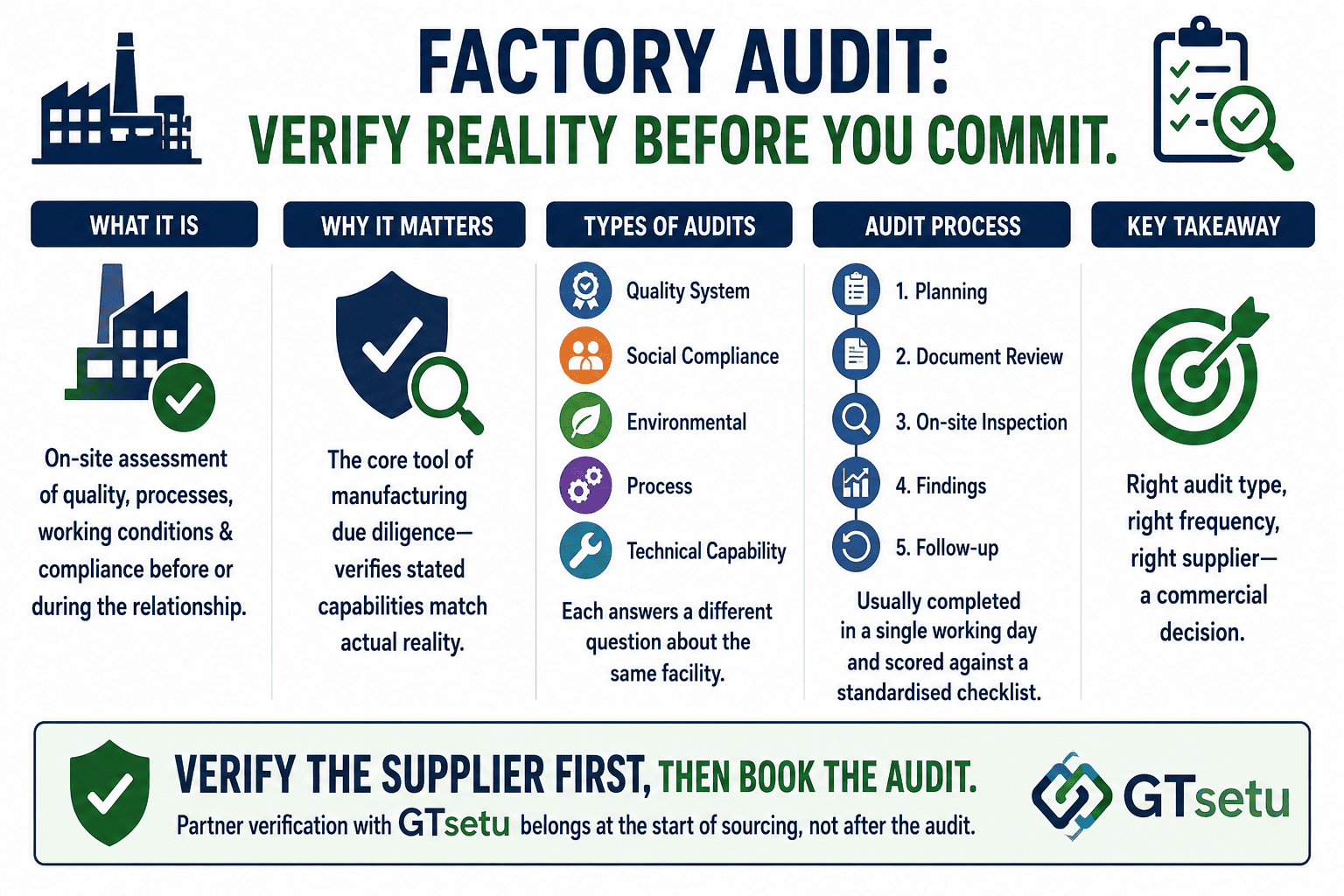
Direct Answer: A factory audit is a structured, on-site assessment of a manufacturing facility’s quality management system, production processes, working conditions, and regulatory compliance, conducted before a buyer commits to a supplier or periodically during an ongoing relationship. It is the core tool of manufacturing due diligence, it verifies whether a factory’s stated capabilities match its actual operating reality. Factory audits fall into several types, quality system, social compliance, environmental, process, and technical capability, each answering a different question about the same facility. A typical audit runs through planning, document review, on-site inspection, findings, and follow-up, usually completed within a single working day and scored against a standardised checklist. Choosing the right audit type, at the right frequency, for the right supplier is a commercial decision, and it should follow, not replace, verifying that the supplier itself is a real, legitimately registered company, which is why partner verification through a platform like GTsetu belongs at the start of the sourcing process, not after the audit is booked.
📅 July 14, 2026⏱ 19 min read✍️ GTsetu Editorial Team🔄 Updated regularly
5
Core Audit Types Covered
9
Checklist Categories Explained
100+
Countries on GTsetu
0%
GTsetu Partner Commission
A polished sample and a confident sales call tell a buyer almost nothing about whether a factory can actually deliver. The gap between what a supplier claims and what a supplier can consistently produce is where late shipments, failed shipments, and compliance disasters come from. A factory audit is how that gap gets closed before an order, not after a container arrives with defects.
This guide explains factory audits end to end, what they are, the different types and what each one actually verifies, the step-by-step process auditors follow, the checklist categories every audit should cover, and how to read the resulting report. It is written for manufacturers, distributors, and cross-border buyers who need to treat supplier verification as a structured discipline rather than a formality. For related context, see our guides on cross-border business partnerships, who owns tooling and moulds, and common red flags in international partnerships.
💡 Editorial Notice
This guide provides general commercial guidance on factory audits for educational purposes. It does not constitute legal, regulatory, or engineering advice. Audit standards, checklist content, and applicable regulations vary by industry, product category, and jurisdiction. Always engage a qualified third-party inspection firm or in-house quality team, and consult applicable local regulations, before relying on an audit as the sole basis for a sourcing decision. For guidance on finding and verifying manufacturing partners before commissioning an audit, GTsetu’s verified matchmaking platform is available at platform.gtsetu.com.
SECTION 1
1 What Is a Factory Audit
🎯 Core Definition
A factory audit is a systematic, evidence-based assessment of a manufacturing facility’s ability to produce goods that meet a buyer’s requirements for quality, safety, legal compliance, and operational reliability. Unlike a sales visit or a video call, an audit is structured around a checklist, involves document review, physical facility inspection, and staff interviews, and results in a scored, written report. It is, in effect, manufacturing due diligence, the same category of pre-commitment verification that a background check or company registration search performs for a corporate partner, applied to the physical reality of a production floor.
What It Verifies
Capability & Capacity
Whether the factory has the machinery, floor space, technical skill, and production capacity to manufacture the specific product a buyer needs, at the volumes and timelines required.
Whether stated production capacity matches observed capacity, a common gap when a factory subcontracts orders to unaudited third parties without disclosing it.
Whether the facility that will actually produce the goods is the facility the buyer believes they are dealing with.
Whether the factory’s quality management system, documentation, and process controls can consistently reproduce the quality of an approved sample, not just once, but across every production run.
Whether the factory complies with labor law, safety regulation, and environmental regulation in its jurisdiction, and whether certifications presented are genuine, current, and within scope.
Whether the working conditions and management practices pose a reputational or legal risk to the buyer’s own supply chain.
Why Factory Audits Matter Before an Order Is Placed
A factory audit is typically the first structured checkpoint after a buyer has shortlisted a supplier and before any purchase order, tooling investment, or deposit is committed. Skipping it does not remove the risk, it simply defers discovery of the risk to a point where it is far more expensive to fix, whether that is a failed shipment, a compliance violation surfacing in a retailer’s own audit of the buyer, or a factory that turns out to be a trading company with no real production floor at all. See also: the true cost of global expansion for how unverified supplier risk compounds across a sourcing programme.
Question a Factory Audit Answers
Why It Matters to the Buyer
Is this the facility that will actually produce my goods?
Rules out unauthorised subcontracting to unaudited third-party factories
Does the factory have a functioning quality system?
Determines whether defects are caught before shipment or discovered after
Can it meet my volume and timeline requirements?
Prevents overcommitment and missed delivery dates
Are certifications genuine and in scope?
Confirms legal authorisation to manufacture and export the product type
Are labor and safety practices compliant?
Protects the buyer from reputational, legal, and supply-continuity risk
SECTION 2
2 Types of Factory Audits
“Factory audit” is an umbrella term. In practice, buyers commission different audit types depending on what they need to verify, and a single factory may go through several different audit types over the life of a relationship, each answering a distinct question.
📋
Quality System Audit
Evaluates the factory’s quality management system (QMS)
What It Covers
Quality policy and objectives, documented procedures, document control, incoming material inspection, in-process checkpoints, final inspection, non-conforming product handling, corrective and preventive action processes, and traceability, typically benchmarked against ISO 9001.
Best Used For
New supplier qualification before the first purchase order, and periodic reassessment (typically annual) for existing suppliers producing quality-sensitive goods.
👷
Social Compliance Audit
Evaluates labor practices, wages, and worker safety
What It Covers
Working hours, wage records, overtime compensation, freedom of association, child and forced labor safeguards, worker dormitory and facility conditions, and grievance mechanisms, typically through document review, facility walkthrough, and confidential worker interviews.
Best Used For
Buyers with retailer or brand codes of conduct, regulated categories (apparel, footwear, toys), and any sourcing programme where labor risk carries reputational exposure.
🌱
Environmental Audit
Evaluates waste, emissions, and hazardous material handling
What It Covers
Wastewater discharge permits, air emissions controls, hazardous chemical storage and spill response, solid waste management, and energy usage against local environmental regulation.
Best Used For
Chemical-intensive processes such as dyeing, plating, and printing, and any category where a sudden regulatory shutdown of the factory would disrupt the buyer’s supply chain.
⚙️
Process Audit
Evaluates one specific manufacturing step, not the whole facility
What It Covers
A single production stage in depth, for example, a soldering line, a dyeing process, or a welding station, checking equipment calibration, operator training, in-line checkpoints, and adherence to standard operating procedures.
Best Used For
Situations where recurring defects have already been traced to a specific stage, and a full facility audit would be unnecessarily broad.
🔧
Technical / Capability Audit
Evaluates whether the factory can physically make this product
What It Covers
Machinery inventory and condition, tooling and mould ownership, in-house vs subcontracted production steps, available floor space, and current order book against claimed capacity.
Best Used For
New supplier vetting for technically demanding products, and confirming a factory is not overcommitted before placing a large order. See: who owns tooling and moulds.
💡 Follow-Up Audits Close the Loop
A follow-up (or re-audit) is not a distinct category so much as a second pass, typically scheduled three to six months after an initial audit, to verify that corrective actions for previously flagged non-conformities have actually been implemented, rather than simply promised. Skipping the follow-up is one of the most common reasons audit findings never translate into real improvement.
SECTION 3
3 The Factory Audit Process, Step by Step
Regardless of audit type, the underlying process follows a consistent structure so that findings are objective, repeatable, and comparable across suppliers and over time. Most standard audits are completed by one or two auditors within a single working day, though larger facilities or combined audit types can take two to three days.
1
Scope Definition and Planning
The buyer and auditor agree the audit type, the checklist to be used, any buyer-specific or retailer-specific criteria, the date, and the documents the factory should have ready, quality manual, certifications, production records, and licences.
2
Pre-Audit Document Review
The auditor reviews available documentation before or at the start of the visit to identify likely areas of concern and focus on-site time efficiently, rather than discovering basic gaps only after arriving on the floor.
3
Opening Meeting
The auditor meets factory management to confirm scope, timeline, and the day’s schedule, and requests any outstanding records, training logs, calibration certificates, and prior audit reports.
4
Facility and Production Walkthrough
A floor-to-floor inspection covering production lines, raw material and finished goods storage, QC stations, testing labs, and worker facilities, with photographic evidence captured for any non-conformance identified along the way.
5
Documentation and Records Cross-Check
The auditor cross-references QMS documents, calibration logs, training records, and corrective-action history against the checklist and, where relevant, against a random batch traced backward to raw materials and forward to shipment records.
6
Staff Interviews
Structured conversations with management and, for social compliance audits, confidential interviews with workers away from supervisors, to verify that documented policy matches actual practice.
7
Findings, Scoring, and Report
The auditor scores the factory against the checklist, documents every non-conformity with evidence and severity classification, and issues a written report with recommended corrective actions and timelines.
8
Follow-Up and Re-Audit
Corrective actions are tracked against agreed deadlines, and a follow-up audit, focused specifically on the previously flagged items, is scheduled to confirm the issues have been genuinely resolved, not just documented as resolved.
SECTION 4
4 Factory Audit Checklist: Nine Core Categories
Checklist content varies by audit type and industry, but nearly every well-structured factory audit checklist draws on the same nine underlying categories. Understanding what each covers helps a buyer read a report critically rather than simply trusting a summary score.
🏢
1. General & Legal Information
Factory name, address, legal registration, business licence, and confirmation that the entity being audited matches the entity on the buyer’s contract.
📑
2. Quality Management System
Quality policy, quality manual, document control, internal audit process, and corrective/preventive action procedures, usually benchmarked against ISO 9001.
⚙️
3. Manufacturing Processes
Production planning, process controls, equipment maintenance and calibration, non-conforming product handling, and in-process inspection checkpoints.
✅
4. Product Quality & Testing
Product specifications, testing procedures and equipment, traceability practices, packaging and labelling controls, and customer complaint handling.
🌱
5. Environmental Management
Environmental policy, waste and wastewater handling, emissions controls, and hazardous material storage and spill response protocols.
👷
6. Working Conditions & Safety
Workplace safety protocols, PPE usage, fire safety and emergency exits, machinery guarding, lockout/tagout procedures, and employee training records.
🧾
7. Labor & Social Compliance
Working hours, wage and overtime records, freedom of association, and safeguards against child and forced labor, verified through records and worker interviews.
🏗️
8. Facility & Capacity
Building condition, layout and material flow, storage capacity, machinery inventory, and observed capacity against the factory’s stated production capacity.
🤝
9. Management & Business Practices
Organisational structure, management stability, financial and legal standing, past performance references, and ethical business conduct including anti-bribery policy.
⚠️ A Certificate Is Not the Same as a Verified System
A framed ISO 9001 certificate in a factory lobby confirms that the certifying body issued a certificate, it does not confirm the certificate is current, that it covers the product category in question, or that the underlying system is actually followed day to day. Auditors should independently verify the certifier, expiry date, and scope, and then test the system against physical evidence, a certificate for basic assembly does not authorise a facility to manufacture complex electronics to the same standard. Treat every certification as a starting point for verification, not a substitute for it.
SECTION 5
5 Reading a Factory Audit Report and Scoring
📊
What a Factory Audit Report Contains
Reading past the summary score to the underlying findings
Structure of a Typical Report
Executive summary and overall score or rating; factory identification and scope confirmation; findings organised by checklist category; photographic evidence for each non-conformity; severity classification (critical, major, minor); and a corrective action plan with recommended timelines.
How to Read It Critically
Do not rely on the headline score alone, a high overall score can still mask a single critical finding (such as a fire exit blocked or an expired certification) that should independently disqualify the factory. Check the severity classification of each individual finding, not just the average.
Practical Tip
Ask the auditor or inspection firm for the full findings report with photographic evidence, not just a pass/fail summary or star rating, the detail is where the actionable risk information lives. See: common red flags in international partnerships for related due diligence signals to watch for.
Severity
What It Means
Typical Buyer Response
Critical
Life-safety, legal, or zero-tolerance compliance failure (e.g., blocked fire exits, child labor indicators, invalid licence)
Immediate escalation; order placement paused until resolved
Major
Significant gap likely to affect product quality, delivery, or ongoing compliance (e.g., no calibration records, weak traceability)
Corrective action plan required before or shortly after order placement
Minor
Isolated or low-impact gap unlikely to affect outcomes on its own (e.g., incomplete signage, minor housekeeping)
Tracked for the next scheduled audit; rarely order-blocking alone
SECTION 6
6 Cost, Timeline, and Frequency
1 Day
typical duration for a standard single-facility audit (one auditor, one man-day)
48 Hrs
common turnaround for a scored report after the on-site visit is complete
1–2×
per year is a common minimum audit frequency for an active production supplier
Cost varies by audit type, facility size, location, and whether it is commissioned through a third-party inspection firm or performed in-house, but a single-day quality system or capability audit is generally a modest, fixed cost relative to the size of the order it is protecting. Social compliance and multi-day or multi-site audits typically cost more, given the additional interviews and documentation review involved. Frequency should scale with risk: new suppliers, high-value categories, and regulated product types warrant more frequent and more comprehensive audits than low-risk, established relationships. See: partnership evaluation criteria for a broader framework on scaling due diligence to risk.
SECTION 7
7 Who Conducts a Factory Audit
🧑💼
Third-Party vs In-House Auditors
Who should be in the room, and why independence matters
Third-Party Inspection Firms
Independent quality control and inspection companies conduct the audit on the buyer’s behalf, using standardised checklists and reporting formats. This preserves objectivity, provides comparability across multiple suppliers, and is the most common approach for buyers without a large in-house quality team or local presence in the supplier’s country.
In-House Quality Teams
Larger buyers with dedicated supplier quality functions may send their own auditors, particularly for strategic or high-volume suppliers, allowing deeper category-specific technical assessment and a direct relationship with factory management, at higher internal cost and lower scalability across many suppliers.
Implication
Whichever route is used, the auditor’s independence from the factory being assessed is essential, an audit paid for and controlled entirely by the factory itself, with no buyer visibility into the auditor’s identity or methodology, provides materially weaker assurance than one commissioned and scoped by the buyer.
SECTION 8
8 Factory Audit vs Product Inspection
Buyers frequently conflate factory audits with product inspections, but the two serve different purposes at different points in the relationship, and a mature sourcing programme uses both.
Dimension
Factory Audit
Product Inspection
What it evaluates
The facility, its systems, and its ongoing capability
A specific batch or shipment of goods
When it happens
Before committing to a supplier; periodically thereafter
During production (DUPRO) or before shipment (PSI), on every order
Core question
Can this factory consistently produce quality goods?
Does this specific batch meet the agreed specification?
Frequency
Typically annual or upon supplier onboarding
Typically every production run or shipment
Output
Scored capability and compliance report
Pass/fail against a specific AQL sampling standard
SECTION 9
9 Decision Framework: Which Audit Type to Commission
Which factory audit to commission, and how often, should be driven by the stage of the relationship, the risk profile of the product category, and any buyer- or retailer-specific compliance obligations. The following framework maps common decision factors to the appropriate audit type.
Decision Factor
→ Lighter-Touch Audit
→ Full / Multi-Type Audit
Is this a brand-new supplier with no order history, or an established one?
Established supplier, prior audit history and consistent performance
New supplier, full quality system and capability audit before first order
Does the buyer or retailer have a mandatory code of conduct for labor practices?
No formal code of conduct in place
Yes, social compliance audit required as a condition of doing business
Does the process involve chemicals, dyeing, plating, or other environmentally sensitive steps?
Low environmental risk process
High environmental risk, environmental audit recommended
Have recurring defects already been traced to one specific production stage?
No pattern identified, full facility audit more appropriate
Yes, a targeted process audit on that stage is sufficient
Is this a high-value or long-term strategic sourcing relationship?
Low-value, short-term, or trial order
High-value or strategic, combined quality, capability, and social audit warranted
Did a prior audit flag major or critical non-conformities?
No, clean prior audit, standard annual re-audit cycle applies
Yes, follow-up audit required within three to six months
💡 The Most Common Pattern: Scale Audit Depth With Risk and Order Value
Few buyers can afford, or need, a full multi-day audit for every supplier and every order. The most effective sourcing programmes calibrate audit type and frequency to risk: a lighter capability check for a small trial order from a known-good factory type, escalating to a full quality system, social compliance, and environmental audit for a new, high-value, or regulated-category supplier. Treating every audit decision as binary (audit or don’t) rather than as a question of depth and frequency is a common and avoidable inefficiency.
SECTION 10
10 Common Mistakes and Red Flags
1 in 5
audited facilities are found to be operating from an address different from the one presented to the buyer
3–6 Mo
is the typical window for a follow-up re-audit after major corrective actions are agreed
High Cost
of skipping an audit relative to its cost when a factory turns out to lack real production capability
🚩
Accepting a Certificate Without Verifying Scope
Treating a displayed ISO or industry certificate as proof of compliance without checking the certifying body, expiry date, and whether the scope actually covers the product category being ordered.
🚩
Auditing an Announced Visit Only
Relying solely on a pre-scheduled audit that gives the factory weeks to prepare a “show floor,” rather than combining it with unannounced spot checks or follow-up visits for higher-risk suppliers.
🚩
Ignoring Environmental Findings as a PR Formality
Treating environmental non-conformities as low priority when unresolved wastewater, emissions, or hazardous material issues can trigger a sudden government shutdown that halts production mid-order.
🚩
No Follow-Up on Corrective Actions
Filing the initial audit report and never verifying whether flagged non-conformities were actually resolved, allowing the same critical issues to persist unnoticed into future orders.
🚩
Confusing an Audit With an Inspection
Assuming a facility audit performed once at onboarding removes the need for per-shipment product inspection, when the two verify entirely different things at different stages.
🚩
Auditing an Unverified Company
Commissioning a costly on-site audit before confirming the counterparty’s basic company registration, legal standing, and identity, auditing the wrong or a fraudulently represented entity wastes the audit entirely. Verify the company first with GTsetu’s verified matchmaking platform, then commission the audit.
SECTION 11
11 Verifying the Supplier Before You Book the Audit
A factory audit is a powerful tool, but it is only as useful as the company it is performed on. Booking and paying for a full-day audit at a facility whose legal identity, registration status, or ownership has never been independently confirmed risks auditing the wrong entity entirely, or a facility that will not exist under the same name by the time an order is placed. Partner verification should come first; the audit is what happens after a candidate has cleared that initial screen.
🤝 Platform Spotlight, GTsetu
Verify the Company Before You Commission the Audit
GTsetu is a verified B2B matchmaking platform that helps manufacturers and distributors identify, verify, and engage the right trade partners before any factory audit, purchase order, or site visit is scheduled. Every company on GTsetu is verified using government tie-ups on six key points: Name, Address, Registration Number, Company Status, Company Type, and Date of Certificate of Incorporation. AI-assisted matching then surfaces the highest-fit manufacturing partners by industry, geography, product category, company size, and capability. Whether you are shortlisting suppliers for a quality system audit or assessing a potential manufacturing partner ahead of a technical capability audit, GTsetu gives you verified, commercially relevant candidates, with a built-in NDA workflow and encrypted workspace to protect the due diligence process that follows.
🏛️
6-Point Govt. Verification
Every partner verified on Name, Address, Registration Number, Company Status, Company Type, and Date of Incorporation through government sources before joining.
🤖
AI-Assisted Matching
Multi-criteria fit scoring by industry, geography, product category, company size, and manufacturing capability, surfacing the highest-fit verified candidates automatically.
🕵️
Anonymous Discovery
Browse verified manufacturers across 100+ countries without revealing your identity or sourcing intentions until you are ready to signal interest to a specific candidate.
📄
Built-In NDA Workflow
Digital NDA execution with timestamped signatures triggered before any commercially sensitive due diligence data, including pre-audit documentation, is exchanged.
🔐
Encrypted Due Diligence Workspace
AES-256 encrypted document workspace with full audit trail for all information exchanged during partner assessment, the data that feeds the eventual factory audit scope.
🚫
Zero Commission
No broker fee or success commission on any partnership formed. GTsetu’s incentives are fully aligned with finding you the best, most verifiable manufacturing partner.
🌍
100+ Countries
Verified manufacturers and distributors across Asia, Middle East, Europe, Africa, Australia, and the Americas, available for matching from one platform.
📋
Full Audit Trail
Every access event, NDA signature, and document exchange logged with timestamp, providing a defensible record of the due diligence process ahead of any physical factory audit.
How GTsetu Supports the Manufacturing Due Diligence Pipeline
✅
Step 1, Verify the Manufacturer Before Scoping the Audit
Every company on GTsetu is verified on six government-sourced points before joining. When you identify a potential manufacturing partner through GTsetu, you already know their company registration is legitimate, their status is current, and their incorporation details are confirmed, before any factory audit is scoped or booked. This eliminates the most basic risk in manufacturing due diligence: auditing a facility that isn’t legally what it claims to be.
Pre-Audit
🤖
Step 2, Confirm Category and Capacity Fit Before Committing Audit Budget
GTsetu’s AI-assisted matching scores prospective manufacturers against your criteria across product category, geography, and scale. Before spending budget on a technical capability audit, you have already confirmed the candidate is broadly the right type and size of factory, reducing wasted audit spend on poor-fit candidates. See: contract between manufacturer and distributor.
Matching
🕵️
Step 3, Conduct Anonymous Discovery During Early Assessment
Browse and assess potential manufacturing partners anonymously before revealing your identity or sourcing volumes. This protects your negotiating position during the assessment phase, particularly important before committing to on-site audit logistics with a specific factory. See: B2B matchmaking tool guide.
Protection
📄
Step 4, Execute NDA Before Sharing Pre-Audit Documentation
GTsetu’s built-in NDA workflow ensures that the encrypted document workspace, where quality manuals, certifications, and capacity data are shared ahead of the audit, only unlocks after both parties have digitally signed a confidentiality agreement. See: business partnership contract guide for the clauses that typically follow NDA execution.
Legal Gate
🔐
Step 5, Exchange Pre-Audit Data in an Encrypted, Audited Workspace
All documents shared during partner assessment, certifications, capacity claims, financial summaries, and proposed heads of terms, are exchanged in GTsetu’s AES-256 encrypted workspace with a full timestamped audit trail, creating a defensible record ahead of the physical factory audit itself.
Security
🚫
Step 6, Move Into Auditing and Production With Zero Commission
GTsetu takes zero commission on any partnership formed, whether the manufacturing relationship proceeds via a collaboration agreement, a distribution arrangement, a technology partnership, or a joint venture following the audit. The full commercial economics of the relationship remain between the parties. See: collaboration agreement vs joint venture for structuring the relationship once the factory has been audited and cleared.
Zero Cost
FAQ
? Frequently Asked Questions
QWhat is a factory audit?
A factory audit is a structured, on-site assessment of a manufacturing facility’s quality management system, production processes, working conditions, and regulatory compliance. It is typically performed before a buyer places an order with a new supplier, or periodically during an ongoing relationship, to verify that the factory can consistently produce goods that meet the buyer’s quality, safety, and compliance requirements. A factory audit functions as manufacturing due diligence, it tells a buyer whether the supplier’s stated capabilities match its actual operating reality. See: who owns tooling and moulds and cross-border business partnerships.
QWhat are the main types of factory audits?
The main types of factory audits are: quality system audits, which evaluate the factory’s quality management system against a standard such as ISO 9001; social compliance audits, which assess labor practices, working hours, wages, and worker safety; environmental audits, which review waste management, emissions, and hazardous material handling; process audits, which focus on a specific production line or manufacturing step; technical or capability audits, which assess whether the factory has the machinery, capacity, and technical skill to produce a specific product; and follow-up audits, which verify that corrective actions from a prior audit have been implemented. See: common red flags in international partnerships.
QWhat is the process of a factory audit?
A factory audit typically follows several stages: planning, where the buyer and auditor agree the audit scope, type, and checklist; pre-audit document review of the quality manual, certifications, and records; the on-site visit, involving an opening meeting, a floor walkthrough of production and storage areas, documentation cross-checks, and staff interviews; findings and reporting, where the auditor scores the factory against the checklist and documents non-conformities with photographic evidence and severity classification; and follow-up, where corrective actions are tracked and a re-audit is scheduled, typically three to six months later, if major issues were identified. See: partnership evaluation criteria.
QHow much does a factory audit cost and how long does it take?
A standard factory audit is typically completed by one or two auditors within a single working day (a one-man-day audit), though larger or more complex facilities, or combined audit types, may require two to three days. Cost depends on audit type, facility size, and location, and is generally a modest, fixed line item relative to the order value it is protecting when commissioned through a third-party inspection or quality control firm. Social compliance and multi-site audits generally cost more than a single-day quality system audit due to the additional interviews and documentation review involved. As a general rule, active production suppliers warrant at least an annual audit cycle, with more frequent checks for new, high-risk, or previously flagged factories.
QIs a factory audit the same as a product inspection?
No. A factory audit evaluates the facility, its systems, and its processes, it asks whether the supplier is capable of consistently producing quality goods. A product inspection evaluates a specific batch or shipment of goods against agreed specifications at a defined stage of production, such as during production (DUPRO) or before shipment (PSI). Buyers typically use a factory audit once, before committing to a supplier, and use product inspections repeatedly, on every order or production run, once the relationship is underway. See: technology partnerships for how technical due diligence extends beyond the factory floor.
QWhat should happen before a factory audit is even booked?
Before committing budget and logistics to a physical factory audit, buyers should first verify the basic legal identity of the counterparty, company registration, legal status, and address, to confirm they are dealing with a real, currently active company rather than a shell entity, a trading company misrepresenting itself as a manufacturer, or a facility that will not exist under the same name by the time an order is placed. This verification step is faster and cheaper than a full audit, and it prevents wasted audit spend on candidates that fail at the most basic level of legitimacy. Platforms that perform government-sourced company verification, such as GTsetu, are designed for exactly this pre-audit screening step. See: international business development consulting.
QWhat happens if a factory audit uncovers serious problems mid-relationship?
If a periodic or follow-up audit uncovers major or critical non-conformities in an existing supplier relationship, buyers typically pause new order placement, require a documented corrective action plan with a firm timeline, and schedule a targeted re-audit to confirm resolution before resuming full volume. If the issues are not resolved or recur, the relationship may need to be wound down, a process that should be planned with the same contractual discipline used to enter it. See: ending a business partnership contract for a framework on managing that exit.
Verify the Manufacturer Before You Schedule the Audit
Whether you are booking a quality system audit, a social compliance audit, or a full technical capability review, the partner’s legitimacy should be confirmed first. Join 500+ verified manufacturers and distributors across 100+ countries on GTsetu, AI-assisted matching, anonymous discovery, built-in NDA workflows, encrypted due diligence workspace, and zero broker commissions on every partnership formed.
They represents the product, and research team behind GTsetu, a global B2B collaboration platform built to help companies explore cross-border partnerships with clarity and trust. The team focuses on simplifying early-stage international business discovery by combining structured company profiles, verification-led access, and controlled collaboration workflows.
With a strong emphasis on trust, and disciplined engagement, Team GTsetu shares insights on global trade, partnerships, and cross-border collaboration, helping businesses make informed decisions before entering deeper commercial discussions.