International Business Development Consulting: Complete Guide for Manufacturers & Distributors | GTsetu
Home ›
Blogs ›
International Business Development Consulting
🌐 Global Expansion & Business Development
International Business Development Consulting: Complete Guide for Manufacturers & Distributors
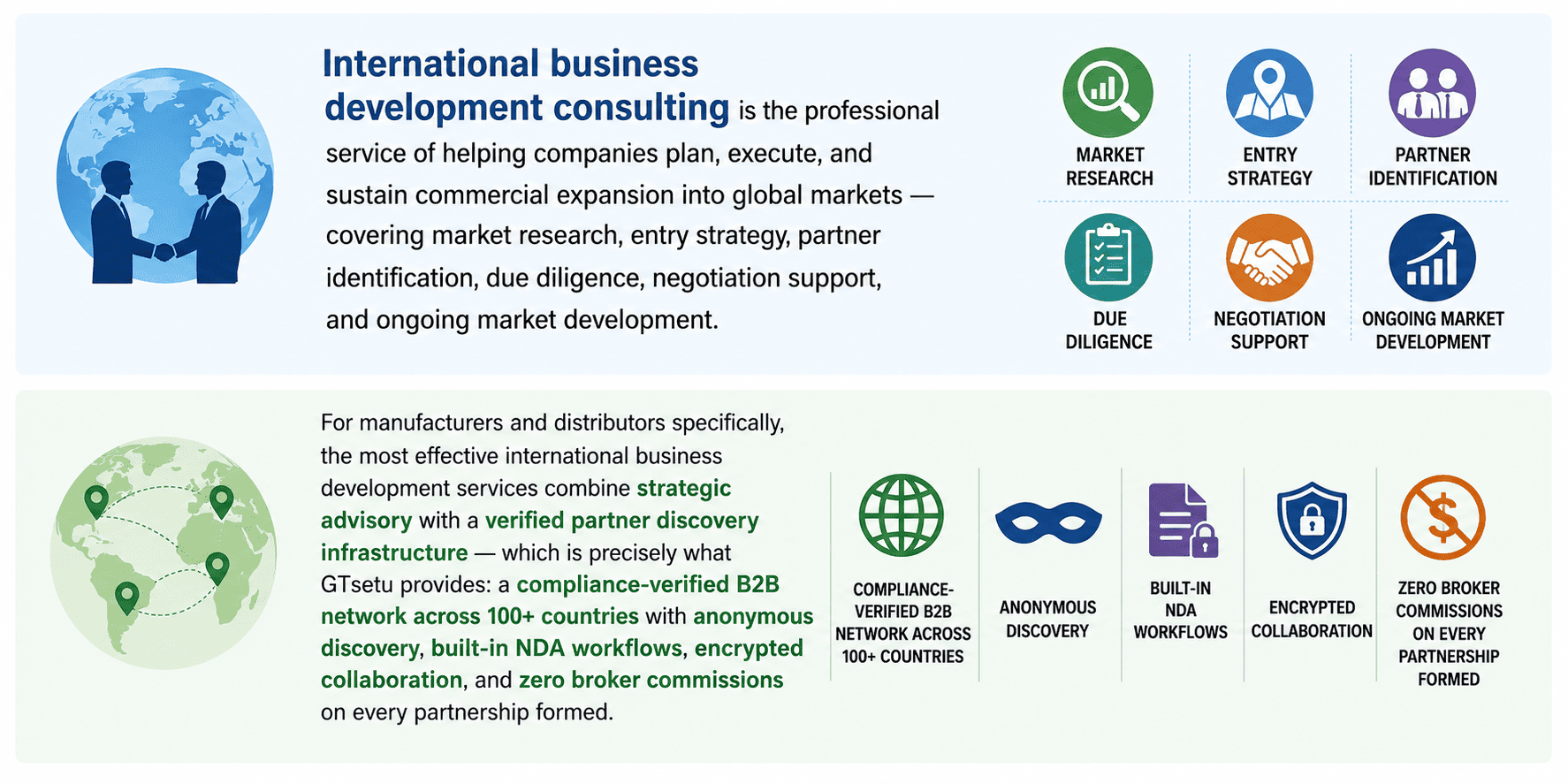
Direct Answer: International business development consulting is the professional service of helping companies plan, execute, and sustain commercial expansion into global markets, covering market research, entry strategy, partner identification, due diligence, negotiation support, and ongoing market development. For manufacturers and distributors specifically, the most effective international business development services combine strategic advisory with a verified partner discovery infrastructure, which is precisely what GTsetu provides: a network of companies verified on 6 key data points (Name, Address, Registration Number, Company Status, Company Type, Date of Certificate of Incorporation) using government tie-ups, spanning 100+ countries, with anonymous discovery, built-in NDA workflows, encrypted collaboration, and zero broker commissions on every partnership formed.
📅 March 20, 2026⏱ 20 min read✍️ GTsetu Editorial Team🔄 Updated regularly
500+
Verified Companies
100+
Countries
6-Point
Govt. Tie-Up Verification
0%
Broker Commission
Every manufacturer that has successfully entered a new international market, and every distributor that has built a diversified portfolio of global brand principals, has relied on some form of international business development infrastructure to get there. Whether that was a boutique consulting firm, an in-house BD team, a bilateral chamber of commerce, or a verified B2B platform, the underlying function is the same: identifying the right partners in the right markets, qualifying them with sufficient rigour, and creating the commercial structure that turns initial interest into sustained revenue.
This guide covers every dimension of international business development consulting in depth: what it means, what the leading firms provide, how to evaluate consultants, the market entry models most relevant to manufacturers and distributors, the legal and commercial foundations every engagement must address, and how GTsetu provides a technology-driven alternative to traditional consulting firms, with verified partner discovery across 100+ countries, zero broker commissions, and the full security infrastructure required for professional cross-border trade partnership formation. You may also benefit from our related guides on global collaboration examples and the B2B business network landscape.
💡 Who Is This Guide For?
This guide is written for manufacturers seeking international distribution partners, distributors looking to add global brand principals, business development leaders responsible for company global expansion, procurement heads building international supplier networks, and executives evaluating whether to hire an international business development consulting firm, build an in-house team, or use a verified platform like GTsetu. It is also a reference for anyone comparing cross-border business partnership options or studying international business and development strategies.
SECTION 1
1 What Is International Business Development?
🎯 Definition
International business development is the strategic and operational process by which a company identifies, initiates, structures, and grows commercial relationships in markets outside its home country. It is broader than international sales, which focuses on transactional revenue, and encompasses the full lifecycle of global commercial relationship building: market opportunity assessment, partner identification and qualification, entry model selection, negotiation, contract formation, and ongoing partner development. For manufacturers and distributors, it is the primary mechanism for accessing new geographies, revenue streams, and supply chains without building local infrastructure from scratch.
International Business Development vs. International Sales vs. Global Marketing
Function
Primary Focus
Time Horizon
Key Output
Who Owns It
International Business Development
Building new commercial relationships and market access channels in new geographies
Long-term (12–36+ months to mature partnership)
Signed distribution, licensing, JV, or manufacturing agreements; new market revenue streams
BD director, country manager, or IBD consultant
International Sales
Generating revenue from existing or new buyers in international markets
The critical insight for manufacturers and distributors: international business development is not a department, it is a set of interconnected commercial activities. Done poorly (or not at all), it results in missed market opportunities, unverified partners, and costly failed market entries. Done well, with a verified partner discovery process, structured qualification, and formal commercial frameworks, it becomes the primary growth engine for companies that compete globally. See the advantages and disadvantages of global expansion to frame the strategic context before beginning.
SECTION 2
2 International Business Development Consulting, Defined
🎯 Definition
International business development consulting is the professional service of advising and supporting companies in planning and executing their commercial expansion into international markets. International business development consultants and international business development consulting firms provide market research, entry strategy development, partner identification and qualification, due diligence support, negotiation advisory, contract review, regulatory compliance navigation, and ongoing partnership management, reducing the risk and accelerating the timeline of international market entry for their clients.
The Spectrum of International Business Development Services
International business development consulting exists on a spectrum from pure strategic advisory to full operational execution. Understanding where a firm sits on this spectrum, and matching it to your actual needs, is the most important factor in selecting the right partner.
📊
Pure Strategy Advisory
Market attractiveness analysis, country prioritisation, entry model recommendation, competitive landscape mapping. Delivers a strategy document, execution is left to the client. Typical providers: Big 4, McKinsey, Bain, BCG.
Strategy Only
🔍
Market Research & Intelligence
Primary and secondary research on target markets, consumer demand, regulatory requirements, competitive pricing, channel structure, and import/export regulations. Informs strategy but does not execute it.
Intelligence
🤝
Partner Identification & Introduction
Identifying potential distributors, agents, or manufacturing partners in target markets. Quality varies enormously, from curated, verified introductions (rare) to forwarded email lists of unverified contacts (common). This is where most IBD consulting value is won or lost.
Core Function
✅
Due Diligence & Qualification
Verifying potential partners’ legal standing, financial health, market coverage, regulatory compliance, and track record before commercial engagement. Essential, yet frequently underinvested in by both consultants and their clients. See business verification and ID requirements.
Sustained support post-launch: distributor performance tracking, product training, marketing support, pricing management, and channel conflict resolution. The most value-generative, and most underutilised, phase of international business development.
Long-Term
SECTION 3
3 Core International Business Development Services
The following are the specific deliverables and service modules that competent international business development consulting firms provide, and that manufacturers and distributors should expect, evaluate, and contractually define before engaging any IBD consultant or platform.
🗺️Market Intelligence
Market Opportunity Assessment
Country-level analysis of market size, growth trajectory, competitive intensity, regulatory environment, import tariffs, channel structure, and consumer or B2B demand patterns, to prioritise which markets to enter and in what sequence. This is the strategic foundation that prevents expensive mispriced market entry decisions.
🔭Strategy
Market Entry Strategy Development
Recommendation of the optimal entry model for each target market, distribution partnership, joint venture, contract manufacturing, licensing, or direct establishment, accounting for the client’s capital availability, risk appetite, product complexity, and local market conditions. See our comparison of market entry partnership models and joint venture vs. strategic alliance options.
🔍Partner Discovery
International Distributor & Partner Identification
Systematic identification of candidate distributors, agents, manufacturing partners, or joint venture candidates in target markets, using proprietary networks, sector databases, trade association directories, and in-market contacts. The quality differential between consultants on this dimension is enormous. GTsetu’s verified platform provides direct access to partners verified on 6 key data points via government tie-ups across 100+ countries. Learn more about how to find international distributors.
✅Risk Management
Partner Due Diligence & Verification
Formal verification of prospective partners’ business registration, financial standing, regulatory compliance, existing brand portfolio conflicts, market coverage, and authorised representative identity, before any commercially sensitive information is exchanged. This is the single highest-leverage risk control in international business development. See requirements for business verification and ID.
📄Legal Infrastructure
NDA & Confidentiality Framework
Drafting and executing appropriate confidentiality agreements before sensitive commercial information is shared, covering confidentiality scope, permitted disclosure, duration, governing law, and jurisdiction. Understanding mutual vs. one-way NDAs and non-compete vs. non-circumvention clauses is essential at this stage. GTsetu’s built-in NDA workflow executes this automatically before documents can be exchanged.
Sustained post-launch support including distributor performance management, product training, marketing activation support, pricing governance, channel conflict mediation, and contract renewal negotiation. This phase determines whether a market entry produces sustained revenue or an expensive one-time experiment. Most IBD firms underinvest here relative to the upfront strategy and partner-finding phases.
🔐Security
Secure Information Exchange Infrastructure
Providing or advising on encrypted channels for exchanging commercially sensitive data, product specifications, pricing, capacity plans, between parties during the partnership formation process. This is the domain where platforms like GTsetu provide structural advantage over traditional consulting: built-in AES-256 encrypted workspaces, role-based access controls, and full audit trail. See our guide on B2B secure collaboration.
SECTION 4
4 Types of International Business Development Consulting Firms
The international business development consulting market is fragmented, ranging from global strategy giants to single-person boutiques to technology platforms. Understanding the different firm types helps manufacturers and distributors select the right fit for their specific stage, budget, and requirements.
🏛️
Global Strategy Firms
McKinsey, Bain, BCG, Roland Berger, and their peers. Excel at high-level market analysis and executive-aligned strategy. Less strong on hands-on partner identification in mid-market sectors. Cost: high (typically $200K–$2M+ for a full market entry strategy engagement).
Enterprise-Focused
🏢
Big 4 Advisory Practices
Deloitte, EY, KPMG, PwC offer international expansion advisory through their transaction advisory and consulting practices, strongest on financial due diligence, regulatory compliance, and tax structuring for market entry. Less strong on operational partner identification in specific industry verticals.
Compliance-Strong
🎯
Specialist Trade & Distribution Consultancies
Mid-market firms specialising in specific geographies or sectors, e.g., India market entry, Southeast Asia distribution, or specific verticals like food & beverage, pharma, or industrial equipment. Often have genuine in-market networks and sector expertise that larger firms lack. Highly variable quality; reference checking is essential.
Sector-Specialist
🤝
Bilateral Chambers & Trade Bodies
Indo-German Chamber, India-UK Business Council, and similar bilateral chambers provide structured networking environments, member directories, event programmes, and introductions, at membership cost rather than consulting fees. Valuable as a complementary channel, not a standalone IBD solution.
Community
👤
Independent IBD Consultants
Experienced individuals with deep sector or geography expertise, operating as freelancers or boutique one-person firms. Can provide excellent hands-on support at lower cost, but are entirely dependent on the individual’s network quality and bandwidth. Highest variability in quality; due diligence on the consultant is as important as due diligence on the partners they introduce.
Variable Quality
💻
Verified B2B Platforms
Technology-driven platforms like GTsetu that verify companies on 6 key data points (Name, Address, Registration Number, Company Status, Company Type, Date of Certificate of Incorporation) using government tie-ups, and provide structured partner discovery, NDA workflow, and secure collaboration infrastructure. Deliver the partner identification and qualification functions of traditional IBD consulting at a fraction of the cost, with greater transparency and zero broker commissions on partnerships formed.
Tech-Driven
⚠️ The Broker Commission Problem
Many independent IBD consultants and smaller consultancies operate on success-fee models, taking 3–15% of the value of every transaction or contract in markets they helped enter, sometimes for years. This creates a structural conflict of interest: the consultant is incentivised to close a deal (any deal) rather than find the best partner. Their ongoing commission income is linked to your transaction volume, not your partnership quality. GTsetu charges zero commission on any partnership formed. All commercial value stays between you and your partner.
SECTION 5
5 IBD Consulting vs. Traditional Strategy Consulting
A common mistake among companies beginning international expansion is engaging a top-tier strategy consulting firm, and receiving a beautifully formatted strategy document that no one inside the company has the capability, network, or market access to execute. Understanding the distinction between strategy consulting and genuine international business development services is critical to spending IBD budget effectively.
Signed partnership agreements, verified introductions, executed market entry
Partner identification
✗ Rarely included; secondary to strategy
✓ Core function, pre-qualified or verified partner introductions
Partner verification
✗ Client’s responsibility post-engagement
✓ Integrated, verified on 6 key data points via government tie-ups
Negotiation support
~ Occasionally offered; extra cost
✓ Typically included in full-service IBD engagements
Commission structure
Project fee (fixed)
✓ Zero commission (GTsetu); or project fee (consulting firms)
Secure data exchange
✗ Not provided, client uses own infrastructure
✓ Built-in on platforms like GTsetu, encrypted workspace, NDA workflow
Typical engagement cost
$200K–$2M+ (large firms); $20K–$150K (boutiques)
Subscription / platform fee; zero success commission
Speed to qualified partner introduction
3–9 months (strategy → execution gap)
✓ Days to weeks on verified platforms
💡 When to Use Each
Use a top-tier strategy consultancy when you need executive-level market prioritisation across 10+ countries, complex regulatory navigation, or M&A-adjacent market entry. Use a specialist IBD consultancy or verified platform like GTsetu when you need verified partner discovery, negotiation support, and commercial execution in specific target markets. The most effective international business development programmes combine a focused market strategy with a verified partner discovery platform, not one or the other alone.
SECTION 6
6 Global Market Entry Models for Manufacturers & Distributors
One of the most consequential decisions in international business development is selecting the right market entry model. The wrong model, even with the right partner, creates misaligned incentives, operational friction, and commercial underperformance. Here are the primary entry models relevant to manufacturers and distributors, with their key characteristics and trade-offs.
Entry Model
How It Works
Capital Required
Control Level
Best For
Key Guide
Distribution Partnership
Manufacturer grants territory rights to a local distributor who buys and resells the product
7 Building a Global Expansion Strategy: Step-by-Step
A global expansion strategy is not a document, it is a decision framework and operational plan that guides every international business development action from market prioritisation through to active partner management. Here is the complete process for manufacturers and distributors building a disciplined IBD strategy.
01
Market Prioritisation, Where to Go First
Not all international markets deserve equal attention. Prioritise markets using a structured scoring framework: market size and growth rate, regulatory accessibility (tariffs, import restrictions, product approvals), competitive intensity, cultural proximity to your existing positioning, and the presence of a qualified partner network you can access. Begin with two or three high-probability markets before attempting wide simultaneous expansion. Review the full advantages and disadvantages of global expansion before committing to a market sequence. The most common IBD mistake is attempting too many markets simultaneously with insufficient resources to execute any one of them properly.
02
Entry Model Selection, How to Enter
Select the entry model that matches your capital availability, risk appetite, product complexity, and the target market’s regulatory and distribution landscape. A manufacturer entering Southeast Asia with a branded FMCG product typically enters via a national distributor. The same manufacturer entering Germany with a technically complex industrial product may use an exclusive agent instead. Entry model selection drives every subsequent decision, partner type, contract structure, pricing, and performance KPIs. Consulting our guide on market entry partnerships before selecting provides a full decision framework.
03
Ideal Partner Profile Definition, Who You Need
Before searching for partners, define exactly what you are looking for in quantifiable terms: geography coverage within the target country, distribution tier (importer, national distributor, regional distributor, wholesaler), existing category specialisation, minimum annual revenue (proxy for financial capacity), existing brand portfolio and conflict check, required regulatory licences, and management quality indicators. A specific ideal partner profile converts every discovery interaction from a general conversation into a structured qualification assessment. This definition also drives the search criteria used on verified platforms like GTsetu.
04
Partner Discovery, Finding Qualified Candidates
Execute partner discovery through the highest-quality channels available. For verified discovery with compliance-checked company profiles across 100+ countries, GTsetu’s platform provides anonymous browsing of pre-verified manufacturers and distributors, the most efficient and secure discovery channel for cross-border trade partnerships. Supplement with targeted trade show attendance, bilateral chamber engagement, and structured referral requests from existing supply chain partners. Avoid relying solely on open marketplaces where identity verification is absent. Compare alternatives to Alibaba, alternatives to IndiaMart, and alternatives to TradeIndia for verified platform options.
05
Due Diligence & Verification, Qualify Before Committing
Every prospective partner must be formally verified before commercial engagement: business registration documents, tax identification, import/export licences, relevant industry certifications, financial reference check, and a conflict-of-interest check on their existing brand portfolio. This step eliminates fraud risk, prevents wasted engagement with unqualified parties, and creates a documented due diligence trail that protects your organisation if the relationship later becomes disputed. GTsetu performs this verification (Name, Address, Registration Number, Company Status, Company Type, Date of Certificate of Incorporation) using government tie-ups as a prerequisite of network access, eliminating the due diligence burden for every partner you discover through the platform. See the full business verification requirements.
06
NDA & Secure Information Exchange, Protect Before Sharing
Execute a mutual NDA before sharing any commercially sensitive information, pricing, product specifications, production capacity, market strategy, or client data. In cross-border partnerships, the NDA must specify governing law, jurisdiction, confidentiality duration, permitted disclosure, and remedies for breach. All subsequent information exchange, product samples excluded, should occur through encrypted channels, not open email. On GTsetu, the NDA workflow is built into the platform and activates automatically before the encrypted document workspace unlocks. See our guide on B2B secure collaboration for the full information security framework.
07
Commercial Negotiation, Define Every Term with Precision
Execute the business partnership contract with full legal review in the relevant jurisdiction. Address risk allocation, dispute resolution mechanisms, force majeure provisions, and non-circumvention clauses before signature. Plan the market launch sequence, product registration, initial stock, distributor training, joint go-to-market activity, with defined milestones and shared accountability. A well-executed launch in the first 90 days determines whether the partnership builds momentum or stalls.
SECTION 8
8 How to Choose the Right International Business Development Consultant
Selecting the right international business development consultant or firm is one of the highest-stakes vendor decisions a manufacturer or distributor makes. The wrong choice, a firm with claimed but unverified networks, misaligned incentives, or insufficient sector expertise, can cost months of time, significant fees, and introduce unqualified or fraudulent partner introductions that damage commercial credibility. Here is the evaluation framework.
🎯
Sector Specificity
Does the consultant have genuine experience in your product category? A firm that has run ten food & beverage distribution deals in Southeast Asia is far more valuable than a generalist claiming “broad sector experience.” Ask for specific client examples in your category.
🌍
Verified Network Depth
Can they demonstrate, not just claim, pre-existing relationships with qualified partners in your target markets? Ask for three references from distributors they have introduced in the last 24 months and call all three. Claimed network vs. verified network is the most consequential quality differential.
💰
Fee Structure Alignment
Prefer fixed-scope engagements or platform subscriptions over success-fee models. Success fees create incentive to close any deal rather than the right deal. If a success fee is unavoidable, cap it at the first transaction only, not ongoing transaction royalties that persist for years.
🔍
Verification Standards
How do they verify the partners they introduce? Ask specifically: what documentation do they collect? Who checks it? What happens if a partner they introduce turns out to be fraudulent? Consultants who cannot answer this clearly are not doing meaningful due diligence.
🔐
Information Security Practices
How will your commercially sensitive data, pricing, product specs, market strategy, be protected during the engagement? Email-based sharing with uncontrolled forwarding is unacceptable for serious commercial data. Expect encrypted channels, NDA-before-sharing discipline, and role-based access controls.
📋
Transparency of Methodology
Will they show you their partner discovery methodology, qualification criteria, and the actual candidates before formal introduction? Consultants who operate as opaque intermediaries, presenting introductions without showing their workings, are structurally similar to unaligned brokers. Transparency of process is a quality signal.
📈
Post-Introduction Support
What happens after the introduction? Do they support negotiation, contract review, and market launch, or does their engagement end when the introduction is made? Partners who disappear after the introduction leave you with the hardest part of IBD, execution, unsupported.
📞
Client References from Comparable Situations
Request two or three references from manufacturers or distributors of similar size, in similar product categories, entering similar geographies. Call the references, do not accept written testimonials. The quality of their past clients and their experiences is the most predictive indicator of your experience.
⚡ The Platform Alternative
If the evaluation above leads you to conclude that the IBD consulting market has a quality and transparency problem, you are not wrong. That is precisely why platforms like GTsetu were built. GTsetu verifies every company on 6 key data points (Name, Address, Registration Number, Company Status, Company Type, Date of Certificate of Incorporation) using government tie-ups; charges zero commission on partnerships formed; provides built-in NDA workflow and encrypted document exchange; and gives you direct, anonymous access to 500+ verified manufacturers and distributors across 100+ countries, without a consulting intermediary between you and your potential partner.
SECTION 9
9 7 Costly Mistakes in International Business Development
The most expensive IBD lessons are the ones companies learn after a failed market entry, a fraudulent partner introduction, or a distribution agreement that tied them to an underperforming partner for years with no viable exit. Here are the seven mistakes that account for the majority of IBD failures, and how to avoid each one.
01
Skipping Partner Verification
The single most common and costly mistake. Companies receive an introduction, through a consultant, trade show, or online directory, and begin sharing pricing, product specs, and market strategy before verifying the partner’s identity, registration, or regulatory standing. Fraudulent companies actively target this gap: they present credibly until they have extracted useful commercial intelligence, after which they vanish or use the information against you. Always verify first. No exceptions. GTsetu’s platform eliminates this risk by verifying all companies on 6 key data points using government tie-ups before they appear in the network.
02
Granting Exclusivity Too Early and Too Broadly
Giving a new distributor exclusive rights to an entire country, or entire product range, before they have proven market performance is one of the most common contract mistakes in international distribution. If the distributor underperforms, you may be locked out of the market for 2–5 years with no recourse. Structure exclusivity as earned: time-limited initially, triggered to extended exclusivity only upon hitting defined performance thresholds. See our detailed guide on exclusivity clauses in distribution agreements.
03
Sharing Sensitive Data Before NDA Execution
Every piece of commercially sensitive data shared before a signed NDA is a potential competitor intelligence leak, regardless of how professional the introduction or how credible the counterparty appears. Product formulations, pricing matrices, production capacity, and market entry strategy are all assets that competitors actively seek. Stage your disclosure: public information first, verification second, NDA third, proprietary information only after both conditions are met. GTsetu’s platform enforces this sequence automatically by requiring NDA execution before the encrypted workspace unlocks.
04
Choosing the Wrong Entry Model for the Market
A distribution model that works perfectly in one market may be entirely wrong for another. A manufacturer entering Japan may need a wholly different channel structure than one entering Brazil, because retail concentration, import regulations, and distributor business models are fundamentally different. Investing 6 months in a distribution partnership search in a market where direct-to-retail or agent models dominate wastes resources and produces poor results. Get the entry model right before investing in partner search. Our market entry partnership guide provides the decision framework by market type.
05
Neglecting Legal Framework Differences
What is enforceable in your home jurisdiction may be entirely unenforceable in your partner’s jurisdiction. Distribution agreements governed by UK or US law but signed with a Vietnamese or Turkish company may produce no practical legal protection if the partner breaches. Always specify governing law and jurisdiction explicitly; always engage local legal counsel in the partner’s jurisdiction to review enforceability; understand international dispute resolution mechanisms before you need them. Force majeure provisions and risk allocation clauses must also be jurisdiction-appropriate.
06
Underinvesting in Post-Launch Partner Support
The most common pattern in failed international distribution relationships: manufacturer signs agreement, ships initial stock, provides one product training session, and then waits for sell-through data. The distributor, without ongoing support, loses momentum; sales stall; the manufacturer blames the distributor; the distributor blames the product; the relationship deteriorates. Sustained commercial success requires ongoing investment in market development, joint promotional activity, quarterly business reviews, pricing governance, and proactive problem resolution, especially in the first 18 months of any new market relationship.
07
Engaging Success-Fee Brokers as Primary IBD Channel
Success-fee brokers, whether labelled consultants, agents, or intermediaries, are structurally motivated to introduce as many parties as possible to generate transaction volume, not to find the best-qualified partner for your specific requirements. Their fee is linked to your deal size, not your partnership quality. The result is frequently a quantity of introductions with poor qualification rigour, biased toward partners who are willing to sign quickly (and pay the broker’s commission) rather than partners who are the best commercial fit. Use platforms and consultants whose compensation is decoupled from your transaction value.
SECTION 10
10 Legal & Commercial Foundations Every IBD Engagement Must Address
Every serious international business development engagement, whether conducted through a consulting firm, an in-house team, or a verified platform, must address a set of legal and commercial foundations before any partnership can be considered properly formed. These are not optional additions to negotiate later: they are the structural prerequisites of a durable cross-border commercial relationship.
Legal / Commercial Term
Why It Matters
Key Considerations
Reference Guide
Confidentiality / NDA
Protects commercially sensitive information shared during partner evaluation and negotiation
Mutual vs. one-way; governing law; duration; permitted disclosure; remedies
They represents the product, and research team behind GTsetu, a global B2B collaboration platform built to help companies explore cross-border partnerships with clarity and trust. The team focuses on simplifying early-stage international business discovery by combining structured company profiles, verification-led access, and controlled collaboration workflows.
With a strong emphasis on trust, and disciplined engagement, Team GTsetu shares insights on global trade, partnerships, and cross-border collaboration, helping businesses make informed decisions before entering deeper commercial discussions.