Platforms That Manage Distributor and Supplier Networks (2026) | GTsetu
Home ›
Blogs ›
Platforms That Manage Distributor & Supplier Networks
📦 Distributor & Supplier Network Platforms
Platforms That Manage Distributor & Supplier Networks: Complete Guide (2026)
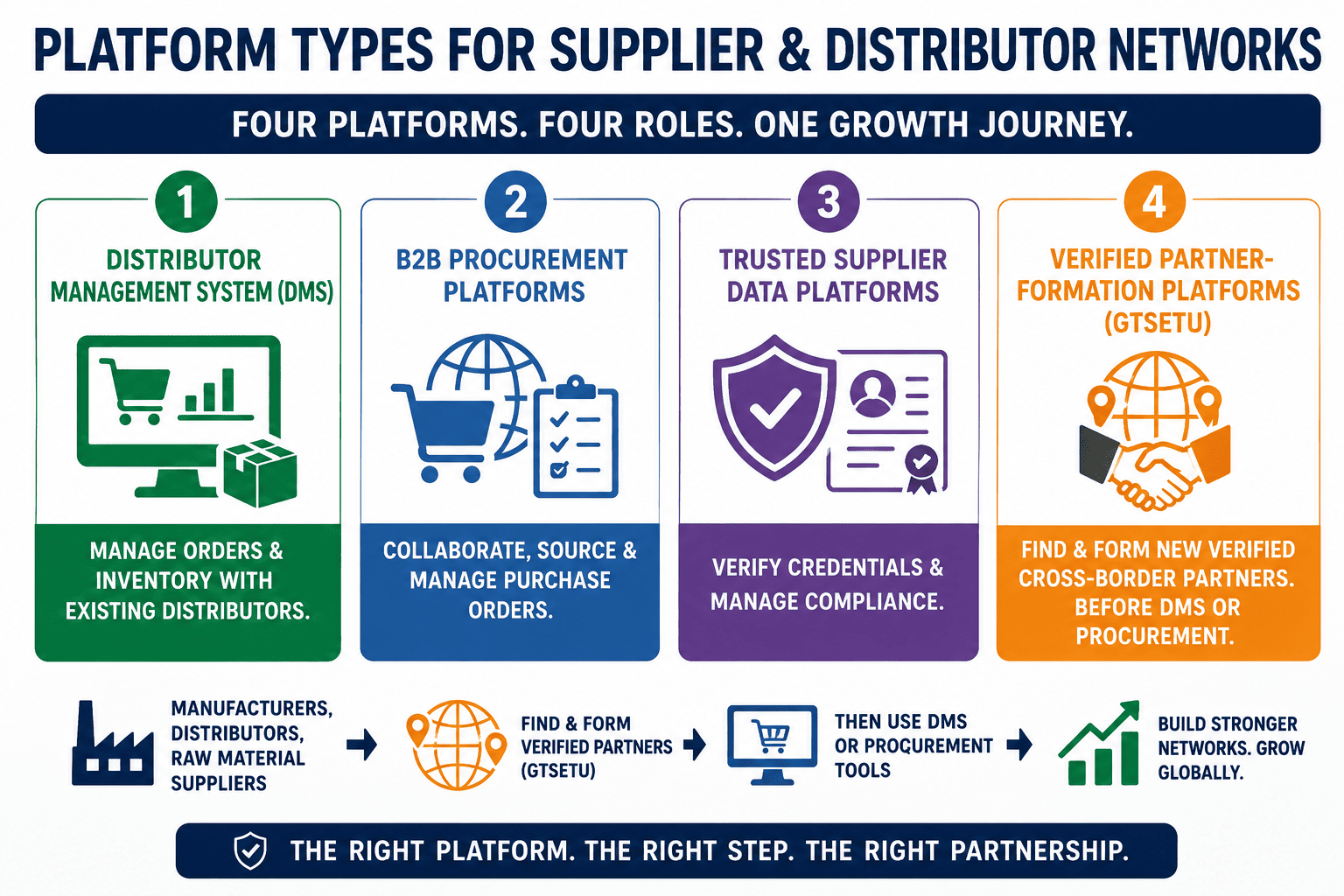
At a glance: Platforms that manage distributor and supplier networks fall into four distinct categories, Distributor Management Systems (DMS) for operational order and inventory management with existing distributors; B2B procurement platforms for supplier collaboration, sourcing, and purchase order management; trusted supplier data platforms for verified credential and compliance management; and verified partner-formation platforms like GTsetu, purpose-built for manufacturers, distributors, and raw material suppliers who need to find and form new verified, legally protected cross-border trade partnerships, the step that comes before any DMS or procurement tool is relevant.
📅 May 2026⏱ 20 min read✍️ GTsetu Editorial Team🔄 Updated regularly
4
Platform Categories
12+
Platforms Reviewed
100+
Countries on GTsetu
0%
Broker Commission
When a manufacturer, distributor, or raw material supplier searches for platforms that manage distributor and supplier networks, they are almost always looking for one of two fundamentally different things, and the distinction between them determines which category of platform is actually the right answer.
The first need is operational management: tools that help manage orders, inventory, secondary sales, claims, incentives, and field execution within an already-established network of distributors or suppliers. This is the world of Distributor Management Systems (DMS), Distribution ERP modules, and B2B procurement platforms.
The second need is network formation: finding the right distributors, verifying their identity and credentials, protecting commercially sensitive information during negotiations, and building the legal foundation for a new trade partnership across a border or into an entirely new market. This is the world that DMS tools and procurement platforms do not serve, and where purpose-built verified partner platforms like GTsetu operate.
This guide maps all four categories clearly, reviews the leading platforms in each, and explains how to identify which layer you actually need, and when you need more than one.
💡 How to Use This Guide
If you already have a distributor or supplier network and need tools to manage it operationally, orders, inventory, secondary sales, incentives, go to Section 2. If you need to source more efficiently from existing verified suppliers, go to Section 3. If you need to verify supplier credentials and compliance data for your existing network, go to Section 4. If you need to find and form new verified distributor or manufacturing partnerships in new geographies, go directly to Section 5.
SECTION 1
1 The 4 Categories of Distributor & Supplier Network Platforms
📖 The Landscape Mapped
Platforms that manage distributor and supplier networks can be meaningfully grouped into four categories, each serving a different operational need and serving a different point in the trade relationship lifecycle. Understanding which category matches your goal eliminates the most common and most expensive platform selection mistake: buying an operational management tool when what you actually need is a partner-formation platform, or vice versa.
📊
Category 1, Operational
Distributor Management Systems (DMS)
Software that manages the day-to-day operations of an existing distributor network, order capture, secondary sales visibility, inventory tracking, van stock, delivery performance, claims processing, and field team execution. These tools assume the distributor relationship already exists.
Key platforms: PepUpSales, Aforza, Salesbabu DMS, Zoho Creator Distribution, SAP Distribution
Platforms that manage RFQ, purchase orders, supplier performance, and supplier collaboration within an established supply chain. These tools optimise sourcing efficiency with existing suppliers and help manage supplier relationships at scale across procurement teams.
Platforms that centralise, verify, and maintain supplier master data, covering legal identity, certifications, financial health, compliance status, and risk ratings. These tools ensure supplier information in procurement and ERP systems is accurate, current, and auditable.
Platforms built to discover, verify, and form new distributor, manufacturer, and supplier partnerships across borders, with government-verified credentials, NDA workflows, and encrypted deal infrastructure. These platforms operate before the DMS or procurement layer.
projected distribution management software market size by 2030, growing at ~20% CAGR
73%
of failed cross-border partnerships trace back to inadequate partner verification before the first commercial discussion
5–15%
broker and intermediary commissions extracted from every partnership on commission-based platforms
SECTION 2
2 Distributor Management Systems (DMS), Operational Tools
📊 Category 1, Operational Management of Existing Networks
Distributor Management Systems are the most well-understood category of distributor network platforms. They are operational tools, designed to give manufacturers visibility into what is happening within their existing distributor network, including how much stock is moving, where field teams are, what secondary sales look like, and how claims and returns are being processed. A DMS does not help you find or verify a new distributor. It helps you manage one you already have.
ℹ️ What DMS Tools Are Designed For
DMS platforms solve the post-appointment operational gap, the period after you have signed a distributor and need to manage daily commercial operations across that network. If you have not yet identified and appointed your distributors, a DMS is not the tool you need. The partner-formation layer described in Section 5 addresses that upstream step. See also: building a distributor network.
Leading DMS Platforms Reviewed
1
PepUpSales
pepupsales.com · India-Focused DMS & Sales Force Automation
🇮🇳 India DMS Leader
PepUpSales is a comprehensive Distributor Management System built for Indian FMCG, pharma, agri-tech, automotive, and consumer goods companies. It combines DMS with Sales Force Automation (SFA), covering distributor order management, secondary sales tracking, van sales, route optimisation, field salesman tracking, retail execution, and visual merchandising. It is particularly strong for FMCG manufacturers with multi-tier distribution networks requiring real-time visibility into secondary and tertiary sales, beat planning, and retailer-level coverage metrics. The platform’s AI suite adds forecasting and anomaly detection on top of the operational data layer. As with all DMS platforms, PepUpSales assumes the distributor relationship already exists, it does not help manufacturers identify or verify new distributor partners.
Secondary Sales TrackingVan SalesRoute OptimisationField Force TrackingRetailer AppAI-Powered Forecasting
Best for: Indian FMCG, pharma, and consumer goods manufacturers managing established multi-tier distributor networks domestically. Not for: Finding or verifying new distributors, especially internationally. See: contract between manufacturer and distributor.
2
Aforza
aforza.com · Consumer Goods DMS with AI-Powered Route-to-Market
🌐 Consumer Goods
Aforza is a consumer goods-focused DMS and route-to-market platform built on Salesforce, combining distributor management, retail execution, trade promotion management, revenue growth management, and key account management in a single platform. Its differentiator is vertical AI, the Ava platform provides intelligent automation for order management, van stock optimisation, demand forecasting, and claims processing. Aforza is positioned for mid-to-large consumer goods companies managing complex, multi-country distributor networks and requiring deep integration between field execution, secondary sales data, and central commercial planning. The platform requires an established distributor network to operate, it manages existing relationships, not new partner discovery.
Best for: Mid-to-large consumer goods companies managing established multi-country distributor networks with complex trade promotion and field execution requirements. Not for: Partner identification, verification, or legal protection during new distributor onboarding.
3
Zoho Creator, Distribution Management
zoho.com/creator · Low-Code Customisable DMS for SMEs
🛠️ Low-Code / SME
Zoho Creator’s distribution management application is a low-code, customisable solution built on Zoho’s platform for small and mid-sized manufacturers and distributors who need DMS functionality without the implementation cost and complexity of enterprise software. It covers order management, inventory tracking, dispatch management, dealer portal access, and basic analytics, and integrates natively with the broader Zoho ecosystem (CRM, Books, Inventory, Analytics). Its flexibility makes it suitable for businesses with non-standard distribution workflows that need to be configured, not just deployed. It does not include partner discovery, verification, or legal protection features.
Best for: Small and mid-sized manufacturers needing a customisable, affordable DMS that integrates with existing Zoho tools. Not for: Enterprise-scale DMS with AI-driven insights or cross-border partner formation.
4
SalesBabu DMS
salesbabu.com · SaaS DMS for Indian Manufacturers & Dealers
🇮🇳 Indian SME DMS
SalesBabu is a SaaS-based online dealer and distributor management system built for Indian manufacturers and their dealer or distributor networks. It covers primary and secondary order management, stock tracking, scheme and discount management, dealer performance reporting, and field sales monitoring. It is widely used by mid-sized Indian manufacturers across FMCG, pharma, building materials, and consumer durables. Its pricing and implementation approach makes it accessible to businesses that are moving from spreadsheets to their first formal DMS, without requiring a large IT budget or implementation partner.
Best for: Mid-sized Indian manufacturers moving from spreadsheets to a first formal DMS for domestic dealer and distributor network management. Not for: International distributor formation, verification, or cross-border partnership infrastructure.
ZINFI is a comprehensive unified partner management platform covering partner onboarding, training and enablement, marketing co-funds (MDF), deal registration, incentives and rebates management, co-selling, and channel analytics. It is positioned for technology companies and manufacturers who manage complex indirect sales channels, resellers, distributors, VARs, system integrators, and need structured programmes, content, and incentive infrastructure across those channels. ZINFI’s strength is in managing existing partner programmes at scale; it assumes the partner network is already defined and contracted, providing the operational layer for running that network efficiently.
Partner OnboardingMDF ManagementDeal RegistrationIncentives & RebatesChannel AnalyticsCo-Sell Support
Best for: Technology companies and manufacturers running structured indirect channel programmes with MDF, rebates, and deal registration across defined partner networks. Not for: Identifying or verifying new trade partners for industrial sector cross-border partnerships. See: technology partnership.
Creatio is an AI-native, no-code business platform that combines CRM (sales, marketing, service) with flexible workflow automation, making it applicable to distributor management when combined with its no-code configuration tools. While not a purpose-built DMS, Creatio’s flexibility allows companies to build distributor management workflows on top of its platform, covering order pipelines, distributor performance tracking, sales forecasting, and service management. It is suited to businesses that need both CRM and distributor management in a single platform and have the configuration capacity to tailor it to their specific distribution workflow.
Best for: Companies that need CRM and distributor workflow management in a single flexible platform with AI automation. Not for: Operational DMS with deep secondary sales tracking, van stock management, or verified partner discovery.
B2B procurement platforms that enhance supplier collaboration are distinct from DMS tools, they sit on the buyer’s side rather than the manufacturer’s commercial network side. These platforms manage RFQ processes, purchase order workflows, supplier performance measurement, contract management, and spend analytics within an established supply chain. The most widely used enterprise-grade procurement platforms include SAP Ariba, Coupa, Jaggaer, Oracle Procurement Cloud, Zycus, and GEP SMART.
SAP Ariba is the world’s largest business commerce network, connecting buyers and suppliers for procurement, sourcing, invoicing, and supply chain collaboration at enterprise scale. For large manufacturers and procurement organisations managing complex, multi-tier supply chains, Ariba provides sourcing, contract management, supplier lifecycle management, and spend analytics in a single integrated platform. It is best suited to organisations with structured procurement functions, ERP integration requirements, and complex multi-supplier category management.
Best for: Enterprise procurement organisations managing complex supply chains with ERP integration requirements. Not for: SME procurement, cross-border partner-formation, or industrial sector distributor discovery.
2
Coupa
coupa.com · Business Spend Management Platform
💰 Spend Management
Coupa is a business spend management platform covering procurement, invoicing, expense management, and supply chain design, with a strong emphasis on AI-driven spend visibility, risk management, and supplier collaboration. It is positioned for mid-to-large enterprises seeking a unified view of all business spend across direct and indirect categories, with supplier collaboration features that go beyond simple order management into supplier risk and performance management.
Best for: Mid-to-large enterprises seeking unified spend management and AI-powered supplier risk visibility across procurement categories. Not for: Industrial partner formation or distributor network discovery.
3
Jaggaer
jaggaer.com · Autonomous Procurement Platform
⚙️ Autonomous Sourcing
Jaggaer is an autonomous procurement platform with particular strength in direct materials sourcing, making it relevant for manufacturers managing complex multi-tier supply chains for raw materials, components, and production inputs. Its supplier collaboration module enables joint product development, supplier quality management, and design collaboration alongside standard RFQ and purchase order workflows. Strong in manufacturing, pharma, and aerospace verticals.
Direct Materials SourcingSupplier QualityDesign CollaborationManufacturing VerticalsAI Autonomous Buying
Best for: Manufacturers with complex direct materials supply chains needing integrated sourcing, quality management, and supplier collaboration. Not for: New trade partner discovery or distributor appointment infrastructure. See: supply chain partner agreements.
ℹ️ The Critical Gap in Procurement Platforms
Enterprise procurement platforms like SAP Ariba, Coupa, and Jaggaer excel at managing existing supplier relationships, sourcing events, contract management, and spend analytics with approved vendors. What they do not address is how to identify, verify, and form relationships with new suppliers or distributors, particularly across borders. That is a partner-formation problem, not a procurement management problem. See: B2B matchmaking tools and international business development consulting.
SECTION 4
4 Trusted Supplier Data Platforms
🗄️ Category 3, Supplier Verification & Data Management
Trusted supplier data platforms address a specific problem: the quality, accuracy, and compliance-readiness of the supplier information held within procurement systems, ERP platforms, and partner master data repositories. As supply chains have become more global and regulatory scrutiny on supply chain integrity has increased (UK Modern Slavery Act, EU Corporate Sustainability Due Diligence, US FCPA, ISO 20400), the need to maintain independently verified supplier data, not just self-reported supplier profiles, has become a compliance requirement for large enterprises.
🏛️
Legal Identity Verification
Confirming that a supplier’s legal name, registration number, and registered address match official government records, catching cases where a supplier operates under a different entity name, has a struck-off registration, or is misrepresenting its corporate structure.
📜
Certification & Compliance Tracking
Maintaining current, unexpired copies of ISO certifications, GMP licences, food safety certifications, environmental compliance documents, and export/import licences, with automated expiry alerts and renewal workflows.
💰
Financial Health Monitoring
Ongoing monitoring of supplier financial stability, credit ratings, payment behaviour, insolvency risk indicators, to identify supply chain concentration risk before a supplier failure disrupts production.
⚖️
ESG & Modern Slavery Compliance
Supplier questionnaires, third-party audits, and ESG rating data to demonstrate supply chain due diligence under the UK Modern Slavery Act, EU CSDDD, and equivalent regulatory frameworks in other jurisdictions.
🔍
Sanctions & Watchlist Screening
Automated screening of supplier entities and beneficial owners against OFAC, EU, UN, and other sanctions lists, a baseline requirement for any business operating under US, EU, or UK trade compliance frameworks.
📊
Audit Trail for Regulatory Defence
A timestamped, downloadable record of all supplier verification activities, demonstrating to regulators, auditors, and board-level risk committees that supply chain due diligence was conducted and documented. See: risk allocation in cross-border deals.
The leading trusted supplier data platforms in this category include Dun & Bradstreet Supplier Risk, Ecovadis (ESG and sustainability ratings), Achilles (energy and infrastructure supply chain verification), Avetta (safety and compliance), and Riskmethods (supply chain risk intelligence). These are primarily used by large enterprises as a layer on top of their procurement systems, they do not include partner discovery, NDA workflows, or deal formation infrastructure.
🏛️ GTsetu’s Approach to Trusted Supplier Data
GTsetu operates as a trusted partner data layer specifically for industrial trade partnership formation, verifying every company on the platform against government records across 6 points (legal name, registered address, registration number, company status, type, incorporation date) before any engagement is permitted. This provides the same foundation of verified identity that enterprise supplier data platforms offer for large procurement organisations, but built into the partner-formation workflow for manufacturers, distributors, and raw material suppliers at all sizes, not just enterprises with dedicated procurement functions. See: partnership evaluation criteria.
SECTION 5
5 Partner-Formation Platforms: The Layer Before DMS
🤝 Category 4, The Missing Layer in Most Platform Stacks
Of the four categories of platforms that manage distributor and supplier networks, partner-formation platforms are the least understood and the most frequently absent from the technology stacks of manufacturers and distributors who are expanding into new markets.
The logic is straightforward: DMS platforms manage distributor operations. Procurement platforms manage supplier sourcing. Supplier data platforms verify existing supplier credentials. But who helps you identify, verify, and legally protect the first engagement with a distributor in a new country, before you have a DMS relationship to manage or a supplier in your procurement system to source from?
📊 DMS / Procurement Tools
What They Assume Is Already Done
These platforms are designed for use after a trade relationship is established. They assume:
You already know who your distributor is
The distributor’s identity has already been verified
A commercial agreement is already signed
Pricing, terms, and territory are already defined
The distributor is already onboarded into your system
🤝 Partner-Formation Platforms
What Happens Before DMS Is Relevant
Partner-formation platforms address the upstream challenge:
Discovering the right distributors in target markets
Verifying their legal identity via government sources
Protecting commercial information with NDA infrastructure
Evaluating commercial fit before sharing sensitive data
Building the legal framework for the first agreement
Without a partner-formation layer, businesses either rely on trade shows and broker intermediaries, expensive, commission-laden, and unverified, or they engage prospective partners directly through directories and RFQ platforms where identity cannot be confirmed and commercial information is shared without legal protection. Both paths create exposure that compounds over time: a wrongly appointed distributor, a competitor who received your pricing, or a market locked by an exclusivity agreement with an underperforming partner who cannot be terminated cleanly.
The three most expensive outcomes of skipping proper partner formation are: (1) appointing an unverified distributor who misrepresented their market presence or legal standing, discoverable only after stock has been shipped and payment terms exposed; (2) sharing pricing and product specifications with a prospective partner who turns out to be a competitor or a broker for one, without an NDA in place, that information cannot be recalled or legally protected; and (3) granting exclusivity to a distributor who underperforms without enforceable volume commitments, resulting in a locked market where no revenue is generated and no other partner can be appointed. See: risk allocation in cross-border deals and force majeure in global trade.
SECTION 6
6 GTsetu: Verified Partner Formation for Industrial Sectors
GTsetu operates exclusively in the partner-formation category, the layer upstream of every DMS, procurement platform, and supplier data tool. It is built specifically for manufacturers, distributors, and raw material suppliers in industrial sectors who need to identify, verify, and legally structure new cross-border trade partnerships: manufacturing principals for distributors, export markets for manufacturers, long-term supply agreements for raw material suppliers.
🤝 Verified Partner Formation, Not Just Management
GTsetu: The Infrastructure Layer for Finding and Forming Verified Trade Partnerships
GTsetu is not a DMS. It is not a procurement platform. It is the verified partnership infrastructure that enables manufacturers, distributors, and raw material suppliers to identify the right trade partners, confirm their identity via government tie-ups, protect commercial information before it is shared, and structure the legal foundation for a long-term cross-border trade relationship, across 100+ countries, with zero broker commissions.
🏛️
6-Point Govt Tie-Up VerificationLegal name, registered address, registration number, company status, type, and incorporation date, verified via government sources before any engagement begins.
🕵️
Anonymous DiscoveryBrowse and evaluate verified manufacturer, distributor, and supplier profiles across 100+ countries without revealing your company identity or expansion plans.
📄
Built-in NDA WorkflowsDigital NDA triggered automatically before any pricing, product, or strategy data changes hands, with a full timestamped audit trail for compliance purposes.
🔐
Encrypted Document SharingAES-256 at rest, TLS in transit. No unprotected email attachments for pricing sheets, product specifications, or draft agreements.
🚫
Zero Broker CommissionNo percentage of deal value extracted. The full commercial value of every partnership stays between the two parties who built it.
🌍
100+ CountriesVerified manufacturers, distributors, and raw material suppliers across the Middle East, Europe, Southeast Asia, Africa, Australia, and the Americas.
🏭
Industrial Sector FocusManufacturers, distributors, and raw material suppliers, not FMCG field sales management or enterprise procurement. See: OEM vs ODM vs EMS.
📋
Full Audit TrailDownloadable, timestamped record of all verifications, NDA executions, document exchanges, and engagement milestones, for anti-bribery and regulatory compliance.
Manufacturers seeking verified distributors in new export markets, Middle East, Europe, Southeast Asia, Africa, the Americas, without broker intermediaries or unverified directories. See: building a distributor network
Distributors seeking verified manufacturer principals for new product categories or markets, including white label and private label sourcing from verified Indian or Asian manufacturers
Raw Material Suppliers seeking long-term manufacturing customers rather than competing on spot-order RFQs from unverified platforms
Contract Manufacturers seeking principals for their production capacity, looking for stable, verified supply agreements rather than unprotected one-time enquiries. See: OEM vs ODM vs EMS explained
Industrial sector businesses entering new geographies who need to evaluate verified counterparties anonymously before revealing their expansion plans. See: international business development consulting
Procurement and business development teams who need a trusted supplier data layer for cross-border industrial partnerships, not an enterprise ERP bolt-on. See: partnership evaluation criteria
SECTION 7
7 How to Choose the Right Platform for Your Goal
The right platform depends entirely on where you are in the distributor or supplier network lifecycle. Use this decision matrix to identify the right category, and specific platform, for your current need.
Your Goal
Right Category
Recommended Platforms
Why
Manage secondary sales, van stock, and field execution with existing distributors in India
DMS (Category 1)
PepUpSales, SalesBabu DMS
Purpose-built for Indian FMCG/consumer goods domestic DMS operations
Manage multi-country distributor operations with trade promotion and AI-powered analytics
DMS (Category 1)
Aforza
Consumer goods multi-country DMS with vertical AI and Salesforce integration
Run a customisable DMS for a small/mid-sized manufacturer without a large IT budget
DMS (Category 1)
Zoho Creator Distribution
Low-code, affordable, integrates with Zoho ecosystem
The table below compares all platforms reviewed in this guide across the criteria most relevant to manufacturers, distributors, and raw material suppliers evaluating which platform fits their specific goal.
QWhat are platforms that manage distributor and supplier networks?
Platforms that manage distributor and supplier networks fall into four categories: (1) Distributor Management Systems (DMS), operational tools like PepUpSales, Aforza, and SalesBabu that manage orders, inventory, secondary sales, and field execution within an existing distributor network; (2) B2B procurement and supplier collaboration platforms, enterprise tools like SAP Ariba, Coupa, and Jaggaer that manage sourcing, purchase orders, and spend with existing supplier relationships; (3) trusted supplier data platforms like Ecovadis and Dun & Bradstreet that verify and monitor supplier credentials, ESG compliance, and financial health; and (4) verified partner-formation platforms like GTsetu, purpose-built for manufacturers, distributors, and raw material suppliers who need to find, verify, and legally structure new cross-border trade partnerships before a DMS or procurement platform is relevant.
QWhat is the difference between a DMS and a partner-formation platform?
A Distributor Management System (DMS) is an operational tool used after a distributor relationship is already in place, it manages orders, inventory, secondary sales, claims, and field execution within an existing network. A partner-formation platform like GTsetu operates before the DMS is relevant: it is used to discover verified distributors across new markets, confirm their legal identity via government tie-up verification, protect commercial information with NDA infrastructure before any pricing or product data is shared, and build the legal foundation for a new trade relationship. In simple terms: partner formation comes first; DMS management follows. If you do not yet know who your distributor in Southeast Asia or the Gulf will be, a DMS cannot help you. GTsetu can. See: building a distributor network.
QWhat is a trusted supplier data platform?
A trusted supplier data platform is a system that maintains independently verified, up-to-date information about suppliers, covering legal identity, certifications, financial health, ESG compliance, and risk ratings. These platforms replace self-reported supplier data with credentials that have been verified against official sources. For large enterprises, platforms like Ecovadis (ESG ratings), Dun & Bradstreet Supplier Risk (financial health and sanctions screening), and Achilles (safety and compliance for energy and infrastructure) serve this role. GTsetu provides a focused version of trusted supplier data for the industrial trade partnership context, verifying every company’s legal identity, registration, and status via government tie-ups before any engagement is permitted, with a full audit trail for compliance. See: partnership evaluation criteria.
The leading B2B procurement platforms for supplier collaboration are SAP Ariba (largest business commerce network; integrated sourcing, contracting, and supplier lifecycle management), Coupa (spend management with AI-driven supplier risk and collaboration), Jaggaer (direct materials sourcing and supplier quality management, strong in manufacturing and pharma), Oracle Procurement Cloud (integrated ERP-native procurement), Zycus (cognitive procurement with AI-powered sourcing), and GEP SMART (unified spend management for enterprise). These platforms are suited for managing established supplier relationships at scale. For identifying and verifying new suppliers or distributor partners for cross-border industrial trade, a partner-formation platform like GTsetu addresses the upstream step these tools assume is already done. See: B2B matchmaking tools.
QHow does GTsetu help with distributor and supplier network management?
GTsetu operates at the partner-formation layer, the stage before a DMS or procurement platform is relevant. For manufacturers, it provides a verified pool of distributors across 100+ countries, discoverable anonymously and engageable through built-in NDA workflows and encrypted document sharing, with zero broker commissions on any partnership formed. For distributors, it provides verified manufacturer principals whose identity and credentials have been confirmed via government tie-ups. For raw material suppliers, it connects them with verified manufacturing partners seeking long-term supply relationships rather than one-off RFQ quotations. Once a partnership is formed through GTsetu, businesses can then deploy a DMS or procurement tool to manage the operational dimension of that relationship. GTsetu solves the formation problem; DMS and procurement platforms solve the management problem. See: cross-border business partnerships and international business development consulting.
QWhat should I look for in a distributor resource platform?
The right distributor resource platform depends on what phase of the distributor relationship you are in. If you need to manage an existing distributor network operationally, orders, inventory, secondary sales, trade promotion, look for a DMS like PepUpSales (India), Aforza (multi-country consumer goods), or ZINFI (channel programme management). If you need to find and verify new distributors for export market entry, and protect your commercial information during the evaluation process, you need a partner-formation platform like GTsetu, which provides 6-point government-verified distributor profiles across 100+ countries, anonymous discovery, and built-in NDA infrastructure. Most businesses eventually need both layers: partner formation to find and appoint the right distributors, and a DMS to manage them operationally once appointed. See: contract between manufacturer and distributor and international wholesale distributors.
QCan a single platform handle both partner formation and operational DMS management?
In practice, no single platform does both well. Partner formation requires verified identity, anonymised discovery, NDA infrastructure, and cross-border reach, features that are entirely absent from operational DMS tools, which are optimised for order management, inventory tracking, and field execution within an established network. The two categories have different user profiles (business development and commercial teams for formation; supply chain and sales operations teams for DMS), different data requirements (verified identity and legal documents for formation; transactional operational data for DMS), and different technology architectures. The right approach for most manufacturers entering new markets is to use a verified partner-formation platform like GTsetu to identify and appoint the right distributor, then deploy an appropriate DMS to manage that relationship operationally once the appointment is made. See: partnership evaluation criteria and business partnership contracts.
Ready to Find and Form Verified Distributor or Supplier Partnerships?
GTsetu is the verified partner-formation platform for manufacturers, distributors, and raw material suppliers in industrial sectors, 6-point government verification, anonymous discovery, built-in NDA workflows, encrypted document sharing, and zero broker commissions across 100+ countries. Form the partnerships first. Manage them with a DMS after.
They represents the product, and research team behind GTsetu, a global B2B collaboration platform built to help companies explore cross-border partnerships with clarity and trust. The team focuses on simplifying early-stage international business discovery by combining structured company profiles, verification-led access, and controlled collaboration workflows.
With a strong emphasis on trust, and disciplined engagement, Team GTsetu shares insights on global trade, partnerships, and cross-border collaboration, helping businesses make informed decisions before entering deeper commercial discussions.